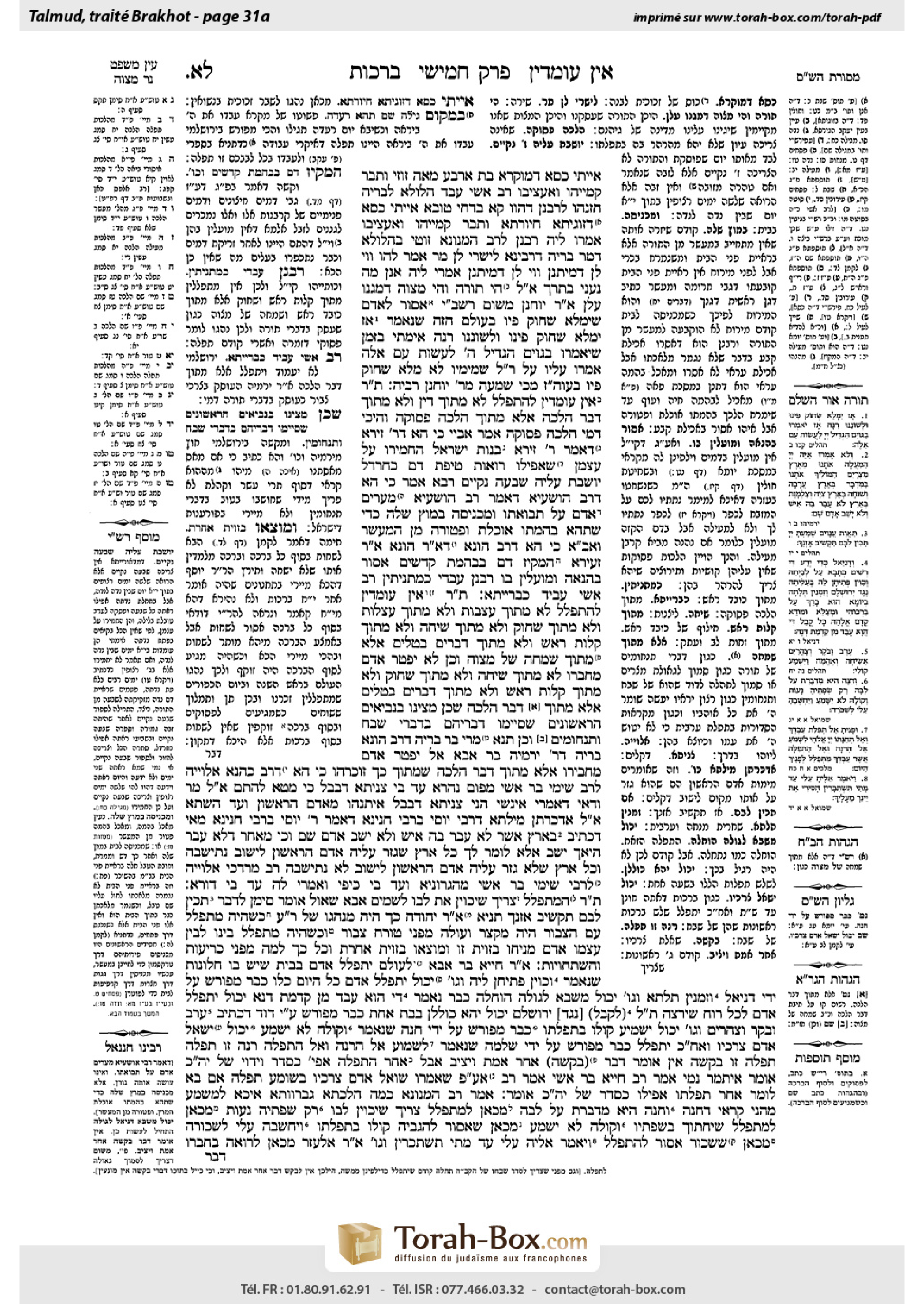
Berakhot 31a: Talmud study for Daf Yomi
Study the Talmud for Daf Yomi with scanned pages, Hebrew text, English translations from Sefaria and AI-generated French translations.
Passage selection and English or AI-generated French translation are available where the scan has annotations. Daf Study is independent of Torah-Box and Sefaria.
Browse Berakhot · ברכות · All tractatesBerakhot 31a text and translations
This page of Berakhot includes the Aramaic text, an English translation and an AI-generated French translation, alongside the scan above.
ברכות ל״א א · Aramaic and Hebrew text
אַיְּיתִי כָּסָא דְמוֹקְרָא בַּת אַרְבַּע מְאָה זוּזִי, וְתַבַּר קַמַּיְהוּ, וְאִעֲצִיבוּ.
רַב אָשֵׁי עֲבַד הִילּוּלָא לִבְרֵיהּ, חֲזַנְהוּ לְרַבָּנַן דַּהֲווֹ קָא בָדְחִי טוּבָא. אַיְּיתִי כָּסָא דְּזוּגִּיתָא חִיוָּרְתָּא, וְתַבַּר קַמַּיְהוּ, וְאִעֲצִיבוּ.
אֲמַרוּ לֵיהּ רַבָּנַן לְרַב הַמְנוּנָא זוּטֵי בְּהִלּוּלָא דְּמָר בְּרֵיהּ דְּרָבִינָא: לִישְׁרֵי לַן מָר. אֲמַר לְהוּ: וַי לַן, דְּמִיתְנַן. וַי לַן, דְּמִיתְנַן. אָמְרִי לֵיהּ: אֲנַן מָה נַעֲנֵי בָּתְרָךְ? אֲמַר לְהוּ: הֵי תּוֹרָה, וְהֵי מִצְוָה דְּמַגְּנוּ עֲלַן.
אָמַר רַבִּי יוֹחָנָן מִשּׁוּם רַבִּי שִׁמְעוֹן בֶּן יוֹחַאי: אָסוּר לְאָדָם שֶׁיְּמַלֵּא שְׂחוֹק פִּיו בָּעוֹלָם הַזֶּה, שֶׁנֶּאֱמַר: ״אָז יִמָּלֵא שְׂחוֹק פִּינוּ וּלְשׁוֹנֵנוּ רִנָּה״. אֵימָתַי, בִּזְמַן שֶׁ״יֹּאמְרוּ בַגּוֹיִם הִגְדִּיל ה׳ לַעֲשׂוֹת עִם אֵלֶּה״. אָמְרוּ עָלָיו עַל רֵישׁ לָקִישׁ שֶׁמִּיָּמָיו לֹא מִלֵּא שְׂחוֹק פִּיו בָּעוֹלָם הַזֶּה, מִכִּי שַׁמְעַהּ מֵרַבִּי יוֹחָנָן רַבֵּיהּ.
תָּנוּ רַבָּנַן: אֵין עוֹמְדִין לְהִתְפַּלֵּל לֹא מִתּוֹךְ דִּין, וְלֹא מִתּוֹךְ דְּבַר הֲלָכָה, אֶלָּא מִתּוֹךְ הֲלָכָה פְּסוּקָה.
וְהֵיכִי דָּמֵי הֲלָכָה פְּסוּקָה?
אֲמַר אַבָּיֵי: כִּי הָא דְּרַבִּי זֵירָא, דְּאָמַר רַבִּי זֵירָא: בְּנוֹת יִשְׂרָאֵל הֶחֱמִירוּ עַל עַצְמָן, שֶׁאֲפִילּוּ רוֹאוֹת טִיפַּת דָּם כְּחַרְדָּל יוֹשְׁבוֹת עָלֶיהָ שִׁבְעָה נְקִיִּים.
רָבָא אָמַר, כִּי הָא דְּרַב הוֹשַׁעְיָא, דְּאָמַר רַב הוֹשַׁעְיָא: מַעֲרִים אָדָם עַל תְּבוּאָתוֹ וּמַכְנִיסָהּ בַּמּוֹץ שֶׁלָּהּ, כְּדֵי שֶׁתְּהֵא בְּהֶמְתּוֹ אוֹכֶלֶת, וּפְטוּרָה מִן הַמַּעֲשֵׂר.
וְאִיבָּעֵית אֵימָא, כִּי הָא דְּרַב הוּנָא, דְּאָמַר רַב הוּנָא, אָמַר רַבִּי זְעֵירָא: הַמַּקִּיז דָּם בְּבֶהֱמַת קׇדָשִׁים, אָסוּר בַּהֲנָאָה, וּמוֹעֲלִין בּוֹ.
רַבָּנַן עָבְדִי כְּמַתְנִיתִין, רַב אָשֵׁי עָבֵיד כְּבָרַיְיתָא.
תָּנוּ רַבָּנַן: אֵין עוֹמְדִין לְהִתְפַּלֵּל לֹא מִתּוֹךְ עַצְבוּת, וְלֹא מִתּוֹךְ עַצְלוּת, וְלֹא מִתּוֹךְ שְׂחוֹק, וְלֹא מִתּוֹךְ שִׂיחָה, וְלֹא מִתּוֹךְ קַלּוּת רֹאשׁ, וְלֹא מִתּוֹךְ דְּבָרִים בְּטֵלִים, אֶלָּא מִתּוֹךְ שִׂמְחָה שֶׁל מִצְוָה.
וְכֵן לֹא יִפָּטֵר אָדָם מֵחֲבֵרוֹ לֹא מִתּוֹךְ שִׂיחָה, וְלֹא מִתּוֹךְ שְׂחוֹק, וְלֹא מִתּוֹךְ קַלּוּת רֹאשׁ, וְלֹא מִתּוֹךְ דְּבָרִים בְּטֵלִים, אֶלָּא מִתּוֹךְ דְּבַר הֲלָכָה. שֶׁכֵּן מָצִינוּ בַּנְּבִיאִים הָרִאשׁוֹנִים, שֶׁסִּייְּמוּ דִּבְרֵיהֶם בְּדִבְרֵי שֶׁבַח וְתַנְחוּמִים.
וְכֵן תְּנָא מָרִי בַּר בְּרֵיהּ דְּרַב הוּנָא בְּרֵיהּ דְּרַבִּי יִרְמְיָה בַּר אַבָּא: אַל יִפָּטֵר אָדָם מֵחֲבֵירוֹ אֶלָּא מִתּוֹךְ דְּבַר הֲלָכָה, שֶׁמִּתּוֹךְ כָּךְ זוֹכְרֵהוּ.
כִּי הָא דְּרַב כָּהֲנָא אַלְוְיֵיהּ לְרַב שִׁימִי בַּר אָשֵׁי מִפּוּם נַהֲרָא עַד בֵּי צִנְיָתָא דְּבָבֶל. כִּי מְטָא לְהָתָם אֲמַר לֵיהּ: מָר, וַדַּאי דְאָמְרִי אִינָשֵׁי: הָנֵי צִנְיָתָא דְּבָבֶל אִיתַנְהוּ מֵאָדָם הָרִאשׁוֹן וְעַד הַשְׁתָּא?
אֲמַר לֵיהּ: אַדְכַּרְתַּן מִילְּתָא דְּרַבִּי יוֹסֵי בְּרַבִּי חֲנִינָא, דְּאָמַר רַבִּי יוֹסֵי בְּרַבִּי חֲנִינָא: מַאי דִּכְתִיב ״בְּאֶרֶץ אֲשֶׁר לֹא עָבַר בָּהּ אִישׁ וְלֹא יָשַׁב אָדָם שָׁם״, וְכִי מֵאַחַר דְּלֹא עָבַר הֵיאַךְ יָשַׁב? אֶלָּא לוֹמַר לָךְ כׇּל אֶרֶץ שֶׁגָּזַר עָלֶיהָ אָדָם הָרִאשׁוֹן לְיִשּׁוּב — נִתְיַשְּׁבָה. וְכׇל אֶרֶץ שֶׁלֹּא גָּזַר עָלֶיהָ אָדָם הָרִאשׁוֹן לְיִשּׁוּב — לֹא נִתְיַשְּׁבָה.
רַב מָרְדְּכַי אַלְוְיֵיהּ לְרַב שִׁימִי בַּר אָשֵׁי מֵהַגְרוֹנְיָא, וְעַד בֵּי כֵיפֵי. וְאָמְרִי לַהּ עַד בֵּי דוּרָא.
תָּנוּ רַבָּנַן: הַמִּתְפַּלֵּל צָרִיךְ שֶׁיְּכַוֵּין אֶת לִבּוֹ לַשָּׁמַיִם. אַבָּא שָׁאוּל אוֹמֵר: סִימָן לַדָּבָר, ״תָּכִין לִבָּם תַּקְשִׁיב אׇזְנֶךָ״.
תַּנְיָא אָמַר רַבִּי יְהוּדָה: כָּךְ הָיָה מִנְהָגוֹ שֶׁל רַבִּי עֲקִיבָא, כְּשֶׁהָיָה מִתְפַּלֵּל עִם הַצִּיבּוּר — הָיָה מְקַצֵּר וְעוֹלֶה, מִפְּנֵי טוֹרַח צִבּוּר. וּכְשֶׁהָיָה מִתְפַּלֵּל בֵּינוֹ לְבֵין עַצְמוֹ — אָדָם מַנִּיחוֹ בְּזָוִית זוֹ, וּמוֹצְאוֹ בְּזָוִית אַחֶרֶת. וְכׇל כָּךְ לָמָּה? מִפְּנֵי כְּרִיעוֹת וְהִשְׁתַּחֲוָיוֹת.
אָמַר רַבִּי חִיָּיא בַּר אַבָּא: לְעוֹלָם יִתְפַּלֵּל אָדָם בְּבַיִת שֶׁיֵּשׁ בּוֹ חַלּוֹנוֹת, שֶׁנֶּאֱמַר: ״וְכַוִּין פְּתִיחָן לֵיהּ וְגוֹ׳״.
יָכוֹל יִתְפַּלֵּל אָדָם כׇּל הַיּוֹם כּוּלּוֹ — כְּבָר מְפוֹרָשׁ עַל יְדֵי דָּנִיאֵל: ״וְזִמְנִין תְּלָתָא וְגוֹ׳״.
יָכוֹל מִשֶּׁבָּא לַגּוֹלָה הוּחַלָּה — כְּבָר נֶאֱמַר: ״דִּי הֲוָא עָבֵד מִן קַדְמַת דְּנָא״.
יָכוֹל יִתְפַּלֵּל אָדָם לְכׇל רוּחַ שֶׁיִּרְצֶה — תַּלְמוּד לוֹמַר: ״(לָקֳבֵל) [נֶגֶד] יְרוּשְׁלֶם״.
יָכוֹל יְהֵא כּוֹלְלָן בְּבַת אַחַת — כְּבָר מְפוֹרָשׁ עַל יְדֵי דָּוִד, דִּכְתִיב: ״עֶרֶב וָבֹקֶר וְצָהֳרַיִם וְגוֹ׳״.
יָכוֹל יַשְׁמִיעַ קוֹלוֹ בִּתְפִלָּתוֹ — כְּבָר מְפוֹרָשׁ עַל יְדֵי חַנָּה, שֶׁנֶּאֱמַר: ״וְקוֹלָהּ לֹא יִשָּׁמֵעַ״.
יָכוֹל יִשְׁאַל אָדָם צְרָכָיו וְאַחַר כָּךְ יִתְפַּלֵּל — כְּבָר מְפוֹרָשׁ עַל יְדֵי שְׁלֹמֹה, שֶׁנֶּאֱמַר: ״לִשְׁמֹעַ אֶל הָרִנָּה וְאֶל הַתְּפִלָּה״. ״רִנָּה״ זוֹ תְּפִלָּה, ״תְּפִלָּה״ זוֹ בַּקָּשָׁה. אֵין אוֹמֵר דְּבַר בַּקָּשָׁה אַחַר ״אֱמֶת וְיַצִּיב״. אֲבָל אַחַר הַתְּפִלָּה, אֲפִילּוּ כְּסֵדֶר וִדּוּי שֶׁל יוֹם הַכִּפּוּרִים אוֹמֵר.
אִיתְּמַר נָמֵי, אָמַר רַב חִיָּיא בַּר אָשֵׁי אָמַר רַב: אַף עַל פִּי שֶׁאָמְרוּ שׁוֹאֵל אָדָם צְרָכָיו בְּ״שׁוֹמֵעַ תְּפִלָּה״, אִם בָּא לוֹמַר אַחַר תְּפִלָּתוֹ — אֲפִילּוּ כְּסֵדֶר שֶׁל יוֹם הַכִּפּוּרִים אוֹמֵר.
אָמַר רַב הַמְנוּנָא: כַּמָּה הִלְכְתָא גִּבָּרָווֹתָא אִיכָּא לְמִשְׁמַע מֵהָנֵי קְרָאֵי דְחַנָּה. ״וְחַנָּה הִיא מְדַבֶּרֶת עַל לִבָּהּ״ — מִכָּאן לַמִּתְפַּלֵּל צָרִיךְ שֶׁיְּכַוֵּין לִבּוֹ. ״רַק שְׂפָתֶיהָ נָּעוֹת״ — מִכָּאן לַמִּתְפַּלֵּל שֶׁיַּחְתּוֹךְ בִּשְׂפָתָיו. ״וְקוֹלָהּ לֹא יִשָּׁמֵעַ״ — מִכָּאן שֶׁאָסוּר לְהַגְבִּיהַּ קוֹלוֹ בִּתְפִלָּתוֹ. ״וַיַּחְשְׁבֶהָ עֵלִי לְשִׁכֹּרָה״ — מִכָּאן שֶׁשִּׁכּוֹר אָסוּר לְהִתְפַּלֵּל.
״וַיֹּאמֶר אֵלֶיהָ עֵלִי עַד מָתַי תִּשְׁתַּכָּרִין וְגוֹ׳״. אָמַר רַבִּי אֶלְעָזָר: מִכָּאן לָרוֹאֶה בַּחֲבֵרוֹ
Berakhot 31a · English translation
He brought a valuable cup worth four hundred zuz and broke it before them and they became sad.
The Gemara also relates: Rav Ashi made a wedding feast for his son and he saw the Sages, who were excessively joyous. He brought a cup of extremely valuable white glass and broke it before them, and they became sad.
Similarly, the Gemara relates: The Sages said to Rav Hamnuna Zuti at the wedding feast of Mar, son of Ravina: Let the Master sing for us. Since he believed that the merriment had become excessive, he said to them, singing: Woe unto us, for we shall die, woe unto us, for we shall die. They said to him: What shall we respond after you? What is the chorus of the song? He said to them, you should respond: Where is Torah and where is mitzva that protect us?
In a similar vein, Rabbi Yoḥanan said in the name of Rabbi Shimon ben Yoḥai: One is forbidden to fill his mouth with mirth in this world, as long as we are in exile (ge’onim), as it is stated: “When the Lord returns the captivity of Zion we will be as dreamers” (Psalms 126:1). Only “then will our mouths fill with laughter and our lips with song” (Psalms 126:2). When will that joyous era arrive? When “they will say among nations, the Lord has done great things with these” (Psalms 126:2). They said about Reish Lakish that throughout his life he did not fill his mouth with laughter in this world once he heard this statement from his teacher, Rabbi Yoḥanan.
We learned in the mishna that it is appropriate to stand and begin to pray from an atmosphere of gravity. Regarding this, the Sages taught: One may neither stand and begin to pray, directly from involvement in judgment nor directly from deliberation over the ruling in a matter of halakha, as his preoccupation with the judgment or the halakhic ruling will distract him from prayer. Rather it is appropriate to pray directly from involvement in the study of a universally accepted conclusive halakha that leaves no room for further deliberation and will not distract him during prayer.
And the Gemara asks: What is an example of a conclusive halakha?
The Gemara offers several examples: Abaye said: One like this halakha of Rabbi Zeira, as Rabbi Zeira said: The daughters of Israel were stringent with themselves; to the extent that even if they see a drop of blood corresponding to the size of a mustard seed she sits seven clean days for it. By Torah law, a woman who witnesses the emission of blood during the eleven days following her fixed menstrual period is not considered a menstruating woman; rather she immerses herself and is purified the next day. However, the women of Israel accepted the stringency upon themselves that if they see any blood whatsoever, they act as it if were the blood of a zava, which obligates her to count seven more clean days before becoming ritually pure (see Leviticus 15:25).
Citing an additional example of a conclusive halakha, Rava said: One like this halakha of Rav Hoshaya, as Rav Hoshaya said: A person may employ artifice to circumvent obligations incumbent upon him in dealing with his grain and bring it into the courtyard in its chaff so that his animal will eat from it, and the grain is exempt from tithes. Halakha dictates that one is obligated to tithe grain that has been threshed and piled, regardless of the ultimate purpose for which the grain was intended. By Torah law, one is exempt from tithing grain that was not threshed and is therefore still in its chaff. By rabbinic law, one is prohibited from eating this grain in the framework of a meal. Feeding animals is permitted without first tithing that grain.
And if you wish, say instead yet another example of a conclusive halakha, which is the recommended prelude to prayer. One like this halakha of Rav Huna, as Rav Huna said that Rabbi Zeira said: One who lets blood from a consecrated animal that was consecrated as a sacrifice; deriving benefit from that blood is prohibited. Although blood of an offering that was sprinkled on the altar is not considered Temple property, nevertheless, deriving benefit from the blood of a living, consecrated animal is considered prohibited use of Temple property. In so doing, one misuses property consecrated to the Temple, and as in any other case of misusing Temple property, if he did so unwittingly, he is liable to bring a guilt-offering.
It is related that the Sages acted in accordance with the opinion of our mishna and rose to pray from an atmosphere of gravity; Rav Ashi acted in accordance with the opinion of the baraita and preceded his prayer with a conclusive halakha.
On the topic of proper preparation for prayer, the Sages taught: One may neither stand to pray from an atmosphere of sorrow nor from an atmosphere of laziness, nor from an atmosphere of laughter, nor from an atmosphere of conversation, nor from an atmosphere of frivolity, nor from an atmosphere of purposeless matters. Rather, one should approach prayer from an atmosphere imbued with the joy of a mitzva.
Similarly, a person should neither take leave of another from an atmosphere of conversation, nor from an atmosphere of laughter, nor from an atmosphere of frivolity, nor from an atmosphere of purposeless matters. Rather, one should take leave of another from involvement in a matter of halakha. As we found in the books of the Bible dealing with the early prophets, that they would conclude their talks with words of praise and consolation.
And so Mari, the grandson of Rav Huna, son of Rabbi Yirmeya bar Abba, taught in a baraita: One should only take leave of another from involvement in a matter of halakha, so that, consequently, he will remember him; whenever he recalls the one from whom he took leave, he will think well of him because of the new halakha that he taught him (Eliyahu Zuta).
As in the incident related by the Gemara that Rav Kahana accompanied Rav Shimi bar Ashi from the town of Pum Nahara to the palm grove in Babylonia. When he arrived there, Rav Kahana said to Rav Shimi bar Ashi: Master, what is meant by that which people say: These palm trees of Babylonia have been in this place from the time of Adam the first man until now?
Rav Shimi bar Ashi said to him: You reminded me of something that Rabbi Yosei, son of Rabbi Ḥanina, said, as Rabbi Yosei, son of Rabbi Ḥanina, said: What is the meaning of that which is written: “In a land through which no man has passed and where no person [adam] has settled” (Jeremiah 2:6)? This verse is difficult; since it is a land through which no person has passed, how could anyone have settled there permanently? The statement that “no person has settled there” is redundant. Rather, this verse comes to teach that every land through which Adam the first man passed and decreed that it would be settled was settled, and every land through which Adam passed and decreed that it would not be settled was not settled. Based on this, what people say is true, and the palm trees of Babylonia are from the time of Adam, meaning that from the time of Adam this land was decreed to be suitable for growing palm trees (Me’iri). The Gemara cited an example of how one who parts from another with Torah learns something new.
Having mentioned the mitzva for a student to accompany his Rabbi, the Gemara relates that Rav Mordekhai accompanied his mentor, Rav Shimi bar Ashi, a great distance, from the city of Hagronya to Bei Keifei; and some say that he accompanied from Hagronya to Bei Dura.
Returning to the topic of preparation for prayer, the Sages taught in the Tosefta: One who prays must focus his heart toward Heaven. Abba Shaul says: An indication of the importance of this matter is stated in the verse: “The desire of the humble You have heard, Lord; direct their hearts, Your ear will listen” (Psalms 10:17). In other words, if one focuses his heart in prayer as a result of God directing his heart, his prayer will be accepted as God’s ear will listen.
With regard to one’s intent during prayer, it was taught in a baraita that Rabbi Yehuda said: This was the custom of Rabbi Akiva, when he would pray with the congregation he would shorten his prayer and go up, due to his desire to avoid being an encumbrance on the congregation by making them wait for him to finish his prayer. But when he prayed by himself he would extend his prayers to an extent that a person would leave Rabbi Akiva alone in one corner of the study hall and later find him still praying in another corner. And why would Rabbi Akiva move about so much? Because of his bows and prostrations. Rabbi Akiva’s enthusiasm in prayer was so great, that as a result of his bows and prostrations, he would unwittingly move from one corner to the other (Rav Hai Gaon).
Many halakhot are derived from evoking the prayers of biblical characters. Rabbi Ḥiyya bar Abba said: One should always pray in a house with windows, as it is stated regarding Daniel: “And when Daniel knew that the writing was signed, he went to his house. In his attic there were open windows facing Jerusalem, and three times a day he knelt upon his knees and prayed and gave thanks before his God, just as he had done before” (Daniel 6:11).
In the Tosefta, additional halakhot were derived from Daniel’s prayer. I might have thought that one could pray as many times as he wishes throughout the entire day; it has already been articulated by Daniel, with regard to whom it is stated: “And three times a day he knelt upon his knees and prayed.” This teaches that there are fixed prayers.
I might have thought that this practice of fixed prayer began only when he came to the Babylonian exile; it was stated: “Just as he had done before.”
Further, I might have thought that one may pray facing any direction he wishes; the verse states: The appropriate direction for prayer is “facing Jerusalem.”
Daniel does not describe how these three prayers are distributed during the day. I might have thought that one may include all three prayers at one time; it has already been articulated by David that one may not do so, as it is written: “Evening and morning and noon, I pray and cry aloud and He hears my voice” (Psalms 55:18).
Furthermore, I might have thought that one may make his voice heard in his Amida prayer; it has already been articulated by Hannah in her prayer, as it is stated: “And Hannah spoke in her heart, only her lips moved and her voice could not be heard” (I Samuel 1:13).
Halakhot regarding the order of the prayers were also learned from the prayers of biblical characters. I might have thought that one should request his own needs first, and afterwards recite prayers of thanksgiving and praise; it has already been articulated by Solomon that this is not so, as in Solomon’s prayer at the dedication of the Holy Temple it is stated: “To hear the song and the prayer that Your servant prays before You today” (I Kings 8:28). In this verse, song is prayer in the sense of thanks and praise, and prayer is one’s request of his personal needs. Therefore, one who is praying does not speak matters of request after he began to recite emet veyatziv prior to the Amida prayer, which is the essence of prayer. Rather, he begins with praise in the first three blessings of the Amida prayer, and only thereafter does he include requests for his needs. But after the Amida prayer there is no limit. If he desires to recite even the equivalent of the order of the confession of Yom Kippur, he may recite it.
This was also stated by an amora; Rav Ḥiyya bar Ashi said that Rav said: Although the Sages said that one requests his personal needs in the blessing: Who listens to prayer, that is with regard to one who wishes to do so as part of the Amida prayer. If he comes to add and recite additional requests after completing his Amida prayer, even if his personal requests are the equivalent of the order of the confession of Yom Kippur, he may recite them.
Rav Hamnuna said: How many significant halakhot can be derived from these verses of the prayer of Hannah? As it says: “And Hannah spoke in her heart, only her lips moved and her voice could not be heard, so Eli thought her to be drunk” (I Samuel 1:13). The Gemara elaborates: From that which is stated here: “And Hannah spoke in her heart,” the halakha that one who prays must focus his heart on his prayer is derived. And from that which is stated here: “Only her lips moved,” the halakha that one who prays must enunciate the words with his lips, not only contemplate them in his heart, is derived. From that which is written here: “And her voice could not be heard,” the halakha that one is forbidden to raise his voice in his Amida prayer as it must be recited silently. From the continuation of the verse here: “So Eli thought her to be drunk,” the halakha that a drunk person is forbidden to pray. That is why he rebuked her.
On the subject of Eli’s rebuke of Hannah, as it is stated: “And Eli said to her: How long will you remain drunk? Remove your wine from yourself” (I Samuel 1:14); Rabbi Elazar said: From here the halakha that one who sees in another
Berakhot 31a · Traduction française (IA)
Il apporta un verre précieux valant quatre cents zuz et le brisa devant eux et ils furent tristes.
La Guemara rapporte également : Rav Ashi organisa un banquet de mariage pour son fils et il vit les Sages, qui étaient excessivement joyeux. Il apporta un verre de verre blanc extrêmement précieux et le brisa devant eux, et ils furent tristes.
De même, la Guemara rapporte : Les Sages dirent à Rav Hamnuna Zuti lors du banquet de mariage de Mar, fils de Ravina : Faisons chanter le Maître pour nous. Puisqu'il croyait que la joie avait devenu excessive, il dit à ceux-ci, en chantant : Malheur à nous, car nous mourrons, malheur à nous, car nous mourrons. Ils dirent à lui : Quelle réponse devons-nous faire après toi ? Quel est le refrain de la chanson ? Il dit à ceux-ci : Vous devriez répondre : Où est la Torah et où est la mitsva qui nous protègent ?
De même, Rabbi Yoḥanan dit au nom de Rabbi Shimon ben Yoḥai : On ne doit pas remplir sa bouche de joie dans ce monde, tant que nous sommes en exil (géonim), car il est dit : « Quand le Seigneur ramènera l'achèvement de Sion, nous serons comme des rêveurs » (Psaumes 126:1). Seul alors : « Nos bouches seront remplies de rire et nos lèvres de chant » (Psaumes 126:2). Quand ce temps joyeux arrivera-t-il ? Quand « ils diront parmi les nations, le Seigneur a fait de grandes choses avec ces gens » (Psaumes 126:2). Ils dirent à propos de Reish Lakish qu'il ne remplissait pas sa bouche de rire dans ce monde une seule fois durant toute sa vie après avoir entendu cette déclaration de son maître, Rabbi Yoḥanan.
Nous avons appris dans la Michna que c'est approprié de se lever et de commencer à prier dans un climat de gravité. À ce sujet, les Sages enseignèrent : On ne doit ni se lever et commencer à prier directement après une implication dans un jugement, ni directement après une réflexion sur la décision d'une question de halakha, car son préoccupation par le jugement ou la décision halakhique le distrairait de la prière. Il est plutôt approprié de prier directement après une implication dans l'étude d'une halakha universellement acceptée et concluante, qui ne laisse aucune place à une réflexion supplémentaire et ne le distraira pas pendant la prière.
Et la Guemara demande : Quel est un exemple d'une halakha concluante ?
La Guemara offre plusieurs exemples : Abaye dit : On est comme cette halakha de Rabbi Zeira, car Rabbi Zeira dit : Les filles d'Israël étaient strictes avec elles-mêmes ; à tel point qu'elles restaient sept jours purs même s'ils voyaient une goutte de sang correspondant à la taille d'une grain de moutarde. Selon la loi juive, une femme qui voit le dégagement de sang pendant les onze jours suivant son cycle menstruel n'est pas considérée comme une femme menstruante ; elle s'immerge et est purifiée le lendemain. Cependant, les femmes d'Israël ont accepté la stricteur selon laquelle si elles voient du sang, elles agissent comme si c'était le sang d'une zava, ce qui oblige à compter sept jours supplémentaires avant de devenir pure (voir Lévitique 15:25).
Citant un autre exemple d'une halakha concluante, Rava dit : On est comme cette halakha de Rav Hoshaya, car Rav Hoshaya dit : Une personne peut employer un artifice pour contourner ses obligations dans la gestion de son grain et l'amener dans le courtil avec son épi de blé, de sorte que son animal puisse en manger, et le grain est exempt de dîmes. La halakha stipule qu'on est tenu de dîmer le grain qui a été battu et empilé, indépendamment de l'usage final du grain. Selon la loi juive, on est exempt de dîmer le grain qui n'a pas été battu et reste donc dans son épi. Selon la loi rabbinique, on est interdit de manger ce grain dans le cadre d'un repas. Alimenter les animaux est permis sans dîmer d'abord ce grain.
Et si vous le souhaitez, dites plutôt un autre exemple d'une halakha concluante, qui est le préambule recommandé pour la prière. On est comme cette halakha de Rav Huna, car Rav Huna dit que Rabbi Zeira dit : Celui qui fait couler le sang d'un animal consacré qui a été consacré comme sacrifice ; tirer profit de ce sang est interdit. Bien que le sang d'un sacrifice qui a été versé sur l'autel ne soit pas considéré comme propriété du Temple, néanmoins, tirer profit du sang d'un animal vivant consacré est considéré comme une utilisation interdite de la propriété du Temple. En agissant ainsi, on abuse de la propriété consacrée au Temple, et comme dans tout autre cas d'abuse de la propriété du Temple, si l'on y a succombé sans le savoir, il est tenu de présenter un sacrifice de culpabilité.
Il est rapporté que les Sages agirent selon l'opinion de notre mitsna et se levèrent pour prier dans un climat de gravité ; Rav Ashi agit selon l'opinion de la baraïta et précéda sa prière avec une halakha concluante.
Sur le sujet de la préparation appropriée pour la prière, les Sages enseignèrent : On ne doit ni se lever pour prier dans un climat de tristesse, ni dans un climat de paresse, ni dans un climat de rire, ni dans un climat de conversation, ni dans un climat de frivolité, ni dans un climat de choses vaines. Il est plutôt approprié d'approcher la prière dans un climat imprégné de la joie d'une mitsva.
De même, une personne ne doit pas prendre congé d'une autre dans un climat de conversation, ni dans un climat de rire, ni dans un climat de frivolité, ni dans un climat de choses vaines. Il est plutôt approprié de prendre congé d'une autre dans l'implication dans une question de halakha. Comme nous l'avons trouvé dans les livres de la Bible concernant les prophètes anciens, ils concluaient leurs discours par des paroles d'éloge et de consolation.
Et ainsi Mari, le petit-fils de Rav Huna, fils de Rabbi Yirmeya bar Abba, enseigna dans une baraïta : On doit seulement prendre congé d'une autre dans l'implication dans une question de halakha, de sorte que, par conséquent, il le rappelle ; chaque fois qu'il se rappelle celui d'avec lequel il a pris congé, il pensera bien de lui à cause de la nouvelle halakha qu'il lui a apprise (Eliyahu Zuta).
Comme dans l'incident rapporté par la Guemara, Rav Kahana accompagnait Rav Shimi bar Ashi du village de Pum Nahara jusqu'au bosquet de palmiers en Mésopotamie. Lorsqu'il arriva là, Rav Kahana dit à Rav Shimi bar Ashi : Maître, que signifie ce que les gens disent : Ces palmiers de Mésopotamie sont présents depuis le temps d'Adam, le premier homme, jusqu'à présent ?
Rav Shimi bar Ashi lui répondit : Tu m'as rappelé quelque chose que Rabbi Yosei, fils de Rabbi Ḥanina, avait dit, comme Rabbi Yosei, fils de Rabbi Ḥanina, avait dit : Que signifie la parole écrite : « Dans un pays par lequel personne n'est passé et où personne [adam] n'a établi sa demeure » (Jérémie 2:6) ? Cette versette est difficile ; puisque c'est un pays par lequel personne n'est passé, comment pouvait-on y établir une demeure ? L'affirmation que « personne n'a établi sa demeure » est redondante. En réalité, cette versette vient enseigner que tout pays par lequel Adam, le premier homme, est passé et a décidé qu'il serait habité a été habité, et tout pays par lequel Adam est passé et a décidé qu'il ne serait pas habité n'a pas été habité. D'après cela, ce que les gens disent est vrai, et les palmiers de Mésopotamie sont depuis le temps d'Adam, c'est-à-dire que depuis le temps d'Adam, ce pays a été décidé d'être propice à la culture des palmiers (Me’iri). La Guemara cite un exemple de la manière dont une personne qui se sépare d'une autre avec la Torah apprend quelque chose de nouveau.
Ayant mentionné la mitsva d'un étudiant d'accompagner son maître, la Guemara rapporte que Rav Mordekhai accompagnait son mentor, Rav Shimi bar Ashi, sur une grande distance, de la ville de Hagronya à Bei Keifei ; et certains disent qu'il l'accompagnait de Hagronya à Bei Dura.
En revenant à la question de la préparation à la prière, les Sages enseignèrent dans la Tosefta : Celui qui prie doit concentrer son cœur vers le Ciel. Abba Shaul dit : Une indication de l'importance de cette affaire est exprimée dans la versette : « Le désir des humbles tu as entendu, Seigneur ; dirige leurs cœurs, ton oreille écoutera » (Psaumes 10:17). En d'autres termes, si l'on concentre son cœur en prière en raison de Dieu qui dirige son cœur, sa prière sera acceptée, car Dieu écoutera son oreille.
En ce qui concerne l'intention d'une personne pendant la prière, il a été enseigné dans une baraïta que Rabbi Yéhouda dit : C'était la coutume de Rabbi Akiva, lorsqu'il priait avec la congrégation, de raccourcir sa prière et de monter, en raison de son désir d'éviter d'être une charge pour la congrégation en les faisant attendre pour qu'il finisse sa prière. Mais lorsqu'il priait seul, il étendait ses prières à un point tel que l'on laissait Rabbi Akiva seul dans un coin de la salle de study et l'on trouvait plus tard qu'il priait encore dans un autre coin. Et pourquoi Rabbi Akiva se déplaçait-il ainsi ? À cause de ses génuflexions et de ses prosternations. L'enthousiasme de Rabbi Akiva en prière était si grand que, à cause de ses génuflexions et de ses prosternations, il se déplaçait inconsciemment d'un coin à l'autre (Rav Hai Gaon).
Beaucoup de halakhot sont dérivées de l'évocation des prières des personnages bibliques. Rabbi Ḥiyya bar Abba dit : On devrait toujours prier dans une maison avec des fenêtres, car il est dit concernant Daniel : « Et quand Daniel sut que l'écriture était signée, il alla chez lui. Dans son grenier, il y avait des fenêtres ouvertes vers Jérusalem, et trois fois par jour il se prosternait et priait et rendait grâce à son Dieu, comme il l'avait fait avant » (Daniel 6:11).
Dans la Tosefta, d'autres halakhot sont dérivées de la prière de Daniel. J'avais peut-être pensé qu'on pouvait prier autant de fois qu'on le souhaitait tout au long de la journée ; il a déjà été dit par Daniel, concernant lequel il est dit : « Et trois fois par jour il se prosternait et priait », ce qui enseigne qu'il existe des prières fixes.
J'avais peut-être pensé que cette pratique de prière fixe avait commencé seulement lorsqu'il était arrivé en exil en Babylone ; il a été dit : « Comme il l'avait fait avant. »
En outre, j'avais peut-être pensé qu'on pouvait prier dans n'importe quelle direction qu'on souhaitait ; la versette indique que la direction appropriée pour la prière est « face à Jérusalem. »
Daniel ne décrit pas comment ces trois prières sont réparties pendant la journée. J'avais peut-être pensé qu'on pouvait inclure les trois prières à la fois ; il a déjà été dit par David que cela n'est pas permis, car il est écrit : « Le soir et le matin et le midi, je prie et je crie haut et fort, et Il entend ma voix » (Psaumes 55:18).
En outre, j'avais peut-être pensé qu'on pouvait faire entendre sa voix lors de sa prière Amida ; il a déjà été dit par Hannah dans sa prière, comme il est dit : « Et Hannah parlait dans son cœur, seulement ses lèvres bougeaient et sa voix ne pouvait pas être entendue » (I Samuel 1:13).
Des halakhot concernant l'ordre des prières ont également été apprises à partir des prières des personnages bibliques. J'avais peut-être pensé qu'on devrait d'abord demander ses besoins personnels, puis réciter des prières de gratitude et d'éloge ; il a déjà été dit par Salomon que cela n'est pas ainsi, comme dans la prière de Salomon lors de la dédicace du Temple Saint, il est dit : « Pour entendre la chanson et la prière que ton serviteur prie devant toi aujourd'hui » (I Rois 8:28). Dans cette versette, la chanson est la prière au sens de gratitude et d'éloge, et la prière est la demande de ses besoins personnels. Ainsi, celui qui prie ne doit pas parler de choses de demande après avoir commencé à réciter emet veyatziv avant la prière Amida, qui est l'essence de la prière. Il commence plutôt par l'éloge dans les trois premières bénédictions de la prière Amida, et seulement ensuite inclut des demandes pour ses besoins. Mais après la prière Amida, il n'y a pas de limite. S'il désire réciter même l'équivalent de l'ordre de la confession du Yom Kippur, il peut le réciter.
Cela a également été dit par un amora ; Rav Ḥiyya bar Ashi a dit que Rav a dit : Bien que les Sages aient dit qu'on demande ses besoins personnels dans la berakha : Celui qui écoute la prière, c'est en ce qui concerne celui qui le fait en tant que partie de la prière d'Amida. Si l'on vient ajouter et réciter des suppliques supplémentaires après avoir terminé sa prière d'Amida, même si ses demandes personnelles sont équivalentes à l'ordre de la confession du Yom Kippur, il peut les réciter.
Rav Hamnuna a dit : Combien de halakhot importantes peuvent être déduites de ces versets de la prière de Hannah ? Comme il est dit : « Et Hannah parlait dans son cœur, seulement ses lèvres bougeaient et sa voix ne pouvait pas être entendue, donc Eli croyait qu'elle était ivre » (I Samuel 1:13). La Guemara développe : De ce qui est dit ici : « Et Hannah parlait dans son cœur », on déduit la halakha que celui qui prie doit concentrer son cœur sur sa prière. Et de ce qui est dit ici : « Seulement ses lèvres bougeaient », on déduit la halakha que celui qui prie doit articuler les mots avec ses lèvres, pas seulement les contempler dans son cœur. De ce qui est écrit ici : « Et sa voix ne pouvait pas être entendue », on déduit la halakha que l'on est interdit de lever la voix lors de la prière d'Amida, car elle doit être récitée en silence. De la continuation du verset ici : « Donc Eli croyait qu'elle était ivre », on déduit la halakha que la personne ivre est interdite de prier. C'est pourquoi il l'a réprimandée.
Sur le sujet du réprimandement d'Eli envers Hannah, comme il est dit : « Et Eli dit à elle : Combien de temps resteras-tu ivre ? Retire ton vin de toi-même » (I Samuel 1:14) ; Rabbi Elazar a dit : D'ici on déduit la halakha que celui qui voit chez un autre
Traduction française générée par IA à partir de l’édition anglaise de Sefaria. Vérifie toujours un passage avec le texte source.
Text from Sefaria: William Davidson Edition - Vocalized Aramaic (CC BY NC); William Davidson Edition - English (CC BY NC).