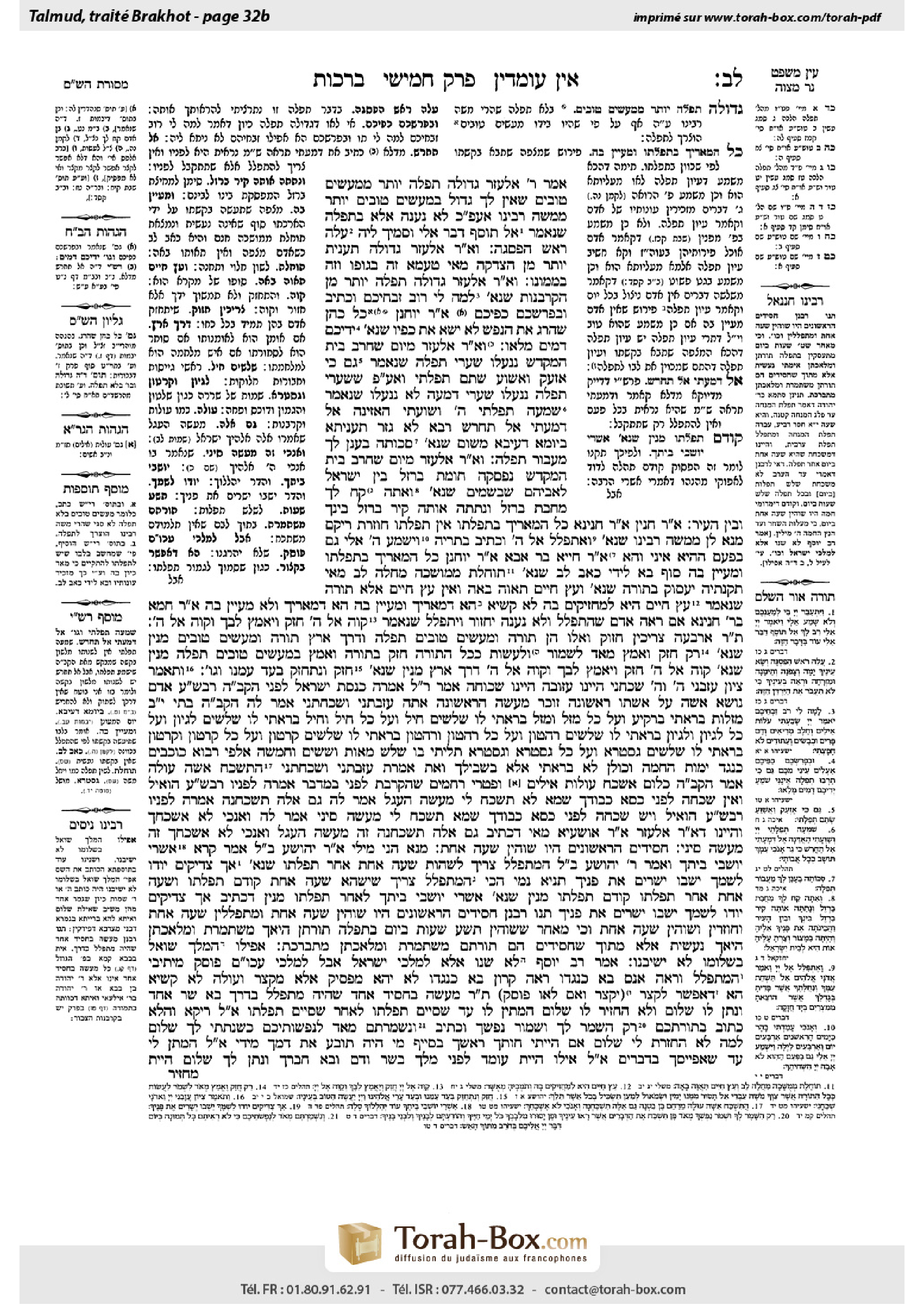
Berakhot 32b: Talmud study for Daf Yomi
Study the Talmud for Daf Yomi with scanned pages, Hebrew text, English translations from Sefaria and AI-generated French translations.
Passage selection and English or AI-generated French translation are available where the scan has annotations. Daf Study is independent of Torah-Box and Sefaria.
Browse Berakhot · ברכות · All tractatesBerakhot 32b text and translations
This page of Berakhot includes the Aramaic text, an English translation and an AI-generated French translation, alongside the scan above.
ברכות ל״ב ב · Aramaic and Hebrew text
אָמַר רַבִּי אֶלְעָזָר: גְּדוֹלָה תְּפִלָּה יוֹתֵר מִמַּעֲשִׂים טוֹבִים, שֶׁאֵין לְךָ גָּדוֹל בְּמַעֲשִׂים טוֹבִים יוֹתֵר מִמֹּשֶׁה רַבֵּינוּ, אַף עַל פִּי כֵן לֹא נַעֲנָה אֶלָּא בִּתְפִלָּה. שֶׁנֶּאֱמַר: ״אַל תּוֹסֶף דַּבֵּר אֵלַי״ וּסְמִיךְ לֵיהּ: ״עֲלֵה רֹאשׁ הַפִּסְגָּה״.
וְאָמַר רַבִּי אֶלְעָזָר: גְּדוֹלָה תַּעֲנִית יוֹתֵר מִן הַצְּדָקָה. מַאי טַעְמָא — זֶה בְּגוּפוֹ, וְזֶה בְּמָמוֹנוֹ.
וְאָמַר רַבִּי אֶלְעָזָר: גְּדוֹלָה תְּפִלָּה יוֹתֵר מִן הַקָּרְבָּנוֹת, שֶׁנֶּאֱמַר ״לָמָּה לִּי רֹב זִבְחֵיכֶם״, וּכְתִיב: ״וּבְפָרִשְׂכֶם כַּפֵּיכֶם״.
אָמַר רַבִּי יוֹחָנָן: כׇּל כֹּהֵן שֶׁהָרַג אֶת הַנֶּפֶשׁ — לֹא יִשָּׂא אֶת כַּפָּיו, שֶׁנֶּאֱמַר: ״יְדֵיכֶם דָּמִים מָלֵאוּ״.
וְאָמַר רַבִּי אֶלְעָזָר: מִיּוֹם שֶׁחָרַב בֵּית הַמִּקְדָּשׁ נִנְעֲלוּ שַׁעֲרֵי תְּפִלָּה, שֶׁנֶּאֱמַר: ״גַּם כִּי אֶזְעַק וַאֲשַׁוֵּעַ שָׂתַם תְּפִלָּתִי״. וְאַף עַל פִּי שֶׁשַּׁעֲרֵי תְפִילָּה נִנְעֲלוּ, שַׁעֲרֵי דִמְעָה לֹא נִנְעֲלוּ, שֶׁנֶּאֱמַר: ״שִׁמְעָה תְפִלָּתִי ה׳ וְשַׁוְעָתִי הַאֲזִינָה אֶל דִּמְעָתִי אַל תֶּחֱרַשׁ״.
רָבָא לָא גְּזַר תַּעֲנִיתָא בְּיוֹמָא דְעֵיבָא, מִשּׁוּם שֶׁנֶּאֱמַר ״סַכֹּתָה בֶעָנָן לָךְ מֵעֲבוֹר תְּפִלָּה״.
וְאָמַר רַבִּי אֶלְעָזָר: מִיּוֹם שֶׁחָרַב בֵּית הַמִּקְדָּשׁ נִפְסְקָה חוֹמַת בַּרְזֶל בֵּין יִשְׂרָאֵל לַאֲבִיהֶם שֶׁבַּשָּׁמַיִם, שֶׁנֶּאֱמַר: ״וְאַתָּה קַח לְךָ מַחֲבַת בַּרְזֶל וְנָתַתָּ אוֹתָהּ קִיר בַּרְזֶל בֵּינְךָ וּבֵין הָעִיר״.
אָמַר רַבִּי חָנִין אָמַר רַבִּי חֲנִינָא: כׇּל הַמַּאֲרִיךְ בִּתְפִלָּתוֹ, אֵין תְּפִלָּתוֹ חוֹזֶרֶת רֵיקָם. מְנָא לַן — מִמֹּשֶׁה רַבֵּינוּ, שֶׁנֶּאֱמַר: ״וָאֶתְפַּלֵּל אֶל ה׳״, וּכְתִיב בָּתְרֵיהּ: ״וַיִּשְׁמַע ה׳ אֵלַי גַּם בַּפַּעַם הַהִיא״.
אִינִי?! וְהָא אָמַר רַבִּי חִיָּיא בַּר אַבָּא אָמַר רַבִּי יוֹחָנָן: כָּל הַמַּאֲרִיךְ בִּתְפִילָּתוֹ וּמְעַיֵּין בָּהּ — סוֹף בָּא לִידֵי כְּאֵב לֵב, שֶׁנֶּאֱמַר: ״תּוֹחֶלֶת מְמֻשָּׁכָה מַחֲלָה לֵב״. מַאי תַּקַּנְתֵּיהּ — יַעֲסוֹק בַּתּוֹרָה, שֶׁנֶּאֱמַר: ״וְעֵץ חַיִּים תַּאֲוָה בָאָה״, וְאֵין עֵץ חַיִּים אֶלָּא תּוֹרָה, שֶׁנֶּאֱמַר: ״עֵץ חַיִּים הִיא לַמַּחֲזִיקִים בָּהּ״. לָא קַשְׁיָא, הָא דְּמַאֲרֵיךְ וּמְעַיֵּין בַּהּ. הָא דְּמַאֲרֵיךְ וְלָא מְעַיֵּין בַּהּ
אָמַר רַבִּי חָמָא בְּרַבִּי חֲנִינָא: אִם רָאָה אָדָם שֶׁהִתְפַּלֵּל וְלֹא נַעֲנָה — יַחְזוֹר וְיִתְפַּלֵּל. שֶׁנֶּאֱמַר: ״קַוֵּה אֶל ה׳ חֲזַק וְיַאֲמֵץ לִבֶּךָ וְקַוֵּה אֶל ה׳״.
תָּנוּ רַבָּנַן: אַרְבָּעָה צְרִיכִין חִזּוּק, וְאֵלּוּ הֵן: תּוֹרָה, וּמַעֲשִׂים טוֹבִים, תְּפִלָּה, וְדֶרֶךְ אֶרֶץ.
תּוֹרָה וּמַעֲשִׂים טוֹבִים מִנַּיִן? — שֶׁנֶּאֱמַר: ״רַק חֲזַק וֶאֱמַץ מְאֹד לִשְׁמֹר וְלַעֲשׂוֹת כְּכׇל הַתּוֹרָה״, ״חֲזַק״ — בַּתּוֹרָה, ״וֶאֱמַץ״ — בְּמַעֲשִׂים טוֹבִים.
תְּפִלָּה מִנַּיִן? — שֶׁנֶּאֱמַר ״קַוֵּה אֶל ה׳ חֲזַק וְיַאֲמֵץ לִבֶּךָ וְקַוֵּה אֶל ה׳״.
דֶּרֶךְ אֶרֶץ מִנַּיִן? — שֶׁנֶּאֱמַר ״חֲזַק וְנִתְחַזַּק בְּעַד עַמֵּנוּ וְגוֹ׳״.
״וַתֹּאמֶר צִיּוֹן עֲזָבַנִי ה׳ וַה׳ שְׁכֵחָנִי״. הַיְינוּ עֲזוּבָה, הַיְינוּ שְׁכוּחָה? אָמַר רֵישׁ לָקִישׁ: אָמְרָה כְּנֶסֶת יִשְׂרָאֵל לִפְנֵי הַקָּדוֹשׁ בָּרוּךְ הוּא: רִבּוֹנוֹ שֶׁל עוֹלָם, אָדָם נוֹשֵׂא אִשָּׁה עַל אִשְׁתּוֹ רִאשׁוֹנָה, זוֹכֵר מַעֲשֵׂה הָרִאשׁוֹנָה. אַתָּה עֲזַבְתַּנִי וּשְׁכַחְתַּנִי.
אָמַר לָהּ הַקָּדוֹשׁ בָּרוּךְ הוּא: בִּתִּי, שְׁנֵים עָשָׂר מַזָּלוֹת בָּרָאתִי בָּרָקִיעַ, וְעַל כׇּל מַזָּל וּמַזָּל בָּרָאתִי לוֹ שְׁלֹשִׁים חַיִל, וְעַל כׇּל חַיִל וְחַיִל בָּרָאתִי לוֹ שְׁלֹשִׁים לִגְיוֹן, וְעַל כׇּל לִגְיוֹן וְלִגְיוֹן בָּרָאתִי לוֹ שְׁלֹשִׁים רַהֲטוֹן, וְעַל כׇּל רַהֲטוֹן וְרַהֲטוֹן בָּרָאתִי לוֹ שְׁלֹשִׁים קְרָטוֹן, וְעַל כׇּל קְרָטוֹן וּקְרָטוֹן בָּרָאתִי לוֹ שְׁלֹשִׁים גַּסְטְרָא, וְעַל כׇּל גַּסְטְרָא וְגַסְטְרָא תָּלִיתִי בּוֹ שְׁלֹשׁ מֵאוֹת וְשִׁשִּׁים וַחֲמִשָּׁה אַלְפֵי רִבּוֹא כּוֹכָבִים כְּנֶגֶד יְמוֹת הַחַמָּה. וְכוּלָּן לֹא בָּרָאתִי אֶלָּא בִּשְׁבִילֵךְ, וְאַתְּ אָמַרְתְּ ״עֲזַבְתַּנִי״ וּ״שְׁכַחְתַּנִי״?!
״הֲתִשְׁכַּח אִשָּׁה עוּלָהּ״, אָמַר הַקָּדוֹשׁ בָּרוּךְ הוּא: כְּלוּם אֶשְׁכַּח עוֹלוֹת אֵילִים וּפִטְרֵי רְחָמִים שֶׁהִקְרַבְתְּ לְפָנַי בַּמִּדְבָּר?! אָמְרָה לְפָנָיו: רִבּוֹנוֹ שֶׁל עוֹלָם, הוֹאִיל וְאֵין שִׁכְחָה לִפְנֵי כִּסֵּא כְבוֹדֶךָ, שֶׁמָּא לֹא תִּשְׁכַּח לִי מַעֲשֵׂה הָעֵגֶל? אָמַר לָהּ: ״גַּם אֵלֶּה תִשְׁכַּחְנָה״.
אָמְרָה לְפָנָיו: רִבּוֹנוֹ שֶׁל עוֹלָם, הוֹאִיל וְיֵשׁ שִׁכְחָה לִפְנֵי כִּסֵּא כְבוֹדֶךָ, שֶׁמָּא תִּשְׁכַּח לִי מַעֲשֵׂה סִינַי? אָמַר לָהּ: ״וְאָנֹכִי לֹא אֶשְׁכָּחֵךְ״.
וְהַיְינוּ דְּאָמַר רַבִּי אֶלְעָזָר אָמַר רַב אוֹשַׁעְיָא: מַאי דִּכְתִיב ״גַּם אֵלֶּה תִשְׁכַּחְנָה״ — זֶה מַעֲשֵׂה הָעֵגֶל, ״וְאָנֹכִי לֹא אֶשְׁכָּחֵךְ״ — זֶה מַעֲשֵׂה סִינַי.
חֲסִידִים הָרִאשׁוֹנִים הָיוּ שׁוֹהִין שָׁעָה אַחַת:
מְנָא הָנֵי מִילֵּי? אָמַר רַבִּי יְהוֹשֻׁעַ בֶּן לֵוִי, אָמַר קְרָא: ״אַשְׁרֵי יוֹשְׁבֵי בֵיתֶךָ״.
וְאָמַר רַבִּי יְהוֹשֻׁעַ בֶּן לֵוִי: הַמִּתְפַּלֵּל צָרִיךְ לִשְׁהוֹת שָׁעָה אַחַת אַחַר תְּפִלָּתוֹ, שֶׁנֶּאֱמַר: ״אַךְ צַדִּיקִים יוֹדוּ לִשְׁמֶךָ יֵשְׁבוּ יְשָׁרִים אֶת פָּנֶיךָ״.
תַּנְיָא נָמֵי הָכִי: הַמִּתְפַּלֵּל צָרִיךְ שֶׁיִּשְׁהֶא שָׁעָה אַחַת קוֹדֶם תְּפִלָּתוֹ, וְשָׁעָה אַחַת אַחַר תְּפִלָּתוֹ. קוֹדֶם תְּפִלָּתוֹ, מִנַּיִן? שֶׁנֶּאֱמַר: ״אַשְׁרֵי יוֹשְׁבֵי בֵיתֶךָ״. לְאַחַר תְּפִלָּתוֹ מִנַּיִן? — דִּכְתִיב: ״אַךְ צַדִּיקִים יוֹדוּ לִשְׁמֶךָ יֵשְׁבוּ יְשָׁרִים אֶת פָּנֶיךָ״.
תָּנוּ רַבָּנַן: חֲסִידִים הָרִאשׁוֹנִים הָיוּ שׁוֹהִין שָׁעָה אַחַת, וּמִתְפַּלְּלִין שָׁעָה אַחַת, וְחוֹזְרִין וְשׁוֹהִין שָׁעָה אַחַת. וְכִי מֵאַחַר שֶׁשּׁוֹהִין תֵּשַׁע שָׁעוֹת בַּיּוֹם בִּתְפִלָּה, תּוֹרָתָן הֵיאַךְ מִשְׁתַּמֶּרֶת, וּמְלַאכְתָּם הֵיאַךְ נַעֲשֵׂית?
אֶלָּא מִתּוֹךְ שֶׁחֲסִידִים הֵם — תּוֹרָתָם מִשְׁתַּמֶּרֶת, וּמְלַאכְתָּן מִתְבָּרֶכֶת.
אֲפִילּוּ הַמֶּלֶךְ שׁוֹאֵל בִּשְׁלוֹמוֹ לֹא יְשִׁיבֶנּוּ.
אָמַר רַב יוֹסֵף, לֹא שָׁנוּ אֶלָּא לְמַלְכֵי יִשְׂרָאֵל, אֲבָל לְמַלְכֵי אוּמּוֹת הָעוֹלָם — פּוֹסֵק.
מֵיתִיבִי: הַמִּתְפַּלֵּל וְרָאָה אַנָּס בָּא כְּנֶגְדּוֹ, רָאָה קָרוֹן בָּא כְּנֶגְדּוֹ — לֹא יְהֵא מַפְסִיק, אֶלָּא מְקַצֵּר וְעוֹלֶה!
לָא קַשְׁיָא, הָא דְּאֶפְשָׁר לְקַצֵּר (יְקַצֵּר. וְאִם לָאו — פּוֹסֵק).
תָּנוּ רַבָּנַן: מַעֲשֶׂה בְּחָסִיד אֶחָד שֶׁהָיָה מִתְפַּלֵּל בַּדֶּרֶךְ. בָּא הֶגְמוֹן אֶחָד וְנָתַן לוֹ שָׁלוֹם, וְלֹא הֶחְזִיר לוֹ שָׁלוֹם. הִמְתִּין לוֹ עַד שֶׁסִּייֵּם תְּפִלָּתוֹ. לְאַחַר שֶׁסִּייֵּם תְּפִלָּתוֹ, אָמַר לוֹ: רֵיקָא, וַהֲלֹא כָּתוּב בְּתוֹרַתְכֶם ״רַק הִשָּׁמֶר לְךָ וּשְׁמֹר נַפְשְׁךָ״, וּכְתִיב ״וְנִשְׁמַרְתֶּם מְאֹד לְנַפְשֹׁתֵיכֶם״. כְּשֶׁנָּתַתִּי לְךָ שָׁלוֹם לָמָּה לֹא הֶחְזַרְתָּ לִי שָׁלוֹם? אִם הָיִיתִי חוֹתֵךְ רֹאשְׁךָ בְּסַיִיף, מִי הָיָה תּוֹבֵעַ אֶת דָּמְךָ מִיָּדִי?!
אָמַר לוֹ: הַמְתֵּן לִי עַד שֶׁאֲפַיֶּיסְךָ בִּדְבָרִים. אָמַר לוֹ: אִילּוּ הָיִיתָ עוֹמֵד לִפְנֵי מֶלֶךְ בָּשָׂר וָדָם, וּבָא חֲבֵרְךָ וְנָתַן לְךָ שָׁלוֹם — הָיִיתָ
Berakhot 32b · English translation
Rabbi Elazar said: This story proves that prayer is greater than good deeds without prayer (Tosafot), as there was none greater in the performance of good deeds than Moses our teacher; nevertheless, his request was granted, albeit in a limited manner, in his request to enter Eretz Yisrael, only through prayer, when God permitted him to climb the mountain and look out over the land. As, initially it is stated: “Speak no more to Me,” juxtaposed to which is: “Go up to the summit of the mountain.”
After comparing and contrasting prayer and good deeds, the Gemara explores another comparison. Rabbi Elazar said: A fast is greater than charity. What is the reason that fasting is greater? Because a fast is a mitzva performed with one’s body as he afflicts himself, while charity is performed only with one’s money.
In another comparison, Rabbi Elazar said: Prayer is greater than sacrifices, as it is stated: “To what purpose is the multitude of your sacrifices to Me, says the Lord. I am full of the burnt-offerings of rams and the fat of fed beasts; I do not desire the blood of bulls and sheep and goats” (Isaiah 1:11). And several verses later it is written: “And when you spread forth your hands I will hide My eyes from you, and even if you increase your prayer, I will not hear; your hands are full of blood” (Isaiah 1:15). Not only Israel’s sacrifices, but even their prayers, which are on a higher spiritual level, will not be accepted.
Speaking of that verse in Isaiah, the Gemara cites that Rabbi Yoḥanan said: Any priest who killed a person may not lift his hands in the Priestly Blessing as it is stated: “And when you spread forth your hands I will hide My eyes from you…your hands are full of blood.” Here we see that the Priestly Blessing, performed with hands spread forth, is not accepted when performed by priests whose “hands are full of blood.”
On the subject of prayer, Rabbi Elazar also said: Since the day the Temple was destroyed the gates of prayer were locked and prayer is not accepted as it once was, as it is said in lamentation of the Temple’s destruction: “Though I plead and call out, He shuts out my prayer” (Lamentations 3:8). Yet, despite the fact that the gates of prayer were locked with the destruction of the Temple, the gates of tears were not locked, and one who cries before God may rest assured that his prayers will be answered, as it is stated: “Hear my prayer, Lord, and give ear to my pleading, keep not silence at my tears” (Psalms 39:13). Since this prayer is a request that God should pay heed to the tears of one who is praying, he is certain that at least the gates of tears are not locked.
With regard to the locking of the gates of prayer, the Gemara relates that Rava did not decree a fast on a cloudy day because it is stated: “You have covered Yourself in a cloud, through which prayer cannot pass” (Lamentations 3:44). The verse indicates that clouds are a bad omen, indicating that God has averted His face (Rav Hai Gaon).
And Rabbi Elazar said: Since the day the Temple was destroyed an iron wall separates Israel from their Father in heaven, as it is stated to the prophet Ezekiel, instructing him to symbolize that separation: “And take for yourself an iron griddle, and set it as an iron wall between yourself and the city…it will be a sign for the house of Israel” (Ezekiel 4:3).
The Gemara cites other statements in praise of prayer: Rabbi Ḥanin said that Rabbi Ḥanina said: Anyone who prolongs his prayer is assured that his prayer does not return unanswered; it will surely be accepted. From where do we derive this? From Moses our teacher, as it is stated that Moses said: “So I fell down before the Lord the forty days and forty nights that I fell down; and I prayed to the Lord” (Deuteronomy 9:26–27), and it is written thereafter: “And the Lord heard me that time as well, the Lord would not destroy you” (Deuteronomy 10:10).
The Gemara raises an objection: Is that so? Didn’t Rabbi Ḥiyya bar Abba say that Rabbi Yoḥanan said: Anyone who prolongs his prayer and expects it to be answered, will ultimately come to heartache, as it will not be answered. As it is stated: “Hope deferred makes the heart sick” (Proverbs 13:12). And what is the remedy for one afflicted with that illness? He should engage in Torah study, as it is stated: “But desire fulfilled is the tree of life” (Proverbs 13:12), and tree of life is nothing other than Torah, as it is stated: “It is a tree of life to those who hold fast to it, and those who support it are joyous” (Proverbs 3:18). This is not difficult. This, Rabbi Ḥiyya bar Abba’s statement that one will suffer heartache refers to one who prolongs his prayer and expects it to be answered; that, Rabbi Ḥanin’s statement that one who prolongs his prayer is praiseworthy refers to one who prolongs his prayer and does not expect it to be answered.
On a similar note, Rabbi Ḥama, son of Rabbi Ḥanina, said: A person who prayed and saw that he was not answered should pray again, as it is stated: “Hope in the Lord, strengthen yourself, let your heart take courage, and hope in the Lord” (Psalms 27:14). One should turn to God with hope, and if necessary turn to God again with hope.
Connected to the emphasis on the need to bolster one’s effort in prayer, the Gemara notes that the Sages taught in a baraita: Four things require bolstering, constant effort to improve, and they are: Torah, good deeds, prayer, and occupation.
For each of these, a biblical proof is cited: From where is it derived that Torah and good deeds require bolstering? As it is stated in the instruction to Joshua: “Only be strong and be extremely courageous, observe and do all of the Torah that Moses My servant commanded you; do not deviate to the right or to the left, that you may succeed wherever you go” (Joshua 1:7). In this verse, observe refers to Torah study and do refers to good deeds (Maharsha); the apparently repetitive language is not extraneous. The Gemara derives: Be strong in Torah and be courageous in good deeds.
From where is it derived that prayer requires bolstering? As it is said: “Hope in the Lord, strengthen yourself, let your heart take courage, and hope in the Lord.”
From where is it derived that occupation requires bolstering? As it is stated: “Be strong and we will be strong for the sake of our nation and for the cities of our God” (II Samuel 10:12). All of one’s labor requires bolstering.
The Gemara cites a midrash on the following verse from Isaiah, relating to the sin of the Golden Calf and Moses’ supplication for forgiveness: “But Zion said: The Lord has forsaken me and the Lord has forgotten me. Can a woman forget her suckling baby, that she would not have compassion for the child of her womb? These may forget, but you I will not forget” (Isaiah 49:14–15). The Gemara seeks to clarify: Forsaken is the same as forgotten. They are synonymous; why repeat the same idea twice? Reish Lakish said: The community of Israel said before the Holy One, Blessed be He: Master of the Universe, even when a man marries a second wife after his first wife, he certainly recalls the deeds of his first wife. Yet You have not only forsaken me, but You have forgotten me as well.
The Holy One, Blessed be He, said to Israel: My daughter, I created twelve constellations in the firmament, and for each and every constellation I have created thirty armies, and for each and every army I have created thirty legions [ligyon], and for each and every legion I have created thirty infantry division leaders [rahaton], and for each and every infantry division leader I have created thirty military camp leaders [karton], and for each and every military camp leader I have created thirty leaders of forts [gastera], and on each and every leader of a fort I have hung three hundred and sixty-five thousand stars corresponding to the days of the solar year. And all of them I have created only for your sake; and you said the Lord has forsaken me and the Lord has forgotten me?
The verse goes on to say: “Can a woman forget her suckling baby, that she would not have compassion for the child of her womb? These may forget, but you I will not forget.” The meaning of this verse is that the Holy One, Blessed be He, said to the community of Israel: Have I forgotten the ram offerings and firstborn animals that you offered before Me in the desert? The community of Israel replied to Him: Master of the Universe, since there is no forgetfulness before the Throne of Your Glory, perhaps you will not forget my sin of the Golden Calf? God responded to Israel: “These [eleh] too shall be forgotten.” “These” is a reference to the sin of the Golden Calf, regarding which Israel said: “These [eleh] are your gods.”
The community of Israel said before Him: Master of the Universe, since there is forgetfulness before the Throne of Your Glory, perhaps You will also forget the events revolving around the revelation at Sinai? God said to Israel: I [anokhi] will not forget you the revelation at Sinai, which began with: “I [anokhi] am the Lord your God.”
The Gemara notes: That is what Rabbi Elazar said that Rav Oshaya said: What is the meaning of that which is written: “These too will be forgotten”? That is the sin of the Golden Calf. And what is the meaning of I will not forget you? Those are the events that transpired at Sinai.
We learned in the mishna that the early generations of pious men would wait one hour in order to achieve the solemn frame of mind appropriate for prayer.
The Gemara asks: From where are these matters derived? Rabbi Yehoshua ben Levi said: This is alluded to when the verse states: “Happy are those who dwell in Your House” (Psalms 84:5), immediately after which it is said: “They will yet praise You, Selah.”
And Rabbi Yehoshua ben Levi said: One who prays must also wait one hour after his prayer, as it is stated: “Surely the righteous will give thanks unto Your name, the upright will sit before You” (Psalms 140:14), meaning that after thanking God through prayer, one should stay and sit before Him.
That opinion was also taught in a baraita: One who prays must wait one hour before his prayer and one hour after his prayer. From where is it derived that one must wait one hour before his prayer? As it is stated: “Happy are those who dwell in Your House.” And from where is it derived that one must stay one hour after his prayer? As it is written: “Surely the righteous will give thanks unto Your name, the upright will sit before You.”
The Sages taught in a baraita with regard to waiting before and after prayer: The early generations of pious men would wait one hour, pray one hour, then wait one hour again. This raises the question: Since the early pious men would spend nine hours per day engaged either in prayer or the requisite waiting periods before and after prayer, three hours each for the morning, afternoon, and evening prayers, how is their Torah preserved? There was little time remaining to review their studies. And how was their work accomplished?
The Gemara answers: Rather, because they were pious they merited that their Torah is preserved and their work is blessed.
Additionally, we learned in the mishna: Even if the king greets him while he is praying, he should not respond to him as one may not interrupt his prayer.
In limiting application of this principle, Rav Yosef said: They only taught this mishna with regard to kings of Israel, as a Jewish king would understand that the individual did not fail to respond to his greeting due to disrespect for the king. However, with regard to kings of the nations of the world, he interrupts his prayer and responds to their greeting due to the potential danger.
The Gemara raised an objection to Rav Yosef’s statement: One who is praying and saw a violent person, feared by all, coming toward him, or a carriage coming toward him and he is in the way, he should not stop his prayer but rather abridge it and move out of the way.
The Gemara responds: This is not difficult. Rather, this that teaches to abridge one’s prayer rather than stopping, refers to a case where it is possible to abridge his prayer and complete it in time, in which case he should abridge it. And if it is not a situation where he can abridge his prayer, he interrupts his prayer.
The Sages taught: There was a related incident, involving a particular pious man who was praying while traveling along his path when an officer [hegmon] came and greeted him. The pious man did not pause from his prayer and did not respond with a greeting. The officer waited for him until he finished his prayer.
After he finished his prayer, the officer said to him: You good for nothing. You endangered yourself; I could have killed you.
Isn’t it written in your Torah: “Take utmost care and guard yourself diligently” (Deuteronomy 4:9)?
And it is also written: “Take therefore good heed unto yourselves” (Deuteronomy 4:15)? Why did you ignore the danger to your life?
When I greeted you, why did you not respond with a greeting?
Were I to sever your head with a sword, who would hold me accountable for your spilled blood?
The pious man said to him: Wait for me until I will appease you with my words.
He said to him: Had you been standing before a flesh and blood king and your friend came and greeted you, would you
return his greeting?
Berakhot 32b · Traduction française (IA)
Rabbi Elazar a dit : Cette histoire prouve que la prière est supérieure aux bonnes œuvres sans prière (Tosafot), car il n'y avait personne de plus accompli dans l'accomplissement de bonnes œuvres que Moïse notre maître ; néanmoins, sa demande fut exaucée, bien que de manière limitée, lorsqu'il demanda d'entrer en Terre d'Israël, uniquement par la prière, lorsque Dieu permit à Moïse de monter la montagne et de contempler la terre. Car, d'abord il est dit : « Ne parle plus à Moi », juxtaposé à cela est : « Monte sur le sommet de la montagne ».
Après avoir comparé et contrasté la prière et les bonnes œuvres, le Guemara explore une autre comparaison. Rabbi Elazar a dit : Le jeûne est supérieur à la charité. Quelle est la raison pour laquelle le jeûne est supérieur ? Parce que le jeûne est une mitsva accomplie avec son corps, car il s'afflige, tandis que la charité est accomplie uniquement avec ses deniers.
Dans une autre comparaison, Rabbi Elazar a dit : La prière est supérieure aux sacrifices, car il est dit : « À quoi bon les nombreux sacrifices que tu m'offres, dit l'Éternel. Je suis plein des offrandes de taigues et de la graisse des bêtes grasses ; je n'ai pas envie du sang des taureaux et des brebis et des boucs » (Isaïe 1:11). Et plusieurs versets plus tard, il est écrit : « Et quand tu étends tes mains, je fermerai mes yeux à toi, et même si tu augmentes ta prière, je ne t'écouterai pas ; tes mains sont pleines de sang » (Isaïe 1:15). Non seulement les sacrifices d'Israël, mais même leurs prières, qui sont à un niveau spirituel plus élevé, ne seront pas acceptées.
En parlant de ce verset d'Isaïe, le Guemara cite que Rabbi Yoḥanan a dit : Tout prêtre qui a tué une personne ne peut pas lever ses mains dans la Bénédiction du Prêtre, car il est dit : « Et quand tu étends tes mains, je fermerai mes yeux à toi… tes mains sont pleines de sang ». Ici nous voyons que la Bénédiction du Prêtre, accomplie avec les mains étendues, n'est pas acceptée lorsqu'elle est accomplie par des prêtres dont « les mains sont pleines de sang ».
Sur le sujet de la prière, Rabbi Elazar a aussi dit : Depuis le jour où le Temple a été détruit, les portes de la prière ont été verrouillées et la prière n'est plus acceptée comme avant, car il est dit dans la lamentation de la destruction du Temple : « Bien que je supplie et appelle, Il ferme ma prière » (Lamentations 3:8). Cependant, malgré le fait que les portes de la prière aient été verrouillées avec la destruction du Temple, les portes des larmes n'ont pas été verrouillées, et celui qui pleure devant Dieu peut être assuré que ses prières seront exaucées, car il est dit : « Écoute ma prière, Seigneur, et écoute ma supplique, ne t'abstiens pas de mes larmes » (Psaumes 39:13). Puisque cette prière est une demande que Dieu devrait écouter les larmes de celui qui prie, il est certain que du moins les portes des larmes ne sont pas verrouillées.
En ce qui concerne le verrouillage des portes de la prière, le Guemara rapporte que Rava n'a pas ordonné un jeûne un jour nuageux, car il est dit : « Tu t'es couvert d'un nuage, par lequel la prière ne peut pas passer » (Lamentations 3:44). Ce verset indique que les nuages sont un mauvais présage, indiquant que Dieu a tourné le dos (Rav Hai Gaon).
Et Rabbi Elazar a dit : Depuis le jour où le Temple a été détruit, un mur d'acier sépare Israël de leur Père céleste, car il est dit au prophète Ézéchiel, l'instruisant de symboliser cette séparation : « Et prends-toi une plaque de fer, et mets-la comme un mur de fer entre toi et la ville… elle sera un signe pour la maison d'Israël » (Ézéchiel 4:3).
Le Guemara cite d'autres déclarations en l'honneur de la prière : Rabbi Ḥanin a dit que Rabbi Ḥanina a dit : Quiconque prolonge sa prière est assuré que sa prière ne revient pas sans réponse ; elle sera certainement acceptée. D'où tirons-nous cela ? De Moïse notre maître, car il est dit que Moïse a dit : « Ainsi je suis tombé devant l'Éternel quarante jours et quarante nuits que je suis tombé ; et j'ai prié devant l'Éternel » (Deutéronome 9:26–27), et il est écrit ensuite : « Et l'Éternel m'a entendu cette fois-ci aussi, l'Éternel ne détruirait pas vous » (Deutéronome 10:10).
Le Guemara soulève un objection : Est-ce ainsi ? N'a-t-il pas dit Rabbi Ḥiyya bar Abba que Rabbi Yoḥanan a dit : Quiconque prolonge sa prière et s'attend à ce qu'elle soit exaucée, finira par avoir le cœur brisé, car elle ne sera pas exaucée. Car il est dit : « L'attente différée rend le cœur malade » (Proverbes 13:12). Et quelle est la remède pour celui qui souffre de cette maladie ? Il devrait étudier la Torah, car il est dit : « Le désir accompli est l'arbre de la vie » (Proverbes 13:12), et l'arbre de la vie n'est autre que la Torah, car il est dit : « C'est un arbre de vie pour ceux qui le tiennent fermement, et ceux qui le soutiennent sont joyeux » (Proverbes 3:18). Ce n'est pas difficile. Cela, la déclaration de Rabbi Ḥiyya bar Abba que l'on souffrira du cœur brisé, fait référence à celui qui prolonge sa prière et s'attend à ce qu'elle soit exaucée ; celui-ci, la déclaration de Rabbi Ḥanin que celui qui prolonge sa prière est louable, fait référence à celui qui prolonge sa prière et ne s'attend pas à ce qu'elle soit exaucée.
Sur un point similaire, Rabbi Ḥama, fils de Rabbi Ḥanina, a dit : Une personne qui a prié et a vu qu'elle n'était pas exaucée devrait prier à nouveau, car il est dit : « Espère en l'Éternel, fortifie-toi, fais courage à ton cœur, et espère en l'Éternel » (Psaumes 27:14). On devrait se tourner vers Dieu avec de l'espoir, et si nécessaire, se tourner à nouveau vers Dieu avec de l'espoir.
En lien avec l'accent mis sur la nécessité de renforcer son effort dans la prière, le Guemara note que les Sages ont enseigné dans une baraïta : Quatre choses nécessitent un renforcement, un effort constant pour s'améliorer, et ce sont : la Torah, les bonnes œuvres, la prière et l'occupation.
Pour chacune de ces choses, un témoignage biblique est cité : D'où tire-t-on que la Torah et les bonnes œuvres nécessitent un renforcement ? Car il est dit dans l'instruction à Josué : « Seulement sois fort et sois extrêmement courageux, observe et fais tout la Torah que Moïse mon serviteur t'a commandé ; ne détourne pas à droite ni à gauche, afin de réussir partout où tu iras » (Josué 1:7). Dans ce verset, « observe » fait référence à l'étude de la Torah et « fais » fait référence aux bonnes œuvres (Maharsha) ; la langue répétée n'est pas superflue. Le Guemara tire : Sois fort en Torah et sois courageux en bonnes œuvres.
D'où vient l'enseignement que la prière nécessite un soutien ? Comme il est dit : « Espérez en l'Éternel, fortifiez-vous, que votre cœur ait du courage, et espérez en l'Éternel. »
D'où vient l'enseignement que l'occupation nécessite un soutien ? Comme il est dit : « Soyez forts et nous serons forts pour le compte de notre peuple et pour les villes de notre Dieu » (II Samuel 10:12). Toute la force de travail d'une personne nécessite un soutien.
Le Guemara cite un midrash sur le verset suivant d'Isaïe, concernant le péché du bœuf d'or et la supplication de Moïse pour l'indulgence : « Mais Sion dit : L'Éternel m'a abandonné et l'Éternel m'a oublié. Peut-on une femme oublier son enfant à lait, qu'elle ne serait pas miséricordieuse envers l'enfant de son ventre ? Ces-ci peuvent oublier, mais toi je ne t'oublierai pas » (Isaïe 49:14–15). Le Guemara cherche à clarifier : Abandonné est la même chose que oublié. Ils sont synonymes ; pourquoi répéter la même idée deux fois ? Reish Lakish a dit : La communauté d'Israël a dit devant le Saint, le Très Haut : Seigneur du Monde, même quand un homme épouse une deuxième femme après sa première femme, il se souvient certainement des actes de sa première femme. Cependant, Tu n'as pas seulement abandonné moi, mais Tu as oublié moi aussi.
Le Saint, le Très Haut, a dit à Israël : Ma fille, j'ai créé douze constellations dans le firmament, et pour chaque constellation j'ai créé trente armées, et pour chaque armée trente légions [ligyon], et pour chaque légion trente chefs de divisions militaires [rahaton], et pour chaque chef de division militaire trente chefs de camps [karton], et pour chaque chef de camp trente chefs de forteresses [gastera], et sur chaque chef de forteresse j'ai suspendu trois cent soixante-cinq mille étoiles correspondant aux jours de l'année solaire. Et tout cela j'ai créé uniquement à cause de vous ; et vous avez dit que l'Éternel m'a abandonné et l'Éternel m'a oublié ?
Le verset continue en disant : « Peut-on une femme oublier son enfant à lait, qu'elle ne serait pas miséricordieuse envers l'enfant de son ventre ? Ces-ci peuvent oublier, mais toi je ne t'oublierai pas. » Le sens de ce verset est que le Saint, le Très Haut, a dit à la communauté d'Israël : Ai-je oublié les offrandes de bœufs et les premiers-nés que vous avez offerts devant Moi dans le désert ? La communauté d'Israël a répondu à Lui : Seigneur du Monde, puisque l'oubli n'existe pas devant le Trône de Votre Gloire, peut-être ne oublierez-vous pas mon péché du bœuf d'or ? Dieu a répondu à Israël : « Ces-ci [eleh] aussi seront oubliés. » « Ces-ci » fait référence au péché du bœuf d'or, concernant lequel Israël a dit : « Ces-ci [eleh] sont vos dieux. »
La communauté d'Israël a dit devant Lui : Seigneur du Monde, puisque l'oubli existe devant le Trône de Votre Gloire, peut-être oublierez-vous aussi les événements liés à la révélation au Sinaï ? Dieu a dit à Israël : « Je [anokhi] ne t'oublierai pas la révélation au Sinaï, qui a commencé par : « Je [anokhi] suis l'Éternel votre Dieu. »
Le Guemara note : C'est ce que Rabbi Elazar a dit que Rav Oshaya a dit : Quel est le sens de ce qui est écrit : « Ces-ci aussi seront oubliés » ? C'est le péché du bœuf d'or. Et quel est le sens de « Je ne t'oublierai pas » ? Ce sont les événements qui se sont produits au Sinaï.
Nous avons appris dans la mishna que les générations précoces des hommes pieux attendaient une heure afin d'atteindre l'état d'esprit solennel approprié à la prière.
Le Guemara pose la question : D'où viennent ces choses ? Rabbi Yéhoshua ben Levi a dit : Cela est allégué lorsque le verset dit : « Heureux sont ceux qui habitent dans Votre maison » (Psaumes 84:5), immédiatement suivi de : « Ils loueront encore Vous, Selah. »
Et Rabbi Yéhoshua ben Levi a dit : Celui qui prie doit aussi attendre une heure après sa prière, car il est écrit : « Assurément les justes béniront le nom de l'Éternel, les droits s'assiedront devant Vous » (Psaumes 140:14), signifiant que, après avoir remercié Dieu par la prière, on devrait rester et s'asseoir devant Lui.
Cette opinion a également été enseignée dans une baraïta : Celui qui prie doit attendre une heure avant sa prière et une heure après sa prière. D'où vient l'enseignement que l'on doit attendre une heure avant sa prière ? Comme il est dit : « Heureux sont ceux qui habitent dans Votre maison. » Et d'où vient l'enseignement que l'on doit rester une heure après sa prière ? Comme il est écrit : « Assurément les justes béniront le nom de l'Éternel, les droits s'assiedront devant Vous. »
Les Sages ont enseigné dans une baraïta concernant l'attente avant et après la prière : Les générations précoces des hommes pieux attendaient une heure, priaient une heure, puis attendaient une heure à nouveau. Cela soulève la question : Puisque les hommes pieux précoces passaient neuf heures par jour soit en prière soit dans les périodes d'attente avant et après la prière, trois heures chacune pour les prières du matin, de l'après-midi et du soir, comment leur Torah est-elle préservée ? Il restait peu de temps pour réviser leurs études. Et comment leur travail était-il accompli ?
Le Guemara répond : Plutôt, parce qu'ils étaient pieux, ils méritaient que leur Torah soit préservée et leur travail bénis.
De plus, nous avons appris dans la mishna : Même si le roi lui fait la salutation pendant qu'il prie, il ne doit pas répondre à lui, car on ne doit pas interrompre sa prière.
En limitant l'application de ce principe, Rav Yosef a dit : Ils ont enseigné cette mishna uniquement concernant les rois d'Israël, car un roi juif comprendrait que l'individu n'avait pas manqué de répondre à sa salutation en raison de manque de respect pour le roi. Cependant, concernant les rois des nations du monde, il interrompt sa prière et répond à leur salutation en raison du danger potentiel.
La Guemara souleva un objet contre la déclaration de R. Yosef : celui qui prie et voit un homme violent, redouté de tous, qui vient vers lui, ou un carrosse qui vient vers lui et il est sur son chemin, ne doit pas interrompre sa prière mais plutôt la raccourcir et se retirer du chemin.
La Guemara répondit : cela n'est pas difficile. En effet, ce qui enseigne de raccourcir sa prière plutôt que de l'interrompre, se réfère à un cas où il est possible de raccourcir sa prière et de la terminer à temps, dans ce cas-là il doit la raccourcir. Et si ce n'est pas un cas où il peut raccourcir sa prière, il interrompt sa prière.
Les Sages enseignèrent : il y a eu un incident similaire, concernant un homme particulièrement pieux qui priait en voyageant sur son chemin lorsque vint un officier [hegmon] et le salua. L'homme pieux ne s'arrêta pas de sa prière et n' répondit pas au salut. L'officier attendit qu'il finisse sa prière. Après avoir terminé sa prière, l'officier lui dit : Tu es un mauvais sujet. Tu as mis ta vie en danger ; je pouvais te tuer. N'est-il pas écrit dans votre Torah : « Prenez garde à vous-mêmes avec la plus grande vigilance » (Deutéronome 4:9) ? Et il est aussi écrit : « Prenez donc garde à vous-mêmes » (Deutéronome 4:15) ? Pourquoi as-tu ignoré le danger pour ta vie ? Quand j'ai salué, pourquoi n'as-tu pas répondu au salut ? Si j'avais coupé ta tête avec une épée, qui m'aurait tenu responsable de ton sang versé ?
L'homme pieux lui dit : Attendez-moi jusqu'à ce que je vous apaise avec mes paroles. Il lui répond : Si tu avais été devant un roi de chair et de sang et que ton ami est venu te saluer, aurais-tu répondu à son salut ?
Traduction française générée par IA à partir de l’édition anglaise de Sefaria. Vérifie toujours un passage avec le texte source.
Text from Sefaria: William Davidson Edition - Vocalized Aramaic (CC BY NC); William Davidson Edition - English (CC BY NC).