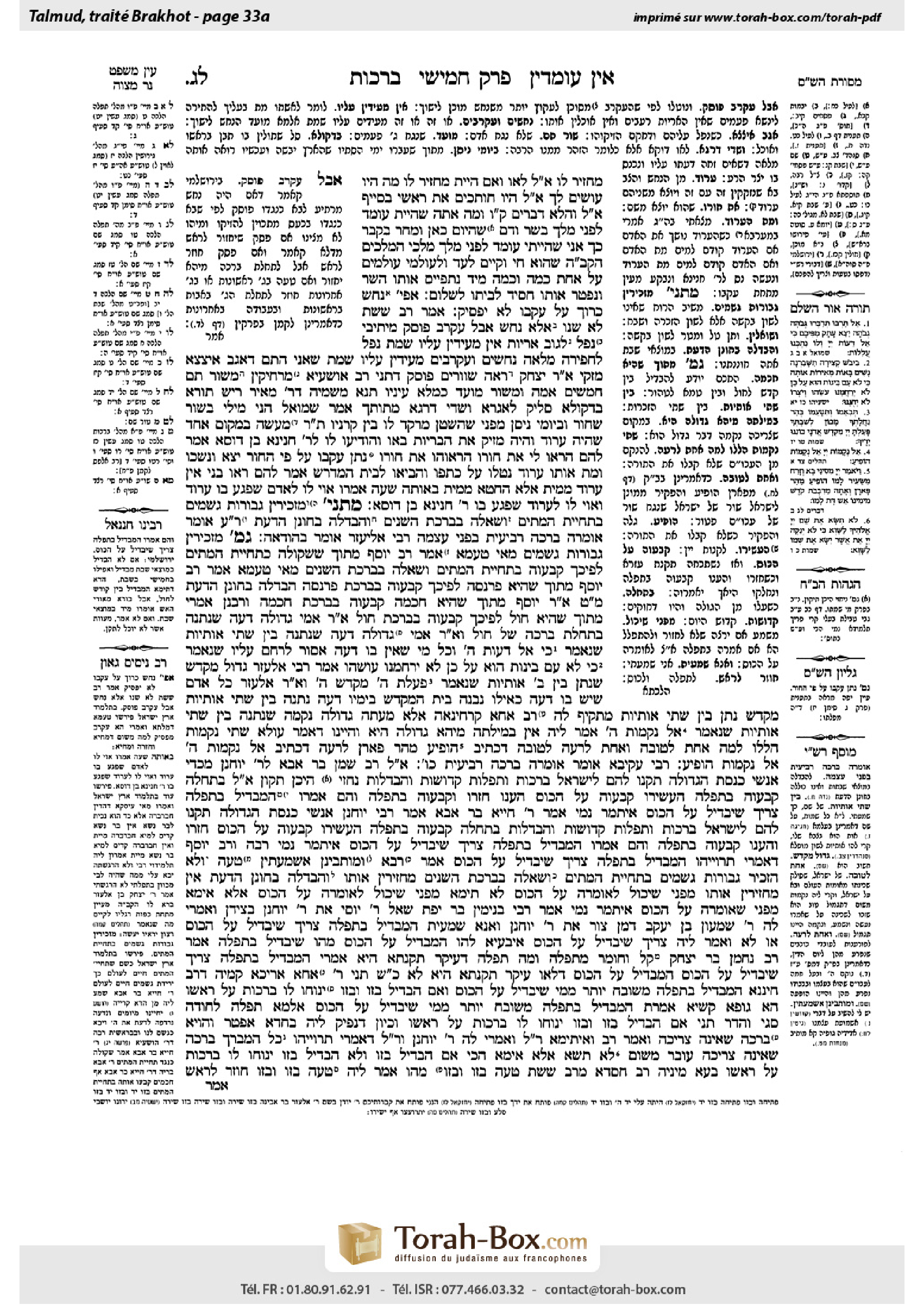
Berakhot 33a: Talmud study for Daf Yomi
Study the Talmud for Daf Yomi with scanned pages, Hebrew text, English translations from Sefaria and AI-generated French translations.
Passage selection and English or AI-generated French translation are available where the scan has annotations. Daf Study is independent of Torah-Box and Sefaria.
Browse Berakhot · ברכות · All tractatesBerakhot 33a text and translations
This page of Berakhot includes the Aramaic text, an English translation and an AI-generated French translation, alongside the scan above.
ברכות ל״ג א · Aramaic and Hebrew text
מַחֲזִיר לוֹ?! אָמַר לוֹ: לָאו. וְאִם הָיִיתָ מַחֲזִיר לוֹ, מָה הָיוּ עוֹשִׂים לְךָ? אָמַר לוֹ: הָיוּ חוֹתְכִים אֶת רֹאשִׁי בְּסַיִיף. אָמַר לוֹ: וַהֲלֹא דְּבָרִים קַל וָחוֹמֶר, וּמָה אַתָּה שֶׁהָיִיתָ עוֹמֵד לִפְנֵי מֶלֶךְ בָּשָׂר וָדָם, שֶׁהַיּוֹם כָּאן וּמָחָר בַּקֶּבֶר — כָּךְ אֲנִי שֶׁהָיִיתִי עוֹמֵד לִפְנֵי מֶלֶךְ מַלְכֵי הַמְּלָכִים הַקָּדוֹשׁ בָּרוּךְ הוּא, שֶׁהוּא חַי וְקַיָּים לָעַד וּלְעוֹלְמֵי עוֹלָמִים — עַל אַחַת כַּמָּה וְכַמָּה.
מִיָּד נִתְפַּיֵּיס אוֹתוֹ הֶגְמוֹן, וְנִפְטַר אוֹתוֹ חָסִיד לְבֵיתוֹ לְשָׁלוֹם.
אֲפִילּוּ נָחָשׁ כָּרוּךְ עַל עֲקֵבוֹ, לֹא יַפְסִיק. אָמַר רַב שֵׁשֶׁת: לֹא שָׁנוּ אֶלָּא נָחָשׁ. אֲבָל עַקְרָב — פּוֹסֵק.
מֵיתִיבִי: נָפַל לְגוֹב אֲרָיוֹת — אֵין מְעִידִין עָלָיו שֶׁמֵּת. נָפַל לַחֲפִירָה מְלֵאָה נְחָשִׁים וְעַקְרַבִּים — מְעִידִין עָלָיו שֶׁמֵּת!
שָׁאנֵי הָתָם, דְּאַגַּב אִיצְצָא מַזְּקִי.
אָמַר רַבִּי יִצְחָק: רָאָה שְׁוָורִים — פּוֹסֵק. דְּתָנֵי רַב הוֹשַׁעְיָה: מַרְחִיקִין מִשּׁוֹר תָּם חֲמִשִּׁים אַמָּה, וּמִשּׁוֹר מוּעָד — כִּמְלוֹא עֵינָיו.
תָּנָא מִשְּׁמֵיהּ דְּרַבִּי מֵאִיר: רֵישׁ תּוֹרָא בְּדִקּוּלָא — סְלֵיק לְאַגְרָא וּשְׁדִי דַּרְגָּא מִתּוּתָךְ. אָמַר שְׁמוּאֵל: הָנֵי מִילֵּי בְּשׁוֹר שָׁחוֹר וּבְיוֹמֵי נִיסָן, מִפְּנֵי שֶׁהַשָּׂטָן מְרַקֵּד לוֹ בֵּין קַרְנָיו.
תָּנוּ רַבָּנַן: מַעֲשֶׂה בְּמָקוֹם אֶחָד שֶׁהָיָה עַרְוָד, וְהָיָה מַזִּיק אֶת הַבְּרִיּוֹת. בָּאוּ וְהוֹדִיעוּ לוֹ לְרַבִּי חֲנִינָא בֶּן דּוֹסָא. אָמַר לָהֶם: הַרְאוּ לִי אֶת חוֹרוֹ! הֶרְאוּהוּ אֶת חוֹרוֹ. נָתַן עֲקֵבוֹ עַל פִּי הַחוֹר, יָצָא וּנְשָׁכוֹ — וּמֵת אוֹתוֹ עַרְוָד.
נְטָלוֹ עַל כְּתֵפוֹ וֶהֱבִיאוֹ לְבֵית הַמִּדְרָשׁ. אָמַר לָהֶם: רְאוּ בָּנַי, אֵין עַרְוָד מֵמִית, אֶלָּא הַחֵטְא מֵמִית.
בְּאוֹתָהּ שָׁעָה אָמְרוּ: אוֹי לוֹ לָאָדָם שֶׁפָּגַע בּוֹ עַרְוָד, וְאוֹי לוֹ לָעַרְוָד שֶׁפָּגַע בּוֹ רַבִּי חֲנִינָא בֶּן דּוֹסָא.
מַתְנִי׳ מַזְכִּירִין גְּבוּרוֹת גְּשָׁמִים בִּתְחִיַּית הַמֵּתִים, וּשְׁאֵלָה בְּבִרְכַּת הַשָּׁנִים, וְהַבְדָּלָה בְּחוֹנֵן הַדָּעַת. רַבִּי עֲקִיבָא אוֹמֵר: אוֹמְרָהּ בְּרָכָה רְבִיעִית בִּפְנֵי עַצְמָהּ. רַבִּי אֱלִיעֶזֶר אוֹמֵר: בַּהוֹדָאָה.
גְּמָ׳ מַזְכִּירִין גְּבוּרוֹת גְּשָׁמִים: מַאי טַעְמָא?
אָמַר רַב יוֹסֵף: מִתּוֹךְ שֶׁשְּׁקוּלָה כִּתְחִיַּית הַמֵּתִים לְפִיכָךְ קְבָעוּהָ בִּתְחִיַּית הַמֵּתִים.
וּשְׁאֵלָה בְּבִרְכַּת הַשָּׁנִים: מַאי טַעְמָא?
אָמַר רַב יוֹסֵף: מִתּוֹךְ שֶׁהִיא פַּרְנָסָה, לְפִיכָךְ קְבָעוּהָ בְּבִרְכַּת פַּרְנָסָה.
הַבְדָּלָה בְּ״חוֹנֵן הַדָּעַת״: מַאי טַעְמָא?
אָמַר רַב יוֹסֵף: מִתּוֹךְ שֶׁהִיא חָכְמָה, קְבָעוּהָ בְּבִרְכַּת חָכְמָה. וְרַבָּנַן אָמְרִי: מִתּוֹךְ שֶׁהִיא חוֹל, לְפִיכָךְ קְבָעוּהָ בְּבִרְכַּת חוֹל.
אָמַר רַב אַמֵּי: גְּדוֹלָה דֵּעָה, שֶׁנִּתְּנָה בִּתְחִלַּת בְּרָכָה שֶׁל חוֹל.
וְאָמַר רַב אַמֵּי: גְּדוֹלָה דֵּעָה, שֶׁנִּתְּנָה בֵּין שְׁתֵּי אוֹתִיּוֹת, שֶׁנֶּאֱמַר ״כִּי אֵל דֵּעוֹת ה׳״. וְכׇל מִי שֶׁאֵין בּוֹ דֵּעָה — אָסוּר לְרַחֵם עָלָיו, שֶׁנֶּאֱמַר: ״כִּי לֹא עַם בִּינוֹת הוּא עַל כֵּן לֹא יְרַחֲמֶנּוּ עוֹשֵׂהוּ״.
אָמַר רַבִּי אֶלְעָזָר: גָּדוֹל מִקְדָּשׁ שֶׁנִּתַּן בֵּין שְׁתֵּי אוֹתִיּוֹת, שֶׁנֶּאֱמַר: ״פָּעַלְתָּ ה׳ מִקְּדָשׁ ה׳״.
וְאָמַר רַבִּי אֶלְעָזָר: כׇּל אָדָם שֶׁיֵּשׁ בּוֹ דֵּעָה כְּאִילּוּ נִבְנָה בֵּית הַמִּקְדָּשׁ בְּיָמָיו. דֵּעָה נִתְּנָה בֵּין שְׁתֵּי אוֹתִיּוֹת, מִקְדָּשׁ נִתַּן בֵּין שְׁתֵּי אוֹתִיּוֹת.
מַתְקִיף לַהּ רַב אַחָא קַרְחִינָאָה: אֶלָּא מֵעַתָּה, גְּדוֹלָה נְקָמָה שֶׁנִּתְּנָה בֵּין שְׁתֵּי אוֹתִיּוֹת, שֶׁנֶּאֱמַר ״אֵל נְקָמוֹת ה׳״!
אֲמַר לֵיהּ: אִין, בְּמִילְּתַהּ מִיהָא גְּדוֹלָה הִיא. וְהַיְינוּ דְּאָמַר עוּלָּא שְׁתֵּי נְקָמוֹת הַלָּלוּ לָמָּה? אַחַת לְטוֹבָה, וְאַחַת לְרָעָה. לְטוֹבָה — דִּכְתִיב: ״הוֹפִיעַ מֵהַר פָּארָן״. לְרָעָה — דִּכְתִיב: ״אֵל נְקָמוֹת ה׳ אֵל נְקָמוֹת הוֹפִיעַ״.
רַבִּי עֲקִיבָא אוֹמֵר: אוֹמְרָהּ בְּרָכָה רְבִיעִית כּוּ׳.
אֲמַר לֵיהּ רַב שֶׁמֶן בַּר אַבָּא לְרַבִּי יוֹחָנָן: מִכְּדִי אַנְשֵׁי כְּנֶסֶת הַגְּדוֹלָה תִּקְּנוּ לָהֶם לְיִשְׂרָאֵל בְּרָכוֹת וּתְפִלּוֹת, קְדוּשּׁוֹת וְהַבְדָּלוֹת. נֶחְזֵי הֵיכָן תַּקּוּן.
אֲמַר לֵיהּ: בַּתְּחִילָּה קְבָעוּהָ בַּתְּפִלָּה. הֶעֱשִׁירוּ — קְבָעוּהָ עַל הַכּוֹס. הֶעֱנוּ — חָזְרוּ וּקְבָעוּהָ בַּתְּפִלָּה. וְהֵם אָמְרוּ: הַמַּבְדִּיל בַּתְּפִלָּה צָרִיךְ שֶׁיַּבְדִּיל עַל הַכּוֹס.
אִיתְּמַר נָמֵי: אָמַר רַבִּי חִיָּיא בַּר אַבָּא אָמַר רַבִּי יוֹחָנָן: אַנְשֵׁי כְּנֶסֶת הַגְּדוֹלָה תִּקְּנוּ לָהֶם לְיִשְׂרָאֵל בְּרָכוֹת וּתְפִלּוֹת, קְדוּשּׁוֹת וְהַבְדָּלוֹת. בַּתְּחִלָּה קְבָעוּהָ בַּתְּפִלָּה. הֶעֱשִׁירוּ — קְבָעוּהָ עַל הַכּוֹס. חָזְרוּ וְהֶעֱנוּ — קְבָעוּהָ בַּתְּפִלָּה. וְהֵם אָמְרוּ: הַמַּבְדִּיל בַּתְּפִלָּה — צָרִיךְ שֶׁיַּבְדִּיל עַל הַכּוֹס.
אִיתְּמַר נָמֵי: רַבָּה וְרַב יוֹסֵף דְּאָמְרִי תַּרְוַיְיהוּ: הַמַּבְדִּיל בַּתְּפִלָּה — צָרִיךְ שֶׁיַּבְדִּיל עַל הַכּוֹס.
אָמַר רָבָא, וּמוֹתְבִינַן אַשְּׁמַעְתִּין: טָעָה וְלֹא הִזְכִּיר גְּבוּרוֹת גְּשָׁמִים בִּתְחִיַּית הַמֵּתִים וּשְׁאֵלָה בְּבִרְכַּת הַשָּׁנִים — מַחֲזִירִין אוֹתוֹ, וְהַבְדָּלָה בְּ״חוֹנֵן הַדָּעַת״ — אֵין מַחֲזִירִין אוֹתוֹ, מִפְּנֵי שֶׁיָּכוֹל לְאוֹמְרָהּ עַל הַכּוֹס.
לָא תֵּימָא: ״מִפְּנֵי שֶׁיָּכוֹל לְאוֹמְרָהּ עַל הַכּוֹס״, אֶלָּא אֵימָא: ״מִפְּנֵי שֶׁאוֹמְרָהּ עַל הַכּוֹס״.
אִיתְּמַר נָמֵי, אָמַר רַבִּי בִּנְיָמִין בַּר יֶפֶת: שָׁאַל רַבִּי יוֹסֵי אֶת רַבִּי יוֹחָנָן בְּצַיְדָּן, וְאָמְרִי לַהּ רַבִּי שִׁמְעוֹן בֶּן יַעֲקֹב דְּמִן צוֹר אֶת רַבִּי יוֹחָנָן, וַאֲנָא שְׁמַעִית: הַמַּבְדִּיל בַּתְּפִלָּה, צָרִיךְ שֶׁיַּבְדִּיל עַל הַכּוֹס, אוֹ לֹא? וַאֲמַר לֵיהּ: צָרִיךְ שֶׁיַּבְדִּיל עַל הַכּוֹס.
אִיבַּעְיָא לְהוּ: הַמַּבְדִּיל עַל הַכּוֹס, מַהוּ שֶׁיַּבְדִּיל בַּתְּפִלָּה?
אָמַר רַב נַחְמָן בַּר יִצְחָק: קַל וָחוֹמֶר מִתְּפִלָּה. וּמָה תְפִלָּה דְּעִיקַּר תַּקַּנְתָּא הִיא, אָמְרִי: הַמַּבְדִּיל בַּתְּפִלָּה — צָרִיךְ שֶׁיַּבְדִּיל עַל הַכּוֹס. הַמַּבְדִּיל עַל הַכּוֹס, דְּלָאו עִיקַּר תַּקַּנְתָּא הִיא — לֹא כׇּל שֶׁכֵּן!
תָּנֵי רַב אַחָא אֲרִיכָא קַמֵּיהּ דְּרַב חִינָּנָא: הַמַּבְדִּיל בַּתְּפִלָּה מְשׁוּבָּח יוֹתֵר מִמִּי שֶׁיַּבְדִּיל עַל הַכּוֹס. וְאִם הִבְדִּיל בְּזוֹ וּבָזוֹ — יָנוּחוּ לוֹ בְּרָכוֹת עַל רֹאשׁוֹ.
הָא גוּפָא קַשְׁיָא: אָמְרַתְּ הַמַּבְדִּיל בַּתְּפִלָּה מְשׁוּבָּח יוֹתֵר מִמִּי שֶׁיַּבְדִּיל עַל הַכּוֹס, אַלְמָא תְּפִלָּה לְחוּדַהּ סַגִּי. וַהֲדַר תָּנֵי אִם הִבְדִּיל בְּזוֹ וּבָזוֹ — יָנוּחוּ לוֹ בְּרָכוֹת עַל רֹאשׁוֹ. וְכֵיוָן דְּנָפֵיק לֵיהּ בַּחֲדָא — אִפְּטַר, וְהָוְיָא בְּרָכָה שֶׁאֵינָהּ צְרִיכָה, וְאָמַר רַב וְאִיתֵּימָא רֵישׁ לָקִישׁ, וְאָמְרִי לַהּ רַבִּי יוֹחָנָן וְרֵישׁ לָקִישׁ דְּאָמְרִי תַּרְוַיְיהוּ: כׇּל הַמְבָרֵךְ בְּרָכָה שֶׁאֵינָהּ צְרִיכָה — עוֹבֵר מִשּׁוּם ״לֹא תִשָּׂא״!
אֶלָּא, אֵימָא הָכִי: אִם הִבְדִּיל בְּזוֹ וְלֹא הִבְדִּיל בָּזוֹ — יָנוּחוּ לוֹ בְּרָכוֹת עַל רֹאשׁוֹ.
בְּעָא מִינֵּיהּ רַב חִסְדָּא מֵרַב שֵׁשֶׁת: טָעָה בְּזוֹ וּבָזוֹ, מַהוּ? אֲמַר לֵיהּ: טָעָה בְּזוֹ וּבָזוֹ — חוֹזֵר לָרֹאשׁ.
Berakhot 33a · English translation
The officer said to him: No.
The pious man continued: And if you would greet him, what would they do to you?
The officer said to him: They would cut off my head with a sword.
The pious man said to him: Isn’t this matter an a fortiori inference?
You who were standing before a king of flesh and blood,
of whom your fear is limited because today he is here but tomorrow he is in the grave,
would have reacted in that way;
I, who was standing and praying before the Supreme King of kings, the Holy One, Blessed be He,
Who lives and endures for all eternity,
all the more so that I could not pause to respond to someone’s greeting.
When he heard this, the officer was immediately appeased and the pious man returned home in peace.
We learned in the mishna that even if a snake is wrapped around his heel, he may not interrupt his prayer. In limiting application of this principle, Rav Sheshet said: They only taught this mishna with regard to a snake, as if one does not attack the snake it will not bite him. But if a scorpion approaches an individual while he is praying, he stops, as the scorpion is liable to sting him even if he does not disturb it.
The Gemara raises an objection based on what was taught in a Tosefta: Those who saw one fall into a lions’ den but did not see what happened to him thereafter, do not testify that he died. Their testimony is not accepted by the court as proof that he has died as it is possible that the lions did not eat him. However, those who saw one fall into a pit of snakes and scorpions, testify that he died as surely the snakes bit him.
The Gemara responds: This is not difficult. There, in the case of one who falls into a pit of snakes, it is different, as due to the pressure of his falling on top of them, the snakes will harm him, but a snake who is not touched will not bite.
The Gemara cites another halakha stating that he must interrupt his prayer in a case of certain danger. Rabbi Yitzḥak said: One who saw oxen coming toward him, he interrupts his prayer, as Rav Hoshaya taught: One distances himself fifty cubits from an innocuous ox [shor tam], an ox with no history of causing damage with the intent to injure, and from a forewarned ox [shor muad], an ox whose owner was forewarned because his ox has gored three times already, one distances himself until it is beyond eyeshot.
It was taught in the name of Rabbi Meir: While the head of the ox is still in the basket and he is busy eating, go up on the roof and kick the ladder out from underneath you. Shmuel said: This applies only with regard to a black ox, and during the days of Nisan, because that species of ox is particularly dangerous, and during that time of year Satan dances between its horns.
With regard to the praise for one who prays and need not fear even a snake, the Sages taught: There was an incident in one place where an arvad was harming the people. They came and told Rabbi Ḥanina ben Dosa and asked for his help. He told them: Show me the hole of the arvad. They showed him its hole. He placed his heel over the mouth of the hole and the arvad came out and bit him, and died.
Rabbi Ḥanina ben Dosa placed the arvad over his shoulder and brought it to the study hall. He said to those assembled there: See, my sons, it is not the arvad that kills a person, rather transgression kills a person. The arvad has no power over one who is free of transgression.
At that moment the Sages said: Woe unto the person who was attacked by an arvad and woe unto the arvad that was attacked by Rabbi Ḥanina ben Dosa.
MISHNA: This mishna speaks of additions to the standard formula of the Amida prayer and the blessings in which they are incorporated. One mentions the might of the rains and recites: He makes the wind blow and the rain fall, in the second blessing of the Amida prayer, the blessing of the revival of the dead. And the request for rain: And grant dew and rain as a blessing, in the ninth blessing of the Amida prayer, the blessing of the years. And the prayer of distinction [havdala], between the holy and the profane recited in the evening prayer following Shabbat and festivals, in the fourth blessing of the Amida prayer: Who graciously grants knowledge. Rabbi Akiva says: Havdala is recited as an independent fourth blessing. Rabbi Eliezer says that it is recited in the seventeenth blessing of the Amida prayer, the blessing of thanksgiving.
GEMARA: We learned in the mishna that one mentions the might of the rains in the second blessing of the Amida prayer, the blessing of the revival of the dead. The Gemara asks: What is the reason that the might of the rains is mentioned specifically in that blessing?
Rav Yosef said: Because the might of the rains is equivalent to the resurrection of the dead, as rain revives new life in the plant world (Jerusalem Talmud), therefore it was inserted in the blessing of the revival of the dead.
And we also learned in the mishna that the request for rain is added to the blessing of the years. Here, too, the Gemara asks: What is the reason that the request for rain is recited specifically in that blessing?
Rav Yosef said: Because rain is a component of sustenance, therefore it was inserted in the blessing of sustenance as part of our request for bountiful sustenance.
We also learned in the mishna that havdala, distinguishing between Shabbat and the weekdays, is added in the blessing of: Who graciously grants knowledge. Here too the Gemara asks: What is the reason that havdala is recited specifically in that blessing?
Rav Yosef said: Havdala is recited in that blessing because it requires wisdom to distinguish between two entities, they established it in the blessing of wisdom. The Rabbis say a different reason: Because havdala is the distinction between the sacred and the profane, the Sages established it in the blessing of weekdays. The first three blessings of the Amida prayer are recited both on weekdays and on Shabbat and Festivals. The blessing: Who graciously grants knowledge, is the first of the blessings recited exclusively during the week.
Having mentioned the blessing of wisdom, the Gemara cites that which Rav Ami said with regard to knowledge: Great is knowledge that was placed at the beginning of the weekday blessings; an indication of its significance.
And Rav Ami said in praise of knowledge: Great is knowledge that was placed between two letters, two names of God, as it is stated: “For God of knowledge is the Lord” (I Samuel 2:3). And since knowledge is regarded so highly, anyone without knowledge, it is forbidden to have compassion upon him, as it is stated: “For they are a people of no wisdom, so their Creator will have no compassion upon them and their Creator will not be gracious unto them” (Isaiah 27:11). If God shows no mercy for those who lack wisdom, all the more so should people refrain from doing so.
Similarly, Rabbi Elazar said: Great is the Holy Temple, as it too was placed between two letters, two names of God, as it is stated: “The place in which to dwell which You have made, Lord, the Temple, Lord, which Your hands have prepared” (Exodus 15:17).
Noting the parallel between these two ideas, Rabbi Elazar added and said: Anyone with knowledge, it is as if the Holy Temple was built in his days; knowledge was placed between two letters and the Temple was placed between two letters, signifying that they stand together.
Rav Aḥa Karḥina’a strongly objects to this approach that being placed between two names of God accords significance: However, if so, the same should hold true for vengeance. Great is revenge that was placed between two letters, as it is stated: “God of vengeance, Lord, God of vengeance shine forth” (Psalms 94:1).
He said to him: Yes. At least in its place, in the appropriate context, it is great. At times it is necessary. That is that which Ulla said: Why are these two vengeances mentioned in a single verse? One for good and one for evil. Vengeance for good, as it is written: “He shined forth from Mount Paran” (Deuteronomy 33:2) with regard to God’s vengeance against the wicked; vengeance for evil, as it is written: “God of vengeance, Lord, God of vengeance shine forth” with regard to the punishment of Israel.
A tannaitic dispute is cited in the mishna with regard to the appropriate blessing in which to recite havdala within the Amida prayer. Rabbi Akiva says: Havdala is recited as an independent fourth blessing. Rabbi Eliezer says that it is recited in the seventeenth blessing of the Amida prayer, the blessing of thanksgiving. The first tanna says that it is recited in the fourth blessing of the Amida prayer: Who graciously grants knowledge.
Regarding this, Rav Shemen, Shimon, bar Abba said to Rabbi Yoḥanan: Now, since the eighteen blessings of the Amida prayer and the other prayer formulas for prayer were instituted for Israel by the members of the Great Assembly just like all the other blessings and prayers, sanctifications and havdalot; let us see where in the Amida prayer the members of the Great Assembly instituted to recite havdala.
Rabbi Yoḥanan replied that that would be impossible, as the customs associated with havdala went through several stages. He said to him: Initially, during the difficult, early years of the Second Temple, they established that havdala is to be recited in the Amida prayer. Subsequently, when the people became wealthy, they established that havdala is to be recited over the cup of wine. When the people became impoverished, they again established that it was to be recited in the Amida prayer. And they said: One who recites havdala in the Amida prayer must, if he is able (Shitta Mekubbetzet, Me’iri), recite havdala over the cup of wine as well. Due to all these changes, it was not clear when exactly havdala was to be recited.
It was also stated: Rabbi Ḥiyya bar Abba said that Rabbi Yoḥanan said: The members of the Great Assembly established for Israel blessings and prayers, sanctifications and havdalot. Initially, they established that havdala is to be recited in the Amida prayer. Subsequently, when the people became wealthy, they established that havdala is to be recited over the cup of wine. When the people again became impoverished, they established that it was to be recited in the Amida prayer. And they said: One who recites havdala in the Amida prayer must recite havdala over the cup of wine as well.
It was also stated: Rabba and Rav Yosef who both said: One who recites havdala in the Amida prayer must recite havdala over the cup of wine as well.
Rava said: We raise an objection to our halakha based on what was taught in a Tosefta: One who erred and did not mention the might of the rains in the second blessing in the Amida, the blessing on the revival of the dead, and one who erred and failed to recite the request for rain in the ninth blessing of the Amida, the blessing of the years, we require him to return to the beginning of the prayer and repeat it. However, one who erred and failed to recite havdala in the blessing: Who graciously grants knowledge, we do not require him to return to the beginning of the prayer and repeat it, as he can recite havdala over the cup of wine. Apparently, havdala over the cup of wine is optional, not obligatory, at it says because he can recite and not that he must.
The Gemara answers: Do not say as it appears in the Tosefta: Because he can recite havdala over the cup of wine. Rather, say: Because he recites havdala over the cup of wine.
Proof that one must recite havdala over the cup of wine as well as in the Amida prayer was also stated: Rabbi Binyamin bar Yefet said that Rabbi Yosei asked Rabbi Yoḥanan in Sidon, and some say that Rabbi Shimon ben Ya’akov from the city of Tyre asked Rabbi Yoḥanan, and I, Binyamin bar Yefet, heard: One who already recited havdala in the Amida prayer, must he recite havdala over the cup of wine or not? And Rabbi Yoḥanan said to him: He must recite havdala over the cup.
Having clarified the question whether one who recited havdala during the Amida prayer must also recite havdala over the cup of wine, a dilemma was raised before the Sages: One who already recited havdala over the cup of wine, what is the ruling as far as his obligation to recite havdala in the Amida prayer is concerned?
Rav Naḥman bar Yitzḥak said: This can be derived a fortiori from the established halakha regarding havdala in the Amida prayer. Just as havdala in the Amida prayer, which is where the principal ordinance to recite havdala was instituted, the Sages said that it is not sufficient and one who recited havdala in the Amida prayer must recite havdala over the cup of wine as well, all the more so that one who recited havdala over the cup of wine, which is not where the principal ordinance to recite havdala was instituted, but was merely a later addition, did not fulfill his obligation and must recite havdala in the Amida prayer.
Rabbi Aḥa Arikha, the tall, taught a baraita before Rav Ḥinnana: One who recited havdala in the Amida prayer is more praiseworthy than one who recites it over the cup of wine, and if he recited havdala in this, the Amida prayer, and that, over the cup of wine, may blessings rest upon his head.
This baraita is apparently self-contradictory. On the one hand, you said that one who recites havdala in the Amida prayer is more praiseworthy than one who recites havdala over the cup of wine, indicating that reciting havdala in the Amida prayer alone is sufficient. And then it is taught: If one recited havdala in this, the Amida prayer, and that, over the cup of wine, may blessings rest upon his head. And since he fulfilled his obligation to recite havdala with one, he is exempt, and the additional recitation of havdala over the cup of wine is an unnecessary blessing. And Rav, and some say Reish Lakish, and still others say Rabbi Yoḥanan and Reish Lakish both said: Anyone who recites an unnecessary blessing violates the biblical prohibition: “Do not take the name of the Lord your God in vain” (Exodus 20:7).
Rather, emend this baraita and say as follows: If one recited havdala in this and not in that, may blessings rest upon his head.
Rav Ḥisda asked Rav Sheshet with regard to these blessings: If one erred in havdala both in this and in that, what is the ruling? Rav Sheshet said to him: One who erred in this, the Amida prayer, and that, over the cup of wine, returns to the beginning of both the Amida prayer and the havdala over the cup of wine.
Berakhot 33a · Traduction française (IA)
L'officier lui dit : Non. Le just homme continua : Et si tu lui adressais la parole, que ferais-tu ? L'officier lui dit : Ils me couperaient la tête avec un épée. Le just homme lui dit : Ce n'est pas une déduction a fortiori ? Tu qui étais devant un roi de chair et de sang, à qui tu as peur limitée, car aujourd'hui il est ici mais demain il est dans la tombe, tu as réagi ainsi ; Je, qui étais debout et priant devant le Roi Suprême des rois, le Saint, béni soit-Il, Qui vit et subsiste éternellement, tout autant que je n'aurais pas pu m'arrêter pour répondre à une salutation.
Lorsqu'il entendit cela, l'officier fut aussitôt apaisé et le just'homme rentra chez lui en paix.
Nous avons appris dans la Michna que même si un serpent est enroulé autour de son talon, il ne doit pas interrompre sa prière. En limitant l'application de ce principe, Rav Sheshet dit : Ils ont enseigné cette Michna uniquement concernant un serpent, car si l'on ne provoque pas le serpent, il ne le mordra pas. Mais si un scorpion s'approche d'une personne pendant qu'elle prie, elle s'arrête, car le scorpion peut piquer même si l'on ne le dérange pas.
Le Guemara soulève une objection basée sur ce qui a été enseigné dans une Tosefta : Ceux qui ont vu quelqu'un tomber dans un trou de lions mais n'ont pas vu ce qui s'est passé ensuite, ne témoignent pas qu'il est mort. Leur témoignage n'est pas accepté par la cour comme preuve qu'il est mort, car il est possible que les lions ne l'aient pas mangé. Cependant, ceux qui ont vu quelqu'un tomber dans un trou de serpents et de scorpions témoignent qu'il est mort, car certainement les serpents l'ont mordu.
Le Guemara répond : Ce n'est pas difficile. Là, dans le cas d'une personne tombant dans un trou de serpents, c'est différent, car en raison de la pression de sa chute sur eux, les serpents le blesseront, mais un serpent non touché ne mordra pas.
Le Guemara cite une autre halakha disant qu'il doit interrompre sa prière dans un cas de danger certain. Rabbi Yitzḥak dit : Celui qui voit des bœufs venir vers lui interrompt sa prière, car Rav Hoshaya enseigna : On s'éloigne cinquante coudées d'un bœuf inoffensif [shor tam], un bœuf sans histoire de causer des dommages avec l'intention de blesser, et d'un bœuf averti [shor muad], un bœuf dont l'owner a été averti car son bœuf a tourné trois fois déjà, on s'éloigne jusqu'à ce qu'il soit hors de vue.
Il a été enseigné en nom de Rabbi Meir : Tant que la tête du bœuf est encore dans le panier et qu'il est occupé à manger, monte sur le toit et jette l'échelle sous toi. Shmuel dit : Cela s'applique uniquement concernant un bœuf noir, et durant les jours de Nisan, car cette espèce de bœuf est particulièrement dangereuse, et durant cette saison de l'année, le Diable danse entre ses cornes.
Concernant l'éloge de celui qui prie et n'a pas à craindre même un serpent, les Sages enseignèrent : Il y avait un incident dans une ville où un arvad nuisait aux gens. Ils vinrent et dirent à Rabbi Ḥanina ben Dosa et demandèrent son aide. Il leur dit : Montrez-moi le trou de l'arvad. Ils lui montrèrent son trou. Il posa son talon sur la bouche du trou et l'arvad sortit et le mordit, et mourut.
Rabbi Ḥanina ben Dosa posa l'arvad sur son épaule et l'apporta dans la salle de study. Il dit à ceux qui étaient présents : Voyez, mes fils, ce n'est pas l'arvad qui tue une personne, mais la transgression tue une personne. L'arvad n'a aucun pouvoir sur celui qui est libre de transgression.
À ce moment-là, les Sages dirent : Malheur à la personne attaquée par un arvad et malheur à l'arvad attaqué par Rabbi Ḥanina ben Dosa.
MICHNA : Cette mitsva parle des additions à la formule standard de la prière Amida et des bénédictions dans lesquelles elles sont incorporées. On mentionne la puissance des pluies et on récite : Il fait souffler le vent et tomber la pluie, dans la deuxième bénédictions de la prière Amida, la bénédictions de la résurrection des morts. Et la demande de pluie : Et donne la rosée et la pluie comme une bénédiction, dans la neuvième bénédictions de la prière Amida, la bénédictions des années. Et la prière de distinction [havdala], entre le saint et le profane, récitée dans la prière du soir suivant le Shabbat et les fêtes, dans la quatrième bénédictions de la prière Amida : Celui qui accorde gracieusement la connaissance. Rabbi Akiva dit : La havdala est récitée comme une bénédictions indépendante. Rabbi Eliezer dit qu'elle est récitée dans la dix-septième bénédictions de la prière Amida, la bénédictions de remerciement.
GUEMARA : Nous avons appris dans la mitsva que l'on mentionne la puissance des pluies dans la deuxième bénédictions de la prière Amida, la bénédictions de la résurrection des morts. Le Guemara demande : Quelle est la raison que la puissance des pluies est mentionnée spécifiquement dans cette bénédictions ?
Rav Yosef dit : Parce que la puissance des pluies est équivalente à la résurrection des morts, car la pluie réanime la vie nouvelle dans le monde végétal (Talmud de Jérusalem), donc elle a été insérée dans la bénédiction de la résurrection des morts.
Et nous avons aussi appris dans la mitsna que la demande de pluie est ajoutée dans la bénédiction des années. Là aussi, la Guemara demande : Quelle est la raison pour laquelle la demande de pluie est récitée spécifiquement dans cette bénédiction ?
Rav Yosef dit : Parce que la pluie est un composant de la subsistance, donc elle a été insérée dans la bénédiction de la subsistance comme partie de notre demande de subsistance abondante.
Nous avons également appris dans la Michna que la havdala, la distinction entre le Shabbat et les jours ordinaires, est ajoutée dans la bénédiction : Celui qui accorde gracieusement la connaissance. Là aussi, la Guemara pose la question : Quelle est la raison pour laquelle la havdala est récitée spécifiquement dans cette bénédiction ?
Rav Yosef a dit : On récite la bénédiction de la séparation parce qu'elle exige de la sagesse pour distinguer entre deux entités, ils l'ont établie dans la bénédiction de la sagesse. Les Sages disent une autre raison : Parce que la séparation est la distinction entre le sacré et le profane, les Sages l'ont établie dans la bénédiction des jours ordinaires. Les trois premières bénédictions de la prière d'Amida sont récitées à la fois les jours ordinaires et le Shabbat et les fêtes. La bénédiction : Celui qui accorde gracieusement la connaissance, est la première des bénédictions récitées exclusivement durant la semaine.
Ayant mentionné la bénédiction de la sagesse, le Guemara cite ce que Rav Ami a dit concernant la connaissance : Grande est la connaissance qui a été placée au début des bénédictions des jours ordinaires ; une indication de son importance.
Et Rav Ami a dit en l'honneur de la connaissance : Grande est la connaissance qui a été placée entre deux lettres, deux noms de Dieu, comme il est dit : « Car Dieu de connaissance est l'Éternel » (1 Samuel 2:3). Et puisque la connaissance est considérée si hautement, celui qui n'a pas de connaissance, il est interdit de lui témoigner de la compassion, comme il est dit : « Car ils sont un peuple sans sagesse, donc leur Créateur n'aura pas de compassion envers eux et leur Créateur ne sera pas miséricordieux envers eux » (Isaïe 27:11). Si Dieu ne montre pas de miséricorde envers ceux qui manquent de sagesse, autant encore faut-il que les gens s'abstiennent de le faire.
De même, Rabbi Eléazar a dit : Grande est le Temple Saint, car il a été placé entre deux lettres, deux noms de Dieu, comme il est dit : « Le lieu où habiter que tu as fait, Éternel, le Temple, Éternel, que tes mains ont préparé » (Exode 15:17).
En notant le parallèle entre ces deux idées, Rabbi Eléazar a ajouté et dit : Celui qui a la connaissance, c'est comme si le Temple Saint avait été construit à ses jours ; la connaissance a été placée entre deux lettres et le Temple a été placé entre deux lettres, signifiant qu'ils sont ensemble.
Rav Acha Karḥina’a s'oppose fermement à cette approche selon laquelle être placé entre deux noms de Dieu accorde de l'importance : Cependant, si c'est ainsi, la même chose devrait s'appliquer à la vengeance. Grande est la vengeance qui a été placée entre deux lettres, comme il est dit : « Éternel de vengeance, Éternel, Éternel de vengeance brille » (Psaumes 94:1).
Il lui a répondu : Oui. Au moins à son endroit, dans le contexte approprié, c'est grand. À certains moments, il est nécessaire. C'est ce que Ulla a dit : Pourquoi ces deux vengeances sont-elles mentionnées dans un seul verset ? Une pour le bien et une pour le mal. La vengeance pour le bien, comme il est écrit : « Il s'est éclairé depuis le mont Paran » (Deutéronome 33:2) concernant la vengeance de Dieu contre les méchants ; la vengeance pour le mal, comme il est écrit : « Éternel de vengeance, Éternel, Éternel de vengeance brille » concernant la punition d'Israël.
Un débat tannaitique est cité dans la mitsna concernant la bénédiction appropriée dans laquelle réciter la havdala dans la prière d'Amida. Rabbi Akiva dit : La havdala est récitée comme une bénédiction indépendante quatrième. Rabbi Eliezer dit qu'elle est récitée dans la dix-septième bénédiction de la prière d'Amida, la bénédiction de la gratitude. Le premier tanna dit qu'elle est récitée dans la quatrième bénédiction de la prière d'Amida : Celui qui accorde gracieusement la connaissance.
Concernant cela, Rav Shemen, Shim'on, fils de Abba a dit à Rabbi Yoḥanan : Maintenant, puisque les dix-huit bénédictions de la prière d'Amida et les autres formules de prière pour la prière ont été instituées pour Israël par les membres de l'Assemblée Grande comme toutes les autres bénédictions et prières, sanctifications et havdalot ; voyons où dans la prière d'Amida les membres de l'Assemblée Grande ont institué de réciter la havdala.
Rabbi Yoḥanan répondit que cela serait impossible, car les coutumes associées à la havdala ont traversé plusieurs étapes. Il dit à lui : Au début, durant les années difficiles, les premières années du Second Temple, ils établirent que la havdala est à réciter dans la prière d'Amida. Par la suite, lorsque le peuple devint riche, ils établirent que la havdala est à réciter sur le verre de vin. Lorsque le peuple revint à la pauvreté, ils établirent à nouveau que la havdala devait être récitée dans la prière d'Amida. Et ils dirent : Celui qui récite la havdala dans la prière d'Amida doit, s'il le peut (Shitta Mekubbetzet, Me'iri), réciter la havdala sur le verre de vin également. En raison de tous ces changements, il n'était pas clair exactement quand la havdala devait être récitée.
Il fut également dit : Rabbi Ḥiyya bar Abba dit que Rabbi Yoḥanan dit : Les membres de l'Assemblée Grande ont institué pour Israël des bénédictions et des prières, des sanctifications et des havdalot. Au début, ils établirent que la havdala est à réciter dans la prière d'Amida. Par la suite, lorsque le peuple devint riche, ils établirent que la havdala est à réciter sur le verre de vin. Lorsque le peuple revint à la pauvreté, ils établirent à nouveau que la havdala devait être récitée dans la prière d'Amida. Et ils dirent : Celui qui récite la havdala dans la prière d'Amida doit réciter la havdala sur le verre de vin également.
Il fut également dit : Rabba et Rav Yosef, qui dirent tous les deux : Celui qui récite la havdala dans la prière d'Amida doit réciter la havdala sur le verre de vin également.
Rava a dit : Nous dressons une objection contre notre halakha basée sur ce qui a été enseigné dans une Tosefta : Celui qui s'est trompé et n'a pas mentionné la puissance des pluies dans la deuxième bénédiction de la prière d'Amida, la bénédiction sur la résurrection des morts, et celui qui s'est trompé et n'a pas récité la prière pour la pluie dans la neuvième bénédiction de la prière d'Amida, la bénédiction des années, nous exigeons qu'il revienne au début de la prière et la répète. Cependant, celui qui s'est trompé et n'a pas récité la séparation dans la bénédiction : Celui qui accorde gracieusement la connaissance, nous ne lui exigeons pas de revenir au début de la prière et de la répéter, car il peut réciter la séparation sur le verre de vin. Apparemment, la séparation sur le verre de vin est optionnelle, pas obligatoire, car il dit qu'il peut réciter et non qu'il doit.
La Guemara répond : Ne dis pas comme il apparaît dans la Tosefta : Parce qu'il peut réciter la havdala sur le verre de vin. Plutôt, dis : Parce qu'il récite la havdala sur le verre de vin.
Une preuve que l'on doit réciter la havdala sur le verre de vin ainsi que dans la prière de l'Amida a également été émise : Rabbi Binyamin bar Yefet a dit que Rabbi Yosei avait interrogé Rabbi Yoḥanan à Sidon, et certains disent que Rabbi Shimon ben Ya’akov de la ville de Tyr avait interrogé Rabbi Yoḥanan, et moi, Binyamin bar Yefet, j'ai entendu : Celui qui a déjà récité la havdala dans la prière de l'Amida, doit-il réciter la havdala sur le verre de vin ou non ? Et Rabbi Yoḥanan a dit à lui : Il doit réciter la havdala sur le verre.
Ayant clarifié la question de savoir si celui qui récitait la havdala pendant la prière de l'Amida devait également réciter la havdala sur le verre de vin, un dilemme a été soulevé devant les Sages : Celui qui a déjà récité la havdala sur le verre de vin, quelle est la décision concernant son obligation de réciter la havdala dans la prière de l'Amida ?
Rav Naḥman bar Yitzḥak a dit : Cela peut être déduit a fortiori de la halakha établie concernant la séparation dans la prière de l'Amida. Tout comme la séparation dans la prière de l'Amida, qui est le lieu principal où l'ordre de réciter la séparation a été institué, les Sages ont dit qu'il n'était pas suffisant et que celui qui récitait la séparation dans la prière de l'Amida devait également réciter la séparation sur le verre de vin, tout autant que celui qui récitait la séparation sur le verre de vin, qui n'est pas le lieu principal où l'ordre de réciter la séparation a été institué, mais qui était simplement une addition ultérieure, n'avait pas accompli son obligation et devait réciter la séparation dans la prière de l'Amida.
Rabbi Aḥa Arikha, le grand, a enseigné une baraïta devant Rav Ḥinnana : Celui qui récitait la séparation dans la prière de l'Amida est plus méritoire que celui qui récitait la séparation sur le verre de vin, et si il récitait la séparation dans celle-ci, la prière de l'Amida, et celle-là, sur le verre de vin, des bénédictions reposent sur sa tête.
Cette baraïta semble être contradictoire. D'une part, vous dites que celui qui récite la séparation dans la prière de l'Amida est plus méritoire que celui qui récite la séparation sur le verre de vin, indiquant que réciter la séparation dans la prière de l'Amida seule suffit. Et puis vous enseignez : Si l'on récitait la séparation dans celle-ci, la prière de l'Amida, et celle-là, sur le verre de vin, des bénédictions reposent sur sa tête. Et puisque l'on a accompli son obligation de réciter la séparation avec l'une, il est exempt, et la récitation supplémentaire de la séparation sur le verre de vin est une prière inutile. Et Rav, et certains disent Reish Lakish, et d'autres encore disent Rabbi Yoḥanan et Reish Lakish tous deux ont dit : Quiconque récite une prière inutile viole la prohibition biblique : « Ne prends pas le nom du Seigneur ton Dieu en vain » (Exode 20:7).
Plutôt, corrigez cette baraïta et dites comme suit : Si l'on a récité la séparation ici et non là, des bénédictions reposent sur sa tête.
Rav Ḥisda a interrogé Rav Sheshet concernant ces bénédictions : Si l'on s'était trompé dans la séparation à la fois ici et là, quelle est la décision ? Rav Sheshet a dit à lui : Celui qui s'est trompé dans celle-ci, la prière de l'Amida, et celle-là, sur le verre de vin, revient au début de la prière de l'Amida et de la séparation sur le verre de vin.
Traduction française générée par IA à partir de l’édition anglaise de Sefaria. Vérifie toujours un passage avec le texte source.
Text from Sefaria: William Davidson Edition - Vocalized Aramaic (CC BY NC); William Davidson Edition - English (CC BY NC).