Berakhot 3a: Talmud study for Daf Yomi
Study the Talmud for Daf Yomi with scanned pages, Hebrew text, English translations from Sefaria and AI-generated French translations.
Passage selection and English or AI-generated French translation are available where the scan has annotations. Daf Study is independent of Torah-Box and Sefaria.
Browse Berakhot · ברכות · All tractatesBerakhot 3a text and translations
This page of Berakhot includes the Aramaic text, an English translation and an AI-generated French translation, alongside the scan above.
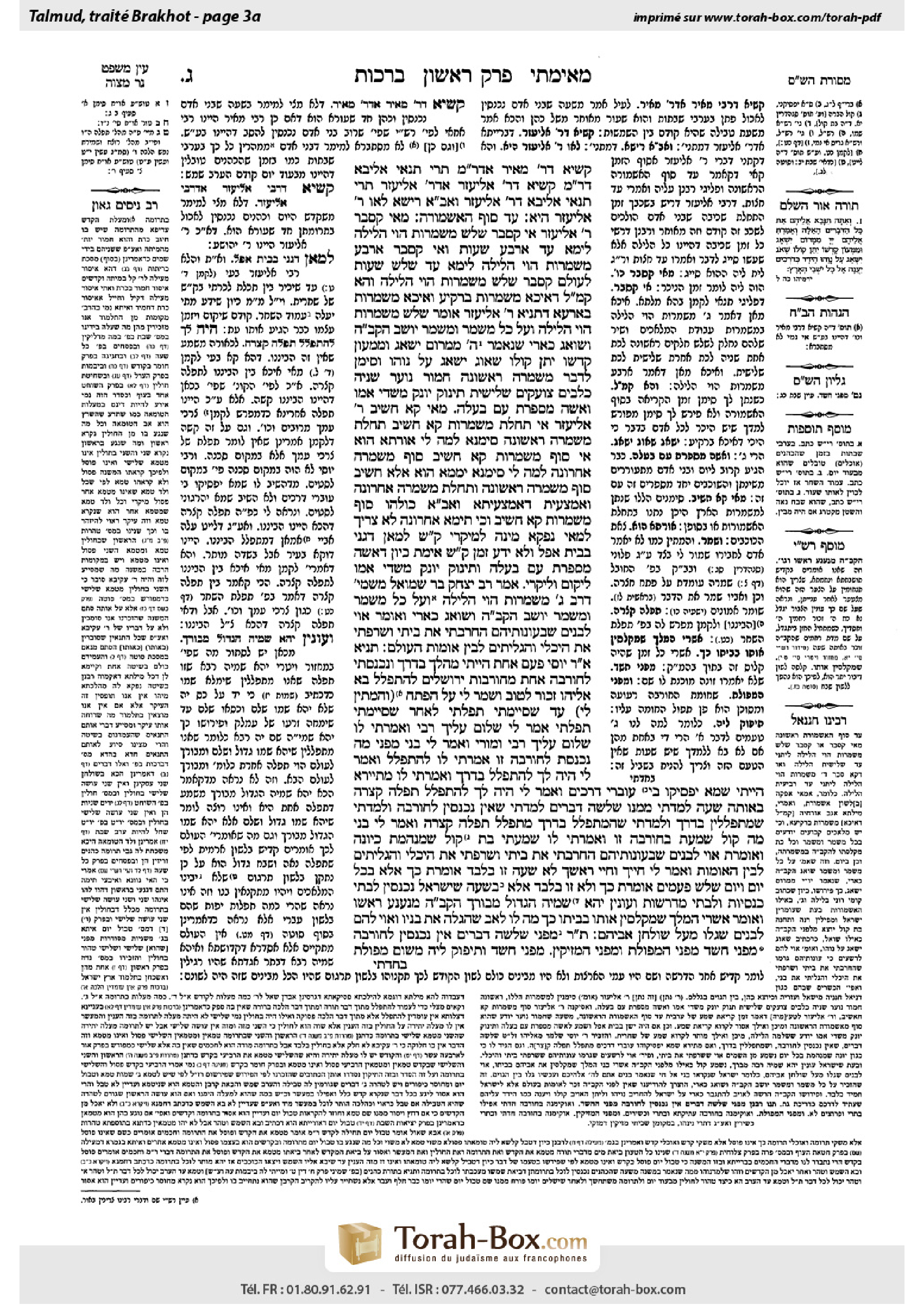
ברכות ג׳ א · Aramaic and Hebrew text
קַשְׁיָא דְּרַבִּי מֵאִיר אַדְּרַבִּי מֵאִיר! תְּרֵי תַּנָּאֵי אַלִּיבָּא דְּרַבִּי מֵאִיר.
קַשְׁיָא דְּרַבִּי אֱלִיעֶזֶר אַדְּרַבִּי אֱלִיעֶזֶר!
תְּרֵי תַּנָּאֵי אַלִּיבָּא דְּרַבִּי אֱלִיעֶזֶר, וְאִיבָּעֵית אֵימָא: רֵישָׁא לָאו רַבִּי אֱלִיעֶזֶר הִיא.
עַד סוֹף הָאַשְׁמוּרָה.
מַאי קָסָבַר רַבִּי אֱלִיעֶזֶר? אִי קָסָבַר שָׁלֹשׁ מִשְׁמָרוֹת הָוֵי הַלַּיְלָה, לֵימָא ״עַד אַרְבַּע שָׁעוֹת״. וְאִי קָסָבַר אַרְבַּע מִשְׁמָרוֹת הָוֵי הַלַּיְלָה, לֵימָא ״עַד שָׁלֹשׁ שָׁעוֹת״!
לְעוֹלָם קָסָבַר שָׁלֹשׁ מִשְׁמָרוֹת הָוֵי הַלַּיְלָה, וְהָא קָמַשְׁמַע לָן: דְּאִיכָּא מִשְׁמָרוֹת בָּרָקִיעַ וְאִיכָּא מִשְׁמָרוֹת בְּאַרְעָא. דְּתַנְיָא, רַבִּי אֱלִיעֶזֶר אוֹמֵר: שָׁלֹשׁ מִשְׁמָרוֹת הָוֵי הַלַּיְלָה, וְעַל כָּל מִשְׁמָר וּמִשְׁמָר יוֹשֵׁב הַקָּדוֹשׁ בָּרוּךְ הוּא וְשׁוֹאֵג כָּאֲרִי, שֶׁנֶּאֱמַר: ״ה׳ מִמָּרוֹם יִשְׁאָג, וּמִמְּעוֹן קָדְשׁוֹ יִתֵּן קוֹלוֹ שָׁאֹג יִשְׁאַג עַל נָוֵהוּ״.
וְסִימָן לַדָּבָר: מִשְׁמָרָה רִאשׁוֹנָה חֲמוֹר נוֹעֵר, שְׁנִיָּה כְּלָבִים צוֹעֲקִים, שְׁלִישִׁית, תִּינוֹק יוֹנֵק מִשְּׁדֵי אִמּוֹ, וְאִשָּׁה מְסַפֶּרֶת עִם בַּעֲלָהּ.
מַאי קָא חָשֵׁיב רַבִּי אֱלִיעֶזֶר, אִי תְּחִלַּת מִשְׁמָרוֹת קָא חָשֵׁיב — תְּחִלַּת מִשְׁמָרָה רִאשׁוֹנָה סִימָנָא לְמָה לִי? אוּרְתָּא הוּא! אִי סוֹף מִשְׁמָרוֹת קָא חָשֵׁיב, סוֹף מִשְׁמָרָה אַחֲרוֹנָה לְמָה לִי סִימָנָא? יְמָמָא הוּא!
אֶלָּא: חָשֵׁיב סוֹף מִשְׁמָרָה רִאשׁוֹנָה, וּתְחִלַּת מִשְׁמָרָה אַחֲרוֹנָה, וְאֶמְצָעִית דְּאֶמְצָעִיתָא. וְאִיבָּעֵית אֵימָא: כּוּלְּהוּ סוֹף מִשְׁמָרוֹת קָא חָשֵׁיב, וְכִי תֵּימָא אַחֲרוֹנָה לָא צְרִיךְ.
לְמַאי נָפְקָא מִינַּהּ — לְמִיקְרֵי קְרִיאַת שְׁמַע לְמַאן דְּגָנֵי בְּבַיִת אָפֵל וְלָא יָדַע זְמַן קְרִיאַת שְׁמַע אֵימַת. כֵּיוָן דְּאִשָּׁה מְסַפֶּרֶת עִם בַּעֲלָהּ וְתִינוֹק יוֹנֵק מִשְּׁדֵי אִמּוֹ, לִיקוּם וְלִיקְרֵי.
אָמַר רַב יִצְחָק בַּר שְׁמוּאֵל מִשְּׁמֵיהּ דְּרַב: שָׁלֹשׁ מִשְׁמָרוֹת הָוֵי הַלַּיְלָה, וְעַל כָּל מִשְׁמָר וּמִשְׁמָר יוֹשֵׁב הַקָּדוֹשׁ בָּרוּךְ הוּא וְשׁוֹאֵג כַּאֲרִי, וְאוֹמֵר: ״אוֹי שֶׁהֶחֱרַבְתִּי אֶת בֵּיתִי וְשָׂרַפְתִּי אֶת הֵיכָלִי וְהִגְלֵיתִי אֶת בָּנַי לְבֵין אוּמּוֹת הָעוֹלָם״.
תַּנְיָא, אָמַר רַבִּי יוֹסֵי: פַּעַם אַחַת הָיִיתִי מְהַלֵּךְ בַּדֶּרֶךְ וְנִכְנַסְתִּי לְחוּרְבָּה אַחַת מֵחוּרְבוֹת יְרוּשָׁלַיִם לְהִתְפַּלֵּל. בָּא אֵלִיָּהוּ זָכוּר לַטּוֹב וְשָׁמַר לִי עַל הַפֶּתַח, (וְהִמְתִּין לִי) עַד שֶׁסִּייַּמְתִּי תְּפִלָּתִי. לְאַחַר שֶׁסִּייַּמְתִּי תְּפִלָּתִי אָמַר לִי: ״שָׁלוֹם עָלֶיךָ, רַבִּי״. וְאָמַרְתִּי לוֹ: ״שָׁלוֹם עָלֶיךָ, רַבִּי וּמוֹרִי״. וְאָמַר לִי: בְּנִי, מִפְּנֵי מָה נִכְנַסְתָּ לְחוּרְבָּה זוֹ? אָמַרְתִּי לוֹ: לְהִתְפַּלֵּל. וְאָמַר לִי: הָיָה לְךָ לְהִתְפַּלֵּל בַּדֶּרֶךְ. וְאָמַרְתִּי לוֹ: מִתְיָרֵא הָיִיתִי שֶׁמָּא יַפְסִיקוּ בִּי עוֹבְרֵי דְּרָכִים, וְאָמַר לִי הָיָה לְךָ לְהִתְפַּלֵּל תְּפִלָּה קְצָרָה.
בְּאוֹתָהּ שָׁעָה לָמַדְתִּי מִמֶּנּוּ שְׁלֹשָׁה דְּבָרִים: לָמַדְתִּי שֶׁאֵין נִכְנָסִין לְחוּרְבָּה, וְלָמַדְתִּי שֶׁמִּתְפַּלְּלִין בַּדֶּרֶךְ, וְלָמַדְתִּי שֶׁהַמִּתְפַּלֵּל בְּדֶרֶךְ מִתְפַּלֵּל תְּפִלָּה קְצָרָה.
וְאָמַר לִי: בְּנִי, מָה קוֹל שָׁמַעְתָּ בְּחוּרְבָּה זוֹ? וְאָמַרְתִּי לוֹ: שָׁמַעְתִּי בַּת קוֹל שֶׁמְּנַהֶמֶת כְּיוֹנָה וְאוֹמֶרֶת: ״אוֹי שֶׁהֶחֱרַבְתִּי אֶת בֵּיתִי וְשָׂרַפְתִּי אֶת הֵיכָלִי וְהִגְלֵיתִי אֶת בָּנַי לְבֵין אוּמּוֹת הָעוֹלָם״. וְאָמַר לִי: חַיֶּיךָ וְחַיֵּי רֹאשְׁךָ, לֹא שָׁעָה זוֹ בִּלְבַד אוֹמֶרֶת כָּךְ, אֶלָּא בְּכָל יוֹם וָיוֹם, שָׁלֹשׁ פְּעָמִים אוֹמֶרֶת כָּךְ. וְלֹא זוֹ בִּלְבַד אֶלָּא, בְּשָׁעָה שֶׁיִּשְׂרָאֵל נִכְנָסִין לְבָתֵּי כְּנֵסִיּוֹת וּלְבָתֵּי מִדְרָשׁוֹת וְעוֹנִין ״יְהֵא שְׁמֵיהּ הַגָּדוֹל מְבֹורָךְ״, הַקָּדוֹשׁ בָּרוּךְ הוּא מְנַעְנֵעַ רֹאשׁוֹ, וְאוֹמֵר: אַשְׁרֵי הַמֶּלֶךְ שֶׁמְּקַלְּסִין אוֹתוֹ בְּבֵיתוֹ כָּךְ, מַה לּוֹ לָאָב שֶׁהִגְלָה אֶת בָּנָיו, וְאוֹי לָהֶם לַבָּנִים שֶׁגָּלוּ מֵעַל שׁוּלְחַן אֲבִיהֶם.
תָּנוּ רַבָּנָן, מִפְּנֵי שְׁלֹשָׁה דְּבָרִים אֵין נִכְנָסִין לְחוּרְבָּה: מִפְּנֵי חֲשָׁד, מִפְּנֵי הַמַּפּוֹלֶת, וּמִפְּנֵי הַמַּזִּיקִין. ״מִפְּנֵי חֲשָׁד״, וְתִיפּוֹק לֵיהּ ״מִשּׁוּם מַפּוֹלֶת״?
Berakhot 3a · English translation
The previous baraita cited Rabbi Meir’s opinion that the time for the recitation of Shema begins when the priests immerse before partaking of their teruma. In the Tosefta, it was taught that Rabbi Meir holds that one begins to recite Shema from when people enter to eat their meal on Shabbat eve. One opinion of Rabbi Meir seems to contradict another opinion of Rabbi Meir. The Gemara responds: Two tanna’im, students of Rabbi Meir, expressed different opinions in accordance with Rabbi Meir’s opinion.
So too, the opinion of Rabbi Eliezer cited in the mishna contradicts the opinion of Rabbi Eliezer cited in the baraita. In the mishna, Rabbi Eliezer holds that the time for the recitation of Shema begins with the emergence of the stars: From the time when the priests enter to partake of their teruma, while in the baraita, he states that the time for the recitation of Shema begins when the day becomes sanctified on the eve of Shabbat.
The Gemara responds: There are two possible resolutions to the apparent contradiction in Rabbi Eliezer’s opinion. Either two tanna’im expressed different opinions in accordance with Rabbi Eliezer’s opinion, or if you wish, say instead that the first clause of the mishna, according to which we begin to recite Shema when the priests enter to partake of their teruma, is not actually Rabbi Eliezer’s opinion. Only the second half of the statement: Until the end of the first watch, was stated by Rabbi Eliezer.
In the mishna, we learned that Rabbi Eliezer establishes that one may recite the evening Shema until the end of the first watch. These watches are mentioned in the Bible as segments of the night, but it must be established: Into precisely how many segments is the night divided, three or four? Moreover, why does Rabbi Eliezer employ such inexact parameters rather than a more precise definition of time (Tosefot HaRosh)?
What does Rabbi Eliezer actually hold? If he holds that the night consists of three watches, let him say explicitly that one recites the evening Shema until the fourth hour. If he holds that the night consists of four watches, let him say explicitly until the third hour.
The Gemara responds: Actually, Rabbi Eliezer holds that the night consists of three watches, and he employs this particular language of watches in order to teach us: There are watches in heaven and there are watches on earth; just as our night is divided into watches, so too is the night in the upper worlds. As it was taught in a baraita: Rabbi Eliezer says: The night consists of three watches, and over each and every watch, the Holy One, Blessed be He, sits and roars like a lion in pain over the destruction of the Temple. This imagery is derived from a reference in the Bible, as it is stated: “The Lord roars [yishag] from on high, from His holy dwelling He makes His voice heard. He roars mightily [shaog yishag] over His dwelling place, He cries out like those who tread grapes, against all the inhabitants of the earth” (Jeremiah 25:30). The three instances of the root shin-alef-gimmel in this verse correspond to the three watches of the night.
And signs of the transition between each of these watches in the upper world can be sensed in this world: In the first watch, the donkey brays; in the second, dogs bark; and in the third people begin to rise, a baby nurses from its mother’s breast and a wife converses with her husband.
With regard to these earthly manifestations of the three heavenly watches as established in the baraita, the Gemara asks: What did Rabbi Eliezer enumerate? If he enumerated the beginning of the watch, why do I need a sign for the beginning of the first watch? It is when evening begins; an additional sign is superfluous. If he enumerated the end of the watches, why do I need a sign for the end of the last watch? It is when day begins; an additional sign is similarly superfluous.
The Gemara answers: Rather, he enumerated the signs for the end of the first watch and the beginning of the last watch, both of which require a sign, as well as the middle of the middle watch. And if you wish, say instead: He enumerated the ends of all of the watches. And if you say that a sign indicating the end of the final watch is unnecessary because it is day, nevertheless, that sign is useful.
What is the practical ramification of this sign? It is relevant to one who recites Shema while lying in a dark house, who cannot see the dawn and who does not know when the time for reciting Shema arrives. That person is provided with a sign that when a woman speaks with her husband and a baby nurses from its mother’s breast, the final watch of the night has ended and he must rise and recite Shema.
Rav Yitzḥak bar Shmuel said in the name of Rav: The night consists of three watches, and over each and every watch the Holy One, Blessed be He sits and roars like a lion, because the Temple service was connected to the changing of these watches (Tosefot HaRosh), and says: “Woe to Me, that due to their sins I destroyed My house, burned My Temple and exiled them among the nations of the world.”
Incidental to the mention of the elevated significance of the night watches, the Gemara cites a related story: It was taught in a baraita that Rabbi Yosei said: I was once walking along the road when I entered the ruins of an old, abandoned building among the ruins of Jerusalem in order to pray. I noticed that Elijah, of blessed memory, came and guarded the entrance for me and waited at the entrance until I finished my prayer. When I finished praying and exited the ruin, Elijah said to me, deferentially as one would address a rabbi: Greetings to you, my rabbi. I answered him: Greetings to you, my rabbi, my teacher. And Elijah said to me: My son, why did you enter this ruin? I said to him: In order to pray. And Elijah said to me: You should have prayed on the road. And I said to him: I was unable to pray along the road, because I was afraid that I might be interrupted by travelers and would be unable to focus. Elijah said to me: You should have recited the abbreviated prayer instituted for just such circumstances.
Rabbi Yosei concluded: At that time, from that brief exchange, I learned from him three things: I learned that one may not enter a ruin; and I learned that one need not enter a building to pray, but he may pray along the road; and I learned that one who prays along the road recites an abbreviated prayer, so that he may maintain his focus.
And after this introduction, Elijah said to me: What voice did you hear in that ruin?
I responded: I heard a Heavenly voice, like an echo of that roar of the Holy One, Blessed be He (Maharsha), cooing like a dove and saying: Woe to the children, due to whose sins I destroyed My house, burned My Temple, and exiled them among the nations of the world.
And Elijah said to me: By your life and by your head, not only did that voice cry out in that moment, but it cries out three times each and every day. Moreover, any time that God’s greatness is evoked, such as when Israel enters synagogues and study halls and answers in the kaddish prayer, May His great name be blessed, the Holy One, Blessed be He, shakes His head and says: Happy is the king who is thus praised in his house. When the Temple stood, this praise was recited there, but now: How great is the pain of the father who exiled his children, and woe to the children who were exiled from their father’s table, as their pain only adds to that of their father (Rabbi Shem Tov ibn Shaprut).
The Sages taught, for three reasons one may not enter a ruin: Because of suspicion of prostitution, because the ruin is liable to collapse, and because of demons. Three separate reasons seem extraneous, so the Gemara asks: Why was the reason because of suspicion necessary? Let this halakha be derived because of collapse.
Berakhot 3a · Traduction française (IA)
La baraïta précédente cite l'opinion de Rabbi Meir selon laquelle le moment de la récitation du Chéma commence lorsque les prêtres s'immergent avant de consommer leur terouma. Dans la Tosefta, il a été enseigné que Rabbi Meir considère que l'on commence à réciter le Chéma lorsque les gens entrent pour manger leur repas à la veille de la fête. Une opinion de Rabbi Meir semble s'opposer à une autre opinion de Rabbi Meir. La Guemara répond : Deux tannaïm, élèves de Rabbi Meir, expriment des opinions différentes conformément à l'opinion de Rabbi Meir.
De même, l'opinion de Rabbi Eliezer citée dans la mishna s'oppose à l'opinion de Rabbi Eliezer citée dans la baraïta. Dans la mishna, Rabbi Eliezer considère que le moment de la récitation du Chéma commence avec l'apparition des étoiles : À partir du moment où les prêtres entrent pour consommer leur terouma, tandis que dans la baraïta, il affirme que le moment de la récitation du Chéma commence lorsque la journée devient sanctifiée à la veille de la fête.
La Guemara répond : Il existe deux solutions possibles à l'apparente contradiction dans l'opinion de Rabbi Eliezer. Soit deux tannaïm ont exprimé des opinions différentes conformément à l'opinion de Rabbi Eliezer, soit, si vous le souhaitez, dites plutôt que la première partie de la mishna, selon laquelle l'on commence à réciter le Chéma lorsque les prêtres entrent pour consommer leur terouma, n'est pas réellement l'opinion de Rabbi Eliezer. Seule la seconde moitié de l'affirmation : Jusqu'à la fin de la première veille, a été émise par Rabbi Eliezer.
Dans la Michna, nous avons appris que Rabbi Eliezer établit que l'on peut réciter le Chéma du soir jusqu'à la fin de la première veille. Ces veilles sont mentionnées dans la Bible comme des segments de la nuit, mais il faut établir : En combien de segments exactement la nuit est-elle divisée, trois ou quatre ? De plus, pourquoi Rabbi Eliezer utilise-t-il des paramètres approximatifs plutôt qu'une définition plus précise du temps (Tosefot HaRosh) ?
Qu'entend-on exactement par Rabbi Eliezer ? Si il considère que la nuit est divisée en trois veilles, qu'il dise explicitement que l'on récite le Chéma du soir jusqu'à la quatrième heure. Si il considère que la nuit est divisée en quatre veilles, qu'il dise explicitement jusqu'à la troisième heure.
La Guemara répond : En réalité, Rabbi Eliezer considère que la nuit est divisée en trois veilles, et il utilise cette expression particulière de veilles afin de nous enseigner : Il y a des veilles au ciel et des veilles sur terre ; tout comme notre nuit est divisée en veilles, ainsi est-elle divisée la nuit dans les mondes supérieurs. Comme il a été enseigné dans une baraïta : Rabbi Eliezer dit : La nuit est divisée en trois veilles, et sur chaque veille, le Saint, le Très Haut, siège et rugit comme un lion en souffrance à cause de la destruction du Temple. Cette image est tirée d'une référence dans la Bible, car il est dit : « L'Éternel rugit [yishag] depuis le haut, de son lieu saint il fait entendre sa voix. Il rugit fort [shaog yishag] sur son lieu saint, il crie comme ceux qui tressent du raisin, contre tous les habitants de la terre » (Jérémie 25:30). Les trois occurrences du racine shin-alef-gimmel dans cette verset correspondent aux trois veilles de la nuit.
Et des signes de la transition entre chacune de ces veilles dans le monde supérieur peuvent être perçus dans ce monde : Dans la première veille, le chameau mugit ; dans la deuxième, les chiens aboient ; et dans la troisième, les gens commencent à se lever, un bébé tète du sein de sa mère et une femme parle avec son mari.
Concernant ces manifestations terrestres des trois veilles célestes établies dans la baraïta, la Guemara pose la question : Qu'a-t-il énuméré Rabbi Eliezer ? Si il a énuméré le début de la veille, pourquoi ai-je besoin d'un signe pour le début de la première veille ? C'est lorsque commence le crépuscule ; un signe supplémentaire est inutile. Si il a énuméré la fin des veilles, pourquoi ai-je besoin d'un signe pour la fin de la dernière veille ? C'est lorsque commence le jour ; un signe supplémentaire est également inutile.
La Guemara répond : Plutôt, il a énuméré les signes pour la fin de la première veille et le début de la dernière veille, lesquels nécessitent un signe, ainsi que le milieu de la veille centrale. Et si vous le souhaitez, dites plutôt : Il a énuméré les fins de toutes les veilles. Et si vous dites que le signe indiquant la fin de la dernière veille est inutile car c'est le jour, néanmoins, ce signe est utile.
Quelle est la conséquence pratique de ce signe ? Elle est pertinente pour celui qui récite le Chéma allongé dans une maison sombre, qui ne peut pas voir l'aube et qui ne sait pas quand le moment de réciter le Chéma arrive. Cette personne est donnée un signe : lorsque une femme parle avec son mari et que le bébé tète du sein de sa mère, la dernière veille de la nuit est terminée et il doit se lever et réciter le Chéma.
Rav Yitzḥak bar Shmuel a dit en nom de Rav : La nuit est divisée en trois veilles, et sur chaque veille, le Saint, le Très Haut, siège et rugit comme un lion, car le service du Temple était lié au changement de ces veilles (Tosefot HaRosh), et il dit : « Malheur à Moi, à cause de leurs péchés, j'ai détruit Mon temple, brûlé Mon temple et exilé les gens parmi les nations du monde. »
En mentionnant la haute importance des veilles nocturnes, la Guemara cite une histoire liée : Il a été enseigné dans une baraïta que Rabbi Yosei a dit : J'étais un jour en chemin lorsque j'ai entré dans les ruines d'un ancien bâtiment abandonné parmi les ruines de Jérusalem afin de prier. J'ai remarqué que Elie, de bénédiction, est venu et a gardé l'entrée pour moi, attendant à l'entrée jusqu'à ce que j'aie fini ma prière. Lorsque j'ai terminé ma prière et que je suis sorti de la ruine, Elie m'a dit, avec déférence comme on s'adresserait à un rabbin : Salut à toi, mon rabbi. J'ai répondu : Salut à toi, mon rabbi, mon maître. Et Elie m'a dit : Mon fils, pourquoi es-tu entré dans cette ruine ? J'ai répondu : Pour prier. Et Elie m'a dit : Tu aurais dû prier sur la route. J'ai répondu : Je n'ai pas pu prier sur la route, car j'avais peur d'être interrompu par des voyageurs et de ne pas pouvoir m'attarder. Elie m'a dit : Tu aurais dû réciter la prière abrégée instituée pour de tels cas.
Rabbi Yosei a conclu : À ce moment-là, de cette brève conversation, j'ai appris de lui trois choses : j'ai appris qu'on ne doit pas entrer dans une ruine ; j'ai appris qu'on n'a pas besoin d'entrer dans un bâtiment pour prier, mais on peut prier sur la route ; et j'ai appris qu'on qui prie sur la route récite une prière abrégée, afin de maintenir son attention.
Et après cette introduction, Elie m'a dit : Quelle voix as-tu entendu dans cette ruine ? J'ai répondu : J'ai entendu une voix céleste, semblable à l'écho de ce rugissement du Saint, le Très Haut (Maharsha), chantant comme une colombe et disant : Malheur aux enfants, à cause de leurs péchés, j'ai détruit ma maison, j'ai brûlé mon Temple, et j'ai exilé les gens parmi les nations du monde. Et Elie m'a dit : Par ta vie et par ta tête, non seulement cette voix a crié à ce moment-là, mais elle crie trois fois chaque jour. De plus, chaque fois que la grandeur de Dieu est évoquée, comme lorsque Israël entre dans les synagogues et les salles de étude et répond à la prière kaddish, Que soit béni le grand nom, le Saint, le Très Haut, Il secoue sa tête et dit : Heureux est le roi qui est ainsi loué dans son temple. Lorsque le Temple était debout, cette louange était récitée là, mais maintenant : Quel est le chagrin du père qui a exilé ses enfants, et malheur aux enfants qui ont été exilés de leur table paternelle, car leur chagrin ne fait qu'ajouter à celui de leur père (Rabbi Shem Tov ibn Shaprut).
Les Sages ont enseigné que trois raisons font qu'on ne doit pas entrer dans une ruine : à cause de la suspicion de prostitution, à cause du risque de ruine, et à cause des démons. Trois raisons distinctes semblent inutiles, donc la Guemara demande : Pourquoi la raison de la suspicion était-elle nécessaire ? Que cette halakha soit dérivée à cause du risque de ruine.
Traduction française générée par IA à partir de l’édition anglaise de Sefaria. Vérifie toujours un passage avec le texte source.
Text from Sefaria: William Davidson Edition - Vocalized Aramaic (CC BY NC); William Davidson Edition - English (CC BY NC).