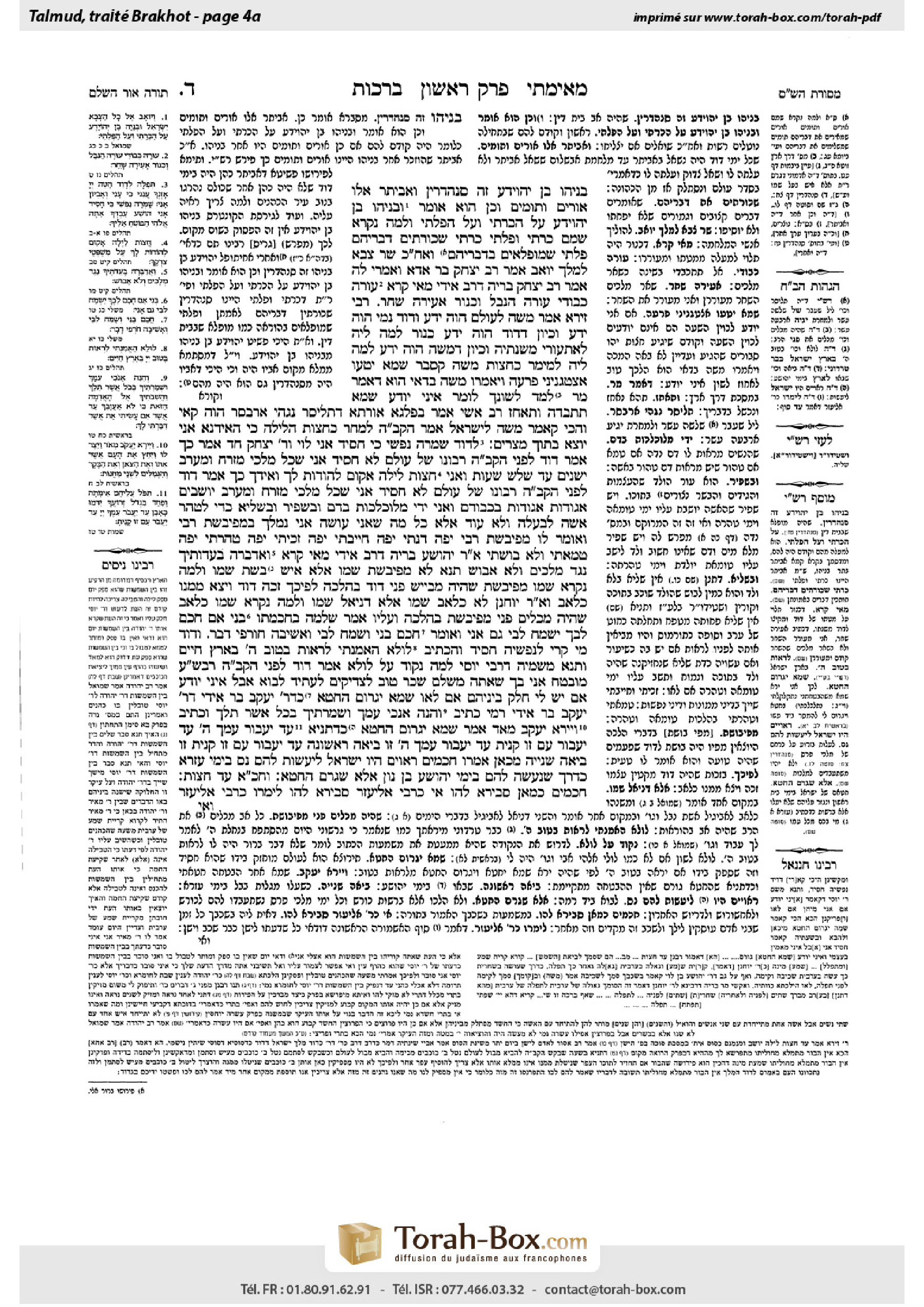
Berakhot 4a: Talmud study for Daf Yomi
Study the Talmud for Daf Yomi with scanned pages, Hebrew text, English translations from Sefaria and AI-generated French translations.
Passage selection and English or AI-generated French translation are available where the scan has annotations. Daf Study is independent of Torah-Box and Sefaria.
Browse Berakhot · ברכות · All tractatesBerakhot 4a text and translations
This page of Berakhot includes the Aramaic text, an English translation and an AI-generated French translation, alongside the scan above.
ברכות ד׳ א · Aramaic and Hebrew text
״בְּנָיָהוּ בֶּן יְהוֹיָדָע״ זֶה סַנְהֶדְרִין, ״וְאֶבְיָתָר״ אֵלּוּ אוּרִים וְתוּמִּים.
וְכֵן הוּא אוֹמֵר: ״וּבְנָיָהוּ בֶּן יְהוֹיָדָע עַל הַכְּרֵתִי וְעַל הַפְּלֵתִי״. וְלָמָּה נִקְרָא שְׁמָם ״כְּרֵתִי״ וּ״פְלֵתִי״? ״כְּרֵתִי״ שֶׁכּוֹרְתִים דִּבְרֵיהֶם, ״פְּלֵתִי״ שֶׁמּוּפְלָאִים בְּדִבְרֵיהֶם. וְאַחַר כָּךְ ״שַׂר צָבָא לַמֶּלֶךְ יוֹאָב״.
אָמַר רַב יִצְחָק בַּר אַדָּא, וְאָמְרִי לַהּ אָמַר רַב יִצְחָק בְּרֵיהּ דְּרַב אִידִי: מַאי קְרָא ״עוּרָה כְבוֹדִי עוּרָה הַנֵּבֶל וְכִנּוֹר אָעִירָה שָּׁחַר״.
רַבִּי זֵירָא אָמַר: מֹשֶׁה לְעוֹלָם הֲוָה יָדַע, וְדָוִד נָמֵי הֲוָה יָדַע.
וְכֵיוָן דְּדָוִד הֲוָה יָדַע, כִּנּוֹר לְמָה לֵיהּ? לְאִתְּעוֹרֵי מִשִּׁנְתֵּיהּ.
וְכֵיוָן דְּמֹשֶׁה הֲוָה יָדַע, לְמָה לֵיהּ לְמֵימַר ״כַּחֲצוֹת״? — מֹשֶׁה קָסָבַר: שֶׁמָּא יִטְעוּ אִצְטַגְנִינֵי פַּרְעֹה, וְיֹאמְרוּ ״מֹשֶׁה בַּדַּאי הוּא״. דְּאָמַר מָר: לַמֵּד לְשׁוֹנְךָ לוֹמַר ״אֵינִי יוֹדֵעַ״, שֶׁמָּא תִּתְבַּדֶּה וְתֵאָחֵז.
רַב אָשֵׁי אָמַר: בְּפַלְגָא אוּרְתָּא דִתְלֵיסַר נָגְהֵי אַרְבֵּסַר הֲוָה קָאֵי, וְהָכִי קָאָמַר מֹשֶׁה לְיִשְׂרָאֵל, אָמַר הַקָּדוֹשׁ בָּרוּךְ הוּא: לְמָחָר כַּחֲצוֹת הַלַּיְלָה כִּי הָאִידָּנָא אֲנִי יוֹצֵא בְּתוֹךְ מִצְרָיִם.
״לְדָוִד, שָׁמְרָה נַפְשִׁי כִּי חָסִיד אָנִי״. לֵוִי וְרַבִּי יִצְחָק. חַד אָמַר: כָּךְ אָמַר דָּוִד לִפְנֵי הַקָּדוֹשׁ בָּרוּךְ הוּא: רִבּוֹנוֹ שֶׁל עוֹלָם, לֹא חָסִיד אֲנִי? שֶׁכָּל מַלְכֵי מִזְרָח וּמַעֲרָב יְשֵׁנִים עַד שָׁלֹשׁ שָׁעוֹת, וַאֲנִי ״חֲצוֹת לַיְלָה אָקוּם לְהוֹדוֹת לְךָ״.
וְאִידַּךְ, כָּךְ אָמַר דָּוִד לִפְנֵי הַקָּדוֹשׁ בָּרוּךְ הוּא: רִבּוֹנוֹ שֶׁל עוֹלָם, לֹא חָסִיד אֲנִי? שֶׁכָּל מַלְכֵי מִזְרָח וּמַעֲרָב יוֹשְׁבִים אֲגוּדּוֹת אֲגוּדּוֹת בִּכְבוֹדָם, וַאֲנִי יָדַי מְלוּכְלָכוֹת בְּדָם וּבְשָׁפִיר וּבְשִׁלְיָא כְּדֵי לְטַהֵר אִשָּׁה לְבַעֲלָהּ. וְלֹא עוֹד, אֶלָּא כָּל מָה שֶׁאֲנִי עוֹשֶׂה, אֲנִי נִמְלָךְ בִּמְפִיבֹשֶׁת רַבִּי, וְאוֹמֵר לוֹ: ״מְפִיבֹשֶׁת רַבִּי, יָפֶה דַּנְתִּי? יָפֶה חִייַּבְתִּי? יָפֶה זִכִּיתִי? יָפֶה טִהַרְתִּי? יָפֶה טִמֵּאתִי?״, וְלֹא בּוֹשְׁתִּי.
אָמַר רַבִּי יְהוֹשֻׁעַ בְּרֵיהּ דְּרַב אִידִי: מַאי קְרָא — ״וַאֲדַבְּרָה בְעֵדֹתֶיךָ נֶגֶד מְלָכִים וְלֹא אֵבוֹשׁ״.
תָּנָא: לֹא ״מְפִיבֹשֶׁת״ שְׁמוֹ, אֶלָּא ״אִישׁ בּשֶׁת״ שְׁמוֹ, וְלָמָּה נִקְרָא שְׁמוֹ מְפִיבֹשֶׁת? שֶׁהָיָה מְבַיֵּישׁ פְּנֵי דָּוִד בַּהֲלָכָה, לְפִיכָךְ זָכָה דָּוִד וְיָצָא מִמֶּנּוּ כִּלְאָב.
וְאָמַר רַבִּי יוֹחָנָן: לֹא ״כִּלְאָב״ שְׁמוֹ אֶלָּא ״דָּנִיאֵל״ שְׁמוֹ, וְלָמָּה נִקְרָא שְׁמוֹ ״כִּלְאָב״ — שֶׁהָיָה מַכְלִים פְּנֵי מְפִיבֹשֶׁת בַּהֲלָכָה.
וְעָלָיו אָמַר שְׁלֹמֹה בְּחָכְמָתוֹ ״בְּנִי אִם חָכַם לִבֶּךָ יִשְׂמַח לִבִּי גַם אָנִי״, וְאוֹמֵר: ״חֲכַם בְּנִי וְשַׂמַּח לִבִּי וְאָשִׁיבָה חֹרְפִי דָבָר״.
וְדָוִד מִי קָרֵי לְנַפְשֵׁיהּ ״חָסִיד״? וְהָכְתִיב ״לוּלֵא הֶאֱמַנְתִּי לִרְאוֹת בְּטוּב ה׳ בְּאֶרֶץ חַיִּים״, וְתָנָא מִשְּׁמֵיהּ דְּרַבִּי יוֹסֵי: לָמָּה נָקוּד עַל ״לוּלֵא״? — אָמַר דָּוִד לִפְנֵי הַקָּדוֹשׁ בָּרוּךְ הוּא: רִבּוֹנוֹ שֶׁל עוֹלָם, מוּבְטָח אֲנִי בְּךָ שֶׁאַתָּה מְשַׁלֵּם שָׂכָר טוֹב לַצַּדִּיקִים לֶעָתִיד לָבוֹא, אֲבָל אֵינִי יוֹדֵעַ אִם יֵשׁ לִי חֵלֶק בֵּינֵיהֶם אִם לָאו?!
שֶׁמָּא יִגְרוֹם הַחֵטְא.
כִּדְרַבִּי יַעֲקֹב בַּר אִידִי, דְּרַבִּי יַעֲקֹב בַּר אִידִי רָמֵי, כְּתִיב: ״וְהִנֵּה אָנֹכִי עִמָּךְ וּשְׁמַרְתִּיךָ בְּכָל אֲשֶׁר תֵּלֵךְ״, וּכְתִיב: ״וַיִּירָא יַעֲקֹב מְאֹד״ אָמַר: שֶׁמָּא יִגְרוֹם הַחֵטְא.
כִּדְתַנְיָא ״עַד יַעֲבֹר עַמְּךָ ה׳, עַד יַעֲבֹר עַם זוּ קָנִיתָ״.
״עַד יַעֲבֹר עַמְּךָ ה׳״ — זוֹ בִּיאָה רִאשׁוֹנָה, ״עַד יַעֲבֹר עַם זוּ קָנִיתָ״ — זוֹ בִּיאָה שְׁנִיָּה. מִכָּאן אָמְרוּ חֲכָמִים: רְאוּיִם הָיוּ יִשְׂרָאֵל לֵיעָשׂוֹת לָהֶם נֵס בִּימֵי עֶזְרָא כְּדֶרֶךְ שֶׁנַּעֲשָׂה לָהֶם בִּימֵי יְהוֹשֻׁעַ בִּן נוּן. אֶלָּא שֶׁגָּרַם הַחֵטְא.
וַחֲכָמִים אוֹמְרִים עַד חֲצוֹת: חֲכָמִים כְּמַאן סְבִירָא לְהוּ, אִי כְּרַבִּי אֱלִיעֶזֶר סְבִירָא לְהוּ — לֵימְרוּ כְּרַבִּי אֱלִיעֶזֶר.
Berakhot 4a · English translation
Benayahu ben Yehoyada corresponds to the Sanhedrin, since he was the head of the Sanhedrin, and Evyatar corresponds to the Urim VeTummim, as Evyatar ben Ahimelekh the priest would oversee inquiries directed to the Urim VeTummim (see I Samuel 23:9).
And so it says regarding Benayahu ben Yehoyada’s position as head of the Sanhedrin: “And Benayahu ben Yehoyada was over the Kereti and over the Peleti” (II Samuel 20:23). And why was the Sanhedrin called Kereti UPeleti? It was called Kereti because they were decisive [koretim] in their pronouncements. It was called Peleti because their pronouncements and wisdom were wondrous [mufla’im]. The head of the Kereti UPeleti was the head of the Sanhedrin. According to the order of the verse, upon being instructed by King David to go to war, the Sages first consulted with Ahitophel, then with the Sanhedrin, then they would ask the Urim VeTummim, and only thereafter was the general of the king’s army, Yoav, given the command to ready the military for battle.
Rav Yitzḥak bar Adda, and some say Rav Yitzḥak, son of Rav Idi, said: From what verse is it derived that David’s lyre would wake him at midnight? “Awake, my glory; awake, harp and lyre; I will wake the dawn” (Psalms 57:9). This means that the playing lyre has already woken, and now I must engage in Torah study until dawn.
Rabbi Zeira offered a different solution to the question of whether Moses and David knew exactly when it was midnight and said: Moses certainly knew when it was midnight, and David also knew.
The Gemara asks: If David knew, then why did he need the lyre? The Gemara answers: He needed the lyre to wake him from his sleep.
Similarly with regard to Moses, since Moses knew the precise moment of midnight, why did he say: About midnight, instead of: At midnight? Moses did so because he maintained: Lest Pharaoh’s astrologers err and believe midnight to be earlier. Since no disaster would have occurred, they would say: Moses is a liar. Moses spoke in accordance with the principle articulated by the Master: Accustom your tongue to say: I do not know, lest you become entangled in a web of deceit.
Rav Ashi said: This question is unfounded, as Moses was standing at midnight of the thirteenth, leading into the fourteenth, when he pronounced his prophecy, and Moses told Israel that the Holy One, Blessed be He, said that tomorrow, at the exact time like midnight tonight, I will go out into the midst of Egypt. This indicates that the passage should not be understood to mean about midnight, an approximation; but rather, like midnight, as a comparison, likening midnight tomorrow to midnight tonight.
The Gemara further explores King David’s character. It is said: “A prayer of David…Keep my soul, for I am pious” (Psalms 86:1–2). Levi and Rabbi Yitzḥak debated the meaning of this verse and how David’s piety is manifest in the fact that he went beyond his fundamental obligations. One said: David’s declaration of piety referred to his awakening during the night to pray, and so said David before the Holy One, Blessed be He: Master of the Universe, am I not pious? As all of the kings of the East and the West sleep until the third hour of the day, but although I am a king like them, “At midnight I rise to give thanks” (Psalms 119:62).
And the other Sage said: David said the following before the Holy One, Blessed be He: Master of the Universe, am I not pious? For all of the kings of the East and the West sit in groups befitting their honored status, but I sit as a judge who issues rulings for the people. Women come with questions of ritual impurity and my hands become soiled with their blood as I labor to determine whether or not it is blood of impurity and she has menstruating woman status, and with a fetus that miscarried at a stage of development before it was clear whether or not it is considered a birth, and with placenta, which women sometimes discharge unrelated to the birth of a child (see Leviticus 15:19–30 with regard to blood, and 12:1–8 with regard to miscarriage and placenta). King David went to all this trouble in order to render a woman ritually pure and consequently permitted to her husband. If, after examination, a Sage declares the woman ritually pure, she is permitted to be with her husband, which leads to increased love and affection, and ultimately to procreation (Rabbi Yoshiyahu Pinto). And not only do I engage in activity considered to be beneath the station of a king, but I consult my teacher, Mefivoshet, son of King Saul’s son, Jonathan, with regard to everything that I do. I say to him: Mefivoshet, my teacher, did I decide properly? Did I convict properly? Did I acquit properly? Did I rule ritually pure properly? Did I rule ritually impure properly? And I was not embarrassed. Forgoing royal dignity should make me worthy to be called pious.
Rav Yehoshua, son of Rav Idi, said: What verse alludes to this? “And I speak Your testimonies before kings and I will not be ashamed” (Psalms 119:46). This verse alludes both to David’s commitment to Torah, in contrast to the kings of the East and the West, as well as to the fact that he was not ashamed to discuss matters of Torah with Mefivoshet, a descendant of kings. David was not afraid to have his mistakes corrected by Mefivoshet.
It was taught in a Tosefta from a tannaitic tradition: His name was not Mefivoshet, but rather Ish Boshet was his name. Why was Ish Boshet referred to as Mefivoshet? Because he would embarrass [mevayesh] David in matters of halakha. According to this approach, Mefivoshet is an abbreviation of boshet panim, embarrassment. Because David was not embarrassed to admit his errors, he merited that Kilav, who, according to tradition, was exceedingly wise, would descend from him.
Rabbi Yoḥanan said: His name was not Kilav; rather, his name was Daniel, as it appears in a different list of David’s descendants. Why was he called Kilav? Because he would embarrass [makhlim] Mefivoshet, the teacher or authority figure [av] in matters of halakha.
In his book of wisdom, Solomon said about this wise son: “My son, if your heart is wise, my heart will be glad, even mine” (Proverbs 23:15), as David enjoyed witnessing his son Kilav develop into a Torah luminary to the extent that Kilav was able to respond to Mefivoshet. And Solomon says about Kilav: “Be wise, my son, and make my heart glad, that I may respond to those who taunt me” (Proverbs 27:11).
With regard to David’s statement, “Keep my soul, for I am pious,” the Gemara asks: Did David call himself pious? Isn’t it written: “If I had not [luleh] believed to look upon the goodness of the Lord in the land of the living” (Psalms 27:13). The dots that appear over the word luleh in the text indicate doubt and uncertainty of his piety, and whether he was deserving of a place in the land of the living (see Avot DeRabbi Natan 34). In the name of Rabbi Yosei, it was taught in a Tosefta: Why do dots appear over the word luleh, as if there are some reservations? Because David said before the Holy One, Blessed be He: Master of the Universe. I have every confidence in You that You grant an excellent reward to the righteous in the World-to-Come since God’s ultimate goodness is manifest in the land of eternal life, but I still harbor uncertainty with regard to myself, and I do not know whether or not I definitely have a portion among them. In any case, apparently David was uncertain whether or not he deserved to receive a portion of God’s reward for the righteous; how, then, could he characterize himself as pious?
The Gemara responds: His concern does not prove anything, as King David knew that he was pious. He was simply concerned lest a transgression that he might commit in the future will cause him to lose his opportunity to look upon the goodness of the Lord in the land of the living.
The Gemara cites a proof that there is room for one to fear lest he commit a transgression in the future in accordance with the opinion of Rabbi Ya’akov bar Idi, as Rabbi Ya’akov bar Idi raised a contradiction between two verses. It is written that God told Jacob in his vision of the ladder: “Behold, I am with you and I guard you wherever you go” (Genesis 28:15), yet when Jacob returned to Canaan and realized that Esau was coming to greet him, it is written: “And Jacob became very afraid, and he was pained” (Genesis 32:8). Why did Jacob not rely on God’s promise? Jacob had concerns and said to himself: Lest a transgression that I might have committed after God made His promise to me will cause God to revoke His promise of protection.
Apparently, at times, transgression does cause God’s promise to go unfulfilled, as it was taught explicitly in a baraita with regard to the ostensibly redundant language in a verse in the Song of the Sea: “Until Your people will cross, Lord, until the people You have acquired will cross. You bring them in and plant them in the mountain of Your inheritance, the place, Lord, which You made for Your dwelling” (Exodus 15:16–17).
The Gemara interprets homiletically that until Your people will cross refers to the first entry into Eretz Yisrael during the time of Joshua, while until the people You have acquired pass over refers to the second entry following the exile in Babylonia. Based on the juxtaposition of these two entries in this single verse, the Sages said: Israel was worthy of having a miracle performed on its behalf in the time of Ezra the scribe, just as one was performed on their behalf in the time of Joshua bin Nun. However, transgression caused the absence of a miracle.
The Gemara returns to explain what we learned in the mishna: And the Rabbis say: The time for the recitation of the evening Shema is until midnight. The Gemara asks: In accordance with whose opinion do they hold in explaining the verse: “When you lie down”? If they explain this verse in accordance with the opinion of Rabbi Eliezer, who says that “when you lie down” is the time when people customarily go to sleep, then let the Rabbis also say that the time for the recitation of Shema extends, in accordance with the opinion of Rabbi Eliezer, until the end of the first watch.
Berakhot 4a · Traduction française (IA)
Benayahu ben Yehoyada correspond à la Sanhédrin, car il était son chef, et Evyatar correspond aux Urim VeTummim, car Evyatar ben Ahimelekh le prêtre supervisait les consultations adressées aux Urim VeTummim (voir I Samuel 23:9).
Et ainsi il est dit concernant la position de Benayahu ben Yehoyada en tant que chef de la Sanhédrin : « Et Benayahu ben Yehoyada était sur les Kereti et sur les Peleti » (II Samuel 20:23). Et pourquoi la Sanhédrin était-elle appelée Kereti UPeleti ? Elle était appelée Kereti car ils étaient décisifs [koretim] dans leurs déclarations. Elle était appelée Peleti car leurs déclarations et leur sagesse étaient merveilleuses [mufla’im]. Le chef de la Kereti UPeleti était le chef de la Sanhédrin. Selon l'ordre du verset, lorsqu'il était instruit par le roi David de partir à la guerre, les Sages consultaient d'abord Ahitophel, puis la Sanhédrin, puis ils consultaient les Urim VeTummim, et seulement après cela le général de l'armée du roi, Yoav, était chargé de préparer l'armée pour la bataille.
Rav Yitzḥak bar Adda, et certains disent Rav Yitzḥak, fils de Rav Idi, a dit : D'après quel verset dérive-t-on que la lyre de David le réveillait à minuit ? « Réveille, mon gloire ; réveille, harpe et lyre ; je réveillerai l'aube » (Psaumes 57:9). Cela signifie que la lyre jouée a déjà réveillé, et maintenant je dois étudier la Torah jusqu'à l'aube.
Rabbi Zeira a proposé une autre solution à la question de savoir si Moïse et David connaissaient exactement l'heure du minuit et a dit : Moïse connaissait certainement l'heure du minuit, et David aussi.
La Guemara demande : Si David le savait, pourquoi avait-il besoin de la lyre ? La Guemara répond : Il avait besoin de la lyre pour le réveiller de son sommeil.
De même concernant Moïse, puisque Moïse connaissait l'heure exacte du minuit, pourquoi a-t-il dit : « Vers le minuit », au lieu de : « À minuit » ? Moïse l'a fait car il maintenait : afin que les astrologues du pharaon ne se trompent pas et ne croient pas que le minuit est plus tôt. Puisque aucun désastre ne s'était produit, ils auraient dit : Moïse est un menteur. Moïse a parlé selon le principe articulé par le Maître : Accoutume ta langue à dire : Je ne sais pas, afin que tu ne te retrouves pas enlisé dans un réseau de mensonges.
Rav Ashi a dit : Cette question est infondée, car Moïse était debout à minuit du treizi, entrant dans le quatorzième, lorsqu'il prononça sa prophétie, et Moïse a dit aux Israélites que l'Éternel, béni soit Son Nom, avait dit qu'au lendemain, à l'heure exacte comme le minuit de cette nuit, Il sortirait au milieu d'Égypte. Cela indique que la passation ne doit pas être comprise comme signifiant « vers le minuit », une approximation ; mais plutôt, comme le minuit, en comparaison, comparant le minuit du lendemain au minuit de cette nuit.
La Guemara explore davantage le caractère de roi David. Il est dit : « Une prière de David… Garde mon âme, car je suis pieux » (Psaumes 86:1–2). Levi et Rabbi Yitzḥak débattaient du sens de ce verset et de la manière dont la piété de David est manifestée par le fait qu'il dépassait ses obligations fondamentales. L'un a dit : La déclaration de piété de David faisait référence à son réveil pendant la nuit pour prier, et ainsi David a dit devant l'Éternel, béni soit Son Nom : Maître du Monde, ne suis-je pas pieux ? Comme tous les rois de l'Est et de l'Ouest dorment jusqu'à la troisième heure de la journée, mais bien que je sois un roi comme eux, « À minuit je me lève pour rendre grâce » (Psaumes 119:62).
Et l'autre Sage a dit : David a dit cela devant le Saint, béni soit Son Nom : Maître du Monde, ne suis-je pas pieux ? Car tous les rois de l'Est et de l'Ouest s'assoient en groupes dignes de leur statut honorifique, mais je m'assoie comme un juge qui rend des jugements pour le peuple. Les femmes viennent avec des questions de souillure rituelle et mes mains deviennent souillées de leur sang alors que je travaille à déterminer si c'est du sang de souillure et si elle est en état de menstruation, et avec un fœtus qui a été expulsé à un stade de développement avant qu'il ne soit clair s'il est considéré comme une naissance, et avec le placenta, que les femmes parfois expulsent indépendamment de la naissance d'un enfant (voir Lévitique 15:19–30 concernant le sang, et 12:1–8 concernant l'accouchement et le placenta). Le roi David s'est donné cette peine afin de rendre une femme pure rituellement et ainsi lui permettre d'être avec son mari. Si, après l'examen, un Sage déclare la femme pure rituellement, elle est autorisée à être avec son mari, ce qui entraîne une augmentation de l'amour et de l'affection, et finalement une procréation (Rabbi Yoshiyahu Pinto). Et non seulement j'engage en activité considérée comme inférieure au statut de roi, mais je consulte mon maître, Mefivoshet, fils du fils du roi Saül, Jonathan, concernant tout ce que je fais. Je dis à lui : Mefivoshet, mon maître, ai-je décidé correctement ? Ai-je condamné correctement ? Ai-je acquitté correctement ? Ai-je jugé pure rituellement correctement ? Ai-je jugé impure rituellement correctement ? Et je n'étais pas honteux. Léguer la dignité royale devrait me rendre digne d'être appelé pieux.
Rav Yehoshua, fils de Rav Idi, a dit : Quel verset évoque cela ? « Et je parle tes témoignages devant les rois et je ne me honte pas » (Psaumes 119:46). Ce verset évoque à la fois la dévotion de David à la Torah, en contraste avec les rois de l'Est et de l'Ouest, ainsi que le fait qu'il n'était pas honteux de discuter des questions de Torah avec Mefivoshet, un descendant de rois. David n'avait pas peur que ses erreurs soient corrigées par Mefivoshet.
Il a été enseigné dans une Tosefta d'une tradition tannaitique : Son nom n'était pas Mefivoshet, mais plutôt Ish Boshet était son nom. Pourquoi Ish Boshet était-il appelé Mefivoshet ? Parce qu'il embarrassait David dans les questions de halakha. Selon cette approche, Mefivoshet est une abréviation de boshet panim, humiliation. Parce que David n'était pas honteux d'admettre ses erreurs, il méritait que Kilav, qui, selon la tradition, était extrêmement sage, descende de lui.
Rabbi Yoḥanan a dit : Son nom n'était pas Kilav ; plutôt, son nom était Daniel, comme il apparaît dans une autre liste des descendants de David. Pourquoi était-il appelé Kilav ? Parce qu'il embarrassait Mefivoshet, le maître ou la figure d'autorité dans les questions de halakha.
Dans son livre de sagesse, Salomon a dit à propos de ce fils sage : « Mon fils, si ton cœur est sage, mon cœur sera joyeux, même le mien » (Proverbes 23:15), car David a pris plaisir à voir son fils Kilaï développer en un luminaire de la Torah à tel point que Kilaï pouvait répondre à Mefivoshet. Et Salomon dit à propos de Kilaï : « Sois sage, mon fils, et fais mon cœur joyeux, afin que je puisse répondre à ceux qui m’insultent » (Proverbes 27:11).
Concernant la déclaration de David : « Garde mon âme, car je suis pieux », la Guemara se demande : David a-t-il appelé lui-même pieux ? N’est-il pas écrit : « Si je n’avais pas cru voir la bonté du Seigneur dans la terre des vivants » (Psaumes 27:13). Les points qui apparaissent sur le mot luleh dans le texte indiquent un doute et une incertitude concernant sa piété, ainsi que la question de savoir s’il méritait une place dans la terre des vivants (voir Avot DeRabbi Natan 34). En nom de Rabbi Yosei, il a été enseigné dans une Tosefta : Pourquoi les points apparaissent-ils sur le mot luleh, comme si il y avait des réserves ? Parce que David a dit devant le Saint, béni soit-Il : Seigneur de l’Univers. J’ai toute confiance en Vous que Vous accordez une récompense excellente aux justes dans l’Ouverture du Monde, puisque la bonté divine ultime est manifeste dans la terre de la vie éternelle, mais j’ai encore des doutes concernant moi-même, et je ne sais pas si je suis certainement inclus parmi eux. En tout cas, apparemment David était incertain quant à savoir s’il méritait de recevoir une part de la récompense divine pour les justes ; comment, alors, pouvait-il se qualifier lui-même de pieux ?
La Guemara répond : Son inquiétude ne prouve rien, car le roi David savait qu’il était pieux. Il s’inquiétait simplement de crainte qu’une transgression qu’il pourrait commettre à l’avenir ne lui fasse perdre l’opportunité de voir la bonté du Seigneur dans la terre des vivants.
La Guemara cite une preuve montrant qu'il y a place à la crainte de commettre une transgression à l'avenir, conformément à l'opinion de Rabbi Ya'akov bar Idi, car Rabbi Ya'akov bar Idi a soulevé une contradiction entre deux versets. Il est écrit que Dieu a dit à Jacob dans sa vision de l'échelle : « Voici, je suis avec toi et je t'égarderai partout où tu vas » (Genèse 28:15), mais lorsque Jacob est revenu en Canaan et a réalisé que Esau venait le saluer, il est écrit : « Et Jacob devint très effrayé, et il fut tourmenté » (Genèse 32:8). Pourquoi Jacob n'a-t-il pas compté sur la promesse divine ? Jacob avait des inquiétudes et s'est dit : De peur qu'une transgression que j'aurais pu commettre après que Dieu ait fait sa promesse à moi ne cause à Dieu de révoquer sa promesse de protection.
Apparemment, parfois, la transgression cause que la promesse divine ne soit pas accomplie, comme il a été enseigné explicitement dans une baraïta concernant la langue redondante d'un verset dans le Chant des Mers : « Jusqu'à ce que votre peuple traverse, Seigneur, jusqu'à ce que le peuple que tu as acquis traverse. Tu les introduis et les plantes dans la montagne de ton héritage, le lieu, Seigneur, que tu as fait pour ton séjour » (Exode 15:16–17).
La Guemara interprète hétérodoxement que « jusqu'à ce que votre peuple traverse » fait référence à l'entrée première en Eretz Yisrael durant la période de Josué, tandis que « jusqu'à ce que le peuple que tu as acquis traverse » fait référence à l'entrée suivante après l'exil en Babylone. Selon la juxtaposition de ces deux entrées dans ce seul verset, les Sages ont dit : Israël méritait un miracle accompli en leur faveur durant la période d'Ezra le scribe, tout comme un miracle avait été accompli en leur faveur durant la période de Josué ben Nun. Cependant, la transgression a causé l'absence de miracle.
La Guemara revient à expliquer ce que nous avons appris dans la Michna : Et les Rabbins disent : Le temps de la prière du Chéma du soir est jusqu’à minuit. La Guemara se demande : Selon l’opinion de qui ces Rabbins tiennent-ils pour expliquer le verset : « Quand tu te couches » ? Si ils expliquent ce verset selon l’opinion de Rabbi Eliezer, qui dit que « quand tu te couches » est le moment où les gens habituellement vont se coucher, alors que disent les Rabbins aussi que le temps de la prière du Chéma s’étend, selon l’opinion de Rabbi Eliezer, jusqu’à la fin de la première veille.
Traduction française générée par IA à partir de l’édition anglaise de Sefaria. Vérifie toujours un passage avec le texte source.
Text from Sefaria: William Davidson Edition - Vocalized Aramaic (CC BY NC); William Davidson Edition - English (CC BY NC).