Berakhot 4b: Talmud study for Daf Yomi
Study the Talmud for Daf Yomi with scanned pages, Hebrew text, English translations from Sefaria and AI-generated French translations.
Passage selection and English or AI-generated French translation are available where the scan has annotations. Daf Study is independent of Torah-Box and Sefaria.
Browse Berakhot · ברכות · All tractatesBerakhot 4b text and translations
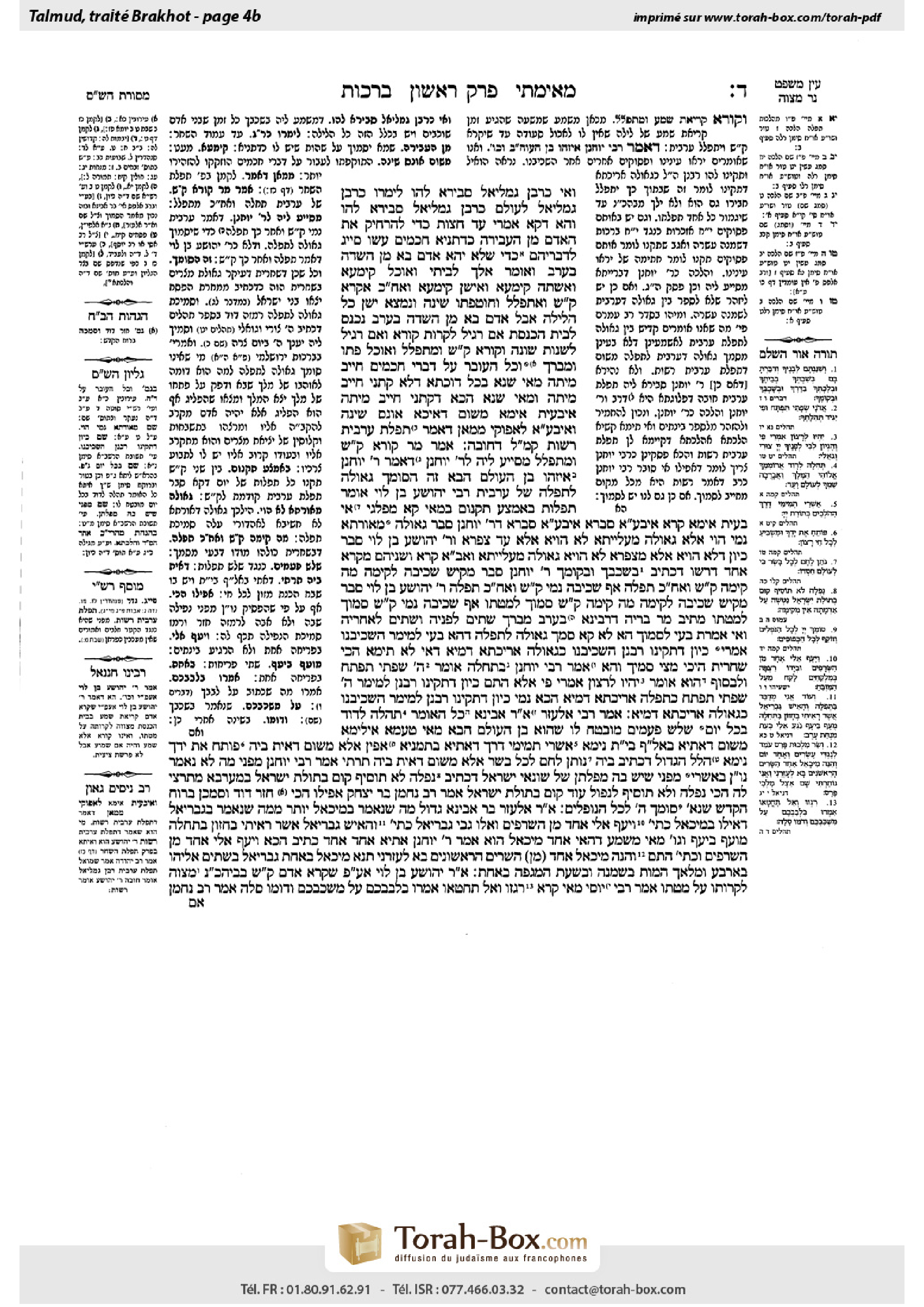
This page of Berakhot includes the Aramaic text, an English translation and an AI-generated French translation, alongside the scan above.
ברכות ד׳ ב · Aramaic and Hebrew text
וְאִי כְּרַבָּן גַּמְלִיאֵל סְבִירָא לְהוּ — לֵימְרוּ כְּרַבָּן גַּמְלִיאֵל.
לְעוֹלָם כְּרַבָּן גַּמְלִיאֵל סְבִירָא לְהוּ, וְהָא דְּקָא אָמְרִי ״עַד חֲצוֹת״, כְּדֵי לְהַרְחִיק אֶת הָאָדָם מִן הָעֲבֵירָה. כִּדְתַנְיָא, חֲכָמִים עָשׂוּ סְיָיג לְדִבְרֵיהֶם, כְּדֵי שֶׁלֹּא יְהֵא אָדָם בָּא מִן הַשָּׂדֶה בָּעֶרֶב, וְאוֹמֵר: ״אֵלֵךְ לְבֵיתִי וְאוֹכַל קִימְעָא וְאֶשְׁתֶּה קִימְעָא, וְאִישַׁן קִימְעָא, וְאַחַר כָּךְ אֶקְרָא קְרִיאַת שְׁמַע וְאֶתְפַּלֵּל״, וְחוֹטַפְתּוֹ שֵׁינָה וְנִמְצָא יָשֵׁן כָּל הַלַּיְלָה. אֲבָל אָדָם בָּא מִן הַשָּׂדֶה בָּעֶרֶב, נִכְנָס לְבֵית הַכְּנֶסֶת, אִם רָגִיל לִקְרוֹת — קוֹרֵא. וְאִם רָגִיל לִשְׁנוֹת — שׁוֹנֶה, וְקוֹרֵא קְרִיאַת שְׁמַע וּמִתְפַּלֵּל, וְאוֹכֵל פִּתּוֹ וּמְבָרֵךְ.
וְכָל הָעוֹבֵר עַל דִּבְרֵי חֲכָמִים חַיָּיב מִיתָה.
מַאי שְׁנָא בְּכָל דּוּכְתָּא דְּלָא קָתָנֵי ״חַיָּיב מִיתָה״, וּמַאי שְׁנָא הָכָא דְּקָתָנֵי ״חַיָּיב מִיתָה״?
אִיבָּעֵית אֵימָא מִשּׁוּם דְּאִיכָּא אוֹנֶס שֵׁינָה. וְאִיבָּעֵית אֵימָא: לְאַפּוֹקֵי מִמַּאן דְּאָמַר ״תְּפִלַּת עַרְבִית רְשׁוּת״, קָא מַשְׁמַע לָן דְּחוֹבָה.
אָמַר מָר, קוֹרֵא קְרִיאַת שְׁמַע וּמִתְפַּלֵּל. מְסַיַּיע לֵיהּ לְרַבִּי יוֹחָנָן. דְּאָמַר רַבִּי יוֹחָנָן: אֵיזֶהוּ בֶּן הָעוֹלָם הַבָּא — זֶה הַסּוֹמֵךְ גְּאוּלָּה לִתְפִלָּה שֶׁל עַרְבִית. רַבִּי יְהוֹשֻׁעַ בֶּן לֵוִי אוֹמֵר: תְּפִלּוֹת בָּאֶמְצַע תִּקְּנוּם.
בְּמַאי קָא מִפַּלְּגִי?
אִי בָּעֵית אֵימָא קְרָא, אִי בָּעֵית אֵימָא סְבָרָא.
אִי בָּעֵית אֵימָא סְבָרָא.
דְּרַבִּי יוֹחָנָן סָבַר גְּאוּלָּה מֵאוּרְתָּא נָמֵי הָוֵי, אֶלָּא גְּאוּלָּה מְעַלַּיְיתָא לָא הָוְיָא אֶלָּא עַד צַפְרָא. וְרַבִּי יְהוֹשֻׁעַ בֶּן לֵוִי סָבַר כֵּיוָן דְּלָא הָוְיָא אֶלָּא מִצַּפְרָא — לָא הָוְיָא גְּאוּלָּה מְעַלַּיְיתָא.
וְאִיבָּעֵית אֵימָא קְרָא, וּשְׁנֵיהֶם מִקְרָא אֶחָד דָּרְשׁוּ, דִּכְתִיב ״בְּשָׁכְבְּךָ וּבְקוּמֶךָ״.
רַבִּי יוֹחָנָן סָבַר: מַקִּישׁ שְׁכִיבָה לְקִימָה, מָה קִימָה — קְרִיאַת שְׁמַע וְאַחַר כָּךְ תְּפִלָּה, אַף שְׁכִיבָה נָמֵי — קְרִיאַת שְׁמַע וְאַחַר כָּךְ תְּפִלָּה. רַבִּי יְהוֹשֻׁעַ בֶּן לֵוִי סָבַר: מַקִּישׁ שְׁכִיבָה לְקִימָה: מָה קִימָה — קְרִיאַת שְׁמַע סָמוּךְ לְמִטָּתוֹ, אַף שְׁכִיבָה נָמֵי — קְרִיאַת שְׁמַע סָמוּךְ לְמִטָּתוֹ.
מֵתִיב מָר בְּרֵיהּ דְּרָבִינָא, בָּעֶרֶב מְבָרֵךְ שְׁתַּיִם לְפָנֶיהָ וּשְׁתַּיִם לְאַחֲרֶיהָ. וְאִי אָמְרַתְּ בָּעֵי לִסְמוֹךְ, הָא לָא קָא סָמֵךְ גְּאוּלָּה לִתְפִלָּה, דְּהָא בָּעֵי לְמֵימַר ״הַשְׁכִּיבֵנוּ״!
אָמְרִי: כֵּיוָן דְּתַקִּינוּ רַבָּנַן ״הַשְׁכִּיבֵנוּ״ — כִּגְאוּלָּה אֲרִיכְתָּא דָּמְיָא. דְּאִי לָא תֵּימָא הָכִי, שַׁחֲרִית הֵיכִי מָצֵי סָמֵיךְ? וְהָא אָמַר רַבִּי יוֹחָנָן: בַּתְּחִלָּה אוֹמֵר: ״ה׳ שְׂפָתַי תִּפְתָּח״, וּלְבַסּוֹף הוּא אוֹמֵר: ״יִהְיוּ לְרָצוֹן אִמְרֵי פִי״.
אֶלָּא הָתָם כֵּיוָן דְּתַקִּינוּ רַבָּנַן לְמֵימַר ״ה׳ שְׂפָתַי תִּפְתָּח״ — כִּתְפִלָּה אֲרִיכְתָּא דָּמְיָא. הָכָא נָמֵי, כֵּיוָן דְּתַקִּינוּ רַבָּנַן לְמֵימַר ״הַשְׁכִּיבֵנוּ״ — כִּגְאוּלָּה אֲרִיכְתָּא דָּמְיָא.
אָמַר רַבִּי אֶלְעָזָר, אָמַר רַבִּי אֲבִינָא: כָּל הָאוֹמֵר ״תְּהִלָּה לְדָוִד״ בְּכָל יוֹם שָׁלֹשׁ פְּעָמִים — מוּבְטָח לוֹ שֶׁהוּא בֶּן הָעוֹלָם הַבָּא.
מַאי טַעְמָא?
אִילֵּימָא מִשּׁוּם דְּאָתְיָא בְּאָלֶף בֵּית, נֵימָא ״אַשְׁרֵי תְמִימֵי דָרֶךְ״ דְּאָתְיָא בִּתְמָנְיָא אַפִּין.
אֶלָּא מִשּׁוּם דְּאִית בֵּיהּ ״פּוֹתֵחַ אֶת יָדֶךָ״, נֵימָא ״הַלֵּל הַגָּדוֹל״ דִּכְתִיב בֵּיהּ ״נֹתֵן לֶחֶם לְכָל בָּשָׂר״.
אֶלָּא מִשּׁוּם דְּאִית בֵּיהּ תַּרְתֵּי.
אָמַר רַבִּי יוֹחָנָן: מִפְּנֵי מָה לֹא נֶאֱמַר נוּן בְּ״אַשְׁרֵי״ — מִפְּנֵי שֶׁיֵּשׁ בָּהּ מַפַּלְתָּן שֶׁל שׂוֹנְאֵי יִשְׂרָאֵל, דִּכְתִיב: ״נָפְלָה לֹא תוֹסִיף קוּם בְּתוּלַת יִשְׂרָאֵל״.
בְּמַעְרְבָא מְתָרְצִי לַהּ הָכִי: ״נָפְלָה וְלֹא תּוֹסִיף לִנְפּוֹל עוֹד, קוּם בְּתוּלַת יִשְׂרָאֵל״. אָמַר רַב נַחְמָן בַּר יִצְחָק: אֲפִילּוּ הָכִי, חָזַר דָּוִד וּסְמָכָן בְּרוּחַ הַקֹּדֶשׁ, שֶׁנֶּאֱמַר ״סוֹמֵךְ ה׳ לְכָל הַנֹּפְלִים״.
אָמַר רַבִּי אֶלְעָזָר בַּר אֲבִינָא: גָּדוֹל מַה שֶּׁנֶּאֱמַר בְּמִיכָאֵל יוֹתֵר מִמַּה שֶּׁנֶּאֱמַר בְּגַבְרִיאֵל, דְּאִילּוּ בְּמִיכָאֵל כְּתִיב: ״וַיָּעׇף אֵלַי אֶחָד מִן הַשְּׂרָפִים״. וְאִילּוּ גַּבֵּי גַבְרִיאֵל כְּתִיב: ״וְהָאִישׁ גַּבְרִיאֵל אֲשֶׁר רָאִיתִי בֶחָזוֹן בַּתְּחִלָּה מֻעָף בִּיעָף וְגוֹ׳״.
מַאי מַשְׁמַע דְּהַאי ״אֶחָד״ מִיכָאֵל הוּא?
אָמַר רַבִּי יוֹחָנָן: אַתְיָא ״אֶחָד״ ״אֶחָד״. כְּתִיב הָכָא ״וַיָּעׇף אֵלַי אֶחָד מִן הַשְּׂרָפִים״, וּכְתִיב הָתָם: ״וְהִנֵּה מִיכָאֵל אֶחָד (מִן) הַשָּׂרִים הָרִאשׁוֹנִים בָּא לְעָזְרֵנִי״.
תָּנָא: מִיכָאֵל — בְּאַחַת, גַּבְרִיאֵל — בִּשְׁתַּיִם, אֵלִיָּהוּ — בְּאַרְבַּע, וּמַלְאַךְ הַמָּוֶת — בִּשְׁמֹנֶה. וּבִשְׁעַת הַמַּגֵּפָה, בְּאֶחָת.
אָמַר רַבִּי יְהוֹשֻׁעַ בֶּן לֵוִי: אַף עַל פִּי שֶׁקָּרָא אָדָם קְרִיאַת שְׁמַע בְּבֵית הַכְּנֶסֶת — מִצְוָה לִקְרוֹתוֹ עַל מִטָּתוֹ. אָמַר רַבִּי יוֹסֵי: מַאי קְרָא — ״רִגְזוּ וְאַל תֶּחֱטָאוּ אִמְרוּ בִלְבַבְכֶם עַל מִשְׁכַּבְכֶם וְדֹמּוּ סֶלָה״.
אָמַר רַב נַחְמָן:
Berakhot 4b · English translation
And if they explain this verse in accordance with the opinion of Rabban Gamliel who says that “when you lie down” refers to the entire night, then let the Rabbis also say that one may recite the evening Shema until dawn, in accordance with the opinion of Rabban Gamliel.
The Gemara answers: Actually, the Rabbis hold in accordance with the opinion of Rabban Gamliel, and the fact that they say until midnight is in order to distance a person from transgression. As it was taught in a baraita, the Rabbis created a “fence” for their pronouncements with regard to the recitation of Shema in order to prevent a situation where a person comes home from the field in the evening, tired from his day’s work, and knowing that he is permitted to recite Shema until dawn says to himself: I will go home, eat a little, drink a little, sleep a little and then I will recite Shema and recite the evening prayer. In the meantime, he is overcome by sleep and ends up sleeping all night. However, since one is concerned lest he fall asleep and fail to wake up before midnight in order to recite Shema at the appropriate time, he will come from the field in the evening, enter the synagogue, and until it is time to pray, he will immerse himself in Torah. If he is accustomed to reading the Bible, he reads. If he is accustomed to learning mishnayot, a more advanced level of study, he learns. And then he recites Shema and prays as he should. When he arrives home, he eats his meal with a contented heart and recites a blessing.
The baraita concludes with a warning: Anyone who transgresses the pronouncements of the Sages is liable to receive the death penalty.
This is a startling conclusion. What is different in all other places that it is not taught that one is liable to receive the death penalty and what is different here that it is taught that he is liable to receive the death penalty? There is no unique stringency apparent in the rabbinic restriction on the recitation of Shema.
The Gemara offers two answers, explaining that the conclusion of the baraita essentially stems not from the magnitude of the transgression, but rather from concern that the “fence” created around this particular mitzva may be neglected. If you wish, say that one returning from work is quite anxious to go to sleep, and due to the risk that he will be overcome by sleep, he must be particularly vigilant in the recitation of Shema. And if you wish, say instead that strong language is employed here in order to exclude the opinion of he who says that although the morning prayer and the afternoon prayer are mandatory, the evening prayer is optional. Therefore, it teaches us that the evening prayer is mandatory, and anyone who transgresses the pronouncement of the Sages in this regard is liable to receive the death penalty.
In this baraita, the Master said that when one returns from work in the evening, he enters the synagogue, recites Shema, and prays. From this baraita, we see that at night, just as during the day, one first recites Shema and then prays. This supports the opinion of Rabbi Yoḥanan, as Rabbi Yoḥanan said: Who is assured of a place in the World-to-Come? It is one who juxtaposes the blessing of redemption, recited after Shema, to the evening prayer. Rabbi Yehoshua ben Levi says: The prayers were instituted to be recited between the two recitations of Shema. According to Rabbi Yehoshua ben Levi, one recites the morning Shema, then recites all of the prayers and only after the recitation of the evening prayer does he recite the evening Shema.
Although the practical difference between these two positions is clear, the Gemara seeks to determine: With regard to what do they disagree? What is the basis of their argument?
The Gemara answers: If you wish, say that they disagree over the interpretation of a verse; if you wish, say instead that they disagree on a point of logic.
If you say that they disagree on a point of logic, then the argument relates to the redemption recited after Shema, whose focus is the exodus from Egypt, the first redemption. The question is whether that redemption began at night, which would render it appropriate to juxtapose redemption to the blessing of the evening prayers as well, in prayer for immediate redemption. Or, perhaps, the redemption from Egypt only began during the day.
Rabbi Yoḥanan holds: Redemption occurred in the evening as well; however, the full-fledged redemption was only in the morning. Since the redemption began in the evening, it is appropriate to juxtapose the blessing of redemption to the daily evening prayer. Rabbi Yehoshua ben Levi, on the other hand, holds: Since full-fledged redemption only occurred in the morning, and the redemption of the previous evening was not a full-fledged redemption, there is no need to juxtapose the blessing of redemption to the evening prayer.
And if you wish, say instead that the dispute between Rabbi Yoḥanan and Rabbi Yehoshua ben Levi is not a difference over a point of logic, but over the interpretation of a verse. Both derived their opinions from the same verse: “When you lie down, and when you rise.” Both interpreted that the juxtaposition in this verse of the recitation of Shema at night and the recitation of Shema in the morning draws a parallel between them.
Rabbi Yoḥanan holds: The verse juxtaposes lying down and rising. Just as when one rises, the recitation of Shema is followed by prayer, as everyone agrees that in the morning one juxtaposes redemption to the morning prayer, so too, when one lies down, the recitation of Shema is followed by prayer. And Rabbi Yehoshua ben Levi maintains: The verse juxtaposes lying down and rising in a different sense. Just as when one rises, he recites Shema adjacent to rising from his bed, as the verse, when you rise, means when one awakens, so too when one lies down, he recites Shema adjacent to lying down in his bed. Therefore, the recitation of the evening Shema should be performed as close as possible to the moment when one actually lies down.
According to Rabbi Yoḥanan, it is a mitzva to recite Shema before the evening prayer. Mar, son of Ravina, raises an objection from a mishna: How can one do that? We learn in a later mishna: In the evening, one recites two blessings prior to the recitation of Shema and two blessings afterward. And if you say that one must juxtapose redemption to prayer, doesn’t he fail to juxtapose redemption to prayer, as he must recite: Help us lie down [hashkivenu], the blessing recited after the blessing of redemption, which constitutes an interruption between redemption and prayer?
They say in response: Since the Sages instituted the practice of reciting: Help us lie down, it is considered one extended blessing of redemption, and therefore does not constitute an interruption. As if you fail to say that the sections added by the Sages are considered no less significant than the original prayers, then can one juxtapose redemption to prayer even in the morning? Didn’t Rabbi Yoḥanan say: Before every prayer one recites the verse: “Lord, open my lips, that my mouth may declare Your glory” (Psalms 51:17) as a prelude to prayer? Afterward, one recites the verse: “May the words of my mouth and the meditations of my heart be acceptable before You” (Psalms 19:15). Doesn’t the verse: Lord, open my lips, constitute an interruption between redemption and prayer?
Rather, there, since the Sages instituted that one must recite: Lord, open my lips, it is considered as an extended prayer and not as an interruption. Here, too, with regard to the evening prayer, since the Sages instituted to recite the blessing Help us lie down, it is considered as one extended blessing of redemption.
Tangential to Rabbi Yoḥanan’s statement that one who juxtaposes redemption and prayer is assured of a place in the World-to-Come, a similar statement is cited. Rabbi Elazar said that Rabbi Avina said: Anyone who recites: “A Psalm of David” (Psalms 145) three times every day is assured of a place in the World-to-Come.
This statement extolling the significance of this particular chapter of Psalms, usually referred to as ashrei because its recitation is preceded by recitation of the verse, “Happy [ashrei] are those who dwell in Your House, they praise You Selah” (Psalms 84:5), raises the question: What is the reason that such significance is ascribed to this particular chapter?
If you say that it is because it is arranged alphabetically, then let us say: “Happy are they who are upright in the way” (Psalms 119) where the alphabetical arrangement appears eight times.
Rather, if you suggest that this particular chapter is recited because it contains praise for God’s provision of sustenance to all of creation: “You open Your hand and satisfy every living thing with favor” (Psalms 145:16), then let him recite the great hallel (Psalms 136), in which numerous praises are written, including: “Who provides food to all flesh, Whose kindness endures forever” (Psalms 136:25).
Rather, the reason why tehilla leDavid is accorded preference is because it contains both an alphabetic acrostic as well as mention of God’s provision of sustenance to all creation.
Additionally, with regard to this psalm, Rabbi Yoḥanan said: Why is there no verse beginning with the letter nun in ashrei? Because it contains an allusion to the downfall of the enemies of Israel, a euphemism for Israel itself. As it is written: “The virgin of Israel has fallen and she will rise no more; abandoned in her land, none will raise her up” (Amos 5:2), which begins with the letter nun. Due to this verse, ashrei does not include a verse beginning with the letter nun.
In order to ease the harsh meaning of this verse, in the West, in Eretz Yisrael, they interpreted it with a slight adjustment: “She has fallen but she shall fall no more; rise, virgin of Israel.” Rav Naḥman bar Yitzḥak adds: Even so, David went and provided support, through divine inspiration. Although King David did not include a verse beginning with the letter nun alluding to Israel’s downfall, he foresaw the verse that would be written by Amos through divine inspiration; and the very next verse, which begins with the letter samekh, reads: “The Lord upholds the fallen and raises up those who are bowed down” (Psalms 145:14). Therefore, through divine inspiration, David offered hope and encouragement; although the virgin of Israel may have fallen, the Lord upholds the fallen.
After this discussion of the statement that Rabbi Elazar said that Rabbi Avina said, another statement of Rabbi Elazar is cited. Rabbi Elazar bar Avina said: What was said about the angel Michael is greater than what was said about the angel Gabriel. As about Michael, it is written: “And one of the seraphim flew to me” (Isaiah 6:6), indicating that with a single flight, the seraph arrived and performed his mission, while regarding Gabriel, it is written: “The man, Gabriel, whom I had seen at the beginning, in a vision, being caused to fly swiftly, approached close to me about the time of the evening offering” (Daniel 9:21). The double language used in the phrase “to fly swiftly [muaf biaf],” indicates that he did not arrive at his destination in a single flight, but rather, that it took him two flights.
To Rabbi Elazar bar Avina, it is clear that “one of the seraphim” refers to Michael, and the Gemara asks: From where is it inferred that the one mentioned in the verse is Michael?
Rabbi Yoḥanan said: This is derived through a verbal analogy between the words one and one. Here, it is written: “And one of the seraphim flew to me” (Isaiah 6:6), and there, it is written: “And behold, Michael, one of the chief ministers of the king, came to my aid” (Daniel 10:13). Since the verse from Daniel refers to Michael as “one,” which aggadic midrash interprets as “the unique one,” so, too, “one of the seraphs” described in Isaiah must also refer to the unique one, Michael.
This discussion in the Gemara concludes with a Tosefta that arrives at a hierarchy of angels based on the number of flights required by each to arrive at his destination. It was taught in a Tosefta: Michael, as stated above, in one flight; Gabriel, in two flights; Elijah the Prophet, in four flights; and the Angel of Death, in eight flights. During a time of plague, however, when the Angel of Death seems ubiquitous, he arrives everywhere in one flight.
Rabbi Yehoshua ben Levi said: Even though one recited Shema in the synagogue, it is a mitzva to recite it upon his bed in fulfillment of the verse: “When you lie down.” Rabbi Yosei said: What verse alludes to the fact that one must recite Shema in the evening, upon his bed, as well? “Tremble, and do not sin; say to your heart upon your bed and be still, Selah” (Psalms 4:5). This is understood to mean: Recite Shema, about which it is written, “on your hearts,” upon your bed, and afterward be still and sleep.
With regard to Rabbi Yehoshua ben Levi’s statement, Rabbi Naḥman said:
Berakhot 4b · Traduction française (IA)
Et si l'on explique cette versette selon l'opinion de Rabban Gamliel, qui dit que « quand tu te couches » désigne toute la nuit, alors que les Rabbins disent aussi que l'on peut réciter le Chéma du soir jusqu'au lever du jour, selon l'opinion de Rabban Gamliel.
La Guemara répond : En réalité, les Rabbins suivent l'opinion de Rabban Gamliel, et le fait qu'ils disent jusqu'à minuit est afin d'éloigner une personne de la transgression. Comme il a été enseigné dans une baraïta, les Rabbins ont créé un « mur » autour de leurs déclarations concernant la récitation du Chéma afin d'éviter une situation où une personne rentre du champ le soir, fatiguée de sa journée de travail, et sachant qu'elle est autorisée à réciter le Chéma jusqu'au lever du jour, se dit : Je vais rentrer, manger un peu, boire un peu, dormir un peu et ensuite je réciterai le Chéma et je réciterai la prière du soir. Pendant ce temps, il est pris de somnolence et finit par dormir toute la nuit. Cependant, on s'occupe du fait qu'il puisse s'endormir et ne pas se réveiller avant minuit afin de réciter le Chéma à l'heure appropriée, il sort du champ le soir, entre dans la synagogue, et jusqu'au moment de prier, il s'immerge dans la Torah. S'il est habitué à lire la Bible, il lit. S'il est habitué à apprendre les mishnayot, un niveau plus avancé d'étude, il apprend. Et ensuite, il récite le Chéma et prie comme il convient. Lorsqu'il arrive chez lui, il mange son repas avec un cœur content et récite une bénédiction.
La baraïta conclut avec une mise en garde : Celui qui transgresse les déclarations des Sages est punissable de la peine de mort.
C'est une conclusion surprenante. Qu'est-ce qui diffère dans tous les autres endroits où il n'est pas enseigné que l'on soit punissable de la peine de mort, et qu'est-ce qui diffère ici où il est enseigné que l'on soit punissable de la peine de mort ? Il n'y a pas de stricte rigidité apparente dans la restriction rabbinique concernant la récitation du Chéma.
La Guemara propose deux réponses, expliquant que la conclusion de la baraïta provient essentiellement non pas de la gravité de la transgression, mais plutôt de la préoccupation que le « mur » créé autour de cette particularité de la mitsva puisse être négligé. Si tu veux, dis que celui qui rentre du travail est très pressé de dormir, et en raison du risque qu'il soit pris de somnolence, il doit être particulièrement vigilant dans la récitation du Chéma. Et si tu veux, dis plutôt que des termes forts sont employés ici afin d'exclure l'opinion de celui qui dit que bien que la prière du matin et la prière de midi soient obligatoires, la prière du soir est facultative. Ainsi, il nous apprend que la prière du soir est obligatoire, et celui qui transgresse la déclaration des Sages à cet égard est punissable de la peine de mort.
Dans cette baraïta, le Maître dit que lorsqu'on rentre du travail le soir, on entre dans la synagogue, on récite le Chéma et on prie. À partir de cette baraïta, nous voyons que la nuit, tout comme la journée, on récite d'abord le Chéma puis on prie. Cela soutient l'opinion de Rabbi Yoḥanan, car Rabbi Yoḥanan a dit : Qui est assuré d'une place dans le Monde à Venir ? C'est celui qui juxtapose la bénédiction de la délivrance, récitée après le Chéma, à la prière du soir. Rabbi Yehoshua ben Levi dit : Les prières ont été instituées pour être récitées entre les deux récitations du Chéma. Selon Rabbi Yehoshua ben Levi, on récite la prière du matin, puis on récite toutes les prières, et seulement après la récitation de la prière du soir, on récite le Chéma du soir.
Bien que la différence pratique entre ces deux positions soit claire, la Guemara cherche à déterminer : Sur quel point discutent-ils ? Quelle est la base de leur argumentation ?
La Guemara répond : Si tu veux, dis qu'ils discutent sur l'interprétation d'un verset ; si tu veux, dis plutôt qu'ils discutent sur un point de logique.
Si tu dis qu'ils discutent sur un point de logique, alors l'argument concerne la bénédiction de la délivrance récitée après le Chéma, dont le sujet est la sortie d'Égypte, la première délivrance. La question est de savoir si cette délivrance a commencé la nuit, ce qui rendrait approprié de juxtaposer la bénédiction de la délivrance à la prière du soir, dans la prière pour la délivrance immédiate. Ou, peut-être, la délivrance d'Égypte n'a commencé qu'au jour.
Rabbi Yoḥanan dit : La délivrance a eu lieu aussi la nuit ; cependant, la délivrance complète n'a eu lieu que le matin. Puisque la délivrance a commencé la nuit, il est approprié de juxtaposer la bénédiction de la délivrance à la prière du soir. Rabbi Yehoshua ben Levi, en revanche, dit : Puisque la délivrance complète n'a eu lieu que le matin, et que la délivrance de la nuit précédente n'était pas une délivrance complète, il n'est pas nécessaire de juxtaposer la bénédiction de la délivrance à la prière du soir.
Et si tu veux, dis plutôt que le désaccord entre Rabbi Yoḥanan et Rabbi Yehoshua ben Levi n'est pas un désaccord sur un point de logique, mais sur l'interprétation d'un verset. Les deux ont tiré leurs opinions du même verset : « Quand tu te couches, et quand tu te lèves. » Les deux ont interprété que la juxtaposition dans ce verset de la récitation du Chéma la nuit et de la récitation du Chéma le matin établit une parallèle entre elles.
Rabbi Yoḥanan dit : Le verset juxtapose le couchage et le lever. Tout comme lorsque l'on se lève, la récitation du Chéma est suivie de la prière, comme tout le monde convient que le matin, on juxtapose la délivrance à la prière du matin, ainsi aussi lorsque l'on se couche, la récitation du Chéma est suivie de la prière. Et Rabbi Yehoshua ben Levi maintient : Le verset juxtapose le couchage et le lever dans un sens différent. Tout comme lorsque l'on se lève, on récite le Chéma adjacent au lever du lit, comme le verset « quand tu te lèves » signifie quand l'on s'éveille, ainsi aussi lorsque l'on se couche, on récite le Chéma adjacent au couchage dans son lit. Ainsi, la récitation du Chéma du soir devrait être effectuée aussi près que possible du moment où l'on se couche effectivement.
Selon le Rabbi Yoḥanan, il est un mitsva de réciter le Chéma avant la prière du soir. Mar, fils de Ravina, émet une objection à partir d'une Michna : Comment peut-on faire cela ? Nous apprenons dans une Michna ultérieure : Le soir, on récite deux bénédictions avant la récitation du Chéma et deux bénédictions après. Et si l'on dit qu'il faut juxtaposer la rédemption à la prière, n'est-ce pas qu'il manque de juxtaposer la rédemption à la prière, car il doit réciter : Aide-nous à nous allonger [hashkivenu], la bénédictions récités après la bénédictions de la rédemption, qui constitue une interruption entre la rédemption et la prière ?
Ils répondent en disant : Puisque les Sages ont institué la pratique de réciter : Aide-nous à nous allonger, cela est considéré comme une seule bénédictions de rédemption prolongée, et par conséquent ne constitue pas une interruption. Comme si l'on ne disait pas que les sections ajoutées par les Sages sont aussi importantes que les prières originales, alors peut-on juxtaposer la rédemption à la prière même le matin ? N'a-t-on pas dit que le Rabbi Yoḥanan : Avant chaque prière, on récite le verset : « L'Éternel, ouvre mes lèvres, afin que ma bouche proclame ta gloire » (Psaumes 51:17) comme introduction à la prière ? Après cela, on récite le verset : « Que les paroles de ma bouche et les méditations de mon cœur soient agréables à tes yeux » (Psaumes 19:15). N'est-ce pas que le verset : L'Éternel, ouvre mes lèvres, constitue une interruption entre la rédemption et la prière ?
Plutôt, là, puisque les Sages ont institué que l'on doive réciter : L'Éternel, ouvre mes lèvres, cela est considéré comme une prière prolongée et non comme une interruption. Ici aussi, concernant la prière du soir, puisque les Sages ont institué de réciter la bénédictions Aide-nous à nous allonger, cela est considéré comme une seule bénédictions de rédemption prolongée.
En marge de l'affirmation du Rabbi Yoḥanan que celui qui juxtapose la rédemption et la prière est assuré d'une place dans le Monde à Venir, une affirmation similaire est citée. Le Rabbi Elazar a dit que le Rabbi Avina a dit : Quiconque récite : « Un psaume de David » (Psaumes 145) trois fois par jour est assuré d'une place dans le Monde à Venir.
Cette affirmation valorisant l'importance de ce chapitre particulier des Psaumes, généralement désigné sous le nom d'ashrei car sa récitation est précédée de la récitation du verset : « Heureux [ashrei] sont ceux qui habitent dans ton temple, ils te louent Selah » (Psaumes 84:5), soulève la question : Quelle est la raison pour laquelle une telle importance est attribuée à ce chapitre particulier ?
Si vous dites que c'est parce qu'il est ordonné alphabetiquement, alors disons : « Heureux sont ceux qui sont droits dans la voie » (Psaumes 119) où l'ordre alphabetique apparaît huit fois.
Plutôt, si vous suggérez que ce chapitre particulier est récité parce qu'il contient des louanges sur la providence de Dieu pour tous les créatures : « Tu ouvres ta main et satisfais toute créature avec bonté » (Psaumes 145:16), alors faites-lire le grand hallel (Psaumes 136), dans lequel de nombreuses louanges sont écrites, notamment : « Celui qui nourrit toutes les créatures, dont la bonté dure éternellement » (Psaumes 136:25).
Plutôt, la raison pour laquelle la tefilla leDavid est privilégiée est qu'elle contient à la fois un acrostique alphabetique ainsi que la mention de la providence de Dieu pour toutes les créatures.
De plus, concernant ce psaume, le Rabbi Yoḥanan a dit : Pourquoi n'y a-t-il pas de verset commençant par la lettre nun dans ashrei ? Parce qu'il contient une allusion à la chute des ennemis d'Israël, une allusion à Israël lui-même. Comme il est écrit : « La vierge d'Israël a chuté et elle ne se lèvera plus ; abandonnée dans son pays, personne ne la relèvera » (Amos 5:2), qui commence par la lettre nun. En raison de ce verset, ashrei ne contient pas de verset commençant par la lettre nun.
Afin d'atténuer le sens dur de ce verset, dans l'Ouest, en Terre d'Israël, ils l'ont interprété avec une légère modification : « Elle a chuté mais elle ne tombera plus ; lève-toi, vierge d'Israël. » Rav Naḥman bar Yitzḥak ajoute : Même ainsi, David est allé fournir un soutien, par inspiration divine. Bien que le roi David n'ait pas inclus un verset commençant par la lettre nun allusionnant à la chute d'Israël, il a anticipé le verset qui serait écrit par Amos par inspiration divine ; et le verset suivant, qui commence par la lettre samekh, dit : « L'Éternel soutient ceux qui tombent et relève ceux qui sont courbés » (Psaumes 145:14). Ainsi, par inspiration divine, David a offert de l'espoir et de l'encouragement ; bien que la vierge d'Israël ait pu tomber, l'Éternel soutient ceux qui tombent.
Après cette discussion sur l'affirmation que le Rabbi Elazar a dit que le Rabbi Avina a dit, une autre affirmation du Rabbi Elazar est citée. Le Rabbi Elazar bar Avina a dit : Ce qui a été dit sur l'ange Michel est plus grand que ce qui a été dit sur l'ange Gabriel. Concernant Michel, il est écrit : « Et l'un des seraphim vole vers moi » (Isaïe 6:6), indiquant que par un seul vol, le seraph est arrivé et a accompli sa mission, tandis que concernant Gabriel, il est écrit : « L'homme, Gabriel, que j'avais vu au début, dans une vision, étant causé de voler rapidement, s'approcha de moi à l'heure de l'offrande du soir » (Daniel 9:21). L'expression double « voler rapidement [muaf biaf] » indique qu'il n'est pas arrivé à son destination en un seul vol, mais plutôt qu'il a fallu deux vols.
Au Rabbi Elazar bar Avina, il est clair que « l'un des seraphim » fait référence à Michel, et la Guemara pose la question : D'où est-il inféré que celui mentionné dans le verset est Michel ?
Le Rabbi Yoḥanan a dit : Cela est déduit par une analogie verbale entre les mots « un » et « un ». Ici, il est écrit : « Et l'un des seraphim vint à moi » (Isaïe 6:6), et là, il est écrit : « Et voici, Michel, un des principaux ministres du roi, vint à mon secours » (Daniel 10:13). Puisque le verset de Daniel fait référence à Michel comme « un », que l'aggada interprète comme « l'unique », de même, « l'un des seraphim » décrit dans Isaïe doit aussi faire référence à l'unique, Michel.
Cette discussion dans la Guemara se termine avec une Tosefta qui établit une hiérarchie d'anges selon le nombre de volées nécessaires pour atteindre leur destination. Il a été enseigné dans une Tosefta : Michel, comme mentionné ci-dessus, en une seule volée ; Gabriel, en deux volées ; Elie le Prophète, en quatre volées ; et l'Ange de la Mort, en huit volées. Cependant, lors d'une épidémie, lorsque l'Ange de la Mort semble omniprésent, il arrive partout en une seule volée.
Rabbi Yéhoshua ben Lévi a dit : Même si l'on a récité le Chéma dans la synagogue, il est une mitsva de le réciter sur son lit en accomplissement de la parole : « Quand tu te couches. » Rabbi Yosei a dit : Quelle parole suggère que l'on doit réciter le Chéma le soir, sur son lit ? « Tremble, et ne péche pas ; dis à ton cœur sur ton lit et sois tranquille, Selah » (Psaumes 4:5). Cela signifie : Récite le Chéma, dont il est écrit « sur ton cœur », sur ton lit, et ensuite sois tranquille et dors.
Concernant l'affirmation de Rabbi Yéhoshua ben Lévi, Rabbi Naḥman a dit :
Traduction française générée par IA à partir de l’édition anglaise de Sefaria. Vérifie toujours un passage avec le texte source.
Text from Sefaria: William Davidson Edition - Vocalized Aramaic (CC BY NC); William Davidson Edition - English (CC BY NC).