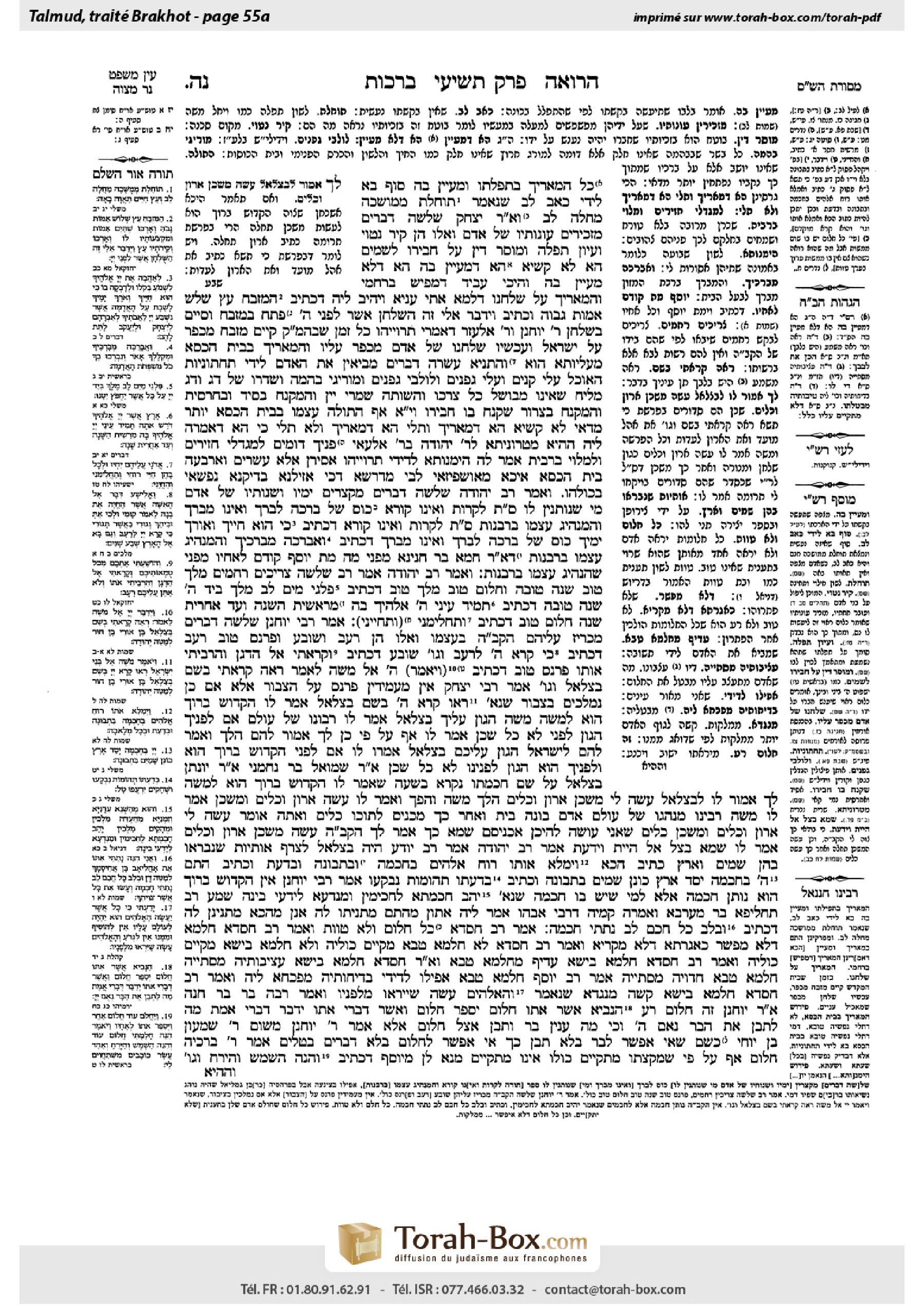
Berakhot 55a: Talmud study for Daf Yomi
Study the Talmud for Daf Yomi with scanned pages, Hebrew text, English translations from Sefaria and AI-generated French translations.
Passage selection and English or AI-generated French translation are available where the scan has annotations. Daf Study is independent of Torah-Box and Sefaria.
Browse Berakhot · ברכות · All tractatesBerakhot 55a text and translations
This page of Berakhot includes the Aramaic text, an English translation and an AI-generated French translation, alongside the scan above.
ברכות נ״ה א · Aramaic and Hebrew text
כׇּל הַמַּאֲרִיךְ בִּתְפִלָּתוֹ וּמְעַיֵּין בָּהּ — סוֹף בָּא לִידֵי כְּאֵב לֵב, שֶׁנֶּאֱמַר: ״תּוֹחֶלֶת מְמֻשָּׁכָה מַחֲלָה לֵב״. וְאָמַר רַבִּי יִצְחָק: שְׁלֹשָׁה דְּבָרִים מַזְכִּירִים עֲוֹנוֹתָיו שֶׁל אָדָם, וְאֵלּוּ הֵן: קִיר נָטוּי, וְעִיּוּן תְּפִלָּה, וּמוֹסֵר דִּין עַל חֲבֵירוֹ לַשָּׁמַיִם!
הָא לָא קַשְׁיָא: הָא דִּמְעַיֵּין בַּהּ, הָא דְּלָא מְעַיֵּין בַּהּ. וְהֵיכִי עָבֵיד? — דְּמַפֵּישׁ בְּרַחֲמֵי.
וְהַמַּאֲרִיךְ עַל שֻׁלְחָנוֹ: דִּלְמָא אָתֵי עַנְיָא וְיָהֵיב לֵיהּ. דִּכְתִיב: ״הַמִּזְבֵּחַ עֵץ שָׁלוֹשׁ אַמּוֹת גָּבֹהַּ״, וּכְתִיב: ״וַיְדַבֵּר אֵלַי זֶה הַשֻּׁלְחָן אֲשֶׁר לִפְנֵי ה׳״, פָּתַח בְּמִזְבֵּחַ וְסִיֵּים בְּשֻׁלְחָן! רַבִּי יוֹחָנָן וְרַבִּי אֶלְעָזָר דְּאָמְרִי תַּרְוַיְיהוּ: כׇּל זְמַן שֶׁבֵּית הַמִּקְדָּשׁ קַיָּים — מִזְבֵּחַ מְכַפֵּר עַל יִשְׂרָאֵל, וְעַכְשָׁיו, שֻׁלְחָנוֹ שֶׁל אָדָם מְכַפֵּר עָלָיו.
וְהַמַּאֲרִיךְ בְּבֵית הַכִּסֵּא: מְעַלְּיוּתָא הוּא? וְהָתַנְיָא: עֲשָׂרָה דְּבָרִים מְבִיאִין אֶת הָאָדָם לִידֵי תַּחְתּוֹנִיּוֹת: הָאוֹכֵל עֲלֵי קָנִים, וַעֲלֵי גְפָנִים, וְלוּלַבֵּי גְפָנִים, וּמוֹרִיגֵּי בְהֵמָה, וְשִׁדְרוֹ שֶׁל דָּג, וְדָג מָלִיחַ שֶׁאֵינוֹ מְבוּשָּׁל כׇּל צָרְכּוֹ, וְהַשּׁוֹתֶה שִׁמְרֵי יַיִן, וְהַמְקַנֵּחַ בְּסִיד וּבְחַרְסִית. וְהַמְקַנֵּחַ בִּצְרוֹר שֶׁקִּנַּח בּוֹ חֲבֵרוֹ, וְיֵשׁ אוֹמְרִים: אַף הַתּוֹלֶה עַצְמוֹ בְּבֵית הַכִּסֵּא יוֹתֵר מִדַּאי.
לָא קַשְׁיָא: הָא דְּמַאֲרִיךְ וְתָלֵי, הָא דְּמַאֲרִיךְ וְלָא תָּלֵי.
כִּי הָא דַּאֲמַרָה לֵיהּ הָהִיא מַטְרוֹנִיתָא לְרַבִּי יְהוּדָה בְּרַבִּי אִלְעַאי: פָּנֶיךָ דּוֹמִים לִמְגַדְּלֵי חֲזִירִים וּלְמַלְוֵי בְּרִבִּית. אֲמַר לַהּ: הֵימָנוּתָא, לְדִידִי תַּרְוַיְיהוּ אֲסִירָן, אֶלָּא — עֶשְׂרִים וְאַרְבָּעָה בֵּית הַכִּסֵּא אִיכָּא מֵאוּשְׁפִּיזַאי לְבֵי מִדְרְשָׁא, דְּכִי אָזֵילְנָא, בָּדֵיקְנָא נַפְשַׁאי בְּכוּלְּהוּ.
וְאָמַר רַב יְהוּדָה: שְׁלֹשָׁה דְּבָרִים מְקַצְּרִים יָמָיו וּשְׁנוֹתָיו שֶׁל אָדָם: מִי שֶׁנּוֹתְנִין לוֹ סֵפֶר תּוֹרָה לִקְרוֹת וְאֵינוֹ קוֹרֵא, כּוֹס שֶׁל בְּרָכָה לְבָרֵךְ וְאֵינוֹ מְבָרֵךְ, וְהַמַּנְהִיג עַצְמוֹ בְּרַבָּנוּת.
סֵפֶר תּוֹרָה לִקְרוֹת וְאֵינוֹ קוֹרֵא, דִּכְתִיב: ״כִּי הוּא חַיֶּיךָ וְאֹרֶךְ יָמֶיךָ״. כּוֹס שֶׁל בְּרָכָה לְבָרֵךְ וְאֵינוֹ מְבָרֵךְ — דִּכְתִיב: ״וַאֲבָרְכָה מְבָרְכֶיךָ״. וְהַמַּנְהִיג עַצְמוֹ בְּרַבָּנוּת — דְּאָמַר רַבִּי חָמָא בַּר חֲנִינָא: מִפְּנֵי מָה מֵת יוֹסֵף קוֹדֶם לְאֶחָיו — מִפְּנֵי שֶׁהִנְהִיג עַצְמוֹ בְּרַבָּנוּת.
וְאָמַר רַב יְהוּדָה אָמַר רַב, שְׁלֹשָׁה צְרִיכִים רַחֲמִים: מֶלֶךְ טוֹב, שָׁנָה טוֹבָה וַחֲלוֹם טוֹב. מֶלֶךְ טוֹב — דִּכְתִיב: ״פַּלְגֵי מַיִם לֶב מֶלֶךְ בְּיַד ה׳״. שָׁנָה טוֹבָה — דִּכְתִיב: ״תָּמִיד עֵינֵי ה׳ אֱלֹהֶיךָ בָּהּ מֵרֵאשִׁית הַשָּׁנָה וְעַד אַחֲרִית שָׁנָה״. חֲלוֹם טוֹב — דִּכְתִיב: ״וְתַחֲלִימֵנִי וְתַחֲיֵינִי״.
אָמַר רַבִּי יוֹחָנָן: שְׁלֹשָׁה דְּבָרִים מַכְרִיז עֲלֵיהֶם הַקָּדוֹשׁ בָּרוּךְ הוּא בְּעַצְמוֹ וְאֵלּוּ הֵן: רָעָב, וְשׂוֹבַע, וּפַרְנָס טוֹב. רָעָב — דִּכְתִיב: ״כִּי קָרָא ה׳ לָרָעָב וְגוֹ׳״. שׂוֹבַע — דִּכְתִיב: ״וְקָרָאתִי אֶל הַדָּגָן וְהִרְבֵּיתִי אֹתוֹ״. פַּרְנָס טוֹב — דִּכְתִיב: ״וַיֹּאמֶר ה׳ אֶל מֹשֶׁה לֵּאמֹר. רְאֵה קָרָאתִי בְשֵׁם בְּצַלְאֵל וְגוֹ׳״.
אָמַר רַבִּי יִצְחָק: אֵין מַעֲמִידִין פַּרְנָס עַל הַצִּבּוּר אֶלָּא אִם כֵּן נִמְלָכִים בַּצִּבּוּר, שֶׁנֶּאֱמַר: ״רְאוּ קָרָא ה׳ בְּשֵׁם בְּצַלְאֵל״, אָמַר לוֹ הַקָּדוֹשׁ בָּרוּךְ הוּא לְמֹשֶׁה: מֹשֶׁה, הָגוּן עָלֶיךָ בְּצַלְאֵל? אָמַר לוֹ: רִבּוֹנוֹ שֶׁל עוֹלָם, אִם לְפָנֶיךָ הָגוּן — לְפָנַי לֹא כׇּל שֶׁכֵּן! אָמַר לוֹ: אַף עַל פִּי כֵן, לֵךְ אֱמוֹר לָהֶם. הָלַךְ וְאָמַר לָהֶם לְיִשְׂרָאֵל: הָגוּן עֲלֵיכֶם בְּצַלְאֵל? אָמְרוּ לוֹ: אִם לִפְנֵי הַקָּדוֹשׁ בָּרוּךְ הוּא וּלְפָנֶיךָ הוּא הָגוּן, לְפָנֵינוּ לֹא כׇּל שֶׁכֵּן!
אָמַר רַבִּי שְׁמוּאֵל בַּר נַחְמָנִי אָמַר רַבִּי יוֹנָתָן: בְּצַלְאֵל עַל שֵׁם חׇכְמָתוֹ נִקְרָא. בְּשָׁעָה שֶׁאָמַר לוֹ הַקָּדוֹשׁ בָּרוּךְ הוּא לְמֹשֶׁה: לֵךְ אֱמוֹר לוֹ לִבְצַלְאֵל ״עֲשֵׂה לִי מִשְׁכָּן אָרוֹן וְכֵלִים״. הָלַךְ מֹשֶׁה וְהָפַךְ וְאָמַר לוֹ: ״עֲשֵׂה אָרוֹן וְכֵלִים וּמִשְׁכָּן״. אָמַר לוֹ: מֹשֶׁה רַבֵּינוּ, מִנְהָגוֹ שֶׁל עוֹלָם אָדָם בּוֹנֶה בַּיִת וְאַחַר כָּךְ מַכְנִיס לְתוֹכוֹ כֵּלִים, וְאַתָּה אוֹמֵר ״עֲשֵׂה לִי אָרוֹן וְכֵלִים וּמִשְׁכָּן״, כֵּלִים שֶׁאֲנִי עוֹשֶׂה, לְהֵיכָן אַכְנִיסֵם? שֶׁמָּא כָּךְ אָמַר לְךָ הַקָּדוֹשׁ בָּרוּךְ הוּא, ״עֲשֵׂה מִשְׁכָּן אָרוֹן וְכֵלִים״?! אָמַר לוֹ: שֶׁמָּא בְּצֵל אֵל הָיִיתָ וְיָדַעְתָּ?
אָמַר רַב יְהוּדָה אָמַר רַב: יוֹדֵעַ הָיָה בְּצַלְאֵל לְצָרֵף אוֹתִיּוֹת שֶׁנִּבְרְאוּ בָּהֶן שָׁמַיִם וָאָרֶץ. כְּתִיב הָכָא: ״וַיְמַלֵּא אֹתוֹ רוּחַ אֱלֹהִים בְּחׇכְמָה וּבִתְבוּנָה וּבְדַעַת״, וּכְתִיב הָתָם: ״ה׳ בְּחׇכְמָה יָסַד אָרֶץ כּוֹנֵן שָׁמַיִם בִּתְבוּנָה״. וּכְתִיב: ״בְּדַעְתּוֹ תְּהוֹמוֹת נִבְקָעוּ״.
אָמַר רַבִּי יוֹחָנָן: אֵין הַקָּדוֹשׁ בָּרוּךְ הוּא נוֹתֵן חָכְמָה אֶלָּא לְמִי שֶׁיֵּשׁ בּוֹ חָכְמָה, שֶׁנֶּאֱמַר: ״יָהֵב חׇכְמְתָא לְחַכִּימִין וּמַנְדְּעָא לְיָדְעֵי בִינָה״. שְׁמַע רַב תַּחְלִיפָא בַּר מַעְרְבָא וְאַמְרַהּ קַמֵּיהּ דְּרַבִּי אֲבָהוּ. אָמַר לֵיהּ: אַתּוּן מֵהָתָם מַתְנִיתוּ לַהּ, אֲנַן מֵהָכָא מַתְנִינַן לַהּ, דִּכְתִיב: ״וּבְלֵב כׇּל חֲכַם לֵב נָתַתִּי חׇכְמָה״.
אָמַר רַב חִסְדָּא: כׇּל חֲלוֹם, וְלָא טְווֹת. וְאָמַר רַב חִסְדָּא: חֶלְמָא דְּלָא מְפַשַּׁר כְּאִגַּרְתָּא דְּלָא מִקַּרְיָא. וְאָמַר רַב חִסְדָּא: לָא חֶלְמָא טָבָא מִקַּיַּים כּוּלֵּיהּ וְלָא חֶלְמָא בִּישָׁא מִקַּיַּים כּוּלֵּיהּ. וְאָמַר רַב חִסְדָּא: חֶלְמָא בִּישָׁא עֲדִיף מֵחֶלְמָא טָבָא. וְאָמַר רַב חִסְדָּא: חֶלְמָא בִּישָׁא — עֲצִיבוּתֵיהּ מִסְתְּיֵיהּ, חֶלְמָא טָבָא — חֶדְוֵיהּ מִסְתְּיֵיהּ. אָמַר רַב יוֹסֵף: חֶלְמָא טָבָא, אֲפִילּוּ לְדִידִי, בְּדִיחוּתֵיהּ מְפַכְּחָא לֵיהּ. וְאָמַר רַב חִסְדָּא: חֶלְמָא בִּישָׁא קָשֶׁה מִנְּגָדָא, שֶׁנֶּאֱמַר: ״וְהָאֱלֹהִים עָשָׂה שֶׁיִּרְאוּ מִלְּפָנָיו״, וְאָמַר רַבָּה בַּר בַּר חָנָה אָמַר רַבִּי יוֹחָנָן: זֶה חֲלוֹם רַע.
״הַנָּבִיא אֲשֶׁר אִתּוֹ חֲלוֹם יְסַפֵּר חֲלוֹם וַאֲשֶׁר דְּבָרִי אִתּוֹ יְדַבֵּר דְּבָרִי אֱמֶת מַה לַתֶּבֶן אֶת הַבָּר נְאֻם ה׳״. וְכִי מָה עִנְיַן בַּר וְתֶבֶן אֵצֶל חֲלוֹם? אֶלָּא אָמַר רַבִּי יוֹחָנָן מִשּׁוּם רַבִּי שִׁמְעוֹן בֶּן יוֹחַי: כְּשֵׁם שֶׁאִי אֶפְשָׁר לְבַר בְּלֹא תֶּבֶן, כָּךְ אִי אֶפְשָׁר לַחֲלוֹם בְּלֹא דְּבָרִים בְּטֵלִים.
אָמַר רַבִּי בֶּרֶכְיָה: חֲלוֹם, אַף עַל פִּי שֶׁמִּקְצָתוֹ מִתְקַיֵּים — כּוּלּוֹ אֵינוֹ מִתְקַיֵּים. מְנָא לַן? — מִיּוֹסֵף, דִּכְתִיב: ״וְהִנֵּה הַשֶּׁמֶשׁ וְהַיָּרֵחַ וְגוֹ׳״.
Berakhot 55a · English translation
Anyone who prolongs his prayer and expects it to be answered, will ultimately come to heartache, as it is stated: “Hope deferred makes the heart sick” (Proverbs 13:12). Similarly, Rabbi Yitzḥak said: Three matters evoke a person’s sins, and they are: Endangering oneself by sitting or standing next to an inclined wall that is about to collapse, expecting prayer to be accepted, as that leads to an assessment of his status and merit, and passing a case against another to Heaven, as praying for Heaven to pass judgment on another person causes one’s own deeds to be examined and compared with the deeds of that other person. This proves that prolonging prayer is a fault.
The Gemara resolves the apparent contradiction: This is not difficult. This, where we learned that prolonging prayer is undesirable, refers to a situation when one expects his prayer to be accepted, while this, where Rav Yehuda says that prolonging prayer prolongs one’s life, refers to a situation where one does not expect his prayer to be accepted. How does he prolong his prayer? By increasing his supplication.
As for the virtue of prolonging one’s mealtime at the table, which Rav Yehuda mentioned, the Gemara explains: Perhaps a poor person will come during the meal and the host will be in a position to give him food immediately, without forcing the poor person to wait. The Sages elsewhere praised a person who acts appropriately at a meal, as it is written: “The altar, three cubits high and the length thereof, two cubits, was of wood, and so the corners thereof; the length thereof, and the walls thereof, were also of wood” (Ezekiel 41:22), and it is written in the continuation of that verse: “And he said unto me: This is the table that is before the Lord.” The language of this verse is difficult, as it begins with the altar and concludes with the table. Rather, Rabbi Yoḥanan and Rabbi Elazar both say: As long as the Temple stood, the altar atoned for Israel’s transgressions. Now that it is destroyed, a person’s table atones for his transgressions.
With regard to what Rav Yehuda said in praise of one who prolongs his time in the bathroom, the Gemara asks: Is that a virtue? Wasn’t it taught in a baraita: Ten things bring a person to suffer from hemorrhoids: One who eats the leaves of bulrushes, grape leaves, tendrils of grapevines, the palate and tongue of an animal, as well as any other part of the animal which is not smooth and which has protrusions, the spine of a fish, a salty fish that is not fully cooked, and one who drinks wine dregs, and one who wipes himself with lime and clay, the materials from which earthenware is made, and one who wipes himself with a stone with which another person wiped himself. And some say: One who suspends himself too much in the bathroom as well. This proves that prolonging one’s time in the bathroom is harmful.
The Gemara responds: This is not difficult. This baraita, which teaches that doing so is harmful, refers to where one prolongs his time there and suspends himself, while this statement of Rav Yehuda refers to where one prolongs his time there and does not suspend himself.
The Gemara relates the benefits of prolonging one’s time in the bathroom. Like that incident when a matron [matronita] said to Rabbi Yehuda son of Rabbi El’ai: Your face is fat and full, like the faces of pig farmers and usurers who do not work hard and who make a plentiful living. He said to her: Honestly, those two occupations are prohibited to me; rather, why is it that my face is nice? Because there are twenty-four bathrooms between my lodging and the study hall, and when I walk I stop and examine myself in all of them.
And Rav Yehuda said: Three things curtail a person’s days and years: One who is invited and given the Torah scroll to read and he does not read, one who is given a cup of blessing over which to recite a blessing and he does not recite a blessing, and one who conducts himself with an air of superiority.
The Gemara details the biblical sources for these cases: One who is given the Torah scroll to read and he does not read, as it is written of the Torah: “It is your life and the length of your days” (Deuteronomy 30:20). A cup of blessing over which to recite a blessing and he does not recite a blessing, as it is written: “I will bless them that bless you” (Genesis 12:3); one who blesses is blessed and one who does not bless does not merit a blessing. And with regard to one who conducts himself with an air of superiority, as Rabbi Ḥama, son of Rabbi Ḥanina, said: Why did Joseph die before his brothers, as evidenced by the order in the verse: “And Joseph died, and all his brethren, and all that generation” (Exodus 1:6)? Because he conducted himself with an air of superiority, and those who did not serve in a leadership role lived on after he died.
Rav Yehuda said in the name of Rav: Three matters require a plea for mercy to bring them about: A good king, a good year, and a good dream. These three, kings, years, and dreams, are all bestowed by God and one must pray that they should be positive and constructive. The Gemara enumerates the sources for these cases: A good king, as it is written: “The king’s heart is in the hand of the Lord as the watercourses: He turns it whithersoever He will” (Proverbs 21:1). A good year, as it is written: “The eyes of the Lord, thy God, are always upon it, from the beginning of the year even unto the end of the year” (Deuteronomy 11:12). And a good dream, as it is written: “O Lord, by these things men live, and altogether therein is the life of my spirit; wherefore You will recover me [vataḥlimeni], and make me to live” (Isaiah 38:16). Due to their apparent etymological similarity, the word taḥlimeni is interpreted as deriving from the word ḥalom, dream.
Similarly, Rabbi Yoḥanan said: Three matters are proclaimed by the Holy One, Blessed be He, Himself: Famine, plenty, and a good leader. The Gemara enumerates the sources for these cases: Famine, as it is written: “For the Lord has called for a famine; and it shall also come upon the land seven years” (II Kings 8:1). Plenty, as it is written: “And I will call for the grain, and will increase it, and lay no famine upon you” (Ezekiel 36:29). And a good leader, as it is written: “And the Lord spoke unto Moses, saying: See, I have called by name Bezalel, son of Uri, son of Hur, of the tribe of Judah” (Exodus 31:1–2).
With regard to Bezalel’s appointment, Rabbi Yitzḥak said: One may only appoint a leader over a community if he consults with the community and they agree to the appointment, as it is stated: “And Moses said unto the children of Israel: See, the Lord has called by name Bezalel, son of Uri, son of Hur, of the tribe of Judah” (Exodus 35:30). The Lord said to Moses: Moses, is Bezalel a suitable appointment in your eyes? Moses said to Him: Master of the universe, if he is a suitable appointment in Your eyes, then all the more so in my eyes. The Holy One, Blessed be He, said to him: Nevertheless, go and tell Israel and ask their opinion. Moses went and said to Israel: Is Bezalel suitable in your eyes? They said to him: If he is suitable in the eyes of the Holy One, Blessed be He, and in your eyes, all the more so he is suitable in our eyes.
Rabbi Shmuel bar Naḥmani said that Rabbi Yonatan said: Bezalel was called by that name on account of his wisdom. When the Holy One, Blessed be He, said to Moses: Go say to Bezalel, “Make a tabernacle, an ark, and vessels” (see Exodus 31:7–11), Moses went and reversed the order and told Bezalel: “Make an ark, and vessels, and a tabernacle” (see Exodus 25–26). He said to Moses: Moses, our teacher, the standard practice throughout the world is that a person builds a house and only afterward places the vessels in the house, and you say to me: Make an ark, and vessels, and a tabernacle. If I do so in the order you have commanded, the vessels that I make, where shall I put them? Perhaps God told you the following: “Make a tabernacle, ark, and vessels” (see Exodus 36). Moses said to Bezalel: Perhaps you were in God’s shadow [betzel El], and you knew precisely what He said. You intuited God’s commands just as He stated them, as if you were there.
Rav Yehuda said that Rav said: Bezalel knew how to join the letters with which heaven and earth were created. From where do we derive this? It is written here in praise of Bezalel: “And I have filled him with the spirit of God, in wisdom, and in understanding, and in knowledge, and in all manner of workmanship” (Exodus 31:3); and it is written there with regard to creation of heaven and earth: “The Lord, by wisdom, founded the earth; by understanding He established the heavens” (Proverbs 3:19), and it is written: “By His knowledge the depths were broken up and the skies drop down the dew” (Proverbs 3:20). We see that wisdom, understanding, and knowledge, the qualities with which the heavens and earth were created, are all found in Bezalel.
On a similar note, Rabbi Yoḥanan said: The Holy One, Blessed be He, only grants wisdom to one who already possesses wisdom, as it is stated: “He gives wisdom unto the wise, and knowledge to they who know understanding” (Daniel 2:21). Rav Taḥalifa, from the West, Eretz Yisrael, heard this and repeated it before Rabbi Abbahu. Rabbi Abbahu said to him: You learned proof for this idea from there; we learn it from here: As it is written in praise of the builders of the Tabernacle: “And in the hearts of all who are wise-hearted I have placed wisdom” (Exodus 31:6).
Related to what was stated above, that one should pray for a good dream, the Gemara cites additional maxims concerning dreams and their interpretation. Rav Ḥisda said: One should see any dream, and not a fast. In other words, any dream is preferable to a dream during a fast. And Rav Ḥisda said: A dream not interpreted is like a letter not read. As long as it is not interpreted it cannot be fulfilled; the interpretation of a dream creates its meaning. And Rav Ḥisda said: A good dream is not entirely fulfilled and a bad dream is not entirely fulfilled. And Rav Ḥisda said: A bad dream is preferable to a good dream, as a bad dream causes one to feel remorse and to repent. And Rav Ḥisda said: A bad dream, his sadness is enough for him; a good dream, his joy is enough for him. This means that the sadness or joy engendered by the dream renders the actual fulfillment of the dream superfluous. Similarly, Rav Yosef said: Even for me, the joy of a good dream negates it. Even Rav Yosef, who was blind and ill, derived such pleasure from a good dream that it was never actually realized. And Rav Ḥisda said: A bad dream is worse than lashes, as it is stated: “God has so made it, that men should fear before Him” (Ecclesiastes 3:14), and Rabba bar bar Ḥana said that Rabbi Yoḥanan said: That is a bad dream that causes man to fear.
With regard to the verse: “The prophet that has a dream, let him tell a dream; and he that has My word, let him speak My word faithfully. What has the straw to do with the grain? says the Lord” (Jeremiah 23:28), the Gemara asks: What do straw and grain have to do with a dream? Rather, Rabbi Yoḥanan said in the name of Rabbi Shimon bar Yoḥai: Just as it is impossible for the grain to grow without straw, so too it is impossible to dream without idle matters. Even a dream that will be fulfilled in the future contains some element of nonsense.
On a similar note, Rabbi Berekhya said: Even though part of a dream is fulfilled, all of it is not fulfilled. From where do we derive this? From the story of Joseph’s dream, as it is written: “And he said: Behold, I have dreamed yet a dream: and, behold, the sun and the moon
Berakhot 55a · Traduction française (IA)
Tout celui qui prolonge sa prière et attend qu'elle soit exaucée, finira par ressentir une douleur morale, car il est dit : « L'espérance déçue afflige le cœur » (Proverbes 13:12). De même, le Rabbi Yitzḥak a dit : Trois choses évoquent les péchés d'une personne, et ce sont : se mettre en danger en s'asseyant ou en se tenant près d'un mur penché qui risque de s'effondrer, attendre que la prière soit acceptée, car cela conduit à une évaluation de son statut et de ses mérites, et de transmettre un cas contre un autre à Dieu, car prier Dieu pour qu'il juge un autre personne fait examiner ses actes et les comparer à ceux de cette autre personne. Cela prouve que prolonger la prière est un défaut.
La Guemara résout ce paradoxe apparent : Ce n'est pas difficile. Celui où nous avons appris que prolonger la prière est indésirable, fait référence à un cas où l'on attend que la prière soit exaucée, tandis que celui où Rav Yehuda dit que prolonger la prière prolonge la vie, fait référence à un cas où l'on ne s'attend pas à ce que la prière soit exaucée. Comment prolonge-t-on sa prière ? En augmentant ses supplications.
Quant à la vertu de prolonger le temps du repas, mentionné par Rav Yehuda, la Guemara explique : Peut-être un pauvre viendra pendant le repas et le maître sera en position de lui donner à manger immédiatement, sans forcer le pauvre à attendre. Les Sages ailleurs ont loué une personne qui agit correctement lors d'un repas, car il est écrit : « L'autel, trois coudées de haut et la longueur, deux coudées, était en bois, et ainsi les angles ; la longueur et les murs étaient également en bois » (Ezéchiel 41:22), et il est écrit dans la continuation de cette verset : « Et il me dit : C'est la table qui est devant l'Éternel. » La langue de cette verset est difficile, car elle commence par l'autel et se termine par la table. Plutôt, Rabbi Yoḥanan et Rabbi Elazar disent tous les deux : Tant que le Temple était debout, l'autel expiait les transgressions d'Israël. Maintenant qu'il est détruit, la table d'une personne expie ses transgressions.
En ce qui concerne ce que Rav Yehuda a dit en l'honneur de celui qui prolonge son temps dans la salle de bain, la Guemara pose la question : C'est une vertu ? N'avait-il pas été enseigné dans une baraïta : Dix choses conduisent une personne à souffrir d'hémorroïdes : celui qui mange les feuilles de roseaux, les feuilles de raisin, les tiges de vigne, la langue et la palate d'un animal, ainsi que toute autre partie de l'animal qui n'est pas lisse et qui a des bosses, la colonne vertébrale d'un poisson, un poisson salé qui n'est pas bien cuit, et celui qui boit les débris de vin, et celui qui se lave avec de la chaux et de la terre, les matériaux dont sont faits les terres cuites, et celui qui se lave avec une pierre avec laquelle une autre personne s'est lavé. Et certains disent : celui qui suspend trop longtemps dans la salle de bain. Cela prouve que prolonger son temps dans la salle de bain est nuisible.
La Guemara répond : Ce n'est pas difficile. Cette baraïta, qui enseigne que cela est nuisible, fait référence à celui qui prolonge son temps là-bas et se suspend, tandis que cette déclaration de Rav Yehuda fait référence à celui qui prolonge son temps là-bas et ne se suspend pas.
La Guemara relate les bénéfices de prolonger son temps dans la salle de bain. Comme dans l'incident où une matrona a dit à Rabbi Yehuda fils de Rabbi El'ai : Votre visage est gras et plein, comme celui des éleveurs de porcs et des usuriers qui ne travaillent pas dur et qui vivent abondamment. Il lui a répondu : Honnêtement, ces deux métiers sont interdits à moi ; plutôt, pourquoi est-ce que mon visage est agréable ? Parce qu'il y a vingt-quatre salles de bain entre mon logement et la salle de étude, et quand je marche, je m'arrête et examine mon visage dans toutes ces salles.
Et Rav Yehuda a dit : Trois choses raccourcissent les jours et les années d'une personne : celui qui est invité et lui est donné le rouleau de la Torah pour lire et il ne lit pas, celui qui est donné un verre de bénédiction sur lequel il doit réciter une bénédiction et il ne récite pas une bénédiction, et celui qui se comporte avec un air de supériorité.
La Guemara détaille les sources bibliques pour ces cas : celui qui est donné le rouleau de la Torah pour lire et il ne lit pas, car il est écrit de la Torah : « C'est ta vie et la longueur de tes jours » (Deutéronome 30:20). Un verre de bénédiction sur lequel il doit réciter une bénédiction et il ne récite pas une bénédiction, car il est écrit : « Je bénirai ceux qui te bénissent » (Génèse 12:3) ; celui qui bénit est béni et celui qui ne bénit pas ne mérite pas une bénédiction. Et concernant celui qui se comporte avec un air de supériorité, comme Rabbi Ḥama, fils de Rabbi Ḥanina, a dit : Pourquoi Joseph est-il mort avant ses frères, comme le montre l'ordre dans la verset : « Et Joseph mourut, et tous ses frères, et toute cette génération » (Exode 1:6) ? Parce qu'il se comportait avec un air de supériorité, et ceux qui n'ont pas servi dans un rôle de leadership ont vécu après sa mort.
Rav Yehuda a dit en nom de Rav : Trois choses nécessitent une prière pour obtenir la miséricorde : un bon roi, une bonne année et un bon rêve. Ces trois choses, les rois, les années et les rêves, sont toutes données par Dieu et on doit prier qu'elles soient positives et constructives. La Guemara énumère les sources pour ces cas : un bon roi, car il est écrit : « Le cœur du roi est entre les mains de l'Éternel, comme les cours d'eau : Il le tourne où il veut » (Proverbes 21:1). Une bonne année, car il est écrit : « Les yeux de l'Éternel, ton Dieu, sont toujours sur elle, du début de l'année jusqu'à la fin de l'année » (Deutéronome 11:12). Et un bon rêve, car il est écrit : « Ô Éternel, par ces choses les hommes vivent, et tout en cela est la vie de mon âme ; pourquoi tu me rétabliras [vataḥlimeni], et me feras vivre » (Isaïe 38:16). En raison de leur similitude étiologique, le mot taḥlimeni est interprété comme provenant du mot ḥalom, rêve.
De même, le Rabbi Yoḥanan a dit : Trois choses sont proclamées par le Saint, le Très Haut, Lui-même : la famine, l'abondance et un bon chef. La Guemara énumère les sources de ces cas : la famine, comme il est écrit : « Car l'Éternel a appelé une famine ; et elle viendra sur la terre sept ans » (II Rois 8:1). L'abondance, comme il est écrit : « Et je demanderai la moisson, et je l'augmenterai, et je ne mettrai pas de famine sur vous » (Ezéchiel 36:29). Et un bon chef, comme il est écrit : « Et l'Éternel parla à Moïse, disant : Voici, j'ai appelé par son nom Bezaléel, fils de Uri, fils de Hur, du tribu de Juda » (Exode 31:1–2).
Concernant l'appointment de Bezaléel, le Rabbi Yitzḥak a dit : On ne peut appointer un chef sur une communauté que si l'on consulte la communauté et qu'elle accepte l'appointment, comme il est dit : « Et Moïse dit aux enfants d'Israël : Voici, l'Éternel a appelé par son nom Bezaléel, fils de Uri, fils de Hur, du tribu de Juda » (Exode 35:30). L'Éternel dit à Moïse : Moïse, est-ce que Bezaléel est un bon appointment à tes yeux ? Moïse dit à Lui : Seigneur du monde, si c'est un bon appointment à tes yeux, alors encore plus à mes yeux. L'Éternel, le Saint, le Très Haut, dit à lui : Toutefois, va et dis à Israël et demande leur avis. Moïse alla et dit à Israël : Est-ce que Bezaléel est bon à tes yeux ? Ils dirent à lui : Si c'est bon aux yeux de l'Éternel, le Saint, le Très Haut, et à tes yeux, encore plus c'est bon à nos yeux.
Le Rabbi Shmuel bar Naḥmani a dit que le Rabbi Yonatan a dit : Bezaléel a été appelé ainsi à cause de sa sagesse. Quand l'Éternel, le Saint, le Très Haut, a dit à Moïse : « Va et dis à Bezaléel : Construis un tabernacle, un arca et des objets » (voir Exode 31:7–11), Moïse est allé et a inversé l'ordre, puis a dit à Bezaléel : « Construis un arca, des objets et un tabernacle » (voir Exode 25–26). Il a dit à Moïse : Moïse, notre maître, la pratique courante dans le monde est que l'on construit une maison et ensuite on place les objets dans la maison, et tu dis à moi : Construis un arca, des objets et un tabernacle. Si je fais cela dans l'ordre que tu as commandé, les objets que je construirai, où les mettrai-je ? Peut-être que Dieu t'a dit : « Construis un tabernacle, un arca et des objets » (voir Exode 36). Moïse a dit à Bezaléel : Peut-être que tu étais dans l'ombre d'Él [betzel El], et tu savais exactement ce qu'Il avait dit. Tu as intuité les commandements de Dieu comme s'il les avait dit lui-même, comme si tu étais présent.
Rav Yehuda a dit que Rav a dit : Bezaléel savait comment joindre les lettres avec lesquelles le ciel et la terre ont été créés. D'où tirons-nous cela ? Il est écrit ici en l'honneur de Bezaléel : « Et j'ai rempli lui de l'esprit de Dieu, en sagesse, en compréhension, en connaissance, et en toutes sortes de travaux manuels » (Exode 31:3) ; et il est écrit là concernant la création du ciel et de la terre : « L'Éternel, par la sagesse, a fondé la terre ; par la compréhension, Il a établi les cieux » (Proverbes 3:19), et il est écrit : « Par sa connaissance, les profondeurs ont été rompues et les cieux ont fait tomber la rosée » (Proverbes 3:20). Nous voyons que la sagesse, la compréhension et la connaissance, les qualités avec lesquelles le ciel et la terre ont été créés, sont toutes trouvées chez Bezaléel.
Sur un point similaire, le Rabbi Yoḥanan a dit : L'Éternel, le Saint, le Très Haut, accorde la sagesse uniquement à celui qui possède déjà la sagesse, comme il est dit : « Il donne la sagesse aux sages, et la connaissance à ceux qui connaissent la compréhension » (Daniel 2:21). Rav Taḥalifa, du West, d'Eretz Yisrael, a entendu cela et l'a répété devant Rabbi Abbahu. Rabbi Abbahu a dit à lui : Tu as appris la preuve pour cette idée là ; nous l'apprenons ici : comme il est écrit en l'honneur des constructeurs du Tabernacle : « Et dans les cœurs de tous ceux qui sont de cœur sages, j'ai mis la sagesse » (Exode 31:6).
Relatif à ce qui a été dit ci-dessus, que l'on devrait prier pour un bon rêve, la Guemara cite d'autres maximes concernant les rêves et leur interprétation. Rav Ḥisda a dit : On devrait voir tout rêve, et non un jeûne. En d'autres termes, tout rêve est préférable à un rêve pendant un jeûne. Et Rav Ḥisda a dit : Un rêve non interprété est comme une lettre non lue. Tant qu'il n'est pas interprété, il ne peut être accompli ; l'interprétation d'un rêve crée son sens. Et Rav Ḥisda a dit : Un bon rêve n'est pas entièrement accompli et un mauvais rêve n'est pas entièrement accompli. Et Rav Ḥisda a dit : Un mauvais rêve est préférable à un bon rêve, car un mauvais rêve cause à l'homme la repentance et la réforme. Et Rav Ḥisda a dit : Un mauvais rêve, sa tristesse est suffisante pour lui ; un bon rêve, sa joie est suffisante pour lui. Cela signifie que la tristesse ou la joie engendrées par le rêve rendent l'accomplissement réel du rêve superflu. De même, Rav Yosef a dit : Même pour moi, la joie d'un bon rêve annule ce rêve. Même Rav Yosef, qui était aveugle et malade, a tiré telle satisfaction d'un bon rêve qu'il n'a jamais été réalisé. Et Rav Ḥisda a dit : Un mauvais rêve est pire que des coups de fouet, comme il est dit : « L'Éternel a ainsi fait, afin que les hommes craignent devant Lui » (Ecclésiaste 3:14), et Rabba bar bar Ḥana a dit que Rabbi Yoḥanan a dit : C'est un mauvais rêve qui cause à l'homme la crainte.
Concernant la verset : « Le prophète qui a un rêve, qu'il raconte un rêve ; et celui qui a la parole de l'Éternel, qu'il parle la parole de l'Éternel fidèlement. Qu'as-tu à faire avec la paille par rapport au grain ? dit l'Éternel » (Jérémie 23:28), la Guemara pose la question : Qu'ont à faire la paille et le grain avec un rêve ? Plutôt, Rabbi Yoḥanan, en nom de Rabbi Shimon bar Yoḥai, a dit : Comme il est impossible que le grain croisse sans la paille, de même il est impossible de rêver sans des choses vaines. Même un rêve qui sera accompli à l'avenir contient un élément de nonsens.
Sur un point similaire, Rabbi Berekhya a dit : Même si une partie d'un rêve est accomplie, toute la partie n'est pas accomplie. D'où tirons-nous cela ? De l'histoire du rêve de Joseph, comme il est écrit : « Et il dit : Voici, j'ai rêvé encore un rêve : et voici, le soleil et la lune »
Traduction française générée par IA à partir de l’édition anglaise de Sefaria. Vérifie toujours un passage avec le texte source.
Text from Sefaria: William Davidson Edition - Vocalized Aramaic (CC BY NC); William Davidson Edition - English (CC BY NC).