Berakhot 54b: Talmud study for Daf Yomi
Study the Talmud for Daf Yomi with scanned pages, Hebrew text, English translations from Sefaria and AI-generated French translations.
Passage selection and English or AI-generated French translation are available where the scan has annotations. Daf Study is independent of Torah-Box and Sefaria.
Browse Berakhot · ברכות · All tractatesBerakhot 54b text and translations
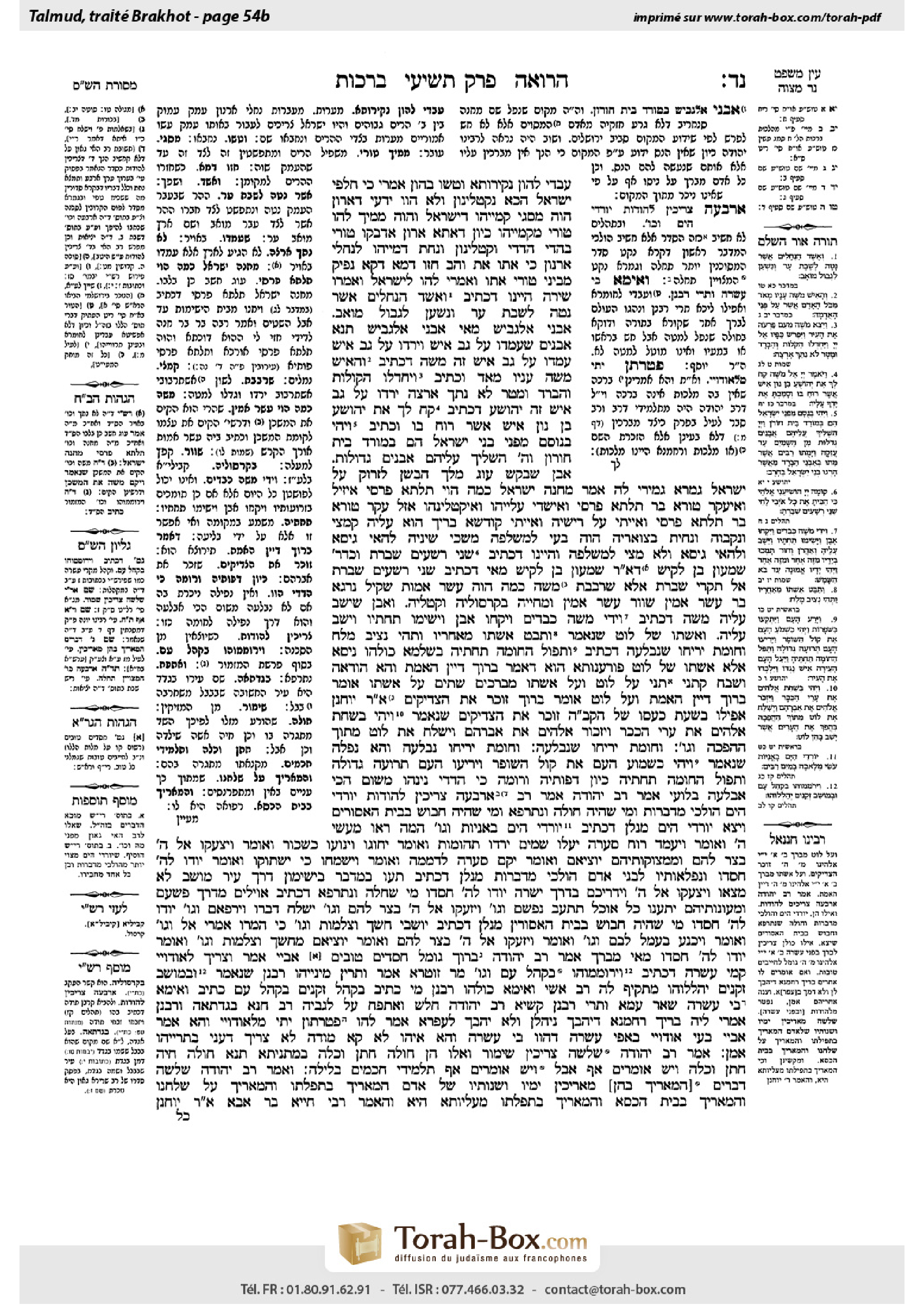
This page of Berakhot includes the Aramaic text, an English translation and an AI-generated French translation, alongside the scan above.
ברכות נ״ד ב · Aramaic and Hebrew text
עָבְדִי לְהוֹן נְקִירָתָא וּטְשׁוֹ בְּהוֹן. אָמְרִי: כִּי חָלְפִי יִשְׂרָאֵל הָכָא — נִקְטְלִינּוּן, וְלָא הֲווֹ יָדְעִי דְּאָרוֹן הֲוָה מְסַגֵּי קַמַּיְיהוּ דְּיִשְׂרָאֵל וַהֲוָה מַמֵּיךְ לְהוּ טוּרֵי מִקַּמַּיְיהוּ. כֵּיוָן דַּאֲתָא אָרוֹן, אִדְּבַקוּ טוּרֵי בַּהֲדֵי הֲדָדֵי, וְקַטְלִינּוּן, וּנְחַת דְּמַיְיהוּ לְנַחֲלֵי אַרְנוֹן. כִּי אֲתוֹ אֶת וָהֵב, חֲזוֹ דְּמָא דְּקָא נָפֵיק מִבֵּינֵי טוּרֵי. אֲתוֹ וְאָמְרִי לְהוּ לְיִשְׂרָאֵל וַאֲמַרוּ שִׁירָה. הַיְינוּ דִּכְתִיב: ״וְאֶשֶׁד הַנְּחָלִים אֲשֶׁר נָטָה לְשֶׁבֶת עָר וְנִשְׁעַן לִגְבוּל מוֹאָב״.
אַבְנֵי אֶלְגָּבִישׁ. מַאי אַבְנֵי אֶלְגָּבִישׁ?
תָּנָא: אֲבָנִים שֶׁעָמְדוּ עַל גַּב אִישׁ, וְיָרְדוּ עַל גַּב אִישׁ. עָמְדוּ עַל גַּב אִישׁ — זֶה מֹשֶׁה, דִּכְתִיב: ״וְהָאִישׁ מֹשֶׁה עָנָו מְאֹד״, וּכְתִיב: ״וַיַּחְדְּלוּ הַקֹּלוֹת וְהַבָּרָד וּמָטָר לֹא נִתַּךְ אָרְצָה״. יָרְדוּ עַל גַּב אִישׁ — זֶה יְהוֹשֻׁעַ, דִּכְתִיב: ״קַח לְךָ אֶת יְהוֹשֻׁעַ בִּן נוּן אִישׁ אֲשֶׁר רוּחַ בּוֹ״, וּכְתִיב: ״וַיְהִי בְּנוּסָם מִפְּנֵי בְּנֵי יִשְׂרָאֵל הֵם בְּמוֹרַד בֵּית חוֹרֹן וַה׳ הִשְׁלִיךְ עֲלֵיהֶם אֲבָנִים גְּדֹלוֹת״.
אֶבֶן שֶׁבִּקֵּשׁ עוֹג מֶלֶךְ הַבָּשָׁן לִזְרוֹק עַל יִשְׂרָאֵל, גְּמָרָא גְּמִירִי לַהּ. אֲמַר מַחֲנֵה יִשְׂרָאֵל כַּמָּה הָוֵי — תְּלָתָא פַּרְסֵי, אֵיזֵיל וְאֶיעֱקַר טוּרָא בַּר תְּלָתָא פַּרְסֵי וְאִישְׁדֵּי עֲלַיְיהוּ, וְאִיקְטְלִינְהוּ. אֲזַל עֲקַר טוּרָא בַּר תְּלָתָא פַּרְסֵי וְאַיְיתִי עַל רֵישֵׁיהּ, וְאַיְיתִי קוּדְשָׁא בְּרִיךְ הוּא עֲלֵיהּ קַמְצֵי וְנַקְבוּהּ, וּנְחֵית בְּצַוְּארֵיהּ.
הֲוָה בָּעֵי לְמִשְׁלְפֵהּ, מָשְׁכִי שִׁינֵּיהּ לְהַאי גִּיסָא וּלְהַאי גִּיסָא וְלָא מָצֵי לְמִשְׁלְפֵהּ. וְהַיְינוּ דִּכְתִיב: ״שִׁנֵּי רְשָׁעִים שִׁבַּרְתָּ״. וְכִדְרַבִּי שִׁמְעוֹן בֶּן לָקִישׁ. דְּאָמַר רַבִּי שִׁמְעוֹן בֶּן לָקִישׁ: מַאי דִּכְתִיב ״שִׁנֵּי רְשָׁעִים שִׁבַּרְתָּ״ — אַל תִּקְרֵי ״שִׁבַּרְתָּ״ אֶלָּא ״שִׁרְבַּבְתָּ״.
מֹשֶׁה כַּמָּה הֲוָה — עֶשֶׂר אַמּוֹת, שְׁקֵיל נַרְגָּא בַּר עֲשַׂר אַמִּין, שְׁוַור עֲשַׂר אַמִּין, וּמַחְיֵיהּ בְּקַרְסוּלֵּיהּ וְקַטְלֵיהּ.
וְאֶבֶן שֶׁיָּשַׁב עָלֶיהָ מֹשֶׁה — דִּכְתִיב: ״וִידֵי מֹשֶׁה כְּבֵדִים וַיִּקְחוּ אֶבֶן וַיָּשִׂימוּ תַחְתָּיו וַיֵּשֶׁב עָלֶיהָ״.
וְאִשְׁתּוֹ שֶׁל לוֹט — שֶׁנֶּאֱמַר: ״וַתַּבֵּט אִשְׁתּוֹ מֵאַחֲרָיו וַתְּהִי נְצִיב מֶלַח״. וְחוֹמַת יְרִיחוֹ שֶׁנִּבְלְעָה — דִּכְתִיב: ״וַתִּפֹּל הַחוֹמָה תַּחְתֶּיהָ״.
בִּשְׁלָמָא כּוּלְּהוּ — נִיסָּא, אֶלָּא אִשְׁתּוֹ שֶׁל לוֹט פּוּרְעָנוּתָא הוּא! — דְּאָמַר ״בָּרוּךְ … דַּיַּין הָאֱמֶת״.
וְהָא ״הוֹדָאָה וָשֶׁבַח״ קָתָנֵי! תְּנִי: עַל לוֹט וְעַל אִשְׁתּוֹ מְבָרְכִים שְׁתַּיִם. עַל אִשְׁתּוֹ אוֹמֵר ״בָּרוּךְ … דַּיַּין הָאֱמֶת״, וְעַל לוֹט אוֹמֵר ״בָּרוּךְ … זוֹכֵר אֶת הַצַּדִּיקִים״. אָמַר רַבִּי יוֹחָנָן: אֲפִילּוּ בִּשְׁעַת כַּעֲסוֹ שֶׁל הַקָּדוֹשׁ בָּרוּךְ הוּא, זוֹכֵר אֶת הַצַּדִּיקִים, שֶׁנֶּאֱמַר: ״וַיְהִי בְּשַׁחֵת אֱלֹהִים אֶת עָרֵי הַכִּכָּר וַיִּזְכֹּר אֱלֹהִים אֶת אַבְרָהָם וַיְשַׁלַּח אֶת לוֹט מִתּוֹךְ הַהֲפֵכָה וְגוֹ׳״.
וְחוֹמַת יְרִיחוֹ שֶׁנִּבְלְעָה. וְחוֹמַת יְרִיחוֹ נִבְלְעָה? וְהָא נָפְלָה, שֶׁנֶּאֱמַר: ״וַיְהִי כִשְׁמֹעַ הָעָם אֶת קוֹל הַשּׁוֹפָר וַיָּרִיעוּ הָעָם תְּרוּעָה גְדוֹלָה וַתִּפֹּל הַחוֹמָה תַּחְתֶּיהָ״! — כֵּיוָן דְּפוּתְיַהּ וְרוּמַהּ כִּי הֲדָדֵי נִינְהוּ, מִשּׁוּם הָכִי אִבַּלְעָה בְּלוֹעֵי.
אָמַר רַב יְהוּדָה אָמַר רַב: אַרְבָּעָה צְרִיכִין לְהוֹדוֹת: יוֹרְדֵי הַיָּם, הוֹלְכֵי מִדְבָּרוֹת, וּמִי שֶׁהָיָה חוֹלֶה וְנִתְרַפֵּא, וּמִי שֶׁהָיָה חָבוּשׁ בְּבֵית הָאֲסוּרִים וְיָצָא.
יוֹרְדֵי הַיָּם מְנָלַן? — דִּכְתִיב: ״יוֹרְדֵי הַיָּם בָּאֳנִיּוֹת וְגוֹ׳ הֵמָּה רָאוּ מַעֲשֵׂי ה׳״. וְאוֹמֵר: ״וַיַּעֲמֵד רוּחַ סְעָרָה יַעֲלוּ שָׁמַיִם יֵרְדוּ תְהוֹמוֹת״, וְאוֹמֵר: ״יָחוֹגּוּ וְיָנוּעוּ כַּשִּׁכּוֹר״, וְאוֹמֵר: ״וַיִּצְעֲקוּ אֶל ה׳ בַּצַּר לָהֶם וּמִמְּצוּקֹתֵיהֶם יוֹצִיאֵם״, וְאוֹמֵר: ״יָקֵם סְעָרָה לִדְמָמָה״, וְאוֹמֵר: ״וַיִּשְׂמְחוּ כִי יִשְׁתֹּקוּ״, וְאוֹמֵר: ״יוֹדוּ לַה׳ חַסְדּוֹ וְנִפְלְאוֹתָיו לִבְנֵי אָדָם״.
הוֹלְכֵי מִדְבָּרוֹת מְנָלַן? דִּכְתִיב: ״תָּעוּ בַמִּדְבָּר בִּישִׁימוֹן דָּרֶךְ עִיר מוֹשָׁב לֹא מָצָאוּ … וַיִּצְעֲקוּ אֶל ה׳ … וַיַּדְרִיכֵם בְּדֶרֶךְ יְשָׁרָה … יוֹדוּ לַה׳ חַסְדּוֹ״.
מִי שֶׁחָלָה וְנִתְרַפֵּא, דִּכְתִיב: ״אֱוִילִים מִדֶּרֶךְ פִּשְׁעָם וּמֵעֲוֹנֹתֵיהֶם יִתְעַנּוּ. כׇּל אֹכֶל תְּתַעֵב נַפְשָׁם וְגוֹ׳ וַיִּזְעֲקוּ אֶל ה׳ בַּצַּר לָהֶם וְגוֹ׳ יִשְׁלַח דְּבָרוֹ וְיִרְפָּאֵם וְגוֹ׳ יוֹדוּ לַה׳ חַסְדּוֹ״.
מִי שֶׁהָיָה חָבוּשׁ בְּבֵית הָאֲסוּרִין מְנָלַן? — דִּכְתִיב: ״יֹשְׁבֵי חֹשֶׁךְ וְצַלְמָוֶת וְגוֹ׳ כִּי הִמְרוּ אִמְרֵי אֵל וְגוֹ׳״. וְאוֹמֵר: ״וַיַּכְנַע בֶּעָמָל לִבָּם וְגוֹ׳״, וְאוֹמֵר: ״וַיִּזְעֲקוּ אֶל ה׳ בַּצַּר לָהֶם״, וְאוֹמֵר: ״יוֹצִיאֵם מֵחֹשֶׁךְ וְצַלְמָוֶת וְגוֹ׳״, וְאוֹמֵר: ״יוֹדוּ לַה׳ חַסְדּוֹ״.
מַאי מְבָרֵךְ? אָמַר רַב יְהוּדָה: ״בָּרוּךְ גּוֹמֵל חֲסָדִים טוֹבִים״. אַבָּיֵי אָמַר: וְצָרִיךְ לְאוֹדוֹיֵי קַמֵּי עַשְׂרָה, דִּכְתִיב: ״וִירוֹמְמוּהוּ בִּקְהַל עָם וְגוֹ׳״. מָר זוּטְרָא אָמַר: וּתְרֵין מִינַּיְיהוּ רַבָּנַן, שֶׁנֶּאֱמַר: ״וּבְמוֹשַׁב זְקֵנִים יְהַלְלוּהוּ״.
מַתְקֵיף לַהּ רַב אָשֵׁי: וְאֵימָא כּוּלְּהוּ רַבָּנַן?! — מִי כְּתִיב ״בִּקְהַל זְקֵנִים״? ״בִּקְהַל עָם״ כְּתִיב. וְאֵימָא בֵּי עַשְׂרָה שְׁאָר עַמָּא, וּתְרֵי רַבָּנַן! קַשְׁיָא.
רַב יְהוּדָה חֲלַשׁ וְאִתְּפַח. עָל לְגַבֵּיהּ רַב חָנָא בַּגְדָּתָאָה וְרַבָּנַן. אָמְרִי לֵיהּ: ״בְּרִיךְ רַחֲמָנָא דְּיַהֲבָךְ נִיהֲלַן וְלָא יַהֲבָךְ לְעַפְרָא״. אֲמַר לְהוּ: פְּטַרְתּוּן יָתִי מִלְּאוֹדוֹיֵי.
וְהָא אָמַר אַבָּיֵי בָּעֵי אוֹדוֹיֵי בְּאַפֵּי עַשְׂרָה! — דַּהֲווֹ בֵּי עַשְׂרָה. וְהָא אִיהוּ לָא קָא מוֹדֵה! — לָא צְרִיךְ, דְּעָנֵי בָּתְרַיְיהוּ ״אָמֵן״.
אָמַר רַב יְהוּדָה: שְׁלֹשָׁה צְרִיכִין שִׁימּוּר, וְאֵלּוּ הֵן — חוֹלֶה, חָתָן, וְכַלָּה. בְּמַתְנִיתָא תָּנָא: חוֹלֶה, חַיָּה, חָתָן, וְכַלָּה. וְיֵשׁ אוֹמְרִים: אַף אָבֵל. וְיֵשׁ אוֹמְרִים: אַף תַּלְמִידֵי חֲכָמִים בַּלַּיְלָה.
וְאָמַר רַב יְהוּדָה: שְׁלֹשָׁה דְּבָרִים הַמַּאֲרִיךְ בָּהֶן מַאֲרִיכִין יָמָיו וּשְׁנוֹתָיו שֶׁל אָדָם. הַמַּאֲרִיךְ בִּתְפִלָּתוֹ, וְהַמַּאֲרִיךְ עַל שֻׁלְחָנוֹ, וְהַמַּאֲרִיךְ בְּבֵית הַכִּסֵּא.
וְהַמַּאֲרִיךְ בִּתְפִלָּתוֹ מְעַלְּיוּתָא הִיא? וְהָאָמַר רַבִּי חִיָּיא בַּר אַבָּא אָמַר רַבִּי יוֹחָנָן:
Berakhot 54b · English translation
and prepared caves for themselves and they hid in them. They said: When Israel passes here we will kill them. And they did not know that the Ark of the Covenant preceded the children of Israel and would flatten mountains before them. When the Ark came, the mountains adhered one to another and killed them; and their blood flowed down to the streams of Arnon. When Et and Hev, the lepers, arrived, they saw the blood that was emerging from between the mountains, and they came and told Israel what had happened. Israel recited a song of praise, as it is stated: “And at the cascade of the brooks that goes down to the dwelling of Ar, and lies upon the border of Moab” (Numbers 21:15). This refers to the cascade of the brooks where the mountain, which had once been a valley, spread out in the direction of the mountain in Ar, in Moab.
Among the sites enumerated in the baraita where one is obligated to recite a blessing in recognition of the miracles that occurred there, was the site of the hailstones of Elgavish. The Gemara asks: What are the hailstones of Elgavish?
It is taught in the midrash: They are the stones that remained suspended in the air and did not fall because of [al gav] a man [ish] and they fell down because of [al gav] a man [ish]. The Gemara explains: They remained suspended because of a man; that is Moses, whom the verse refers to as a man, as it is written: “And the man Moses was very modest” (Numbers 12:3), and it is written: “And Moses went out of the city from Pharaoh, and spread forth his hands unto the Lord; the thunders and hail ceased, and the rain was not poured upon the earth” (Exodus 9:33). Moses’ hailstones remained suspended. And the stones descended because of a man; that is Joshua, who was also called man, as it is written: “Take Joshua the son of Nun, a man in whom is spirit” (Numbers 27:18). And it is written that when Joshua and his people waged war against the army of the Emorite kings, God told him not to fear them because God would deliver them into his hands; and indeed, they died by means of these stones: “As they fled from before Israel, while they were at the descent of Beit Ḥoron, that the Lord cast down great stones from heaven upon them unto Azeka, and they died; they were more who died with the hailstones than they whom the children of Israel slew by sword” (Joshua 10:11).
With regard to the rock that Og, King of Bashan, sought to throw upon Israel, there is no biblical reference, but rather a tradition was transmitted. The Gemara relates that Og said: How large is the camp of Israel? It is three parasangs. I will go and uproot a mountain three parasangs long and I will hurl it upon them and kill them. He went, uprooted a mountain three parasangs long, and brought it on his head. And The Holy One, Blessed be He, brought grasshoppers upon it and they pierced the peak of the mountain and it fell on his neck.
Og wanted to remove it from his head; his teeth were extended to one side of his head and to the other and he was unable to remove it. And that is what is written: “You break the teeth of the wicked” (Psalms 3:8). And this is in accordance with the homiletic interpretation of Rabbi Shimon Ben Lakish, as Rabbi Shimon Ben Lakish said: What is the meaning of that which is written: “You break the teeth of the wicked”? Do not read it as: You break [shibarta], but rather as: You lengthened [shirbavta].
The story concludes: How tall was Moses? He was ten cubits tall. He took an axe ten cubits long, jumped up ten cubits, and struck Og in the ankle and killed him.
One must recite a blessing when he sees the rock upon which Moses sat, as it is written: “But Moses’ hands were heavy; and they took a stone and put it under him, and he sat thereon” (Exodus 17:12).
And one must recite a blessing upon seeing Lot’s wife, as it is stated: “But his wife looked back from behind him, and she became a pillar of salt” (Genesis 19:26). And the wall of Jericho that was swallowed, as it is written: “And the wall fell down flat” (Joshua 6:20).
The Gemara asks: Granted, that one recites a blessing on all of these. They are miracles; however, Lot’s wife is a tragedy. Why recite a blessing on a tragedy? The Gemara answers: One who sees that place recites: Blessed…the true Judge.
The Gemara asks: But the baraita teaches that for all of these one must give thanks and offer praise? The Gemara answers: The language of the baraita should be emended and teach: Over Lot and his wife one recites two blessings. Over his wife he recites: Blessed…the true Judge, and on Lot he recites: Blessed…Who remembers the righteous. As Rabbi Yoḥanan said: From the story of Lot it is possible to learn that even during a time of wrath of the Holy One, Blessed be He, He remembers the righteous, as it is stated: “And it came to pass, when God destroyed the cities of the plain, that God remembered Abraham and sent Lot out of the midst of the overthrow, when He overthrew the cities in which Lot dwelt” (Genesis 19:29).
The baraita also taught that we recite a blessing for the wall of Jericho that was swallowed up in its place. The Gemara asks: Were the walls of Jericho swallowed up into the ground? Didn’t they fall, as it is stated: “And it came to pass, when the people heard the sound of the shofar, that the people shouted with a great shout, and the wall fell down flat” (Joshua 6:20)? The Gemara explains: Since the width and height of the walls were equal to one another, therefore, they were swallowed. Had they merely fallen it would have had no effect, as their width was equal to their height.
Rav Yehuda said that Rav said: Four must offer thanks to God with a thanks-offering and a special blessing. They are: Seafarers, those who walk in the desert, and one who was ill and recovered, and one who was incarcerated in prison and went out. All of these appear in the verses of a psalm (Psalms 107).
The Gemara elaborates: From where do we derive that seafarers are required to thank God?
As it is written: “They who go down to the sea in ships, who do business in great waters; they see the works of the Lord” (Psalms 107:23–24).
And it says: “For He commands and raises the stormy wind which lifts up the waves thereof.
They mount up to the heaven, they go down again to the depths: their soul is melted because of trouble” (Psalms 107:25–26).
And it says: “They reel to and fro, and stagger like a drunken man, and are at their wits’ end.”
And it says immediately thereafter: “Then they cry unto the Lord in their trouble, and He brings them out of their distress” (Psalms 107:28).
And it says: “He makes the storm calm, so the waves thereof are still” (Psalms 107:29),
and it says: “Then are they glad because they be quiet; so He brings them unto their desired haven” (Psalms 107:30),
and it says: “They are grateful to God for His loving-kindness and His wonders for mankind” (Psalms 107:31).
The Gemara asks: From where do we derive that those who walk in the desert are required to thank God? The Gemara answers:
As it is written in the same psalm:
“They wandered in the wilderness in a solitary way; they found no city in which to dwell” (Psalms 107:4),
“And then they cried unto the Lord in their trouble, and He delivered them out of their distresses.
And He led them forth by the right way” (Psalms 107:6–7).
After God guides them on the right way, it is said: “They are grateful to God for His goodness” (Psalms 107:8).
That one who was ill and recovered must offer thanks is derived, as it is written:
“Fools, because of their transgression and because of their iniquities, are afflicted.
Their soul abhors all manner of food and they draw near unto the gates of death” (Psalms 107:17–18),
and: “Then they cry unto the Lord in their trouble, and He saves them from their distress” (Psalms 107:19),
and then: “He sent His word and healed them, and delivered them from their destructions” (Psalms 107:20).
After they are healed: “They are grateful to God for His goodness” (Psalms 107:21).
From where do we derive that one who was incarcerated in prison must offer thanks?
As it is written: “Such as sit in darkness and in the shadow of death, bound in affliction and iron.
Because they rebelled against the words of God and scorned the counsel of the most High” (Psalms 107:10–11).
And it says: “Therefore He brought down their heart with labor; they fell down, and there was none to help” (Psalms 107:12),
and it says: “Then they cried unto the Lord in their trouble, and He saved them from their distresses” (Psalms 107:13),
and it says: “He brought them out of darkness and the shadow of death,
and broke their shackles” (Psalms 107:14).
And after God takes them out from that darkness and shadow of death, it says: “They are grateful to God for His goodness.”
The Gemara asks: What blessing does he recite? Rav Yehuda said: Blessed is…Who bestows acts of loving-kindness. Abaye said: And he must offer thanks before ten people, as it is written in the same chapter: “Let them exalt Him also in the congregation of the people and praise Him in the assembly of the elders” (Psalms 107:32), and congregation indicates a group of at least ten. Mar Zutra said: Two of them must be Sages, as it is stated there: “And praise Him in the assembly of elders.” These elders are the Sages, and the use of the plural indicates a minimum of two.
Rav Ashi strongly objects to this: Say that all of them must be Sages. The Gemara rejects this: Is it written: In the congregation of elders? In the congregation of the people is written; and the Sages are among them. Yet there is still room to object: Say that ten are from the rest of the people, and in addition there must be two Sages. No satisfactory answer was found, and the question remains difficult, although the halakha was not rejected.
The Gemara relates: Rav Yehuda fell sick and recovered, Rav Ḥana of Baghdad and the Sages entered to visit him. They said to him: Blessed is God Who gave you to us and did not give you to the dust. He said to them: You have exempted me from offering thanks, as your statement fulfilled my obligation to recite a blessing.
The Gemara asks: But didn’t Abaye say that one must offer thanks before ten? The Gemara answers: There were ten people there when the Sages blessed God in Rav Yehuda’s presence. The Gemara raises another difficulty: But Rav Yehuda did not offer thanks himself; others offered thanks on his behalf. The Gemara answers: He did not need to recite it himself as he answered amen after their blessing. Answering amen after a blessing is tantamount to reciting the blessing himself.
Incidental to Rav Yehuda’s earlier statement, which organized several cases into a single category, the Gemara cites similar statements of his. Rav Yehuda said: Three require protection from harm: A sick person, a bridegroom, and a bride. It was taught in a baraita: A sick person, a woman in childbirth, a bridegroom, and a bride require protection from harm. And some say: Even a mourner. And some say: Even Torah scholars at night. Those whose thoughts are focused elsewhere or are in a weakened physical state require protection.
And Rav Yehuda said: There are three matters which, when one who prolongs their duration, they extend a person’s days and years. They are: One who prolongs his prayer, one who prolongs his mealtime at the table, and one who prolongs his time in the bathroom.
The Gemara asks: And one who prolongs his prayer; is that a virtue? Didn’t Rabbi Ḥiyya bar Abba say that Rabbi Yoḥanan said:
Berakhot 54b · Traduction française (IA)
et ils se mirent à préparer des grottes pour eux-mêmes et s'y réfugièrent. Ils dirent : Lorsque le peuple d'Israël passera par ici, nous les tuerons. Et ils ne savaient pas que l'Arca du Pacte précédait les enfants d'Israël et que celle-ci flattait les montagnes devant eux. Lorsque l'Arca arriva, les montagnes s'adherèrent les unes aux autres et les tuèrent ; et leur sang coula jusqu'aux rivières d'Arnon. Lorsque Ét et Hév, les lépreux, arrivèrent, ils virent le sang qui sortait entre les montagnes et vinrent raconter à Israël ce qui s'était passé. Israël chanta un cantique de louange, comme il est dit : « Et à la cascade des ruisseaux qui descend vers la demeure d'Ar, et qui s'étend sur la frontière de Moab » (Nombres 21:15). Cela fait référence à la cascade des ruisseaux où la montagne, qui avait été un vallon, s'étendait dans la direction de la montagne d'Ar, en Moab.
Parmi les lieux énumérés dans la baraïta où l'on est tenu de réciter une bénédiction en reconnaissance des miracles qui s'y sont produits, se trouvait le lieu des pierres de pluie d'Elgavish. La Guemara demande : Quels sont les pierres de pluie d'Elgavish ?
Il est enseigné dans le midrash : Ce sont les pierres qui restaient suspendues dans l'air et ne tombaient pas à cause d'un homme, et tombèrent à cause d'un homme. La Guemara explique : Elles restaient suspendues à cause d'un homme, c'est-à-dire Moïse, auquel la Bible fait référence comme à un homme, comme il est écrit : « Et Moïse était très modeste » (Nombres 12:3), et il est écrit : « Et Moïse sortit de la ville de Pharaon, et étendit ses mains vers l'Éternel ; les tonnerres et la grêle cessèrent, et la pluie ne fut pas versée sur la terre » (Exode 9:33). Les pierres de grêle de Moïse restèrent suspendues. Et les pierres descendirent à cause d'un homme, c'est-à-dire Josué, qui fut également appelé homme, comme il est écrit : « Prends Josué, fils de Nun, un homme dans lequel il y a un esprit » (Nombres 27:18). Et il est écrit que lorsqu'Josué et son peuple combattaient l'armée des rois amoréens, Dieu lui dit de ne pas avoir peur d'eux, car Dieu les livrerait entre ses mains ; et effectivement, ils moururent par ces pierres : « Comme ils fuyaient devant Israël, alors qu'ils étaient à la descente de Beit Ḥoron, l'Éternel jeta des pierres gigantesques du ciel sur eux jusqu'à Azeka, et ils moururent ; plus de gens moururent par ces pierres de grêle que ceux que les enfants d'Israël tuèrent avec l'épée » (Josué 10:11).
Concernant la roche que Og, roi de Bashan, voulait jeter sur Israël, il n'y a pas de référence biblique, mais plutôt une tradition transmise. La Guemara rapporte que Og dit : Combien est grand le camp d'Israël ? Il est de trois parasangs. Je vais aller arracher une montagne de trois parasangs de long et je la jeterai sur eux et les tuerai. Il partit, arracha une montagne de trois parasangs de long et la porta sur sa tête. Et le Saint, béni soit Son Nom, envoya des sauterelles sur elle et elles perçaient le sommet de la montagne et elle tomba sur son cou.
Og voulait la retirer de sa tête ; ses dents s'étendaient d'un côté de sa tête à l'autre et il ne pouvait pas la retirer. Et c'est ce qui est écrit : « Tu brises les dents des méchants » (Psaumes 3:8). Et cela correspond à l'interprétation homiletique de Rabbi Shimon Ben Lakish, comme Rabbi Shimon Ben Lakish dit : Quelle est la signification de ce qui est écrit : « Tu brises les dents des méchants » ? Ne le lis pas comme : Tu brises [shibarta], mais plutôt comme : Tu allongeas [shirbavta].
L'histoire se termine ainsi : Quelle était la hauteur de Moïse ? Il mesurait dix coudées. Il prit un hache de dix coudées de long, sauta dix coudées et frappa Og à l'orteil et le tua.
On doit réciter une bénédiction lorsqu'on voit la roche sur laquelle Moïse s'était assis, car il est écrit : « Mais les mains de Moïse étaient lourdes ; et ils prirent une pierre et la posèrent sous lui, et il s'assit dessus » (Exode 17:12).
Et on doit réciter une bénédiction en voyant la femme de Lot, car il est dit : « Mais sa femme regarda en arrière derrière lui, et elle devint une colonne de sel » (Genèse 19:26). Et le mur de Jéricho qui fut avalé, car il est écrit : « Et le mur s'effondra tout à fait » (Josué 6:20).
La Guemara demande : Cela est admis, qu'on récite une bénédiction sur tous ces lieux. Ils sont des miracles ; cependant, la femme de Lot est une tragédie. Pourquoi réciter une bénédiction sur une tragédie ? La Guemara répond : Celui qui voit ce lieu récite : Béni soit l'Éternel, le vrai Juge.
La Guemara demande : Mais la baraïta enseigne que pour tous ces cas on doit rendre grâce et louer ? La Guemara répond : La langue de la baraïta devrait être corrigée et enseigner : Sur Lot et sa femme on récite deux bénédiction. Sur sa femme on récite : Béni soit l'Éternel, le vrai Juge, et sur Lot on récite : Béni soit l'Éternel, Celui qui souvient des justes. Comme Rabbi Yoḥanan a dit : À partir de l'histoire de Lot, on peut apprendre que même durant une époque de colère de l'Éternel, béni soit Son Nom, Il souvient des justes, comme il est dit : « Et il arriva, lorsqu'Éternel détruisit les villes de la plaine, qu'Éternel souvint d'Abraham et envoya Lot hors du milieu de la ruine, lorsqu'Il détruisit les villes où habitait Lot » (Genèse 19:29).
La baraïta a également enseigné que l'on récite une bénédiction pour le mur de Jéricho qui fut avalé à sa place. La Guemara demande : Les murs de Jéricho furent-ils avalés dans le sol ? N'ont-ils pas simplement tombé, comme il est dit : « Et il arriva, lorsqu'on entendit le son du cor, que le peuple cria avec un cri puissant, et le mur s'effondra tout à fait » (Josué 6:20) ? La Guemara explique : Puisque la largeur et la hauteur des murs étaient égales entre elles, donc ils furent avalés. Si seulement ils avaient simplement tombé, cela n'aurait pas eu d'effet, car leur largeur était égale à leur hauteur.
Rav Yehuda a dit que Rav a dit : Quatre doivent rendre grâce à Dieu avec un sacrifice de remerciement et une bénédiction spéciale. Ils sont : les marins, ceux qui marchent dans le désert, et celui qui était malade et guéri, et celui qui était en prison et est sorti. Tous ces personnages apparaissent dans les versets d'un psaume (Psaumes 107).
La Guemara développe : D'où dérivons-nous que les marins doivent remercier Dieu ? Comme il est écrit : « Ceux qui descendent à la mer en navires, qui font du commerce dans les grandes eaux ; ils voient les œuvres du Seigneur » (Psaumes 107:23–24). Et il est dit : « Car Il commande et souffle le vent tempestueux qui soulève les vagues. Ils montent jusqu'au ciel, ils retournent à la profondeur : leur âme est fondue par la détresse » (Psaumes 107:25–26). Et il est dit : « Ils tanguent de côté, et vacillent comme un homme ivre, et sont à leur dernier souffle. » Et il est dit immédiatement après : « Alors ils crient à Dieu en leur détresse, et Il les sort de leur affliction » (Psaumes 107:28). Et il est dit : « Il fait calmer la tempête, de sorte que les vagues s'apaisent » (Psaumes 107:29), et il est dit : « Alors ils sont heureux parce qu'ils sont en paix ; Il les conduit vers leur lieu désiré » (Psaumes 107:30), et il est dit : « Ils sont reconnaissants envers Dieu pour Sa bonté et Ses miracles pour l'humanité » (Psaumes 107:31).
La Guemara demande : D'où dérivons-nous que ceux qui marchent dans le désert doivent remercier Dieu ? La Guemara répond : Comme il est écrit dans le même psaume : « Ils erraient dans le désert en chemin solitaire ; ils n'avaient trouvé aucune ville où habiter » (Psaumes 107:4), « Et alors ils crièrent à Dieu en leur détresse, et Il les délivra de leurs afflictions. Et Il les conduisit par le chemin droit » (Psaumes 107:6–7). Après que Dieu les guide sur le chemin droit, il est dit : « Ils sont reconnaissants envers Dieu pour Sa bonté » (Psaumes 107:8).
Que celui qui était malade et guéri doive rendre grâce est tiré, comme il est écrit : « Les fous, à cause de leur transgression et à cause de leurs iniquités, sont affligés. Leur âme déteste toute sorte de nourriture et ils s'approchent des portes de la mort » (Psaumes 107:17–18), ainsi que : « Alors ils crièrent à Dieu en leur détresse, et Il les sauva de leur détresse » (Psaumes 107:19), puis : « Il envoya Son mot et les guérit, et les délivra de leurs destructions » (Psaumes 107:20). Après qu'ils soient guéris : « Ils sont reconnaissants envers Dieu pour Sa bonté » (Psaumes 107:21).
D'où dérivons-nous que celui qui a été emprisonné doive rendre grâce ? Comme il est écrit : « Ceux qui sont assis dans l'obscurité et dans l'ombre de la mort, liés par l'affliction et l'acier. À cause qu'ils ont rebelle contre les paroles de Dieu et ont méprisé le conseil du Très-Haut » (Psaumes 107:10–11). Et il est dit : « Par conséquent Il fit descendre leur cœur en travail ; ils tombèrent, et il n'y avait personne pour les aider » (Psaumes 107:12), et il est dit : « Alors ils crièrent à Dieu en leur détresse, et Il les sauva de leurs afflictions » (Psaumes 107:13), et il est dit : « Il les sortit de l'obscurité et de l'ombre de la mort, Et il brisa leurs chaînes » (Psaumes 107:14). Et après que Dieu les ait sortis de cette obscurité et de cette ombre de la mort, il est dit : « Ils sont reconnaissants envers Dieu pour Sa bonté. »
La Guemara demande : Quelle bénédiction doit-il réciter ? Rav Yehuda dit : Béni soit… Celui qui fait des actes de bonté. Abaye dit : Et il doit rendre grâce devant dix personnes, comme il est écrit dans le même chapitre : « Qu'ils exaltent Lui aussi dans la congrégation du peuple et l'adorent dans l'assemblée des anciens » (Psaumes 107:32), et congrégation indique un groupe de dix personnes au moins. Mar Zutra dit : Deux d'entre eux doivent être des Sages, comme il est dit là : « Et l'adore dans l'assemblée des anciens. » Ces anciens sont les Sages, et l'emploi du pluriel indique un minimum de deux.
Rav Ashi s'oppose fermement à cela : Disons que tous doivent être des Sages. La Guemara rejette cela : Est-ce écrit : Dans la congrégation des anciens ? Dans la congrégation du peuple est écrit ; et les Sages sont parmi eux. Cependant, il reste encore une difficulté à résoudre : Disons que dix sont parmi le peuple, et en plus il faut deux Sages. Aucune réponse satisfaisante n'a été trouvée, et la question reste difficile, bien que la halakha n'ait pas été rejetée.
La Guemara rapporte : Rav Yehuda tomba malade et guéri, Rav Ḥana de Bagdad et les Sages entrèrent le visiter. Ils dirent à lui : Béni soit Dieu Qui t'a donné à nous et ne t'a pas donné à la poussière. Il répondit à eux : Vous m'avez exempté de rendre grâce, car votre déclaration a accompli mon obligation de réciter une bénédiction.
La Guemara demande : Mais n'a-t-il pas dit Abaye que l'on doit rendre grâce devant dix ? La Guemara répond : Il y avait dix personnes là lors que les Sages bénirent Dieu en présence de Rav Yehuda. La Guemara soulève une autre difficulté : Mais Rav Yehuda n'a pas rendu grâce lui-même ; d'autres ont rendu grâce à sa place. La Guemara répond : Il n'avait pas besoin de le réciter lui-même car il a répondu « amen » après leur bénédiction. Répondre « amen » après une bénédiction équivaut à réciter la bénédiction lui-même.
En complément de la déclaration précédente de Rav Yehuda, qui a organisé plusieurs cas dans une seule catégorie, la Guemara cite d'autres déclarations similaires de lui. Rav Yehuda dit : Trois nécessitent une protection contre les dangers : une personne malade, un marié et une mariée. Il a été enseigné dans une baraïta : Une personne malade, une femme en travail, un marié et une mariée nécessitent une protection contre les dangers. Et certains disent : Même un veuf. Et certains disent : Même les savants de la Torah la nuit. Ceux dont les pensées sont ailleurs ou qui sont dans un état physique affaibli nécessitent une protection.
Et Rav Yehuda dit : Il y a trois choses qui, lorsqu'on les prolonge, prolongent la durée de vie d'une personne. Elles sont : celui qui prolonge sa prière, celui qui prolonge son repas à la table, et celui qui prolonge son temps dans la salle de bain.
La Guemara demande : Et celui qui prolonge sa prière ; est-ce une vertu ? N'a-t-il pas dit Rabbi Ḥiyya bar Abba que Rabbi Yoḥanan a dit :
Traduction française générée par IA à partir de l’édition anglaise de Sefaria. Vérifie toujours un passage avec le texte source.
Text from Sefaria: William Davidson Edition - Vocalized Aramaic (CC BY NC); William Davidson Edition - English (CC BY NC).