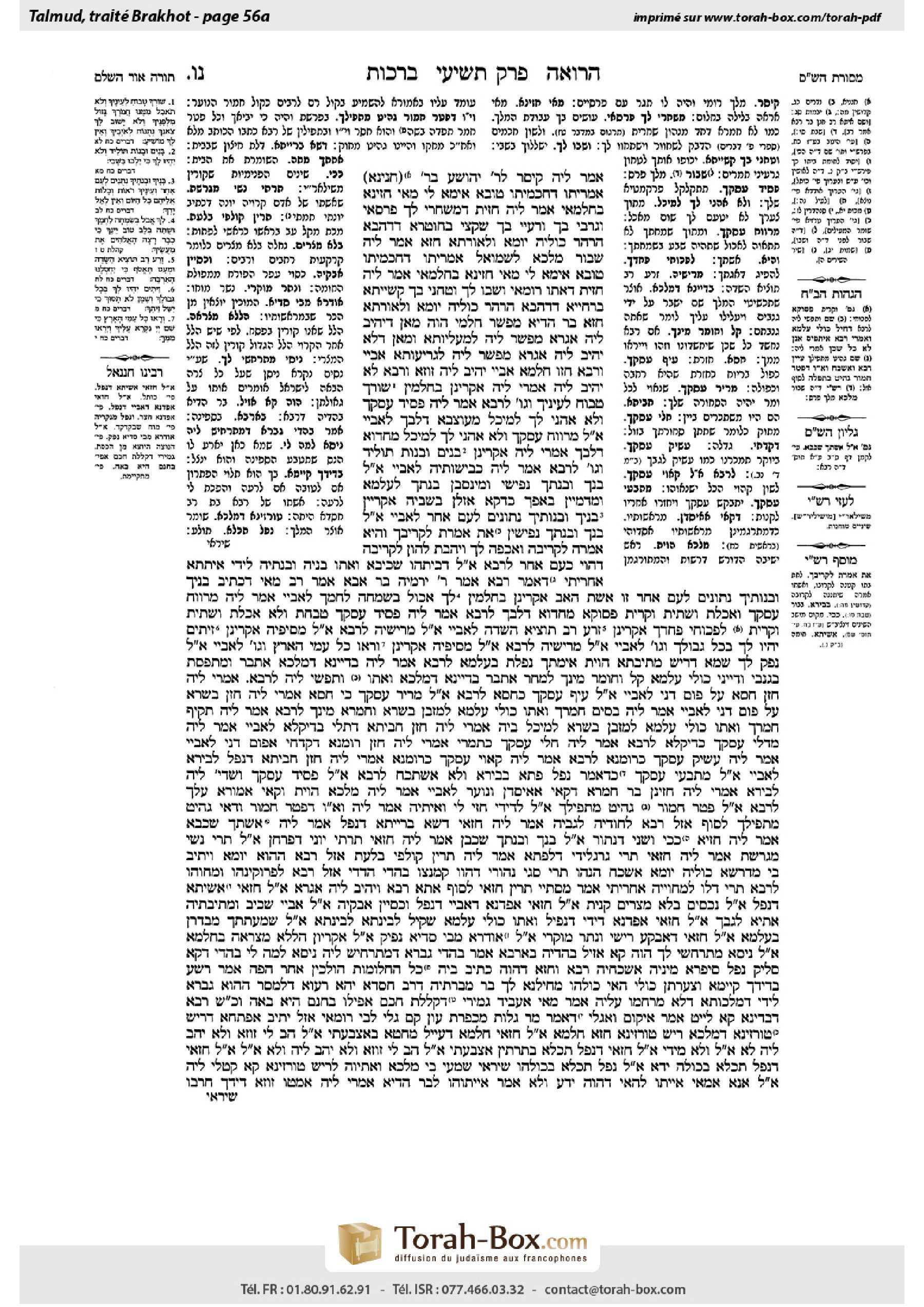
Berakhot 56a: Talmud study for Daf Yomi
Study the Talmud for Daf Yomi with scanned pages, Hebrew text, English translations from Sefaria and AI-generated French translations.
Passage selection and English or AI-generated French translation are available where the scan has annotations. Daf Study is independent of Torah-Box and Sefaria.
Browse Berakhot · ברכות · All tractatesBerakhot 56a text and translations
This page of Berakhot includes the Aramaic text, an English translation and an AI-generated French translation, alongside the scan above.
ברכות נ״ו א · Aramaic and Hebrew text
אֲמַר לֵיהּ קֵיסָר לְרַבִּי יְהוֹשֻׁעַ בְּרַבִּי חֲנַנְיָא: אָמְרִיתוּ דְּחָכְמִיתוּ טוּבָא, אֵימָא לִי מַאי חָזֵינָא בְּחֶלְמַאי. אֲמַר לֵיהּ: חָזֵית דִּמְשַׁחֲרִי לָךְ פָּרְסָאֵי וְגָרְבִי בָּךְ, וְרָעֲיִי בָּךְ שִׁקְצֵי בְּחוּטְרָא דְּדַהֲבָא. הַרְהַר כּוּלֵּיהּ יוֹמָא, וּלְאוּרְתָּא חֲזָא. אֲמַר לֵיהּ שַׁבּוּר מַלְכָּא, לִשְׁמוּאֵל: אָמְרִיתוּ דְּחָכְמִיתוּ טוּבָא, אֵימָא לִי מַאי חָזֵינָא בְּחֶלְמַאי. אֲמַר לֵיהּ: חָזֵית דְּאָתוּ רוֹמָאֵי וְשָׁבוּ לָךְ, וְטָחֲנִי בָּךְ קַשְׁיָיתָא בְּרִחְיָיא דְּדַהֲבָא. הַרְהַר כּוּלֵּיהּ יוֹמָא, וּלְאוּרְתָּא חֲזָא.
בַּר הֶדְיָא מְפַשַּׁר חֶלְמֵי הֲוָה. מַאן דְּיָהֵיב לֵיהּ אַגְרָא — מְפַשַּׁר לֵיהּ לִמְעַלְּיוּתָא, וּמַאן דְּלָא יָהֵיב לֵיהּ אַגְרָא — מְפַשַּׁר לֵיהּ לִגְרִיעוּתָא. אַבָּיֵי וְרָבָא חֲזוֹ חֶלְמָא. אַבָּיֵי יְהֵיב לֵיהּ זוּזָא, וְרָבָא לָא יְהֵיב לֵיהּ. אָמְרִי לֵיהּ: אַקְרִינַן בְּחֶלְמִין ״שׁוֹרְךָ טָבוּחַ לְעֵינֶיךָ וְגוֹ׳״. לְרָבָא אֲמַר לֵיהּ: פָּסֵיד עִסְקָךְ וְלָא אַהֲנִי לָךְ לְמֵיכַל מֵעוּצְבָּא דְּלִבָּךְ. לְאַבָּיֵי אֲמַר לֵיהּ: מַרְוַוח עִסְקָךְ וְלָא אַהֲנִי לָךְ לְמֵיכַל מֵחֶדְוָא דְּלִבָּךְ.
אָמְרִי לֵיהּ: אַקְרִינַן ״בָּנִים וּבָנוֹת תּוֹלִיד וְגוֹ׳״ לְרָבָא אֲמַר לֵיהּ: כְּבִישׁוּתֵיהּ. לְאַבָּיֵי אֲמַר לֵיהּ: בְּנָךְ וּבְנָתָךְ נְפִישִׁי, וּמִינַּסְבָן בְּנָתָךְ לְעָלְמָא, וּמִדַּמְיָין בְּאַפָּךְ כִּדְקָא אָזְלָן בְּשִׁבְיָה.
אַקְרְיֻין ״בָּנֶיךָ וּבְנֹתֶיךָ נְתֻנִים לְעַם אַחֵר״. לְאַבָּיֵי אֲמַר לֵיהּ: בְּנָךְ וּבְנָתָךְ נְפִישִׁין, אַתְּ אָמְרַתְּ לְקָרִיבָךְ וְהִיא אָמְרָה לְקָרִיבַהּ, וְאָכְפָה לָךְ וְיָהֲבַתְּ לְהוֹן לְקָרִיבַהּ, דְּהָוֵי כְּעַם אַחֵר. לְרָבָא אֲמַר לֵיהּ: דְּבֵיתְהוּ שְׁכִיבָא, וְאָתוּ בְּנֵיהּ וּבְנָתֵיהּ לִידֵי אִיתְּתָא אַחֲרִיתִי. דְּאָמַר רָבָא אָמַר רַבִּי יִרְמְיָה בַּר אַבָּא אָמַר רַב: מַאי דִּכְתִיב ״בָּנֶיךָ וּבְנֹתֶיךָ נְתֻנִים לְעַם אַחֵר״ — זוֹ אֵשֶׁת הָאָב.
אַקְרִינַן בְּחֶלְמִין: ״לֵךְ אֱכֹל בְּשִׂמְחָה לַחְמֶךָ״. לְאַבָּיֵי אֲמַר לֵיהּ: מַרְוַוח עִסְקָךְ וְאָכְלַתְּ וְשָׁתֵית וְקָרֵית פְּסוּקָא מֵחֶדְוָא דְלִבָּךְ. לְרָבָא אֲמַר לֵיהּ: פָּסֵיד עִסְקָךְ, טָבְחַתְּ וְלָא אָכְלַתְּ וְשָׁתֵית וְקָרֵית לְפַכּוֹחֵי פַּחְדָּךְ.
אַקְרִינַן ״זֶרַע רַב תּוֹצִיא הַשָּׂדֶה״. לְאַבָּיֵי אֲמַר לֵיהּ מֵרֵישֵׁיהּ, לְרָבָא אֲמַר לֵיהּ מִסֵּיפֵיהּ.
אַקְרִינַן ״זֵיתִים יִהְיוּ לְךָ בְּכׇל גְּבוּלֶךָ וְגוֹ׳״. לְאַבָּיֵי אֲמַר לֵיהּ מֵרֵישֵׁיהּ, לְרָבָא אֲמַר לֵיהּ מִסֵּיפֵיהּ.
אַקְרִינַן ״וְרָאוּ כׇּל עַמֵּי הָאָרֶץ וְגוֹ׳״. לְאַבָּיֵי אֲמַר לֵיהּ: נָפֵק לָךְ שְׁמָא דְּרֵישׁ מְתִיבְתָּא הָוֵית, אֵימְתָךְ נְפַלַת בְּעָלְמָא. לְרָבָא אֲמַר לֵיהּ: בֵּדַיְינָא דְּמַלְכָּא אִתְּבַר, וּמִתְּפַסַתְּ בְּגַנָּבֵי, וְדָיְינִי כּוּלֵּי עָלְמָא קַל וָחוֹמֶר מִינָּךְ. לִמְחַר אִתְּבַר בֵּדַיְינָא דְּמַלְכָּא וַאֲתוֹ וְתָפְשִׂי לֵיהּ לְרָבָא.
אָמְרִי לֵיהּ: חֲזַן חַסָּא עַל פּוּם דַּנֵּי. לְאַבָּיֵי אֲמַר לֵיהּ: עִיף עִסְקָךְ כְּחַסָּא. לְרָבָא אֲמַר לֵיהּ: מָרִיר עִסְקָךְ כִּי חַסָּא.
אָמְרִי לֵיהּ: חֲזַן בִּשְׂרָא עַל פּוּם דַּנֵּי. לְאַבָּיֵי אֲמַר לֵיהּ: בָּסֵים חַמְרָךְ, וְאָתוּ כּוּלֵּי עָלְמָא לְמִזְבַּן בִּשְׂרָא וְחַמְרָא מִינָּךְ. לְרָבָא אֲמַר לֵיהּ: תָּקֵיף חַמְרָךְ, וְאָתוּ כּוּלֵּי עָלְמָא לְמִזְבַּן בִּשְׂרָא לְמֵיכַל בֵּיהּ.
אָמְרִי לֵיהּ: חֲזַן חָבִיתָא דִּתְלֵי בְּדִיקְלָא. לְאַבָּיֵי אֲמַר לֵיהּ: מִדְּלֵי עִסְקָךְ כְּדִיקְלָא. לְרָבָא אֲמַר לֵיהּ: חֲלֵי עִסְקָךְ כְּתַמְרֵי.
אָמְרִי לֵיהּ: חֲזַן רוּמָּנָא דְּקָדְחָא אַפּוּם דַּנֵּי, לְאַבָּיֵי אֲמַר לֵיהּ: עֲשִׁיק עִסְקָךְ כְּרוּמָּנָא. לְרָבָא אֲמַר לֵיהּ: קָאוֵי עִסְקָךְ כְּרוּמָּנָא.
אָמְרִי לֵיהּ: חֲזַן חָבִיתָא דִּנְפַל לְבֵירָא. לְאַבָּיֵי אֲמַר לֵיהּ: מִתְבְּעֵי עִסְקָךְ, כִּדְאָמַר ״נְפַל פִּתָּא בְּבֵירָא וְלָא אִשְׁתְּכַח״. לְרָבָא אֲמַר לֵיהּ: פָּסֵיד עִסְקָךְ וְשָׁדֵית לֵיהּ לְבֵירָא.
אָמְרִי לֵיהּ: חֲזֵינַן בַּר חֲמָרָא דְּקָאֵי אַאִיסָדַן וְנוֹעֵר. לְאַבָּיֵי אֲמַר לֵיהּ: מַלְכָּא הָוֵית, וְקָאֵי אָמוֹרָא עֲלָךְ. לְרָבָא אֲמַר לֵיהּ: ״פֶּטֶר חֲמוֹר״ גְּהִיט מִתְּפִילָּךְ. אֲמַר לֵיהּ: לְדִידִי חֲזֵי לִי וְאִיתֵיהּ. אֲמַר לֵיהּ: וָאו דְּ״פֶטֶר חֲמוֹר״ וַדַּאי גְּהִיט מִתְּפִילָּךְ.
לְסוֹף אֲזַל רָבָא לְחוֹדֵיהּ לְגַבֵּיהּ. אֲמַר לֵיהּ: חֲזַאי דַּשָּׁא בָּרָיְיתָא דִּנְפַל. אֲמַר לֵיהּ: אִשְׁתְּךָ שָׁכְבָא. אֲמַר לֵיהּ: חֲזַאי כַּכַּי וְשִׁנַּי דִּנְתוּר. אֲמַר לֵיהּ: בְּנָךְ וּבְנָתָךְ שָׁכְבָן. אֲמַר לֵיהּ: חֲזַאי תַּרְתֵּי יוֹנֵי דְּפָרְחָן. אֲמַר לֵיהּ: תְּרֵי נְשֵׁי מְגָרְשַׁתְּ. אֲמַר לֵיהּ: חֲזַאי תְּרֵי גַּרְגְּלִידֵי דְלִפְתָּא. אֲמַר לֵיהּ: תְּרֵין קוּלְפֵי בָּלְעַתְּ. אֲזַל רָבָא הָהוּא יוֹמָא וִיתֵיב בֵּי מִדְרְשָׁא כּוּלֵּיהּ יוֹמָא. אַשְׁכַּח הָנְהוּ תְּרֵי סַגִּי נְהוֹרֵי דַּהֲווֹ קָמִנְּצוּ בַּהֲדֵי הֲדָדֵי. אֲזַל רָבָא לְפָרוֹקִינְהוּ, וּמְחוֹהוּ לְרָבָא תְּרֵי. דְּלוֹ לְמַחוֹיֵיהּ אַחֲרִיתִי, אֲמַר: מִסְתַּיי, תְּרֵין חֲזַאי.
לְסוֹף אֲתָא רָבָא וִיהֵיב לֵיהּ אַגְרָא. אֲמַר לֵיהּ: חֲזַאי אֲשִׁיתָא דִּנְפַל. אֲמַר לֵיהּ: נְכָסִים בְּלֹא מְצָרִים קָנֵית. אֲמַר לֵיהּ: חֲזַאי אַפַּדְנָא דְּאַבָּיֵי דִּנְפַל וְכַסְּיַין אַבְקֵיהּ. אֲמַר לֵיהּ: אַבָּיֵי שָׁכֵיב וּמְתִיבְתֵּיהּ אָתְיָא לְגַבָּךְ. אֲמַר לֵיהּ: חֲזַאי אַפַּדְנָא דִידִי דִּנְפַל, וַאֲתוֹ כּוּלֵּי עָלְמָא שְׁקוּל לְבֵינְתָּא לְבֵינְתָּא. אֲמַר לֵיהּ: שְׁמַעְתָּתָךְ מִבַּדְּרָן בְּעָלְמָא. אֲמַר לֵיהּ: חֲזַאי דְּאִבְּקַע רֵישִׁי וּנְתַר מוּקְרִי. אֲמַר לֵיהּ: אוּדְרָא מִבֵּי סָדְיָא נָפֵיק. אֲמַר לֵיהּ: אַקְרְיוּן הַלֵּלָא מִצְרָאָה בְּחֶלְמָא. אֲמַר לֵיהּ: נִיסֵּי מִתְרַחְשִׁי לָךְ.
הֲוָה קָא אָזֵיל בַּהֲדֵיהּ בְּאַרְבָּא. אָמַר: בַּהֲדֵי גַּבְרָא דְּמִתְרְחִישׁ לֵיהּ נִיסָּא לְמָה לִי. בַּהֲדֵי דְּקָא סָלֵיק נְפַל סִיפְרָא מִינֵּיהּ. אַשְׁכְּחֵיהּ רָבָא וַחֲזָא דַּהֲוָה כְּתִיב בֵּיהּ ״כׇּל הַחֲלוֹמוֹת הוֹלְכִין אַחַר הַפֶּה״. אֲמַר: רָשָׁע, בְּדִידָךְ קָיְימָא, וְצַעַרְתַּן כּוּלֵּי הַאי. כּוּלְּהוּ מָחֵילְנָא לָךְ, בַּר מִבְּרַתֵּיה דְּרַב חִסְדָּא. יְהֵא רַעֲוָא דְּלִמְּסַר הַהוּא גַּבְרָא לִידֵי דְּמַלְכוּתָא דְּלָא מְרַחֲמוּ עֲלֵיהּ.
אָמַר: מַאי אַעֲבֵיד? גְּמִירִי דְּקִלְלַת חָכָם, אֲפִילּוּ בְּחִנָּם הִיא בָּאָה, וְכׇל שֶׁכֵּן רָבָא דִּבְדִינָא קָא לָיֵיט. אָמַר: אֵיקוּם וְאֶגְלֵי, דַּאֲמַר מָר: גָּלוּת מְכַפֶּרֶת עָוֹן.
קָם גְּלִי לְבֵי רוֹמָאֵי. אֲזַל יְתֵיב אַפִּתְחָא דְּרֵישׁ טוּרְזִינָא דְּמַלְכָּא. רֵישׁ טוּרְזִינָא חֲזָא חֶלְמָא. אֲמַר לֵיהּ: חֲזַאי חֶלְמָא דְּעָיֵיל מַחְטָא בְּאֶצְבַּעְתִּי. אֲמַר לֵיהּ: הַב לִי זוּזָא, וְלָא יְהַב לֵיהּ. לָא אֲמַר לֵיהּ וְלָא מִידֵּי. אֲמַר לֵיהּ: חֲזַאי דִּנְפַל תִּכְלָא בְּתַרְתֵּין אֶצְבְּעָתִי. אֲמַר לֵיהּ: הַב לִי זוּזָא, וְלָא יְהַב לֵיהּ, וְלָא אֲמַר לֵיהּ. אֲמַר לֵיהּ: חֲזַאי דִּנְפַל תִּכְלָא בְּכוּלַּהּ יְדָא. אֲמַר לֵיהּ: נְפַל תִּכְלָא בְּכוּלְּהוּ שִׁירָאֵי. שָׁמְעִי בֵּי מַלְכָּא, וְאַתְיוּהּ לְרֵישׁ טוּרְזִינָא קָא קָטְלִי לֵיהּ. אָמַר לְהוּ: אֲנָא אַמַּאי? אַיְיתוֹ לְהַאי דַּהֲוָה יָדַע וְלָא אֲמַר. אַיְיתוּהוּ בַּר הֶדְיָא, אָמְרִי לֵיהּ: אַמַּטּוּ זוּזָא דִידָךְ חֲרַבוּ
Berakhot 56a · English translation
On a similar note, the Gemara relates that the Roman emperor said to Rabbi Yehoshua, son of Rabbi Ḥananya: You Jews say that you are extremely wise. If that is so, tell me what I will see in my dream. Rabbi Yehoshua said to him: You will see the Persians capture you, and enslave you, and force you to herd unclean animals with a golden staff. He thought the entire day about the images described to him by Rabbi Yehoshua and that night he saw it in his dream. King Shapur of Persia said to Shmuel: You Jews say that you are extremely wise. If that is so, tell me what I will see in my dream. Shmuel said to him: You will see the Romans come and take you into captivity and force you to grind date pits in mills of gold. He thought the entire day about the images described to him by Shmuel, and that night he saw it in his dream.
The Gemara relates: Bar Haddaya was an interpreter of dreams. For one who gave him a fee, he would interpret the dream favorably, and for one who did not give him a fee, he would interpret the dream unfavorably. The Gemara relates: There was an incident in which both Abaye and Rava saw an identical dream and they asked bar Haddaya to interpret it. Abaye gave him money and paid his fee, while Rava did not give him money. They said to him: The verse: “Your ox shall be slain before your eyes and you shall not eat thereof” (Deuteronomy 28:31) was read to us in our dream. He interpreted their dream and to Rava he said: Your business will be lost and you will derive no pleasure from eating because of the extreme sadness of your heart. To Abaye he said: Your business will profit and you will be unable to eat due to the joy in your heart.
They said to him: The verse, “You shall beget sons and daughters, but they shall not be yours; for they shall go into captivity” (Deuteronomy 28:41), was read to us in our dream. He interpreted their dreams, and to Rava he said its literal, adverse sense. To Abaye he said: Your sons and daughters will be numerous, and your daughters will be married to outsiders and it will seem to you as if they were taken in captivity.
They said to him: The verse: “Your sons and your daughters shall be given unto another people” (Deuteronomy 28:32), was read to us in our dream. To Abaye he said: Your sons and daughters will be numerous. You say, that they should marry your relatives and your wife says that they should marry her relatives and she will impose her will upon you and they will be given in marriage to her relatives, which is like another nation as far as you are concerned. To Rava he said: Your wife will die and your sons and daughters will come into the hands of another woman. As Rava said that Rabbi Yirmeya bar Abba said that Rav said: What is the meaning of that which is written in the verse: “Your sons and your daughters shall be given unto another people”? This refers to the father’s wife, the stepmother.
They said to him: The verse: “Go your way, eat your bread with joy, and drink your wine with a merry heart” (Ecclesiastes 9:7) was read to us in our dream. To Abaye he said: Your business will profit and you will eat and drink and read the verse out of the joy of your heart. To Rava he said: Your business will be lost, you will slaughter but not eat, you will drink wine and read passages from the Bible in order to allay your fears.
They said to him: The verse: “You shall carry much seed out into the field, and shall gather little in; for the locust shall consume it” (Deuteronomy 28:38), was read to us in our dream. To Abaye he said from the beginning of the verse, that he will enjoy an abundant harvest. To Rava he said from the end of the verse, that his harvest will be destroyed.
They said to him: The verse: “You shall have olive trees throughout all your borders, but you shall not anoint yourself with the oil; for your olives shall drop off” (Deuteronomy 28:40), was read to us in our dream. And again, to Abaye he said from the beginning of the verse. To Rava he said from the end of the verse.
They said to him: The verse: “All the peoples of the earth shall see that the name of the Lord is called upon you; and they shall be afraid of you” (Deuteronomy 28:10), was read to us in our dream. To Abaye he said: Your name will become well-known as head of the yeshiva, and you will be feared by all. To Rava he said: The king’s treasury was broken into and you will be apprehended as a thief, and everyone will draw an a fortiori inference from you: If Rava who is wealthy and of distinguished lineage can be arrested on charges of theft, what will become of the rest of us? Indeed, the next day, the king’s treasury was burglarized, and they came and apprehended Rava.
Abaye and Rava said to him: We saw lettuce on the mouth of the barrels. To Abaye he said: Your business will double like lettuce whose leaves are wide and wrinkled. To Rava he said: Your work will be bitter like a lettuce stalk.
They said to him: We saw meat on the mouth of barrels. To Abaye he said: Your wine will be sweet and everyone will come to buy meat and wine from you. To Rava he said: Your wine will spoil, and everyone will go to buy meat in order to eat with it, to dip the meat in your vinegar.
They said to him: We saw a barrel hanging from a palm tree. To Abaye he said: Your business will rise like a palm tree. To Rava he said: Your work will be sweet like dates which are very cheap in Babylonia, indicating that you will be compelled to sell your merchandise at a cheap price.
They said to him: We saw a pomegranate taking root on the mouth of barrels. To Abaye he said: Your business will increase in value like a pomegranate. To Rava he said: Your work will go sour like a pomegranate.
They said to him: We saw a barrel fall into a pit. To Abaye he said: Your merchandise will be in demand as the adage says: Bread falls in a pit and is not found. In other words, everyone will seek your wares and they will not find them due to increased demand. To Rava he said: Your merchandise will be ruined and you will throw it away into a pit.
They said to him: We saw a donkey foal standing near our heads, braying. To Abaye he said: You will be a king, that is to say, head of the yeshiva, and an interpreter will stand near you to repeat your teachings to the masses out loud. To Rava he said: I see the words peter ḥamor, first-born donkey, erased from your phylacteries. Rava said to him: I myself saw it and it is there. Bar Haddaya said to him: The letter vav of the word peter ḥamor is certainly erased from your phylacteries.
Ultimately, Rava went to bar Haddaya alone. Rava said to him: I saw the outer door of my house fall. Bar Haddaya said to him: Your wife will die, as she is the one who protects the house. Rava said to him: I saw my front and back teeth fall out. He said to him: Your sons and daughters will die. Rava said to him: I saw two doves that were flying. He said to him: You will divorce two women. Rava said to him: I saw two turnip heads [gargelidei]. He said to him: You will receive two blows with a club shaped like a turnip. That same day Rava went and sat in the study hall the entire day. He discovered these two blind people who were fighting with each other. Rava went to separate them and they struck Rava two blows. When they raised their staffs to strike him an additional blow, he said: That is enough for me, I only saw two.
Ultimately, Rava came and gave him, bar Haddaya, a fee. And then Rava said to him: I saw my wall fall. Bar Haddaya said to him: You will acquire property without limits. Rava said to him: I saw Abaye’s house [appadna] fall and its dust covered me. Bar Haddaya said to him: Abaye will die and his yeshiva will come to you. Rava said to him: I saw my house fall, and everyone came and took the bricks. He said to him: Your teachings will be disseminated throughout the world. Rava said to him: I saw that my head split and my brain fell out. He said to him: A feather will fall out of the pillow near your head. Rava said to him: The Egyptian hallel, the hallel that celebrates the Exodus, was read to me in a dream. He said to him: Miracles will be performed for you.
Bar Haddaya was going with Rava on a ship; bar Haddaya said: Why am I going with a person for whom miracles will be performed, lest the miracle will be that the ship will sink and he alone will be saved. As bar Haddaya was climbing onto the ship a book fell from him. Rava found it and saw: All dreams follow the mouth, written therein. He said to bar Haddaya: Scoundrel. It was dependent on you, and you caused me so much suffering. I forgive you for everything except for the daughter of Rav Ḥisda, Rava’s wife, whom bar Haddaya predicted would die. May it be Your will that this man be delivered into the hands of a kingdom that has no compassion on him.
Bar Haddaya said to himself: What will I do? We learned through tradition that the curse of a Sage, even if baseless, comes true. And all the more so in the case of Rava, as he cursed me justifiably. He said to himself: I will get up and go into exile, as the Master said: Exile atones for transgression.
He arose and exiled himself to the seat of the Roman government. He went and sat by the entrance, where the keeper of the king’s wardrobe stood. The wardrobe guard dreamed a dream. He said to bar Haddaya: I saw in the dream that a needle pierced my finger. Bar Haddaya said to him: Give me a zuz. He did not give him the coin so bar Haddaya said nothing to him. Again, the guard said to him: I saw a worm that fell between my two fingers, eating them. Bar Haddaya said to him: Give me a zuz. He did not give him the coin, so bar Haddaya said nothing to him. Again, the guard said to him: I saw that a worm fell upon my entire hand, eating it. Bar Haddaya said to him: A worm fell upon and ate all the silk garments. They heard of this in the king’s palace and they brought the wardrobe keeper and were in the process of executing him. He said to them: Why me? Bring the one who knew and did not say the information that he knew. They brought bar Haddaya and said to him: Because of your zuz, ruin came upon
Berakhot 56a · Traduction française (IA)
Sur un sujet similaire, le Guemara rapporte que l'empereur romain dit à Rabbi Yéhoshua, fils de Rabbi Ḥananyah : Vous Juifs dites que vous êtes extrêmement sages. Si c'est ainsi, dites-moi ce que je verrai dans mon rêve. Rabbi Yéhoshua lui dit : Vous verrez les Perses vous capturer, vous esclaviser et vous forcer à dresser des animaux impurs avec un bâton d'or. Il réfléchit toute la journée aux images décrites par Rabbi Yéhoshua et, cette nuit-là, il les vit dans son rêve. L'empereur Shapur des Perses dit à Shmuel : Vous Juifs dites que vous êtes extrêmement sages. Si c'est ainsi, dites-moi ce que je verrai dans mon rêve. Shmuel lui dit : Vous verrez les Romains venir et vous emmener en captivité, vous forcer à moudre des noyaux de dattes dans des moules d'or. Il réfléchit toute la journée aux images décrites par Shmuel et, cette nuit-là, il les vit dans son rêve.
Le Guemara rapporte : Bar Haddaya était un interprète de rêves. Pour celui qui lui donnait un prix, il interprétait le rêve favorablement, et pour celui qui ne lui donnait pas de prix, il interprétait le rêve de manière défavorable. Le Guemara rapporte : Il y avait un incident où Abaye et Rava virent un rêve identique et ils demandèrent à Bar Haddaya d'interpréter ce rêve. Abaye lui donna de l'argent et paya son prix, tandis que Rava ne lui donna pas d'argent. Ils lui dirent : La parole : « Ton bœuf sera tué devant tes yeux et tu ne mangeras pas de lui » (Deutéronome 28:31) a été lue à nous dans notre rêve. Il interpréta leurs rêves et à Rava il dit : Ton commerce sera perdu et tu ne trouveras aucun plaisir à manger en raison de la tristesse extrême de ton cœur. À Abaye il dit : Ton commerce sera profitable et tu ne pourras pas manger à cause de la joie de ton cœur.
Ils lui dirent : La parole : « Tu donneras des enfants et des enfants, mais ils ne seront pas à toi ; car ils iront en captivité » (Deutéronome 28:41) a été lue à nous dans notre rêve. Il interpréta leurs rêves et à Rava il dit son sens littéral, défavorable. À Abaye il dit : Tes enfants et tes filles seront nombreux, et tes filles épouseront des étrangers et cela te semblera comme si elles étaient en captivité.
Ils lui dirent : La parole : « Tes fils et tes filles seront donnés à un autre peuple » (Deutéronome 28:32) a été lue à nous dans notre rêve. À Abaye il dit : Tes fils et tes filles seront nombreux. Tu dis qu'ils doivent épouser tes parents et ta femme dit qu'ils doivent épouser ses parents et elle imposera sa volonté sur toi et ils seront mariés à ses parents, ce qui est comme un autre peuple pour toi. À Rava il dit : Ta femme mourra et tes fils et tes filles passeront entre les mains d'une autre femme. Comme Rava dit que Rabbi Yirméya bar Abba a dit que Rav a dit : Quel est le sens de la parole : « Tes fils et tes filles seront donnés à un autre peuple » ? Cela fait référence à la femme du père, la belle-mère.
Ils lui dirent : La parole : « Va, mange ton pain avec joie, et bois ton vin avec un cœur joyeux » (Ecclésiaste 9:7) a été lue à nous dans notre rêve. À Abaye il dit : Ton commerce sera profitable et tu mangeras et boiras et liras la parole en raison de la joie de ton cœur. À Rava il dit : Ton commerce sera perdu, tu tueras mais ne mangeras pas, tu boiras du vin et liras des passages de la Bible pour apaiser tes craintes.
Ils lui dirent : La parole : « Tu semeras beaucoup de grain dans le champ, et tu récolteras peu ; car la locustes dévoreront » (Deutéronome 28:38) a été lue à nous dans notre rêve. À Abaye il dit du début de la parole, que tu profiteras d'une récolte abondante. À Rava il dit de la fin de la parole, que ta récolte sera détruite.
Ils lui dirent : La parole : « Tu auras des oliviers dans toute ta frontière, mais tu ne te feras pas huiler ; car tes olives tomberont » (Deutéronome 28:40) a été lue à nous dans notre rêve. Et encore, à Abaye il dit du début de la parole. À Rava il dit de la fin de la parole.
Ils lui dirent : La parole : « Tout les peuples de la terre verront que le nom du Seigneur est invoqué sur toi ; et ils craindront toi » (Deutéronome 28:10) a été lue à nous dans notre rêve. À Abaye il dit : Ton nom deviendra célèbre comme chef de la yeshiva, et tu seras craint de tous. À Rava il dit : Le trésor du roi a été cambriolé et tu seras arrêté comme voleur, et tout le monde en tirera une conclusion par a fortiori : Si Rava, qui est riche et de noble lignage, peut être arrêté pour des accusations de vol, que deviendra le reste de nous ? En effet, le lendemain, le trésor du roi avait été cambriolé et ils vinrent et arrêtèrent Rava.
Abaye et Rava dirent à lui : Nous avons vu de la laitue sur la bouche des tonneaux. À Abaye il dit : Ton commerce doublera comme de la laitue dont les feuilles sont larges et ridées. À Rava il dit : Ton travail sera amer comme un tige de laitue.
Ils lui dirent : Nous avons vu de la viande sur la bouche des tonneaux. À Abaye il dit : Ton vin sera doux et tout le monde viendra acheter de la viande et du vin chez toi. À Rava il dit : Ton vin se gâttera, et tout le monde ira acheter de la viande pour le manger avec, pour tremper la viande dans ton vinaigre.
Ils lui dirent : Nous avons vu un tonneau suspendu à un palmier. À Abaye il dit : Ton commerce augmentera comme un palmier. À Rava il dit : Ton travail sera doux comme des dattes très bon marché en Babylone, indiquant que tu seras contraint de vendre tes marchandises à un prix bas.
Ils lui dirent : Nous avons vu une grenade prendre racine sur la bouche des tonneaux. À Abaye il dit : Ton commerce augmentera en valeur comme une grenade. À Rava il dit : Ton travail se gâttera comme une grenade.
Ils lui dirent : Nous avons vu une barrique tomber dans un puits. À Abaye, il dit : Vos marchandises seront en demande, comme l'adage le dit : Le pain tombe dans un puits et n'est pas trouvé. Autrement dit, tout le monde cherchera vos marchandises et ne les trouvera pas à cause de la forte demande. À Rava, il dit : Vos marchandises seront ruinées et vous les jeterez dans un puits.
Ils lui dirent : Nous avons vu un poulain de chameau près de nos têtes, mugissant. À Abaye, il dit : Vous serez roi, c'est-à-dire, chef de la yeshiva, et un interprète se tiendra près de vous pour répéter vos enseignements à la foule. À Rava, il dit : Je vois les mots pétér ḥamor, premier poulain de chameau, effacés de vos phylactères. Rava dit à lui : Je l'ai moi-même vu et il est là. Bar Haddaya dit à lui : La lettre vav du mot pétér ḥamor est certainement effacée de vos phylactères.
Finalement, Rava alla seul chez Bar Haddaya. Rava dit à lui : J'ai vu la porte de ma maison tomber. Bar Haddaya dit à lui : Votre femme mourra, car c'est elle qui protège la maison. Rava dit à lui : J'ai vu mes dents de devant et de derrière tomber. Il dit à lui : Vos enfants et vos filles mourront. Rava dit à lui : J'ai vu deux moineaux qui volaient. Il dit à lui : Vous divorceriez de deux femmes. Rava dit à lui : J'ai vu deux têtes de navet [gargelidei]. Il dit à lui : Vous recevrez deux coups avec un bâton en forme de navet. Le même jour, Rava alla et s'assit toute la journée dans la salle de étude. Il découvrit ces deux aveugles qui se battaient entre eux. Rava alla les séparer et ils frappèrent Rava deux coups. Lorsqu'ils levèrent leurs bâtons pour lui donner un troisième coup, il dit : C'est assez pour moi, j'ai seulement vu deux.
Finalement, Rava vint donner à Bar Haddaya une récompense. Et puis Rava dit à lui : J'ai vu mon mur tomber. Bar Haddaya dit à lui : Vous acquerrez des biens sans limites. Rava dit à lui : J'ai vu la maison d'Abaye [appadna] tomber et sa poussière m'a recouvert. Bar Haddaya dit à lui : Abaye mourra et sa yeshiva viendra vers vous. Rava dit à lui : J'ai vu ma maison tomber, et tout le monde vint prendre les briques. Il dit à lui : Vos enseignements seront répandus dans le monde entier. Rava dit à lui : J'ai vu que ma tête s'était fendue et que mon cerveau était tombé. Il dit à lui : Une plume tombera du coussin près de votre tête. Rava dit à lui : L'hallel égyptien, l'hallel qui célèbre l'Exode, a été lu à moi en rêve. Il dit à lui : Des miracles seront faits pour vous.
Bar Haddaya était en route avec Rava sur un bateau ; Bar Haddaya dit : Pourquoi vais-je avec une personne pour laquelle des miracles seront faits, de peur que le miracle soit que le bateau coule et qu'il seul survive. Alors que Bar Haddaya montait sur le bateau, un livre tomba de lui. Rava le trouva et vit : Tous les rêves suivent la bouche, écrit dedans. Il dit à Bar Haddaya : Traître. Cela dépendait de vous, et vous m'avez causé tant de souffrance. Je vous pardonne pour tout sauf la fille de Rav Ḥisda, l'épouse de Rava, que Bar Haddaya avait prédit mourir. Que cela soit selon votre volonté que cet homme soit livré aux mains d'un royaume qui n'a pas de compassion envers lui.
Bar Haddaya se dit à lui-même : Que ferai-je ? Nous avons appris par la tradition que la malédiction d'un Sage, même infondée, se réalise. Et encore plus dans le cas de Rava, car il m'a maudis justement. Il se dit à lui-même : Je me leverai et je m'exilerai, car le Maître a dit : L'exil expie la transgression.
Il se leva et s'exila vers le siège du gouvernement romain. Il alla et s'assit à l'entrée, où le gardien des vêtements du roi était. Le gardien des vêtements rêva un rêve. Il dit à Bar Haddaya : J'ai vu dans le rêve qu'une aiguille perçait mon doigt. Bar Haddaya dit à lui : Donnez-moi un zuz. Il ne lui donna pas la pièce, donc Bar Haddaya dit rien à lui. De nouveau, le gardien dit à lui : J'ai vu un ver qui tomba entre mes deux doigts, les mangeant. Bar Haddaya dit à lui : Donnez-moi un zuz. Il ne lui donna pas la pièce, donc Bar Haddaya dit rien à lui. De nouveau, le gardien dit à lui : J'ai vu qu'un ver tomba sur toute ma main, la mangeant. Bar Haddaya dit à lui : Un ver tomba sur et mangea toutes les robes de soie. Ils entendirent cela dans le palais du roi et ils amenèrent le gardien des vêtements et étaient en train de l'exécuter. Il dit à eux : Pourquoi moi ? Apportez celui qui savait et ne dit pas l'information qu'il savait. Ils amenèrent Bar Haddaya et dirent à lui : À cause de votre zuz, la ruine est venue
Traduction française générée par IA à partir de l’édition anglaise de Sefaria. Vérifie toujours un passage avec le texte source.
Text from Sefaria: William Davidson Edition - Vocalized Aramaic (CC BY NC); William Davidson Edition - English (CC BY NC).