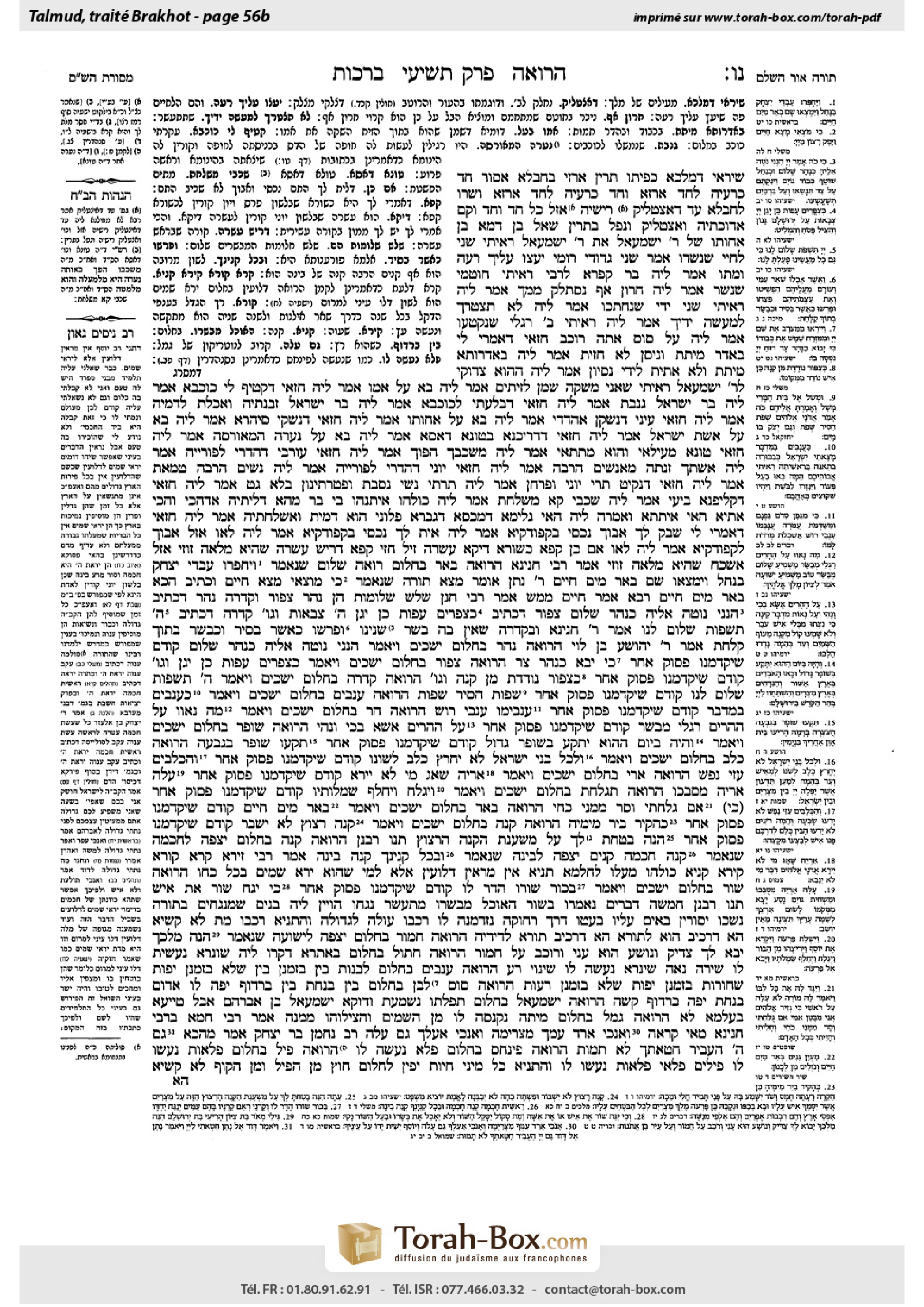
Berakhot 56b: Talmud study for Daf Yomi
Study the Talmud for Daf Yomi with scanned pages, Hebrew text, English translations from Sefaria and AI-generated French translations.
Passage selection and English or AI-generated French translation are available where the scan has annotations. Daf Study is independent of Torah-Box and Sefaria.
Browse Berakhot · ברכות · All tractatesBerakhot 56b text and translations
This page of Berakhot includes the Aramaic text, an English translation and an AI-generated French translation, alongside the scan above.
ברכות נ״ו ב · Aramaic and Hebrew text
שִׁירָאֵי דְּמַלְכָּא! כְּפִיתוּ תְּרֵין אַרְזֵי בְּחַבְלָא, אֲסוּר חַד כְּרָעֵיהּ לְחַד אַרְזָא וְחַד כְּרָעֵיהּ לְחַד אַרְזָא, וּשְׁרוֹ לְחַבְלָא עַד דְּאִצְטְלִיק רֵישֵׁיהּ. אֲזַל כׇּל חַד וְחַד וְקָם אַדּוּכְתֵּיהּ וְאִצְטְלִיק וּנְפַל בִּתְרֵין.
שָׁאַל בֶּן דָּמָא בֶּן אֲחוֹתוֹ שֶׁל רַבִּי יִשְׁמָעֵאל אֶת רַבִּי יִשְׁמָעֵאל: רָאִיתִי שְׁנֵי לְחָיַי שֶׁנָּשְׁרוּ. אָמַר: שְׁנֵי גְּדוּדֵי רוֹמִי יָעֲצוּ עָלֶיךָ רָעָה, וּמֵתוּ.
אֲמַר לֵיהּ בַּר קַפָּרָא לְרַבִּי: רָאִיתִי חוֹטְמִי שֶׁנָּשַׁר. אֲמַר לֵיהּ: חֲרוֹן אַף נִסְתַּלֵּק מִמְּךָ. אֲמַר לֵיהּ: רָאִיתִי שְׁנֵי יָדַי שֶׁנֶּחְתְּכוּ. אֲמַר לֵיהּ: לֹא תִּצְטָרֵךְ לְמַעֲשֵׂה יָדֶיךָ. אֲמַר לֵיהּ: רָאִיתִי שְׁתֵּי רַגְלַי שֶׁנִּקְטְעוּ. אֲמַר לֵיהּ: עַל סוּס אַתָּה רוֹכֵב. חֲזַאי דְּאָמְרִי לִי בַּאֲדָר מָיְתַתְּ וְנִיסָן לָא חָזֵית. אֲמַר לֵיהּ: בְּאַדְרוּתָא מָיְתַתְּ וְלָא אָתֵית לִידֵי נִסָּיוֹן.
אֲמַר לֵיהּ הָהוּא מִינָא לְרַבִּי יִשְׁמָעֵאל: רָאִיתִי שֶׁאֲנִי מַשְׁקֶה שֶׁמֶן לְזֵיתִים. אֲמַר לֵיהּ: בָּא עַל אִמּוֹ. אֲמַר לֵיהּ: חֲזַאי דִּקְטִיף לִי כּוֹכְבָא. אֲמַר לֵיהּ: בַּר יִשְׂרָאֵל גְּנַבְתְּ. אֲמַר לֵיהּ: חֲזַאי דִּבְלַעְתֵּיהּ לְכוֹכְבָא. אֲמַר לֵיהּ: בַּר יִשְׂרָאֵל זַבֵּנְתֵּיהּ וַאֲכַלְתְּ לִדְמֵיהּ. אֲמַר לֵיהּ: חֲזַאי עֵינַי דְּנָשְׁקָן אַהֲדָדֵי. אֲמַר לֵיהּ: בָּא עַל אֲחוֹתוֹ. אֲמַר לֵיהּ: חֲזַאי דִּנְשַׁקִי סֵיהֲרָא. אֲמַר לֵיהּ: בָּא עַל אֵשֶׁת יִשְׂרָאֵל. אֲמַר לֵיהּ: חֲזַאי דְּדָרֵיכְנָא בְּטוּנָא דְּאָסָא. אֲמַר לֵיהּ: בָּא עַל נַעֲרָה הַמְאוֹרָסָה. אֲמַר לֵיהּ: חֲזַאי טוּנָא מֵעִילַּאי וְהוּא מִתַּתַּאי. אֲמַר לֵיהּ: מִשְׁכָּבְךָ הָפוּךְ. אֲמַר לֵיהּ: חֲזַאי עוֹרְבֵי דְּהָדְרִי לְפוּרְיֵיהּ. אֲמַר לֵיהּ: אִשְׁתְּךָ זָנְתָה מֵאֲנָשִׁים הַרְבֵּה. אֲמַר לֵיהּ: חֲזַאי יוֹנֵי דְּהָדְרִי לְפוּרְיֵיהּ. אֲמַר לֵיהּ: נָשִׁים הַרְבֵּה טִמֵּאתָ. אֲמַר לֵיהּ: חֲזַאי דְּנָקֵיטְנָא תְּרֵי יוֹנֵי וּפָרְחָן. אֲמַר לֵיהּ: תַּרְתֵּי נְשֵׁי נְסַבְתְּ וּפְטַרְתִּינּוּן בְּלָא גֵּט.
אֲמַר לֵיהּ: חֲזַאי דְּקָלֵיפְנָא בֵּיעֵי. אֲמַר לֵיהּ: שָׁכְבֵי קָא מְשַׁלְּחַתְּ. אֲמַר לֵיהּ: כּוּלְּהוּ אִיתַנְהוּ בִּי, בַּר מֵהָא דְּלֵיתֵיהּ. אַדְּהָכִי וְהָכִי אָתְיָא הַאי אִיתְּתָא וְאָמְרָה לֵיהּ: הַאי גְּלִימָא דְּמִכַּסַּתְּ — דְּגַבְרָא פְּלוֹנִי הוּא, דְּמִית וְאַשְׁלַחְתֵּיהּ.
אֲמַר לֵיהּ: חֲזַאי דְּאָמְרִי לִי: שְׁבַק לָךְ אֲבוּךְ נִכְסֵי בְּקַפּוֹדְקְיָא. אֲמַר לֵיהּ: אִית לָךְ נִכְסֵי בְּקַפּוֹדְקְיָא? אֲמַר לֵיהּ לָאו. אֲזַל אֲבוּךְ לְקַפּוֹדְקְיָא? אֲמַר לֵיהּ: לָאו. אִם כֵּן: קַפָּא כְּשׁוּרָא, דֵּיקָא עַשְׂרָה. זִיל חֲזִי קַפָּא דְּרֵישׁ עַשְׂרָה שֶׁהִיא מְלֵאָה זוּזֵי. אֲזַל אַשְׁכַּח שֶׁהִיא מְלֵאָה זוּזֵי.
אָמַר רַבִּי חֲנִינָא: הָרוֹאֶה בְּאֵר בַּחֲלוֹם — רוֹאֶה שָׁלוֹם, שֶׁנֶּאֱמַר: ״וַיַּחְפְּרוּ עַבְדֵי יִצְחָק בַּנָּחַל וַיִּמְצְאוּ שָׁם בְּאֵר מַיִם חַיִּים״. רַבִּי נָתָן אוֹמֵר: מָצָא תּוֹרָה — שֶׁנֶּאֱמַר: ״כִּי מֹצְאִי מָצָא חַיִּים״, וּכְתִיב הָכָא: ״בְּאֵר מַיִם חַיִּים״. רָבָא אָמַר: חַיִּים מַמָּשׁ.
אָמַר רַבִּי חָנָן שָׁלֹשׁ שְׁלוֹמוֹת הֵן: נָהָר, צִפּוֹר, וּקְדֵרָה. נָהָר — דִּכְתִיב: ״הִנְנִי נֹטֶה אֵלֶיהָ כְּנָהָר שָׁלוֹם״. צִפּוֹר — דִּכְתִיב: ״כְּצִפֳּרִים עָפוֹת כֵּן יָגֵן ה׳ צְבָאוֹת וְגוֹ׳״. קְדֵרָה — דִּכְתִיב: ״ה׳ תִּשְׁפֹּת שָׁלוֹם לָנוּ״. אָמַר רַבִּי חֲנִינָא: וּבִקְדֵרָה שֶׁאֵין בָּהּ בָּשָׂר שָׁנִינוּ. ״וּפָרְשׂוּ כַּאֲשֶׁר בַּסִּיר וּכְבָשָׂר בְּתוֹךְ קַלָּחַת״.
אָמַר רַבִּי יְהוֹשֻׁעַ בֶּן לֵוִי: הָרוֹאֶה נָהָר בַּחֲלוֹם, יַשְׁכִּים וְיֹאמַר: ״הִנְנִי נֹטֶה אֵלֶיהָ כְּנָהָר שָׁלוֹם״, קוֹדֶם שֶׁיִּקְדְּמֶנּוּ פָּסוּק אַחֵר — ״כִּי יָבֹא כַנָּהָר צָר״. הָרוֹאֶה צִפּוֹר בַּחֲלוֹם, יַשְׁכִּים וְיֹאמַר ״כְּצִפֳּרִים עָפוֹת כֵּן יָגֵן וְגוֹ׳״, קוֹדֶם שֶׁיִּקְדְּמֶנּוּ פָּסוּק אַחֵר — ״כְּצִפּוֹר נוֹדֶדֶת מִן קִנָּהּ וְגוֹ׳״. הָרוֹאֶה קְדֵרָה בַּחֲלוֹם, יַשְׁכִּים וְיֹאמַר: ״ה׳ תִּשְׁפֹּת שָׁלוֹם לָנוּ״, קוֹדֶם שֶׁיִּקְדְּמֶנּוּ פָּסוּק אַחֵר — ״שְׁפֹת הַסִּיר שְׁפֹת״.
הָרוֹאֶה עֲנָבִים בַּחֲלוֹם, יַשְׁכִּים וְיֹאמַר ״כַּעֲנָבִים בַּמִּדְבָּר״, קוֹדֶם שֶׁיִּקְדְּמֶנּוּ פָּסוּק אַחֵר — ״עֲנָבֵמוֹ עִנְּבֵי רוֹשׁ״. הָרוֹאֶה הַר בַּחֲלוֹם, יַשְׁכִּים וְיֹאמַר — ״מַה נָּאווּ עַל הֶהָרִים רַגְלֵי מְבַשֵּׂר״, קוֹדֶם שֶׁיִּקְדְּמֶנּוּ פָּסוּק אַחֵר — ״עַל הֶהָרִים אֶשָּׂא בְכִי וָנֶהִי״.
הָרוֹאֶה שׁוֹפָר בַּחֲלוֹם, יַשְׁכִּים וְיֹאמַר ״וְהָיָה בַּיּוֹם הַהוּא יִתָּקַע בְּשׁוֹפָר גָּדוֹל״, קוֹדֶם שֶׁיִּקְדְּמֶנּוּ פָּסוּק אַחֵר — ״תִּקְעוּ שׁוֹפָר בַּגִּבְעָה״.
הָרוֹאֶה כֶּלֶב בַּחֲלוֹם, יַשְׁכִּים וְיֹאמַר ״וּלְכֹל בְּנֵי יִשְׂרָאֵל לֹא יֶחֱרַץ כֶּלֶב לְשֹׁנוֹ״, קוֹדֶם שֶׁיִּקְדְּמֶנּוּ פָּסוּק אַחֵר — ״וְהַכְּלָבִים עַזֵּי נֶפֶשׁ״. הָרוֹאֶה אֲרִי בַּחֲלוֹם, יַשְׁכִּים וְיֹאמַר ״אַרְיֵה שָׁאָג מִי לֹא יִירָא״, קוֹדֶם שֶׁיִּקְדְּמֶנּוּ פָּסוּק אַחֵר — ״עָלָה אַרְיֵה מִסֻּבְּכוֹ״.
הָרוֹאֶה תִּגְלַחַת בַּחֲלוֹם, יַשְׁכִּים וְיֹאמַר ״וַיְגַלַּח וַיְחַלֵּף שִׂמְלֹתָיו״, קוֹדֶם שֶׁיִּקְדְּמֶנּוּ פָּסוּק אַחֵר — ״כִּי אִם גֻּלַּחְתִּי וְסָר מִמֶּנִּי כֹחִי״. הָרוֹאֶה בְּאֵר בַּחֲלוֹם, יַשְׁכִּים וְיֹאמַר ״בְּאֵר מַיִם חַיִּים״, קוֹדֶם שֶׁיִּקְדְּמֶנּוּ פָּסוּק אַחֵר — ״כְּהָקִיר בַּיִר מֵימֶיהָ״. הָרוֹאֶה קָנֶה בַּחֲלוֹם, יַשְׁכִּים וְיֹאמַר ״קָנֶה רָצוּץ לֹא יִשְׁבּוֹר״, קוֹדֶם שֶׁיִּקְדְּמֶנּוּ פָּסוּק אַחֵר — ״הִנֵּה בָטַחְתָּ לְּךָ עַל מִשְׁעֶנֶת הַקָּנֶה הָרָצוּץ״.
תָּנוּ רַבָּנַן: הָרוֹאֶה קָנֶה בַּחֲלוֹם — יְצַפֶּה לְחׇכְמָה, שֶׁנֶּאֱמַר: ״קְנֵה חָכְמָה״. קָנִים — יְצַפֶּה לְבִינָה, שֶׁנֶּאֱמַר: ״וּבְכׇל קִנְיָנְךָ קְנֵה בִינָה״. אָמַר רַבִּי זֵירָא: קָרָא, קוּרָא, קִירָא, קַנְיָא — כּוּלְּהוּ מְעַלּוּ לְחֶלְמָא. תַּנְיָא: אֵין מַרְאִין דִּלּוּעִין אֶלָּא לְמִי שֶׁהוּא יְרֵא שָׁמַיִם בְּכָל כֹּחוֹ.
הָרוֹאֶה שׁוֹר בַּחֲלוֹם, יַשְׁכִּים וְיֹאמַר ״בְּכוֹר שׁוֹרוֹ הָדָר לוֹ״, קוֹדֶם שֶׁיִּקְדְּמֶנּוּ פָּסוּק אַחֵר — ״כִּי יִגַּח שׁוֹר אֶת אִישׁ״.
תָּנוּ רַבָּנַן: חֲמִשָּׁה דְּבָרִים נֶאֶמְרוּ בְּשׁוֹר. הָאוֹכֵל מִבְּשָׂרוֹ — מִתְעַשֵּׁר. נְגָחוֹ — הָוְיִין לֵיהּ בָּנִים שֶׁמְנַגְּחִים בַּתּוֹרָה. נְשָׁכוֹ — יִסּוּרִין בָּאִים עָלָיו. בְּעָטוֹ — דֶּרֶךְ רְחוֹקָה נִזְדַּמְּנָה לוֹ. רְכָבוֹ — עוֹלֶה לִגְדוּלָּה.
וְהָתַנְיָא רְכָבוֹ — מֵת! לָא קַשְׁיָא, הָא דְּרָכֵיב הוּא לְתוֹרָא. הָא, דְּרָכֵיב תּוֹרָא לְדִידֵיהּ.
הָרוֹאֶה חֲמוֹר בַּחֲלוֹם — יְצַפֶּה לִישׁוּעָה, שֶׁנֶּאֱמַר: ״הִנֵּה מַלְכֵּךְ יָבוֹא לָךְ צַדִּיק וְנוֹשָׁע הוּא עָנִי וְרֹכֵב עַל חֲמוֹר״. הָרוֹאֶה חָתוּל בַּחֲלוֹם — בְּאַתְרָא דְּקָרוּ לֵיהּ ״שׁוּנָּרָא״ — נַעֲשֵׂית לוֹ שִׁירָה נָאָה. ״שִׁינָּרָא״ — נַעֲשֶׂה לוֹ שִׁינּוּי רַע. הָרוֹאֶה עֲנָבִים בַּחֲלוֹם, לְבָנוֹת, בֵּין בִּזְמַנָּן, וּבֵין שֶׁלֹּא בִּזְמַנָּן — יָפוֹת. שְׁחוֹרוֹת בִּזְמַנָּן — יָפוֹת. שֶׁלֹּא בִּזְמַנָּן — רָעוֹת. הָרוֹאֶה סוּס לָבָן בַּחֲלוֹם, בֵּין בְּנַחַת, בֵּין בְּרָדוּף — יָפֶה לוֹ. אָדוֹם, בְּנַחַת — יָפֶה, בְּרָדוּף — קָשֶׁה.
הָרוֹאֶה יִשְׁמָעֵאל בַּחֲלוֹם — תְּפִלָּתוֹ נִשְׁמַעַת. וְדַוְקָא יִשְׁמָעֵאל בֶּן אַבְרָהָם, אֲבָל טַיָּיעָא בְּעָלְמָא — לָא. הָרוֹאֶה גָּמָל בַּחֲלוֹם — מִיתָה נִקְנְסָה לוֹ מִן הַשָּׁמַיִם וְהִצִּילוּהוּ מִמֶּנָּה. אָמַר רַבִּי חָמָא בְּרַבִּי חֲנִינָא: מַאי קְרָאָה — ״וְאָנֹכִי אֵרֵד עִמְּךָ מִצְרַיְמָה וְאָנֹכִי אַעַלְךָ גַם עָלֹה״. רַב נַחְמָן בַּר יִצְחָק אָמַר: מֵהָכָא: ״גַּם ה׳ הֶעֱבִיר חַטָּאתְךָ לֹא תָמוּת״.
הָרוֹאֶה פִּינְחָס בַּחֲלוֹם — פֶּלֶא נַעֲשָׂה לוֹ. הָרוֹאֶה פִּיל בַּחֲלוֹם — פְּלָאוֹת נַעֲשׂוּ לוֹ. פִּילִים — פִּלְאֵי פְּלָאוֹת נַעֲשׂוּ לוֹ.
וְהָתַנְיָא כׇּל מִינֵי חַיּוֹת יָפִין לַחֲלוֹם, חוּץ מִן הַפִּיל וּמִן הַקּוֹף! לָא קַשְׁיָא,
Berakhot 56b · English translation
the king’s silk garments. They tied two cedar trees together with a rope, and tied one of his legs to one cedar and one of his legs to the other cedar, and they released the rope until his head split open. Each tree went back and stood in its place and bar Haddaya split and fell completely split in two.
The Gemara relates a story with regard to a Sage who interpreted dreams, Rabbi Yishmael. Ben Dama, son of Rabbi Yishmael’s sister, asked his uncle, Rabbi Yishmael: I saw in a dream that my two cheeks fell off. What does my dream mean? Rabbi Yishmael said to him: Two Roman battalions spoke ill of you, and they died. Cheeks symbolize a mouth that speaks evil.
Similarly, the Gemara relates: Bar Kappara said to Rabbi Yehuda HaNasi: I saw in a dream that my nose fell off. What does my dream mean? He said to him: This is an allusion that anger [ḥaron af] that had been directed against you has been removed from you. Bar Kappara said to him: I saw in a dream that my two hands were cut off. Rabbi said to him: This dream means that you will not require the labor of your hands, as you will be rich and you will have considerable means without effort. Bar Kappara said to him: I saw my two legs were cut off. Rabbi Yehuda HaNasi said: You are riding a horse. He said to him: I saw that they were saying to me that in the month of Adar I will die and I will not see Nisan. He said to him: You will die in glory [adruta] and you will not be brought to temptation [nissayon].
The Gemara relates a different case of dream interpretation: A certain heretic said to Rabbi Yishmael: I saw in my dream that I was irrigating olives with olive oil. What is the interpretation of my dream? He said to him: It is a sign that you had relations with your mother, as oil comes from the olive, and he is returning the oil to the olives. That heretic said to Rabbi Yishmael: I saw that I was plucking a star. He said to him: You kidnapped an Israelite man, as Israel is likened to the stars. The heretic said to him: I saw that I swallowed a star. He said to him: You sold the Israelite man whom you kidnapped and spent the money that you received from the sale. The heretic said to him: I saw my eyes kissing one another. He said to him: You had relations with your sister, as siblings are like two eyes. The heretic said to him: I saw myself kissing the moon. He said to him: You slept with an Israelite woman, who is likened to the moon. He said to him: I saw that I was treading in the shade of a myrtle tree. He said to him: You slept with a betrothed young woman, as it was customary to make a canopy of myrtle for the betrothal. He said to him: I saw that the shade was above me, and the tree was below me. He said to him: Your bed is upside-down, your relations with the betrothed woman were unnatural. He said to him: I saw ravens circling my bed. He said to him: Your wife committed adultery with many men. He said to him: I saw doves circling around my bed. He said to him: You defiled many women. He said to him: I saw that I was holding two doves and they were flying. He said to him: You married two women and dismissed them from your house without a divorce.
He said to him: I saw myself peeling eggs. He said to him: You stripped dead people, because an egg is eaten at the meal of comfort after burying the dead. The same heretic said to him: Everything you have interpreted is true, with the exception of this one, the last interpretation, which is not true. Meanwhile, this woman came and said to him: This cloak that you are wearing belongs to such-and-such a man, who died and whom you stripped of his clothing.
He said to Rabbi Yishmael: I saw that they said to me in a dream: Your father left you property in Cappadocia. Rabbi Yishmael said to him: Do you have property in Cappadocia? The heretic said to him: No. Did your father ever go to Cappadocia? The heretic said to him: No. Rabbi Yishmael said to him: If so, it must be understood as follows: Kappa in Greek means beam; deka means ten. Go look at the tenth beam in your house and you will find that it is full of coins. He went and found that it was full of coins.
The Gemara continues dealing with interpretations of the details of dreams: Rabbi Ḥanina said: One who sees a well in a dream sees peace, as it is said: “And Isaac’s servants dug in the valley and found there a well of living water” (Genesis 26:19), and ultimately there was peace. Rabbi Natan says: One who sees a well in his dream it is a symbol that he has found Torah, as the well symbolizes Torah. As it is stated with regard to the Torah: “For whoever finds me finds life” (Proverbs 8:35), and it is written here: “A well of living water,” and we see that a well is linked to Torah as both are associated with life. Rava said: The well in the dream symbolizes actual life.
Rabbi Ḥanan said: There are three items seen in dreams that are indications of peace: A river, a bird and a pot. The Gemara elaborates: A river, as it is written: “I will extend peace to her like a river” (Isaiah 66:12); a bird, as it is written: “As birds hovering, so will the Lord of hosts protect Jerusalem” (Isaiah 31:5); and a pot, as it is written: “Lord, You will establish [tishpot] peace for us” (Isaiah 26:12). Peace is likened to a pot which is placed [shafat] on the fire. And Rabbi Ḥanina said: We learned that a pot in a dream is a sign of peace with regard to a pot that does not have meat in it, as a pot that has meat in it symbolizes calamity, as it is stated: “Yea, they chop them in pieces, as that which is in the pot, and as flesh within the cauldron” (Micah 3:3).
Since rivers, birds, and pots have ambiguous connotations, it is recommended that someone who sees them in a dream recite a verse that interprets the dream positively. Rabbi Yehoshua ben Levi said: One who sees something in a dream that may be interpreted ambiguously should quickly recite an appropriate verse suggestive of a positive interpretation. For example, one who sees a river in a dream should rise early and recite: “I will extend peace to her like a river,” before a different verse, with a negative connotation, can precede it in becoming reality: “For distress will come in like a river” (Isaiah 59:19). One who sees a bird in a dream should rise early and recite: “As birds hovering, so will the Lord of hosts protect Jerusalem,” before a different verse, with a negative connotation, can precede it in becoming reality: “As a bird that wanders from her nest, so is a man that wanders from his place” (Proverbs 27:8). One who sees a pot in a dream should rise early and recite: “Lord, You will establish peace for us,” before a different verse, which concludes with a wrathful prophecy, can precede it in becoming reality: “Set on the pot, set it on” (Ezekiel 24:3).
Similarly, one who sees grapes in a dream should rise early and recite: “I found Israel like grapes in the wilderness” (Hosea 9:10), before a different verse, with a negative connotation, can precede it in becoming reality: “Their grapes are grapes of gall, their clusters are bitter” (Deuteronomy 32:32). One who sees a mountain in a dream should rise early and recite: “How beautiful upon the mountains are the feet of the messenger of good tidings, that announces peace, the harbinger of good tidings, that announces salvation” (Isaiah 52:7), before a different verse, with a negative connotation, can precede it in becoming reality: “For the mountains will I take up a weeping and wailing” (Jeremiah 9:9).
One who sees a shofar in a dream should rise early and recite: “And it shall come to pass in that day, that a great shofar shall be sounded; and they shall come that were lost in the land of Assyria, and they that were dispersed in the land of Egypt” (Isaiah 27:13), before a different verse, in which the shofar is a symbol of war, can precede it in becoming reality: “Blow you the horn [shofar] in Giva” (Hosea 5:8).
One who sees a dog in a dream should rise early and recite: “But against any of the children of Israel shall not a dog whet his tongue” (Exodus 11:7), before a different verse, with a negative connotation, can precede it in becoming reality: “Yea, the dogs are greedy” (Isaiah 56:11). One who sees a lion in a dream should rise early and recite: “The lion has roared, who will not fear? The Lord God has spoken, who can but prophesy?” (Amos 3:8), before a different verse, with a negative connotation, can precede it in becoming reality: “A lion is gone up from his thicket, and a destroyer of nations is set out, gone forth from his place” (Jeremiah 4:7).
One who sees a shave in a dream should rise early and recite: “And he shaved himself, and changed his raiment” (Genesis 41:14), which was said with regard to Joseph when he left prison and rose to greatness, before a different verse, with a negative connotation, can precede it in becoming reality: “If I be shaven, then my strength will go from me, and I shall become weak” (Judges 16:17). One who sees a well in a dream should rise early and recite: “A well of living waters” (Song of Songs 4:15), before a different verse, with a negative connotation, can precede it in becoming reality: “As a cistern wells with her waters, so it wells in its wickedness” (Jeremiah 6:7). One who sees a reed in a dream should rise early and recite: “A bruised reed shall he not break” (Isaiah 42:3), in praise of the Messiah, before a different verse, with a negative connotation, can precede it in becoming reality: “Now, behold, you trust upon the staff of this bruised reed” (II Kings 18:21), which is a disparaging depiction of Egypt.
The Sages teach: One who sees a reed [kaneh] in a dream should expect wisdom, as it is stated: “Get [kene] wisdom” (Proverbs 4:7). One who sees several reeds [kanim] should expect understanding, as it said: “Yea, with all your acquisitions [kinyanekha] acquire understanding” (Proverbs 4:7). Rabbi Zeira said: Pumpkin [kara], heart of palm [kura], wax [kira], and reed [kanya], are all advantageous when one dreams about them. It was taught in a baraita: A pumpkin is only shown in a dream to one who fears Heaven with all his might, because pumpkins [delu’im] are interpreted as an acronym for dalu einai lamarom, “My eyes were raised on high” (Isaiah 38:14).
One who sees an ox in a dream, should rise early and recite: “His firstling bullock, majesty is his” (Deuteronomy 33:17), before a different verse, with a negative connotation, can precede it in becoming reality: “And if an ox gore a man” (Exodus 21:28).
The Sages taught in a baraita: Five matters are said about dreams with regard to the ox. One who dreams that he ate from its flesh will become wealthy. One who dreams that it gored him will have sons who are Torah scholars, who gore each other in an attempt to better understand Torah. One who dreams that it bit him, suffering is coming to him. One who dreams that it kicked him will be required to travel a great distance in the future. One who dreams that he was riding it, it is a sign that he will rise to greatness.
The Gemara challenges: Wasn’t it taught in a baraita that one who dreams that he was riding it, it is a sign that he will die? The Gemara responds: This is not difficult. This, which taught that he will rise to greatness, refers to a case where he saw that he was riding the ox, while this, which taught that it is a sign of his imminent death, refers to a case where he saw that the ox was riding him.
One who sees a donkey in a dream should anticipate salvation, as it is said: “Behold, your king comes unto you; he is triumphant, and victorious, lowly, and riding upon a donkey” (Zechariah 9:9). One who sees a cat in a dream in a place where in Aramaic they call it shunra, a nice song [shira na’a] will be composed for him. If he sees a cat in a place where they call cats shinra, it is a sign that he will undergo a change for the worse [shinui ra]. One who sees grapes in a dream and they were white or light colored, regardless of whether it was in their season or not in their season, it is a good sign. One who sees black grapes in their season, it is a good omen. However, one who sees black grapes when it was not in their season, it is a bad omen. One who sees a white horse in a dream, regardless of whether the horse was walking or running, it is a good omen for him. One who sees a red horse walking, it is a good omen; running, it is a bad omen.
The Gemara says: One who sees Ishmael in a dream, it is an omen that his prayer will be heard, just as Ishmael’s prayer was heard. The Gemara notes: This refers specifically to where one saw Ishmael, son of Abraham, but not if one saw a random Arab. One who sees a camel [gamal] in a dream, it is an omen that death was decreed upon him from heaven but he was spared. Rabbi Ḥama, son of Rabbi Ḥanina, said: What verse alludes to this? “I will go down with you into Egypt; and I will also surely bring you up again [gam alo]” (Genesis 46:4), the acronym for which is gamal. Rav Naḥman bar Yitzḥak said: The source for this is from here, another verse: “The Lord also [gam] has put away your sin; you shall not die” (II Samuel 12:13).
One who sees Pinehas in a dream, it is an omen that a miracle will be performed on his behalf, just as miracles were performed for Pinehas. One who sees an elephant [pil] in a dream it is an omen that miracles [pelaot] will be performed for him. One who sees multiple elephants in a dream, miracles upon miracles will be performed for him.
The Gemara asks: Was it not taught in a baraita: All species of animals are good omens in a dream, with the exception of an elephant and a monkey? The Gemara answers: This is not difficult.
Berakhot 56b · Traduction française (IA)
les vêtements de soie du roi. Ils attachèrent deux arbres de cèdre ensemble avec une corde, et attachèrent une de ses jambes à un cèdre et l'autre à l'autre cèdre, et ils relâchèrent la corde jusqu'à ce que sa tête se déchire. Chaque arbre revint et resta à sa place et bar Haddaya se brisa et tomba complètement en deux.
La Guemara raconte une histoire concernant un Sage qui interprétait les rêves, Rabbi Yishmael. Ben Dama, fils de la sœur de Rabbi Yishmael, demanda à son oncle, Rabbi Yishmael : J'ai vu dans un rêve que mes deux joues tombaient. Quel est le sens de mon rêve ? Rabbi Yishmael dit à lui : Deux bataillons romains parlaient mal de toi, et ils moururent. Les joues symbolisent une bouche qui parle mal.
De même, la Guemara raconte : Bar Kappara dit à Rabbi Yehuda HaNasi : J'ai vu dans un rêve que mon nez tombait. Quel est le sens de mon rêve ? Il dit à lui : C'est une allusion que la colère [ḥaron af] qui était dirigée contre toi a été enlevée de toi. Bar Kappara dit à lui : J'ai vu dans un rêve que mes deux mains étaient coupées. Rabbi dit à lui : Ce rêve signifie que tu ne nécessiteras plus le travail de tes mains, car tu seras riche et tu auras des moyens considérables sans effort. Bar Kappara dit à lui : J'ai vu dans un rêve que mes deux jambes étaient coupées. Rabbi Yehuda HaNasi dit : Tu montes à cheval. Il dit à lui : J'ai vu que l'on disait à moi que dans le mois d'Adar je mourrai et je ne verrai pas Nisan. Il dit à lui : Tu mourras en gloire [adruta] et tu ne seras pas soumis à l'épreuve [nissayon].
La Guemara relate un autre cas d'interprétation de rêves : Un certain hérétique dit à Rabbi Yishmael : J'ai vu dans mon rêve que j'irriguais les olives avec l'huile d'olive. Quel est le sens de mon rêve ? Il lui répond : C'est un signe que tu as eu des relations avec ta mère, car l'huile vient de l'olive, et il renvoie l'huile aux olives. Cet hérétique dit à Rabbi Yishmael : J'ai vu que j'arrachais une étoile. Il lui répond : Tu as enlevé un homme israélite, car Israël est comparé aux étoiles. L'hérétique dit à lui : J'ai vu que j'avale une étoile. Il lui répond : Tu as vendu l'homme israélite que tu avais enlevé et tu as dépensé l'argent que tu avais reçu de la vente. L'hérétique dit à lui : J'ai vu mes yeux s'embrassant l'un l'autre. Il lui répond : Tu as eu des relations avec ta sœur, car les frères et sœurs sont comme deux yeux. L'hérétique dit à lui : J'ai vu que je baisais la lune. Il lui répond : Tu as couché avec une femme israélite, qui est comparée à la lune. Il lui répond : J'ai vu que j'étais en train de marcher sous le dais d'un arbre de la berce. Il lui répond : Tu as couché avec une jeune femme fiancée, car il était coutume de faire un dais de berce avec des arbres de la berce. Il lui répond : J'ai vu que le dais était au-dessus de moi et l'arbre était en dessous de moi. Il lui répond : Ton lit est renversé, tes relations avec la jeune femme fiancée étaient inusitées. Il lui répond : J'ai vu des corbeaux tournoyant autour de mon lit. Il lui répond : Votre femme a commis l'adultère avec beaucoup d'hommes. Il lui répond : J'ai vu des moineaux tournoyant autour de mon lit. Il lui répond : Tu as souillé beaucoup de femmes. Il lui répond : J'ai vu que j'étais en train de tenir deux moineaux et ils volaient. Il lui répond : Tu as épousé deux femmes et les as expulsées de ta maison sans divorce.
Il dit à lui : J'ai vu moi-même que j'épluchais des œufs. Il dit à lui : Tu as dépouillé des morts, car un œuf est mangé lors du repas de consolation après avoir enterré les morts. Le même hérétique dit à lui : Tout ce que vous avez interprété est vrai, sauf ce dernier, l'interprétation, qui n'est pas vraie. En même temps, cette femme vint et dit à lui : Ce manteau que vous portez appartient à tel et tel homme, qui est mort et que vous avez dépouillé de ses vêtements.
Il dit à Rabbi Yishmael : J'ai vu que l'on disait à moi dans un rêve : Votre père vous a laissé une propriété en Cappadocie. Rabbi Yishmael dit à lui : Avez-vous une propriété en Cappadocie ? L'hérétique dit à lui : Non. Votre père est-il jamais allé en Cappadocie ? L'hérétique dit à lui : Non. Rabbi Yishmael dit à lui : Si c'est ainsi, il faut le comprendre ainsi : Kappa en grec signifie une poutre ; deka signifie dix. Allez regarder la dixième poutre de votre maison et vous trouverez qu'elle est pleine de pièces. Il alla et trouva qu'elle était pleine de pièces.
La Guemara continue à traiter des interprétations des détails des rêves : Rabbi Ḥanina dit : Celui qui voit un puits dans un rêve voit la paix, car il est dit : « Et les serviteurs d'Isaac creusèrent dans le vallon et trouvèrent là un puits d'eau vive » (Genèse 26:19), et finalement il y eut la paix. Rabbi Natan dit : Celui qui voit un puits dans son rêve est un symbole qu'il a trouvé la Torah, car le puits symbolise la Torah. Comme il est dit concernant la Torah : « Celui qui me trouve trouve la vie » (Proverbes 8:35), et il est écrit ici : « Un puits d'eau vive », et nous voyons que le puits est lié à la Torah, car les deux sont associés à la vie. Rava dit : Le puits dans le rêve symbolise la vie réelle.
Rabbi Ḥanan dit : Il y a trois choses vues dans les rêves qui sont des signes de paix : un fleuve, un oiseau et une marmite. La Guemara développe : un fleuve, car il est dit : « Je prolongerai la paix pour elle comme un fleuve » (Isaïe 66:12) ; un oiseau, car il est dit : « Comme des oiseaux planant, ainsi l'Éternel des armées protégera Jérusalem » (Isaïe 31:5) ; et une marmite, car il est dit : « L'Éternel, Vous établirez la paix pour nous » (Isaïe 26:12). La paix est comparée à une marmite qui est placée sur le feu. Et Rabbi Ḥanina dit : Nous avons appris que la marmite dans un rêve est un signe de paix concernant une marmite qui n'a pas de viande dedans, car une marmite qui a de la viande dedans symbolise une calamité, car il est dit : « Oui, ils les coupent en morceaux, comme ce qui est dans la marmite, et comme la viande dans la marmite » (Micha 3:3).
Puisque les rivières, les oiseaux et les pots ont des connotations ambiguës, il est recommandé que celui qui les voit dans un rêve récite un verset qui interprète le rêve de manière positive. Rabbi Yéhoshua ben Lévi a dit : celui qui voit quelque chose dans un rêve qui peut être interprété de manière ambiguë devrait rapidement réciter un verset approprié qui suggère une interprétation positive. Par exemple, celui qui voit une rivière dans un rêve devrait se lever tôt et réciter : « Je prolongerai la paix à elle comme une rivière », avant qu'un autre verset, dont l'interprétation est négative, ne devienne réalité : « La détresse viendra comme une rivière » (Isaïe 59:19). Celui qui voit un oiseau dans un rêve devrait se lever tôt et réciter : « Comme des oiseaux qui planent, ainsi l'Éternel des armées protégera Jérusalem », avant qu'un autre verset, dont l'interprétation est négative, ne devienne réalité : « Comme un oiseau qui s'éloigne de son nid, ainsi est l'homme qui s'éloigne de son lieu » (Proverbes 27:8). Celui qui voit un pot dans un rêve devrait se lever tôt et réciter : « L'Éternel, Tu établiras la paix pour nous », avant qu'un autre verset, qui se termine par une prophétie de colère, ne devienne réalité : « Place sur le pot, place-le » (Ézéchiel 24:3).
De même, celui qui voit des rais dans un rêve devrait se lever tôt et réciter : « J'ai trouvé Israël comme des rais dans le désert » (Hosée 9:10), avant qu'un autre verset, dont l'interprétation est négative, ne devienne réalité : « Leurs rais sont des rais de bile, leurs grappes sont amères » (Deutéronome 32:32). Celui qui voit une montagne dans un rêve devrait se lever tôt et réciter : « Quel est le bel aspect des pieds du messager de bonnes nouvelles, celui qui annonce la paix, l'annonceur de bonnes nouvelles, celui qui annonce la salut » (Yachout 52:7), avant qu'un autre verset, dont l'interprétation est négative, ne devienne réalité : « Car les montagnes je ferai pleurer et gémir » (Jérémie 9:9).
Celui qui voit un cor dans un rêve devrait se lever tôt et réciter : « Et cela arrivera en ce jour, qu'un grand cor sera sonné ; et ils viendront ceux qui étaient perdus dans la terre d'Assur, et ceux qui étaient dispersés dans la terre d'Égypte » (Yachout 27:13), avant qu'un autre verset, dans lequel le cor est un symbole de guerre, ne devienne réalité : « Souffle le cor [cor] à Giva » (Hosée 5:8).
Celui qui voit un chien dans un rêve devrait se lever tôt et réciter : « Mais contre aucun des enfants d'Israël ne fera un chien aiguiser sa langue » (Exode 11:7), avant qu'un autre verset, dont l'interprétation est négative, ne devienne réalité : « En effet, les chiens sont gourmands » (Yachout 56:11). Celui qui voit un lion dans un rêve devrait se lever tôt et réciter : « Le lion a rugi, qui ne craindra pas ? L'Éternel, Dieu, a parlé, qui ne peut pas prophétiser ? » (Amos 3:8), avant qu'un autre verset, dont l'interprétation est négative, ne devienne réalité : « Un lion est monté de son buisson, et un destructeur des nations est sorti, est parti de son lieu » (Jérémie 4:7).
Celui qui voit un rasage dans un rêve devrait se lever tôt et réciter : « Et il se rasait, et changeait ses vêtements » (Genèse 41:14), ce qui a été dit à propos de Joseph lorsqu'il est sorti de la prison et est monté à la grandeur, avant qu'un autre verset, dont l'interprétation est négative, ne devienne réalité : « Si je suis rasé, alors ma force s'écoulera, et je deviendrai faible » (Juges 16:17). Celui qui voit un puits dans un rêve devrait se lever tôt et réciter : « Un puits d'eau vive » (Cantique des Cantiques 4:15), avant qu'un autre verset, dont l'interprétation est négative, ne devienne réalité : « Comme un puits qui jaillit de ses eaux, ainsi il jaillit en son malice » (Jérémie 6:7). Celui qui voit un roseau dans un rêve devrait se lever tôt et réciter : « Il ne brisera pas un roseau brisé » (Isaïe 42:3), en l'honneur du Messie, avant qu'un autre verset, dont l'interprétation est négative, ne devienne réalité : « Maintenant, regarde, tu tiens sur le bâton de ce roseau brisé » (Rois II 18:21), ce qui est une description méprisante d'Égypte.
Les Sages enseignent : celui qui voit un roseau [kaneh] dans un rêve devrait s'attendre à la sagesse, car il est dit : « Obtenez [kene] la sagesse » (Proverbes 4:7). Celui qui voit plusieurs roseaux [kanim] devrait s'attendre à la compréhension, car il est dit : « En effet, avec toutes tes acquisitions [kinyanekha] acquiers la compréhension » (Proverbes 4:7). Rabbi Zéira a dit : le melon [kara], le cœur de palmier [kura], la cire [kira], et le roseau [kanya], sont tous bénéfiques lorsqu'on les rêve. Il a été enseigné dans une baraïta : le melon est montré dans un rêve uniquement à celui qui craint Dieu avec toute sa force, car les melons [delu’im] sont interprétés comme un acronyme pour dalu einai lamarom, « Mes yeux étaient levés vers le haut » (Isaïe 38:14).
Celui qui voit un bœuf dans un rêve devrait se lever tôt et réciter : « Son premier bœuf, la majesté est la sienne » (Deutéronome 33:17), avant qu'un autre verset, dont l'interprétation est négative, ne puisse précéder son accomplissement : « Et si un bœuf écrase un homme » (Exode 21:28).
Les Sages ont enseigné dans une baraïta : cinq choses sont dites à propos des rêves concernant le bœuf. Celui qui rêve qu'il a mangé de sa chair deviendra riche. Celui qui rêve qu'il a été écorné par lui aura des fils qui sont des savants de la Torah, qui s'écornent mutuellement dans un effort pour mieux comprendre la Torah. Celui qui rêve qu'il a été mordu, la souffrance viendra à lui. Celui qui rêve qu'il a été éperonné, il devra voyager une grande distance à l'avenir. Celui qui rêve qu'il était monté dessus, c'est un signe qu'il montera à la grandeur.
Le Guemara conteste : N'était-ce pas enseigné dans une baraïta que celui qui rêve qu'il était monté dessus, c'est un signe qu'il mourra ? Le Guemara répond : cela n'est pas difficile. Celui qui a enseigné qu'il montera à la grandeur se réfère à un cas où il a vu qu'il était monté sur le bœuf, tandis que celui qui a enseigné qu'il est un signe de sa mort imminente se réfère à un cas où il a vu que le bœuf était monté sur lui.
Celui qui voit un âne dans un rêve devrait s'attendre à la salut, car il est dit : « Voici que ton roi vient vers toi ; il est triomphant, victorieux, modeste, et monte sur un âne » (Zacharie 9:9). Celui qui voit un chat dans un rêve dans un lieu où en araméen on l'appelle shunra, une belle chanson [shira na’a] sera composée pour lui. Si l'on voit un chat dans un lieu où on appelle les chats shinra, c'est un signe qu'il subira un changement pour le pire [shinui ra]. Celui qui voit des raisins dans un rêve et qu'ils sont blancs ou de couleur claire, qu'ils soient en saison ou non, c'est un bon présage. Celui qui voit des raisins noirs en saison, c'est un bon présage. Cependant, celui qui voit des raisins noirs hors de saison, c'est un mauvais présage. Celui qui voit un cheval blanc dans un rêve, qu'il marche ou qu'il course, c'est un bon présage pour lui. Celui qui voit un cheval rouge marchant, c'est un bon présage ; courant, c'est un mauvais présage.
La Guemara dit : Celui qui voit Ismaël dans un rêve, c'est un présage que ses prières seront entendues, comme les prières d'Ismaël furent entendues. La Guemara note : Cela se réfère spécifiquement à celui qui a vu Ismaël, fils d'Abraham, mais pas si l'on a vu un Arabe au hasard. Celui qui voit un chameau [gamal] dans un rêve, c'est un présage que la mort a été décrétée contre lui du ciel mais qu'il a été épargné. Rabbi Ḥama, fils de Rabbi Ḥanina, a dit : Quel verset évoque cela ? « Je descendrai avec toi en Égypte ; et je t'aurai certainement ramené [gam alo] » (Genèse 46:4), dont l'acronyme est gamal. Rav Naḥman bar Yitzḥak a dit : La source de cela est ici, un autre verset : « L'Éternel aussi [gam] a ôté ton péché ; tu ne mourras pas » (II Rois 12:13).
Celui qui voit Pinḥas dans un rêve, c'est un présage qu'un miracle sera accompli en son nom, comme des miracles furent accomplis pour Pinḥas. Celui qui voit un éléphant [pil] dans un rêve, c'est un présage que des miracles [pelaot] seront accomplis pour lui. Celui qui voit plusieurs éléphants dans un rêve, des miracles sur des miracles seront accomplis pour lui.
La Guemara demande : N'a-t-il pas été enseigné dans une baraïta : Tous les espèces d'animaux sont des présages bons dans un rêve, à l'exception de l'éléphant et du singe ? La Guemara répond : Ce n'est pas difficile.
Traduction française générée par IA à partir de l’édition anglaise de Sefaria. Vérifie toujours un passage avec le texte source.
Text from Sefaria: William Davidson Edition - Vocalized Aramaic (CC BY NC); William Davidson Edition - English (CC BY NC).