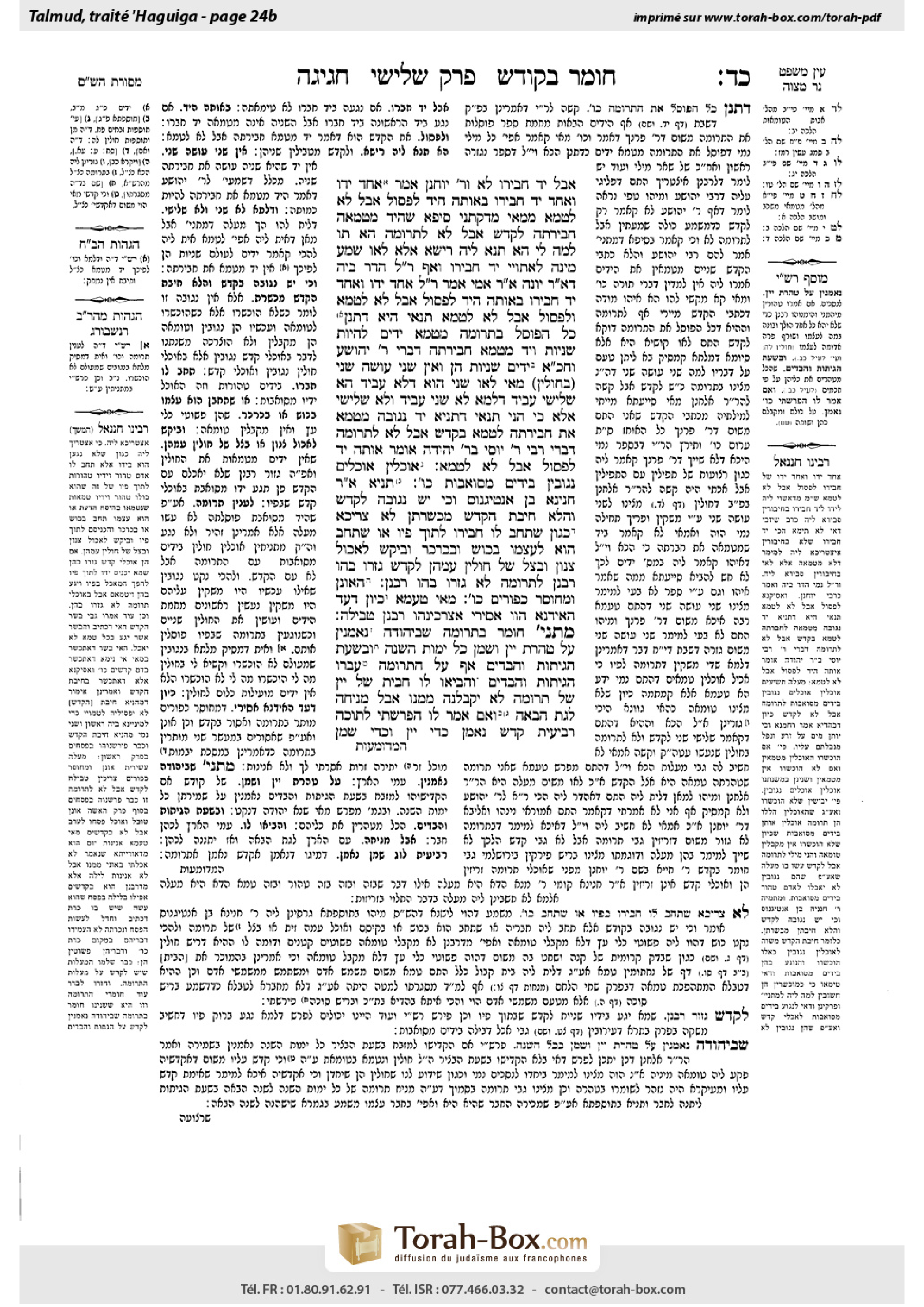
Chagigah 24b: Talmud study for Daf Yomi
Study the Talmud for Daf Yomi with scanned pages, Hebrew text, English translations from Sefaria and AI-generated French translations.
Passage selection and English or AI-generated French translation are available where the scan has annotations. Daf Study is independent of Torah-Box and Sefaria.
Browse Chagigah · חגיגה · All tractatesChagigah 24b text and translations
This page of Chagigah includes the Aramaic text, an English translation and an AI-generated French translation, alongside the scan above.
חגיגה כ״ד ב · Aramaic and Hebrew text
אֲבָל יַד חֲבֵירוֹ — לֹא. וְרַבִּי יוֹחָנָן אָמַר: אֶחָד יָדוֹ וְאֶחָד יַד חֲבֵירוֹ, בְּאוֹתָהּ הַיָּד. לִפְסוֹל, אֲבָל לֹא לְטַמֵּא.
מִמַּאי — מִדְּקָתָנֵי סֵיפָא: שֶׁהַיָּד מְטַמְּאָה חֲבֶירְתָּהּ לַקֹּדֶשׁ, אֲבָל לֹא לַתְּרוּמָה. הָא תּוּ לְמָה לִי? הָא תְּנָא לֵיהּ רֵישָׁא! אֶלָּא לָאו שְׁמַע מִינַּהּ, לְאֵתוֹיֵי יַד חֲבֵירוֹ.
וְאַף רֵישׁ לָקִישׁ הֲדַר בֵּיהּ, דְּאָמַר רַבִּי יוֹנָה אָמַר רַבִּי אַמֵּי אָמַר רֵישׁ לָקִישׁ: אֶחָד יָדוֹ וְאֶחָד יַד חֲבֵירוֹ, בְּאוֹתָהּ הַיָּד, לִפְסוֹל אֲבָל לֹא לְטַמֵּא.
וְלִפְסוֹל אֲבָל לֹא לְטַמֵּא תַּנָּאֵי הִיא. דִּתְנַן: כׇּל הַפּוֹסֵל בִּתְרוּמָה — מְטַמֵּא יָדַיִם לִהְיוֹת שְׁנִיּוֹת, וְיָד מְטַמֵּא חֲבֶירְתָּהּ, דִּבְרֵי רַבִּי יְהוֹשֻׁעַ. וַחֲכָמִים אוֹמְרִים: יָדַיִם שְׁנִיּוֹת הֵן, וְאֵין שֵׁנִי עוֹשֶׂה שֵׁנִי בַּחוּלִּין.
מַאי לָאו: שֵׁנִי הוּא דְּלָא עָבֵיד, הָא שְׁלִישִׁי עָבֵיד.
דִּלְמָא לָא שֵׁנִי עָבֵיד וְלָא שְׁלִישִׁי.
אֶלָּא כִּי הָנֵי תַּנָּאֵי, דְּתַנְיָא: יָד נְגוּבָה מְטַמָּא אֶת חֲבֶירְתָּהּ לְטַמֵּא בַּקֹּדֶשׁ, אֲבָל לֹא לַתְּרוּמָה, דִּבְרֵי רַבִּי. רַבִּי יוֹסֵי בְּרַבִּי יְהוּדָה אוֹמֵר: אוֹתָהּ יָד לִפְסוֹל, אֲבָל לֹא לְטַמֵּא.
אוֹכְלִין אוֹכָלִים נְגוּבִין בְּיָדַיִם מְסוֹאָבוֹת כּוּ׳. תַּנְיָא, אָמַר רַבִּי חֲנִינָא בֶּן אַנְטִיגְנוֹס: וְכִי יֵשׁ נְגוּבָה לַקֹּדֶשׁ? וַהֲלֹא חִיבַּת הַקֹּדֶשׁ מַכְשַׁרְתָּן.
לָא צְרִיכָא, כְּגוֹן שֶׁתָּחַב לוֹ חֲבֵירוֹ לְתוֹךְ פִּיו, אוֹ שֶׁתָּחַב הוּא לְעַצְמוֹ בְּכוּשׁ וּבְכַרְכֵּר, וּבִיקֵּשׁ לֶאֱכוֹל צְנוֹן וּבָצָל שֶׁל חוּלִּין עִמָּהֶן.
לְקֹדֶשׁ גְּזַרוּ בְּהוּ רַבָּנַן, לִתְרוּמָה לָא גְּזַרוּ בְּהוּ רַבָּנַן.
הָאוֹנֵן וּמְחוּסַּר כִּפּוּרִים כּוּ׳. מַאי טַעְמָא — כֵּיוָן דְּעַד הָאִידָּנָא הֲווֹ אֲסִירִי, אַצְרְכִינְהוּ רַבָּנַן טְבִילָה.
מַתְנִי׳ חוֹמֶר בַּתְּרוּמָה, שֶׁבִּיהוּדָה נֶאֱמָנִין עַל טׇהֳרַת יַיִן וָשֶׁמֶן כׇּל יְמוֹת הַשָּׁנָה, וּבִשְׁעַת הַגִּיתּוֹת וְהַבַּדִּים — אַף עַל הַתְּרוּמָה.
עָבְרוּ הַגִּיתּוֹת וְהַבַּדִּים, וְהֵבִיאוּ לוֹ חָבִית שֶׁל יַיִן שֶׁל תְּרוּמָה — לֹא יְקַבְּלֶנָּה מִמֶּנּוּ, אֲבָל מַנִּיחָהּ לַגַּת הַבָּאָה. וְאִם אָמַר לוֹ הִפְרַשְׁתִּי לְתוֹכָהּ רְבִיעִית קֹדֶשׁ — נֶאֱמָן.
כַּדֵּי יַיִן וְכַדֵּי שֶׁמֶן
Chagigah 24b · English translation
but an impure hand does not render impure the hand of another. And Rabbi Yoḥanan said: An impure hand renders another hand impure whether it is his own hand or the hand of another, provided the second hand is touched by the same hand that came into contact with the impurity. Moreover, the impure hand affects the food it touches only to disqualify it, but not to render it impure.
The Gemara elaborates on Rabbi Yoḥanan’s opinion. From where did he learn this? From the fact that it teaches in a latter clause in the mishna: For one renders its counterpart, i.e., the other hand, impure with regard to sacrificial food but not with regard to teruma. Why do I need this phrase as well? It was already taught in the first clause that one hand renders the other hand impure with regard to sacrificial food. Rather, must one not conclude from this added phrase that it comes to include the rendering impure of the hand of another as well as his own other hand?
The Gemara observes: And Reish Lakish, too, retracted his own opinion in favor of Rabbi Yoḥanan’s opinion. For Rabbi Yona said that Rabbi Ami said that Reish Lakish said: The decree that one hand renders another impure applies whether it is his own hand or the hand of another, provided the second hand is touched by the same hand that came into contact with the impurity. Moreover, the impure hand affects the food it touches only to disqualify it, but not to render it impure.
The Gemara comments: And this opinion, that an impure hand affects the sacrificial food only to disqualify it but not to render it impure, is a dispute between tanna’im. As we learned in a mishna (Yadayim 3:2): Anything that disqualifies teruma by contact with it, i.e., anything that is impure at least to the second degree, renders the hands impure to the second degree. And furthermore, a hand that is impure to the second degree renders its counterpart, the other hand, impure; this is the statement of Rabbi Yehoshua. But the Rabbis say: Hands themselves are impure to the second degree, and that which is impure to the second degree cannot impart second-degree impurity to something else with regard to non-sacred food.
From the Rabbis’ response to Rabbi Yehoshua it is clear that the latter’s opinion is that the second hand is indeed rendered impure to the second degree, imparting third-degree impurity to sacrificial food that it touches. Moreover: What, is it not correct to infer from the Rabbis’ words that it is impurity to the second degree that the first hand does not impart to the second hand by touching it, but impurity to the third degree it does impart to the second hand? The second hand would thus only disqualify the sacrificial food that it touches by imparting to it a fourth-degree impurity. Therefore, the Rabbis and Rabbi Yehoshua are arguing about this very point: Does the second hand only disqualify sacrificial food by imparting to it fourth-degree impurity, or does it render the food impure with third-degree impurity?
The Gemara rejects this proof: Perhaps the Rabbis meant that the first hand does not impart impurity to the second hand to either the second or the third degree, for in their opinion one impure hand does not defile the other hand at all, in contradiction to the mishna, whereas the opinion expressed in the mishna would be following Rabbi Yehoshua.
Rather, the issue of which degree of impurity is imparted to the second hand is like the following dispute between tanna’im, as it is taught in the baraita cited earlier: Even a dry hand that is impure renders its counterpart, i.e., the other hand, impure to the extent that the second hand will now render impure food that it touches. This is true with regard to sacrificial food but not with regard to teruma. This is the statement of Rabbi Yehuda HaNasi. Rabbi Yosei, son of Rabbi Yehuda, says: The second hand is not rendered impure to such a severe extent. It can merely disqualify sacrificial food that it touches, by making it impure to the fourth degree, but not render it impure to the third degree.
§ It was taught in the mishna: One may eat dry foods, i.e., foods that have never been wetted and are thus not susceptible to impurity, with impure hands in the case of teruma, but not in the case of sacrificial food. It is taught in a baraita that there is a difficulty with this statement of the mishna: Rabbi Ḥanina ben Antigonus said: Now, is there such a possibility as dry food, i.e., food that is not susceptible to impurity, with regard to sacrificial food? Is it not so that the reverence accorded to sacrificial food itself renders it fit to contract impurity even if it has never been in contact with liquid at all? All sacrificial food is thus automatically susceptible to impurity, and whether it is dry, i.e., it has never been wetted, or not is irrelevant.
The Gemara answers: No, it is necessary for the mishna to state this. And the case is not one of dry sacrificial food, as was first assumed. Rather, the mishna is dealing with a case in which, for example, his friend inserted sacrificial food or teruma into his mouth, or, alternatively, a case in which he inserted it into his own mouth by means of a spindle or whorl, which are wooden vessels without receptacles that cannot contract impurity. In either event the food arrives in his mouth without being rendered impure by his impure hands. And then, while the sacrificial food or teruma is still in his mouth, he wishes to put into his mouth and eat a non-sacred radish or onion along with them.
Non-sacred food is not rendered impure by being touched with impure hands, so it should not be problematic to put a radish or onion into one’s mouth with his hands. However, regarding sacrificial food the Sages enacted a decree against doing so, lest the person inadvertently touch the sacrificial food in his mouth with his impure hand. This decree, the mishna teaches, applies only to sacrificial food, but in a case in which he had teruma in his mouth the Sages did not enact a decree against it.
§ It was taught in the mishna: An acute mourner and one who is lacking atonement require immersion in order to eat sacrificial food, but this is not necessary for teruma. The Gemara explains: What is the reason for this decree? Since until now it was prohibited for them to partake of sacrificial food and they therefore might not have guarded themselves properly from impurity, the Sages required them to undergo immersion before eating sacrificial food.
MISHNA: The previous mishna listed stringencies that apply to sacrificial food but not to teruma. However, there are also stringencies that apply to teruma over sacrificial food: In Judea all people, even people who are not generally meticulous in their observance of the halakhot of ritual purity [amei ha’aretz], are trusted with regard to the purity of consecrated wine and oil throughout all the days of the year. And during the period of the winepress and olive press, when grapes and olives are pressed and made into wine and oil, respectively, they are trusted even with regard to the purity of teruma, as all people, including amei ha’aretz, purify their vessels for this season.
But once the periods of the winepress and olive press have passed, if amei ha’aretz brought to him, i.e., to a priest who is meticulous concerning the halakhot of ritual purity [ḥaver], a barrel of teruma wine, he may not accept it from them, as amei ha’aretz are not trusted with regard to matters of ritual purity during the rest of the year. But the giver may leave it over for the following winepress season, in the following year, at which point the ḥaver priest may accept it from him, although it was prohibited for him to accept the same barrel beforehand. And if the giver said to the priest: I separated and placed into this barrel of teruma a quarter-log of sacrificial wine or oil, he is trusted with regard to the entire contents of the barrel. Since an am ha’aretz is trusted with regard to the purity of sacrificial food, he is also believed with regard to teruma that is mingled with the sacrificial food.
With regard to jugs of wine and jugs of oil
Chagigah 24b · Traduction française (IA)
mais une main impure ne rend pas impure l'autre main. Et Rabbi Yoḥanan a dit : une main impure rend l'autre main impure, qu'il s'agisse de sa propre main ou de celle d'une autre, à condition que la seconde main soit touchée par la même main qui a été en contact avec l'impureté. De plus, la main impure affecte le repas qu'elle touche uniquement pour le rendre inacceptable, mais pas pour le rendre impur.
La Guemara développe l'opinion de Rabbi Yoḥanan. D'où a-t-il tiré cela ? De la constatation que la Michna enseigne dans une clause ultérieure : l'un rend impur son homologue, c'est-à-dire l'autre main, concernant le repas sacré mais pas concernant la terouma. Pourquoi ai-je besoin de cette phrase ? Elle a déjà été enseignée dans la première clause que l'une des mains rend l'autre main impure concernant le repas sacré. Plutôt, ne devrais-je pas conclure de cette phrase ajoutée qu'elle vise à inclure la rendue impure de la main d'une autre ainsi que sa propre autre main ?
La Guemara observe : Et Reish Lakish, lui aussi, a renoncé à son propre avis au profit de l'opinion de Rabbi Yoḥanan. Car Rabbi Yona a dit que Rabbi Ami a dit que Reish Lakish a dit : le décret selon lequel l'une des mains rend l'autre impure s'applique qu'il s'agisse de sa propre main ou de celle d'une autre, à condition que la seconde main soit touchée par la même main qui a été en contact avec l'impureté. De plus, la main impure affecte le repas qu'elle touche uniquement pour le rendre inacceptable, mais pas pour le rendre impur.
La Guemara commente : cette opinion, selon laquelle une main impure affecte le repas sacré uniquement pour le rendre inacceptable mais pas pour le rendre impur, est un débat entre les tannaïm. Comme nous l'avons appris dans une Michna (Yadayim 3:2) : toute chose qui rend la terouma inacceptable par contact, c'est-à-dire toute chose impure au moins au deuxième degré, rend les mains impures au deuxième degré. Et de plus, une main impure au deuxième degré rend son homologue, l'autre main, impure ; c'est l'opinion de Rabbi Yéhoshua. Mais les Rabbins disent : les mains elles-mêmes sont impures au deuxième degré, et ce qui est impur au deuxième degré ne peut pas transmettre l'impureté au deuxième degré à quelque chose d'autre concernant les aliments non sacrés.
De la réponse des Rabbins à l'opinion de Rabbi Yéhoshua, il est clair que l'opinion de ce dernier est que la seconde main est effectivement rendue impure au deuxième degré, transmettant l'impureté au troisième degré au repas sacré qu'elle touche. De plus : qu'est-ce que cela ne serait pas correct de conclure des paroles des Rabbins que c'est l'impureté au deuxième degré que la première main ne transmet pas à la seconde main par contact, mais l'impureté au troisième degré qu'elle transmet à la seconde main ? La seconde main rendrait ainsi le repas sacré qu'elle touche inacceptable en transmettant une impureté au quatrième degré. Par conséquent, les Rabbins et Rabbi Yéhoshua débattent de ce point précis : la seconde main rend-elle le repas sacré inacceptable en transmettant une impureté au troisième degré, ou bien rend-elle le repas sacré impur au quatrième degré ?
La Guemara rejette cette preuve : peut-être les Rabbins veulent dire que la première main ne transmet pas l'impureté à la seconde main à aucun degré, que ce soit au deuxième ou au troisième, car selon leur opinion, une main impure ne rend pas impure l'autre main du tout, contrairement à la Michna, alors que l'opinion exprimée dans la Michna suivrait celle de Rabbi Yéhoshua.
Plutôt, la question de quel degré d'impureté est transmis à la seconde main est comme le débat suivant entre les tannaïm, comme il est enseigné dans la baraïta citée plus haut : même une main sèche impure rend son homologue, c'est-à-dire l'autre main, impure à tel point que la seconde main rendra impure le repas qu'elle touche. Cela est vrai concernant le repas sacré mais pas concernant la terouma. C'est l'opinion de Rabbi Yéhuda HaNasi. Rabbi Yosei, fils de Rabbi Yéhuda, dit : la seconde main n'est pas rendue impure à un tel point. Elle peut seulement rendre inacceptable le repas sacré qu'elle touche en le rendant impur au quatrième degré, mais pas en le rendant impur au troisième degré.
§ Il a été enseigné dans la Michna : on peut manger des aliments secs, c'est-à-dire des aliments jamais mouillés et donc non sujets à l'impureté, avec des mains impures dans le cas de la terouma, mais pas dans le cas du repas sacré. Il a été enseigné dans une baraïta que cela pose un problème avec cette déclaration de la Michna : Rabbi Ḥanina ben Antigonus a dit : maintenant, y a-t-il une telle possibilité que des aliments secs, c'est-à-dire des aliments non sujets à l'impureté, concernant le repas sacré ? N'est-ce pas plutôt que le respect accordé au repas sacré lui-même le rend apte à contracter l'impureté même s'il n'a jamais été en contact avec un liquide ? Tous les aliments sacrés sont donc automatiquement sujets à l'impureté, et que ce soit sec, c'est-à-dire jamais mouillé, ou non est sans importance.
La Guemara répond : Non, il est nécessaire que la Michna énonce cela. Et le cas n'est pas celui d'un aliment sacré sec, comme on l'avait d'abord supposé. Plutôt, la Michna traite d'un cas où, par exemple, son ami a introduit un aliment sacré ou une terouma dans sa bouche, ou, alternativement, un cas où il l'a introduit dans sa propre bouche à l'aide d'un bâton ou d'un rouet, qui sont des objets en bois sans récipient et qui ne peuvent pas contracter l'impureté. Dans aucun cas, l'aliment arrive dans sa bouche sans être rendu impur par ses mains impures. Et puis, pendant que l'aliment sacré ou la terouma est encore dans sa bouche, il souhaite mettre dans sa bouche et manger un radis ou une oignon non sacré avec eux.
L'aliment non sacré n'est pas rendu impur par le contact avec des mains impures, donc il ne devrait pas être problématique de mettre un radis ou un oignon dans sa bouche avec ses mains. Cependant, concernant l'aliment sacré, les Sages ont institué un décret contre cela, de peur que la personne ne touche accidentellement l'aliment sacré dans sa bouche avec ses mains impures. Ce décret, la Michna enseigne, s'applique uniquement à l'aliment sacré, mais dans le cas où il avait de la terouma dans sa bouche, les Sages n'ont pas institué de décret contre cela.
§ Il a été enseigné dans la Michna : Un veuf en deuil et celui qui manque d'atonement nécessitent une immersion afin de manger des aliments sacrés, mais cela n'est pas nécessaire pour la terouma. La Guemara explique : Quelle est la raison de cet édit ? Puisque jusqu'à présent il était interdit pour eux de consommer des aliments sacrés et qu'ils n'ont donc peut-être pas gardé une pureté suffisante, les Sages ont exigé qu'ils subissent une immersion avant de manger des aliments sacrés.
MICHNA : La Michna précédente a listé des stringences applicables aux aliments sacrés mais pas à la terouma. Cependant, il existe également des stringences applicables à la terouma plutôt qu'aux aliments sacrés : En Judée, tous les gens, même ceux qui ne sont pas généralement rigoureux dans l'observation des halakhot de pureté rituelle [amei ha’aretz], sont considérés comme purs concernant la pureté du vin et de l'huile consacrés tout au long de l'année. Et durant la période de la vigne et de l'olivier, lorsque les raisins et les olives sont pressés pour produire du vin et de l'huile, ils sont également considérés comme purs concernant la terouma, car tous les gens, y compris les amei ha’aretz, purifient leurs récipients pour cette saison.
Mais une fois que les périodes de la vigne et de l'olivier sont passées, si des amei ha’aretz apportent à lui, c'est-à-dire à un prêtre rigoureux concernant les halakhot de pureté rituelle [ḥaver], un tonneau de vin terouma, il ne peut pas l'accepter d'eux, car les amei ha’aretz ne sont pas considérés comme fiables concernant les questions de pureté rituelle pendant l'année restante. Cependant, le donneur peut laisser le vin reposer jusqu'à la saison suivante de la vigne, dans l'année suivante, à ce moment-là le prêtre ḥaver peut l'accepter d'eux, bien qu'il soit interdit de l'accepter auparavant. Et si le donneur dit au prêtre : J'ai séparé et mis dans ce tonneau de vin terouma un quart de log de vin ou d'huile sacré, il est considéré comme fiable concernant l'ensemble du contenu du tonneau. Puisque l'amei ha’aretz est considéré comme fiable concernant la pureté des aliments sacrés, il est également considéré comme fiable concernant la terouma mélangée avec les aliments sacrés.
Concernant les tonneaux de vin et les tonneaux d'huile
Traduction française générée par IA à partir de l’édition anglaise de Sefaria. Vérifie toujours un passage avec le texte source.
Text from Sefaria: William Davidson Edition - Vocalized Aramaic (CC BY NC); William Davidson Edition - English (CC BY NC).