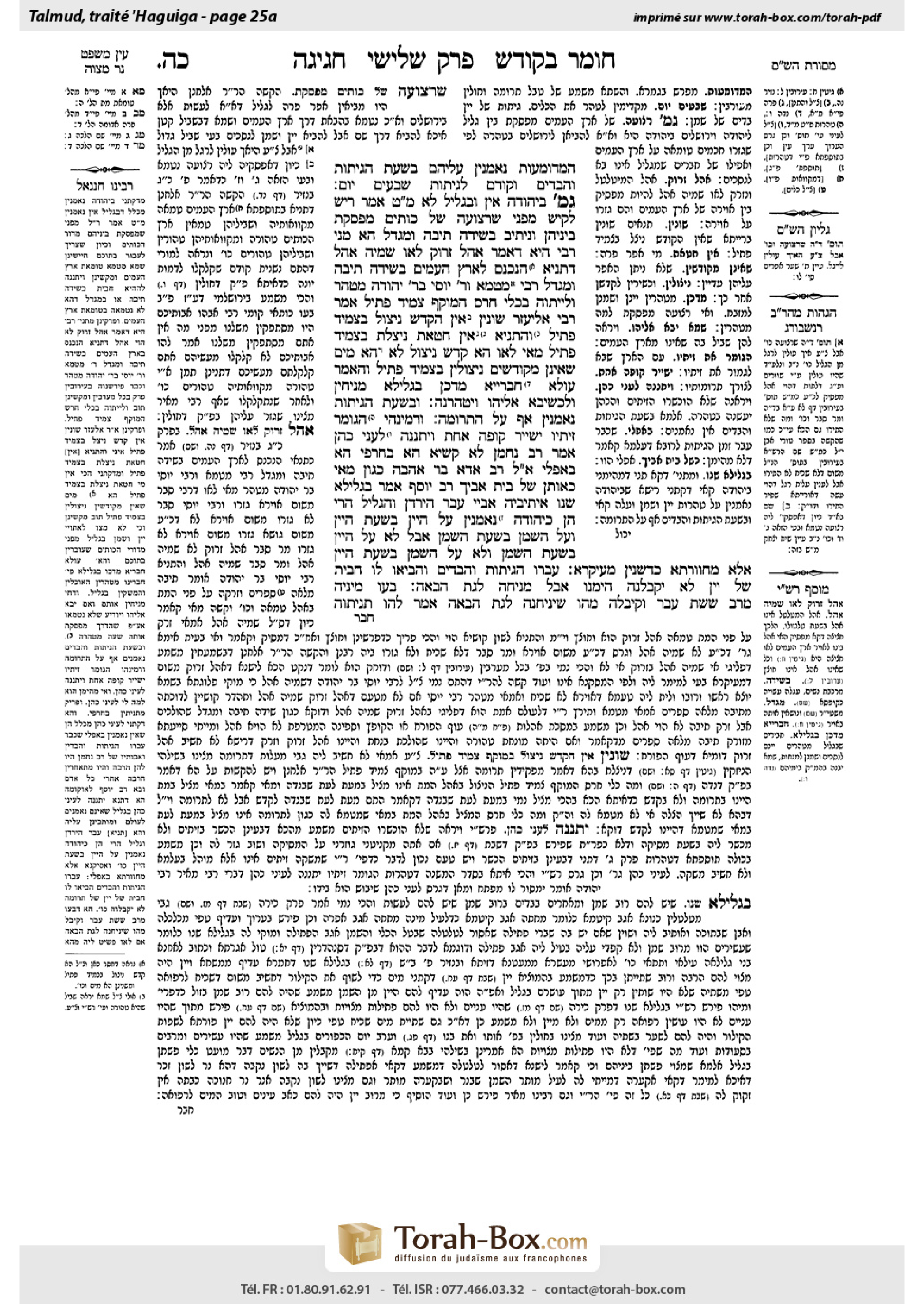
Chagigah 25a: Talmud study for Daf Yomi
Study the Talmud for Daf Yomi with scanned pages, Hebrew text, English translations from Sefaria and AI-generated French translations.
Passage selection and English or AI-generated French translation are available where the scan has annotations. Daf Study is independent of Torah-Box and Sefaria.
Browse Chagigah · חגיגה · All tractatesChagigah 25a text and translations
This page of Chagigah includes the Aramaic text, an English translation and an AI-generated French translation, alongside the scan above.
חגיגה כ״ה א · Aramaic and Hebrew text
הַמְדוּמָּעוֹת — נֶאֱמָנִין עֲלֵיהֶם בִּשְׁעַת הַגִּיתּוֹת וְהַבַּדִּים, וְקוֹדֶם לַגִּיתּוֹת שִׁבְעִים יוֹם.
גְּמָ׳ בִּיהוּדָה אִין, וּבַגָּלִיל לָא, מַאי טַעְמָא?
אָמַר רֵישׁ לָקִישׁ: מִפְּנֵי שֶׁרְצוּעָה שֶׁל כּוּתִים מַפְסֶקֶת בֵּינֵיהֶן.
וְנֵיתֵיב בְּשִׁידָּה תֵּיבָה וּמִגְדָּל? הָא מַנִּי — רַבִּי הִיא, דְּאָמַר: אֹהֶל זָרוּק — לָאו שְׁמֵיהּ אֹהֶל. דְּתַנְיָא: הַנִּכְנָס לְאֶרֶץ הָעַמִּים בְּשִׁידָּה תֵּיבָה וּמִגְדָּל, רַבִּי מְטַמֵּא, וְרַבִּי יוֹסֵי בְּרַבִּי יְהוּדָה מְטַהֵר.
וְלַיְיתוּהּ בִּכְלִי חֶרֶס הַמּוּקָּף צָמִיד פָּתִיל! אָמַר רַבִּי אֱלִיעֶזֶר, שׁוֹנִין: אֵין הַקֹּדֶשׁ נִיצּוֹל בְּצָמִיד פָּתִיל.
וְהָתַנְיָא: אֵין חַטָּאת נִיצֹּלֶת בְּצָמִיד פָּתִיל. מַאי לָאו: הָא קֹדֶשׁ נִיצּוֹל! לָא: הָא מַיִם שֶׁאֵינָן מְקוּדָּשִׁים נִיצּוֹלִין בְּצָמִיד פָּתִיל.
וְהָאָמַר עוּלָּא: חַבְרַיָּיא מְדַכַּן בְּגָלִילָא! מַנִּיחִין, לִכְשֶׁיָּבֹא אֵלִיָּהוּ וִיטַהֲרֶנָּה.
וּבִשְׁעַת הַגִּיתּוֹת נֶאֱמָנִין אַף עַל הַתְּרוּמָה. וּרְמִינְהִי: הַגּוֹמֵר זֵיתָיו — יְשַׁיֵּיר קוּפָּה אַחַת וְיִתְּנֶנָּה לְעָנִי כֹּהֵן!
אָמַר רַב נַחְמָן, לָא קַשְׁיָא: הָא בְּחָרְפֵי, הָא בְּאַפְלֵי. אֲמַר לֵיהּ רַב אַדָּא בַּר אַהֲבָה: כְּגוֹן מַאי? כְּאוֹתָן שֶׁל בֵּית אָבִיךָ.
רַב יוֹסֵף אָמַר: בְּגָלִילָא שָׁנוּ. אֵיתִיבֵיהּ אַבָּיֵי: עֵבֶר הַיַּרְדֵּן וְהַגָּלִיל — הֲרֵי הֵן כִּיהוּדָה, נֶאֱמָנִין עַל הַיַּיִן בִּשְׁעַת הַיַּיִן וְעַל הַשֶּׁמֶן בִּשְׁעַת הַשֶּׁמֶן, אֲבָל לֹא עַל הַיַּיִן בִּשְׁעַת הַשֶּׁמֶן וְלֹא עַל הַשֶּׁמֶן בִּשְׁעַת הַיַּיִן.
אֶלָּא מְחַוַּורְתָּא כִּדְשַׁנִּין מֵעִיקָּרָא.
עָבְרוּ הַגִּיתּוֹת וְהַבַּדִּים וְהֵבִיאוּ לוֹ חָבִית שֶׁל יַיִן — לֹא יְקַבְּלֶנָּה הֵימֶנּוּ, אֲבָל מַנִּיחָהּ לַגַּת הַבָּאָה. בְּעוֹ מִינֵּיהּ מֵרַב שֵׁשֶׁת: עָבַר וְקִיבְּלָהּ, מַהוּ שֶׁיַּנִּיחֶנָּה לַגַּת הַבָּאָה? אֲמַר לְהוּ: תְּנֵיתוּהָ:
Chagigah 25a · English translation
that are mingled, amei ha’aretz are trusted with regard to them during the period of the winepress and the olive press, and also up to seventy days before the winepress, for that is when people begin to purify their vessels in preparation for the wine-pressing season.
GEMARA: The mishna teaches that amei ha’aretz are trusted with regard to the purity of sacrificial wine and oil in Judea. The Gemara infers: In Judea, yes, but in the Galilee, no. What is the reason for this distinction between the two places?
Reish Lakish said: It is because a strip of land inhabited by Samaritans [Kutim] separates between Judea and the Galilee, and it is impossible to travel from one land to the other without traversing this strip. The Sages decreed that lands inhabited by non-Jewish nations are considered ritually impure, so that it would be impossible to transport food from the Galilee to Judea, where the Temple is located, without the food becoming impure. Therefore, even oil and wine prepared by ḥaverim who lived in the Galilee were not accepted for sacrificial use.
The Gemara raises a difficulty: And let the residents of the Galilee place the wine and oil and transport it to Judea in a closed box, a chest, or a closet, whose contents cannot contract impurity, as they have the status of separate tents. The Gemara answers: In accordance with whose opinion is this mishna? It is in accordance with the opinion of Rabbi Yehuda HaNasi, who said: A thrown tent, i.e., a moving tent, is not called a proper tent, and therefore its contents are subject to impurity. In our case, then, the contents would contract the impurity decreed upon the lands of non-Jewish nations. As it is taught in a baraita: Concerning one who enters a land of non-Jewish nations sitting in a box, a chest, or a closet, Rabbi Yehuda HaNasi declares him to be impure, and Rabbi Yosei, son of Rabbi Yehuda, declares him to be pure.
The Gemara raises a further difficulty: And let them bring oil and wine to the Temple in an earthenware vessel sealed with a tightly bound cover, which cannot contract impurity even if it is in the same tent as a corpse, as it states: “And every open vessel, which has no covering tightly bound upon it, is unclean” (Numbers 19:15). Rabbi Eliezer said: The Sages taught in a baraita: Sacrificial food, unlike other items, is not spared from impurity by being in a container with a tightly bound cover.
The Gemara asks: But isn’t it taught in a baraita: Water of purification containing ashes from the red heifer is not spared from impurity by being in a vessel with a tightly bound cover? What, is it not implied in the baraita this inference: That sacrificial food is spared from impurity in such a situation? The baraita seems to imply that this is a special stringency for water of purification, which does not apply to anything else, including sacrificial food. The Gemara rejects this: No, the baraita’s inference should be understood differently, as this: Water that has not yet been consecrated by being mixed with ashes of the red heifer is spared from impurity by being in a vessel with a tightly bound cover, even if they are designated for such a use at a later stage.
The Gemara raises another difficulty: But didn’t Ulla say: Ḥaverim purify their wine and oil, i.e., they produce their wine and oil by the standards of purity used for sacrificial food in the Galilee, to be used for sacrificial purposes? This indicates that there must have been some way of transporting them from the Galilee to the Temple, for otherwise why would they have prepared such items? The Gemara answers: Indeed, they could not transfer these items to the Temple. Rather, they would leave them in their place, and their thought was that when Elijah comes in messianic times and purifies the road from Galilee to Judea, these items will become eligible for use.
§ It was taught in the mishna: And during the period of the winepress and olive press, amei ha’aretz are trusted even with regard to the purity of teruma. And the Gemara raises a contradiction from the following teaching: An am ha’aretz who finishes pressing his olives should leave over one sack of unpressed olives, and give it to a poor priest as teruma, so that the priest himself can make ritually pure oil from it. This shows that even during the period of the olive press the am ha’aretz is not trusted to make pure olive oil himself.
Rav Naḥman said: This is not difficult. This case of the mishna, where amei ha’aretz are trusted to produce pure olive oil themselves, is referring to people who press their olives early, during the regular season of the olive press, while that case is referring to those who press their olives later, after the period when most people press their olives has passed. Rav Adda bar Ahava said to him: Such as what case, for example? Such as those olives of your father’s house. Rav Naḥman’s father had many olives, and he often pressed them after the regular pressing season.
Rav Yosef said a different resolution of the above contradiction. The source that states that amei ha’aretz are not trusted was taught with regard to the Galilee, and as the mishna taught earlier concerning sacrificial wine and oil, amei ha’aretz are trusted only in Judea and not in the Galilee. Abaye raised an objection to him from a baraita: Transjordan and the Galilee are like Judea, in that they are trusted with regard to wine of teruma during the period of wine production, and with regard to oil of teruma during the period of oil production. However, they are not trusted with regard to wine during the period of oil production, nor are they trusted with regard to oil during the period of wine production. This baraita shows that with regard to teruma there is no difference between the trustworthiness of amei ha’aretz who live in the Galilee and that of those who live in Judea.
Rather, Rav Yosef’s answer must be rejected, and it is clear that the correct answer is as we answered initially, that it is speaking of the period following the conclusion of the winepress.
§ It was taught in the mishna: Once the periods of the winepress and olive press have passed, if amei ha’aretz brought to a ḥaver priest a barrel of teruma wine, he may not accept it from them. But the giver may leave it over for the following winepress season, in the following year. They raised a dilemma before Rav Sheshet: If the priest violated the halakha and did accept the wine from an am ha’aretz, what is the halakha? Is it permissible that he should leave it over for himself for the following winepress season? Since it is permissible to accept the wine and oil of an am ha’aretz intentionally left until that time, perhaps it is also permissible if the priest himself intentionally leaves it over until that time. He said to him: You learned it in a mishna (Demai 6:9):
Chagigah 25a · Traduction française (IA)
ceux qui sont mélangés, les amei ha’aretz sont considérés comme fiables concernant eux pendant la période de la vigne et de l'olivier, ainsi que jusqu'à soixante-dix jours avant la période de la vigne, car c'est à ce moment-là que les gens commencent à purifier leurs récipients en préparation pour la saison de la récolte de la vigne.
GUEMARA : La mitsva enseigne que les amei ha’aretz sont considérés comme fiables concernant la pureté du vin et de l'huile sacrés en Judée. La Guemara déduit : En Judée, oui, mais en Galilée, non. Quelle est la raison de cette distinction entre ces deux lieux ?
Reish Lakish a dit : C'est parce qu'un strip de terre habitée par des Samaritains [Kutim] sépare Judée et la Galilée, et il est impossible de voyager d'un lieu à l'autre sans traverser ce strip. Les Sages ont décrété que les terres habitées par des nations non juives sont considérées comme impures rituellement, de sorte qu'il serait impossible de transporter des aliments de la Galilée vers Judée, où se trouve le Temple, sans que ces aliments ne deviennent impurs. Ainsi, même l'huile et le vin préparés par des ḥaverim vivant en Galilée ne pouvaient pas être acceptés pour usage sacré.
La Guemara soulève une difficulté : Et les habitants de la Galilée doivent placer le vin et l'huile et les transporter à Jérusalem dans une boîte, un coffre ou un placard, dont le contenu ne peut pas contracter l'impureté, car ils ont le statut de tentes séparées. La Guemara répond : Selon quel avis est cette mitsna ? C'est selon l'avis de Rabbi Yehuda HaNasi, qui a dit : Une tente jetée, c'est-à-dire une tente mobile, n'est pas appelée une tente propre, et par conséquent son contenu est soumis à l'impureté. Dans notre cas, alors, le contenu contracterait l'impureté décrétée sur les terres des nations non juives. Comme il est enseigné dans une baraïta : Concernant celui qui entre dans une terre des nations non juives, assis dans une boîte, un coffre ou un placard, Rabbi Yehuda HaNasi déclare qu'il est impur, et Rabbi Yosei, fils de Rabbi Yehuda, déclare qu'il est pur.
La Guemara soulève une difficulté supplémentaire : Et qu'ils apportent l'huile et le vin au Temple dans un récipient en terre scellé avec un couvercle étroitement fermé, qui ne peut pas contracter l'impureté même s'il est dans le même tentérieur qu'un cadavre, car il est dit : « Et tout récipient ouvert, qui n'a pas un couvercle étroitement fermé sur lui, est impur » (Lévitique 19:15). Rabbi Eliezer a dit : Les Sages ont enseigné dans une baraïta : Les aliments sacrés, contrairement à d'autres objets, ne sont pas épargnés de l'impureté par être dans un récipient avec un couvercle étroitement fermé.
La Guemara demande : Mais n'est-il pas enseigné dans une baraïta : L'eau de purification contenant des cendres de la bête rouge n'est pas épargné de l'impureté par être dans un récipient avec un couvercle étroitement fermé ? Qu'est-ce que cela signifie, n'est-ce pas impliqué dans la baraïta cette déduction : Que les aliments sacrés sont épargnés de l'impureté dans ce cas ? La baraïta semble impliquer que c'est une stricte exigence spéciale pour l'eau de purification, qui ne s'applique pas à autre chose, y compris les aliments sacrés. La Guemara rejette cela : Non, l'inférence de la baraïta doit être comprise différemment, comme cela : L'eau qui n'a pas encore été consacrée en étant mélangé avec les cendres de la bête rouge est épargné de l'impureté par être dans un récipient avec un couvercle étroitement fermé, même s'ils sont destinés à une telle utilisation à un moment ultérieur.
La Guemara soulève une autre difficulté : Mais n'a-t-il pas dit Ulla : Les ḥaverim purifient leur vin et leur huile, c'est-à-dire qu'ils produisent leur vin et leur huile selon les normes de pureté utilisées pour les aliments sacrés en Galilée, pour être utilisés à des fins sacrées ? Cela indique qu'il devait y avoir un moyen de transporter ces aliments du Galilée vers le Temple, sinon pourquoi auraient-ils préparé de tels objets ? La Guemara répond : En effet, ils ne pouvaient pas transférer ces objets vers le Temple. Plutôt, ils les laisseraient à leur place, et leur pensée était que lorsque Elie viendra en temps messianique et purifiera le chemin du Galilée vers Judée, ces objets deviendraient éligibles à l'usage.
§ Il a été enseigné dans la mitsna : Et pendant la période de la vigne et de l'olivier, les amei ha’aretz sont considérés comme fiables même concernant la pureté de la terouma. Et la Guemara soulève une contradiction à partir de l'enseignement suivant : Un am ha’aretz qui a terminé de presser ses olives devrait laisser un sac d'olives non pressées, et le donner à un prêtre pauvre comme terouma, afin que le prêtre lui-même puisse produire de l'huile rituellement pur. Cela montre que même pendant la période de la pression de l'olivier, l'am ha’aretz n'est pas considéré comme fiable pour produire lui-même de l'huile pure.
Rav Naḥman a dit : Ce n'est pas difficile. Ce cas de la mitsna, où les amei ha’aretz sont considérés comme fiables pour produire de l'huile d'olive pure eux-mêmes, fait référence à des personnes qui pressent leurs olives tôt, pendant la saison régulière de la pression de l'olivier, tandis que ce cas fait référence à ceux qui pressent leurs olives plus tard, après la période où la plupart des gens pressent leurs olives. Rav Adda bar Ahava lui a dit : Quel cas, par exemple ? Comme ceux d'olives de la maison de ton père. Rav Naḥman avait un père qui avait beaucoup d'olives, et il pressait souvent ses olives après la saison de pression régulière.
Rav Yosef a dit une autre résolution de la contradiction ci-dessus. La source qui stipule que les amei ha’aretz ne sont pas considérés comme fiables a été enseignée concernant la Galilée, et comme la mitsna a enseigné plus tôt concernant le vin et l'huile sacrés, les amei ha’aretz sont considérés comme fiables uniquement en Judée et non en Galilée. Abaye a soulevé un objet contre lui à partir d'une baraïta : Transjordanie et la Galilée sont comme Judée, en ce sens qu'ils sont considérés comme fiables concernant le vin de terouma pendant la période de la production du vin, et concernant l'huile de terouma pendant la période de la production de l'huile. Cependant, ils ne sont pas considérés comme fiables concernant le vin pendant la période de la production de l'huile, ni concernant l'huile pendant la période de la production du vin. Cette baraïta montre que concernant la terouma, il n'y a pas de différence entre la fiabilité des amei ha’aretz vivant en Galilée et celle des amei ha’aretz vivant en Judée.
Plutôt, la réponse de Rav Yosef doit être rejetée, et il est clair que la bonne réponse est celle que nous avons donnée initialement, à savoir qu'il s'agit de la période suivant la fin de la récolte de la vigne.
§ Il a été enseigné dans la mitsna : Lorsque les périodes de la vigne et de l'olivier sont passées, si un am ha'aretz apporte à un prêtre ḥaver un tonneau de vin de terouma, il ne doit pas l'accepter. Cependant, le donneur peut laisser le vin pour la prochaine saison de la vigne, dans l'année suivante. Ils ont soulevé un doute devant Rav Sheshet : Si le prêtre a violé la halakha en acceptant volontairement le vin d'un am ha'aretz, quelle est la halakha ? Est-il permis qu'il le laisse pour lui-même pour la prochaine saison de la vigne ? Puisque c'est permis d'accepter volontairement le vin et l'huile d'un am ha'aretz laissés jusqu'à ce moment, peut-être est-il également permis si le prêtre lui-même laisse volontairement le vin jusqu'à ce moment. Il lui a dit : Vous avez appris cela dans une mitsna (Demai 6:9) :
Traduction française générée par IA à partir de l’édition anglaise de Sefaria. Vérifie toujours un passage avec le texte source.
Text from Sefaria: William Davidson Edition - Vocalized Aramaic (CC BY NC); William Davidson Edition - English (CC BY NC).