Chagigah 2a: Talmud study for Daf Yomi
Study the Talmud for Daf Yomi with scanned pages, Hebrew text, English translations from Sefaria and AI-generated French translations.
Passage selection and English or AI-generated French translation are available where the scan has annotations. Daf Study is independent of Torah-Box and Sefaria.
Browse Chagigah · חגיגה · All tractatesChagigah 2a text and translations
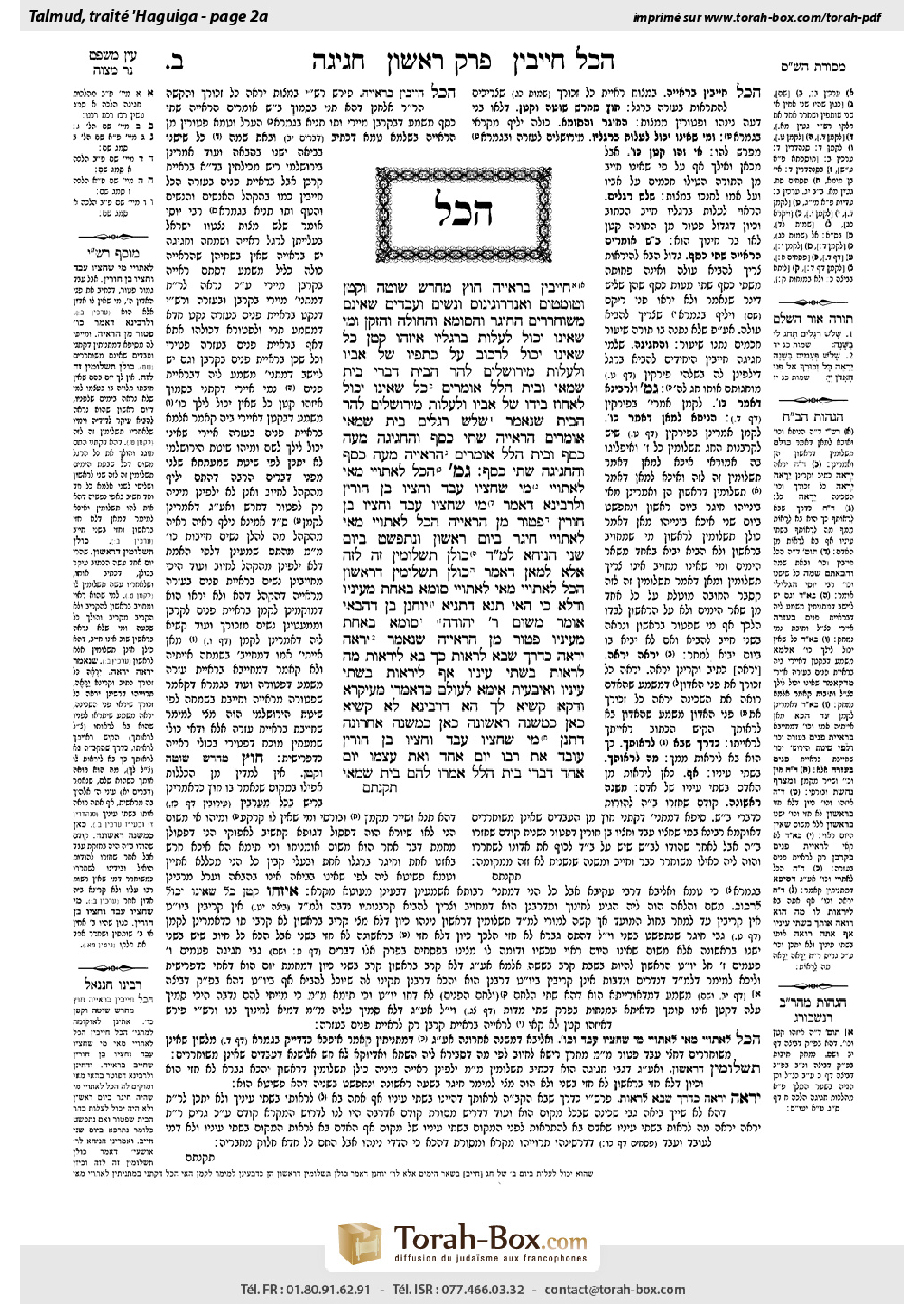
This page of Chagigah includes the Aramaic text, an English translation and an AI-generated French translation, alongside the scan above.
חגיגה ב׳ א · Aramaic and Hebrew text
הַכֹּל חַיָּיבִין בִּרְאִיָּיה, חוּץ מֵחֵרֵשׁ שׁוֹטֶה וְקָטָן, וְטוּמְטוּם וְאַנְדְּרוֹגִינוֹס, וְנָשִׁים, וַעֲבָדִים שֶׁאֵינָם מְשׁוּחְרָרִים, הַחִיגֵּר וְהַסּוֹמֵא, וְהַחוֹלֶה וְהַזָּקֵן, וּמִי שֶׁאֵינוֹ יָכוֹל לַעֲלוֹת בְּרַגְלָיו.
אֵיזֶהוּ קָטָן — כֹּל שֶׁאֵינוֹ יָכוֹל לִרְכּוֹב עַל כְּתֵפָיו שֶׁל אָבִיו וְלַעֲלוֹת מִירוּשָׁלַיִם לְהַר הַבַּיִת, דִּבְרֵי בֵּית שַׁמַּאי. וּבֵית הִלֵּל אוֹמְרִים: כֹּל שֶׁאֵינוֹ יָכוֹל לֶאֱחוֹז בְּיָדוֹ שֶׁל אָבִיו וְלַעֲלוֹת מִירוּשָׁלַיִם לְהַר הַבַּיִת, שֶׁנֶּאֱמַר: ״שָׁלֹשׁ רְגָלִים״.
בֵּית שַׁמַּאי אוֹמְרִים: הָרְאִיָּיה — שְׁתֵּי כֶסֶף, וְהַחֲגִיגָה — מָעָה כֶּסֶף. וּבֵית הִלֵּל אוֹמְרִים: הָרְאִיָּיה מָעָה כֶּסֶף, וְהַחֲגִיגָה שְׁתֵּי כֶסֶף.
גְּמָ׳ ״הַכֹּל״ לְאֵתוֹיֵי מַאי? לְאֵתוֹיֵי מִי שֶׁחֶצְיוֹ עֶבֶד וְחֶצְיוֹ בֶּן חוֹרִין. וּלְרָבִינָא דְּאָמַר מִי שֶׁחֶצְיוֹ עֶבֶד וְחֶצְיוֹ בֶּן חוֹרִין פָּטוּר מִן הָרְאִיָּיה, ״הַכֹּל״ לְאֵתוֹיֵי מַאי? לְאֵתוֹיֵי חִיגֵּר בְּיוֹם רִאשׁוֹן וְנִתְפַּשֵּׁט בְּיוֹם שֵׁנִי.
הָנִיחָא לְמַאן דְּאָמַר כּוּלָּן תַּשְׁלוּמִין זֶה לָזֶה. אֶלָּא לְמַאן דְּאָמַר כּוּלָּן תַּשְׁלוּמִין דְּרִאשׁוֹן, ״הַכֹּל״ לְאֵתוֹיֵי מַאי? לְאֵתוֹיֵי סוֹמֵא בְּאַחַת מֵעֵינָיו.
וּדְלָא כִּי הַאי תַּנָּא, דְּתַנְיָא: יוֹחָנָן בֶּן דַּהֲבַאי אוֹמֵר מִשּׁוּם רַבִּי יְהוּדָה: סוֹמֵא בְּאַחַת מֵעֵינָיו פָּטוּר מִן הָרְאִיָּיה, שֶׁנֶּאֱמַר: ״יִרְאֶה״, ״יֵרָאֶה״ — כְּדֶרֶךְ שֶׁבָּא לִרְאוֹת כָּךְ בָּא לֵירָאוֹת. מָה לִרְאוֹת בִּשְׁתֵּי עֵינָיו, אַף לֵירָאוֹת בִּשְׁתֵּי עֵינָיו.
וְאִיבָּעֵית אֵימָא: לְעוֹלָם כִּדְאָמְרִי מֵעִיקָּרָא, וּדְקָא קַשְׁיָא לָךְ הָא דְּרָבִינָא — לָא קַשְׁיָא: כָּאן כְּמִשְׁנָה רִאשׁוֹנָה, כָּאן כְּמִשְׁנָה אַחֲרוֹנָה. דִּתְנַן: מִי שֶׁחֶצְיוֹ עֶבֶד וְחֶצְיוֹ בֶּן חוֹרִין — עוֹבֵד אֶת רַבּוֹ יוֹם אֶחָד וְאֶת עַצְמוֹ יוֹם אֶחָד, דִּבְרֵי בֵּית הִלֵּל.
אָמְרוּ לָהֶם בֵּית שַׁמַּאי:
Chagigah 2a · English translation
MISHNA: All are obligated on the three pilgrim Festivals in the mitzva of appearance, i.e., to appear in the Temple as well as to sacrifice an offering, except for a deaf-mute, an imbecile, and a minor; and a tumtum, and a hermaphrodite, and women, and slaves who are not emancipated; and the lame, and the blind, and the sick, and the old, and one who is unable to ascend to Jerusalem on his own legs.
Who has the status of a minor with regard to this halakha? Any child who is unable to ride on his father’s shoulders and ascend from Jerusalem to the Temple Mount; this is the statement of Beit Shammai. And Beit Hillel say: Any child who is unable to hold his father’s hand and ascend on foot from Jerusalem to the Temple Mount, as it is stated: “Three times [regalim]” (Exodus 23:14). Since the term for feet is raglayim, Beit Hillel infer from here that the obligation to ascend involves the use of one’s legs.
Beit Shammai say: The burnt-offering of appearance brought on a pilgrim Festival must be worth at least two silver coins, and the Festival peace-offering must be worth at least one silver ma’a coin. And Beit Hillel say: The burnt-offering of appearance must be worth at least one silver ma’a and the Festival peace-offering at least two silver coins.
GEMARA: The Gemara asks: When the mishna states that all are obligated in the mitzva of appearance in the Temple, the term: All, comes to add what in the mishna’s ruling? The Gemara answers: It serves to add one who is half-slave half-freeman. The Gemara asks: And according to the opinion of Ravina, who said: One who is half-slave half-freeman is exempt from the appearance in the Temple, the term: All, comes to add what? The Gemara answers: It comes to add one who was lame on the first day of the Festival and was unable to travel, and was healed on the second day of the Festival. This man is obligated to appear before the end of the Festival.
The Gemara asks: This works out well according to the one who said that all seven days of the Festival redress one another, i.e., the obligation to appear applies equally on all days of the Festival. Consequently, one who was unable to travel on the first day may do so on the second day. However, according to the one who said that the main obligation is on the first day and all the remaining days merely redress the first day, and therefore one who was exempt from appearing on the first day of the Festival remains exempt throughout the rest of the Festival, the term: All, comes to add what? The Gemara answers: It comes to add one who is blind in one of his eyes.
The Gemara notes: And this is not in accordance with the opinion of this tanna, as it is taught in a baraita that Yoḥanan ben Dehavai says in the name of Rabbi Yehuda: One who is blind in one of his eyes is exempt from the mitzva of appearance, as it is stated: “Three occasions in the year all your males will appear [yera’e] before the Lord God” (Exodus 23:17). Since there are no vowels in the text, this can be read as: All your males will see [yireh] the Lord God. This teaches that in the same manner that one comes to see, so he comes to be seen: Just as the usual way to see is with both one’s eyes, so too the obligation to be seen applies only to one who comes with the sight of both his eyes. Therefore, one who is blind in one eye is not obligated in the mitzva of appearance in the Temple.
And if you wish, say instead: Actually, it is as we said initially, that it comes to include one who is half-slave and half-freeman. And as for that which poses a difficulty to the opinion of Ravina, it is not difficult: Here it is in accordance with the initial version of the mishna, whereas there, Ravina’s statement, is in accordance with the ultimate version of the mishna. As we learned in a mishna (Pesaḥim 88a): One who is half-slave half-freeman serves his master one day and works for himself one day. This is the statement of Beit Hillel.
Beit Shammai said to them:
Chagigah 2a · Traduction française (IA)
MICHNA : Tous sont tenus à la mitsva de l'apparition lors des trois fêtes de pèlerinage, c'est-à-dire d'apparaître dans le Temple ainsi que de sacrifier une offrande, à l'exception des sourds-muets, des imbéciles, des mineurs, d'un tumtum, d'un hermaphrodite, des femmes, des esclaves non emancipés, des boiteux, des aveugles, des malades, des personnes âgées, et de celui qui ne peut monter à Jérusalem par ses propres jambes.
Qui est considéré comme un mineur concernant cette halakha ? Tout enfant qui ne peut monter sur les épaules de son père et monter de Jérusalem jusqu'au Mont du Temple ; c'est la déclaration de Beit Shammai. Et Beit Hillel disent : Tout enfant qui ne peut tenir la main de son père et monter à pied de Jérusalem jusqu'au Mont du Temple ; car il est dit : « Trois fois [regalim] » (Exode 23:14). Puisque le terme pour les pieds est raglayim, Beit Hillel en déduisent que l'obligation de monter implique l'utilisation de ses jambes.
Beit Shammai disent : L'holocauste d'apparition offerte lors d'une fête de pèlerinage doit valoir au moins deux monnaies d'argent, et l'offrande de paix de la fête doit valoir au moins une monnaie d'argent ma'a. Et Beit Hillel disent : L'holocauste d'apparition doit valoir au moins une monnaie d'argent ma'a, et l'offrande de paix de la fête au moins deux monnaies d'argent.
GUEMARA : La Guemara pose la question : Lorsque la Michna dit que tous sont tenus à la mitsva d'apparition dans le Temple, le terme « tous » vient-il ajouter quelque chose à la décision de la Michna ? La Guemara répond : Il sert à ajouter celui qui est demi-esclave et demi-libre. La Guemara pose la question : Et selon l'opinion de Ravina, qui dit : Celui qui est demi-esclave et demi-libre est exempt de l'apparition dans le Temple, le terme « tous » vient-il ajouter quelque chose ? La Guemara répond : Il vient ajouter celui qui était boiteux le premier jour de la fête et n'était pas capable de voyager, mais qui s'est guéri le deuxième jour de la fête. Ce homme est tenu d'apparaître avant la fin de la fête.
La Guemara pose la question : Cela fonctionne bien selon celui qui a dit que les sept jours de la fête s'entraident mutuellement, c'est-à-dire que l'obligation d'apparaître s'applique de la même manière à tous les jours de la fête. Par conséquent, celui qui n'était pas capable de voyager le premier jour peut le faire le deuxième jour. Cependant, selon celui qui a dit que l'obligation principale est le premier jour et les autres jours ne s'entraident que le premier jour, et donc celui qui était exempt d'apparaître le premier jour de la fête reste exempt tout au long du reste de la fête, le terme « tous » vient-il ajouter quelque chose ? La Guemara répond : Il vient ajouter celui qui est aveugle dans l'un de ses yeux.
La Guemara note : Et cela ne correspond pas à l'opinion de ce tanna, car il est enseigné dans une baraïta que Yoḥanan ben Dehavai dit au nom de Rabbi Yehuda : Celui qui est aveugle dans l'un de ses yeux est exempt de la mitsva d'apparition, car il est dit : « Trois fois dans l'année, tous vos mâles apparaîtront [yera'e] devant l'Éternel, votre Dieu » (Exode 23:17). Puisque le texte n'a pas de points, cela peut être lu comme : « Tous vos mâles verront [yireh] l'Éternel, votre Dieu ». Cela enseigne que de la même manière qu'on vient pour voir, on vient aussi pour être vu : Comme la manière habituelle de voir est avec les deux yeux, de même l'obligation d'être vu s'applique uniquement à celui qui vient avec la vue des deux yeux. Par conséquent, celui qui est aveugle dans l'un de ses yeux n'est pas tenu de la mitsva d'apparition dans le Temple.
Et si vous le souhaitez, dites plutôt : En réalité, c'est comme nous l'avons dit initialement, que cela vient inclure celui qui est demi-esclave et demi-libre. Et concernant ce qui pose une difficulté à l'opinion de Ravina, cela n'est pas difficile : ici, il s'agit de la version initiale de la Michna, tandis que là, la déclaration de Ravina s'inscrit dans la version ultime de la Michna. Comme nous avons appris dans une Michna (Pesaḥim 88a) : Celui qui est demi-esclave et demi-libre sert son maître un jour et travaille pour lui-même un jour. C'est la déclaration de Beit Hillel.
Beit Shammai dit à eux :
Traduction française générée par IA à partir de l’édition anglaise de Sefaria. Vérifie toujours un passage avec le texte source.
Text from Sefaria: William Davidson Edition - Vocalized Aramaic (CC BY NC); William Davidson Edition - English (CC BY NC).