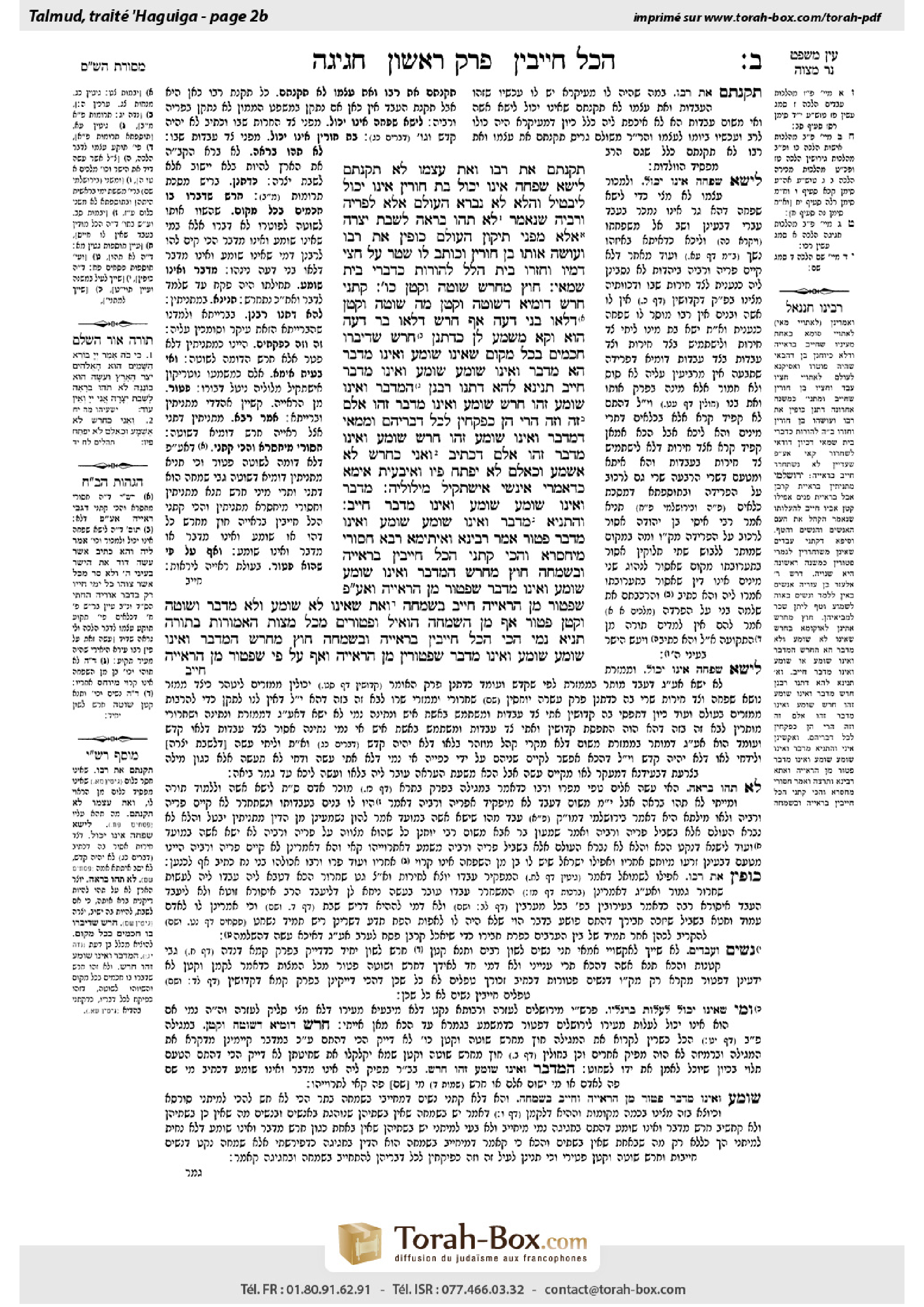
Chagigah 2b: Talmud study for Daf Yomi
Study the Talmud for Daf Yomi with scanned pages, Hebrew text, English translations from Sefaria and AI-generated French translations.
Passage selection and English or AI-generated French translation are available where the scan has annotations. Daf Study is independent of Torah-Box and Sefaria.
Browse Chagigah · חגיגה · All tractatesChagigah 2b text and translations
This page of Chagigah includes the Aramaic text, an English translation and an AI-generated French translation, alongside the scan above.
חגיגה ב׳ ב · Aramaic and Hebrew text
תִּקַּנְתֶּם אֶת רַבּוֹ, וְאֶת עַצְמוֹ לֹא תִּקַּנְתֶּם. לִישָּׂא שִׁפְחָה אֵינוֹ יָכוֹל, בַּת חוֹרִין אֵינוֹ יָכוֹל.
לִיבְטֵּיל — וַהֲלֹא לֹא נִבְרָא הָעוֹלָם אֶלָּא לִפְרִיָּה וּרְבִיָּה, שֶׁנֶּאֱמַר: ״לֹא תֹהוּ בְרָאָהּ לָשֶׁבֶת יְצָרָהּ״. אֶלָּא מִפְּנֵי תִּיקּוּן הָעוֹלָם, כּוֹפִין אֶת רַבּוֹ וְעוֹשֶׂה אוֹתוֹ בֶּן חוֹרִין, וְכוֹתֵב לוֹ שְׁטָר עַל חֲצִי דָּמָיו. וְחָזְרוּ בֵּית הִלֵּל לְהוֹרוֹת כְּדִבְרֵי בֵּית שַׁמַּאי.
חוּץ מֵחֵרֵשׁ שׁוֹטֶה וְקָטָן כּוּ׳. קָתָנֵי חֵרֵשׁ דּוּמְיָא דְּשׁוֹטֶה וְקָטָן: מָה שׁוֹטֶה וְקָטָן — דְּלָאו בְּנֵי דֵעָה, אַף חֵרֵשׁ — דְּלָאו בַּר דֵּעָה הוּא. וְקָא מַשְׁמַע לַן כְּדִתְנַן: חֵרֵשׁ שֶׁדִּיבְּרוּ חֲכָמִים בְּכׇל מָקוֹם, שֶׁאֵינוֹ שׁוֹמֵעַ וְאֵינוֹ מְדַבֵּר. הָא מְדַבֵּר וְאֵינוֹ שׁוֹמֵעַ, שׁוֹמֵעַ וְאֵינוֹ מְדַבֵּר — חַיָּיב.
תְּנֵינָא לְהָא, דְּתָנוּ רַבָּנַן: הַמְדַבֵּר וְאֵינוֹ שׁוֹמֵעַ — זֶהוּ חֵרֵשׁ, שׁוֹמֵעַ וְאֵינוֹ מְדַבֵּר — זֶהוּ אִלֵּם, זֶה וָזֶה — הֲרֵי הֵן כְּפִקְחִין לְכׇל דִּבְרֵיהֶם.
וּמִמַּאי דִּמְדַבֵּר וְאֵינוֹ שׁוֹמֵעַ זֶהוּ חֵרֵשׁ, שׁוֹמֵעַ וְאֵינוֹ מְדַבֵּר זֶהוּ אִלֵּם? דִּכְתִיב: ״וַאֲנִי כְחֵרֵשׁ לֹא אֶשְׁמָע וּכְאִלֵּם לֹא יִפְתַּח פִּיו״. וְאִיבָּעֵית אֵימָא, כִּדְאָמְרִי אִינָשֵׁי: אִישְׁתְּקִיל מִילּוּלֵיהּ.
מְדַבֵּר וְאֵינוֹ שׁוֹמֵעַ, שׁוֹמֵעַ וְאֵינוֹ מְדַבֵּר — חַיָּיב. וְהָתַנְיָא: מְדַבֵּר וְאֵינוֹ שׁוֹמֵעַ, שׁוֹמֵעַ וְאֵינוֹ מְדַבֵּר — פָּטוּר!
אָמַר רָבִינָא, וְאִיתֵּימָא רָבָא: חַסּוֹרֵי מִיחַסְּרָא וְהָכִי קָתָנֵי: הַכֹּל חַיָּיבִין בִּרְאִיָּיה וּבְשִׂמְחָה, חוּץ מֵחֵרֵשׁ הַמְדַבֵּר וְאֵינוֹ שׁוֹמֵעַ, שׁוֹמֵעַ וְאֵינוֹ מְדַבֵּר, שֶׁפָּטוּר מִן הָרְאִיָּיה. וְאַף עַל פִּי שֶׁפָּטוּר מִן הָרְאִיָּיה, חַיָּיב בְּשִׂמְחָה. וְאֶת שֶׁאֵינוֹ לֹא שׁוֹמֵעַ וְלֹא מְדַבֵּר, וְשׁוֹטֶה וְקָטָן — פָּטוּר אַף מִן הַשִּׂמְחָה, הוֹאִיל וּפְטוּרִים מִכׇּל מִצְוֹת הָאֲמוּרוֹת בַּתּוֹרָה.
תַּנְיָא נָמֵי הָכִי: הַכֹּל חַיָּיבִין בִּרְאִיָּיה וּבְשִׂמְחָה, חוּץ מֵחֵרֵשׁ הַמְדַבֵּר וְאֵינוֹ שׁוֹמֵעַ, שׁוֹמֵעַ וְאֵינוֹ מְדַבֵּר, שֶׁפְּטוּרִין מִן הָרְאִיָּיה. וְאַף עַל פִּי שֶׁפָּטוּר מִן הָרְאִיָּיה —
Chagigah 2b · English translation
You have remedied the situation of his master, who benefits fully from all his rights to the slave, but his own situation you have not remedied. How so? He is unable to marry a maidservant, as half of him is already free, and a free Jew may not marry a Canaanite maidservant. He is likewise unable to marry a free woman, as half of him is still a slave.
And if you say he should be idle and not marry, but isn’t it true that the world was created only for procreation, as it is stated: “He did not create it to be a waste; He formed it to be inhabited” (Isaiah 45:18)? Rather, for the betterment of the world we force his master to make him a freeman, and the slave writes a bill to his master accepting his responsibility to pay half his value to him. And Beit Hillel ultimately retracted their opinion, to rule in accordance with the statement of Beit Shammai that a half-slave must be set free.
§ The mishna taught: Except for a deaf-mute, an imbecile, and a minor. The Gemara notes: By listing these three cases together the mishna is teaching that a deaf-mute is similar to an imbecile and a minor: Just as an imbecile and a minor are among those who are not of sound mind, so too the deaf-mute [ḥeresh] mentioned here is one who is not of sound mind. And this teaches us as we learned in a mishna (Terumot 1:2): The ḥeresh, whom the Sages discussed everywhere, is one who does not hear and does not speak, and therefore his mind is not lucid. It can be inferred from this that one who speaks but does not hear and one who hears but does not speak are obligated in mitzvot like any other person.
The Gemara notes: We already learned this, as the Sages taught in the Tosefta (Terumot 1:2): One who speaks but does not hear, this is a deaf person. One who hears but does not speak, this is a mute. Both this one and that one are in the same legal category as those who can see and hear with regard to all matters. This shows that the ḥeresh exempted by the Sages is one who neither hears nor speaks.
The Gemara asks: And from where is it derived that one who speaks but does not hear is a deaf person, and one who hears but does not speak is a mute? As it is written: “But I am as a deaf man, I hear not; and I am as a dumb man [illem] who does not open his mouth” (Psalms 38:14). If you wish, say instead that this is as people say: His speech has been taken [Ishtakeil Milulei]; the term illem is an acronym for this phrase.
The Tosefta taught that one who speaks but does not hear and one who hears but does not speak are obligated in mitzvot. The Gemara asks: Isn’t it taught in a baraita that one who speaks but does not hear and one who hears but does not speak are exempt?
Ravina said, and some say it was Rava who said: The mishna is incomplete and is teaching the following: All are obligated in the mitzvot of appearance in the Temple and rejoicing during the pilgrim Festival by eating the sacrificial meat, except for a deaf person who speaks but does not hear and a mute person who hears but does not speak, each of whom is exempt from the mitzva of appearance. And even though he is exempt from the mitzva of appearance, he is obligated in the mitzva of rejoicing. But one who does not hear and does not speak, and an imbecile and a minor, each of these is exempt even from rejoicing, since they are exempt from all the mitzvot mentioned in the Torah, as they are not of sound mind.
That opinion is also taught in a baraita: All are obligated in the mitzva of appearance and in rejoicing, except for a deaf person who speaks but does not hear and one who hears but does not speak, as they are exempt from the mitzva of appearance. And even though they are exempt from the mitzva of appearance,
Chagigah 2b · Traduction française (IA)
Vous avez réparé la situation de son maître, qui bénéficie pleinement de tous ses droits sur l’esclave, mais votre propre situation, vous n’avez pas réparé. Comment cela ? Il ne peut se marier avec une servante, car la moitié de lui est déjà libre, et un Juif libre ne peut pas se marier avec une servante cananéenne. Il ne peut non plus se marier avec une femme libre, car la moitié de lui est encore esclave.
Et si vous dites qu’il devrait être inactif et ne pas se marier, n’est-ce pas vrai que le monde a été créé uniquement pour la procréation, comme il est dit : « Il ne l’a pas créé pour être inutile ; Il l’a fait pour qu’il soit habité » (Yachout 45:18) ? Plutôt, pour le bien-être du monde, nous forçons son maître à le rendre libre, et l’esclave écrit un billet à son maître acceptant sa responsabilité de lui payer la moitié de sa valeur. Et Beit Hillel a finalement rétracté leur opinion pour décider en conformité avec l’affirmation de Beit Shammai selon laquelle un esclave demi-libre doit être libéré.
§ La mitsva a enseigné : À l’exception d’un sourd-muet, d’un imbécile et d’un mineur. La Guemara note : En listant ces trois cas ensemble, la mitsva enseigne que le sourd-muet est semblable à l’imbécile et au mineur : Comme l’imbécile et le mineur sont parmi ceux qui n’ont pas un esprit clair, de même le sourd-muet mentionné ici n’a pas un esprit clair. Et cela nous apprend comme nous avons appris dans une mitsva (Terouma 1:2) : Le sourd-muet, dont les Sages ont discuté partout, est celui qui ne peut ni entendre ni parler, et par conséquent son esprit n’est pas clair. On peut en déduire que celui qui parle mais n’entend pas et celui qui entend mais ne parle pas sont tenus des mitsvot comme tout autre personne.
La Guemara note : Nous avons déjà appris cela, comme les Sages ont enseigné dans la Tosefta (Terouma 1:2) : Celui qui parle mais n’entend pas, c’est un sourd. Celui qui entend mais ne parle pas, c’est un muet. Les deux sont dans la même catégorie juridique que ceux qui voient et entendent concernant toutes les affaires. Cela montre que le sourd-muet exempté par les Sages est celui qui n’entend ni ne parle.
La Guemara pose la question : Et d’où est tiré que celui qui parle mais n’entend pas est un sourd, et celui qui entend mais ne parle pas est un muet ? Comme il est écrit : « Mais je suis comme un sourd, je n’entends pas ; et je suis comme un muet [illem] qui ne ouvre pas sa bouche » (Psaumes 38:14). Si vous le souhaitez, dites plutôt que cela est comme ce que les gens disent : Sa parole a été enlevée [Ishtakeil Milulei] ; le terme illem est un acronyme pour cette phrase.
La Tosefta a enseigné que celui qui parle mais n’entend pas et celui qui entend mais ne parle pas sont tenus des mitsvot. La Guemara pose la question : N’est-ce pas enseigné dans une baraïta que celui qui parle mais n’entend pas et celui qui entend mais ne parle pas sont exemptés ?
Ravina a dit, et certains disent que c’était Rava qui a dit : La mitsna est incomplète et enseigne ceci : Tous sont tenus des mitsvot de présence dans le Temple et de joie pendant la fête de pèlerinage en mangeant la viande du sacrifice, à l’exception du sourd qui parle mais n’entend pas et du muet qui entend mais ne parle pas, chacun d’eux étant exempt de la mitsva de présence. Et même s’il est exempt de la mitsva de présence, il est tenu de la mitsva de joie. Mais celui qui n’entend pas et ne parle pas, et l’imbécile et le mineur, chacun de ces trois est exempt même de la joie, car ils sont exemptés de toutes les mitsvot mentionnées dans la Torah, car ils n’ont pas un esprit clair.
Cette opinion est également enseignée dans une baraïta : Tous sont tenus de la mitsva de présence et de la joie, à l’exception du sourd qui parle mais n’entend pas et du muet qui entend mais ne parle pas, car ils sont exemptés de la mitsva de présence. Et même s’ils sont exemptés de la mitsva de présence, ils sont tenus de la mitsva de joie.
Traduction française générée par IA à partir de l’édition anglaise de Sefaria. Vérifie toujours un passage avec le texte source.
Text from Sefaria: William Davidson Edition - Vocalized Aramaic (CC BY NC); William Davidson Edition - English (CC BY NC).