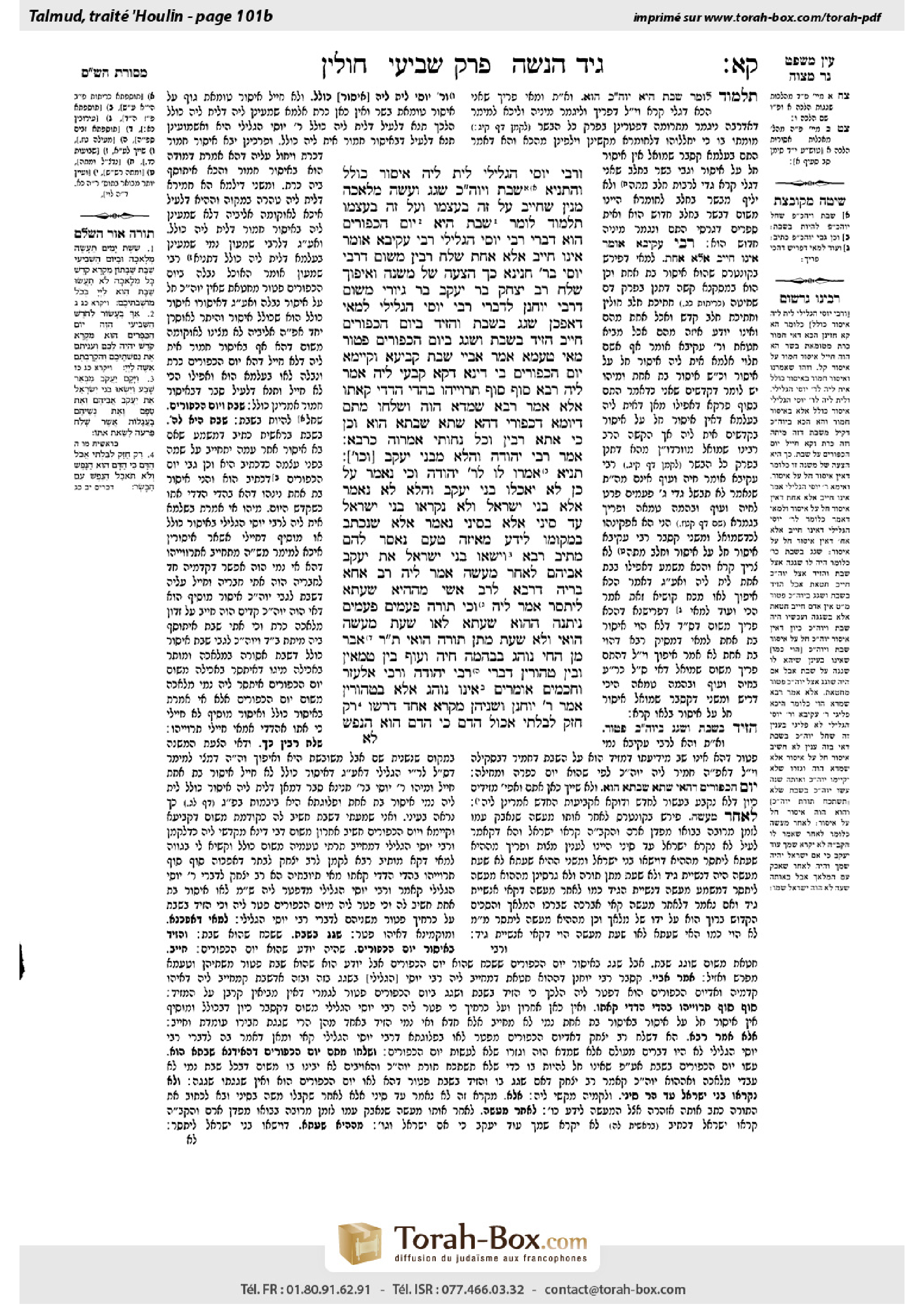
Chullin 101b: Talmud study for Daf Yomi
Study the Talmud for Daf Yomi with scanned pages, Hebrew text, English translations from Sefaria and AI-generated French translations.
Passage selection and English or AI-generated French translation are available where the scan has annotations. Daf Study is independent of Torah-Box and Sefaria.
Browse Chullin · חולין · All tractatesChullin 101b text and translations
This page of Chullin includes the Aramaic text, an English translation and an AI-generated French translation, alongside the scan above.
חולין ק״א ב · Aramaic and Hebrew text
וְרַבִּי יוֹסֵי הַגְּלִילִי לֵית לֵיהּ אִיסּוּר כּוֹלֵל?
וְהָתַנְיָא: שַׁבָּת וְיוֹם הַכִּפּוּרִים, שָׁגַג וְעָשָׂה מְלָאכָה, מִנַּיִן שֶׁחַיָּיב עַל זֶה בְּעַצְמוֹ וְעַל זֶה בְּעַצְמוֹ? תַּלְמוּד לוֹמַר: ״שַׁבָּת הִיא״, ״יוֹם הַכִּפּוּרִים הוּא״, דִּבְרֵי רַבִּי יוֹסֵי הַגְּלִילִי. רַבִּי עֲקִיבָא אוֹמֵר: אֵינוֹ חַיָּיב אֶלָּא אַחַת.
שְׁלַח רָבִין מִשּׁוּם דְּרַבִּי יוֹסֵי בְּרַבִּי חֲנִינָא: כָּךְ הַצָּעָה שֶׁל מִשְׁנָה, וְאֵיפוֹךְ.
שְׁלַח רַב יִצְחָק בַּר יַעֲקֹב בַּר גִּיּוֹרֵי מִשּׁוּם דְּרַבִּי יוֹחָנָן: לְדִבְרֵי רַבִּי יוֹסֵי הַגְּלִילִי, לְמַאי דַּאֲפַכַן, שָׁגַג בְּשַׁבָּת וְהֵזִיד בְּיוֹם הַכִּפּוּרִים – חַיָּיב, הֵזִיד בְּשַׁבָּת וְשָׁגַג בְּיוֹם הַכִּפּוּרִים – פָּטוּר.
מַאי טַעְמָא? אָמַר אַבָּיֵי: שַׁבָּת קְבִיעָא וְקַיְימָא, יוֹם הַכִּפּוּרִים – בֵּי דִינָא דְּקָא קָבְעִי לֵיהּ.
אֲמַר לֵיהּ רָבָא: סוֹף סוֹף, תַּרְוַיְיהוּ בַּהֲדֵי הֲדָדֵי קָאָתוּ. אֶלָּא אָמַר רָבָא: שְׁמָדָא הֲוָה, וּשְׁלַחוּ מִתָּם דְּיוֹמָא דְּכִפּוּרֵי דְּהָא שַׁתָּא שַׁבְּתָא הוּא. וְכֵן כִּי אֲתָא רָבִין וְכֹל נָחוֹתֵי אַמְרוּהָ כְּרָבָא.
אָמַר רַבִּי יְהוּדָה: וַהֲלֹא מִבְּנֵי יַעֲקֹב [וְכוּ׳].
תַּנְיָא, אָמְרוּ לוֹ לְרַבִּי יְהוּדָה: וְכִי נֶאֱמַר ״עַל כֵּן לֹא יֹאכְלוּ בְּנֵי יַעֲקֹב״? וַהֲלֹא לֹא נֶאֱמַר אֶלָּא ״בְּנֵי יִשְׂרָאֵל״, וְלֹא נִקְרְאוּ ״בְּנֵי יִשְׂרָאֵל״ עַד סִינַי! אֶלָּא בְּסִינַי נֶאֱמַר, אֶלָּא שֶׁנִּכְתַּב בִּמְקוֹמוֹ לֵידַע מֵאֵיזֶה טַעַם נֶאֱסַר לָהֶם.
מֵתִיב רָבָא: ״וַיִּשְׂאוּ בְנֵי יִשְׂרָאֵל אֶת יַעֲקֹב אֲבִיהֶם״, לְאַחַר מַעֲשֶׂה.
אֲמַר לֵיהּ רַב אַחָא בְּרֵיהּ דְּרָבָא לְרַב אָשֵׁי: מֵהָהִיא שַׁעְתָּא לִיתְּסַר.
אֲמַר לֵיהּ: וְכִי תוֹרָה פְּעָמִים פְּעָמִים נִיתְּנָה? הָהוּא שַׁעְתָּא לָאו שְׁעַת מַעֲשֶׂה הֲוַאי, וְלָא שְׁעַת מַתַּן תּוֹרָה הֲוַאי.
תָּנוּ רַבָּנַן: אֵבֶר מִן הַחַי נוֹהֵג בִּבְהֵמָה, חַיָּה וָעוֹף, בֵּין טְמֵאִין וּבֵין טְהוֹרִין, דִּבְרֵי רַבִּי יְהוּדָה וְרַבִּי אֶלְעָזָר. וַחֲכָמִים אוֹמְרִים: אֵינוֹ נוֹהֵג אֶלָּא בִּטְהוֹרִין.
אָמַר רַבִּי יוֹחָנָן: וּשְׁנֵיהֶן מִקְרָא אֶחָד דָּרְשׁוּ, ״רַק חֲזַק לְבִלְתִּי אֲכֹל הַדָּם כִּי הַדָּם הוּא הַנָּפֶשׁ
Chullin 101b · English translation
The Gemara asks: And does Rabbi Yosei HaGelili not hold that a more inclusive prohibition takes effect where there is an already existing prohibition?
But isn’t it taught in a baraita: When Shabbat and Yom Kippur occur on the same day, if one acted unwittingly and performed prohibited labor, from where is it derived that he is liable for this by itself and for that by itself, i.e., he is liable to bring two sin offerings, for having transgressed both Shabbat and Yom Kippur? The verse states: “You shall do no manner of work; it is a Shabbat for the Lord in all your dwellings” (Leviticus 23:3), and another verse states: “It is Yom Kippur” (Leviticus 23:27). The term “it is” in each verse teaches that each of these days is considered independently even when it occurs together with another holy day. This is the statement of Rabbi Yosei HaGelili. Rabbi Akiva says: He is liable to bring only one sin offering because a prohibition does not take effect where another prohibition already exists.
The Gemara answers that on this topic Ravin sent a letter citing a statement in the name of Rabbi Yosei, son of Rabbi Ḥanina: This is the correct presentation of this teaching [hatza’a shel mishna], i.e., the opinions in this baraita are accurate, but one must reverse the attributions of each opinion so that the first opinion is that of Rabbi Akiva and the second opinion is that of Rabbi Yosei HaGelili. Consequently, Rabbi Yosei HaGelili holds that two prohibitions do not take effect at the same time even if one is more inclusive or stringent than the other.
The Gemara continues to discuss the opinion of Rabbi Yosei HaGelili. Rav Yitzḥak bar Ya’akov bar Giyorei sent a letter citing a statement in the name of Rabbi Yoḥanan: According to the statement of Rabbi Yosei HaGelili, as stated in the baraita once the attributions have been reversed, if one unwittingly performed a forbidden labor on a Yom Kippur that occurred on Shabbat, he is obligated to bring one sin offering. If he acted unwittingly with regard to the fact that it was Shabbat, i.e., he forgot that it was Shabbat, but acted intentionally with regard to Yom Kippur, he is obligated to bring a sin offering. But if he acted intentionally with regard to Shabbat but unwittingly with regard to Yom Kippur, he is exempt from bringing any offering.
The Gemara asks: What is the reason for Rabbi Yoḥanan’s statement? Abaye said: Shabbat is established and permanent, i.e., it always occurs on the seventh day of the week, whereas in the case of Yom Kippur, it is the court that establishes it, as the Sages determine the New Moon. Consequently, Shabbat is considered to have preceded Yom Kippur, and the prohibition to perform labor on Yom Kippur does not apply, due to the fact that labor is already prohibited because it is Shabbat. Since one brings a sin offering only due to unwitting transgression, he is obligated to bring a sin offering only if he performed labor without realizing it was Shabbat.
Rava said to Abaye: Ultimately both of them, i.e., Shabbat and Yom Kippur, come into effect at the same time. Since both take effect at the beginning of the calendar day, it cannot be said that Shabbat precedes Yom Kippur. Rather Rava said a different explanation. It was a time of religious persecution, and they sent from there, i.e., from Eretz Yisrael, a directive stating that Yom Kippur of this year will not be observed on its proper day but rather on Shabbat. Rabbi Yoḥanan was merely stating that on that particular year one who would unwittingly transgress Yom Kippur would be exempt from bringing a sin offering. And similarly, when Ravin and all those who descended from Eretz Yisrael came to Babylonia, they said that the true explanation is in accordance with the opinion of Rava.
§ The mishna teaches: Rabbi Yehuda said in explanation: Wasn’t the sciatic nerve forbidden for the children of Jacob, as it is written: “Therefore the children of Israel eat not the sciatic nerve” (Genesis 32:33), yet the meat of a non-kosher animal was still permitted to them? Since the sciatic nerve of non-kosher animals became forbidden at that time, it remains forbidden now.
It is taught in a baraita that the Rabbis said to Rabbi Yehuda: But is it stated in the verse: Therefore the children of Jacob do not eat the sciatic nerve? Isn’t it true that it is stated only that: “Therefore the children of Israel do not eat the sciatic nerve?” And the Jewish people were not called “the children of Israel” until they received the Torah at Mount Sinai. Rather, this terminology indicates that the prohibition of eating the sciatic nerve was stated to the Jewish people at Sinai, but was written in its place, after the incident of Jacob wrestling with the angel, to allow the Jewish people to know the reason the sciatic nerve was forbidden to them. Since the prohibition came into effect only at Sinai, there is no proof that it ever applied with regard to non-kosher animals.
Rava raises an objection to this baraita: The verse states: “And Jacob rose up from Beersheba; and the children of Israel carried Jacob their father, and their little ones, and their wives in the wagons that Pharaoh had sent to carry him” (Genesis 46:5). This occurred before the Torah was given at Sinai, and therefore proves that the title “the children of Israel” was in use before the Torah was given. The Gemara answers: Nevertheless, this occurred after the incident, i.e., after Jacob wrestled with the angel and after the prophetic vision in which God changed Jacob’s name to Israel (Genesis 35:10).
Rav Aḥa, son of Rava, said to Rav Ashi: In that case, the sciatic nerve should be understood as having become forbidden to them from that time when they were first called the children of Israel. Since this was before the giving of the Torah, this would be in accordance with the opinion of Rabbi Yehuda and not that of the Rabbis.
Rav Ashi said to him: Was the Torah given piecemeal, on numerous different occasions? It was given at Sinai. Rather, that time when the title “children of Israel” was first used was not the time when the incident of Jacob wrestling with the angel occurred and also was not the time of the giving of the Torah at Mount Sinai. Therefore, there is no reason to assume that the prohibition took effect at that time.
§ The mishna taught a dispute between Rabbi Yehuda and the Rabbis with regard to the prohibition of eating the sciatic nerve. The Gemara now cites a similar dispute between them with regard to eating a limb from a living animal. The Sages taught in a baraita: The prohibition of eating a limb from a living animal applies whether the limb comes from a domesticated animal, an undomesticated animal, or a bird, and whether it is from a non-kosher species or from a kosher species; this is the statement of Rabbi Yehuda and Rabbi Elazar. But the Rabbis say: The prohibition of eating a limb from a living animal applies only to a limb from a kosher species.
Rabbi Yoḥanan says: And both of them, i.e., the Rabbis as well as Rabbi Yehuda and Rabbi Elazar, derived their opinions from one verse: “Only be steadfast in not eating the blood, for the blood is the life;
Chullin 101b · Traduction française (IA)
La Guemara pose la question : Et ne tient-il pas Rabbi Yosei HaGelili pas à ce que l'interdiction plus générale s'applique lorsqu'il existe déjà une interdiction ?
Mais n'est-il pas enseigné dans une baraïta : Lorsque le Sabbat et le Yom Kippur tombent le même jour, si l'on agit sans connaissance et qu'on exécute un travail interdit, d'où est-il tiré qu'il est tenu responsable de cela seul et de cela seul, c'est-à-dire qu'il doit présenter deux sacrifices expiatoires, pour avoir transgressé à la fois le Sabbat et le Yom Kippur ? La Sainte Écriture dit : « Vous ne ferez aucun ouvrage ; c'est un Sabbat pour l'Éternel dans toutes vos demeures » (Lévitique 23:3), et une autre Sainte Écriture dit : « C'est le Yom Kippur » (Lévitique 23:27). Le terme « c'est » dans chaque verset enseigne que chaque jour est considéré indépendamment même lorsqu'il se produit en même temps qu'un autre jour saint. C'est l'opinion de Rabbi Yosei HaGelili. Rabbi Akiva dit : Il est tenu responsable d'un seul sacrifice expiatoire, car une interdiction ne s'applique pas lorsqu'une autre interdiction existe déjà.
La Guemara répond que sur ce sujet Ravin a envoyé une lettre citant une déclaration en nom de Rabbi Yosei, fils de Rabbi Ḥanina : C'est la bonne présentation de cette enseignement [hatza’a shel mishna], c'est-à-dire les opinions dans cette baraïta sont exactes, mais il faut inverser les attributions de chaque opinion de sorte que la première opinion soit celle de Rabbi Akiva et la seconde celle de Rabbi Yosei HaGelili. Ainsi, Rabbi Yosei HaGelili considère que deux interdictions ne s'appliquent pas en même temps même si l'une est plus inclusive ou plus stricte que l'autre.
La Guemara continue à discuter l'opinion de Rabbi Yosei HaGelili. Rav Yitzḥak bar Ya’akov bar Giyorei a envoyé une lettre citant une déclaration en nom de Rabbi Yoḥanan : Selon l'opinion de Rabbi Yosei HaGelili, comme indiqué dans la baraïta une fois que les attributions ont été inversées, si l'on exécute par inadvertence un travail interdit un Yom Kippur qui tombe un Sabbat, il est tenu responsable d'un seul sacrifice expiatoire. Si l'on agit par inadvertence concernant le fait qu'il s'agit du Sabbat, c'est-à-dire qu'on a oublié qu'il s'agit du Sabbat, mais agit intentionnellement concernant le Yom Kippur, il est tenu responsable d'un sacrifice expiatoire. Mais si l'on agit intentionnellement concernant le Sabbat mais par inadvertence concernant le Yom Kippur, il est exempt de présenter tout sacrifice.
La Guemara pose la question : Quel est le motif de la déclaration de Rabbi Yoḥanan ? Abaye dit : Le Sabbat est établi et permanent, c'est-à-dire qu'il tombe toujours le septième jour de la semaine, tandis que dans le cas du Yom Kippur, c'est le tribunal qui l'établit, car les Sages déterminent la nouvelle lune. Ainsi, le Sabbat est considéré comme ayant précédé le Yom Kippur, et l'interdiction d'effectuer un travail le Yom Kippur ne s'applique pas, en raison du fait que le travail est déjà interdit en raison du Sabbat. Puisque l'on présente un sacrifice expiatoire uniquement en raison d'une transgression involontaire, il est tenu responsable d'un sacrifice expiatoire uniquement s'il a effectué un travail sans savoir qu'il s'agissait du Sabbat.
Rava dit à Abaye : Finalement, les deux, c'est-à-dire le Sabbat et le Yom Kippur, entrent en vigueur en même temps. Puisque les deux s'appliquent au début du jour calendrier, il ne peut être dit que le Sabbat précède le Yom Kippur. Rava a donné une autre explication. C'était une époque de persécution religieuse, et ils ont envoyé d'Eretz Yisrael une directive indiquant que le Yom Kippur de cette année ne sera pas observé à sa date normale mais plutôt le Sabbat. Rabbi Yoḥanan a simplement indiqué que dans cette année particulière, celui qui transgresserait par inadvertence le Yom Kippur serait exempt de présenter un sacrifice expiatoire. De même, lorsque Ravin et tous ceux qui descendaient d'Eretz Yisrael sont arrivés en Babylone, ils ont dit que l'explication correcte est conformément à l'opinion de Rava.
§ La mishna enseigne : Rabbi Yehuda dit en explication : N'était-ce pas interdit au peuple de Jacob la moelle du fémur, comme il est écrit : « Ainsi les enfants d'Israël ne mangent pas la moelle du fémur » (Gen 32:33), et pourtant la viande d'un animal non-kosher était encore permise à eux ? Puisque la moelle du fémur des animaux non-kosher est devenue interdite à cette époque, elle reste interdite aujourd'hui.
Il est enseigné dans une baraïta que les Sages dirent à Rabbi Yehuda : Mais n'est-il pas écrit dans la Sainte Écriture : « Ainsi les enfants de Jacob ne mangent pas la moelle du fémur » ? N'est-ce pas vrai que cela est écrit seulement : « Ainsi les enfants d'Israël ne mangent pas la moelle du fémur » ? Et le peuple juif n'était pas appelé « les enfants d'Israël » jusqu'à ce qu'ils reçoivent la Torah au Mont Sinaï. Plutôt, ce terme indique que l'interdiction de manger la moelle du fémur a été énoncée au peuple juif au Sinaï, mais a été inscrite à sa place, après l'incident de Jacob et de l'ange, afin que le peuple juif sache la raison pour laquelle la moelle du fémur était interdite à eux. Puisque l'interdiction a pris effet seulement au Sinaï, il n'y a pas de preuve qu'elle s'appliquait aux animaux non-kosher.
Rava soulève une objection à cette baraïta : La Sainte Écriture dit : « Et Jacob se leva de Béerséba ; et les enfants d'Israël portèrent Jacob leur père, et leurs petits enfants, et leurs femmes dans les chariots que Pharaon avait envoyés pour le porter » (Gen 46:5). Cela s'est produit avant que la Torah ne soit donnée au Sinaï, et donc prouve que le titre « les enfants d'Israël » était utilisé avant la donnée de la Torah. La Guemara répond : Néanmoins, cela s'est produit après l'incident, c'est-à-dire après que Jacob a lutté avec l'ange et après la vision prophétique où Dieu a changé le nom de Jacob en Israël (Gen 35:10).
Rav Aḥa, fils de Rava, dit à Rav Ashi : Dans ce cas, la moelle du fémur devrait être comprise comme interdite à partir du moment où ils ont été appelés « les enfants d'Israël ». Puisque cela s'est produit avant la donnée de la Torah, cela serait conforme à l'opinion de Rabbi Yehuda et non celle des Sages.
Rav Ashi dit à lui : La Torah n'a-t-elle pas été donnée par fragments, à de multiples reprises ? Elle a été donnée à Sinaï. En réalité, le moment où le terme « enfants d'Israël » a été utilisé pour la première fois n'était pas celui de la lutte de Jacob contre l'ange, ni celui de la révélation de la Torah à Sinaï. Par conséquent, il n'y a pas de raison de penser que l'interdiction a pris effet à ce moment-là.
§ La mitsna a enseigné un débat entre Rabbi Yéhuda et les Rabbins concernant l'interdiction de manger la moelle du nerf. La Guemara cite maintenant un débat similaire entre eux concernant la consommation d'une partie d'un animal vivant. Les Sages ont enseigné dans une baraïta : L'interdiction de manger une partie d'un animal vivant s'applique qu'il s'agisse d'une partie d'un animal domestique, d'un animal sauvage ou d'un oiseau, qu'il s'agisse d'une espèce non kasher ou d'une espèce kasher ; c'est l'opinion de Rabbi Yéhuda et de Rabbi Eléazar. Mais les Rabbins disent : L'interdiction de manger une partie d'un animal vivant s'applique uniquement à une partie d'une espèce kasher.
Rabbi Yoḥanan dit : Et les deux d'entre eux, c'est-à-dire les Rabbins ainsi que Rabbi Yéhuda et Rabbi Eléazar, ont tiré leurs opinions d'une seule verset : « Seulement soyez fermes dans ne pas manger le sang, car le sang est la vie ; »
Traduction française générée par IA à partir de l’édition anglaise de Sefaria. Vérifie toujours un passage avec le texte source.
Text from Sefaria: William Davidson Edition - Vocalized Aramaic (unknown); William Davidson Edition - English (CC BY NC).