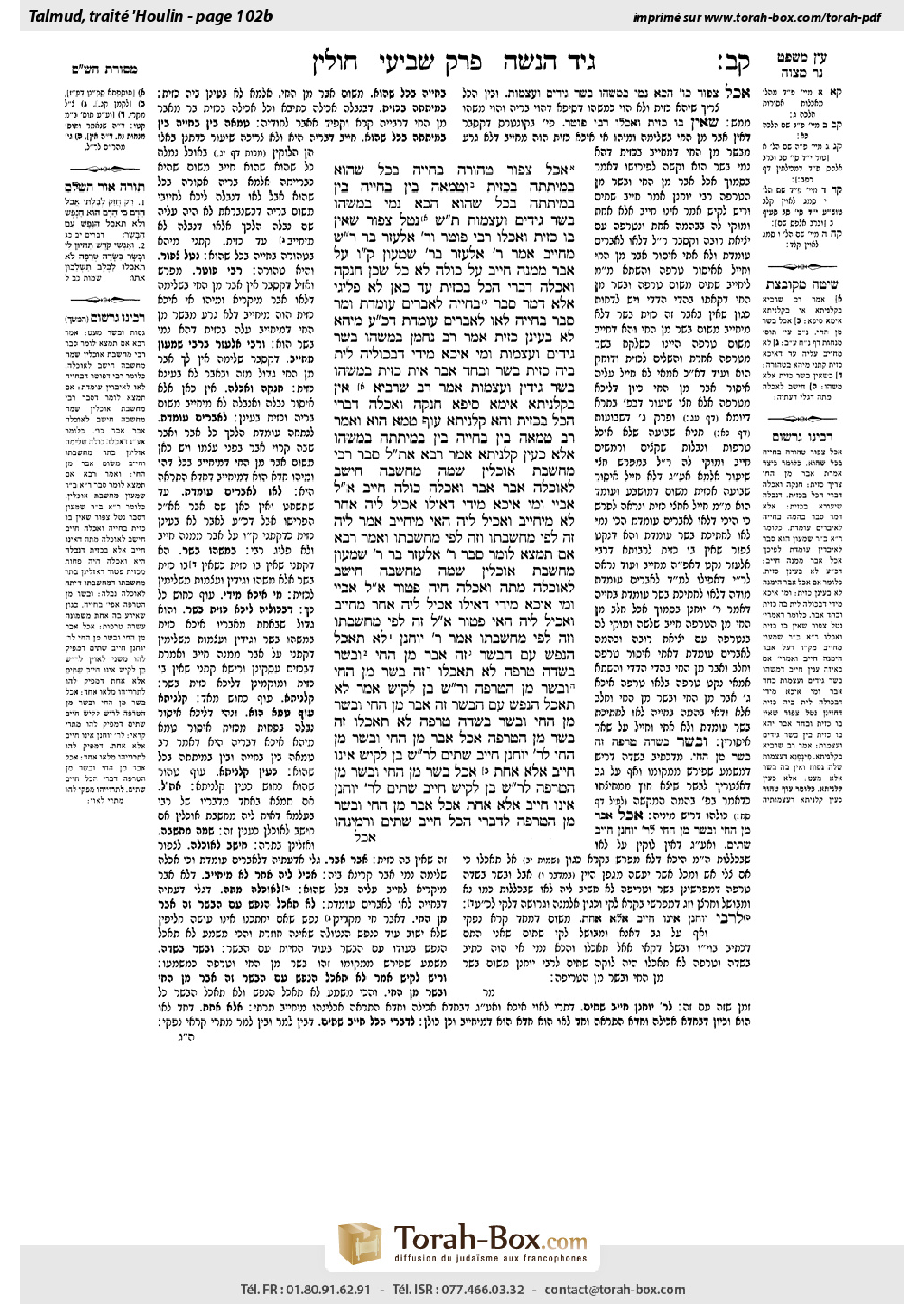
Chullin 102b: Talmud study for Daf Yomi
Study the Talmud for Daf Yomi with scanned pages, Hebrew text, English translations from Sefaria and AI-generated French translations.
Passage selection and English or AI-generated French translation are available where the scan has annotations. Daf Study is independent of Torah-Box and Sefaria.
Browse Chullin · חולין · All tractatesChullin 102b text and translations
This page of Chullin includes the Aramaic text, an English translation and an AI-generated French translation, alongside the scan above.
חולין ק״ב ב · Aramaic and Hebrew text
אָכַל צִפּוֹר טְהוֹרָה בְּחַיֶּיהָ – בְּכׇל שֶׁהוּא, בְּמִיתָתָהּ – בִּכְזַיִת, וּטְמֵאָה בֵּין בְּחַיֶּיהָ בֵּין בְּמִיתָתָהּ – בְּכׇל שֶׁהוּא, הָכָא נָמֵי בְּמַשֶּׁהוּ בָּשָׂר גִּידִים וַעֲצָמוֹת.
תָּא שְׁמַע: נָטַל צִפּוֹר שֶׁאֵין בּוֹ כְּזַיִת וַאֲכָלוֹ – רַבִּי פּוֹטֵר, וְרַבִּי אֶלְעָזָר בַּר רַבִּי שִׁמְעוֹן מְחַיֵּיב. אָמַר רַבִּי אֶלְעָזָר בְּרַבִּי שִׁמְעוֹן: קַל וָחוֹמֶר, עַל אֵבֶר מִמֶּנָּה חַיָּיב, עַל כּוּלָּהּ לֹא כׇּל שֶׁכֵּן! חֲנָקָהּ וַאֲכָלָהּ – דִּבְרֵי הַכֹּל בִּכְזַיִת.
עַד כָּאן לָא פְּלִיגִי, אֶלָּא דְּמָר סָבַר: בְּחַיֶּיהָ לְאֵבָרִים עוֹמֶדֶת, וּמָר סָבַר: בְּחַיֶּיהָ לָאו לְאֵבָרִים עוֹמֶדֶת.
דְּכוּלֵּי עָלְמָא מִיהָא לָא בָּעֵינַן כְּזַיִת, אָמַר רַב נַחְמָן: בְּמַשֶּׁהוּ בָּשָׂר, גִּידִים וַעֲצָמוֹת.
וּמִי אִיכָּא מִידֵּי, דִּבְכוּלֵּיהּ לֵית בֵּיהּ כְּזַיִת בָּשָׂר, וּבְחַד אֵבֶר אִית כְּזַיִת בְּמַשֶּׁהוּ בָּשָׂר גִּידִין וַעֲצָמוֹת? אָמַר רַב שֵׁרֵבְיָא: אִין, בִּקְלָנִיתָא.
אֵימָא סֵיפָא: חֲנָקָהּ וַאֲכָלָהּ, דִּבְרֵי הַכֹּל בִּכְזַיִת, וְהָא קְלָנִיתָא עוֹף טָמֵא הוּא, וְאָמַר רַב: טְמֵאָה, בֵּין בְּחַיֶּיהָ בֵּין בְּמִיתָתָהּ, בְּמַשֶּׁהוּ! אֶלָּא כְּעֵין קְלָנִיתָא.
אָמַר רָבָא: אִם תִּימְצֵי לוֹמַר סָבַר רַבִּי מַחְשְׁבֶת אֳכָלִין שְׁמָהּ מַחְשָׁבָה, חִישֵּׁב לְאוֹכְלָהּ אֵבֶר אֵבֶר, וַאֲכָלָהּ כּוּלָּהּ – חַיָּיב.
אֲמַר לֵיהּ אַבָּיֵי: וּמִי אִיכָּא מִידֵּי, דְּאִילּוּ אָכֵיל לֵיהּ אַחֵר – לָא מִיחַיַּיב, וְאָכֵיל לֵיהּ הַאי – מִיחַיַּיב? אֲמַר לֵיהּ: זֶה לְפִי מַחְשַׁבְתּוֹ, וְזֶה לְפִי מַחְשַׁבְתּוֹ.
וְאָמַר רָבָא: אִם תִּמְצֵי לוֹמַר סָבַר רַבִּי אֶלְעָזָר בַּר רַבִּי שִׁמְעוֹן מַחְשְׁבֶת אֳכָלִין שְׁמָהּ מַחְשָׁבָה, חִישֵּׁב לְאוֹכְלָהּ מֵתָה, וַאֲכָלָהּ חַיָּה – פָּטוּר.
אֲמַר לֵיהּ אַבָּיֵי: וּמִי אִיכָּא מִידֵּי, דְּאִילּוּ אָכֵיל לֵיהּ אַחֵר מִחַיַּיב, וְאָכֵיל לֵיהּ הַאי פָּטוּר? אֲמַר לֵיהּ: זֶה לְפִי מַחְשַׁבְתּוֹ, וְזֶה לְפִי מַחְשַׁבְתּוֹ.
אָמַר רַבִּי יוֹחָנָן: ״לֹא תֹאכַל הַנֶּפֶשׁ עִם הַבָּשָׂר״ – זֶה אֵבֶר מִן הַחַי, ״וּבָשָׂר בַּשָּׂדֶה טְרֵפָה לֹא תֹאכֵלוּ״ – זֶה בָּשָׂר מִן הַחַי וּבָשָׂר מִן הַטְּרֵפָה.
וְרַבִּי שִׁמְעוֹן בֶּן לָקִישׁ אָמַר: ״לֹא תֹאכַל הַנֶּפֶשׁ עִם הַבָּשָׂר״ – זֶה אֵבֶר מִן הַחַי וּבָשָׂר מִן הַחַי, ״וּבָשָׂר בַּשָּׂדֶה טְרֵפָה לֹא תֹאכֵלוּ״ – זֶה בָּשָׂר מִן הַטְּרֵפָה.
אָכַל אֵבֶר מִן הַחַי וּבָשָׂר מִן הַחַי – לְרַבִּי יוֹחָנָן חַיָּיב שְׁתַּיִם, לְרַבִּי שִׁמְעוֹן בֶּן לָקִישׁ אֵינוֹ חַיָּיב אֶלָּא אַחַת. אָכַל בָּשָׂר מִן הַחַי וּבָשָׂר מִן הַטְּרֵפָה – לְרַבִּי שִׁמְעוֹן בֶּן לָקִישׁ חַיָּיב שְׁתַּיִם, לְרַבִּי יוֹחָנָן אֵינוֹ חַיָּיב אֶלָּא אַחַת. אָכַל אֵבֶר מִן הַחַי וּבָשָׂר מִן הַטְּרֵפָה – לְדִבְרֵי הַכֹּל חַיָּיב שְׁתַּיִם.
וּרְמִינְהוּ:
Chullin 102b · English translation
If one ate a kosher bird alive, one is punished with lashes for any amount, i.e., even if he ate less than an olive-bulk. If the bird was dead and was not ritually slaughtered, one is punished with lashes only if he ate an olive-bulk. And if one ate a whole bird of a non-kosher species, whether he ate it when it was alive or dead, he is punished with lashes for any amount, i.e., even if the bird contained less than an olive-bulk of meat. The Gemara answers: Here also explain that Rav’s statement is referring to a case of eating a small amount of meat along with sinews and bones, and the total volume is an olive-bulk.
Come and hear another challenge based upon a baraita: With regard to one who took a live bird of a kosher species that did not have a volume of an olive-bulk and ate it, Rabbi Yehuda HaNasi exempts him from lashes and Rabbi Elazar bar Rabbi Shimon deems him liable for lashes. Rabbi Elazar, son of Rabbi Shimon, said: He should be liable based upon an a fortiori inference: If one is liable to receive lashes for eating a limb of a living animal, all the more so is it not clear that one is liable to receive lashes for eating all of it? The baraita concludes: With regard to one who strangled the bird and ate it, everyone agrees that he is liable to receive lashes only if it had the volume of an olive-bulk.
The Gemara analyzes the baraita: Rabbi Yehuda HaNasi and Rabbi Elazar, son of Rabbi Shimon, disagree only with regard to one who ate an entire live bird, as one Sage, Rabbi Elazar, son of Rabbi Shimon, holds that even during its life all creatures stand to be divided into limbs, i.e., they will ultimately be cut into pieces. Consequently, each of its limbs is considered a separate entity, and even if one eats a limb without first separating it from the rest of the body, one violates the prohibition of eating a limb from a living being. And one Sage, Rabbi Yehuda HaNasi, holds that during its life it does not stand to be divided into limbs. Therefore, one does not violate the prohibition of eating a limb from a living being unless he severs a limb from the body.
But in any event, everyone agrees that we do not require one to eat an olive-bulk of meat in order to be liable for lashes for eating a limb from a living being, which is the basis of the a fortiori inference of Rabbi Elazar, son of Rabbi Shimon. Rav Naḥman says in response: Explain that the baraita is referring to a case where one ate a small amount of meat together with sinews and bones, making a total of an olive-bulk.
The Gemara challenges this answer: But is there any bird that does not have an olive-bulk of meat in its whole body, but in one limb it has an olive-bulk of the combination of a small amount of meat together with sinews and bones? Rav Sherevya said: Yes, this is the case with regard to the kelanita, a bird that is very small and scrawny.
The Gemara challenges this answer that the baraita is referring to a kelanita. Say the latter clause: With regard to one who strangled the bird and ate it, everyone agrees that he is liable to receive lashes only if it had the volume of an olive-bulk. But a kelanita is a non-kosher bird, and Rav says: If one eats a whole non-kosher bird, whether he eats it when it is alive or dead, he is punished with lashes for eating any amount. The Gemara answers: The baraita is not referring to an actual kelanita, but rather to a kosher species of bird similar to a kelanita in that it is small and scrawny.
§ The Gemara above cited a dispute between Rabbi Yehuda HaNasi and Rabbi Elazar, son of Rabbi Shimon, with regard to one who eats an entire live kosher bird that is less than an olive-bulk. With regard to the opinion of Rabbi Yehuda HaNasi, who holds that an entire bird is not considered to be a limb and is therefore not included in the prohibition of eating a limb from a living animal, Rava said: If you say that Rabbi Yehuda HaNasi holds that thought with regard to food is considered thought, i.e., one’s thoughts have halakhic significance in determining a food’s status, then in a case where one thought to eat the bird limb by limb, and instead ate it all at once, Rabbi Yehuda HaNasi would hold that he is liable for transgressing the prohibition of eating a limb from a living animal.
Abaye said to Rava: But is there anything with regard to which if another person ate it he would not be liable, but if this person ate it he is liable? Rava said to Abaye: There can be different outcomes for different people who perform the same act, as this individual’s action is judged according to his thought and that individual’s action is judged according to his thought.
And Rava also said: If you say that Rabbi Elazar bar Rabbi Shimon holds that thought with regard to food is considered thought, then in a case where one at first intended to eat the entire bird after it had died, but ultimately he ate it alive, Rabbi Elazar bar Rabbi Shimon would hold that he is exempt from lashes, as according to his thought it does not stand to be divided into limbs while alive.
Abaye said to Rava: But is there anything that if another person ate it he would be liable, but if this person ate it he is exempt? Rava said to Abaye: This individual’s action is judged according to his thought and that individual’s action is judged according to his thought.
§ The Gemara discusses the source of the prohibition of eating a limb from a living animal. Rabbi Yoḥanan says: “You shall not eat the life with the flesh” (Deuteronomy 12:23); this is the source for the prohibition of eating a limb from a living animal. And the verse: “And you shall not eat any flesh that is torn in the field” (Exodus 22:30); this is the source for the prohibition of eating flesh severed from the living and flesh severed from a tereifa, even if it is not an entire limb.
And Rabbi Shimon ben Lakish says: “You shall not eat the life with the flesh” (Deuteronomy 12:23); this is the source for the prohibitions of eating a limb from a living animal and of eating flesh severed from the living. And the verse: “And you shall not eat any flesh that is torn in the field” (Exodus 22:30); this is the source for the prohibition of eating flesh severed from a tereifa.
The Gemara clarifies the difference between these two opinions. If one ate a limb from a living animal and flesh severed from the living, then according to the opinion of Rabbi Yoḥanan he is liable to receive two sets of lashes but according to the opinion of Rabbi Shimon ben Lakish he is liable to receive only one set of lashes. Conversely, if one ate flesh severed from the living and flesh severed from a tereifa, then according to the opinion of Rabbi Shimon ben Lakish he is liable to receive two sets of lashes but according to the opinion of Rabbi Yoḥanan he is liable to receive only one set of lashes. If one ate a limb from a living animal and flesh severed from a tereifa, everyone agrees that he is liable to receive two sets of lashes.
And the Gemara raises a contradiction to the claim that everyone agrees that one who eats both a limb from a living animal and flesh severed from a tereifa is liable to receive two sets of lashes, based upon the following statement:
Chullin 102b · Traduction française (IA)
Si l'on mange un oiseau kasher vivant, on est puni de fessures pour toute quantité, c'est-à-dire même si l'on a mangé moins qu'une olivette. Si l'oiseau était mort et n'avait pas été sacrifié rituellement, on est puni de fessures uniquement si l'on a mangé une olivette. Et si l'on mange un oiseau entier d'une espèce non kasher, que l'on l'ait mangé vivant ou mort, on est puni de fessures pour toute quantité, c'est-à-dire même si l'oiseau contenait moins qu'une olivette de viande. La Guemara répond : Ici aussi, expliquez que la déclaration de Rav fait référence à un cas où l'on mange une petite quantité de viande avec des nerfs et des os, et la quantité totale est une olivette.
Venez écouter un autre défi basé sur une baraïta : En ce qui concerne celui qui a pris un oiseau vivant d'une espèce kasher qui n'avait pas un volume d'une olivette et l'a mangé, Rabbi Yéhuda HaNasi l'exonère des fessures et Rabbi Eléazar fils de Rabbi Shimon le considère comme dû à des fessures. Rabbi Eléazar, fils de Rabbi Shimon, dit : Il devrait être dû à des fessures par une inférence a fortiori : Si l'on est dû à des fessures pour manger une partie d'un animal vivant, encore plus clairement l'on est dû à des fessures pour manger l'intégralité. La baraïta conclut : En ce qui concerne celui qui a étouffé l'oiseau et l'a mangé, tout le monde s'accorde sur le fait qu'il est dû à des fessures uniquement si l'oiseau avait un volume d'une olivette.
La Guemara analyse la baraïta : Rabbi Yéhuda HaNasi et Rabbi Eléazar, fils de Rabbi Shimon, ne s'entendent que sur celui qui a mangé un oiseau vivant entier, car un Sage, Rabbi Eléazar, fils de Rabbi Shimon, considère que même pendant sa vie, tous les êtres sont susceptibles d'être divisés en parties, c'est-à-dire qu'ils seront finalement découpés. Par conséquent, chaque partie est considérée comme une entité distincte, et même si l'on mange une partie sans d'abord la séparer du reste du corps, l'on viole la prohibition de manger une partie d'un être vivant. Et un Sage, Rabbi Yéhuda HaNasi, considère que pendant sa vie, il ne se divise pas en parties. Par conséquent, l'on ne viole pas la prohibition de manger une partie d'un être vivant à moins qu'on ne sépare une partie du corps.
Mais en tout cas, tout le monde s'accorde sur le fait que l'on ne requiert pas que l'on mange une olivette de viande pour être puni de fessures pour manger une partie d'un être vivant, ce qui est la base de l'inférence a fortiori de Rabbi Eléazar, fils de Rabbi Shimon. Rav Naḥman répond en disant : Expliquez que la baraïta fait référence à un cas où l'on a mangé une petite quantité de viande avec des nerfs et des os, ce qui fait un total d'une olivette.
La Guemara conteste cette réponse : Mais y a-t-il un oiseau qui n'a pas un volume d'une olivette de viande dans tout son corps, mais dans une seule partie, il a un volume d'une olivette de la combinaison d'une petite quantité de viande avec des nerfs et des os ? Rabbi Shérevya dit : Oui, c'est le cas de la kelanita, un oiseau très petit et maigre.
La Guemara conteste cette réponse selon laquelle la baraïta fait référence à une kelanita. Dites la clause suivante : En ce qui concerne celui qui a étouffé l'oiseau et l'a mangé, tout le monde s'accorde sur le fait qu'il est dû à des fessures uniquement si l'oiseau avait un volume d'une olivette. Mais une kelanita est un oiseau non kasher, et Rav dit : Si l'on mange un oiseau non kasher entier, que l'on l'ait mangé vivant ou mort, on est puni de fessures pour toute quantité. La Guemara répond : La baraïta ne fait pas référence à une kelanita réelle, mais plutôt à une espèce kasher similaire à une kelanita en ce qu'elle est petite et maigre.
§ La Guemara ci-dessus a cité un débat entre Rabbi Yéhuda HaNasi et Rabbi Eléazar, fils de Rabbi Shimon, concernant celui qui mange un oiseau kasher vivant entier qui est moins qu'une olivette. En ce qui concerne l'opinion de Rabbi Yéhuda HaNasi, qui considère que l'oiseau entier n'est pas considéré comme une partie et n'est donc pas inclus dans la prohibition de manger une partie d'un être vivant, Rava dit : Si vous dites que Rabbi Yéhuda HaNasi considère que la pensée concernant la nourriture est considérée comme une pensée, c'est-à-dire que les pensées d'une personne ont une signification halakhique pour déterminer le statut de la nourriture, alors dans un cas où l'on pensait à manger l'oiseau pièce par pièce, et finalement l'a mangé d'un seul coup, Rabbi Yéhuda HaNasi considérerait qu'il est dû à des fessures pour avoir transgressé la prohibition de manger une partie d'un être vivant.
Abaye dit à Rava : Mais y a-t-il quelque chose concernant lequel si une autre personne l'avait mangé, il ne serait pas dû à des fessures, mais si cette personne l'a mangé, il est dû à des fessures ? Rava dit à Abaye : Il peut y avoir des résultats différents pour des personnes différentes qui accomplissent la même action, car l'action de cette personne est jugée selon sa pensée et celle de l'autre personne est jugée selon sa pensée.
Et Rava a aussi dit : Si vous dites que Rabbi Eléazar bar Rabbi Shimon considère que la pensée concernant la nourriture est considérée comme une pensée, alors dans un cas où l'on avait initialement l'intention de manger l'oiseau entier après qu'il soit mort, mais finalement l'a mangé vivant, Rabbi Eléazar bar Rabbi Shimon considérerait qu'il est exempt des fessures, car selon sa pensée, il ne se divise pas en parties pendant qu'il est vivant.
Abaye dit à Rava : Mais y a-t-il quelque chose que si une autre personne l'avait mangé, il serait dû à des fessures, mais si cette personne l'a mangé, il est exempt ? Rava dit à Abaye : L'action de cette personne est jugée selon sa pensée et celle de l'autre personne est jugée selon sa pensée.
§ La Guemara discute de la source de la prohibition de manger une partie d'un être vivant. Rabbi Yoḥanan dit : « Vous ne mangerez pas la vie avec la chair » (Deutéronome 12:23) ; c'est la source de la prohibition de manger une partie d'un être vivant. Et la verset : « Et vous ne mangerez pas de chair qui est déchirée dans le champ » (Exode 22:30) ; c'est la source de la prohibition de manger de la chair séparée de l'être vivant et de la chair séparée d'un tereifa, même si ce n'est pas une partie entière.
Et Rabbi Šimon ben Lakish dit : « Tu ne mangeras point la vie avec la chair » (Deutéronome 12:23) ; c'est la source des interdits de manger un membre d'un animal vivant et de manger de la chair détachée d'un animal vivant. Et la parole : « Et tu ne mangeras point de chair qui est déchirée dans le champ » (Exode 22:30) ; c'est la source de l'interdit de manger de la chair détachée d'un tereifa.
La Guemara explique la différence entre ces deux opinions. Si l'on mange un membre d'un animal vivant et de la chair détachée d'un animal vivant, alors selon l'opinion de Rabbi Yoḥanan, on est puni de deux fois la cinquantaine de verges, mais selon l'opinion de Rabbi Šimon ben Lakish, on est puni d'une seule fois la cinquantaine de verges. À l'inverse, si l'on mange de la chair détachée d'un animal vivant et de la chair détachée d'un tereifa, alors selon l'opinion de Rabbi Šimon ben Lakish, on est puni de deux fois la cinquantaine de verges, mais selon l'opinion de Rabbi Yoḥanan, on est puni d'une seule fois la cinquantaine de verges. Si l'on mange un membre d'un animal vivant et de la chair détachée d'un tereifa, tout le monde convient qu'on est puni de deux fois la cinquantaine de verges.
Et la Guemara soulève une contradiction par rapport à l'affirmation que tout le monde convient qu'on est puni de deux fois la cinquantaine de verges si l'on mange à la fois un membre d'un animal vivant et de la chair détachée d'un tereifa, en se basant sur la déclaration suivante :
Traduction française générée par IA à partir de l’édition anglaise de Sefaria. Vérifie toujours un passage avec le texte source.
Text from Sefaria: William Davidson Edition - Vocalized Aramaic (unknown); William Davidson Edition - English (CC BY NC).