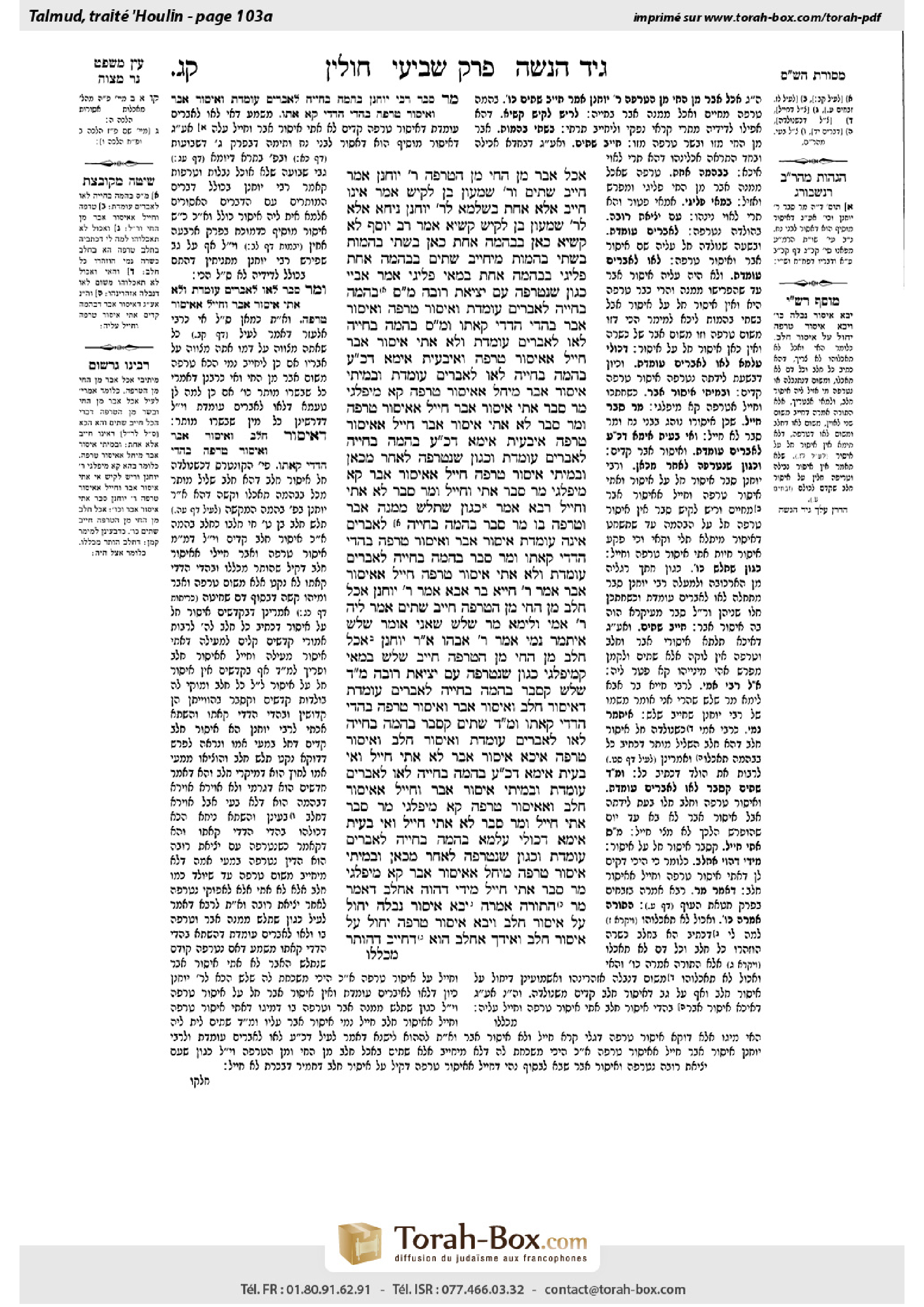
Chullin 103a: Talmud study for Daf Yomi
Study the Talmud for Daf Yomi with scanned pages, Hebrew text, English translations from Sefaria and AI-generated French translations.
Passage selection and English or AI-generated French translation are available where the scan has annotations. Daf Study is independent of Torah-Box and Sefaria.
Browse Chullin · חולין · All tractatesChullin 103a text and translations
This page of Chullin includes the Aramaic text, an English translation and an AI-generated French translation, alongside the scan above.
חולין ק״ג א · Aramaic and Hebrew text
אָכַל אֵבֶר מִן הַחַי מִן הַטְּרֵפָה, רַבִּי יוֹחָנָן אָמַר: חַיָּיב שְׁתַּיִם, וְרַבִּי שִׁמְעוֹן בֶּן לָקִישׁ אָמַר: אֵינוֹ חַיָּיב אֶלָּא אַחַת.
בִּשְׁלָמָא לְרַבִּי יוֹחָנָן נִיחָא, אֶלָּא לְרַבִּי שִׁמְעוֹן בֶּן לָקִישׁ קַשְׁיָא.
אָמַר רַב יוֹסֵף: לָא קַשְׁיָא, כָּאן בִּבְהֵמָה אַחַת, כָּאן בִּשְׁתֵּי בְּהֵמוֹת. בִּשְׁתֵּי בְּהֵמוֹת מִיחַיַּיב שְׁתַּיִם, בִּבְהֵמָה אַחַת פְּלִיגִי.
בִּבְהֵמָה אַחַת, בְּמַאי פְּלִיגִי? אָמַר אַבָּיֵי: כְּגוֹן שֶׁנִּטְרְפָה עִם יְצִיאַת רוּבָּהּ, מָר סָבַר: בְּהֵמָה בְּחַיֶּיהָ לְאֵבָרִים עוֹמֶדֶת, וְאִיסּוּר טְרֵפָה וְאִיסּוּר אֵבֶר בַּהֲדֵי הֲדָדֵי קָאָתוּ.
וּמָר סָבַר, בְּהֵמָה בְּחַיֶּיהָ לָאו לְאֵבָרִים עוֹמֶדֶת, וְלָא אָתֵי אִיסּוּר אֵבֶר חָיֵיל אַאִיסּוּר טְרֵפָה.
וְאִיבָּעֵית אֵימָא, דְּכוּלֵּי עָלְמָא בְּהֵמָה בְּחַיֶּיהָ לָאו לְאֵבָרִים עוֹמֶדֶת, וּבְמֵיתֵי אִיסּוּר אֵבֶר מֵיחַל אַאִיסּוּר טְרֵפָה קָא מִיפַּלְגִי: מָר סָבַר אָתֵי אִיסּוּר אֵבֶר חָיֵיל אַאִיסּוּר טְרֵפָה, וּמָר סָבַר לָא אָתֵי אִיסּוּר אֵבֶר חָיֵיל אַאִיסּוּר טְרֵפָה.
אִיבָּעֵית אֵימָא, דְּכוּלֵּי עָלְמָא בְּהֵמָה בְּחַיֶּיהָ לְאֵבָרִים עוֹמֶדֶת, וּכְגוֹן שֶׁנִּטְרְפָה לְאַחַר מִכָּאן, וּבְמֵיתֵי אִיסּוּר טְרֵפָה חָיֵיל אַאִיסּוּר אֵבֶר קָא מִיפַּלְגִי.
מָר סָבַר אָתֵי וְחָיֵיל, וּמַר סָבַר לָא אָתֵי וְחָיֵיל.
רָבָא אָמַר: כְּגוֹן שֶׁתָּלַשׁ מִמֶּנָּה אֵבֶר וּטְרָפָהּ בּוֹ. מָר סָבַר: בְּהֵמָה בְּחַיֶּיהָ לְאֵבָרִים אֵינָהּ עוֹמֶדֶת, אִיסּוּר אֵבֶר וְאִיסּוּר טְרֵפָה בַּהֲדֵי הֲדָדֵי קָאָתוּ.
וּמָר סָבַר, בְּהֵמָה בְּחַיֶּיהָ לְאֵבָרִים עוֹמֶדֶת, וְלָא אָתֵי אִיסּוּר טְרֵפָה חָיֵיל אַאִיסּוּר אֵבֶר.
אָמַר רַבִּי חִיָּיא בַּר אַבָּא, אָמַר רַבִּי יוֹחָנָן: אָכַל חֵלֶב מִן הַחַי מִן הַטְּרֵפָה – חַיָּיב שְׁתַּיִם. אֲמַר לֵיהּ רַבִּי אַמֵּי: וְלֵימָא מָר שָׁלֹשׁ, שֶׁאֲנִי אוֹמֵר שָׁלֹשׁ. אִיתְּמַר נָמֵי, אָמַר רַבִּי אֲבָהוּ, אָמַר רַבִּי יוֹחָנָן: אָכַל חֵלֶב מִן הַחַי מִן הַטְּרֵפָה – חַיָּיב שָׁלֹשׁ.
בְּמַאי קָמִיפַּלְגִי, כְּגוֹן שֶׁנִּטְרְפָה עִם יְצִיאַת רוּבָּהּ. מַאן דְּאָמַר שָׁלֹשׁ, קָסָבַר: בְּהֵמָה בְּחַיֶּיהָ לְאֵבָרִים עוֹמֶדֶת, דְּאִיסּוּר חֵלֶב וְאִיסּוּר אֵבֶר וְאִיסּוּר טְרֵפָה בַּהֲדֵי הֲדָדֵי קָאָתוּ.
וּמַאן דְּאָמַר שְׁתַּיִם, קָסָבַר בְּהֵמָה בְּחַיֶּיהָ לָאו לְאֵבָרִים עוֹמֶדֶת, וְאִיסּוּר חֵלֶב וְאִיסּוּר טְרֵפָה – אִיכָּא, אִיסּוּר אֵבֶר – לָא אָתֵי חָיֵיל.
וְאִי בָּעֵית אֵימָא, דְּכוּלֵּי עָלְמָא בְּהֵמָה בְּחַיֶּיהָ לָאו לְאֵבָרִים עוֹמֶדֶת, וּבְמֵיתֵי אִיסּוּר אֵבֶר וְחָיֵיל אַאִיסּוּר חֵלֶב וְאַאִיסּוּר טְרֵפָה קָא מִיפַּלְגִי, מָר סָבַר אָתֵי חָיֵיל, וּמַר סָבַר לָא אָתֵי חָיֵיל.
וְאִי בָּעֵית אֵימָא, דְּכוּלֵּי עָלְמָא בְּהֵמָה בְּחַיֶּיהָ לְאֵבָרִים עוֹמֶדֶת, וּכְגוֹן שֶׁנִּטְרְפָה לְאַחַר מִכָּאן, וּבְמֵיתֵי אִיסּוּר טְרֵפָה מֵיחַל אַאִיסּוּר אֵבֶר קָא מִיפַּלְגִי.
מָר סָבַר: אָתֵי חָיֵיל, מִידֵּי דְּהָוֵה אַחֵלֶב, דְּאָמַר מָר: הַתּוֹרָה אָמְרָה יָבֹא אִיסּוּר נְבֵלָה יָחוּל עַל אִיסּוּר חֵלֶב, וְיָבֹא אִיסּוּר טְרֵפָה יָחוּל עַל אִיסּוּר חֵלֶב.
וְאִידַּךְ, אַחֵלֶב הוּא דְּחַיָּיב, דְּהוּתַּר
Chullin 103a · English translation
With regard to one who ate a limb from a living animal that is a tereifa, Rabbi Yoḥanan says: He is liable to receive two sets of lashes, and Rabbi Shimon ben Lakish says: He is liable to receive only one set of lashes.
The Gemara comments: Granted, according to the opinion of Rabbi Yoḥanan, this works out well because the prohibitions of eating a limb from a living animal and of eating flesh severed from a tereifa are derived from two different verses. But according to the opinion of Rabbi Shimon ben Lakish, it is difficult; why does he hold that the individual receives only one set of lashes?
Rav Yosef said: This is not difficult. Here it is referring to one animal, but there it is referring to two animals. Rav Yosef clarifies: In a case of two animals, e.g., where one ate a limb from a living animal and flesh severed from a different animal that was a tereifa, everyone agrees that he is liable to receive two sets of lashes. But in a case where he ate from one animal, e.g., he ate a limb severed from a live tereifa animal, Rabbi Yoḥanan and Rabbi Shimon ben Lakish disagree.
The Gemara asks: With regard to the case of one animal, in what case do they disagree? Abaye said: They disagree, for example, in a case where the animal became a tereifa as the majority of it emerged from its mother’s womb. One Sage, Rabbi Yoḥanan, holds that an animal, even during its life, stands to be divided into limbs, and therefore each of its limbs is considered a separate entity; and here the prohibition of eating a tereifa and the prohibition of eating a limb from a living animal come into effect at the same time. Consequently, both prohibitions apply.
And one Sage, Rabbi Shimon ben Lakish, holds that during its life an animal does not stand to be divided into limbs. Consequently, although the prohibition of eating a tereifa comes into effect when it is born, the prohibition of eating a limb from a living animal does not take effect until the limb is actually severed from the animal, and at that point the prohibition of a limb from a living animal does not come and take effect upon the already existing prohibition of a tereifa.
And if you wish, say instead that everyone agrees that during its life an animal does not stand to be divided into limbs, and they disagree with regard to whether the prohibition of a limb from a living animal comes and takes effect upon the already existing prohibition of a tereifa. One Sage, Rabbi Yoḥanan, holds that the prohibition of eating a limb from a living animal, which applies to gentiles as well as to Jews, comes and takes effect upon the already existing prohibition of eating a tereifa. And one Sage, Rabbi Shimon ben Lakish, holds that the prohibition of eating a limb from a living animal does not come and take effect upon the already existing prohibition of eating a tereifa.
And if you wish, say instead that everyone agrees that an animal, even during its life, stands to be divided into limbs, and the dispute is about a case where the animal became a tereifa afterward, i.e., after it was born, and they disagree with regard to whether the prohibition of a tereifa comes and takes effect upon the already existing prohibition of a limb from a living animal.
One Sage, Rabbi Yoḥanan, holds that the prohibition of eating a tereifa comes and takes effect in addition to the already existing prohibition of eating a limb from a living animal. And one Sage, Rabbi Shimon ben Lakish, holds that the prohibition of eating a tereifa does not come and take effect in addition to the already existing prohibition of eating a limb from a living animal.
Rava says an alternative explanation: This is referring to a case where he severed a limb from the animal and thereby rendered the animal a tereifa. One Sage, Rabbi Yoḥanan, holds that during its life, an animal does not stand to be divided into limbs. Consequently, the prohibition of a limb from a living animal and the prohibition of a tereifa come into effect at the same time.
And one Sage, Rabbi Shimon ben Lakish, holds that even during its life, an animal stands to be divided into limbs, and therefore the prohibition of eating a limb from a living animal takes effect when the animal is born. Consequently, the prohibition of a tereifa does not come and take effect upon the already existing prohibition of a limb from a living animal.
§ Rabbi Ḥiyya bar Abba says that Rabbi Yoḥanan says: If one ate forbidden fat from a living animal that is a tereifa he is liable to receive two sets of lashes. Rabbi Ami said to him: But let the Master say that he is liable to three sets of lashes, because I say that the correct version of Rabbi Yoḥanan’s statement is that he is liable to three sets of lashes. It was also stated: Rabbi Abbahu says that Rabbi Yoḥanan says: If one ate forbidden fat from a living animal that is a tereifa he is liable to three sets of lashes.
The Gemara asks: With regard to what principle do Rabbi Ḥiyya bar Abba and Rabbi Ami disagree? They disagree in a case where the animal became a tereifa as the majority of it emerged from its mother’s womb; the one who said that he is liable to three sets of lashes holds that even during its life an animal stands to be divided into limbs, and each of its limbs is considered as a separate entity, so that the prohibition of eating forbidden fat, the prohibition of eating a limb from a living animal, and the prohibition of eating a tereifa come into effect at the same time.
And the one who said that he is liable to two sets of lashes holds that during its life, an animal does not stand to be divided into limbs, i.e., its limbs are not considered separate entities while the animal is alive. Consequently, the prohibition of eating forbidden fat and the prohibition of eating a tereifa animal apply, as they came into effect at the same time, when the animal was born. By contrast, the prohibition of eating a limb from a living animal does not come and take effect, due to the fact that other prohibitions already apply.
And if you wish, say instead that everyone agrees that during its life an animal does not stand to be divided into limbs, and each of its limbs is not considered as a separate entity. But they disagree with regard to whether the prohibition of eating a limb from a living animal comes and takes effect upon the already existing prohibition of eating forbidden fat and the already existing prohibition of eating a tereifa. One Sage, Rabbi Ami, holds that it does come and take effect, and one Sage, Rabbi Ḥiyya bar Abba, holds that it does not come and take effect.
And if you wish, say instead that everyone agrees that during its life an animal stands to be divided into limbs, and it is a case where the animal became a tereifa afterward, i.e., after it was born; and they disagree with regard to whether the prohibition of eating a tereifa comes and takes effect upon the already existing prohibition of eating a limb from a living animal.
One Sage, Rabbi Ami, holds that it does come and take effect, just as is the halakha with forbidden fat. As the Master said that in the verse: “And the fat of a carcass, and the fat of a tereifa may be used for any other service; but you shall in no way eat of it” (Leviticus 7:24), the Torah said: Let the prohibition of eating a carcass come and take effect upon the prohibition of eating forbidden fat, despite the fact that the prohibition of forbidden fat came into effect first. And similarly, the word “tereifa” teaches: Let the prohibition of eating a tereifa come and take effect upon the prohibition of eating forbidden fat. Consequently, one who eats forbidden fat from a tereifa is liable to receive two sets of lashes. Rabbi Ami holds that just as the prohibition of eating a tereifa takes effect in addition to the prohibition of eating forbidden fat, it also takes effect in addition to the prohibition of eating a limb from a living animal.
And the other Sage, Rabbi Ḥiyya bar Abba, holds that it is only the prohibition of eating forbidden fat for which he is liable in addition to being liable for the prohibition of eating a tereifa. The prohibition of eating a tereifa takes effect in addition to the prohibition of eating forbidden fat because with regard to the latter, there are permitted circumstances that serve as exceptions
Chullin 103a · Traduction française (IA)
Concernant celui qui a mangé une partie d'un animal vivant qui est un tereifa, Rabbi Yoḥanan dit : Il est tenu responsable de deux coups de fouet, et Rabbi Shimon ben Lakish dit : Il est tenu responsable d'un seul coup de fouet.
La Guemara commente : C'est évident selon l'opinion de Rabbi Yoḥanan, car les prohibitions de manger une partie d'un animal vivant et de manger de la viande séparée d'un tereifa sont tirées de deux versets différents. Mais selon l'opinion de Rabbi Shimon ben Lakish, cela est difficile ; pourquoi tient-il que la personne est tenu responsable d'un seul coup de fouet ?
Rav Yosef dit : Ce n'est pas difficile. Ici, il s'agit d'un seul animal, mais là, il s'agit de deux animaux. Rav Yosef clarifie : Dans le cas de deux animaux, par exemple, où l'on a mangé une partie d'un animal vivant et de la viande séparée d'un autre animal qui était un tereifa, tout le monde convient qu'il est tenu responsable de deux coups de fouet. Mais dans le cas où l'on a mangé d'un seul animal, par exemple, l'on a mangé une partie séparée d'un animal tereifa vivant, Rabbi Yoḥanan et Rabbi Shimon ben Lakish sont en désaccord.
La Guemara pose la question : Concernant le cas d'un seul animal, dans quel cas sont-ils en désaccord ? Abaye dit : Ils sont en désaccord, par exemple, dans le cas où l'animal est devenu tereifa lorsque la majorité de lui est sortie de son mère. Un Sage, Rabbi Yoḥanan, considère qu'un animal, même pendant sa vie, peut être divisé en parties, et donc chaque partie est considérée comme une entité séparée ; et ici, la prohibition de manger un tereifa et la prohibition de manger une partie d'un animal vivant s'appliquent en même temps. Ainsi, les deux prohibitions s'appliquent.
Un autre Sage, Rabbi Shimon ben Lakish, considère qu'un animal, pendant sa vie, ne peut pas être divisé en parties. Ainsi, bien que la prohibition de manger un tereifa s'applique dès sa naissance, la prohibition de manger une partie d'un animal vivant ne s'applique qu'au moment où la partie est séparée de l'animal, et à ce moment-là, la prohibition de manger une partie d'un animal vivant ne s'applique pas à la prohibition existante de manger un tereifa.
Et si vous le souhaitez, dites plutôt que tout le monde convient qu'un animal, même pendant sa vie, ne peut pas être divisé en parties, et qu'ils sont en désaccord sur le fait que la prohibition de manger une partie d'un animal vivant s'applique à la prohibition existante de manger un tereifa. Un Sage, Rabbi Yoḥanan, considère que la prohibition de manger une partie d'un animal vivant, qui s'applique aux non-Juifs comme aux Juifs, s'applique à la prohibition existante de manger un tereifa. Un autre Sage, Rabbi Shimon ben Lakish, considère que la prohibition de manger une partie d'un animal vivant ne s'applique pas à la prohibition existante de manger un tereifa.
Et si vous le souhaitez, dites plutôt que tout le monde convient qu'un animal, même pendant sa vie, peut être divisé en parties, et que le désaccord est sur le cas où l'animal est devenu tereifa après sa naissance, c'est-à-dire après qu'il ait été né, et qu'ils sont en désaccord sur le fait que la prohibition de manger un tereifa s'applique à la prohibition existante de manger une partie d'un animal vivant.
Un Sage, Rabbi Yoḥanan, considère que la prohibition de manger un tereifa s'applique en plus de la prohibition existante de manger une partie d'un animal vivant. Un autre Sage, Rabbi Shimon ben Lakish, considère que la prohibition de manger un tereifa ne s'applique pas en plus de la prohibition existante de manger une partie d'un animal vivant.
Rava dit une autre explication : Cela fait référence à un cas où l'on a séparé une partie de l'animal et ainsi l'animal est devenu tereifa. Un Sage, Rabbi Yoḥanan, considère qu'un animal, pendant sa vie, ne peut pas être divisé en parties. Ainsi, la prohibition de manger une partie d'un animal vivant et la prohibition de manger un tereifa s'appliquent en même temps.
Et un Sage, Rabbi Shimon ben Lakish, affirme que même pendant sa vie, un animal peut être divisé en membres, et donc la prohibition de manger un membre d'un animal vivant s'applique dès la naissance de l'animal. Ainsi, la prohibition de manger un tereifa ne s'applique pas à la prohibition existante de manger un membre d'un animal vivant.
§ Rabbi Ḥiyya bar Abba dit que Rabbi Yoḥanan dit : Si l'on a mangé de la graisse interdite d'un animal vivant qui est un tereifa, il est tenu responsable de deux coups de fouet. Rabbi Ami lui dit : Mais disons plutôt qu'il est tenu responsable de trois coups de fouet, car je dis que la version correcte de la déclaration de Rabbi Yoḥanan est qu'il est tenu responsable de trois coups de fouet. Il a également été dit : Rabbi Abbahu dit que Rabbi Yoḥanan dit : Si l'on a mangé de la graisse interdite d'un animal vivant qui est un tereifa, il est tenu responsable de trois coups de fouet.
La Guemara pose la question : Sur quel principe Rabbi Ḥiyya bar Abba et Rabbi Ami sont-ils en désaccord ? Ils sont en désaccord dans le cas où l'animal est devenu tereifa lorsque la majorité de lui est sortie de sa mère ; celui qui dit qu'il est tenu responsable de trois coups de fouet considère qu'un animal, même pendant sa vie, peut être divisé en membres, et que chaque membre est considéré comme une entité séparée, de sorte que la prohibition de manger de la graisse interdite, la prohibition de manger un membre d'un animal vivant et la prohibition de manger un tereifa s'appliquent en même temps.
Et celui qui affirme qu'il est tenu à deux coups de fouet considère que, pendant sa vie, un animal ne peut être divisé en membres, c'est-à-dire que ses membres ne sont pas considérés comme des entités distinctes pendant que l'animal est vivant. Par conséquent, les interdits de consommer la graisse prohibée et celui de manger un animal tereifa s'appliquent, car ils sont entrés en vigueur en même temps, à la naissance de l'animal. À l'inverse, l'interdit de manger un membre d'un animal vivant ne s'applique pas, car d'autres interdits s'appliquent déjà.
Et si vous le souhaitez, dites plutôt que tout le monde convient que pendant sa vie un animal ne peut être divisé en membres, c'est-à-dire que chaque membre n'est pas considéré comme une entité distincte. Mais ils divergent sur le fait que l'interdit de manger un membre d'un animal vivant s'applique et entre en vigueur en même temps que les interdits existants de manger la graisse prohibée et celui de manger un animal tereifa. Un Sage, Rabbi Ami, affirme qu'il s'applique et entre en vigueur, et un autre Sage, Rabbi Ḥiyya bar Abba, affirme qu'il ne s'applique pas.
Et si vous le souhaitez, dites plutôt que tout le monde convient que pendant sa vie un animal peut être divisé en membres, et il s'agit d'un cas où l'animal est devenu tereifa après, c'est-à-dire après sa naissance ; et ils divergent sur le fait que l'interdit de manger un animal tereifa s'applique et entre en vigueur en même temps que l'interdit existant de manger un membre d'un animal vivant.
Un Sage, Rabbi Ami, affirme qu'il s'applique et entre en vigueur, tout comme c'est le cas pour la graisse prohibée. Comme le Maître a dit dans la Torah : « Et la graisse d'un cadavre, et la graisse d'un animal tereifa peut être utilisée pour toute autre utilisation ; mais vous ne devriez en aucun cas en manger » (Lévitique 7:24), la Torah dit : Fassez entrer en vigueur l'interdit de manger un cadavre en même temps que l'interdit de manger la graisse prohibée, malgré le fait que l'interdit de graisse prohibée ait été entré en vigueur en premier. De même, le mot « tereifa » enseigne : Fassez entrer en vigueur l'interdit de manger un animal tereifa en même temps que l'interdit de manger la graisse prohibée. Par conséquent, celui qui mange la graisse prohibée d'un animal tereifa est tenu à deux coups de fouet. Rabbi Ami affirme que tout comme l'interdit de manger un animal tereifa entre en vigueur en plus de l'interdit de manger la graisse prohibée, il entre également en vigueur en plus de l'interdit de manger un membre d'un animal vivant.
Et l'autre Sage, Rabbi Ḥiyya bar Abba, affirme qu'il n'est tenu qu'à l'interdit de manger la graisse prohibée en plus de l'interdit de manger un animal tereifa. L'interdit de manger un animal tereifa entre en vigueur en plus de l'interdit de manger la graisse prohibée car, concernant ce dernier, il existe des circonstances permises qui servent d'exceptions.
Traduction française générée par IA à partir de l’édition anglaise de Sefaria. Vérifie toujours un passage avec le texte source.
Text from Sefaria: William Davidson Edition - Vocalized Aramaic (unknown); William Davidson Edition - English (CC BY NC).