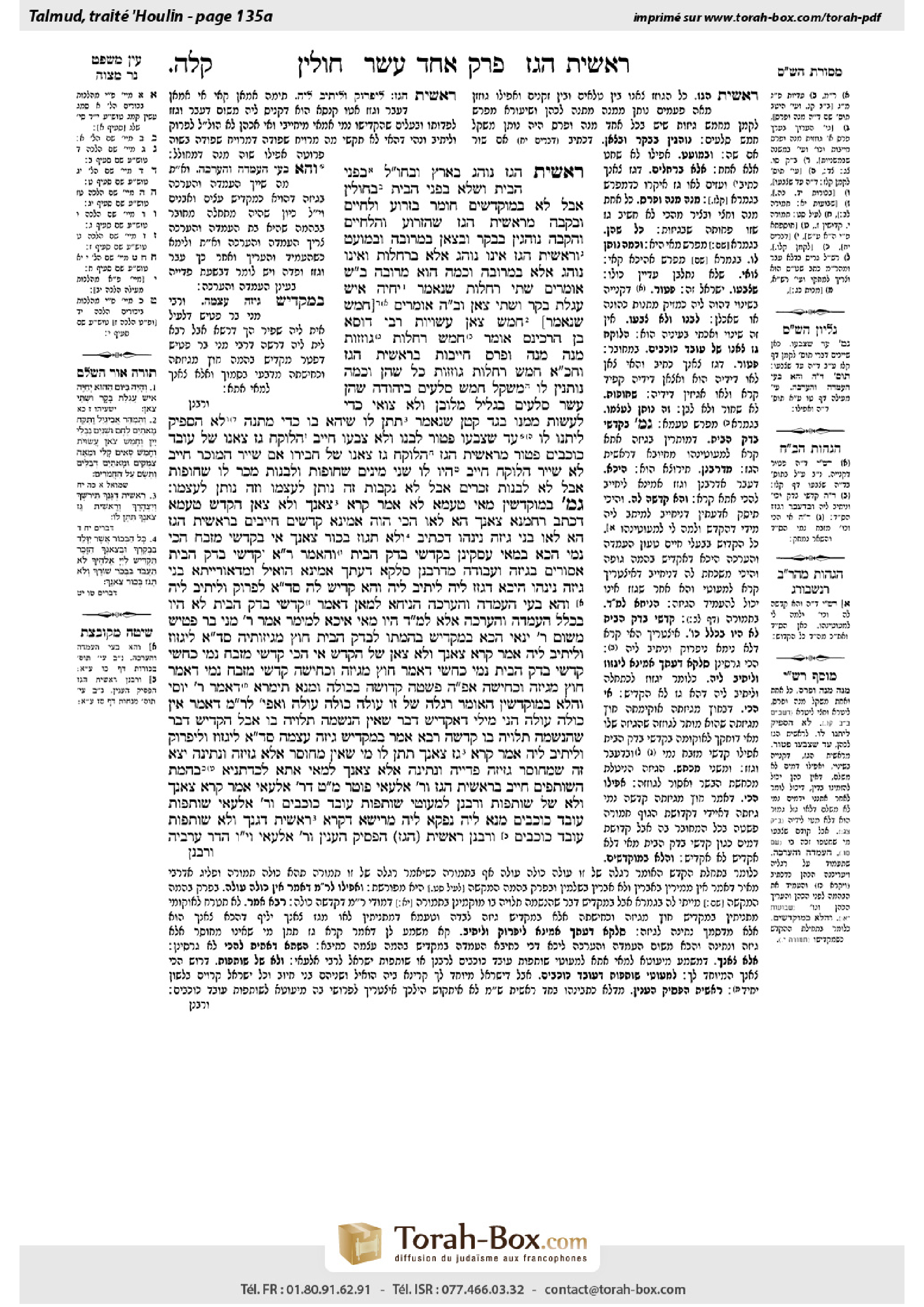
Chullin 135a: Talmud study for Daf Yomi
Study the Talmud for Daf Yomi with scanned pages, Hebrew text, English translations from Sefaria and AI-generated French translations.
Passage selection and English or AI-generated French translation are available where the scan has annotations. Daf Study is independent of Torah-Box and Sefaria.
Browse Chullin · חולין · All tractatesChullin 135a text and translations
This page of Chullin includes the Aramaic text, an English translation and an AI-generated French translation, alongside the scan above.
חולין קל״ה א · Aramaic and Hebrew text
מַתְנִי׳ רֵאשִׁית הַגֵּז נוֹהֵג בָּאָרֶץ וּבְחוּצָה לָאָרֶץ, בִּפְנֵי הַבַּיִת וְשֶׁלֹּא בִּפְנֵי הַבַּיִת, בַּחוּלִּין אֲבָל לֹא בַּמּוּקְדָּשִׁים.
חוֹמֶר בַּזְּרוֹעַ וּלְחָיַיִם וּבַקֵּבָה מֵרֵאשִׁית הַגֵּז – שֶׁהַזְּרוֹעַ וְהַלְּחָיַיִם וְהַקֵּבָה נוֹהֲגִין בַּבָּקָר וּבַצֹּאן, בִּמְרוּבֶּה וּבְמוּעָט, וְרֵאשִׁית הַגֵּז אֵינוֹ נוֹהֵג אֶלָּא בִּרְחֵלוֹת, וְאֵינוֹ נוֹהֵג אֶלָּא בִּמְרוּבֶּה.
וְכַמָּה הוּא מְרוּבֶּה, בֵּית שַׁמַּאי אוֹמְרִים: שְׁתֵּי רְחֵלוֹת, שֶׁנֶּאֱמַר: ״יְחַיֶּה אִישׁ עֶגְלַת בָּקָר וּשְׁתֵּי צֹאן״, וּבֵית הִלֵּל אוֹמְרִים: חָמֵשׁ, שֶׁנֶּאֱמַר: ״חָמֵשׁ צֹאן עֲשׂוּיוֹת״.
רַבִּי דּוֹסָא בֶּן הַרְכִּינָס אוֹמֵר: חָמֵשׁ רְחֵלוֹת גּוֹזְזוֹת מָנֶה מָנֶה וּפְרָס חַיָּיבוֹת בְּרֵאשִׁית הַגֵּז, וַחֲכָמִים אוֹמְרִים: חָמֵשׁ רְחֵלוֹת גּוֹזְזוֹת כׇּל שֶׁהֵן.
וְכַמָּה נוֹתְנִין לוֹ? מִשְׁקַל חֲמֵשׁ סְלָעִים בִּיהוּדָה, שֶׁהֵן עֶשֶׂר סְלָעִים בַּגָּלִיל, מְלוּבָּן וְלֹא צוֹאִי, כְּדֵי לַעֲשׂוֹת מִמֶּנּוּ בֶּגֶד קָטָן, שֶׁנֶּאֱמַר ״תִּתֵּן לוֹ״, שֶׁיְּהֵא בּוֹ כְּדֵי מַתָּנָה.
לֹא הִסְפִּיק לִיתְּנוֹ לוֹ עַד שֶׁצְּבָעוֹ – פָּטוּר, לִבְּנוֹ וְלֹא צְבָעוֹ – חַיָּיב.
הַלּוֹקֵחַ גֵּז צֹאנוֹ שֶׁל גּוֹי – פָּטוּר מֵרֵאשִׁית הַגֵּז. הַלּוֹקֵחַ גֵּז צֹאנוֹ שֶׁל חֲבֵירוֹ, אִם שִׁיֵּיר – הַמּוֹכֵר חַיָּיב, לֹא שִׁיֵּיר – הַלּוֹקֵחַ חַיָּיב. הָיוּ לוֹ שְׁנֵי מִינִים, שְׁחוּפוֹת וּלְבָנוֹת, מָכַר לוֹ שְׁחוּפוֹת אֲבָל לֹא לְבָנוֹת, זְכָרִים אֲבָל לֹא נְקֵבוֹת – זֶה נוֹתֵן לְעַצְמוֹ וְזֶה נוֹתֵן לְעַצְמוֹ.
גְּמָ׳ בְּמוּקְדָּשִׁין, מַאי טַעְמָא לָא? אָמַר קְרָא ״צֹאנְךָ״, וְלֹא צֹאן הֶקְדֵּשׁ.
טַעְמָא דִּכְתַב רַחֲמָנָא ״צֹאנְךָ״, הָא לָאו הָכִי הֲוָה אָמֵינָא קָדָשִׁים חַיָּיבִים בְּרֵאשִׁית הַגֵּז? הָא לָאו בְּנֵי גִיזָּה נִינְהוּ, דִּכְתִיב ״וְלֹא תָגֹז בְּכוֹר צֹאנֶךָ״!
אִי בְּקׇדְשֵׁי מִזְבֵּחַ, הָכִי נָמֵי. הָכָא בְּמַאי עָסְקִינַן – בְּקׇדְשֵׁי בֶּדֶק הַבַּיִת.
וְהָאָמַר רַבִּי אֶלְעָזָר: קׇדְשֵׁי בֶּדֶק הַבַּיִת אֲסוּרִים בְּגִיזָּה וַעֲבוֹדָה! מִדְּרַבָּנַן. סָלְקָא דַּעְתָּךְ אָמֵינָא: הוֹאִיל וּמִדְּאוֹרָיְיתָא בְּנֵי גִיזָּה נִינְהוּ, הֵיכָא דִּגְזַז לֵיהּ – לִיתֵּיב לֵיהּ.
וְהָא קַדֵּישׁ לַהּ! סָלְקָא דַּעְתָּךְ אָמֵינָא: לִפְרוֹק וְלִיתֵּיב לֵיהּ.
וְהָא בָּעֵי הַעֲמָדָה וְהַעֲרָכָה! הָנִיחָא לְמַאן דְּאָמַר קׇדְשֵׁי בֶּדֶק הַבַּיִת לֹא הָיוּ בִּכְלַל הַעֲמָדָה וְהַעֲרָכָה, אֶלָּא לְמַאן דְּאָמַר הָיוּ, מַאי אִיכָּא לְמֵימַר?
אָמַר רַבִּי מָנִי בַּר פַּטִּישׁ מִשּׁוּם רַבִּי יַנַּאי: הָכָא בְּמַקְדִּישׁ בְּהֶמְתּוֹ לְבֶדֶק הַבַּיִת חוּץ מִגִּיזּוֹתֶיהָ. סָלְקָא דַּעְתָּךְ אָמֵינָא: לִיגְזוֹז וְלִיתֵּיב לֵיהּ, אָמַר קְרָא ״צֹאנְךָ״, וְלֹא צֹאן שֶׁל הֶקְדֵּשׁ.
אִי הָכִי, קׇדְשֵׁי מִזְבֵּחַ נָמֵי! כָּחֲשִׁי.
קׇדְשֵׁי בֶּדֶק הַבַּיִת נָמֵי כָּחֲשִׁי! דְּאָמַר: חוּץ מִגִּיזָּה וּכְחִישָׁה.
קׇדְשֵׁי מִזְבֵּחַ נָמֵי! דְּאָמַר: חוּץ מִגִּיזָּה וּכְחִישָׁה, אֲפִילּוּ הָכִי פָּשְׁטָה קְדוּשָּׁה בְּכוּלַּהּ.
וּמְנָא תֵּימְרָא, דְּאָמַר רַבִּי יוֹסֵי: וַהֲלֹא בְּמוּקְדָּשִׁין, הָאוֹמֵר ״רַגְלָהּ שֶׁל זוֹ עוֹלָה״ – כּוּלָּהּ עוֹלָה. וַאֲפִילּוּ לְרַבִּי מֵאִיר דְּאָמַר אֵין כּוּלָּהּ עוֹלָה, הָנֵי מִילֵּי דְּאַקְדֵּישׁ דָּבָר שֶׁאֵין הַנְּשָׁמָה תְּלוּיָה בּוֹ, אֲבָל הִקְדִּישׁ דָּבָר שֶׁהַנְּשָׁמָה תְּלוּיָה בּוֹ – קָדְשָׁה.
רָבָא אָמַר: בְּמַקְדִּישׁ גִּיזָּה עַצְמָהּ, סָלְקָא דַּעְתָּךְ אָמֵינָא: לִיגְזוֹז וְלִיפְרוֹק וְלִיתֵּיב לֵיהּ,
אָמַר קְרָא: ״גֵּז צֹאנְךָ תִּתֶּן לוֹ״, מִי שֶׁאֵין מְחוּסָּר אֶלָּא גְּזִיזָה וּנְתִינָה, יָצָא זֶה שֶׁמְחוּסָּר גְּזִיזָה פְּדִיָּיה וּנְתִינָה.
אֶלָּא ״צֹאנְךָ״ לְמַאי אֲתָא? לְכִדְתַנְיָא: בֶּהֱמַת הַשּׁוּתָּפִים חַיָּיב בְּרֵאשִׁית הַגֵּז, וְרַבִּי אִלְעַאי פּוֹטֵר. מַאי טַעְמָא דְּרַבִּי אִלְעַאי? אָמַר קְרָא ״צֹאנְךָ״, וְלֹא שֶׁל שׁוּתָּפוּת.
וְרַבָּנַן, לְמַעוֹטֵי שׁוּתָּפוּת גּוֹי. וְרַבִּי אִלְעַאי, שׁוּתָּפוּת גּוֹי מְנָא לֵיהּ?
נָפְקָא לֵיהּ מֵרֵישָׁא דִּקְרָא, ״רֵאשִׁית דְּגָנְךָ״, וְלֹא שׁוּתָּפוּת גּוֹי.
וְרַבָּנַן, ״רֵאשִׁית״ (הַגֵּז) הִפְסִיק הָעִנְיָן.
וְרַבִּי אִלְעַאי: וָי״ו הֲדַר עָרְבֵיהּ.
Chullin 135a · English translation
MISHNA: The mitzva of the first sheared wool that every Jew must give to the priest, as stated in the verse: “And the first sheared wool of your flock [tzonekha] shall you give him” (Deuteronomy 18:4), applies both in Eretz Yisrael and outside of Eretz Yisrael, in the presence of the Temple and not in the presence of the Temple, and with regard to non-sacred animals. But it does not apply to sacrificial animals.
There are more stringent elements in the mitzva of the foreleg, the jaw, and the maw (see 130a) than in the halakha of the first sheared wool in that the mitzva of the foreleg, the jaw, and the maw applies to cattle and to sheep, as it is written: “Whether it be ox or sheep, that he shall give unto the priest the foreleg, and the jaw, and the maw” (Deuteronomy 18:3); and it applies to numerous animals and to few animals. But by contrast, the mitzva of the first sheared wool applies only to sheep and not to goats and cattle, and applies only to numerous animals.
And how many are numerous? Beit Shammai say: It is at least two sheep, as it is stated: “That a man shall rear a young cow, and two sheep [tzon]” (Isaiah 7:21), indicating that two sheep are characterized as tzon; and the mitzva of the first sheared wool is written using the term “your flock [tzonekha].” And Beit Hillel say: It is at least five sheep, as it is stated: “And five sheep [tzon] made” (I Samuel 25:18).
Rabbi Dosa ben Harkinas says: When shearing five sheep, the sheared wool of each sheep weighing one hundred dinars each and half [peras] of one hundred dinars each, i.e., one hundred and fifty dinars each, are subject to the obligation of the first sheared wool, i.e., they render the owner obligated to give the first sheared wool to the priests. And the Rabbis say: Any five sheep, each of whose sheared wool weighs any amount, render the owner obligated in the mitzva.
And how much of the sheared wool does one give to the priest? One gives him sheared wool of the weight of five sela in Judea, which are the equivalent of ten sela in the Galilee, as the weight of the Galilean sela is half that of the Judean sela. Furthermore, although one may give the wool to the priest without laundering it, this must be the weight of the wool once laundered and not when sullied, as is characteristic of wool when sheared. The measure that must be given to the priest is enough to fashion a small garment from it, as it is stated: “Shall you give him” (Deuteronomy 18:4), indicating that the sheared wool must contain enough for a proper gift.
If the owner of the shearing did not manage to give it to the priest until he dyed it, the owner is exempt from the mitzva of the first sheared wool, as this constitutes a change in the wool by which means he acquires ownership of it. If he laundered it but did not dye it, he is obligated to give the first sheared wool, as laundering does not constitute a change in the wool.
One who purchases the fleece of the sheep of a gentile is exempt from the obligation of giving the first sheared wool to the priest. With regard to one who purchases the fleece of the sheep of another Jew, if the seller kept some of the wool, then the seller is obligated to give the first sheared wool to the priest. If the seller did not keep any of the wool, the buyer is obligated to give it. If the seller had two types of sheep, gray and white, and he sold the buyer the gray fleece but not the white fleece, or if he sold the fleece of the male sheep but not of the female sheep, then this one, the seller, gives the first sheared wool for himself to the priest from the wool that he kept, and that one, the buyer, gives the first sheared wool for himself to the priest from the wool that he bought.
GEMARA: The mishna states that the mitzva of the first sheared wool does not apply to sacrificial animals. The Gemara asks: What is the reason that it does not apply? The Gemara answers that the verse states: “Your flock” (Deuteronomy 18:4), indicating that the mitzva applies to non-sacred animals, which belong to a private individual, and not to a flock that is consecrated property.
The Gemara challenges: The reason for the exemption of sacrificial animals is that the Merciful One writes “your flock,” from which it may be inferred that were that not the case I would say that even with regard to sacrificial animals one is obligated in the mitzva of the first sheared wool. But this suggestion is impossible, since they are not fit for shearing, as it is written with regard to firstborn animals, which are consecrated: “And you shall not shear the firstborn of your flock” (Deuteronomy 15:19).
The Gemara explains: If the mishna was referring to sheep consecrated for the altar, indeed there would be no need to derive their exemption from the verse. But here we are dealing with sheep consecrated to the treasury for Temple maintenance, which it is permitted to shear, and the verse teaches that even with regard to these one is exempt from the mitzva of the first sheared wool.
The Gemara asks: But didn’t Rabbi Elazar say with regard to animals consecrated for Temple maintenance that it is prohibited to shear them or to work them? The Gemara answers: The prohibition with regard to animals consecrated for Temple maintenance applies by rabbinic law, not by Torah law. Therefore, it might enter your mind to say that since by Torah law they are fit for shearing, in a case where one transgressed the rabbinical prohibition and sheared the consecrated sheep, he should give the first sheared wool to the priest. Consequently, the verse teaches that he is exempt from the mitzva of the first sheared wool.
The Gemara objects: But since he consecrated the wool it is consecrated property, and therefore in practice it cannot be given to a priest. Consequently, there is no need to derive their exemption from the verse. The Gemara explains: It might enter your mind to say that the owner is required to redeem the wool by giving its value to the Temple treasury and then give it to the priest.
The Gemara objects: But when an animal is redeemed it requires standing and valuation, as it is written: “And he shall stand the animal before the priest, and the priest shall value it, whether it be good or bad; as the priest evaluates it, so shall it be” (Leviticus 27:11–12). Once the wool has been sheared this process cannot be performed, which means that the wool cannot be redeemed. The Gemara comments: This works out well according to the one who said that animals consecrated for Temple maintenance were not included in the requirement of standing and valuation. But according to the one who said that they were included in this requirement, what can be said?
Rabbi Mani bar Pattish said in the name of Rabbi Yannai: The statement here in the mishna is referring to a case where one consecrated the rest of his animal for Temple maintenance except for its fleece, which he reserved for himself. Because the owner did not consecrate the wool, it might enter your mind to say: Let him shear the sheep and be obligated to give the wool to the priest. Therefore, the verse states: “Your flock,” indicating that the mitzva applies to non-sacred animals, which belong to an individual, and not to sheep that are consecrated property.
The Gemara raises a difficulty: If so, that the mishna is discussing a case where one consecrated an animal except for its fleece, one could say that it is also referring to animals consecrated for the altar. The Gemara answers: The mishna cannot be discussing animals consecrated for the altar, as it is prohibited to shear them even if their fleece was not consecrated. The reason is that this causes the animal to become weakened, which entails a loss of consecrated property.
The Gemara objects: But animals consecrated for Temple maintenance are also weakened by shearing, and therefore it should be prohibited to shear them as well. The Gemara explains: The mishna is referring to a case where one said that he consecrates his animal for Temple maintenance except for both its fleece and its weakening, i.e., the loss of strength caused by shearing.
The Gemara further objects: The mishna could also be referring to animals consecrated for the altar in a case where one said that he consecrates the animal except for both its fleece and the weakening, i.e., the loss in strength caused by shearing. The Gemara explains: With regard to animals consecrated for the altar this stipulation is ineffective, as even so, i.e., despite his declaration, the sanctity extends to the entire animal, and therefore it is prohibited to shear it.
The Gemara explains: And from where do you say that if one consecrates an animal for the altar the sanctity extends to the entire animal? This is as Rabbi Yosei said: Isn’t it the halakha with regard to sacrificial animals that if one says: The leg of this animal is consecrated as a burnt offering, then the entire animal is a burnt offering, as the sanctity of the leg spreads throughout the animal’s body? And even according to the opinion of Rabbi Meir that it is not entirely a burnt offering, that statement of Rabbi Meir applies only where he consecrated its leg, which is not a matter, i.e., a limb, upon which the animal’s life depends. It is possible for an animal to survive the removal of a leg. But if one consecrated a matter upon which the animal’s life depends, everyone agrees that all of it is consecrated.
§ Rava said that there is no need to interpret the mishna as discussing a case where one consecrated a whole animal apart from its fleece and the loss caused by shearing. Rather, the mishna is referring to one who consecrates the fleece itself to the treasury for Temple maintenance, but not the sheep. It might enter your mind to say: Let him shear the sheep and redeem the wool by giving its value to the Temple treasury, and then be required to give the wool to the priest.
Therefore, the verse states: “The first sheared wool of your flock, shall you give him” (Deuteronomy 18:4), which indicates that there should be no additional action between shearing and giving the first sheared wool to the priest. In other words, the mitzva of first sheared wool applies to a sheep that is lacking only shearing and giving, which excludes this sheep that is lacking shearing, redeeming, and giving.
The Gemara asks: But if this verse is the source of the exemption of consecrated animals, then for what purpose does the term “your flock” come? That term also indicates that certain sheep are excluded from the mitzva. The Gemara answers that it is necessary for that which is taught in a baraita: An animal owned by two partners is obligated, i.e., renders its owners obligated, in the mitzva of the first sheared wool, but Rabbi Ilai exempts them. What is the reason for the ruling of Rabbi Ilai? The reason is that the verse states “your flock,” using the singular pronoun, indicating that the mitzva applies to animals belonging to an individual, but not to sheep that are owned in partnership.
The Gemara asks: But according to the Rabbis, who hold that joint owners of sheep are obligated in the mitzva of the first sheared wool, what is excluded by the term “your flock”? The Gemara answers that this serves to exclude an animal owned in partnership with a gentile. The Gemara asks: And from where does Rabbi Ilai derive that an animal owned in partnership with a gentile renders its Jewish owner exempt from the mitzva?
The Gemara answers: He derives it from the beginning of this verse, which states with regard to teruma: “The first fruits of your grain, of your wine, and of your oil” (Deuteronomy 18:4), using the singular pronoun. This indicates that only in the case of produce owned by a Jew is one obligated to separate teruma, but not with regard to that which is owned in partnership with a gentile.
The Gemara asks: And why do the Rabbis, who derive the exemption of sheep owned in partnership with a gentile from the term “your flock,” not derive this from the term “your grain”? The Gemara answers that the repetition of the term “the first” with regard to the first sheared wool: “The first fruits of your grain, of your wine, and of your oil, and the first sheared wool of your flock, shall you give him” (Deuteronomy 18:4), is an indication that the verse concluded discussion of the previous matter. The superfluous mention of “first” signals that the two issues discussed in this verse, which are the first fruits, i.e., teruma, and the first sheared wool, are two separate matters. Therefore, one cannot derive the halakhot of one from the other.
The Gemara asks: And how does Rabbi Ilai respond to the Rabbis’ claim? The Gemara answers: Rabbi Ilai holds that when the verse states: “And the first sheared wool,” the conjunction “and” goes back and combines the two matters together.
Chullin 135a · Traduction française (IA)
MICHNA: La mitsva de la laine première que chaque Juif doit donner au prêtre, comme dit dans la paracha : « Et la laine première de ton troupeau [tzonekha] tu lui donneras » (Deutéronome 18:4), s'applique à la fois en Terre d'Israël et en dehors de Terre d'Israël, en présence du Temple et non en présence du Temple, et concernant les animaux non sacrés. Mais elle ne s'applique pas aux animaux sacrifiés.
Il y a des éléments plus exigeants dans la Mitsva de la cuisse, de la mâchoire et de la gueule (voir 130a) que dans la halakha de la laine première, car la Mitsva de la cuisse, de la mâchoire et de la gueule s'applique aux bovins et aux moutons, comme il est écrit : « Qu'il donne au prêtre la cuisse, la mâchoire et la gueule, qu'il soit bœuf ou mouton » (Deutéronome 18:3) ; et elle s'applique à de nombreux animaux et à peu d'animaux. En revanche, la Mitsva de la laine première s'applique uniquement aux moutons et non aux chèvres et aux bovins, et uniquement à de nombreux animaux.
Et combien est-ce que de nombreux animaux ? Beit Shammai dit : C'est au moins deux moutons, comme il est dit : « Qu'un homme élève une jeune vache et deux moutons [tzon] » (Isaïe 7:21), indiquant que deux moutons sont caractérisés comme tzon ; et la Mitsva de la laine première est écrite avec le terme « ton troupeau [tzonekha] ». Beit Hillel dit : C'est au moins cinq moutons, comme il est dit : « Et cinq moutons [tzon] ont été faits » (1 Samuel 25:18).
Rabbi Dosa ben Harkinas dit : Lors de la tonte de cinq moutons, la laine de chaque mouton pesant cent dinars chacun et demi [peras] de cent dinars chacun, c'est-à-dire cent cinquante dinars chacun, est soumise à l'obligation de la laine première, c'est-à-dire qu'elle rend le propriétaire obligé de donner la laine première aux prêtres. Et les Sages disent : Toute série de cinq moutons, dont la laine tondue pèse une quantité quelconque, rend le propriétaire obligé de la Mitsva.
Et combien de laine doit-on donner au prêtre ? On lui donne une laine pesant cinq sela en Judée, ce qui équivaut à dix sela en Galilée, car le poids du sela galiléen est la moitié de celui du sela judéen. De plus, bien qu'on puisse donner la laine au prêtre sans la laver, cela doit être le poids de la laine lavée et non lorsqu'elle est souillée, comme c'est le cas de la laine tondue. La mesure à donner au prêtre est suffisante pour faire un petit vêtement, comme il est dit : « Tu lui donneras » (Deutéronome 18:4), indiquant que la laine tondue doit contenir suffisamment pour un don approprié.
Si le propriétaire de la tonte n'a pas réussi à donner la laine au prêtre jusqu'à ce qu'il la teigne, le propriétaire est exempt de la Mitsva de la laine première, car cela constitue un changement dans la laine par lequel il acquiert la propriété. Si on l'a lavée mais pas teintée, il est tenu de donner la laine première, car le lavage ne constitue pas un changement dans la laine.
Celui qui achète la laine d'un mouton d'un non-Juif est exempt de l'obligation de donner la laine première au prêtre. En ce qui concerne celui qui achète la laine d'un mouton d'un autre Juif, si le vendeur a gardé une partie de la laine, alors le vendeur est tenu de donner la laine première au prêtre. Si le vendeur n'a pas gardé de laine, l'acheteur est tenu de la donner. Si le vendeur avait deux types de moutons, gris et blanc, et qu'il a vendu à l'acheteur la laine du mouton gris mais pas celle du mouton blanc, ou s'il a vendu la laine du mouton mâle mais pas celle du mouton femelle, alors celui-ci, le vendeur, donne la laine première pour lui-même au prêtre à partir de la laine qu'il a gardé, et celui-là, l'acheteur, donne la laine première pour lui-même au prêtre à partir de la laine qu'il a achetée.
GUEMARA : La Michna dit que la Mitsva de la laine première ne s'applique pas aux animaux sacrés. La Guemara pose la question : Quel est le motif qui fait qu'elle ne s'applique pas ? La Guemara répond que la paracha dit : « Ton troupeau » (Deutéronome 18:4), indiquant que la Mitsva s'applique aux animaux non sacrés, qui appartiennent à un individu privé, et non à un troupeau qui est propriété consacrée.
La Guemara conteste : Le motif de l'exemption des animaux sacrés est que l'Éternel écrit « ton troupeau », d'où on peut en déduire que si ce n'était pas le cas, je dirais même concernant les animaux sacrés qu'on est tenu de la Mitsva de la laine première. Mais cette suggestion est impossible, car ils ne sont pas adaptés à la tonte, comme il est écrit concernant les premiers-nés, qui sont consacrés : « Et tu ne tondras pas le premier-né de ton troupeau » (Deutéronome 15:19).
La Guemara explique : Si la Michna faisait référence aux moutons consacrés à l'autel, en effet il n'aurait pas été nécessaire de déduire leur exemption de la Torah. Mais ici nous parlons de moutons consacrés au trésor pour l'entretien du Temple, qui sont permis de tondre, et la Torah enseigne que même concernant ces moutons on est exempt de la Mitsva de la laine première.
La Guemara pose la question : Mais n'a-t-il pas dit Rabbi Elazar concernant les animaux consacrés à l'entretien du Temple que c'est interdit de les tondre ou de les travailler ? La Guemara répond : L'interdiction concernant les animaux consacrés à l'entretien du Temple s'applique par ordonnance rabbinique, pas par la Loi de Moïse. Par conséquent, il pourrait entrer en votre esprit de dire que puisque par la Loi de Moïse ils sont adaptés à la tonte, dans un cas où l'on a transgressé l'interdiction rabbinique et qu'on a tondu le mouton consacré, il devrait donner la laine première au prêtre. Ainsi, la Torah enseigne qu'il est exempt de la Mitsva de la laine première.
La Guemara s'oppose : Mais puisque la laine est consacrée, elle est propriété consacrée, et par conséquent en pratique elle ne peut être donnée à un prêtre. Ainsi, il n'est pas nécessaire de déduire leur exemption de la Torah. La Guemara explique : Il pourrait entrer en votre esprit de dire que le propriétaire est tenu de racheter la laine en donnant sa valeur au trésor du Temple et ensuite de la donner au prêtre.
La Guemara s'oppose : Mais lorsqu'un animal est racheté, il faut qu'il soit présenté et évalué, comme il est écrit : « Et il présentera l'animal devant le prêtre, et le prêtre évaluera l'animal, qu'il soit bon ou mauvais ; comme le prêtre l'évalue, ainsi sera-t-il » (Lévitique 27:11-12). Une fois que la laine a été rasée, ce processus ne peut pas être effectué, ce qui signifie que la laine ne peut pas être rachetée. La Guemara commente : Cela fonctionne bien selon celui qui affirmait que les animaux consacrés à l'entretien du Temple n'étaient pas inclus dans la nécessité de présenter et d'évaluer. Mais selon celui qui affirmait qu'ils étaient inclus dans cette exigence, que peut-on dire ?
Rabbi Mani bar Pattish a dit en nom de Rabbi Yannai : L'énoncé ici dans la mitsna fait référence à un cas où l'on a consacré l'animal pour l'entretien du Temple, sauf sa laine, que l'on a réservé pour soi. Puisque l'owner n'a pas consacré la laine, il pourrait entrer en votre esprit de dire : Laissez-le raser le mouton et qu'il soit tenu de donner la laine au prêtre. Ainsi, le verset dit : « Votre troupeau », indiquant que la mitsva s'applique aux animaux non sacrés, qui appartiennent à un individu, et non aux moutons consacrés.
La Guemara soulève une difficulté : Si tel est le cas, c'est-à-dire que la mitsna fait référence à un cas où l'on a consacré un animal sauf sa laine, on pourrait dire qu'elle fait également référence aux animaux consacrés pour l'autel. La Guemara répond : La mitsna ne peut pas faire référence aux animaux consacrés pour l'autel, car il est interdit de les raser même si leur laine n'était pas consacrée. La raison est que cela affaiblit l'animal, ce qui entraîne une perte de propriété sacrée.
La Guemara s'oppose : Mais les animaux consacrés à l'entretien du Temple sont également affaiblis par la rasage, et par conséquent il est interdit de les raser également. La Guemara explique : La mitsva fait référence à un cas où l'on a dit qu'il consacre son animal à l'entretien du Temple sauf sa laine et sa faiblesse, c'est-à-dire la perte de force causée par la rasage.
La Guemara soulève une autre difficulté : La mitsva pourrait également faire référence aux animaux consacrés pour l'autel dans un cas où l'on a dit qu'il consacre l'animal sauf sa laine et sa faiblesse, c'est-à-dire la perte de force causée par la rasage. La Guemara explique : Concernant les animaux consacrés pour l'autel, cette stipulation est inefficace, car même ainsi, c'est-à-dire malgré sa déclaration, la sanctité s'étend à l'animal entier, et par conséquent il est interdit de le raser.
La Guemara explique : Et d'où dis-tu que si l'on consacre un animal pour l'autel la sanctité s'étend à l'animal entier ? C'est comme Rabbi Yosei a dit : N'est-ce pas la halakha concernant les animaux sacrés que si l'on dit : La jambe de cet animal est consacrée comme offrande brûlée, alors l'animal entier est une offrande brûlée, car la sanctité de la jambe s'étend à tout le corps de l'animal ? Et même selon l'opinion de Rabbi Meir qui ne considère pas que l'animal entier est une offrande brûlée, cette déclaration de Rabbi Meir s'applique uniquement dans le cas où il a consacré sa jambe, qui n'est pas un membre, c'est-à-dire un organe, sur lequel la vie de l'animal dépend. Il est possible pour un animal de survivre à la perte d'une jambe. Mais si l'on a consacré un membre sur lequel la vie de l'animal dépend, tout le monde convient que tout est consacré.
Rava a dit que l'interprétation de la Michna n'a pas besoin de parler d'un cas où l'on consacre un animal entier, séparé de sa laine, et où la perte causée par la tonte est prise en compte. En réalité, la Michna parle d'une personne qui consacre la laine elle-même au trésor du Temple, mais pas le mouton. Il pourrait entrer en vous l'idée de dire : qu'il tonte le mouton, qu'il rachète la laine en donnant sa valeur au trésor du Temple, et qu'il soit ensuite tenu de donner la laine au prêtre.
Ainsi, la versette dit : « La laine tondue la première de votre troupeau, vous la donnerez à lui » (Deutéronome 18:4), ce qui indique qu'il ne faut pas entreprendre d'autres actions entre la tonte et la donation de la laine tondue première au prêtre. En d'autres termes, la mitsva de la laine tondue première s'applique à un mouton manquant uniquement de tonte et de donation, ce qui exclut ce mouton manquant de tonte, de rachat et de donation.
La Guemara demande : mais si cette versette est la source de l'exonération des animaux consacrés, alors à quoi sert le terme « votre troupeau » ? Ce terme indique également que certains moutons sont exclus de la mitsva. La Guemara répond que cela est nécessaire pour ce qui est enseigné dans une baraïta : un animal appartenant à deux partenaires est tenu, c'est-à-dire rend ses propriétaires tenu, à la mitsva de la laine tondue première, mais Rabbi Ilai l'exonère. Quelle est la raison de la décision de Rabbi Ilai ? La raison est que la versette dit « votre troupeau », en utilisant le pronom singulier, indiquant que la mitsva s'applique aux animaux appartenant à un individu, mais pas aux moutons appartenant à des partenaires.
La Guemara pose la question : Mais selon les Rabbins, qui affirment que les propriétaires communs de moutons sont tenus de la Mitsva du premier laine tondue, qu'exclude le terme « votre troupeau » ? La Guemara répond qu'il s'agit d'un animal possédé en partage avec un non-Juif. La Guemara pose alors la question : Et d'où Rabbi Ilai tire-t-il que posséder un animal en partage avec un non-Juif exempt son propriétaire juif de la Mitsva ?
La Guemara répond : Il tire cela du début de cette versette, qui parle de la terouma : « Les premiers fruits de votre blé, de votre vin et de votre huile » (Dix-huitième chapitre du Lévitique, verset 4), en utilisant le pronom singulier. Cela indique que la Mitsva de séparer la terouma s'applique uniquement aux produits possédés par un Juif, mais pas aux produits possédés en partage avec un non-Juif.
La Guemara pose la question : Et pourquoi les Sages, qui déduisent l'exemption des brebis appartenant à une association avec un non-Juif du terme « votre troupeau », ne déduisent-ils pas cela du terme « votre blé » ? La Guemara répond que la répétition du terme « le premier » concernant le premier laine tondue : « Le premier des fruits de votre blé, de votre vin et de votre huile, et le premier laine tondue de votre troupeau, vous le donnerez à lui » (Deutéronome 18:4), indique que la discussion du sujet précédent a été conclue. La mention superflue de « premier » signale que les deux sujets discutés dans cette verse, à savoir les premiers fruits, c'est-à-dire la terouma, et le premier laine tondue, sont deux objets distincts. Par conséquent, on ne peut pas déduire les halakhot d'un à partir de l'autre.
La Guemara pose la question : Et comment Rabbi Ilai répond-il à l'affirmation des Sages ? La Guemara répond : Rabbi Ilai considère que lorsque la verse dit : « Et le premier laine tondue », la conjonction « et » remonte et combine les deux sujets ensemble.
Traduction française générée par IA à partir de l’édition anglaise de Sefaria. Vérifie toujours un passage avec le texte source.
Text from Sefaria: William Davidson Edition - Vocalized Aramaic (unknown); William Davidson Edition - English (CC BY NC).