Chullin 134b: Talmud study for Daf Yomi
Study the Talmud for Daf Yomi with scanned pages, Hebrew text, English translations from Sefaria and AI-generated French translations.
Passage selection and English or AI-generated French translation are available where the scan has annotations. Daf Study is independent of Torah-Box and Sefaria.
Browse Chullin · חולין · All tractatesChullin 134b text and translations
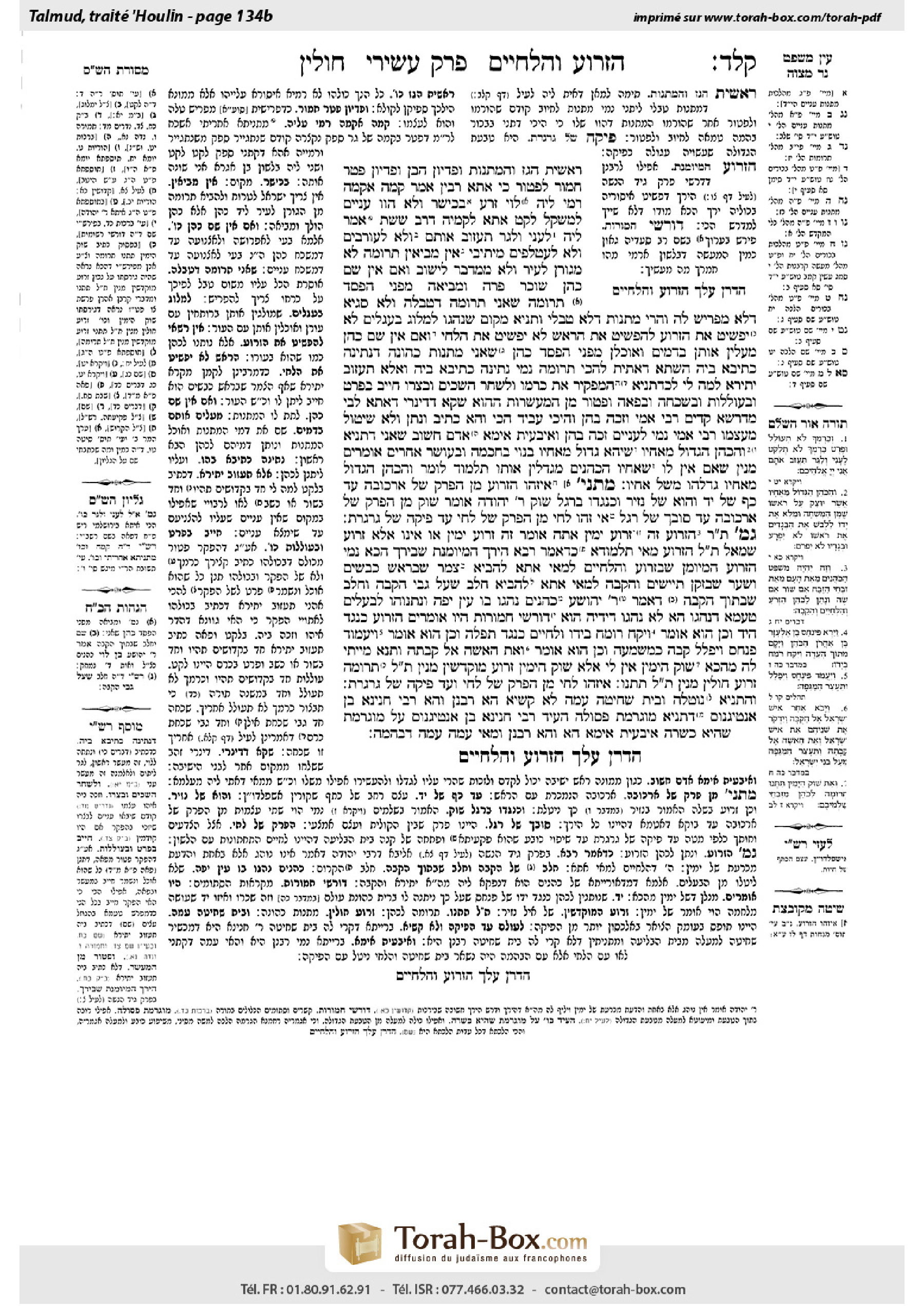
This page of Chullin includes the Aramaic text, an English translation and an AI-generated French translation, alongside the scan above.
חולין קל״ד ב · Aramaic and Hebrew text
רֵאשִׁית הַגֵּז וְהַמַּתָּנוֹת, וּפִדְיוֹן הַבֵּן, וּפִדְיוֹן פֶּטֶר חֲמוֹר – לִפְטוּר.
כִּי אֲתָא רָבִין, אָמַר: קָמָה אַקָּמָה רְמִי לֵיהּ.
לֵוִי זְרַע בְּכִישָׁר, וְלָא הֲווֹ עֲנִיִּים לְמִשְׁקַל לֶקֶט. אֲתָא לְקַמֵּיהּ דְּרַב שֵׁשֶׁת, אֲמַר לֵיהּ: ״לֶעָנִי וְלַגֵּר תַּעֲזֹב אֹתָם״, וְלֹא לְעוֹרְבִים וְלֹא לַעֲטַלֵּפִים.
מֵיתִיבִי: אֵין מְבִיאִין תְּרוּמָה, לֹא מִגּוֹרֶן לָעִיר, וְלֹא מִמִּדְבָּר לַיִּשּׁוּב, וְאִם אֵין שָׁם כֹּהֵן – שׂוֹכֵר פָּרָה וּמְבִיאָהּ, מִפְּנֵי הֶפְסֵד תְּרוּמָה.
שָׁאנֵי תְּרוּמָה, דְּטָבְלָה, וְלָא סַגִּיא דְּלָא מַפְרֵישׁ לַהּ.
וַהֲרֵי מַתָּנוֹת, דְּלָא טָבְלִי, וְתַנְיָא: מָקוֹם שֶׁנָּהֲגוּ לִמְלוֹג בַּעֲגָלִים – לֹא יַפְשִׁיט אֶת הַזְּרוֹעַ.
לְהַפְשִׁיט אֶת הָרֹאשׁ – לֹא יַפְשִׁיט אֶת הַלֶּחִי, וְאִם אֵין שָׁם כֹּהֵן – מַעֲלִין אוֹתָן בְּדָמִים וְאוֹכְלָן, מִפְּנֵי הֶפְסֵד כֹּהֵן.
שָׁאנֵי מַתְּנוֹת כְּהוּנָּה, דִּנְתִינָה כְּתִיבָא בֵּיהּ. הַשְׁתָּא דְּאָתֵית לְהָכִי, תְּרוּמָה נָמֵי נְתִינָה כְּתִיבָא בֵּיהּ.
וְאֶלָּא ״תַּעֲזֹב״ יַתִּירָא לְמָה לִי?
לְכִדְתַנְיָא: הַמַּפְקִיר אֶת כַּרְמוֹ, וְלַשַּׁחַר הִשְׁכִּים וּבְצָרוֹ – חַיָּיב בְּפֶרֶט וּבְעוֹלֵלוֹת וּבְשִׁכְחָה וּבְפֵאָה, וּפָטוּר מִן הַמַּעַשְׂרוֹת.
הָהוּא שַׂקָּא דְּדִינָרֵי דַּאֲתָא לְבֵי מִדְרְשָׁא, קָדֵים רַבִּי אַמֵּי וּזְכָה בָּהֶן. וְהֵיכִי עָבֵיד הָכִי? וְהָא כְּתִיב ״וְנָתַן״ וְלֹא שֶׁיִּטּוֹל מֵעַצְמוֹ! רַבִּי אַמֵּי נָמֵי לַעֲנִיִּים זָכָה בָּהֶן.
וְאִיבָּעֵית אֵימָא: אָדָם חָשׁוּב שָׁאנֵי, דְּתַנְיָא: ״וְהַכֹּהֵן הַגָּדוֹל מֵאֶחָיו״ – שֶׁיְּהֵא גָּדוֹל מֵאֶחָיו בְּנוֹי, בְּחָכְמָה, וּבְעוֹשֶׁר.
אֲחֵרִים אוֹמְרִים: מִנַּיִן שֶׁאִם אֵין לוֹ, שֶׁאֶחָיו הַכֹּהֲנִים מְגַדְּלִין אוֹתוֹ? תַּלְמוּד לוֹמַר: ״וְהַכֹּהֵן הַגָּדוֹל מֵאֶחָיו״ – גַּדְּלֵהוּ מִשֶּׁל אֶחָיו.
מַתְנִי׳ אֵיזֶהוּ הַזְּרוֹעַ? מִן הַפֶּרֶק שֶׁל אַרְכוּבָּה עַד כַּף שֶׁל יָד, וְהוּא שֶׁל נָזִיר, וּכְנֶגְדּוֹ בָּרֶגֶל – שׁוֹק. רַבִּי יְהוּדָה אוֹמֵר: שׁוֹק מִן הַפֶּרֶק שֶׁל אַרְכוּבָּה עַד סוֹבֶךְ שֶׁל רֶגֶל. אֵי זֶהוּ לֶחִי? מִן הַפֶּרֶק שֶׁל לֶחִי עַד פִּיקָה שֶׁל גַּרְגֶּרֶת.
גְּמָ׳ תָּנוּ רַבָּנַן: הַזְּרוֹעַ – זֶה זְרוֹעַ יָמִין. אַתָּה אוֹמֵר זֶה זְרוֹעַ יָמִין, אוֹ אֵינוֹ אֶלָּא זְרוֹעַ שְׂמֹאל? תַּלְמוּד לוֹמַר ״הַזְּרוֹעַ״.
מַאי תַּלְמוּדָא? כִּדְאָמַר רָבָא: ״הַיָּרֵךְ״ – הַמְיוּמֶּנֶת שֶׁבַּיָּרֵךְ, הָכָא נָמֵי: ״הַזְּרוֹעַ״ – הַמְיוּמָּן שֶׁבַּזְּרוֹעַ.
״וְהַלְּחָיַיִם״ לְמַאי אֲתָא? לְהָבִיא צֶמֶר שֶׁבְּרֹאשׁ כְּבָשִׂים, וְשֵׂעָר שֶׁבִּזְקַן תְּיָישִׁים. ״וְהַקֵּבָה״ לְמַאי אֲתָא? לְהָבִיא חֵלֶב שֶׁעַל גַּבֵּי הַקֵּבָה, וְחֵלֶב שֶׁבְּתוֹךְ הַקֵּבָה. דְּאָמַר רַבִּי יְהוֹשֻׁעַ: כֹּהֲנִים נָהֲגוּ בּוֹ עַיִן יָפָה וּנְתָנוּהוּ לַבְּעָלִים. טַעְמָא דְּנָהֲגוּ, הָא לֹא נָהֲגוּ – דִּידֵיהּ הוּא.
דּוֹרְשֵׁי חֲמוּרוֹת הָיוּ אוֹמְרִים: הַזְּרוֹעַ – כְּנֶגֶד הַיָּד, וְכֵן הוּא אוֹמֵר: ״וַיִּקַּח רוֹמַח בְּיָדוֹ״.
וּלְחָיַיִם – כְּנֶגֶד תְּפִלָּה, וְכֵן הוּא אוֹמֵר: ״וַיַּעֲמֹד פִּינְחָס וַיְפַלֵּל״, קֵבָה – כְּמִשְׁמָעָהּ, וְכֵן הוּא אוֹמֵר: ״וְאֶת הָאִשָּׁה אֶל קֳבָתָהּ״.
וְתַנָּא מַיְיתֵי לַהּ מֵהָכָא: ״שׁוֹק הַיָּמִין״ – אֵין לִי אֶלָּא שׁוֹק הַיָּמִין, זְרוֹעַ מוּקְדָּשִׁין מִנַּיִן? תַּלְמוּד לוֹמַר ״תְּרוּמָה״. זְרוֹעַ חוּלִּין מִנַּיִן? תַּלְמוּד לוֹמַר ״תִּתְּנוּ״.
אֵיזֶהוּ לֶחִי – מִן הַפֶּרֶק שֶׁל לְחִי וְעַד פִּיקָּה שֶׁל גַּרְגֶּרֶת, וְהָתַנְיָא: נוֹטְלָהּ וּבֵית שְׁחִיטָה עִמָּהּ?
לָא קַשְׁיָא: הָא רַבָּנַן, וְהָא רַבִּי חֲנִינָא בֶּן אַנְטִיגְנוֹס.
דְּתַנְיָא: מוּגְרֶמֶת פְּסוּלָה, הֵעִיד רַבִּי חֲנִינָא בֶּן אַנְטִיגְנוֹס עַל מוּגְרֶמֶת שֶׁהִיא כְּשֵׁרָה.
אִיבָּעֵית אֵימָא: הָא וְהָא רַבָּנַן, וּמַאי ״עִמָּהּ״? עִמָּהּ דִּבְהֵמָה.
הֲדַרַן עֲלָךְ הַזְּרוֹעַ וְהַלְּחָיַיִם.
Chullin 134b · English translation
And these are the four uncertainties with regard to a convert where the halakha is lenient: The first is an uncertainty with regard to the first sheared wool of one’s sheep, where it is uncertain whether they were shorn before or after his conversion. And the second is whether or not the obligation of giving the gifts of the foreleg, the jaw, and the maw applies to his animal. And the third is an uncertainty with regard to the obligation to give five sela for the mitzva of the redemption of the firstborn son, where it is uncertain if he was born before or after the owner’s conversion. And the last is an uncertainty with regard to the redemption of a firstborn donkey by means of a sheep or a goat, where it is uncertain if it was born before or after the owner’s conversion. In each of these instances, the uncertainty is only with regard to monetary matters, and therefore the halakha is that one is exempt.
In connection to the previous discussion between Rabbi Shimon ben Lakish and Rabbi Yoḥanan, the Gemara relates that when Ravin came from Eretz Yisrael to Babylonia, he said a slightly different version of the above discussion: Rabbi Shimon ben Lakish raised the contradiction to the opinion of Rabbi Meir from a baraita that states that Rabbi Meir exempts the standing crop of a convert from the obligation to leave gleanings for the poor when it is uncertain whether the crop was harvested before or after his conversion. This baraita is in contradiction to the baraita that likewise discusses the standing crop: Grain whose status as gleanings is uncertain is considered gleanings. Rabbi Yoḥanan resolved this contradiction by explaining that the second baraita is the opinion of Rabbi Meir only according to Rabbi Yehuda ben Agra.
§ With regard to gifts left for the poor, the Gemara relates that Levi sowed crops in his field in Kishar, but there were no poor people in Kishar to take gleanings from his field. Levi came before Rav Sheshet to ask what should be done with the gleanings. Rav Sheshet said to him: The verse states with regard to the mitzvot of pe’a and gleanings: “You shall leave them for the poor and for the stranger” (Leviticus 23:22), and not for the ravens nor for the bats. Since there are no poor people to take the gleanings, you should take them for yourself.
The Gemara raises an objection from a baraita: The owner of a field does not need to expend the effort to bring teruma, neither from the threshing floor to the city nor from the wilderness to a settled area, in order to give it to a priest. Rather, the priest must travel to the field to receive the teruma. And if there is no priest there, at the threshing floor or in the wilderness, to receive the teruma, the owner must hire a cow and bring the teruma to the city, due to the loss of teruma that would occur if it were left in the field. According to this baraita, the owner of the field should likewise be obligated to do the same with gleanings.
The Gemara explains: Teruma is different, in that if it is not separated it causes the entire crop to be considered untithed, and it is therefore not possible for one not to separate teruma from the crop. By contrast, gleanings do not render the remaining crop prohibited for consumption, and therefore it is not necessary to set them aside and remove them.
The Gemara objects: But what about the case of the gifts of the priesthood, which do not render the rest of the animal untithed, i.e., they do not prohibit the entire animal in consumption before they are separated. And nevertheless it is taught in a baraita: In a place where they were accustomed to put the meat of slaughtered calves in boiling water in order to remove the hairs from the skin, and then eat the meat with the skin still attached to the flesh, one may not skin the foreleg before giving it to the priest. Rather, he gives it with its skin intact.
The baraita continues: Similarly, in a place where people are accustomed to skin the head of an animal, one may not skin the cheek of the jaw of an animal before giving it to the priest, but must give it with its skin intact so that the priest may use the skin as he wishes. And if there is no priest available to receive the gifts, the gifts are appraised by their monetary value, and the owner may eat them and gives their monetary value to a priest at the next available time, due to the loss that would otherwise be incurred by the priest. Evidently, one must expend effort to ensure that a priest receives the gifts despite the fact that they do not render the entire animal untithed. Why is the halakha different with regard to gleanings?
The Gemara responds: The halakha is different in the case of gifts of the priesthood, as a term of giving is written with regard to it: “That they shall give to the priest the foreleg, and the jaw, and the maw” (Deuteronomy 18:3). This teaches that one must actively give the gifts to a priest, whereas no equivalent term is written with regard to gleanings. The Gemara adds: Now that you have arrived at this explanation with regard to gifts of the priesthood, one can likewise explain that the reason teruma must be brought to a locale where there is a priest is likewise due to the fact that a term of giving is written with regard to it: “The first fruits of your grain, of your wine, and of your oil, and the first sheared wool of your sheep you shall give him” (Deuteronomy 18:4), not because teruma renders the crop untithed.
The Gemara asks: But if so, why do I need the verse to state an extra term of leaving with regard to gleanings? One verse states: “Neither shall you gather the gleaning of your harvest, and your vineyard you shall not harvest completely, and the fallen fruit of your vineyard you shall not gather; you shall leave them for the poor and for the stranger” (Leviticus 19:9–10), and another verse states: “Neither shall you gather the gleaning of your harvest; you shall leave them for the poor and for the stranger” (Leviticus 23:22). Doesn’t this additional mention of leaving indicate that even if there are no poor people to take the gleanings, the owner must collect them and ensure that a poor person can claim them?
The Gemara responds: No, the extra term of leaving is required for that which is taught in a baraita: With regard to one who declares his vineyard ownerless, and in the morning awoke and reclaimed the ownerless vineyard and harvested the grapes, he is obligated in the mitzva of leaving individual fallen grapes for the poor [peret], and in the mitzva of leaving incompletely formed clusters of grapes for the poor [olelot], and in the mitzva of leaving forgotten clusters, and in the mitzva of pe’a. And he is exempt from the obligation to separate the tithes from the grapes, as the vineyard had been ownerless. The baraita rules that he is obligated in the gifts for the poor despite the halakha that the obligation to leave these gifts does not apply to an ownerless vineyard. It is derived from the additional mention of leaving that the obligation of gifts to the poor applies even to an ownerless field of this type.
§ In relation to the discussion of a case where the owner of a field takes gifts left for the poor for himself, the Gemara relates that there was a certain sack of dinars that was brought to the study hall to provide financial assistance for the students. Rabbi Ami rushed and acquired them. The Gemara asks: And how can he act in this manner? But isn’t it written with regard to gifts of the priesthood: “That they shall give to the priest” (Deuteronomy 18:3), and the Sages derived from the verse that a priest should receive the gifts and he should not take them by himself. The same applies to gifts for the poor as well. The Gemara responds: Rabbi Ami too did not take the gifts for himself. Rather, he acquired them for the poor.
And if you wish, say instead that the halakha with regard to a distinguished person such as Rabbi Ami, who was the head of the yeshiva, is different, and he may acquire the gifts for himself. As it is taught in a baraita that the verse: “And the priest who is greater than his brethren” (Leviticus 21:10), indicates that the High Priest should be greater than his priestly brethren in beauty, in wisdom, and in wealth.
Others say: From where is it derived that if the High Priest does not have property of his own, his brethren the priests elevate him and render him wealthy from their own property? The verse states: “And the priest who is greater than his brethren,” i.e., they must elevate him from the property of his brethren. Since the members of the study hall are required to enrich Rabbi Ami from their own property, it is certainly permitted for him to take these gifts for himself.
MISHNA: What is the definition of the foreleg that is given to the priests as one of the gifts? It is the part of the leg from the joint of the lower knee until the rounded protrusion surrounding the thigh bone of the foreleg; and that is the foreleg mentioned in the Torah with regard to the nazirite: “And the priest shall take the foreleg of the ram when it is cooked” (Numbers 6:19). And the parallel in the hind leg is the thigh that is given to the priest from the peace offering, which is also from the joint of the lower knee until the rounded protrusion surrounding the thigh bone. Rabbi Yehuda says: The thigh is from the joint of the lower knee until the upper knee joint, which connects the middle and upper parts of the leg. What is the definition of the jaw? It is from the joint of the lower jaw beneath the temples and downward until the upper ring of the windpipe.
GEMARA: The Sages taught in a baraita: The verse states with regard to the gifts of the priesthood: “That they shall give to the priest the foreleg, and the jaw, and the maw” (Deuteronomy 18:3). “The foreleg”; this is the right foreleg of the animal. The baraita continues: Do you say that this is the right foreleg, or is it only the left foreleg? The verse states: “The foreleg.” The definite article indicates that the verse is referring to the right foreleg.
The Gemara asks: What is the biblical derivation for this, i.e., how is it understood from the definite article that the verse is referring to the right foreleg? The Gemara responds: It is derived like that which Rava said with regard to the verse: “Therefore the children of Israel do not eat the sciatic nerve which is upon the hollow of the thigh” (Genesis 32:33). The definite article indicates that this is referring to the most important thigh. Here too, the definite article in the term “the foreleg” indicates that the verse is referring to the most important foreleg, i.e., the right foreleg.
The Gemara continues: And in the term “and the jaw,” for what purpose does the definite article come, i.e., what halakha does it teach? It serves to include wool that is on the head of lambs and hair that is in the beard of goats in the obligation to give the jaw to the priest. And in the term “and the maw,” for what purpose does the definite article come? It serves to include fat that is on the maw and fat that is inside the maw in the obligation to give the maw to the priest. As Rabbi Yehoshua said: Priests behaved generously with fat that is on the maw and they gave it to its owner, i.e., they relinquished their right to receive it. The Gemara infers: The reason this fat was not given to the priests is that they behaved generously, but had they not behaved generously, the fat would be his, the priest’s.
The Gemara cites a homiletical idea with regard to the gifts of the priesthood: The interpreters of Torah symbolism [dorshei ḥamurot] would say with regard to the reason why the foreleg, the jaw, and the maw are given to the priests: The foreleg corresponds to the hand of Pinehas, son of Elazar the priest, who killed Zimri, son of Salu, thereby bringing an end to the plague that was ravaging the children of Israel. And it likewise states in the verse: “And he took a spear in his hand” (Numbers 25:7).
And the jaw corresponds to the prayer [tefilla] offered by Pinehas during the aforementioned incident. And so it states in the verse: “Then stood up Pinehas, and wrought judgment [vayefallel], and so the plague was stayed. And that was counted to him for righteousness, to all generations forever” (Psalms 106:30). The maw is as its plain meaning in the verses describing the incident, and it likewise states: “And he thrust both of them through, the man of Israel, and the woman through her belly. So the plague was stayed from the children of Israel” (Numbers 25:8).
The Gemara above cited a source for the halakha that the right foreleg is given to the priest. The Gemara notes: And the tanna of the following baraita cites this halakha from here: The verse states with regard to the gift to the priest from a peace offering: “And the right thigh you shall give to the priest as a gift from your sacrifices of peace offerings” (Leviticus 7:32). I have derived only that the right thigh of a peace offering is given to the priest. From where do I derive that the right foreleg of the sacrificial ram of the nazirite is given to the priest? The verse states: “You shall give to the priest as a gift.” And from where is it derived that the right foreleg of a non-sacred animal is also given as a gift to the priest? The verse states: “You shall give.”
§ The mishna taught: What is the definition of the jaw? It is from the joint of the jaw beneath the temples and below until the upper ring of the windpipe. The Gemara objects: But isn’t it taught in a baraita that when one removes the jaw from the animal to give to the priest, he removes it and the area of slaughter on the throat with it? The area of slaughter is beyond the upper ring of the windpipe.
The Gemara responds: This is not difficult. Everyone agrees that the priest receives only the part until the upper ring of the windpipe, and the difference between the two rulings is that this mishna is in accordance with the opinion of the Rabbis, and that baraita is in accordance with the opinion of Rabbi Ḥanina ben Antigonus.
The Gemara explains that this is as it is taught in a baraita: The slaughter of an animal in such a manner that the knife is diverted to an area above the place of slaughter on its throat is not valid. Rabbi Ḥanina ben Antigonus testified with regard to the slaughter of an animal when the knife is diverted that it is valid (see 18b). The baraita calls the area of the jaw until the upper ring of the windpipe the area of slaughter, in accordance with the opinion of Rabbi Ḥanina ben Antigonus, who maintains that it is also a valid area for slaughter.
And if you wish, say instead that this mishna and that baraita are both in accordance with the opinion of the Rabbis, and what does the baraita mean when it says: With it? It means that the area of slaughter remains with the animal, i.e., it remains with the owner and is not given to the priest.
Chullin 134b · Traduction française (IA)
Et ces sont les quatre incertitudes concernant un converti où la halakha est favorable : la première est une incertitude concernant la première laine de mouton de l'homme, où il est incertain s'ils ont été rasés avant ou après sa conversion. La deuxième est de savoir si l'obligation de donner les présents de la cuisse, de la mâchoire et de la gueule s'applique à son animal. La troisième est une incertitude concernant l'obligation de donner cinq sela pour la mitsva du rachat du premier-né, où il est incertain s'il est né avant ou après la conversion du propriétaire. Et la dernière est une incertitude concernant le rachat d'un âne premier-né par un mouton ou une chèvre, où il est incertain s'il est né avant ou après la conversion du propriétaire. Dans chaque cas, l'incertitude est uniquement concernant des affaires monétaires, et donc la halakha est que l'on est exempté.
En lien avec la discussion précédente entre Rabbi Shimon ben Lakish et Rabbi Yoḥanan, le Guemara rapporte que lorsque Ravin est venu de la Terre d'Israël vers Babylone, il a dit une version légèrement différente de la discussion ci-dessus : Rabbi Shimon ben Lakish a soulevé la contradiction par rapport à l'opinion de Rabbi Meir à partir d'une baraïta qui stipule que Rabbi Meir exempt le blé en culture d'un converti de l'obligation de laisser les restes pour les pauvres lorsqu'il est incertain si le blé a été récolté avant ou après sa conversion. Cette baraïta est en contradiction avec une autre baraïta qui discute également du blé en culture : le blé dont le statut de restes est incertain est considéré comme restes. Rabbi Yoḥanan a résolu cette contradiction en expliquant que la deuxième baraïta est l'opinion de Rabbi Meir uniquement selon Rabbi Yehuda ben Agra.
§ En ce qui concerne les présents laissés aux pauvres, le Guemara rapporte que Levi a semé des cultures dans son champ à Kishar, mais il n'y avait pas de pauvres à Kishar pour prendre les restes de son champ. Levi est venu devant Rav Sheshet pour demander ce qu'il devait faire des restes. Rav Sheshet a dit à lui : La parole stipule concernant les mitsvot de pe’a et de restes : « Vous laisserez pour les pauvres et pour l'étranger » (Lévitique 23:22), et non pour les corbeaux ni pour les chauves-souris. Puisque il n'y a pas de pauvres pour prendre les restes, vous devriez les prendre pour vous-même.
Le Guemara soulève une objection tirée d'une baraïta : Le propriétaire d'un champ n'a pas besoin d'employer l'effort de ramener la terouma, ni du moulin vers la ville, ni de la steppe vers un lieu habité, afin de la donner à un prêtre. Plutôt, le prêtre doit se rendre au champ pour recevoir la terouma. Et si il n'y a pas de prêtre là-bas, au moulin ou en steppe, pour recevoir la terouma, le propriétaire doit louer un bœuf et ramener la terouma à la ville, en raison de la perte de terouma qui aurait lieu si elle restait dans le champ. Selon cette baraïta, le propriétaire du champ devrait également être obligé de faire la même chose avec les restes.
Le Guemara explique : La terouma est différente, car si elle n'est pas séparée, cela rend l'ensemble de la récolte non titulée, et donc il n'est pas possible de ne pas séparer la terouma de la récolte. En revanche, les restes ne rendent pas la récolte restante interdite à la consommation, et donc il n'est pas nécessaire de les mettre de côté et de les retirer.
Le Guemara s'oppose : Mais que dire des présents de la communauté, qui ne rendent pas l'animal restant non titulé, c'est-à-dire qui ne l'interdisent pas à la consommation avant qu'ils ne soient séparés. Et pourtant, il est enseigné dans une baraïta : Dans un lieu où on est habitué de mettre la viande des veaux sacrifiés dans l'eau bouillante afin de retirer les poils de la peau, puis de manger la viande avec la peau attachée à la viande, on ne peut pas dépecer la cuisse avant de la donner au prêtre. Plutôt, on le donne avec sa peau intacte.
La baraïta continue : De même, dans un lieu où les gens sont habitués de dépecer la tête d'un animal, on ne peut pas dépecer la joue de la mâchoire d'un animal avant de le donner au prêtre, mais il faut le donner avec sa peau intacte afin que le prêtre puisse utiliser la peau comme il le souhaite. Et si aucun prêtre n'est disponible pour recevoir les présents, les présents sont évalués par leur valeur monétaire, et le propriétaire peut les manger et donner leur valeur monétaire à un prêtre à la prochaine occasion disponible, en raison de la perte que subirait autrement le prêtre. Évidemment, il faut employer l'effort pour garantir que le prêtre reçoit les présents malgré le fait qu'ils ne rendent pas l'animal entier non titulé. Pourquoi la halakha est-elle différente concernant les restes ?
Le Guemara répond : La halakha est différente dans le cas des présents de la haute priesthood, car un terme de don est écrit concernant cela : « Que l'on doive donner au prêtre la cuisse, la mâchoire et la gueule » (Dn 18:3). Cela enseigne qu'il faut activer le don des présents à un prêtre, alors qu'il n'y a pas de terme équivalent concernant les restes. Le Guemara ajoute : Maintenant que vous avez atteint cette explication concernant les présents de la haute priesthood, on peut également expliquer que la raison pour laquelle la terouma doit être amenée vers un lieu où il y a un prêtre est également en raison du fait qu'un terme de don est écrit concernant cela : « Les premiers fruits de votre blé, de votre vin et de votre huile, et la première laine de vos moutons, vous donnerez à lui » (Dn 18:4), et non parce que la terouma rend la récolte non titulée.
Le Guemara demande : Mais si c'est ainsi, pourquoi ai-je besoin de la parole supplémentaire concernant laisser des restes ? Une parole stipule : « Ni ne réunirez les restes de votre récolte, et votre vigne vous ne la récollez pas entièrement, et les fruits tombés de votre vigne vous ne les réunirez pas ; vous laisserez pour les pauvres et pour l'étranger » (Lévitique 19:9–10), et une autre parole stipule : « Ni ne réunirez les restes de votre récolte ; vous laisserez pour les pauvres et pour l'étranger » (Lévitique 23:22). N'est-ce pas cette mention supplémentaire de laisser qui indique que même s'il n'y a pas de pauvres pour prendre les restes, le propriétaire doit les réunir et s'assurer qu'un pauvre puisse les revendiquer ?
La Guemara répond : Non, le terme supplémentaire de laisser est requis pour ce qui est enseigné dans une baraïta : En ce qui concerne celui qui déclare son domaine de vigne sans propriétaire, et qui, le matin, s'est réveillé et a récupéré le domaine de vigne sans propriétaire et a récolté les raisins, il est tenu obligé de la Mitsva de laisser les raisins tombés individuellement pour les pauvres [peret], et de la Mitsva de laisser les grappes incomplètement formées pour les pauvres [olelot], et de la Mitsva de laisser les grappes oubliées, et de la Mitsva de pe’a. Et il est exempt de l'obligation de séparer les dîmes des raisins, car le domaine avait été sans propriétaire. La baraïta déclare qu'il est tenu obligé des dons aux pauvres malgré la halakha selon laquelle l'obligation de laisser ces dons ne s'applique pas à un domaine sans propriétaire. Cela est déduit de la mention supplémentaire de laisser, qui indique que l'obligation des dons aux pauvres s'applique même à un domaine sans propriétaire de ce type.
§ En ce qui concerne la discussion d'un cas où l'propriétaire d'un champ prend les dons laissés pour les pauvres pour lui-même, la Guemara rapporte qu'il existait un certain sac de dinars qui avait été apporté à la salle de étude pour fournir un soutien financier aux étudiants. Rabbi Ami s'est précipité et l'a acquis. La Guemara pose la question : Et comment peut-il agir ainsi ? N'est-il pas écrit concernant les dons du clergé : « Que l'on doive donner au prêtre » (Deutéronome 18:3), et les Sages ont déduit de cette verset que le prêtre doit recevoir les dons et ne doit pas les prendre lui-même. La même chose s'applique aux dons pour les pauvres. La Guemara répond : Rabbi Ami n'a pas non plus pris les dons pour lui-même. Il les a acquis pour les pauvres.
Et si vous le souhaitez, dites plutôt que la halakha concernant une personne distinguée telle que Rabbi Ami, qui était le chef de la yeshiva, est différente, et qu'il peut acquérir les dons pour lui-même. Comme il est enseigné dans une baraïta que le verset : « Et le prêtre qui est supérieur à ses frères » (Lévitique 21:10), indique que le Grand Prêtre doit être supérieur à ses frères prêtres en beauté, en sagesse et en richesse.
D'autres disent : D'où est-il déduit que si le Grand Prêtre n'a pas de propriété propre, ses frères prêtres l'élèvent et le rendent riche à partir de leur propre propriété ? Le verset dit : « Et le prêtre qui est supérieur à ses frères », c'est-à-dire qu'ils doivent l'élèver à partir de la propriété de ses frères. Puisque les membres de la salle de étude sont tenus d'enrichir Rabbi Ami à partir de leur propre propriété, il est certainement permis qu'il prenne ces dons pour lui-même.
MICHNA : Quelle est la définition de la cuisse qui est donnée aux prêtres comme l'un des dons ? C'est la partie de la cuisse du joint du genou inférieur jusqu'au rebord arrondi entourant l'os de la cuisse de la cuisse antérieure ; et c'est la cuisse mentionnée dans la Torah concernant le nazirite : « Et le prêtre prendra la cuisse du bouc lorsqu'elle est cuite » (Nombres 6:19). Et le parallèle dans la cuisse postérieure est la cuisse qui est donnée au prêtre de l'offrande de paix, qui est aussi du joint du genou inférieur jusqu'au rebord arrondi entourant l'os de la cuisse. Rabbi Yéhuda dit : La cuisse est du joint du genou inférieur jusqu'au genou supérieur, qui relie la partie moyenne et supérieure de la jambe. Quelle est la définition de la mâchoire ? C'est du joint de la mâchoire inférieure sous les tempes et en bas jusqu'au cercle supérieur de la trachée.
GUEMARA : Les Sages ont enseigné dans une baraïta : Le verset dit concernant les dons du clergé : « Que l'on doive donner au prêtre la cuisse, la mâchoire et la gueule » (Deutéronome 18:3). « La cuisse » : c'est la cuisse droite de l'animal. La baraïta continue : Vous dites que c'est la cuisse droite, ou est-ce seulement la cuisse gauche ? Le verset dit : « La cuisse ». L'article défini indique que le verset fait référence à la cuisse droite.
La Guemara pose la question : Quelle est la dérivation biblique pour cela, c'est-à-dire comment est-il compris de l'article défini que le verset fait référence à la cuisse droite ? La Guemara répond : Cela est déduit comme cela a été dit par Rava concernant le verset : « Par conséquent, les enfants d'Israël ne mangent pas la moelle du genou qui est sur la fosse de la cuisse » (Genèse 32:33). L'article défini indique que c'est la cuisse la plus importante. Ici aussi, l'article défini dans le terme « la cuisse » indique que le verset fait référence à la cuisse la plus importante, c'est-à-dire la cuisse droite.
La Guemara continue : Et dans le terme « et la mâchoire », à quel effet l'article défini vient-il, c'est-à-dire quelle halakha enseigne-t-il ? Il sert à inclure la laine qui est sur la tête des agneaux et la barbe qui est dans la barbe des boucs dans l'obligation de donner la mâchoire au prêtre. Et dans le terme « et la gueule », à quel effet l'article défini vient-il ? Il sert à inclure la graisse qui est sur la gueule et la graisse qui est à l'intérieur de la gueule dans l'obligation de donner la gueule au prêtre. Comme Rabbi Yéhoshua a dit : Les prêtres ont été généreux avec la graisse qui est sur la gueule et ils l'ont donnée à son propriétaire, c'est-à-dire qu'ils ont renoncé à leur droit de la recevoir. La Guemara déduit : La raison pourquoi cette graisse n'a pas été donnée aux prêtres est qu'ils ont été généreux, mais s'ils n'avaient pas été généreux, la graisse aurait été sienne, celle du prêtre.
La Guemara cite une idée allégorique concernant les dons du clergé : Les interprètes des symboles de la Torah [dorshei ḥamurot] disent concernant la raison pour laquelle la cuisse, la mâchoire et la gueule sont données aux prêtres : La cuisse correspond à la main de Pinéhas, fils d'Élazar le prêtre, qui a tué Zimri, fils de Salu, mettant ainsi fin à l'épidémie qui ravageait les enfants d'Israël. Et il est également dit dans le verset : « Et il prit une lance en main » (Nombres 25:7).
Et la mâchoire correspond à la prière [tefilla] offerte par Pinḥas lors de l'incident mentionné précédemment. Et ainsi il est dit dans la parole : « Alors Pinḥas se leva, et rendit justice [vayefallel], et ainsi l'épidémie fut arrêtée. Et cela fut compté à lui pour la justice, à toutes les générations pour l'éternité » (Psaumes 106:30). La mâchoire est telle que l'indique le sens littéral des versets décrivant l'incident, et il est également dit : « Et il passa les deux à travers, l'homme d'Israël, et la femme par son ventre. Ainsi l'épidémie fut arrêtée des enfants d'Israël » (Nombres 25:8).
La Guemara mentionnée ci-dessus cite une source pour la halakha selon laquelle la cuisse avant droite est donnée au prêtre. La Guemara note : Et le tanna du baraïta suivant cite cette halakha à partir d'ici : Le verset dit concernant le don au prêtre d'une offrande de paix : « Et tu donneras la cuisse droite au prêtre en tant que don de tes offrandes de paix » (Lévitique 7:32). J'ai déduit seulement que la cuisse droite d'une offrande de paix est donnée au prêtre. D'où déduit-on que la cuisse avant droite du bélier de la personne consacrée est donnée au prêtre ? Le verset dit : « Tu donneras au prêtre en tant que don. » D'où déduit-on que la cuisse avant droite d'un animal non sacré est également donnée en tant que don au prêtre ? Le verset dit : « Tu donneras. »
§ La mitsna enseignait : Quelle est la définition de la mâchoire ? C'est depuis l'articulation de la mâchoire sous les tempes et en dessous jusqu'au cercle supérieur de la trachée. La Guemara s'oppose à cela : Mais n'est-il pas enseigné dans un baraïta que lorsqu'on retire la mâchoire de l'animal pour la donner au prêtre, on la retire ainsi que la zone de sacrifice sur la gorge ? La zone de sacrifice est au-delà du cercle supérieur de la trachée.
La Guemara répond : Ce n'est pas difficile. Tout le monde convient que le prêtre reçoit seulement la partie jusqu'au cercle supérieur de la trachée, et la différence entre les deux opinions est que cette mitsna est selon l'opinion des Rabbins, et que ce baraïta est selon l'opinion de Rabbi Ḥanina ben Antigonus.
La Guemara explique que cela est comme il est enseigné dans un baraïta : Le sacrifice d'un animal de telle manière que le couteau est détourné vers une zone au-dessus du lieu de sacrifice sur sa gorge n'est pas valide. Rabbi Ḥanina ben Antigonus a témoigné concernant le sacrifice d'un animal lorsque le couteau est détourné qu'il est valide (voir 18b). Le baraïta appelle la zone de la mâchoire jusqu'au cercle supérieur de la trachée la zone de sacrifice, selon l'opinion de Rabbi Ḥanina ben Antigonus, qui maintient qu'il s'agit également d'une zone valide pour le sacrifice.
Et si vous le souhaitez, dites plutôt que cette mitsna et ce baraïta sont tous deux selon l'opinion des Rabbins, et que signifie le baraïta lorsqu'il dit : Avec elle ? Il signifie que la zone de sacrifice reste avec l'animal, c'est-à-dire qu'elle reste avec l'owner et n'est pas donnée au prêtre.
Traduction française générée par IA à partir de l’édition anglaise de Sefaria. Vérifie toujours un passage avec le texte source.
Text from Sefaria: William Davidson Edition - Vocalized Aramaic (unknown); William Davidson Edition - English (CC BY NC).