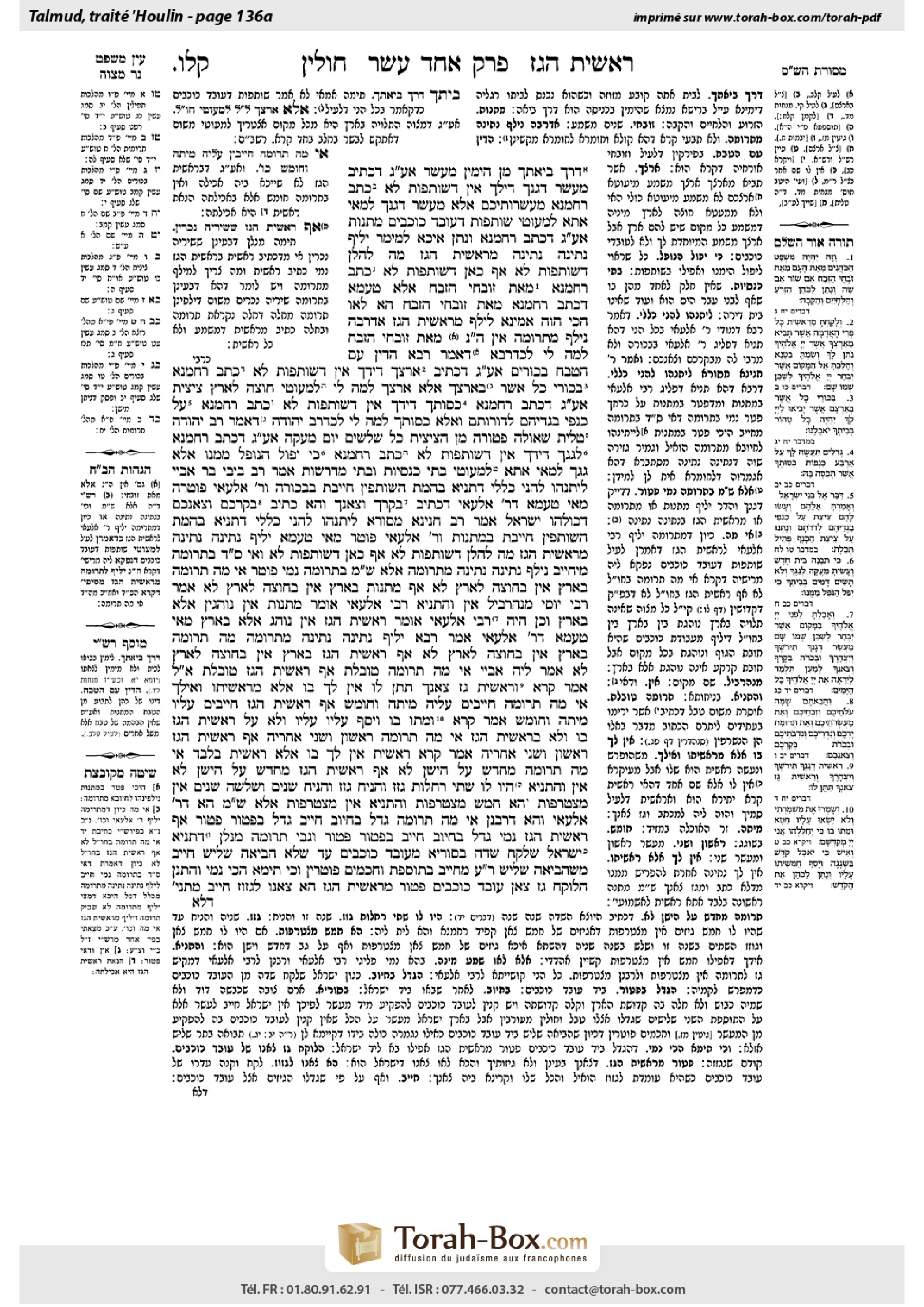
Chullin 136a: Talmud study for Daf Yomi
Study the Talmud for Daf Yomi with scanned pages, Hebrew text, English translations from Sefaria and AI-generated French translations.
Passage selection and English or AI-generated French translation are available where the scan has annotations. Daf Study is independent of Torah-Box and Sefaria.
Browse Chullin · חולין · All tractatesChullin 136a text and translations
This page of Chullin includes the Aramaic text, an English translation and an AI-generated French translation, alongside the scan above.
חולין קל״ו א · Aramaic and Hebrew text
דֶּרֶךְ בִּיאָתְךָ מִן הַיָּמִין.
מַעֲשֵׂר, אַף עַל גַּב דִּכְתִיב ״מַעְשַׂר דְּגָנְךָ״ – דִּילָךְ אִין, דְּשׁוּתָּפוּת לָא. כְּתַב רַחֲמָנָא ״מַעְשְׂרוֹתֵיכֶם״. אֶלָּא ״מַעְשַׂר דְּגָנְךָ״ לְמַאי אֲתָא? לְמַעוֹטֵי שׁוּתָּפוּת דְּגוֹי.
מַתָּנוֹת, אַף עַל גַּב דִּכְתַב רַחֲמָנָא ״וְנָתַן״.
אִיכָּא לְמֵימַר, יָלֵיף ״נְתִינָה״ ״נְתִינָה״ מֵרֵאשִׁית הַגֵּז – מָה לְהַלָּן דְּשׁוּתָּפוּת לָא, אַף כָּאן דְּשׁוּתָּפוּת לָא. כְּתַב רַחֲמָנָא ״מֵאֵת זוֹבְחֵי הַזֶּבַח״.
אֶלָּא טַעְמָא דִּכְתַב רַחֲמָנָא ״מֵאֵת זוֹבְחֵי הַזֶּבַח״, הָא לָאו הָכִי הֲוָה אָמֵינָא לֵילַף מֵרֵאשִׁית הַגֵּז? אַדְּרַבָּה נֵילַף מִתְּרוּמָה.
אִין הָכִי נָמֵי, מֵאֵת ״זוֹבְחֵי הַזֶּבַח״ לְמָה לִּי? לְכִדְרָבָא, דְּאָמַר רָבָא: הַדִּין עִם הַטַּבָּח.
בִּכּוּרִים, אַף עַל גַּב דִּכְתִיב ״אַרְצְךָ״ – דִּידָךְ אִין, דְּשׁוּתָּפוּת לָא.
כְּתַב רַחֲמָנָא ״בִּכּוּרֵי כֹּל אֲשֶׁר (בְּאַרְצְךָ) [בְּאַרְצָם]״, אֶלָּא ״אַרְצְךָ״ לְמָה לִי? לְמַעוֹטֵי חוּצָה לָאָרֶץ.
צִיצִית, אַף עַל גַּב דִּכְתַב רַחֲמָנָא ״כְּסוּתְךָ״ – דִּידָךְ אִין, דְּשׁוּתָּפוּת לָא.
כְּתַב רַחֲמָנָא ״עַל כַּנְפֵי בִגְדֵיהֶם לְדֹרֹתָם״, וְאֶלָּא ״כְּסוּתְךָ״ לְמָה לִי? לְכִדְרַב יְהוּדָה, דְּאָמַר רַב יְהוּדָה: טַלִּית שְׁאוּלָה פְּטוּרָה מִן הַצִּיצִית כׇּל שְׁלֹשִׁים יוֹם.
מַעֲקֶה, אַף עַל גַּב דִּכְתַב רַחֲמָנָא ״לְגַגֶּךָ״ – דִּידָךְ אִין, דְּשׁוּתָּפוּת לָא.
כְּתַב רַחֲמָנָא ״כִּי יִפֹּל הַנֹּפֵל מִמֶּנּוּ״, אֶלָּא ״גַּגֶּךָ״ לְמַאי אֲתָא? לְמַעוֹטֵי בָּתֵּי כְנֵסִיּוֹת וּבָתֵּי מִדְרָשׁוֹת.
אָמַר רַב בִּיבִי בַּר אַבָּיֵי: לֵיתַנְהוּ לְהָנֵי כְּלָלֵי, דְּתַנְיָא: בֶּהֱמַת הַשּׁוּתָּפִין חַיֶּיבֶת בִּבְכוֹרָה, וְרַבִּי אִלְעַאי פּוֹטְרָהּ.
מַאי טַעְמָא דְּרַבִּי אִלְעַאי? דִּכְתִיב: ״בְּקָרְךָ וְצֹאנְךָ״, וְהָא כְּתִיב: ״בְּקַרְכֶם וְצֹאנְכֶם״! דְּכוּלְּהוּ יִשְׂרָאֵל.
אָמַר רַב חֲנִינָא מִסּוּרָא: לֵיתַנְהוּ לְהָנֵי כְּלָלֵי, דְּתַנְיָא: בֶּהֱמַת הַשּׁוּתָּפִין חַיֶּיבֶת בְּמַתָּנוֹת, וְרַבִּי אִלְעַאי פּוֹטֵר. מַאי טַעְמָא? יָלֵיף ״נְתִינָה״ ״נְתִינָה״ מֵרֵאשִׁית הַגֵּז – מָה לְהַלָּן דְּשׁוּתָּפוּת לָא, אַף כָּאן דְּשׁוּתָּפוּת לָא.
וְאִי סָלְקָא דַעְתָּךְ בִּתְרוּמָה מִיחַיַּיב, נֵילַף ״נְתִינָה״ ״נְתִינָה״ מִתְּרוּמָה! אֶלָּא שְׁמַע מִינַּהּ בִּתְרוּמָה נָמֵי פּוֹטֵר.
אִי מָה תְּרוּמָה, בָּאָרֶץ – אִין, בְּחוּצָה לָאָרֶץ – לָא, אַף מַתָּנוֹת, בָּאָרֶץ – אִין, בְּחוּצָה לָאָרֶץ – לָא! אָמַר רַבִּי יוֹסֵי מִנְּהַרְבִּיל: אִין, וְהָתַנְיָא, רַבִּי אִלְעַאי אוֹמֵר: מַתָּנוֹת אִין נוֹהֲגִין אֶלָּא בָּאָרֶץ, וְכֵן הָיָה רַבִּי אִלְעַאי אוֹמֵר: רֵאשִׁית הַגֵּז אִין נוֹהֵג אֶלָּא בָּאָרֶץ.
מַאי טַעְמָא דְּרַבִּי אִלְעַאי? אָמַר רָבָא: יָלֵיף ״נְתִינָה״ ״נְתִינָה״ מִתְּרוּמָה: מָה תְּרוּמָה, בָּאָרֶץ – אִין, בְּחוּצָה לָאָרֶץ – לָא, אַף רֵאשִׁית הַגֵּז, בָּאָרֶץ – אִין, בְּחוּצָה לָאָרֶץ – לָא.
אֲמַר לֵיהּ אַבָּיֵי: אִי מָה תְּרוּמָה טוֹבֶלֶת, אַף רֵאשִׁית הַגֵּז טוֹבֶלֶת? אֲמַר לֵיהּ: אָמַר קְרָא ״וְרֵאשִׁית גֵּז צֹאנְךָ תִּתֶּן לוֹ״ – אֵין לְךָ בּוֹ אֶלָּא מֵרֵאשִׁיתוֹ וְאֵילָךְ.
אִי מָה תְּרוּמָה חַיָּיבִים עָלֶיהָ מִיתָה וָחוֹמֶשׁ, אַף רֵאשִׁית הַגֵּז חַיָּיבִים עָלָיו מִיתָה וָחוֹמֶשׁ?
אָמַר קְרָא: ״וּמֵתוּ בוֹ״, ״וְיָסַף עָלָיו״ – ״עָלָיו״ וְלֹא עַל רֵאשִׁית הַגֵּז, ״בּוֹ״ וְלֹא בְּרֵאשִׁית הַגֵּז.
אִי מָה תְּרוּמָה רִאשׁוֹן וְשֵׁנִי אַחֲרֶיהָ, אַף רֵאשִׁית הַגֵּז רִאשׁוֹן וְשֵׁנִי אַחֲרֶיהָ! אָמַר קְרָא ״רֵאשִׁית״, אֵין לְךָ בּוֹ אֶלָּא רֵאשִׁית בִּלְבַד.
אִי מָה תְּרוּמָה, מֵחָדָשׁ עַל הַיָּשָׁן – לָא, אַף רֵאשִׁית הַגֵּז, מֵחָדָשׁ עַל הַיָּשָׁן – לָא? אִין.
וְהָתַנְיָא: הָיוּ לוֹ שְׁתֵּי רְחֵלוֹת, גָּזַז וְהִנִּיחַ, גָּזַז וְהִנִּיחַ, שְׁתַּיִם וְשָׁלֹשׁ שָׁנִים – אֵין מִצְטָרְפוֹת. הָא חָמֵשׁ – מִצְטָרְפוֹת.
וְהָתַנְיָא: אֵין מִצְטָרְפוֹת! אֶלָּא שְׁמַע מִינַּהּ: הָא דְּרַבִּי אִלְעַאי, וְהָא דְּרַבָּנַן.
אִי מָה תְּרוּמָה, גָּדֵל בְּחִיּוּב – חַיָּיב, גָּדֵל בִּפְטוּר – פָּטוּר, אַף רֵאשִׁית הַגֵּז נָמֵי: גָּדֵל בְּחִיּוּב – חַיָּיב, בִּפְטוּר – פָּטוּר!
וְגַבֵּי תְּרוּמָה מְנָלַן? דְּתַנְיָא: יִשְׂרָאֵל שֶׁלָּקַח שָׂדֶה בְּסוּרְיָא מִגּוֹי, עַד שֶׁלֹּא הֵבִיאָה שְׁלִישׁ – חַיָּיב, מִשֶּׁהֵבִיאָה שְׁלִישׁ – רַבִּי עֲקִיבָא מְחַיֵּיב בְּתוֹסֶפֶת, וַחֲכָמִים פּוֹטְרִין.
וְכִי תֵּימָא הָכִי נָמֵי, וְהָתְנַן: הַלּוֹקֵחַ גֵּז צֹאן גּוֹי – פָּטוּר מֵרֵאשִׁית הַגֵּז, הָא צֹאנוֹ לִגְזוֹז – חַיָּיב! מַתְנִיתִין
Chullin 136a · English translation
The term “your house [beitekha]” is similar to the term: You enter [bi’atkha], indicating that one places the mezuza in the way that you enter the house. When a person lifts his foot to begin walking, he lifts his right foot first. Therefore, the mezuza is affixed to the right side of the doorway, as one enters.
Similarly, with regard to tithe, Rabbi Ilai concedes that joint owners of produce are obligated, even though it is written: “The tithe of your grain [deganekha]” (Deuteronomy 12:17), using the singular pronoun, from which one might have inferred that with regard to your grain, yes, one is obligated, whereas with regard to that which is owned in partnership, one is not obligated. The reason is that the Merciful One writes: “All your tithes [ma’asroteikhem]” (Numbers 18:28), using the plural pronoun, indicating that even partners are obligated in this mitzva. The Gemara asks: But if so, for what purpose does the term: “The tithe of your grain [deganekha],” using the singular pronoun, come? The Gemara answers: It serves to exclude produce owned in partnership with a gentile from the obligation of tithes.
Likewise, with regard to the gifts to which members of the priesthood are entitled, i.e., the foreleg, the jaw, and the maw, Rabbi Ilai concedes that the joint owners of an animal are obligated, even though the Merciful One writes: “And this shall be the priests’ due from the people, from those who slaughter an animal, whether it be ox or sheep; and he shall give to the priest the foreleg, and the jaw, and the maw” (Deuteronomy 18:3).
The Gemara elaborates: It is possible to say that one should derive a verbal analogy between giving mentioned in the context of gifts to the priesthood and giving from the first sheared wool. The Torah states: “He shall give,” with regard to the gifts of the priesthood, and it states: “Shall you give him” (Deuteronomy 18:4), with regard to the first sheared wool; just as there, with regard to the first sheared wool, sheep owned in partnership do not render their owners obligated, so too here, with regard to the gifts of the priesthood, an animal owned in partnership does not render the owners obligated. But the Merciful One writes: “From those who slaughter an animal,” in the plural, indicating that even the owners of an animal owned in partnership are obligated to give the foreleg, the jaw, and the maw.
The Gemara challenges: But according to this inference, the reason the joint owners of an animal are obligated in the gifts of the priesthood is that the Merciful One writes: “From those who slaughter an animal,” in the plural. But were it not so, I would say that they are exempt, as derived by means of a verbal analogy from the first sheared wool. On the contrary, since the term “shall you give him” is also referring to teruma, one should derive by means of a verbal analogy from teruma: Just as the obligation of teruma applies to those who own produce in partnership, so too, the requirement of the gifts of the priesthood applies to partners that own an animal together.
The Gemara explains: Yes, it is indeed so; the obligation of partners with regard to gifts of the priesthood is derived from teruma. But if so, why do I need the phrase “from those who slaughter an animal”? It is necessary for that which Rava taught, as Rava said: The priest issues his demand to receive the foreleg, the jaw, and the maw from the butcher who slaughtered the animal, not from the buyer.
Similarly, with regard to the first fruits, Rabbi Ilai concedes that the joint owners of produce are obligated, even though it is written: “And you shall take of the first of all the fruit of the ground, which you shall bring in from your land [be’artzekha]” (Deuteronomy 26:2), using the singular pronoun. One might have inferred from the singular pronoun that with regard to your land, yes, one is obligated, whereas with regard to that which is owned in partnership one is not obligated.
Therefore, the Merciful One writes: “The first fruits of all that is in their land, which they bring to the Lord, shall be yours” (Numbers 18:13). The use of the plural pronoun indicates that even from land owned in partnership one is obligated to bring first fruits. The Gemara asks: But if so, why do I need the term “your land [artzekha],” using the singular pronoun? The Gemara answers: This serves to exclude produce grown outside of Eretz Yisrael from the mitzva of the first fruits.
Likewise, with regard to the mitzva to attach ritual fringes to one’s garment, Rabbi Ilai concedes that a jointly owned garment is obligated, even though the Merciful One writes: “You shall make yourself twisted cords upon the four corners of your covering [kesutekha]” (Deuteronomy 22:12), using the singular pronoun. It might have been inferred from the singular form that with regard to your covering, yes, it is obligated, whereas with regard to that which is owned in partnership it is not obligated.
Therefore, the Merciful One writes: “And they shall make for themselves fringes in the corners of their garments, throughout their generations, and they shall put with the fringe of each corner a thread of blue” (Numbers 15:38). The use of the plural pronoun indicates that even jointly owned garments are obligated. The Gemara asks: But if so, why do I need the term “your covering [kesutekha],” using the singular pronoun? The Gemara answers: This is necessary for that which Rav Yehuda taught, as Rav Yehuda said: A borrowed cloak is exempt from the mitzva of ritual fringes throughout the first thirty days.
Similarly, with regard to the obligation of establishing a parapet around a roof, Rabbi Ilai concedes that the joint owners of a roof are obligated, even though the Merciful One writes: “When you build a new house, then you shall make a parapet for your roof [legaggekha],” using the singular pronoun, “and you shall not bring blood upon your house, if any man falls from there” (Deuteronomy 22:8). One might have inferred from the singular form that with regard to your roof, yes, one is obligated, whereas with regard to that which is owned in partnership one is not obligated.
Therefore, the Merciful One writes: “If any man falls from there,” indicating that wherever the danger of falling from the roof exists, there is an obligation to erect a parapet. The Gemara asks: But if so, for what purpose does the term “your roof [gaggekha],” using the singular pronoun, come? The Gemara answers: It serves to exclude synagogues and houses of study.
§ Rava maintains that although Rabbi Ilai holds that if a sheep is owned in partnership its owners are exempt from giving the first sheared wool to a priest, he concedes that partners are obligated with regard to all the other issues discussed above, including the mitzva of the firstborn animal and the gifts of the priesthood. Rav Beivai bar Abaye said: These principles stated by Rava are not accepted, as it is taught in a baraita: An animal owned by partners is obligated in the mitzva of a firstborn, i.e., its offspring is subject to firstborn status. And Rabbi Ilai exempts the animal from having its offspring subject to firstborn status.
The Gemara asks: What is the reason for the opinion of Rabbi Ilai? As it is written: “And the firstborn of your herd and of your flock [bekarekha vetzonekha]” (Deuteronomy 12:17), using the singular pronoun, indicating that only privately owned animals are consecrated. The Gemara comments: But it is also written: “And the firstborn of your herd and of your flock [bekarkhem vetzonekhem]” (Deuteronomy 12:6), using the plural pronoun. The Gemara explains: This verse is referring to the obligation of all Jews to bring their firstborn animals to the Temple, but this applies only to animals with a single owner.
Rav Ḥanina of Sura also said: These principles stated by Rava are not accepted, as it is taught in a baraita: An animal owned by partners is obligated, i.e., renders its owners obligated, to take gifts of the priesthood from it, and Rabbi Ilai exempts the partners from the obligation. What is the reason for Rabbi Ilai’s statement? He derives a verbal analogy between giving mentioned in this context and giving from the first sheared wool. The Torah states: “He shall give” (Deuteronomy 18:3), with regard to the gifts of the priesthood, and: “Shall you give him” (Deuteronomy 18:4), with regard to the first sheared wool. Just as there, with regard to the first sheared wool, in the case of sheep owned in partnership the owners are not obligated according to Rabbi Ilai, so too here, with regard to the gifts of the priesthood, if the animal is owned in partnership the owners are not obligated.
Rabbi Ḥanina of Sura adds: And if it enters your mind to accept Rava’s statement that in the case of teruma Rabbi Ilai deems partners obligated, this is not possible. The reason is that the term “shall you give him” is also used with regard to teruma. Accordingly, instead of deriving the halakha of an animal owned by partners with regard to gifts of the priesthood by verbal analogy from the first sheared wool, one should derive by verbal analogy between giving mentioned with regard to gifts of the priesthood and giving from teruma, as follows: Just as joint owners of produce are obligated to separate teruma from that produce, so too with regard to an animal owned in partnership, the owners are obligated to take the gifts of the priesthood from it. Rather, conclude from the baraita that with regard to teruma too, Rabbi Ilai deems partners exempt, and therefore their exemption from the gifts of the priesthood can be derived either from the first sheared wool or from teruma.
The Gemara raises a difficulty: If it is possible to derive halakhot of the gifts of the priesthood from teruma by verbal analogy, one could also say: Just as with regard to teruma the halakha is that in Eretz Yisrael, yes, it applies, whereas outside of Eretz Yisrael it does not apply, so too, with regard to the gifts of the priesthood, in Eretz Yisrael, yes, they apply, whereas outside of Eretz Yisrael they do not apply. Rabbi Yosei of Neharbil said: Yes, it is indeed so, and it is taught in a baraita that Rabbi Ilai says: The gifts of the priesthood apply only in Eretz Yisrael. And likewise, Rabbi Ilai would say: The mitzva of the first sheared wool applies only in Eretz Yisrael.
What is the reason for the ruling of Rabbi Ilai? Rava said: He derives by means of a verbal analogy between giving mentioned in the context of the first sheared wool and giving from teruma that just as with regard to teruma the halakha is that in Eretz Yisrael, yes, it applies, whereas outside of Eretz Yisrael, it does not apply; so too, with regard to the first sheared wool, in Eretz Yisrael, yes, it applies, whereas outside of Eretz Yisrael it does not apply.
Abaye said to Rava: If one compares the first sheared wool to teruma by means of a verbal analogy, one can say that just as with regard to the requirement to separate teruma, it produces the halakhic status of forbidden untithed produce, so too the requirement to separate the first sheared wool produces the halakhic status of untithed produce, i.e., wool from which the first sheared wool has not been separated should be forbidden. Yet this is not the halakha. Rava said to him that the verse states: “And the first sheared wool of your flock, shall you give him,” i.e., the priest, which indicates that you, i.e., the priest, have a right to the first sheared wool only from its designation as the first sheared wool and onward. Since the first sheared wool does not belong to the priest prior to its designation, it does not render the rest of the wool forbidden.
Abaye continues to question Rava: If one compares the first sheared wool to teruma by means of a verbal analogy, one can say that just as non-priests who partake of teruma intentionally are liable to receive the punishment of death at the hand of Heaven, and those who do so unwittingly are obligated to pay an additional one-fifth of its value, so too, non-priests who derive benefit from the first sheared wool intentionally should be liable to death at the hand of Heaven, and those who do so unwittingly should be obligated to pay an additional one-fifth of its value.
Rava replies: The verse states with regard to a non-priest who partakes of teruma: “Lest they bear sin for it, and die because of it, if they profane it…and if a man eat of the holy thing through error, and he shall add its fifth part to it, and shall give to the priest the holy thing” (Leviticus 22:9–14). Rava infers: “He shall add its fifth part to it,” and not to the first sheared wool. “And die because of it,” and not because of the first sheared wool. Consequently, a non-priest is liable to death at the hand of Heaven or to pay an additional one-fifth for partaking of teruma, but not for deriving benefit from the first sheared wool.
Abaye further questions Rava: If one compares the first sheared wool to teruma by verbal analogy, one can say that just as with regard to teruma, the first and second tithes are separated from the produce after teruma is separated, so too with regard to the first sheared wool, first and second tithes should be separated from the fleece after it. Rava replies: The verse states that the first sheared wool is “the first.” Since the verse already stated “first” with regard to teruma, its repetition indicates that in this case there is no second separation. One does not have any separation in this case other than the first one.
Abaye continues to question Rava: If one compares the first sheared wool to teruma by means of a verbal analogy, one can say that just as with regard to teruma one may not separate from the new produce of this year on behalf of the old produce from last year, so too, one may not separate the first sheared wool from the new shearing of this year on behalf of the old shearing from last year. On this occasion Rava replied: Yes, that is the halakha.
Rava proves his point: And it is likewise taught that this is Rabbi Ilai’s opinion, through a contradiction between two baraitot. One baraita teaches: A person had two sheep; he sheared them and left the shearing in his possession, and the following year he again sheared them and left the shearing in his possession, and continued in this manner for two or three years. Although the accumulated wool is equivalent to the wool of five sheep, to which the obligation of the first sheared wool applies, the wool does not accumulate to constitute the minimum amount, as only two sheep were shorn. This indicates that if the wool is from five sheep, then it accumulates, and one is obligated to give the priest the first sheared wool, despite the fact that the wool was shorn in different years.
But isn’t it taught in a baraita that even wool from five sheep shorn in different years does not accumulate to create an obligation? Rather, conclude from this contradiction that this second baraita is in accordance with the opinion of Rabbi Ilai, who compares the first sheared wool to teruma. Therefore, he holds that wool from separate years does not accumulate. And that first baraita is in accordance with the opinion of the Rabbis, who do not compare the first sheared wool to teruma. Therefore, they maintain that wool from separate years does accumulate.
Abaye asks Rava: If one compares the first sheared wool to teruma, one can say that just as with regard to teruma, if a Jew purchased a field from a gentile then produce that grew under the ownership of a Jew, who is obligated to separate teruma from his produce, is obligated, whereas produce that grew under the ownership of a gentile, whose produce is exempt, is exempt even after purchase by a Jew; so too, with regard to the first sheared wool, the fleece that grew under the ownership of a Jew, who is obligated in the first sheared wool, is obligated, whereas the fleece that grew under the ownership of a gentile, who is exempt, is exempt even after purchase by a Jew.
Abaye adds: And with regard to teruma, from where do we derive that produce that grew when owned by a gentile is exempt? As it is taught in a baraita: With regard to a Jew who purchased a field in Syria from a gentile, if he bought the field before the produce reached one-third of its growth, he is obligated to separate teruma. If he bought the field after the produce reached one-third of its growth, Rabbi Akiva deems him obligated to separate teruma from the growth added after he bought the field, and the Rabbis deem him exempt. All agree, though, that he is exempt with regard to the part of the produce that grew under the gentile’s ownership.
And if you would say: Indeed, Rabbi Ilai holds that wool that grew under the ownership of a gentile is exempt from the mitzva of the first sheared wool, that is difficult, as didn’t we learn in the mishna (135a): One who purchases the fleece of the sheep of a gentile is exempt from the obligation of the first sheared wool? It can be inferred from the mishna that if one purchased the gentile’s sheep when they were ready for shearing, he is obligated in the mitzva of the first sheared wool. Rava replied: The mishna
Chullin 136a · Traduction française (IA)
Le terme « votre maison [beitekha] » est semblable au terme : « vous entrez [bi’atkha] », ce qui indique que l'on place la mezuza de la manière dont l'on entre dans la maison. Lorsqu'une personne lève le pied pour commencer à marcher, elle lève d'abord le pied droit. Par conséquent, la mezuza est fixée sur le côté droit de la porte, lorsqu'on entre.
De même, concernant l'offrande, le maître Ilai reconnaît que les propriétaires communs des produits sont obligés, même si l'on lit : « L'offrande de votre blé [deganekha] » (Deutéronome 12:17), en utilisant le pronom singulier, ce qui pourrait suggérer que concernant votre blé, oui, l'on est obligé, tandis que concernant ce qui est possédé en partage, l'on ne l'est pas. La raison est que l'Éternel écrit : « Toutes vos offrandes [ma’asroteikhem] » (Nombres 18:28), en utilisant le pronom pluriel, ce qui indique que même les partenaires sont obligés de cette mitsva. La Guemara demande : Mais si c'est ainsi, à quel effet le terme : « L'offrande de votre blé [deganekha] », en utilisant le pronom singulier, vient-il ? La Guemara répond : Il sert à exclure les produits possédés en partage avec un non-Juif de l'obligation des offrandes.
De même, concernant les dons auxquels les prêtres sont éligibles, c'est-à-dire la cuisse, la mâchoire et la gueule, le maître Ilai reconnaît que les propriétaires communs d'un animal sont obligés, même si l'Éternel écrit : « Et cela sera la part des prêtres du peuple, de ceux qui sacrifient un animal, qu'il soit bœuf ou agneau ; et il donnera au prêtre la cuisse, la mâchoire et la gueule » (Deutéronome 18:3).
La Guemara développe : Il est possible de dire qu'on doit tirer une analogie verbale entre le don mentionné dans le contexte des dons aux prêtres et le don du premier laine. La Torah dit : « Il donnera », concernant les dons des prêtres, et dit : « Tu donneras à lui » (Deutéronome 18:4), concernant le premier laine ; tout comme là, concernant le premier laine, les brebis possédées en partage ne rendent pas leurs propriétaires obligés, de même ici, concernant les dons des prêtres, un animal possédé en partage ne rend pas les propriétaires obligés. Mais l'Éternel écrit : « De ceux qui sacrifient un animal », au pluriel, ce qui indique que même les propriétaires d'un animal possédé en partage sont obligés de donner la cuisse, la mâchoire et la gueule.
La Guemara conteste : Mais selon cette déduction, la raison pour laquelle les propriétaires communs d'un animal sont obligés des dons des prêtres est que l'Éternel écrit : « De ceux qui sacrifient un animal », au pluriel. Mais si ce n'était pas le cas, je dirais qu'ils sont exempt, comme déduit par analogie verbale du premier laine. Au contraire, puisque le terme « tu donneras à lui » s'applique également à la terouma, on devrait déduire par analogie verbale de la terouma : Tout comme l'obligation de la terouma s'applique aux propriétaires de produits possédés en partage, de même l'obligation des dons des prêtres s'applique aux partenaires possédant un animal ensemble.
La Guemara explique : Oui, c'est ainsi ; l'obligation des partenaires concernant les dons des prêtres est déduite de la terouma. Mais si c'est ainsi, pourquoi ai-je besoin du terme « de ceux qui sacrifient un animal » ? Il est nécessaire pour ce que Rav a enseigné, comme Rav a dit : Le prêtre fait sa demande pour recevoir la cuisse, la mâchoire et la gueule du boucher qui a sacrifié l'animal, pas du acheteur.
De même, concernant les premiers fruits, le maître Ilai reconnaît que les propriétaires communs des produits sont obligés, même si l'Éternel écrit : « Et tu prendras du premier des fruits de la terre, que tu apporteras de ta terre [be’artzekha] » (Deutéronome 26:2), en utilisant le pronom singulier. On pourrait en déduire du pronom singulier que concernant votre terre, oui, l'on est obligé, tandis que concernant ce qui est possédé en partage, l'on n'est pas obligé.
Par conséquent, l'Éternel écrit : « Les premiers fruits de tout ce qui est dans leur terre, qu'ils apportent au Seigneur, seront à vous » (Nombres 18:13). L'emploi du pronom pluriel indique que même de la terre possédée en partage, l'on est obligé d'apporter les premiers fruits. La Guemara demande : Mais si c'est ainsi, à quel effet ai-je besoin du terme « votre terre [artzekha] », en utilisant le pronom singulier ? La Guemara répond : Cela sert à exclure les produits cultivés en dehors d'Israël de la mitsva des premiers fruits.
De même, concernant l'obligation de fixer des franges rituelles sur sa vêture, le maître Ilai reconnaît que la vêture possédée en partage est obligée, même si l'Éternel écrit : « Tu feras des cordes tordues sur les quatre coins de ta vêture [kesutekha] » (Deutéronome 22:12), en utilisant le pronom singulier. On pourrait en déduire du pronom singulier que concernant votre vêture, oui, l'obligation s'applique, tandis que concernant ce qui est possédé en partage, elle ne s'applique pas.
Par conséquent, le Merciueux écrit : « Et ils feront des franges aux coins de leurs vêtements, pour toutes les générations, et ils mettront avec la frange de chaque coin un fil bleu » (Nombres 15:38). L'emploi du pronom pluriel indique que même les vêtements possédés en partage sont obligés. La Guemara demande : Mais si c'est ainsi, à quel effet ai-je besoin du terme « votre vêture [kesutekha] », en utilisant le pronom singulier ? La Guemara répond : Cela est nécessaire pour ce que Rav Yéhuda a enseigné, comme Rav Yéhuda a dit : Une couverture empruntée est exemptée de la mitsva des franges pendant les trente premiers jours.
De même, concernant l'obligation d'établir un parapet autour d'un toit, le maître Ilai reconnaît que les propriétaires communs d'un toit sont obligés, même si l'Éternel écrit : « Lorsque tu construis une maison nouvelle, tu feras un parapet pour ton toit [legaggekha] », en utilisant le pronom singulier, « et tu ne verseras pas le sang sur ton toit, si quelqu'un tombe de là » (Deutéronome 22:8). On pourrait en déduire du pronom singulier que concernant votre toit, oui, l'obligation s'applique, tandis que concernant ce qui est possédé en partage, elle ne s'applique pas.
Par conséquent, le Miséricordieux écrit : « Si un homme tombe de là », indiquant que là où existe le danger de tomber du toit, il y a une obligation d'ériger un parapet. La Guemara pose la question : Mais si c'est ainsi, à quel propos l'expression « votre toit [gaggekha] », utilisant le pronom singulier, vient-elle ? La Guemara répond : Elle sert à exclure les synagogues et les maisons de la Torah.
§ Rava affirme que bien que Rabbi Ilai considère que si un mouton est possédé en partage, ses propriétaires sont exemptés de donner la laine première à un prêtre, il reconnaît que les partenaires sont obligés concernant toutes les autres questions discutées ci-dessus, y compris la mitsva du premier-né et les dons du prêtrise. Rav Beivai bar Abaye dit : Ces principes énoncés par Rava ne sont pas acceptés, car il est enseigné dans une baraïta : Un animal possédé en partage est obligé à la mitsva du premier-né, c'est-à-dire que ses descendants sont soumis à la condition de premier-né. Et Rabbi Ilai exempt l'animal de la condition de premier-né pour ses descendants.
La Guemara pose la question : Quel est le fondement de l'opinion de Rabbi Ilai ? Comme il est écrit : « Et le premier-né de votre troupeau et de votre bétail [bekarekha vetzonekha] » (Deutéronome 12:17), utilisant le pronom singulier, indiquant que seul les animaux privés sont consacrés. La Guemara commente : Mais il est aussi écrit : « Et le premier-né de votre troupeau et de votre bétail [bekarkhem vetzonekhem] » (Deutéronome 12:6), utilisant le pronom pluriel. La Guemara explique : Cette verset fait référence à l'obligation de tous les Juifs de présenter leurs premiers-nés au Temple, mais cela s'applique uniquement aux animaux possédés par un seul propriétaire.
Rav Ḥanina de Sura a aussi dit : Ces principes énoncés par Rava ne sont pas acceptés, car il est enseigné dans une baraïta : Un animal possédé en partage est obligé, c'est-à-dire qu'il rend obligés ses propriétaires, à prendre les dons du prêtrise de lui, et Rabbi Ilai exempt les partenaires de l'obligation. Quel est le fondement de l'affirmation de Rabbi Ilai ? Il dérive une analogie verbale entre le don mentionné dans ce contexte et le don des premiers-nés. La Torah dit : « Il lui donnera » (Deutéronome 18:3), concernant les dons du prêtrise, et : « Tu lui donneras » (Deutéronome 18:4), concernant la laine première. Tout comme là, concernant la laine première, dans le cas de moutons possédés en partage, les propriétaires ne sont pas obligés selon Rabbi Ilai, ainsi ici, concernant les dons du prêtrise, si l'animal est possédé en partage, les propriétaires ne sont pas obligés.
Rabbi Ḥanina de Sura ajoute : Et si vous avez l'idée d'accepter l'affirmation de Rava selon laquelle, concernant la terouma, Rabbi Ilai considère les partenaires comme obligés, cela n'est pas possible. La raison est que le terme « tu lui donneras » est aussi utilisé concernant la terouma. Ainsi, au lieu de dériver la halakha d'un animal possédé en partage concernant les dons du prêtrise par analogie verbale avec la laine première, on devrait dériver par analogie verbale entre le don mentionné concernant les dons du prêtrise et le don concernant la terouma, comme suit : Tout comme les propriétaires en partage de produits sont obligés de séparer la terouma de ces produits, ainsi les propriétaires d'un animal possédé en partage sont obligés de prendre les dons du prêtrise de lui. En réalité, concluez de la baraïta que concernant la terouma aussi, Rabbi Ilai considère les partenaires comme exemptés, et par conséquent leur exemption concernant les dons du prêtrise peut être dérivée soit de la laine première soit de la terouma.
La Guemara soulève une difficulté : Si l'on peut dériver les halakhot des dons du prêtrise à partir de la terouma par analogie verbale, on pourrait aussi dire : Tout comme concernant la terouma la halakha est que dans la Terre d'Israël, oui, elle s'applique, tandis que hors de la Terre d'Israël elle ne s'applique pas, ainsi concernant les dons du prêtrise, dans la Terre d'Israël, oui, ils s'appliquent, tandis que hors de la Terre d'Israël ils ne s'appliquent pas. Rabbi Yosei de Neharbil dit : Oui, c'est effectivement ainsi, et il est enseigné dans une baraïta que Rabbi Ilai dit : Les dons du prêtrise s'appliquent uniquement dans la Terre d'Israël. Et de même, Rabbi Ilai dirait : La mitsva de la laine première s'applique uniquement dans la Terre d'Israël.
Quel est le fondement de la décision de Rabbi Ilai ? Rava dit : Il dérive par analogie verbale entre le don mentionné concernant la laine première et le don de la terouma, que tout comme concernant la terouma la halakha est que dans la Terre d'Israël, oui, elle s'applique, tandis que hors de la Terre d'Israël elle ne s'applique pas ; ainsi, concernant la laine première, dans la Terre d'Israël, oui, elle s'applique, tandis que hors de la Terre d'Israël elle ne s'applique pas.
Abaye dit à Rava : Si l'on compare la laine première à la terouma par analogie verbale, on peut dire que tout comme concernant la séparation de la terouma, cela produit le statut halakhique de produit non titré, ainsi la séparation de la laine première produit le statut halakhique de produit non titré, c'est-à-dire que la laine dont la laine première n'a pas été séparée devrait être interdite. Cependant, cela n'est pas la halakha. Rava dit à lui que le verset dit : « Et la laine première de votre troupeau, tu lui donneras », c'est-à-dire le prêtre, ce qui indique que vous, c'est-à-dire le prêtre, avez le droit à la laine première uniquement à partir de sa désignation comme laine première. Puisque la laine première ne appartient pas au prêtre avant sa désignation, elle ne rend pas la laine restante interdite.
Abaye continue à questionner Rava : Si l'on compare la laine première à la terouma par analogie verbale, on peut dire que tout comme les non-prêtres qui consomment la terouma intentionnellement sont punis de mort à la main du Ciel, et ceux qui le font sans le savoir sont obligés de payer un cinquième supplémentaire de sa valeur, ainsi les non-prêtres qui tirent profit de la laine première intentionnellement devraient être punis de mort à la main du Ciel, et ceux qui le font sans le savoir devraient être obligés de payer un cinquième supplémentaire de sa valeur.
Rava répond : La Parashah dit concernant un non-prêtre qui consomme la terouma : « afin qu'ils ne portent pas le péché pour cela, et meurent à cause de cela, s'ils profanent cela... et si un homme mange de la chose sainte par erreur, il ajoutera la cinquième partie à cela, et donnera au prêtre la chose sainte » (Lévitique 22,9-14). Rava conclut : « Il ajoutera la cinquième partie à cela », et non à la première laine tondue. « Et meurt à cause de cela », et non à cause de la première laine tondue. Ainsi, un non-prêtre est puni par la mort à l'oeil du Ciel ou doit payer une cinquième supplémentaire pour avoir mangé de la terouma, mais pas pour avoir tiré profit de la première laine tondue.
Abaye pose une autre question à Rava : Si l'on compare la première laine tondue à la terouma par analogie verbale, on peut dire que tout comme, concernant la terouma, la première et la deuxième dîmes sont séparées du produit après que la terouma ait été séparée, de même, concernant la première laine tondue, la première et la deuxième dîmes devraient être séparées de la laine après elle. Rava répond : La Parashah dit que la première laine tondue est « la première ». Puisque la Parashah a déjà dit « première » concernant la terouma, sa répétition indique que dans ce cas, il n'y a pas de deuxième séparation. Il n'y a donc aucune séparation dans ce cas, hormis la première.
Abaye continue à poser des questions à Rava : Si l'on compare la première laine tondue à la terouma par analogie verbale, on peut dire que tout comme, concernant la terouma, on ne peut pas séparer du produit de cette année pour le compte du produit de l'année précédente, de même, on ne peut pas séparer la première laine tondue du produit de cette année pour le compte du produit de l'année précédente. À cette occasion, Rava répondit : Oui, c'est la halakha.
Rava démontre son point : Et cela est également enseigné par Rabbi Ilai, à travers un conflit entre deux baraitot. Une baraïta enseigne : Un homme avait deux brebis ; il les a tondues et a laissé la laine en son possession, et l'année suivante, il a à nouveau tondues et laissé la laine en son possession, et a continué ainsi pendant deux ou trois ans. Bien que la laine accumulée soit équivalente à la laine de cinq brebis, à laquelle s'applique l'obligation de la première laine tondue, la laine ne s'accumule pas suffisamment pour constituer la quantité minimale, car seulement deux brebis avaient été tondues. Cela indique que si la laine provient de cinq brebis, alors elle s'accumule, et l'obligation de donner la première laine tondue au prêtre s'applique, même si la laine a été tondue en années différentes.
Mais n'est-il pas enseigné dans une baraïta que même la laine provenant de cinq brebis tondues en années différentes ne s'accumule pas pour créer une obligation ? Plutôt, concluez de ce conflit que cette deuxième baraïta est selon l'opinion de Rabbi Ilai, qui compare la première laine tondue à la terouma. Ainsi, il considère que la laine provenant d'années différentes ne s'accumule pas. Et cette première baraïta est selon l'opinion des Rabbins, qui ne comparent pas la première laine tondue à la terouma. Ainsi, ils maintiennent que la laine provenant d'années différentes s'accumule.
Abaye demande à Rava : Si l'on compare la première laine tondue à la terouma, on peut dire que tout comme, concernant la terouma, si un Juif achète un champ d'un non-Juif, alors le produit qui a grandi sous la propriété d'un Juif, qui est tenu de séparer la terouma, est tenu, tandis que le produit qui a grandi sous la propriété d'un non-Juif, dont le produit est exempt, est exempt même après l'achat par un Juif ; de même, concernant la première laine tondue, la laine qui a grandi sous la propriété d'un Juif, tenu de la première laine tondue, est tenu, tandis que la laine qui a grandi sous la propriété d'un non-Juif, exempt, est exempt même après l'achat par un Juif.
Abaye ajoute : Et concernant la terouma, d'où dérivons-nous que le produit qui a grandi sous la propriété d'un non-Juif est exempt ? Comme il est enseigné dans une baraïta : Concernant un Juif qui a acheté un champ en Syrie d'un non-Juif, s'il a acheté le champ avant que le produit ne soit arrivé à un tiers de sa croissance, il est tenu de séparer la terouma. S'il a acheté le champ après que le produit ait atteint un tiers de sa croissance, Rabbi Akiva considère qu'il est tenu de séparer la terouma du produit ajouté après son achat, et les Rabbins considèrent qu'il est exempt. Tout le monde est d'accord, cependant, sur le fait qu'il est exempt concernant la partie du produit qui a grandi sous la propriété du non-Juif.
Et si l'on dit : En effet, Rabbi Ilai considère que la laine qui a grandi sous la propriété d'un non-Juif est exempt de la mitsva de la première laine tondue, cela est difficile, car n'avons-nous pas appris dans la mishna (135a) : Celui qui achète la laine des brebis d'un non-Juif est exempt de l'obligation de la première laine tondue ? On peut en déduire de la mishna que si l'on a acheté les brebis du non-Juif lorsqu'elles étaient prêtes à être tondues, il est tenu de la mitsva de la première laine tondue. Rava répondit : La mishna
Traduction française générée par IA à partir de l’édition anglaise de Sefaria. Vérifie toujours un passage avec le texte source.
Text from Sefaria: William Davidson Edition - Vocalized Aramaic (unknown); William Davidson Edition - English (CC BY NC).