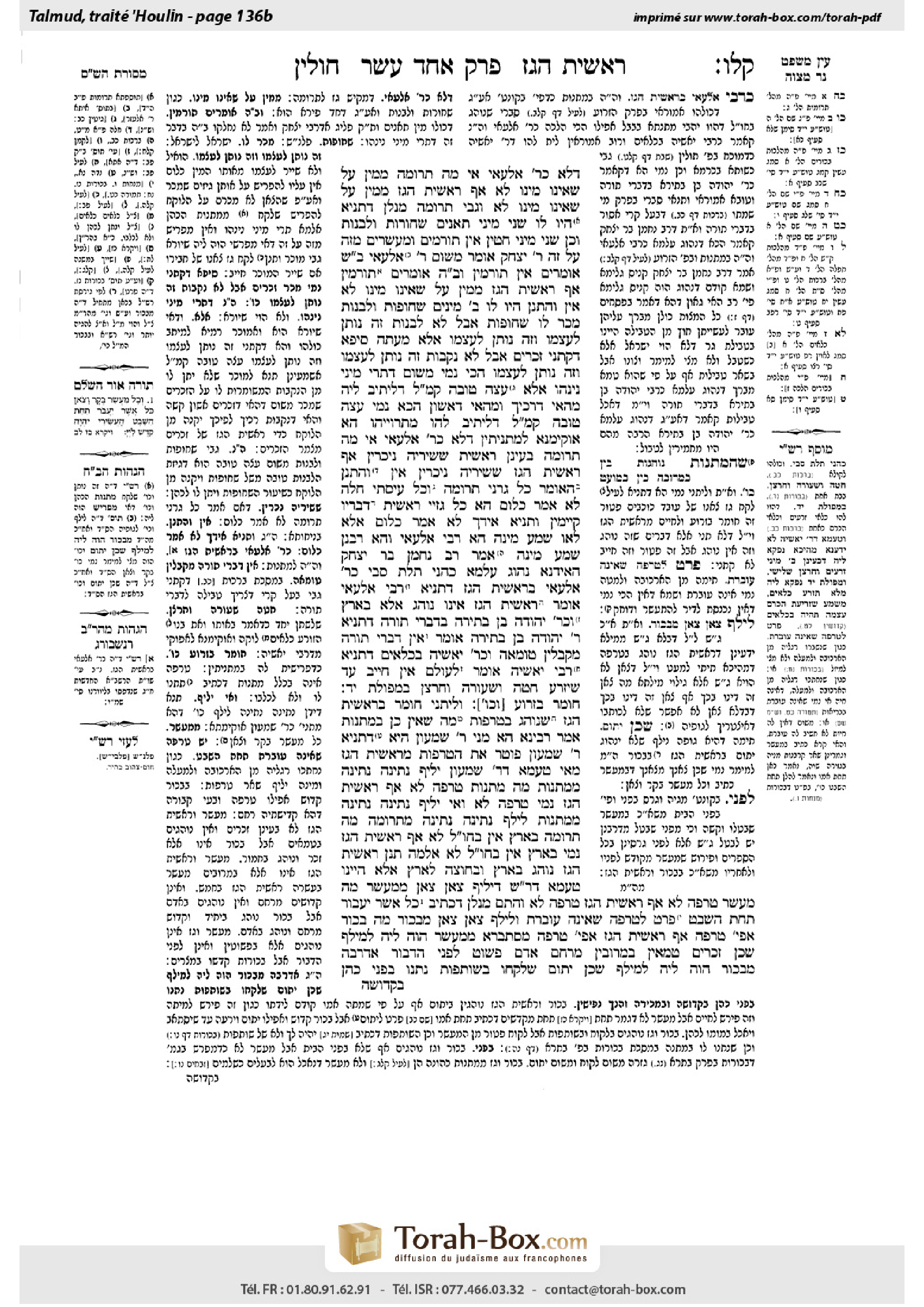
Chullin 136b: Talmud study for Daf Yomi
Study the Talmud for Daf Yomi with scanned pages, Hebrew text, English translations from Sefaria and AI-generated French translations.
Passage selection and English or AI-generated French translation are available where the scan has annotations. Daf Study is independent of Torah-Box and Sefaria.
Browse Chullin · חולין · All tractatesChullin 136b text and translations
This page of Chullin includes the Aramaic text, an English translation and an AI-generated French translation, alongside the scan above.
חולין קל״ו ב · Aramaic and Hebrew text
דְּלָא כְּרַבִּי אִלְעַאי.
אִי מָה תְּרוּמָה, מִמִּין עַל שֶׁאֵינוֹ מִינוֹ – לֹא, אַף רֵאשִׁית הַגֵּז מִמִּין עַל שֶׁאֵינוֹ מִינוֹ – לֹא?
וְגַבֵּי תְּרוּמָה מְנָלַן? דְּתַנְיָא: הָיוּ לוֹ שְׁנֵי מִינֵי תְּאֵנִים, שְׁחוֹרוֹת וּלְבָנוֹת, וְכֵן שְׁנֵי מִינֵי חִטִּין – אֵין תּוֹרְמִים וּמְעַשְּׂרִים מִזֶּה עַל זֶה. רַבִּי יִצְחָק אוֹמֵר מִשּׁוּם רַבִּי אִלְעַאי: בֵּית שַׁמַּאי אוֹמְרִים אֵין תּוֹרְמִין, וּבֵית הִלֵּל אוֹמְרִים תּוֹרְמִין. אַף רֵאשִׁית הַגֵּז מִמִּין עַל שֶׁאֵינוֹ מִינוֹ – לֹא.
אִין, וְהָתְנַן: הָיוּ לוֹ שְׁנֵי מִינִים שְׁחוּפוֹת וּלְבָנוֹת, מָכַר לוֹ שְׁחוּפוֹת אֲבָל לֹא לְבָנוֹת – זֶה נוֹתֵן לְעַצְמוֹ וְזֶה נוֹתֵן לְעַצְמוֹ.
אֶלָּא מֵעַתָּה, סֵיפָא דְּקָתָנֵי: זְכָרִים אֲבָל לֹא נְקֵבוֹת – זֶה נוֹתֵן לְעַצְמוֹ וְזֶה נוֹתֵן לְעַצְמוֹ, הָכִי נָמֵי מִשּׁוּם דִּתְרֵי מִינֵי נִינְהוּ?
אֶלָּא, עֵצָה טוֹבָה קָא מַשְׁמַע לַן, דְּלִיתֵּיב לֵיהּ מֵהַאי דְּרַכִּיךְ וּמֵהַאי דְּאַשּׁוּן. הָכָא נָמֵי, עֵצָה טוֹבָה קָא מַשְׁמַע לַן, דְּלִיתֵּיב לְהוּ מִתַּרְוַיְיהוּ.
הָא אוֹקֵימְנָא לְמַתְנִיתִין דְּלָא כְּרַבִּי אִלְעַאי.
אִי מָה תְּרוּמָה, בָּעֵינַן רֵאשִׁית שֶׁשְּׁיָרֶיהָ נִיכָּרִין, אַף רֵאשִׁית הַגֵּז שֶׁשְּׁיָרֶיהָ נִיכָּרִין? אִין.
וְהָתְנַן: הָאוֹמֵר ״כׇּל גׇּרְנִי תְּרוּמָה וְכׇל עִיסָּתִי חַלָּה״ – לֹא אָמַר כְּלוּם, הָא ״כׇּל גִּזַּיי רֵאשִׁית״ – דְּבָרָיו קַיָּימִין, וְתַנְיָא אִידַּךְ: לֹא אָמַר כְּלוּם.
אֶלָּא לָאו שְׁמַע מִינַּהּ, הָא רַבִּי אִלְעַאי, וְהָא רַבָּנַן. שְׁמַע מִינַּהּ.
אָמַר רַב נַחְמָן בַּר יִצְחָק: הָאִידָּנָא נְהוּג עָלְמָא כְּהָנֵי תְּלָת סָבֵי, כְּרַבִּי אִלְעַאי בְּרֵאשִׁית הַגֵּז, דְּתַנְיָא: רַבִּי אִלְעַאי אוֹמֵר: רֵאשִׁית הַגֵּז אֵינוֹ נוֹהֵג אֶלָּא בָּאָרֶץ.
וּכְרַבִּי יְהוּדָה בֶּן בְּתִירָה בְּדִבְרֵי תוֹרָה, דְּתַנְיָא: רַבִּי יְהוּדָה בֶּן בְּתִירָה אוֹמֵר: אֵין דִּבְרֵי תוֹרָה מְקַבְּלִין טוּמְאָה.
וּכְרַבִּי יֹאשִׁיָּה בְּכִלְאַיִם, דְּתַנְיָא: רַבִּי יֹאשִׁיָּה אוֹמֵר: לְעוֹלָם אֵין חַיָּיב עַד שֶׁיִּזְרַע חִטָּה וּשְׂעוֹרָה וְחַרְצָן בְּמַפּוֹלֶת יָד.
חוֹמֶר בִּזְרוֹעַ [וְכוּ׳]. וְלִיתְנֵי חוֹמֶר בְּרֵאשִׁית הַגֵּז, שֶׁנּוֹהֵג בִּטְרֵפוֹת, מַה שֶּׁאֵין כֵּן בְּמַתָּנוֹת!
אָמַר רָבִינָא: הָא מַנִּי? רַבִּי שִׁמְעוֹן הִיא, דְּתַנְיָא: רַבִּי שִׁמְעוֹן פּוֹטֵר אֶת הַטְּרֵפוֹת מֵרֵאשִׁית הַגֵּז. מַאי טַעְמָא דְּרַבִּי שִׁמְעוֹן? יָלֵיף ״נְתִינָה״ ״נְתִינָה״ מִמַּתָּנוֹת – מָה מַתָּנוֹת, טְרֵפָה – לָא, אַף רֵאשִׁית הַגֵּז נָמֵי, טְרֵפָה – לָא.
וְאִי יָלֵיף נְתִינָה נְתִינָה מִמַּתָּנוֹת, לֵילַף נְתִינָה נְתִינָה מִתְּרוּמָה, מָה תְּרוּמָה: בָּאָרֶץ – אִין, בְּחוּצָה לָאָרֶץ – לָא, אַף רֵאשִׁית הַגֵּז נָמֵי: בָּאָרֶץ – אִין, בְּחוּצָה לָאָרֶץ – לָא. אַלְּמָה תְּנַן: רֵאשִׁית הַגֵּז נוֹהֵג בָּאָרֶץ וּבְחוּצָה לָאָרֶץ?
אֶלָּא, הַיְינוּ טַעְמָא דְּרַבִּי שִׁמְעוֹן, דְּיָלֵיף ״צֹאן״ ״צֹאן״ מִמַּעֲשֵׂר – מָה מַעֲשֵׂר, טְרֵפָה – לָא, אַף רֵאשִׁית הַגֵּז, טְרֵפָה – לָא.
וְהָתָם מְנָלַן? דִּכְתִיב ״כֹּל אֲשֶׁר יַעֲבֹר תַּחַת הַשָּׁבֶט״ – פְּרָט לִטְרֵפָה שֶׁאֵינָהּ עוֹבֶרֶת. וְלֵילַף ״צֹאן״ ״צֹאן״ מִבְּכוֹר – מָה בְּכוֹר אֲפִילּוּ טְרֵפָה, אַף רֵאשִׁית הַגֵּז אֲפִילּוּ טְרֵפָה!
מִסְתַּבְּרָא מִמַּעֲשֵׂר הֲוָה לֵיהּ לְמֵילַף, שֶׁכֵּן זְכָרִים טְמֵאִין.
בִּמְרוּבִּין, מֵרֶחֶם.
אָדָם, פָּשׁוּט, לִפְנֵי הַדִּבּוּר.
אַדְּרַבָּה, מִבְּכוֹר הֲוָה לֵיהּ לְמֵילַף, שֶׁכֵּן: יָתוֹם, שֶׁלָּקְחוּ.
בְּשׁוּתָּפוּת, נָתְנוּ; בִּפְנֵי כֹּהֵן,
Chullin 136b · English translation
is not in accordance with the opinion of Rabbi Ilai, who holds that if the wool grew under the ownership of a gentile one is exempt from separating the first sheared wool.
Abaye further asks Rava: If one compares the first sheared wool to teruma, can one say that just as with regard to teruma one may not separate teruma from one type of produce on behalf of that which is not of the same type, so too, one may not separate the first sheared wool from one type of sheep on behalf of sheep which are not of the same type?
The Gemara asks: And with regard to teruma, from where do we derive that one may not do so? As it is taught in a baraita: If one had two types of figs, black figs and white figs; or similarly, if one had two types of wheat, one may not separate teruma and tithes from this type on behalf of that type. Rabbi Yitzḥak says in the name of Rabbi Ilai: Beit Shammai say that one may not separate teruma from one of these on behalf of the other, and Beit Hillel say that one may separate teruma from one on behalf of the other, as they consider all forms of figs or wheat to be a single type. But all agree that with regard to two distinct types of food one may not separate teruma from one type on behalf of another type. So too, with regard to the first sheared wool, perhaps one may not separate from one type of sheep on behalf of sheep which are not of the same type.
Rava replied: Yes, this is the halakha. And we learned in the mishna (135a) that one may not separate the first sheared wool from one type of sheep on behalf of another: If the seller had two types of sheep, gray and white, and he sold him the gray fleece but not the white fleece, then this seller gives the first sheared wool for himself from the wool that he kept, and that buyer gives the first sheared wool for himself from the wool that he bought.
The Gemara objects: If that is so, then consider the latter clause, which teaches: If he sold the fleece of the male sheep but not of the female sheep, then this seller gives the first sheared wool for himself from the wool that he kept, and that buyer gives the first sheared wool for himself from the wool that he bought. Is this also due to the fact that they are two different types? Clearly, it is not.
The Gemara explains: Rather, the mishna teaches us good advice. The seller is obligated to give the first sheared wool even on behalf of the wool he sold. Since the fleece of the female sheep is softer and more valuable, it is profitable for the seller to buy back part of the fleece of the male sheep and separate it as the first sheared wool on behalf of the sheep he sold, so that he gives the priest both from this wool that is soft and from that wool that is hard, rather than giving him from the fleece of his female sheep on behalf of the male sheep. Here too, with regard to the gray and white sheep, the mishna teaches us good advice, that it is profitable for the seller to buy back part of the fleece of the gray sheep, so that he gives the priests from both types of wool, rather than giving the first sheared wool entirely from the more valuable white fleece.
According to the above explanation, the mishna rules that it is permitted to separate the first sheared wool from one type of sheep on behalf of another type. This is difficult according to the opinion of Rabbi Ilai, who compares the first sheared wool to teruma, where this practice is prohibited. The Gemara answers: We already established that the mishna is not in accordance with the opinion of Rabbi Ilai.
The Gemara challenges further: If one compares the first sheared wool to teruma by means of a verbal analogy, one can say that just as with regard to teruma we require it to be a first gift whose remainders are evident, i.e., a part of the produce must remain after one has separated teruma, so too, the first sheared wool must be a gift whose remainders are evident. The Gemara responds: Yes, it is indeed so.
The Gemara cites a proof for this claim. And we learned in a mishna (Ḥalla 1:9): With regard to one who says: All my granary shall be teruma, or: All my dough shall be ḥalla, he has not said anything. But one can infer from the mishna that if he said: All my shearing shall be designated as first sheared wool, his declaration is valid. And yet it is taught in another tannaitic source, a baraita, that if he said: All my shearing shall be designated as first sheared wool, he did not say anything.
Rather, must one not conclude from the conflicting rulings that this baraita is in accordance with the opinion of Rabbi Ilai, who compares the first sheared wool to teruma, and that mishna is in accordance with the opinion of the Rabbis, who do not compare the two cases? The Gemara affirms: Conclude from here that this is correct.
§ Rav Naḥman bar Yitzḥak said: Nowadays the universally accepted practice is in accordance with the lenient rulings of these three elders: It is in accordance with the opinion of Rabbi Ilai with regard to the first sheared wool, as it is taught in a baraita that Rabbi Ilai says: The mitzva of the first sheared wool applies only in Eretz Yisrael.
And the accepted practice is in accordance with the opinion of Rabbi Yehuda ben Beteira with regard to matters of Torah, as it is taught in a baraita that Rabbi Yehuda ben Beteira says: Matters of Torah are not susceptible to ritual impurity. Therefore, it is permitted for one who experienced a seminal emission to engage in Torah study even without first immersing in a ritual bath.
And lastly, the accepted practice is in accordance with the opinion of Rabbi Yoshiya with regard to diverse kinds, as it is taught in a baraita that Rabbi Yoshiya says: One who sows diverse kinds is never liable by Torah law until he sows wheat and barley and a grape pit with a single hand motion, i.e., by sowing in the vineyard he violates the prohibitions of diverse kinds that apply to seeds and to the vineyard simultaneously.
§ The mishna states: There are more stringent elements in the mitzva of the foreleg, the jaw, and the maw than in the mitzva of the first sheared wool. The mishna then proceeds to list a number of these stringent elements. The Gemara objects: But let the mishna teach that there is a more stringent element in the mitzva of the first sheared wool, as it is in effect with regard to animals with a wound that will cause them to die within twelve months [tereifot], but that is not so with regard to the gifts of the priesthood, i.e., the foreleg, the jaw, and the maw, which are not given to the priest from a tereifa. This is because the Torah states: “He shall give to the priest the foreleg, and the jaw, and the maw” (Deuteronomy 18:3), whereas in the case of a tereifa the gifts are effectively not given to the priest himself but to his dog, as it is prohibited for the priest to eat them.
Ravina said: In accordance with whose opinion is this mishna? It is in accordance with the opinion of Rabbi Shimon, as it is taught in a baraita: Rabbi Shimon deems tereifot exempt from the mitzva of the first sheared wool. What is the reason for the ruling of Rabbi Shimon? The reason is that he derives a verbal analogy between the term giving mentioned with regard to the first sheared wool and giving from the gifts of the priesthood. The Torah states: “Shall you give him” (Deuteronomy 18:4), with regard to the first sheared wool, and it states: “He shall give,” with regard to the gifts of the priesthood. Just as with regard to the gifts of the priesthood, one is not obligated to give them from a tereifa animal, so too, with regard to the first sheared wool, one is not obligated to give them from a tereifa.
The Gemara asks: If Rabbi Shimon derives a verbal analogy between giving mentioned with regard to the first sheared wool and giving from the gifts of the priesthood, let him also derive a verbal analogy between giving mentioned with regard to the first sheared wool and giving from teruma. The Torah states: “The first fruits of your grain, of your wine, and of your oil, and the first sheared wool of your flock shall you give him” (Deuteronomy 18:4). Just as with regard to teruma, produce grown in Eretz Yisrael, yes, it is obligated, whereas produce grown outside of Eretz Yisrael is not obligated, so too with regard to the mitzva of the first sheared wool: In Eretz Yisrael, yes, it applies, whereas outside of Eretz Yisrael it does not apply. Why, then, did we learn in the mishna that the mitzva of the first sheared wool applies both in Eretz Yisrael and outside of Eretz Yisrael?
The Gemara suggests: Rather, this is the reason for the ruling of Rabbi Shimon, as he derives a verbal analogy between the term “flock [tzon]” mentioned with regard to the first sheared wool and the term “flock [tzon]” from the animal tithe. With regard to the first sheared wool, the verse states: “And the first sheared wool of your flock [tzonekha], shall you give him” (Deuteronomy 18:4), and with regard to the animal tithe it states: “And all the tithe of the herd or the flock [tzon], whichever passes under the rod, the tenth shall be holy unto the Lord” (Leviticus 27:32). Just as with regard to the tithe, one is not obligated in the case of an animal that is a tereifa, so too, with regard to the first sheared wool, one is not obligated in the case of a tereifa.
The Gemara asks: And there, with regard to the animal tithe, from where do we derive that it does not apply to a tereifa? The Gemara answers that it is written: “Whichever passes under the rod,” which excludes a tereifa, which is not able to pass under the rod due to its physical state. The Gemara raises a difficulty: But let Rabbi Shimon derive a verbal analogy between the term “flock [tzon]” mentioned in this context and the term “flock [tzon]” from the mitzva to consecrate the male firstborn animal. In that context, the Torah states: “All the firstborn males that are born of your herd and of your flock [tzonekha] you shall sanctify to the Lord your God” (Deuteronomy 15:19). Just as with regard to the consecration of the firstborn even a tereifa is consecrated, so too, with regard to the first sheared wool the obligation applies even in the case of a tereifa.
The Gemara answers: It is reasonable that Rabbi Shimon should derive the halakha of the first sheared wool from the halakha of animal tithe rather than from the mitzva of the firstborn, as there are many halakhot that are common to both the first sheared wool and the animal tithe. The Gemara enumerates these halakhot: First, the first sheared wool and the animal tithe apply to both male and female animals, while the mitzva of the firstborn applies only to males. Furthermore, the first sheared wool and the animal tithe do not apply to non-kosher animals, whereas the sanctity of the firstborn also applies to donkeys, which are not kosher.
In addition, these two mitzvot both apply only in a case of numerous animals: The first sheared wool applies only if one shears no fewer than five sheep, and one must own at least ten animals to set aside the animal tithe, whereas the sanctity of the firstborn applies to a single animal. Another common feature is that unlike the firstborn, the first sheared wool and the animal tithe are not sanctified from the womb, but only once they are designated.
Moreover, both the first sheared wool and the animal tithe apply only to animals, whereas the sanctity of the firstborn also applies to a firstborn son in the case of a man. Likewise, these two mitzvot apply not only to firstborn animals but also to ordinary non-firstborn animals, unlike the sanctity of the firstborn. Finally, the first sheared wool and the animal tithe did not apply before the divine word was issued at the giving of the Torah at Mount Sinai, whereas the sanctity of the firstborn already applied while the Jews were still in Egypt.
The Gemara responds: On the contrary, Rabbi Shimon should derive the halakha of the first sheared wool from the sanctity of the firstborn rather than from the animal tithe, as there are many halakhot common to the first sheared wool and the firstborn animal. The Gemara again enumerates the halakhot in common: Both apply to an orphan animal, i.e., one whose mother died before its birth, whereas the animal tithe does not apply to an animal of this kind. Furthermore, both mitzvot are in effect in the case of an animal that one purchased, whereas the animal tithe does not apply to a purchased animal.
In addition, both the mitzva of the first sheared wool and the mitzva of the firstborn animal apply to an animal owned in partnership, unlike the animal tithe. Both apply as well to an animal that one gave another as a gift, whereas the animal tithe does not apply in the case of a gift. Likewise, both apply even when not in the presence of the Temple, whereas the animal tithe is in effect only when the Temple is standing. Moreover, both the first sheared wool and the firstborn are given to a priest, whereas the animal tithe is eaten by the owner.
Chullin 136b · Traduction française (IA)
Ce n'est pas conforme à l'opinion du Rabbi Ilai, qui considère que si la laine a poussé sous la propriété d'un non-Juif, on est exempt de séparer la première laine tondue.
Abaye pose ensuite une question à Rava : Si l'on compare la première laine tondue à la terouma, peut-on dire que just comme, concernant la terouma, on ne peut pas séparer la terouma d'un type de produit en faveur d'un autre de type différent, de même on ne peut pas séparer la première laine tondue d'un type de mouton en faveur d'un autre de type différent ?
La Guemara pose la question : Et concernant la terouma, d'où dérive-t-on que cela n'est pas permis ? Comme il est enseigné dans une baraïta : Si l'on possède deux types de figues, des figues noires et des figues blanches ; ou de même, si l'on possède deux types de blé, on ne peut pas séparer la terouma et les dîmes de ce type en faveur de celui-ci. Le Rabbi Yitzḥak cite en nom du Rabbi Ilai : Beit Shammai disent qu'on ne peut pas séparer la terouma d'un de ces types en faveur de l'autre, et Beit Hillel disent qu'on peut séparer la terouma d'un en faveur de l'autre, car ils considèrent toutes les formes de figues ou de blé comme un seul type. Tout le monde convient cependant que concernant deux types de nourriture distinctes, on ne peut pas séparer la terouma d'un type en faveur d'un autre. De même, concernant la première laine tondue, peut-être on ne peut pas séparer celle-ci d'un type de mouton en faveur d'un autre de type différent.
Rava répondit : Oui, c'est la halakha. Et nous avons appris dans la mishna (135a) que l'on ne peut pas séparer la première laine tondue d'un type de mouton en faveur d'un autre : Si le vendeur possède deux types de moutons, gris et blanc, et qu'il vend la laine du mouton gris mais pas celle du mouton blanc, alors ce vendeur donne la première laine tondue pour lui-même à partir de la laine qu'il a conservée, et ce acheteur donne la première laine tondue pour lui-même à partir de la laine qu'il a achetée.
La Guemara s'oppose à cela : Si c'est ainsi, considérons la dernière clause, qui enseigne : Si l'on vend la laine du mouton mâle mais pas celle du mouton femelle, alors ce vendeur donne la première laine tondue pour lui-même à partir de la laine qu'il a conservée, et ce acheteur donne la première laine tondue pour lui-même à partir de la laine qu'il a achetée. Est-ce aussi dû au fait qu'ils sont deux types différents ? Évidemment, non.
La Guemara explique : Plutôt, la mishna nous enseigne une bonne conduite. Le vendeur est tenu de donner la première laine tondue même en faveur de la laine qu'il a vendue. Puisque la laine de la moutonne est plus douce et plus précieuse, il est avantageux pour le vendeur d'acheter une partie de la laine du mouton mâle et de la séparer comme première laine tondue en faveur du mouton qu'il a vendu, de sorte qu'il donne au prêtre à la fois de cette laine douce et de celle dure, plutôt que de lui donner celle du mouton femelle en faveur du mouton mâle. De même, concernant les moutons gris et blanc, la mishna nous enseigne une bonne conduite, que c'est avantageux pour le vendeur d'acheter une partie de la laine du mouton gris, de sorte qu'il donne aux prêtres de la laine des deux types, plutôt que de donner la première laine tondue entièrement de la laine plus précieuse du mouton blanc.
Selon l'explication ci-dessus, la Michna règle que l'on peut séparer la première laine tondue d'un type de mouton en faveur d'un autre type. Cela est difficile selon l'opinion du Rabbi Ilai, qui compare la première laine tondue à la terouma, où cette pratique est interdite. La Guemara répond : Nous avons déjà établi que la Michna ne suit pas l'opinion du Rabbi Ilai.
La Guemara conteste davantage : Si l'on compare la première laine tondue à la terouma par analogie verbale, on peut dire que just comme concernant la terouma, on exige qu'il s'agisse d'un don dont les restes sont visibles, c'est-à-dire qu'une partie du produit doit rester après avoir séparé la terouma, de même, la première laine tondue doit être un don dont les restes sont visibles. La Guemara répond : Oui, c'est effectivement ainsi.
La Guemara cite une preuve pour cette affirmation. Et nous avons appris dans une mishna (Ḥalla 1:9) : Concernant celui qui dit : Toute ma granetterie sera terouma, ou : Toute ma pâte sera ḥalla, il n'a pas dit quelque chose. Mais on peut en déduire de la mishna que si l'on dit : Toute ma tonte sera désignée comme première laine tondue, sa déclaration est valide. Et pourtant, il est enseigné dans une autre source tannaitique, une baraïta, que si l'on dit : Toute ma tonte sera désignée comme première laine tondue, il n'a pas dit quelque chose.
Plutôt, ne doit-on pas conclure à partir des décisions contradictoires que cette baraïta suit l'opinion du Rabbi Ilai, qui compare la première laine tondue à la terouma, et que cette mishna suit l'opinion des Rabbins, qui ne comparent pas les deux cas ? La Guemara affirme : Concluez d'ici que c'est correct.
§ Rav Naḥman bar Yitzḥak dit : Maintenant, la pratique universellement acceptée suit les décisions lenientes de ces trois anciens : Elle suit l'opinion du Rabbi Ilai concernant la première laine tondue, comme il est enseigné dans une baraïta que le Rabbi Ilai dit : La mitsva de la première laine tondue s'applique uniquement en Eretz Yisrael.
Et la pratique acceptée suit l'opinion du Rabbi Yehuda ben Beteira concernant les questions de Torah, comme il est enseigné dans une baraïta que le Rabbi Yehuda ben Beteira dit : Les questions de Torah ne sont pas sujettes à la souillure rituelle. Par conséquent, il est permis à celui qui a eu une émission sémencière d'étudier la Torah même sans d'abord se baigner dans un bain rituel.
Et enfin, la pratique acceptée suit l'opinion du Rabbi Yoshiya concernant les diverses espèces, comme il est enseigné dans une baraïta que le Rabbi Yoshiya dit : Celui qui sème diverses espèces n'est jamais responsable selon la Torah jusqu'à ce qu'il sème du blé et du seigle ainsi qu'un pépin de raisin avec un seul geste, c'est-à-dire, en plantant dans un vignoble, il viole les interdits de diverses espèces qui s'appliquent aux semences et au vignoble simultanément.
§ La Michna affirme : Il y a des éléments plus exigeants dans la mitsva du premier laine, de la mâchoire et de la gueule que dans la mitsva du premier laine. La Michna passe ensuite à énumérer certains de ces éléments exigeants. La Guemara s'oppose à cela en disant : Mais la Michna devrait enseigner qu'il y a un élément plus exigeant dans la mitsva du premier laine, car elle s'applique aux animaux qui meurent dans les douze mois [tereifot], mais cela ne s'applique pas aux dons du clergé, c'est-à-dire la mâchoire, la gueule et la première laine, qui ne sont pas donnés au prêtre à partir d'un tereifa. Cela est dû au fait que la Torah dit : « Il donnera au prêtre la mâchoire, la gueule et la première laine » (Deutéronome 18:3), alors que dans le cas d'un tereifa, les dons sont effectivement donnés non pas au prêtre lui-même mais à son chien, car il est interdit au prêtre de les manger.
Ravina dit : Selon l'opinion de qui est cette Michna ? C'est selon l'opinion de Rabbi Shimon, comme il est enseigné dans une baraïta : Rabbi Shimon considère les tereifot comme exemptés de la mitsva du premier laine. Quelle est la raison de cette décision de Rabbi Shimon ? La raison est qu'il dérive une analogie verbale entre le terme « donner » mentionné concernant le premier laine et le « donner » des dons du clergé. La Torah dit : « Tu donneras à lui » (Deutéronome 18:4), concernant le premier laine, et dit : « Il donnera », concernant les dons du clergé. Tout comme concernant les dons du clergé, on n'est pas tenu de les donner d'un animal tereifa, ainsi aussi concernant le premier laine, on n'est pas tenu de les donner d'un animal tereifa.
La Guemara pose la question : Si Rabbi Shimon dérive une analogie verbale entre le terme « donner » concernant le premier laine et le « donner » des dons du clergé, il devrait aussi dériver une analogie verbale entre le terme « donner » concernant le premier laine et le « donner » de la terouma. La Torah dit : « Les premiers fruits de votre blé, de votre vin et de votre huile, et la première laine de votre troupeau, vous donnerez à lui » (Deutéronome 18:4). Tout comme concernant la terouma, les produits cultivés en Terre d'Israël, oui, ils sont obligatoires, alors que les produits cultivés en dehors de Terre d'Israël ne le sont pas, ainsi aussi concernant la mitsva du premier laine : en Terre d'Israël, oui, elle s'applique, alors que hors de Terre d'Israël elle ne s'applique pas. Pourquoi alors la michna a-t-elle appris que la mitsva du premier laine s'applique à la fois en Terre d'Israël et hors de Terre d'Israël ?
La Guemara suggère : Plutôt, c'est la raison de la décision de Rabbi Shimon, comme il dérive une analogie verbale entre le terme « troupeau [tzon] » mentionné concernant le premier laine et le terme « troupeau [tzon] » des dîmes animales. Concernant le premier laine, le verset dit : « Et la première laine de votre troupeau [tzonekha], vous donnerez à lui » (Deutéronome 18:4), et concernant la dîme animale, il dit : « Et toute la dîme du troupeau ou de la bête [tzon], celle qui passe sous le bâton, la dixième sera sainte au Seigneur » (Lévitique 27:32). Tout comme concernant la dîme, on n'est pas tenu dans le cas d'un animal tereifa, ainsi aussi concernant le premier laine, on n'est pas tenu dans le cas d'un tereifa.
La Guemara pose la question : Et là, concernant la dîme animale, d'où dérive-t-on que cela ne s'applique pas à un tereifa ? La Guemara répond que cela est écrit : « Celui qui passe sous le bâton », ce qui exclut un tereifa, qui ne peut pas passer sous le bâton en raison de son état physique. La Guemara soulève une difficulté : Mais Rabbi Shimon devrait dériver une analogie verbale entre le terme « troupeau [tzon] » mentionné dans ce contexte et le terme « troupeau [tzon] » de la mitsva de sanctifier l'animal premier. Dans ce contexte, la Torah dit : « Tous les premiers mâles qui naissent de votre troupeau et de votre bétail [tzonekha], vous sanctifierez au Seigneur votre Dieu » (Deutéronome 15:19). Tout comme concernant la sanctification des premiers, même un tereifa est sanctifié, ainsi aussi concernant le premier laine, l'obligation s'applique même dans le cas d'un tereifa.
La Guemara répond : Il est raisonnable que Rabbi Shimon dérive la halakha du premier laine à partir de la halakha de la dîme animale plutôt que de la mitsva des premiers, car il y a de nombreuses halakhot communes à la fois au premier laine et à la dîme animale. La Guemara énumère ces halakhot : Premièrement, le premier laine et la dîme animale s'appliquent aux animaux masculins et féminins, tandis que la mitsva des premiers s'applique uniquement aux mâles. De plus, le premier laine et la dîme animale ne s'appliquent pas aux animaux non-kosher, alors que la sanctité des premiers s'applique également aux ânes, qui ne sont pas kosher.
En outre, ces deux mitsvot s'appliquent uniquement dans le cas de nombreux animaux : le premier laine s'applique uniquement si l'on tond au moins cinq moutons, et l'on doit posséder au moins dix animaux pour désigner la dîme animale, tandis que la sanctité des premiers s'applique à un seul animal. Un autre point commun est que, contrairement aux premiers, le premier laine et la dîme animale ne sont pas sanctifiés à la naissance, mais seulement une fois qu'ils sont désignés.
De plus, à la fois le premier laine et la dîme animale s'appliquent uniquement aux animaux, tandis que la sanctité des premiers s'applique également à un premier fils dans le cas d'un homme. De même, ces deux mitsvot s'appliquent non seulement aux premiers animaux mais aussi aux animaux ordinaires non-premiers, contrairement à la sanctité des premiers. Enfin, le premier laine et la dîme animale n'étaient pas applicables avant que le mot divin ne soit révélé lors de la révélation de la Torah sur le mont Sinaï, tandis que la sanctité des premiers s'appliquait déjà lorsque les Juifs étaient encore en Égypte.
La Guemara répond : Au contraire, le maître Simon devrait déduire la halakha du premier laine tondue de la sanctité du premier-né plutôt que de l'offrande animale, car il y a de nombreuses halakhot communes entre le premier laine tondue et le premier-né. La Guemara énumère à nouveau ces halakhot communes : les deux s'appliquent à un animal orphelin, c'est-à-dire un animal dont la mère est morte avant sa naissance, tandis que l'offrande animale ne s'applique pas à un animal de ce genre. De plus, les deux mitsvot s'appliquent dans le cas d'un animal acheté, tandis que l'offrande animale ne s'applique pas à un animal acheté.
En outre, à la fois la mitsva du premier laine tondue et la mitsva du premier-né s'appliquent à un animal possédé en partage, contrairement à l'offrande animale. Les deux s'appliquent également à un animal donné à un autre comme cadeau, tandis que l'offrande animale ne s'applique pas dans le cas d'un cadeau. De même, les deux s'appliquent même en l'absence du Temple, tandis que l'offrande animale est en vigueur uniquement lorsque le Temple est dressé. De plus, à la fois le premier laine tondue et le premier-né sont donnés à un prêtre, tandis que l'offrande animale est mangée par l'propriétaire.
Traduction française générée par IA à partir de l’édition anglaise de Sefaria. Vérifie toujours un passage avec le texte source.
Text from Sefaria: William Davidson Edition - Vocalized Aramaic (unknown); William Davidson Edition - English (CC BY NC).