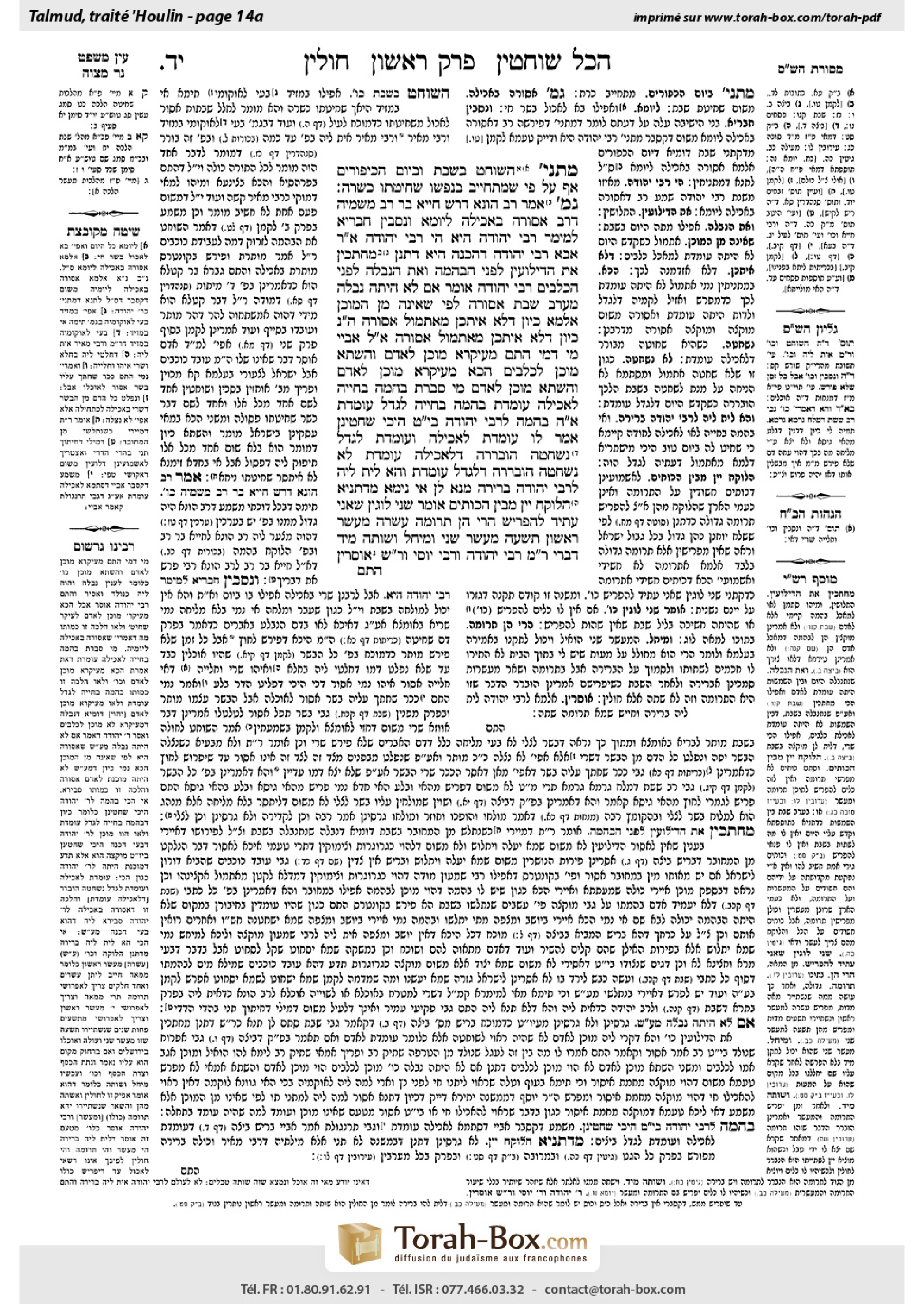
Chullin 14a: Talmud study for Daf Yomi
Study the Talmud for Daf Yomi with scanned pages, Hebrew text, English translations from Sefaria and AI-generated French translations.
Passage selection and English or AI-generated French translation are available where the scan has annotations. Daf Study is independent of Torah-Box and Sefaria.
Browse Chullin · חולין · All tractatesChullin 14a text and translations
This page of Chullin includes the Aramaic text, an English translation and an AI-generated French translation, alongside the scan above.
חולין י״ד א · Aramaic and Hebrew text
מַתְנִי׳ הַשּׁוֹחֵט בְּשַׁבָּת וּבְיוֹם הַכִּיפּוּרִים, אַף עַל פִּי שֶׁמִּתְחַיֵּיב בְּנַפְשׁוֹ – שְׁחִיטָתוֹ כְּשֵׁרָה.
גְּמָ׳ אָמַר רַב הוּנָא, דָּרַשׁ חִיָּיא בַּר רַב מִשְּׁמֵיהּ דְּרַב: אֲסוּרָה בַּאֲכִילָה לְיוֹמָא, וְנָסְבִין חַבְרַיָּא לְמֵימַר רַבִּי יְהוּדָה הִיא.
הֵי רַבִּי יְהוּדָה? אָמַר רַבִּי אַבָּא: רַבִּי יְהוּדָה דַּהֲכָנָה הִיא, דִּתְנַן: מְחַתְּכִין אֶת הַדִּילּוּעִין לִפְנֵי הַבְּהֵמָה וְאֶת הַנְּבֵלָה לִפְנֵי הַכְּלָבִים. רַבִּי יְהוּדָה אוֹמֵר: אִם לֹא הָיְתָה נְבֵלָה מֵעֶרֶב שַׁבָּת אֲסוּרָה, לְפִי שֶׁאֵינָהּ מִן הַמּוּכָן. אַלְמָא, כֵּיוָן דְּלָא אִיתְּכַן מֵאֶתְמוֹל – אֲסוּרָה, הָכָא נָמֵי, כֵּיוָן דְּלָא אִיתְּכַן מֵאֶתְמוֹל – אֲסוּרָה.
אֲמַר לֵיהּ אַבָּיֵי: מִי דָּמֵי? הָתָם מֵעִיקָּרָא מוּכָן לְאָדָם, וְהַשְׁתָּא מוּכָן לִכְלָבִים. הָכָא מֵעִיקָּרָא מוּכָן לְאָדָם, וְהַשְׁתָּא מוּכָן לְאָדָם! מִי סָבְרַתְּ בְּהֵמָה בְּחַיֶּיהָ לַאֲכִילָה עוֹמֶדֶת? בְּהֵמָה בְּחַיֶּיהָ לְגַדֵּל עוֹמֶדֶת!
אִי הָכִי, בְּהֵמָה לְרַבִּי יְהוּדָה בְּיוֹם טוֹב הֵיכִי שָׁחֲטִינַן? אָמַר לוֹ: עוֹמֶדֶת לַאֲכִילָה וְעוֹמֶדֶת לְגַדֵּל, נִשְׁחֲטָה – הוּבְרְרָה דְּלַאֲכִילָה עוֹמֶדֶת, לֹא נִשְׁחֲטָה – הוּבְרְרָה דִּלְגַדֵּל עוֹמֶדֶת.
וְהָא לֵית לֵיהּ לְרַבִּי יְהוּדָה בְּרֵירָה! מְנָא לַן? אִי נֵימָא מִדְּתַנְיָא:
הַלּוֹקֵחַ יַיִן מִבֵּין הַכּוּתִים, אוֹמֵר: ״שְׁנֵי לוּגִּין שֶׁאֲנִי עָתִיד לְהַפְרִישׁ הֲרֵי הֵן תְּרוּמָה, עֲשָׂרָה מַעֲשֵׂר רִאשׁוֹן, תִּשְׁעָה מַעֲשֵׂר שֵׁנִי״, וּמֵיחֵל וְשׁוֹתֶה מִיָּד, דִּבְרֵי רַבִּי מֵאִיר. רַבִּי יְהוּדָה וְרַבִּי יוֹסֵי וְרַבִּי שִׁמְעוֹן אוֹסְרִין.
Chullin 14a · English translation
MISHNA: In the case of one who slaughters an animal on Shabbat or on Yom Kippur, although he is liable to receive the death penalty, his slaughter is valid.
GEMARA: Rav Huna says that Ḥiyya bar Rav taught in the name of Rav: If one slaughtered an animal on Shabbat and Yom Kippur, although the slaughter is valid, consumption of the animal is prohibited for that day, and the members of the company of Sages, i.e., those in the academy, tended to say that this halakha is the opinion of Rabbi Yehuda.
The Gemara asks: Which opinion of Rabbi Yehuda? Rabbi Abba said: It is the opinion of Rabbi Yehuda with regard to preparation for Shabbat, as we learned in a mishna (Shabbat 156b): One may cut the gourds before an animal on Shabbat, provided that they were picked prior to Shabbat. And likewise, one may cut an animal carcass to place before the dogs on Shabbat. Rabbi Yehuda says: If it was not already a carcass prior to Shabbat, it is prohibited to cut it or even move it on Shabbat because it is not prepared for use on Shabbat. Apparently, since it was not prepared from yesterday, it is prohibited. Here too, in the mishna where an animal was slaughtered on Shabbat or Yom Kippur, since it was not prepared from yesterday, it is prohibited.
Abaye said to Rabbi Abba: Are the cases comparable? There, in the mishna in tractate Shabbat, initially the animal is prepared for use by a person, as it was prepared for slaughter, and now that it died without slaughter on Shabbat it is prepared for dogs. But in the mishna here, initially the animal is prepared for use by a person and now after it was slaughtered it remains prepared for use by a person. Rabbi Abba rejects that distinction: Do you hold that an animal during its lifetime is designated for consumption and therefore is prepared for use by a person? On the contrary, an animal during its lifetime is designated for breeding.
Abaye asked: If that is so that an animal is not designated for consumption, according to Rabbi Yehuda, how do we slaughter an animal on a Festival? Rabbi Abba said to Abaye: During its lifetime, the animal is designated for consumption and designated for breeding. If it was slaughtered, it is retroactively clarified that it was designated for consumption; if it was not slaughtered, it is retroactively clarified that it was designated for breeding.
But isn’t it so that Rabbi Yehuda does not accept the principle of retroactive designation? From where do we derive that this is Rabbi Yehuda’s opinion? If we say that we learn it from that which is taught in the following baraita, there is no proof.
It is taught in a baraita (Tosefta, Demai 8:7): In the case of one who purchases wine from among the Samaritans just before Shabbat, and presumably teruma and tithes were not separated, he acts as follows: If there are one hundred log of wine in the barrels, he says: Two log that I will separate in the future are teruma, as the mandated average measure of teruma is one-fiftieth; ten log are first tithe; and a tenth of the remainder, which is nine log, are second tithe. And he deconsecrates the second tithe that he will separate in the future, transferring its sanctity to money, and he may drink the wine immediately, relying on the separation that he will perform later, which will clarify retroactively which log he designated for the tithes and for teruma. This is the statement of Rabbi Meir. Rabbi Yehuda and Rabbi Yosei and Rabbi Shimon prohibit this practice. Apparently, Rabbi Yehuda does not accept the principle of retroactive designation.
Chullin 14a · Traduction française (IA)
MICHNA: Dans le cas d'une personne qui sacrifie un animal le sabbat ou le jour de l'atonement, bien qu'il soit tenu pour responsable de la peine de mort, son sacrifice est valide.
GUEMARA: Rav Huna dit que Ḥiyya bar Rav a enseigné en nom de Rav : Si l'on sacrifie un animal le sabbat et le jour de l'atonement, bien que le sacrifice soit valide, la consommation de l'animal est interdite pour cette journée, et les membres de la compagnie des Sages, c'est-à-dire ceux de l'académie, tendaient à dire que cette halakha est l'opinion de Rabbi Yehuda.
La Guemara pose la question : De quelle opinion de Rabbi Yehuda s'agit-il ? Rabbi Abba dit : C'est l'opinion de Rabbi Yehuda concernant la préparation pour le sabbat, comme nous l'avons appris dans une mitsva (Shabbat 156b) : On peut couper les melons avant un animal le sabbat, à condition qu'ils aient été récoltés avant le sabbat. De même, on peut couper un cadavre d'animal pour le placer devant les chiens le sabbat. Rabbi Yehuda dit : Si ce n'était pas déjà un cadavre avant le sabbat, il est interdit de le couper ou même de le déplacer le sabbat, car il n'était pas préparé à l'usage le sabbat. Apparemment, puisque ce n'était pas préparé la veille, il est interdit. Ici aussi, dans la mitsva où un animal a été sacrifié le sabbat ou le jour de l'atonement, puisque ce n'était pas préparé la veille, il est interdit.
Abaye dit à Rabbi Abba : Les cas sont-ils comparables ? Là, dans la mitsva du traité Shabbat, initialement l'animal est préparé à l'usage par une personne, car il était préparé à la bataille, et maintenant qu'il est mort sans bataille le sabbat, il est préparé pour les chiens. Mais dans la mitsva ici, initialement l'animal est préparé à l'usage par une personne et maintenant qu'il a été sacrifié, il reste préparé à l'usage par une personne. Rabbi Abba rejette cette distinction : Est-ce que vous considérez que l'animal pendant sa vie est désigné pour la consommation et donc préparé à l'usage par une personne ? Au contraire, l'animal pendant sa vie est désigné pour la reproduction.
Abaye demanda : Si c'est ainsi que l'animal n'est pas désigné pour la consommation, selon Rabbi Yehuda, comment peut-on sacrifier un animal un jour de fête ? Rabbi Abba dit à Abaye : Pendant sa vie, l'animal est désigné pour la consommation et pour la reproduction. Si on le sacrifie, on clarifie à posteriori qu'il était désigné pour la consommation ; si on ne le sacrifie pas, on clarifie à posteriori qu'il était désigné pour la reproduction.
Mais n'est-ce pas vrai que Rabbi Yehuda ne reconnaît pas le principe de désignation à posteriori ? D'où tirons-nous que c'est l'opinion de Rabbi Yehuda ? Si nous disons que nous l'apprenons de ce qui est enseigné dans la baraïta suivante, il n'y a pas de preuve.
Il est enseigné dans une baraïta (Tosefta, Demai 8:7) : Dans le cas d'une personne qui achète du vin parmi les Samaritains juste avant le sabbat, et on suppose que la terouma et les dîmes n'ont pas été séparés, il agit ainsi : Si il y a cent log de vin dans les tonneaux, il dit : Deux log que je séparerai à l'avenir sont la terouma, car la mesure obligatoire de la terouma est un cinquantième ; dix log sont la première dîme ; et un dixième du reste, qui est neuf log, sont la deuxième dîme. Et il déconsecrera la deuxième dîme qu'il séparera à l'avenir, transférant sa sanctité à l'argent, et il peut boire le vin immédiatement, en se fondant sur la séparation qu'il fera plus tard, ce qui clarifiera à posteriori quel log il a désigné pour les dîmes et pour la terouma. C'est l'opinion de Rabbi Meir. Rabbi Yehuda et Rabbi Yosei et Rabbi Shimon interdisent cette pratique. Apparemment, Rabbi Yehuda ne reconnaît pas le principe de désignation à posteriori.
Traduction française générée par IA à partir de l’édition anglaise de Sefaria. Vérifie toujours un passage avec le texte source.
Text from Sefaria: William Davidson Edition - Vocalized Aramaic (unknown); William Davidson Edition - English (CC BY NC).