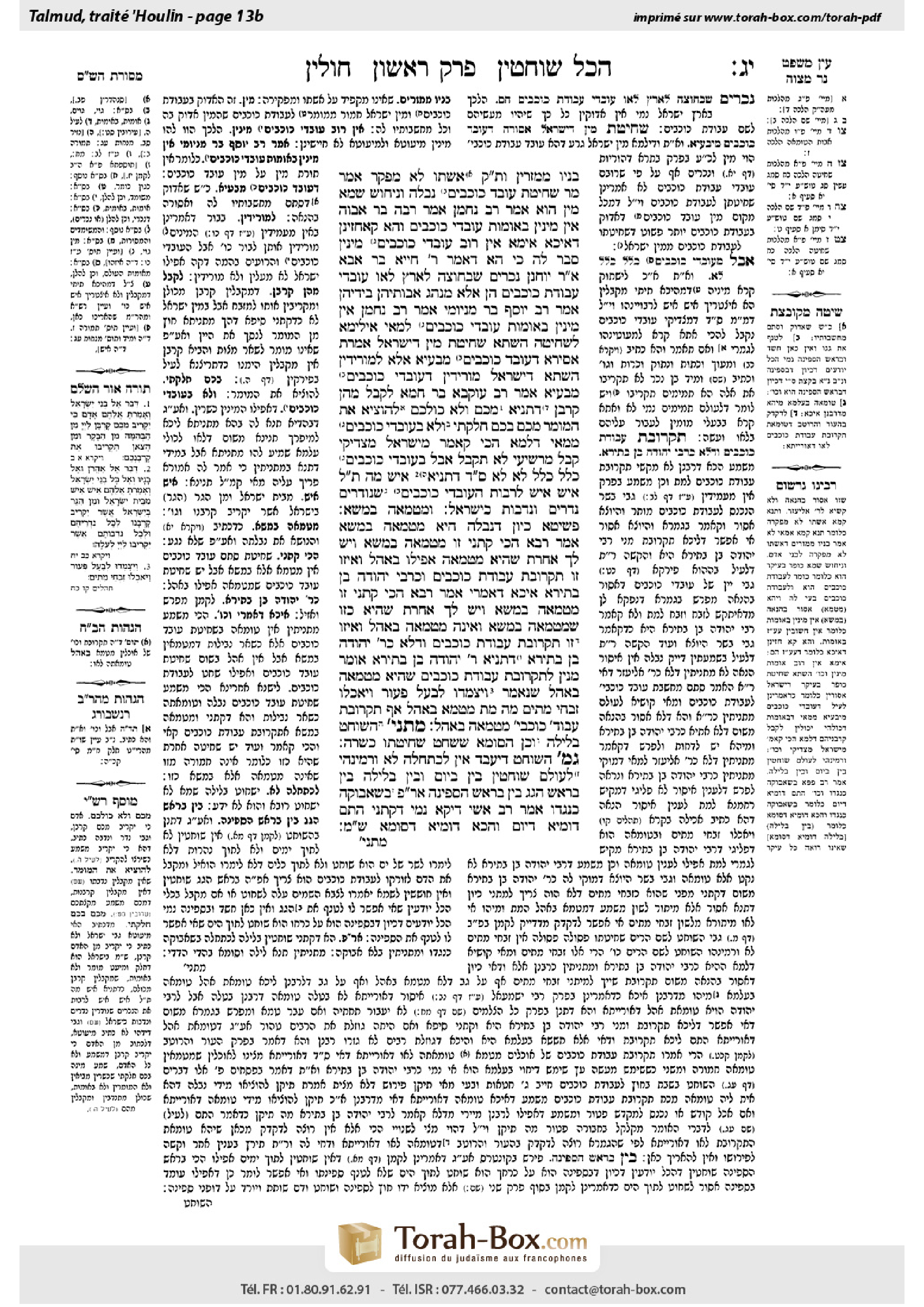
Chullin 13b: Talmud study for Daf Yomi
Study the Talmud for Daf Yomi with scanned pages, Hebrew text, English translations from Sefaria and AI-generated French translations.
Passage selection and English or AI-generated French translation are available where the scan has annotations. Daf Study is independent of Torah-Box and Sefaria.
Browse Chullin · חולין · All tractatesChullin 13b text and translations
This page of Chullin includes the Aramaic text, an English translation and an AI-generated French translation, alongside the scan above.
חולין י״ג ב · Aramaic and Hebrew text
בָּנָיו מַמְזֵרִין.
וְתַנָּא קַמָּא, אִשְׁתּוֹ לָא מַפְקַר.
אָמַר מָר: שְׁחִיטַת נׇכְרִי נְבֵלָה, וְנֵיחוּשׁ שֶׁמָּא מִין הוּא? אָמַר רַב נַחְמָן אָמַר רַבָּה בַּר אֲבוּהּ: אֵין מִינִין בָּאוּמּוֹת.
וְהָא קָחָזֵינַן דְּאִיכָּא? אֵימָא: אֵין רוֹב אוּמּוֹת מִינִין, סָבַר לַהּ כִּי הָא דְּאָמַר רַבִּי חִיָּיא בַּר אַבָּא אָמַר רַבִּי יוֹחָנָן: גּוֹיִם שֶׁבְּחוּצָה לְאָרֶץ לָאו עוֹבְדֵי עֲבוֹדָה זָרָה הֵן, אֶלָּא מִנְהַג אֲבוֹתֵיהֶן בִּידֵיהֶן.
אָמַר רַב יוֹסֵף בַּר מִנְיוֹמֵי אָמַר רַב נַחְמָן: אֵין מִינִין בָּאוּמּוֹת. לְמַאי? אִילֵימָא לִשְׁחִיטָה, הַשְׁתָּא שְׁחִיטַת מִין דְּיִשְׂרָאֵל אָמְרַתְּ אֲסִירָא, דְּגוֹי מִבַּעְיָא? אֶלָּא לְמוֹרִידִין, הַשְׁתָּא דְּיִשְׂרָאֵל מוֹרִידִין, דְּגוֹיִם מִבַּעְיָא?
אָמַר רַב עוּקְבָא בַּר חָמָא: לְקַבֵּל מֵהֶן קׇרְבָּן, דְּתַנְיָא: ״מִכֶּם״ וְלֹא כּוּלְּכֶם, לְהוֹצִיא אֶת הַמְשׁוּמָּד, ״מִכֶּם״ – בָּכֶם חִלַּקְתִּי וְלֹא בָּאוּמּוֹת.
מִמַּאי? דִּלְמָא הָכִי קָאָמַר: מִיִּשְׂרָאֵל – מִצַּדִּיקֵי קַבֵּל, מֵרַשִּׁיעֵי לָא תְּקַבֵּל, אֲבָל בְּאוּמּוֹת הָעוֹלָם – כְּלָל כְּלָל לָא! לָא סָלְקָא דַּעְתָּךְ, דְּתַנְיָא: ״אִישׁ״ – מָה תַּלְמוּד לוֹמַר ״אִישׁ אִישׁ״? לְרַבּוֹת הַגּוֹיִם, שֶׁנּוֹדְרִים נְדָרִים וּנְדָבוֹת כְּיִשְׂרָאֵל.
וּמְטַמְּאָה בְּמַשָּׂא. פְּשִׁיטָא, כֵּיוָן דִּנְבֵלָה הִיא מְטַמְּאָה בְּמַשָּׂא! אָמַר רָבָא: הָכִי קָתָנֵי, זוֹ מְטַמְּאָה בְּמַשָּׂא, וְיֵשׁ לְךָ אַחֶרֶת שֶׁהִיא מְטַמְּאָה אֲפִילּוּ בְּאֹהֶל, וְאֵיזוֹ זוֹ? תִּקְרוֹבֶת עֲבוֹדָה זָרָה, וּכְרַבִּי יְהוּדָה בֶּן בְּתִירָא.
אִיכָּא דְּאָמְרִי, אָמַר רָבָא: הָכִי קָתָנֵי, זוֹ מְטַמְּאָה בְּמַשָּׂא, וְיֵשׁ לְךָ אַחֶרֶת שֶׁהִיא כָּזוֹ שֶׁמְּטַמְּאָה בְּמַשָּׂא וְאֵינָהּ מְטַמְּאָה בְּאֹהֶל, וְאֵיזוֹ זוֹ? תִּקְרוֹבֶת עֲבוֹדָה זָרָה, וּדְלָא כְּרַבִּי יְהוּדָה בֶּן בְּתִירָא.
דְּתַנְיָא, רַבִּי יְהוּדָה בֶּן בְּתִירָא אוֹמֵר: מִנַּיִן לְתִקְרוֹבֶת עֲבוֹדָה זָרָה שֶׁהִיא מְטַמְּאָה בְּאֹהֶל? שֶׁנֶּאֱמַר: ״וַיִּצָּמְדוּ לְבַעַל פְּעוֹר וַיֹּאכְלוּ זִבְחֵי מֵתִים״, מָה מֵת מְטַמֵּא בְּאֹהֶל, אַף תִּקְרוֹבֶת עֲבוֹדָה זָרָה מְטַמְּאָה בְּאֹהֶל.
מַתְנִי׳ הַשּׁוֹחֵט בַּלַּיְלָה, וְכֵן הַסּוֹמֵא שֶׁשָּׁחַט – שְׁחִיטָתוֹ כְּשֵׁרָה.
גְּמָ׳ הַשּׁוֹחֵט דִּיעֲבַד – אִין, לְכַתְּחִלָּה – לָא. וּרְמִינְהִי: לְעוֹלָם שׁוֹחֲטִין, בֵּין בַּיּוֹם וּבֵין בַּלַּיְלָה, בֵּין בְּרֹאשׁ הַגָּג בֵּין בְּרֹאשׁ הַסְּפִינָה!
אָמַר רַב פָּפָּא: בְּשֶׁאֲבוּקָה כְּנֶגְדּוֹ. אָמַר רַב אָשֵׁי: דַּיְקָא נָמֵי, דְּקָתָנֵי הָתָם דּוּמְיָא דְּיוֹם, וְהָכָא דּוּמְיָא דְּסוֹמֵא, שְׁמַע מִינַּהּ.
Chullin 13b · English translation
his sons are mamzerim, as he is indifferent to his wife’s engaging in adultery.
The Gemara asks: And the first tanna, why did he not include the ruling that the sons of a heretic are mamzerim? The Gemara answers: In his opinion, a heretic does not release his wife and allow her to engage in adultery.
The Master said in the mishna: Slaughter performed by a gentile renders the animal an unslaughtered carcass. The Gemara challenges this: And let us be concerned that perhaps he is a heretic who is a devout idolater and deriving benefit from his slaughter is prohibited. Rav Naḥman said that Rabba bar Avuh says: There are no such heretics among the nations of the world.
The Gemara asks: But don’t we see that there are? The Gemara answers: Say the majority of the people of the nations of the world are not heretics, and with regard to slaughter one follows the majority. The Gemara notes: Rabba bar Avuh holds in accordance with that which Rabbi Ḥiyya bar Abba says that Rabbi Yoḥanan says: The status of gentiles outside of Eretz Yisrael is not that of idol worshippers, as their worship is not motivated by faith and devotion. Rather, it is a traditional custom of their ancestors that was transmitted to them.
Rav Yosef bar Minyumi says that Rav Naḥman says: There are no heretics among the nations of the world, i.e., gentile heretics do not have the halakhic status of actual heretics. The Gemara asks: With regard to what matter did Rav Naḥman state the halakha? If we say that it is with regard to slaughter, now that you said the slaughter of a Jewish heretic is forbidden, is it necessary to say the slaughter of a gentile heretic is forbidden? Rather, it is with regard to the halakha that one lowers them into a pit, i.e., one may kill a heretic, and Rav Naḥman holds that one may not kill them. But this too is difficult, as now if one lowers a Jewish heretic into a pit, is it necessary to say that one lowers a gentile heretic?
Rav Ukva bar Ḥama said: It is stated with regard to accepting an offering from them, as it is taught in a baraita with regard to the verse: “When any person of you shall bring an offering” (Leviticus 1:2): The verse states: “Of you,” and not: Of all of you, to exclude the Jewish transgressor who regularly violates a prohibition. Furthermore, God states: “Of you,” to mean that among you, the Jews, I distinguished between a transgressor and other Jews, but not among the nations. One accepts an offering from all gentiles, even a heretic.
The Gemara asks: From where do you draw that conclusion? Perhaps this is what the verse is saying: With regard to offerings from Jews, from righteous Jews accept the offering and from wicked Jews do not accept the offering; but with regard to the nations of the world, do not accept their offerings at all. The Gemara rejects that possibility: That should not enter your mind, as it is taught in a baraita with regard to the verse: “Any man [ish ish] from the house of Israel…who shall sacrifice his offering” (Leviticus 22:18): Since it would have been sufficient to write: A man [ish], what is the meaning when the verse states: “Any man [ish ish]”? It serves to include the gentiles, who may vow to bring vow offerings and gift offerings like a Jew.
§ The mishna states with regard to an animal slaughtered by a gentile: And the carcass imparts ritual impurity through carrying. The Gemara asks: Isn’t it obvious? Since it is considered an unslaughtered carcass it imparts ritual impurity through carrying. Rava said that this is what the tanna is teaching: This slaughtered animal imparts ritual impurity through carrying, and you have another animal that imparts impurity even in a tent, i.e., if one is beneath the same roof with this animal he becomes impure even though he neither touched it nor carried it. And which animal is that? That animal is an idolatrous offering, and this statement is in accordance with the opinion of Rabbi Yehuda ben Beteira cited below.
There are those who say an alternative version of Rava’s statement: Rava said that this is what the tanna is teaching: This slaughtered animal imparts ritual impurity through carrying, and you have another animal that is like this one in that it imparts ritual impurity through carrying and does not impart impurity in a tent. And which animal is this? This animal is an idolatrous offering, and this statement is not in accordance with the opinion of Rabbi Yehuda ben Beteira.
As it is taught in a baraita that Rabbi Yehuda ben Beteira says: From where is it derived with regard to an idolatrous offering that it imparts impurity in a tent? It is derived from a verse, as it is stated: “They adhered to Ba’al-Peor and ate the offerings to the dead” (Psalms 106:28). Just as a corpse imparts impurity in a tent, so too an idolatrous offering imparts impurity in a tent.
MISHNA: In the case of one who slaughters an animal at night, and likewise in the case of the blind person who slaughters an animal, his slaughter is valid.
GEMARA: The Gemara infers from the formulation of the mishna: One who slaughters, and not: One may slaughter, that with regard to the slaughter of one who slaughters at night, after the fact, yes, it is valid, but ab initio, one may not do so. The Gemara raises a contradiction from a baraita (Tosefta 1:4): One may always slaughter, both during the day and at night, both on the rooftop and atop a ship, indicating that slaughter at night is permitted ab initio.
Rav Pappa said: The tanna of the baraita is referring to a case where there is a torch opposite the slaughterer; therefore, it is permitted ab initio. Rav Ashi said: The language of the baraita is also precise, as slaughter at night is taught there in the baraita similar to slaughter during the day, based on the juxtaposition: Both during the day and at night. And here slaughter at night is taught similar to the slaughter performed by a blind person, with no light, based on the juxtaposition: One who slaughters at night, and likewise the blind person who slaughters. Therefore, the slaughter is valid only after the fact. The Gemara concludes: Learn from it.
Chullin 13b · Traduction française (IA)
ses fils sont des mamzerim, car il est indifférent à ce que sa femme commette l'adultère.
La Guemara pose la question : Et le premier tanna, pourquoi n'a-t-il pas inclus la décision selon laquelle les fils d'un hérétique sont des mamzerim ? La Guemara répond : À son avis, un hérétique ne libère pas sa femme et ne permet pas qu'elle commette l'adultère.
Le Maître a dit dans la Michna : L'abattage effectué par un non-Juif rend l'animal un cadavre non abattu. La Guemara conteste cela : Et qu'on ait peur qu'il ne soit un hérétique qui soit un dévot idolâtre et que l'obtenir un bénéfice de son abattage soit interdit. Rav Naḥman a dit que Rabba bar Avuh dit : Il n'y a pas de tels hérétiques parmi les nations du monde.
La Guemara pose la question : Mais ne voyons-nous pas que cela existe ? La Guemara répond : Disons que la majorité des gens des nations du monde ne sont pas des hérétiques, et concernant l'abattage, on suit la majorité. La Guemara note : Rabba bar Avuh suit l'opinion de Rabbi Ḥiyya bar Abba, qui dit que Rabbi Yoḥanan a dit : La situation des non-Juifs hors d'Israël n'est pas celle des adorateurs d'idoles, car leur culte n'est pas motivé par la foi et la dévotion. Plutôt, c'est une tradition de leurs ancêtres qui a été transmise à eux.
Rav Yosef bar Minyumi dit que Rav Naḥman dit : Il n'y a pas d'hérétiques parmi les nations du monde, c'est-à-dire les hérétiques non-Juifs n'ont pas le statut halakhique d'hérétiques réels. La Guemara pose la question : À propos de quelle matière Rav Naḥman a-t-il énoncé la halakha ? Si nous disons que c'est à propos de l'abattage, maintenant que tu as dit que l'abattage d'un hérétique Juif est interdit, est-il nécessaire de dire que l'abattage d'un hérétique non-Juif est interdit ? Plutôt, c'est à propos de la halakha concernant l'abaissement dans un puits, c'est-à-dire qu'on peut tuer un hérétique, et Rav Naḥman considère qu'on ne peut pas tuer les hérétiques. Mais cela aussi est difficile, car maintenant si on abaisse un hérétique Juif dans un puits, est-il nécessaire de dire qu'on abaisse un hérétique non-Juif ?
Rav Ukva bar Ḥama a dit : Il est dit à propos d'accepter une offrande d'eux, comme il est enseigné dans une baraïta à propos de la versette : « Quand un homme de vous apportera une offrande » (Lévitique 1:2) : Le verset dit : « De vous », et non : « De tous vous », pour exclure le transgresseur Juif qui viole régulièrement une interdiction. De plus, Dieu dit : « De vous », pour signifier que parmi vous, les Juifs, Il a distingué entre le transgresseur et les autres Juifs, mais pas parmi les nations. On accepte une offrande de tous les Gentils, même d'un hérétique.
La Guemara pose la question : D'où tirez-vous cette conclusion ? Peut-être que ce verset signifie : Concernant les offrandes des Juifs, on accepte celles des justes et on ne les accepte pas celles des méchants ; mais concernant les nations du monde, on ne les accepte pas du tout. La Guemara rejette cette possibilité : Ce ne devrait pas entrer dans votre esprit, car il est enseigné dans une baraïta à propos du verset : « Tout homme [ish ish] de la maison d'Israël… qui sacrifiera son offrande » (Lévitique 22:18) : Puisque cela aurait suffi d'écrire : Un homme [ish], quelle est la signification lorsque le verset dit : « Tout homme [ish ish] » ? Il sert à inclure les Gentils, qui peuvent jurer de présenter des offrandes de vœu et des offrandes de don comme un Juif.
§ La Michna dit concernant un animal abattu par un Gentil : Et le cadavre transmet la souillure rituelle par le port. La Guemara pose la question : N'est-ce pas évident ? Puisque c'est considéré comme un cadavre non abattu, il transmet la souillure rituelle par le port. Rava a dit que c'est ce que le tanna enseigne : Cet animal abattu transmet la souillure rituelle par le port, et vous avez un autre animal qui transmet la souillure même dans une tente, c'est-à-dire si l'on est sous le même toit avec cet animal, il devient souillé même s'il n'a pas touché ou porté l'animal. Et quel animal est-ce ? Cet animal est une offrande idolâtre, et cette déclaration est en conformité avec l'opinion de Rabbi Yehuda ben Beteira cité ci-dessous.
Certains disent une version alternative de la déclaration de Rava : Rava a dit que c'est ce que le tanna enseigne : Cet animal abattu transmet la souillure rituelle par le port, et vous avez un autre animal qui est comme celui-ci dans le sens où il transmet la souillure rituelle par le port et ne transmet pas la souillure dans une tente. Et quel animal est-ce ? Cet animal est une offrande idolâtre, et cette déclaration n'est pas en conformité avec l'opinion de Rabbi Yehuda ben Beteira.
Il est enseigné dans une baraïta que Rabbi Yehuda ben Beteira dit : D'où est-il dérivé concernant une offrande idolâtre qu'elle transmet la souillure dans une tente ? Il est dérivé d'un verset, comme il est dit : « Ils se sont attachés à Ba’al-Peor et ont mangé les offrandes aux morts » (Psaumes 106:28). Tout comme un cadavre transmet la souillure dans une tente, de même une offrande idolâtre transmet la souillure dans une tente.
MICHNA : Dans le cas d'une personne qui abat un animal la nuit, et dans le cas de la personne aveugle qui abat un animal, son abattage est valide.
GUEMARA : La Guemara déduit de la formulation de la Michna : Celui qui abat, et non : On peut abattre, que concernant l'abattage de celui qui abat la nuit, après coup, oui, c'est valide, mais ab initio, on ne peut pas le faire. La Guemara soulève une contradiction à partir d'une baraïta (Tosefta 1:4) : On peut toujours abattre, tantôt la nuit et tantôt le jour, tantôt sur le toit et sur le bateau, indiquant que l'abattage la nuit est permis ab initio.
Rav Pappa a dit : Le tanna de la baraïta fait référence à un cas où il y a une torche opposée au boucher ; donc, cela est permis dès le début. Rav Ashi a dit : La formulation de la baraïta est également précise, car l'abattage de nuit est enseigné là-bas dans la baraïta de la même manière que l'abattage de jour, en vertu de la juxtaposition : Lorsque l'on abat le jour et la nuit. Et ici, l'abattage de nuit est enseigné de la même manière que l'abattage réalisé par un aveugle, sans lumière, en vertu de la juxtaposition : Celui qui abat la nuit, et de même l'aveugle qui abat. Donc, l'abattage est valide seulement après l'événement. La Guemara conclut : Apprends-en.
Traduction française générée par IA à partir de l’édition anglaise de Sefaria. Vérifie toujours un passage avec le texte source.
Text from Sefaria: William Davidson Edition - Vocalized Aramaic (unknown); William Davidson Edition - English (CC BY NC).