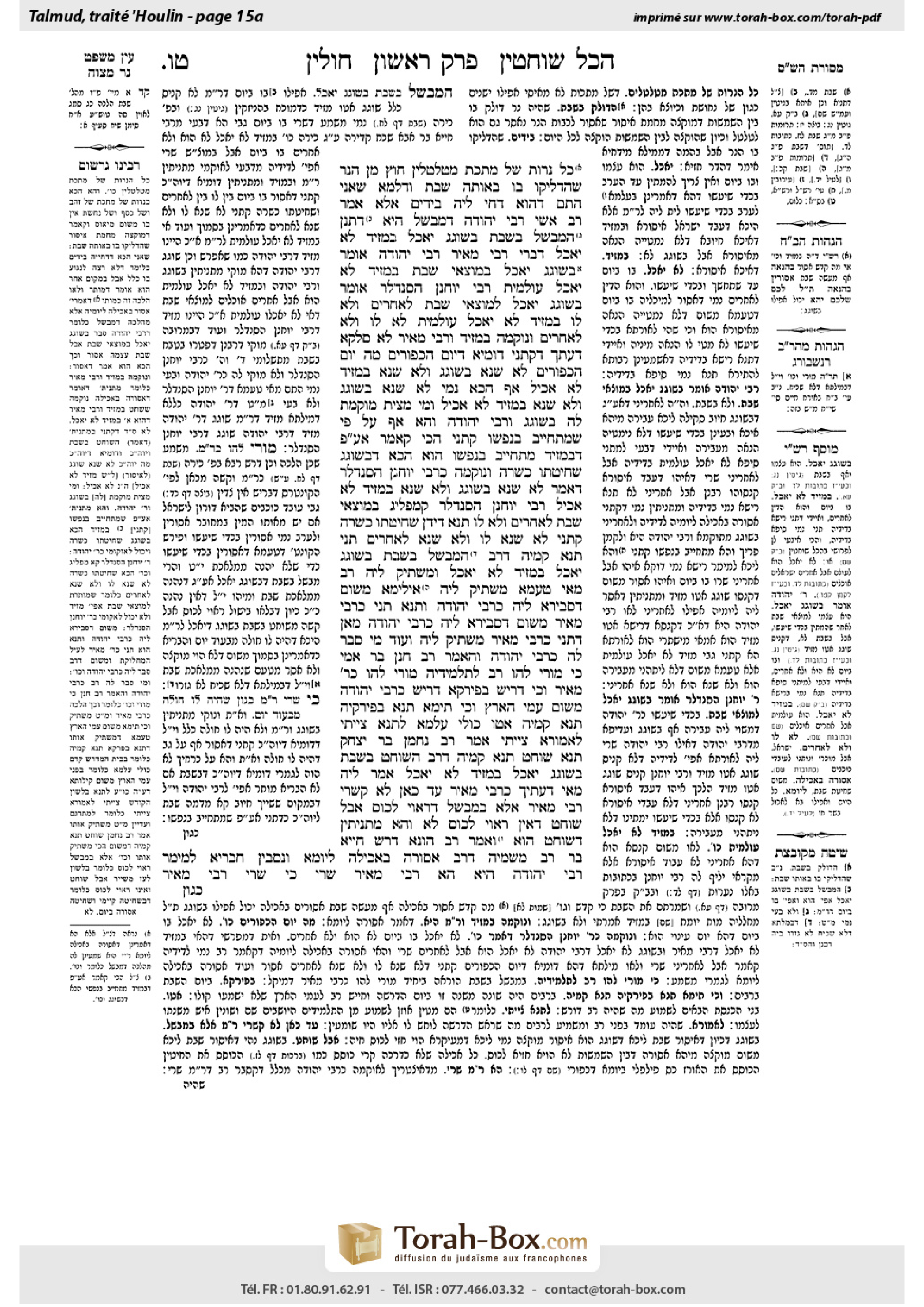
Chullin 15a: Talmud study for Daf Yomi
Study the Talmud for Daf Yomi with scanned pages, Hebrew text, English translations from Sefaria and AI-generated French translations.
Passage selection and English or AI-generated French translation are available where the scan has annotations. Daf Study is independent of Torah-Box and Sefaria.
Browse Chullin · חולין · All tractatesChullin 15a text and translations
This page of Chullin includes the Aramaic text, an English translation and an AI-generated French translation, alongside the scan above.
חולין י״ה א · Aramaic and Hebrew text
כׇּל נֵרוֹת שֶׁל מַתֶּכֶת מִטַּלְטְלִין, חוּץ מִן הַנֵּר שֶׁהִדְלִיקוּ בּוֹ בְּאוֹתָהּ שַׁבָּת.
וְדִלְמָא שָׁאנֵי הָתָם, דְּהוּא דָּחֵי לֵיהּ בְּיָדַיִם!
אֶלָּא אָמַר רַב אָשֵׁי: רַבִּי יְהוּדָה דִּמְבַשֵּׁל הִיא, דִּתְנַן: הַמְבַשֵּׁל בְּשַׁבָּת, בְּשׁוֹגֵג – יֵאָכֵל, בְּמֵזִיד – לֹא יֵאָכֵל, דִּבְרֵי רַבִּי מֵאִיר.
רַבִּי יְהוּדָה אוֹמֵר: בְּשׁוֹגֵג – יֵאָכֵל בְּמוֹצָאֵי שַׁבָּת, בְּמֵזִיד – לֹא יֵאָכֵל עוֹלָמִית.
רַבִּי יוֹחָנָן הַסַּנְדְּלָר אוֹמֵר: בְּשׁוֹגֵג – יֵאָכֵל לְמוֹצָאֵי שַׁבָּת לַאֲחֵרִים וְלֹא לוֹ, בְּמֵזִיד – לֹא יֵאָכֵל עוֹלָמִית, לֹא לוֹ וְלֹא לַאֲחֵרִים.
וְנוֹקְמַהּ בְּמֵזִיד, וְרַבִּי מֵאִיר!
לָא סָלְקָא דַּעְתָּךְ, דְּקָתָנֵי דֻּמְיָא דְּיוֹם הַכִּפּוּרִים – מָה יוֹם הַכִּפּוּרִים לָא שְׁנָא בְּשׁוֹגֵג וְלָא שְׁנָא בְּמֵזִיד – לָא אָכֵיל, אַף הָכָא נָמֵי לָא שְׁנָא בְּשׁוֹגֵג וְלָא שְׁנָא בְּמֵזִיד – לָא אָכֵיל.
וּמִי מָצֵית מוֹקְמַתְּ לַהּ בְּשׁוֹגֵג וְרַבִּי יְהוּדָה? וְהָא ״אַף עַל פִּי שֶׁמִּתְחַיֵּיב בְּנַפְשׁוֹ״ קָתָנֵי! הָכִי קָאָמַר: אַף עַל פִּי דִּבְמֵזִיד מִתְחַיֵּיב בְּנַפְשׁוֹ הוּא, הָכָא דִּבְשׁוֹגֵג – שְׁחִיטָתוֹ כְּשֵׁרָה.
וְנוֹקְמַהּ כְּרַבִּי יוֹחָנָן הַסַּנְדְּלָר, דְּאָמַר: לָא שְׁנָא בְּשׁוֹגֵג וְלָא שְׁנָא בְּמֵזִיד – לָא אָכֵיל! רַבִּי יוֹחָנָן הַסַּנְדְּלָר קָמְפַלֵּיג בְּמוֹצָאֵי שַׁבָּת, לַאֲחֵרִים וְלֹא לוֹ, תַּנָּא דִּידַן ״שְׁחִיטָתוֹ כְּשֵׁרָה״ קָתָנֵי, לָא שְׁנָא לוֹ וְלָא שְׁנָא לַאֲחֵרִים.
תָּנֵי תַּנָּא קַמֵּיהּ דְּרַב: הַמְבַשֵּׁל בְּשַׁבָּת, בְּשׁוֹגֵג – יֵאָכֵל, בְּמֵזִיד – לֹא יֵאָכֵל, וּמְשַׁתֵּיק לֵיהּ רַב.
מַאי טַעְמָא מְשַׁתֵּיק לֵיהּ? אִילֵּימָא מִשּׁוּם דִּסְבִירָא לֵיהּ כְּרַבִּי יְהוּדָה, וְתַנָּא תָּנֵי כְּרַבִּי מֵאִיר, מִשּׁוּם דִּסְבִירָא לֵיהּ כְּרַבִּי יְהוּדָה, מַאן דְּתָנֵי כְּרַבִּי מֵאִיר מְשַׁתֵּיק לֵיהּ?!
וְעוֹד, מִי סָבַר לַהּ כְּרַבִּי יְהוּדָה? וְהָאָמַר רַב חָנָן בַּר אַמֵּי: כִּי מוֹרִי לְהוּ רַב לְתַלְמִידֵיהּ – מוֹרֵי לְהוּ כְּרַבִּי מֵאִיר, וְכִי דָּרֵישׁ בְּפִירְקָא – דָּרֵישׁ כְּרַבִּי יְהוּדָה, מִשּׁוּם עַמֵּי הָאָרֶץ!
וְכִי תֵּימָא: תַּנָּא בְּפִירְקֵיהּ תְּנָא קַמֵּיהּ, אַטּוּ כּוּלֵּי עָלְמָא לְתַנָּא צָיְיתִי? לְאָמוֹרָא צָיְיתִי!
אָמַר רַב נַחְמָן בַּר יִצְחָק: תַּנָּא שׁוֹחֵט תְּנָא קַמֵּיהּ דְּרַב: הַשּׁוֹחֵט בְּשַׁבָּת, בְּשׁוֹגֵג – יֵאָכֵל, בְּמֵזִיד – לֹא יֵאָכֵל. אֲמַר לֵיהּ: מַאי דַּעְתָּיךְ כְּרַבִּי מֵאִיר? עַד כָּאן לָא קָשָׁרֵי רַבִּי מֵאִיר אֶלָּא בִּמְבַשֵּׁל, דְּרָאוּי לָכוֹס, אֲבָל שׁוֹחֵט דְּאֵין רָאוּי לָכוֹס – לָא!
וְהָא מַתְנִיתִין דְּשׁוֹחֵט הוּא, וְאָמַר רַב הוּנָא: דָּרֵשׁ חִיָּיא בַּר רַב מִשְּׁמֵיהּ דְּרַב: אֲסוּרָה בַּאֲכִילָה לְיוֹמָא, וְנָסְבִין חַבְרַיָּא לְמֵימֵר: רַבִּי יְהוּדָה הִיא, הָא רַבִּי מֵאִיר שָׁרֵי!
כִּי שָׁרֵי רַבִּי מֵאִיר,
Chullin 15a · English translation
One may move all metal lamps on Shabbat, even old ones, because they do not become repugnant like earthenware lamps, except for a metal lamp that one kindled on that same Shabbat and that was burning when Shabbat began, which it is prohibited to move for the entire Shabbat due to the prohibition against extinguishing.
The Gemara rejects that analogy. And perhaps it is different there, in the case of the burning lamp, as he set it aside by direct action when he kindled the lamp. By contrast, in the case of an animal, he did not set it aside, and therefore, perhaps once it is slaughtered it is permitted.
Rather, Rav Ashi said: When Rav said that the halakha that consumption of the animal is prohibited for that day is the opinion of Rabbi Yehuda, the reference is to the opinion of Rabbi Yehuda with regard to one who cooks, as we learned in a baraita: With regard to one who cooks on Shabbat, if he did so unwittingly, he may eat what he cooked. If he acted intentionally, he may not eat what he cooked. This is the statement of Rabbi Meir.
Rabbi Yehuda says: If he cooked the food unwittingly, he may eat it at the conclusion of Shabbat, as the Sages penalized even one who sinned unwittingly by prohibiting him from deriving immediate benefit from the dish that he cooked. If he cooked it intentionally, he may never eat from it.
Rabbi Yoḥanan HaSandlar says: If he acted unwittingly, the food may be eaten at the conclusion of Shabbat by others, but not by him. If he cooked the food intentionally, it may never be eaten, neither by him nor by others. According to Rav, the mishna is referring to a case where one slaughtered the animal unwittingly. According to Rabbi Yehuda, the slaughter is valid but it is prohibited to eat the animal on Shabbat.
The Gemara challenges this: And let us interpret the mishna as referring to a case where he slaughtered the animal intentionally, and explain that it is in accordance with the opinion of Rabbi Meir, who rules that eating the animal in such a case is permitted only after the conclusion of Shabbat.
The Gemara responds: That possibility should not enter your mind, as the case of slaughter on Shabbat is juxtaposed to and taught in a manner similar to the case of slaughter on Yom Kippur. Just as with regard to slaughter on Yom Kippur, it is no different whether one slaughtered it unwittingly and it is no different whether he slaughtered it intentionally, he may not eat it that day due to the fast, so too here, with regard to slaughter on Shabbat, it is no different whether he slaughtered it unwittingly and it is no different whether he slaughtered it intentionally, he may not eat it that day. Rabbi Meir, though, deems it permitted for one who cooked unwittingly to eat the cooked food on Shabbat.
The Gemara asks: And can you interpret the mishna as referring to a case of unwitting slaughter and in accordance with the opinion of Rabbi Yehuda? But isn’t it taught in the mishna: Although he is liable to receive the death penalty? One is liable to be executed only if he intentionally performs labor on Shabbat. The Gemara answers that this is what the mishna is saying: Although if he slaughtered it intentionally he is liable to receive the death penalty, here, in a case where he slaughtered the animal unwittingly, his slaughter is valid.
The Gemara challenges: And let us interpret the mishna in accordance with the opinion of Rabbi Yoḥanan HaSandlar, who says: It is no different whether he cooked unwittingly and it is no different whether he cooked intentionally; he may not eat it on Shabbat. The Gemara explains: Rabbi Yoḥanan HaSandlar draws a distinction with regard to the conclusion of Shabbat, in that he permits eating food cooked on Shabbat for others and not for him, while the tanna of our mishna teaches: His slaughter is valid, without qualification, indicating that with regard to his ruling it is no different for him and it is no different for others.
§ The tanna taught a baraita before Rav: One who cooks on Shabbat unwittingly may eat the food that he cooked; if he did so intentionally, he may not eat the food that he cooked, and Rav silenced him.
The Gemara asks: What is the reason that Rav silenced him? If we say it is because Rav holds in accordance with the opinion of Rabbi Yehuda and the tanna taught the baraita in accordance with the opinion of Rabbi Meir, can it be that merely because he holds in accordance with the opinion of Rabbi Yehuda he silences one who teaches a baraita in accordance with the opinion of Rabbi Meir?
And furthermore, does Rav hold in accordance with the opinion of Rabbi Yehuda? But doesn’t Rav Ḥanan bar Ami say: When Rav issues a ruling to his students, he issues a ruling in accordance with the opinion of Rabbi Meir, and when he teaches in his public lecture delivered on the Festival, he teaches in accordance with the opinion of Rabbi Yehuda, due to his concern that the ignoramuses would treat the prohibition of labor on Shabbat with disdain?
And if you would say that the tanna taught the baraita before Rav during the public lecture and Rav silenced him so that the ignoramuses would not learn from him, is that to say that everyone attending the public lecture listens to the tanna who is citing the baraita? There is no need to silence the tanna, because they listen to the disseminator [amora], the Sage who repeats what he hears from Rav loudly for the benefit of those attending the lecture, and the amora quoted Rav’s ruling in accordance with the opinion of Rabbi Yehuda.
Rav Naḥman bar Yitzḥak said: The tanna taught the halakha of one who slaughters before Rav: One who slaughters an animal on Shabbat unwittingly may eat from the slaughtered animal; if he slaughtered it intentionally, he may not eat from the slaughtered animal. Rav said to the tanna: What do you think, that the halakha is in accordance with the opinion of Rabbi Meir? Rabbi Meir deems eating permitted only in the case of one who cooks unwittingly on Shabbat, as even before he cooks the food it is fit to be chewed [lakhos], i.e., to be eaten uncooked, in a permitted manner, and therefore it was not set aside from use when Shabbat began. But in the case of one who slaughters an animal, where the meat was not fit to chew, Rabbi Meir does not permit eating it on Shabbat, because it was set aside from use on Shabbat.
The Gemara asks: But isn’t the mishna addressing the case of one who slaughters an animal, and Rav Huna says that Ḥiyya bar Rav taught in the name of Rav: Consumption of the animal is prohibited for that day, and the members of the company of Sages, i.e., those in the academy, tended to say that this halakha is the opinion of Rabbi Yehuda, from which it may be inferred: But Rabbi Meir permits consumption of the slaughtered animal even on Shabbat, and he is not concerned that the animal was set aside from use when Shabbat began?
The Gemara answers: When Rabbi Meir permits consumption of the slaughtered animal even on Shabbat,
Chullin 15a · Traduction française (IA)
On peut déplacer tous les récipients métalliques le sabbat, même les anciens, car ils ne deviennent pas repoussants comme les lampes en terre, à l'exception d'une lampe métallique allumée le même sabbat et qui brûlait lorsque le sabbat a commencé, dont il est interdit de déplacer tout au long du sabbat en raison de l'interdiction d'éteindre.
La Guemara rejette cette analogie. Et peut-être est-ce différent dans le cas de la lampe brûlante, car il l'a mis de côté par une action directe lorsqu'il a allumé la lampe. À l'inverse, dans le cas d'un animal, il ne l'a pas mis de côté, et donc, peut-être une fois qu'il est tué, il est permis.
Plutôt, Rav Ashi a dit : Lorsque Rav a dit que la halakha interdisant la consommation de l'animal ce jour-là est l'opinion de Rabbi Yehuda, la référence est à l'opinion de Rabbi Yehuda concernant celui qui cuisine, comme nous l'avons appris dans une baraïta : Concernant celui qui cuisine le sabbat, s'il l'a fait sans intention, il peut manger ce qu'il a cuisiné. S'il l'a fait intentionnellement, il ne peut pas manger ce qu'il a cuisiné. C'est la déclaration de Rabbi Meir.
Rabbi Yehuda dit : S'il a cuisiné la nourriture sans intention, il peut la manger à la fin du sabbat, car les Sages ont pénalisé même celui qui a commis un péché sans intention en interdisant de tirer un bénéfice immédiat de la nourriture qu'il a cuisinée. S'il l'a cuisinée intentionnellement, il ne peut jamais en manger.
Rabbi Yoḥanan HaSandlar dit : S'il a agi sans intention, la nourriture peut être mangée à la fin du sabbat par les autres, mais pas par lui. S'il a cuisiné la nourriture intentionnellement, elle ne peut jamais être mangée, ni par lui ni par les autres. Selon Rav, la mishna fait référence à un cas où l'on a tué l'animal sans intention. Selon Rabbi Yehuda, le sacrifice est valide mais il est interdit de manger l'animal le sabbat.
La Guemara conteste cela : Et laissons-nous interpréter la mishna comme faisant référence à un cas où l'on a tué l'animal intentionnellement, et expliquer qu'elle s'inscrit dans l'opinion de Rabbi Meir, qui considère que manger l'animal dans ce cas est permis uniquement après la fin du sabbat.
La Guemara répond : Cette possibilité ne doit pas entrer en votre esprit, car le cas de la mise à mort le sabbat est juxtaposé et enseigné de manière similaire au cas de la mise à mort le Yom Kippur. Tout comme, concernant la mise à mort le Yom Kippur, il n'y a pas de différence entre une mise à mort involontaire et une mise à mort intentionnelle, il ne peut pas manger ce jour-là en raison du jeûne, de même ici, concernant la mise à mort le sabbat, il n'y a pas de différence entre une mise à mort involontaire et une mise à mort intentionnelle, il ne peut pas manger ce jour-là. Rabbi Meir, en revanche, considère que celui qui a cuisiné involontairement peut manger la nourriture le sabbat.
La Guemara pose la question : Et pouvez-vous interpréter la mishna comme faisant référence à un cas de mise à mort involontaire et en conformité avec l'opinion de Rabbi Yehuda ? Mais n'est-il pas enseigné dans la mishna : Bien qu'il soit puni par la mort ? On est puni par la mort uniquement si l'on effectue un travail le sabbat intentionnellement. La Guemara répond que c'est ce que la mishna dit : Bien que s'il a tué intentionnellement, il soit puni par la mort, ici, dans le cas où il a tué l'animal involontairement, sa mise à mort est valide.
La Guemara conteste : Et laissons-nous interpréter la mishna en conformité avec l'opinion de Rabbi Yoḥanan HaSandlar, qui dit : Il n'y a pas de différence entre une cuisson involontaire et une cuisson intentionnelle ; il ne peut pas manger ce qu'il a cuisiné le sabbat. La Guemara explique : Rabbi Yoḥanan HaSandlar fait une distinction concernant la fin du sabbat, en permettant de manger la nourriture cuisinée le sabbat pour les autres et non pour lui, tandis que le tanna de notre mishna enseigne : Sa mise à mort est valide, sans restriction, indiquant que concernant son jugement, il n'y a pas de différence pour lui et pour les autres.
§ Le tanna a enseigné une baraïta devant Rav : Celui qui cuisine le sabbat sans le vouloir peut manger la nourriture qu'il a cuisinée ; s'il l'a fait intentionnellement, il ne peut pas manger la nourriture qu'il a cuisinée, et Rav l'a silencé.
La Guemara pose la question : Quel est le motif pour lequel Rav a silencé ? Si nous disons que c'est parce que Rav tient à l'opinion de Rabbi Yehuda et que le tanna a enseigné la baraïta selon l'opinion de Rabbi Meir, peut-il être que simplement parce qu'il tient à l'opinion de Rabbi Yehuda, il silencie celui qui enseigne une baraïta selon l'opinion de Rabbi Meir ?
Et de plus, Rav tient-il à l'opinion de Rabbi Yehuda ? Mais n'est-ce pas ce que Rav Ḥanan bar Ami dit : Lorsque Rav émet un jugement à ses élèves, il émet un jugement selon l'opinion de Rabbi Meir, et lorsqu'il enseigne lors de son discours public lors d'une fête, il enseigne selon l'opinion de Rabbi Yehuda, en raison de sa crainte que les ignorants traitent la prohibition du travail le sabbat avec dédain ?
Et si vous dites que le tanna a enseigné la baraïta devant Rav lors d'une lecture publique et que Rav l'a fait taire afin que les ignorants ne l'apprennent pas, est-ce dire que tout le monde participant à la lecture publique écoute le tanna qui cite la baraïta ? Il n'y a pas besoin de faire taire le tanna, car ils écoutent le diffuseur [amora], le Sage qui répète ce qu'il entend de Rav à haute voix pour le bénéfice de ceux participant à la lecture, et l'amora a cité le jugement de Rav selon l'opinion de Rabbi Yehuda.
Rav Naḥman bar Yitzḥak a dit : Le tanna a enseigné la halakha concernant celui qui sacrifie avant Rav : Celui qui sacrifie un animal le sabbat sans le savoir peut manger de la viande sacrifiée ; si cependant il sacrifie intentionnellement, il ne peut pas manger de la viande sacrifiée. Rav a dit au tanna : Quel est ton avis, que la halakha suit l'opinion de Rabbi Meir ? Rabbi Meir considère que la consommation est permise uniquement dans le cas de celui qui cuisine sans le savoir le sabbat, car même avant qu'il n'ait cuisiné le repas, il était propre à être mâché [lakhos], c'est-à-dire à être mangé cru, de manière permise, et donc il n'avait pas été mis de côté de l'usage lorsque le sabbat a commencé. Mais dans le cas de celui qui sacrifie un animal, où la viande n'était pas propre à être mâchée, Rabbi Meir ne permet pas de la manger le sabbat, car elle avait été mise de côté de l'usage le sabbat.
Le Guemara demande : Mais n'est-ce pas que la mitsna traite du cas de celui qui sacrifie un animal, et Rav Huna dit que Ḥiyya bar Rav a enseigné en nom de Rav : La consommation de l'animal est interdite pour ce jour, et les membres de la compagnie des Sages, c'est-à-dire ceux de l'académie, avaient tendance à dire que cette halakha est l'opinion de Rabbi Yehuda, d'où on peut déduire : Mais Rabbi Meir permet la consommation de la viande sacrifiée même le sabbat, et il n'a pas peur que l'animal ait été mis de côté de l'usage lorsque le sabbat a commencé ?
Le Guemara répond : Lorsque Rabbi Meir permet la consommation de la viande sacrifiée même le sabbat,
Traduction française générée par IA à partir de l’édition anglaise de Sefaria. Vérifie toujours un passage avec le texte source.
Text from Sefaria: William Davidson Edition - Vocalized Aramaic (unknown); William Davidson Edition - English (CC BY NC).