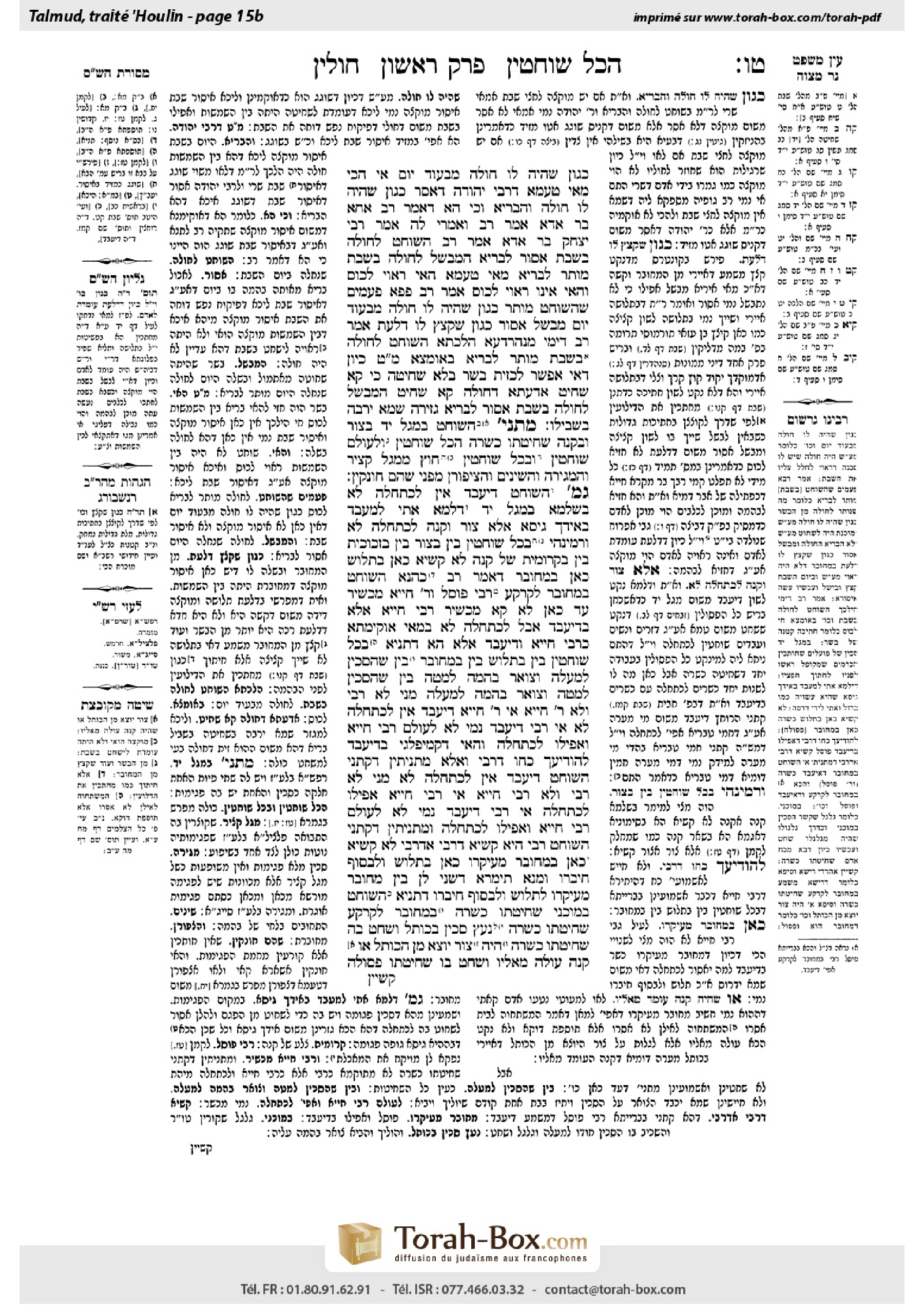
Chullin 15b: Talmud study for Daf Yomi
Study the Talmud for Daf Yomi with scanned pages, Hebrew text, English translations from Sefaria and AI-generated French translations.
Passage selection and English or AI-generated French translation are available where the scan has annotations. Daf Study is independent of Torah-Box and Sefaria.
Browse Chullin · חולין · All tractatesChullin 15b text and translations
This page of Chullin includes the Aramaic text, an English translation and an AI-generated French translation, alongside the scan above.
חולין י״ה ב · Aramaic and Hebrew text
כְּגוֹן שֶׁהָיָה לוֹ חוֹלֶה מִבְּעוֹד יוֹם.
אִי הָכִי, מַאי טַעְמָא דְּרַבִּי יְהוּדָה דְּאָסַר? כְּגוֹן שֶׁהָיָה לוֹ חוֹלֶה וְהִבְרִיא.
וְכִי הָא דְּאָמַר רַב אַחָא בַּר אַדָּא אָמַר רַב, וְאָמְרִי לַהּ אָמַר רַבִּי יִצְחָק בַּר אַדָּא אָמַר רַב: הַשּׁוֹחֵט לַחוֹלֶה בְּשַׁבָּת – אָסוּר לַבָּרִיא, הַמְבַשֵּׁל לַחוֹלֶה בְּשַׁבָּת – מוּתָּר לַבָּרִיא.
מַאי טַעְמָא? הַאי רָאוּי לָכוֹס, וְהַאי אֵינוֹ רָאוּי לָכוֹס.
אָמַר רַב פָּפָּא: פְּעָמִים שֶׁהַשּׁוֹחֵט מוּתָּר, כְּגוֹן שֶׁהָיָה לוֹ חוֹלֶה מִבְּעוֹד יוֹם; מְבַשֵּׁל אָסוּר, כְּגוֹן שֶׁקָּצַץ לוֹ דַּלַּעַת.
אָמַר רַב דִּימִי מִנְּהַרְדְּעָא, הִלְכְתָא: הַשּׁוֹחֵט לַחוֹלֶה בְּשַׁבָּת – מוּתָּר לַבָּרִיא בְּאוּמְצָא, מַאי טַעְמָא? כֵּיוָן דְּאִי אֶפְשָׁר לִכְזַיִת בָּשָׂר בְּלֹא שְׁחִיטָה, כִּי קָא שָׁחֵיט – אַדַּעְתָּא דְּחוֹלֶה קָא שָׁחֵיט. הַמְבַשֵּׁל לַחוֹלֶה בְּשַׁבָּת – אָסוּר לַבָּרִיא, גְּזֵירָה שֶׁמָּא יַרְבֶּה בִּשְׁבִילוֹ.
מַתְנִי׳ הַשּׁוֹחֵט בְּמַגַּל יָד, בְּצוֹר, וּבְקָנֶה – שְׁחִיטָתוֹ כְּשֵׁרָה.
הַכֹּל שׁוֹחֲטִין, וּלְעוֹלָם שׁוֹחֲטִין, וּבַכֹּל שׁוֹחֲטִין, חוּץ מִמַּגַּל קָצִיר, וְהַמְּגֵירָה, וְהַשִּׁינַּיִם, וְהַצִּיפּוֹרֶן, מִפְּנֵי שֶׁהֵם חוֹנְקִין.
גְּמָ׳ הַשּׁוֹחֵט – דִּיעֲבַד אִין, לְכַתְּחִלָּה לָא. בִּשְׁלָמָא בְּמַגַּל יָד – דִּלְמָא אָתֵי לְמֶעְבַּד בְּאִידַּךְ גִּיסָא, אֶלָּא צוֹר וְקָנֶה לְכִתְחִלָּה לָא? וּרְמִינְהִי: בַּכֹּל שׁוֹחֲטִין, בֵּין בְּצוֹר, בֵּין בִּזְכוּכִית, בֵּין בִּקְרוּמִית שֶׁל קָנֶה!
לָא קַשְׁיָא: כָּאן בְּתָלוּשׁ, כָּאן בִּמְחוּבָּר. דְּאָמַר רַב כָּהֲנָא: הַשּׁוֹחֵט בִּמְחוּבָּר לַקַּרְקַע – רַבִּי פּוֹסֵל וְרַבִּי חִיָּיא מַכְשִׁיר; עַד כָּאן לָא קָא מַכְשִׁיר רַבִּי חִיָּיא אֶלָּא בְּדִיעֲבַד, אֲבָל לְכַתְּחִלָּה לָא.
בְּמַאי אוֹקֵימְתַּהּ כְּרַבִּי חִיָּיא וְדִיעֲבַד? אֶלָּא הָא דְּתַנְיָא: בַּכֹּל שׁוֹחֲטִין, בֵּין בְּתָלוּשׁ בֵּין בִּמְחוּבָּר, בֵּין שֶׁהַסַּכִּין לְמַעְלָה וְצַוַּאר בְּהֵמָה לְמַטָּה, בֵּין שֶׁהַסַּכִּין לְמַטָּה וְצַוַּאר בְּהֵמָה לְמַעְלָה – מַנִּי? לָא רַבִּי וְלָא רַבִּי חִיָּיא! אִי רַבִּי חִיָּיא – דִּיעֲבַד אִין, לְכִתְחִלָּה לָא; אִי רַבִּי – דִּיעֲבַד נָמֵי לָא.
לְעוֹלָם רַבִּי חִיָּיא, וַאֲפִילּוּ לְכַתְּחִלָּה, וְהַאי דְּקָמִיפַּלְגִי בְּדִיעֲבַד – לְהוֹדִיעֲךָ כֹּחוֹ דְּרַבִּי.
וְאֶלָּא, מַתְנִיתִין דְּקָתָנֵי ״הַשּׁוֹחֵט״, דִּיעֲבַד – אִין, לְכַתְּחִלָּה – לָא, מַנִּי? לָא רַבִּי וְלָא רַבִּי חִיָּיא, אִי רַבִּי חִיָּיא – אֲפִילּוּ לְכַתְּחִלָּה, אִי רַבִּי – דִּיעֲבַד נָמֵי לָא.
לְעוֹלָם רַבִּי חִיָּיא, וַאֲפִילּוּ לְכַתְּחִלָּה, וּמַתְנִיתִין דְּקָתָנֵי ״הַשּׁוֹחֵט״ – רַבִּי הִיא.
קַשְׁיָא דְּרַבִּי אַדְּרַבִּי? לָא קַשְׁיָא: כָּאן בִּמְחוּבָּר מֵעִיקָּרוֹ, כָּאן בְּתָלוּשׁ וּלְבַסּוֹף חִיבְּרוֹ.
וּמְנָא תֵּימְרָא דְּשָׁנֵי לַן בֵּין מְחוּבָּר מֵעִיקָּרוֹ לְתָלוּשׁ וּלְבַסּוֹף חִיבְּרוֹ? דְּתַנְיָא: הַשּׁוֹחֵט בְּמוּכְנִי – שְׁחִיטָתוֹ כְּשֵׁרָה, בִּמְחוּבָּר לַקַּרְקַע – שְׁחִיטָתוֹ כְּשֵׁרָה, נָעַץ סַכִּין בַּכּוֹתֶל וְשָׁחַט בָּהּ – שְׁחִיטָתוֹ כְּשֵׁרָה, הָיָה צוֹר יוֹצֵא מִן הַכּוֹתֶל אוֹ קָנֶה עוֹלֶה מֵאֵלָיו וְשָׁחַט בּוֹ – שְׁחִיטָתוֹ פְּסוּלָה.
Chullin 15b · English translation
it is in a case where one had a critically ill person in his household while it was still day, before Shabbat, as it is permitted to slaughter the animal for such a person even on Shabbat. Therefore, the unslaughtered animal was not set aside from use.
The Gemara asks: If so, what is the reason that Rabbi Yehuda prohibited consumption of the meat on Shabbat? The Gemara answers: He issued this ruling in a case where one had a critically ill person in his household before Shabbat and that person recovered. In that case, although the unslaughtered animal was not set aside from use when Shabbat began, it is prohibited to slaughter it on Shabbat. According to Rabbi Yehuda, if he slaughtered it unwittingly, its consumption is prohibited on Shabbat.
And that which Rav silenced the tanna for not stating that an unslaughtered animal is set aside from use, even when the prohibited labor of slaughter was performed unwittingly, is in accordance with that which Rav Aḥa bar Adda says that Rav says, and some say it is that which Rabbi Yitzḥak bar Adda says that Rav says: In the case of one who slaughters an animal to feed an ill person on Shabbat, it is prohibited for a healthy person to partake of the slaughtered animal on Shabbat. In a case of one who cooks food to feed an ill person on Shabbat, it is permitted for a healthy person to partake of that food.
What is the reason for this distinction? This food was fit to be chewed before it was cooked, and therefore it was not set aside from use when Shabbat began, and the meat of that animal was not fit to be chewed before the animal was slaughtered, and therefore it was set aside from use when Shabbat began.
Rav Pappa says: There are times when one slaughters for an ill person on Shabbat and it is permitted for a healthy person to eat the meat on Shabbat, such as where he had a critically ill person in his household before Shabbat and the animal was designated for slaughter while it was still day, before Shabbat; in that case, it was not set aside from use. And there are times when one cooks on Shabbat for an ill person and it is prohibited for a healthy person to eat the food on Shabbat, such as where one cut a gourd that was attached to the ground for the ill person on Shabbat. Because it is prohibited to detach the gourd on Shabbat, it is set aside from use and forbidden.
Rav Dimi of Neharde’a says that the halakha is: In the case of one who slaughters for an ill person on Shabbat, it is permitted for a healthy person to eat the raw meat [be’umtza]. What is the reason that it is permitted? Since it is impossible for an olive-bulk of meat to be permitted without slaughter of the entire animal, when he slaughters the animal, he slaughters it with the ill person in mind. Since slaughter of the animal was permitted, all its meat is permitted even for a healthy person. In the case of one who cooks for an ill person on Shabbat, it is prohibited for a healthy person to eat the food on Shabbat. What is the reason that it is prohibited? It is due to a rabbinic decree lest he increase the amount of food that he is cooking on behalf of the healthy person.
MISHNA: In the case of one who slaughters an animal with the smooth side of a hand sickle, which has both a smooth and a serrated side, or with a sharpened flint, or with a reed that was cut lengthwise and sharpened, his slaughter is valid.
All slaughter [hakkol shoḥatin], and one may always slaughter, and one may slaughter with any item that cuts, except for the serrated side of the harvest sickle, a saw, the teeth of an animal when attached to its jawbone, and a fingernail, because they are serrated and they consequently strangle the animal and do not cut its windpipe and gullet as required.
GEMARA: The Gemara notes that the language of the mishna, which states: One who slaughters an animal with a hand sickle, with a flint, or with a reed, rather than: One may slaughter, indicates that after the fact, yes, the slaughter is valid, but one may not slaughter with those blades ab initio. The Gemara asks: Granted, one may not slaughter it with a hand sickle, lest he come to perform the slaughter with the other, serrated, side; but as a flint and a reed have no serrated side, is it so that one may not slaughter with those ab initio? And the Gemara raises a contradiction from a baraita: One may slaughter with any item that cuts, whether with a flint, or with glass shards, or with the stalk of a reed.
The Gemara answers: This is not difficult. There, where the baraita permits slaughter ab initio, it is referring to slaughter with a flint and a reed when they are detached. Here, where the mishna says that the slaughter is valid only after the fact, it is referring to slaughter with a flint and a reed when they are attached to the ground, as Rav Kahana says: In the case of one who slaughters with a blade that is attached to the ground, Rabbi Yehuda HaNasi deems the slaughter not valid and Rabbi Ḥiyya deems it valid. The Gemara infers: Even Rabbi Ḥiyya deems the slaughter valid only after the fact; but one may not do so ab initio.
In accordance with which opinion did you interpret the mishna? Is it in accordance with the opinion of Rabbi Ḥiyya, and the slaughter is valid after the fact? But if so, with regard to that which is taught in a baraita: One may slaughter with any item that cuts, whether with a blade that is detached from the ground or with a blade that is attached to the ground, whether the knife is above and the neck of the animal is below or the knife is below and the neck of the animal is above; in accordance with whose opinion is it? It is in accordance neither with the opinion of Rabbi Yehuda HaNasi nor with the opinion of Rabbi Ḥiyya. If one would claim that it is in accordance with the opinion of Rabbi Ḥiyya, he says: After the fact, yes, the slaughter is valid, but it is not permitted to slaughter in this manner ab initio. If one would claim that it is in accordance with the opinion of Rabbi Yehuda HaNasi, he says: Even after the fact, the slaughter is not valid.
The Gemara answers: Actually, the baraita is in accordance with the opinion of Rabbi Ḥiyya, and he permits slaughter with these blades even ab initio. And the fact that the opinions of Rabbi Yehuda HaNasi and Rabbi Ḥiyya were formulated such that they disagree concerning the halakha after the fact is to convey to you the far-reaching nature of the opinion of Rabbi Yehuda HaNasi that the slaughter is not valid even after the fact.
But rather, the mishna here, which teaches: With regard to one who slaughters, after the fact, yes, it is valid, but it is not ab initio, in accordance with whose opinion is it? It is in accordance neither with the opinion of Rabbi Yehuda HaNasi nor with the opinion of Rabbi Ḥiyya. If one would claim that it is in accordance with the opinion of Rabbi Ḥiyya, he says: The slaughter is permitted even ab initio. If one would claim that it is in accordance with the opinion of Rabbi Yehuda HaNasi, he says: Even after the fact, the slaughter is not valid.
The Gemara answers: Actually, Rabbi Ḥiyya holds that it is permitted to slaughter with these blades, and even ab initio; and the mishna here, which teaches: One who slaughters, is in accordance with the opinion of Rabbi Yehuda HaNasi.
The Gemara objects: This is difficult, as there is a contradiction between one statement of Rabbi Yehuda HaNasi and another statement of Rabbi Yehuda HaNasi, as in his dispute with Rabbi Ḥiyya he holds that the slaughter is not valid. The Gemara answers: This contradiction is not difficult. There, in his dispute with Rabbi Ḥiyya, Rabbi Yehuda HaNasi holds that slaughter is not valid in a case where the blade was attached from the outset; here, in the mishna, Rabbi Yehuda HaNasi deems the slaughter valid after the fact in a case where the blade was detached and ultimately he reattached it.
The Gemara asks: And from where do you say that there is a difference for us between a blade that was attached from the outset and a blade that was detached and ultimately he reattached it? As it is taught in a baraita: With regard to one who slaughters with a mechanism [bemukhni] of a wheel with a knife attached to it, his slaughter is valid; with an item that is attached to the ground, his slaughter is valid; if one embedded a knife in a wall and slaughtered with it, his slaughter is valid. If there was a flint emerging from a wall or a reed arising from the ground on its own and he slaughtered with it, his slaughter is not valid.
Chullin 15b · Traduction française (IA)
Il s'agit d'un cas où l'on avait un malade grave dans sa maison pendant la journée, avant la Shabbat, car il est permis de sacrifier l'animal pour cette personne même le sabbat. Ainsi, l'animal non sacrifié n'était pas mis de côté de l'usage.
La Guemara pose la question : Si c'est ainsi, quelle est la raison pour laquelle le maître Yéhuda interdit la consommation de la viande le sabbat ? La Guemara répond : Il a rendu cette décision dans le cas où l'on avait un malade grave dans sa maison avant le sabbat et que cette personne s'est rétablie. Dans ce cas, bien que l'animal non sacrifié n'ait pas été mis de côté de l'usage au début du sabbat, il est interdit de le sacrifier le sabbat. Selon le maître Yéhuda, si l'on sacrifie de manière involontaire, sa consommation est interdite le sabbat.
Et ce qui a fait taire Rav sur le fait que le tanna n'a pas mentionné que l'animal non sacrifié est mis de côté de l'usage, même lorsqu'on a effectué de manière involontaire le travail interdit de sacrifice, est selon ce que dit Rav Acha bar Adda que Rav dit, et certains disent que c'est ce que dit Rabbi Yitzhak bar Adda que Rav dit : Dans le cas où l'on sacrifie un animal pour nourrir un malade le sabbat, il est interdit à une personne saine de participer à la consommation de la viande le sabbat. Dans le cas où l'on cuisine un plat pour nourrir un malade le sabbat, il est permis à une personne saine de participer à la consommation de ce plat.
Quelle est la raison de cette distinction ? Ce plat était comestible avant qu'il ne soit cuit, et donc n'était pas mis de côté de l'usage au début du sabbat, et la viande de cet animal n'était pas comestible avant qu'il ne soit sacrifié, et donc était mise de côté de l'usage au début du sabbat.
Rav Pappa dit : Il y a des moments où l'on sacrifie pour un malade le sabbat et il est permis à une personne saine de manger la viande le sabbat, comme dans le cas où l'on avait un malade grave dans sa maison avant le sabbat et l'animal était désigné pour être sacrifié pendant la journée, avant le sabbat ; dans ce cas, il n'était pas mis de côté de l'usage. Et il y a des moments où l'on cuisine le sabbat pour un malade et il est interdit à une personne saine de manger le plat le sabbat, comme dans le cas où l'on a coupé un citron attaché au sol pour le malade le sabbat. Puisque c'est interdit de détacher le citron le sabbat, il est mis de côté de l'usage et interdit.
Rav Dimi de Neharde’a dit que la halakha est : Dans le cas où l'on sacrifie pour un malade le sabbat, il est permis à une personne saine de manger la viande crue [be’umtza]. Quelle est la raison pour laquelle cela est permis ? Puisque c'est impossible que la quantité d'olive de viande soit permise sans la sacrifice de l'animal entier, lorsqu'il sacrifie l'animal, il le sacrifie en pensant au malade. Puisque le sacrifice de l'animal était permis, toute sa viande est permise même pour une personne saine. Dans le cas où l'on cuisine pour un malade le sabbat, il est interdit à une personne saine de manger le plat le sabbat. Quelle est la raison pour laquelle cela est interdit ? C'est en raison d'un décret rabbinique afin qu'il ne croisse pas la quantité de nourriture qu'il cuisine en faveur de la personne saine.
MICHNA : Dans le cas où l'on sacrifie un animal avec le côté lisse d'une faux à la main, qui possède à la fois un côté lisse et un côté denté, ou avec un caillou aigu, ou avec un roseau coupé en longueur et aigu, son sacrifice est valide.
Tous les sacrifices [hakkol shoḥatin], et l'on peut toujours sacrifier, et l'on peut sacrifier avec tout objet qui coupe, sauf le côté denté de la faux à la main, une scie, les dents d'un animal attachées à son os de mâchoire, et un ongle, car ils sont dentés et ils étouffent l'animal et ne coupent pas correctement sa trachée et son gosier comme requis.
GUEMARA : La Guemara note que le langage de la mitsna, qui dit : Lorsqu'on sacrifie un animal avec une faux à la main, avec un caillou, ou avec un roseau, plutôt que : On peut sacrifier, indique que, après coup, oui, le sacrifice est valide, mais l'on ne peut pas sacrifier avec ces lames dès le début. La Guemara pose la question : D'accord, l'on ne peut pas sacrifier avec une faux à la main, de peur qu'il sacrifie avec l'autre côté, denté ; mais comme un caillou et un roseau n'ont pas de côté denté, est-ce que l'on ne peut pas sacrifier avec eux dès le début ? Et la Guemara soulève une contradiction à partir d'une baraïta : On peut sacrifier avec tout objet qui coupe, qu'il s'agisse d'un caillou, ou de fragments de verre, ou du tige d'un roseau.
La Guemara répond : Ce n'est pas difficile. Là, où la baraïta permet la mise à mort dès le début, elle parle de la mise à mort avec un caillou et un roseau lorsqu'ils sont détachés. Ici, où la mitsva dit que la mise à mort est valide seulement après coup, elle parle de la mise à mort avec un caillou et un roseau lorsqu'ils sont attachés au sol, comme dit Rav Kahana : Dans le cas où l'on effectue la mise à mort avec une lame attachée au sol, le maître Yéhuda HaNasi considère que la mise à mort n'est pas valide et le maître Ḥiyya considère qu'elle est valide. La Guemara déduit : Même le maître Ḥiyya considère que la mise à mort est valide seulement après coup ; mais l'on ne peut pas la faire dès le début.
Selon quel avis avez-vous interprété la mitsva ? Est-ce selon l'avis du maître Ḥiyya, et la mise à mort est valide après coup ? Mais si c'est ainsi, concernant ce qui est enseigné dans une baraïta : On peut effectuer la mise à mort avec tout objet qui coupe, qu'il s'agisse d'une lame détachée du sol ou d'une lame attachée au sol, qu'il s'agisse du couteau au-dessus et de la gorge de l'animal en dessous ou du couteau en dessous et de la gorge de l'animal au-dessus ; selon quel avis est-ce ? C'est ni selon l'avis du maître Yéhuda HaNasi ni selon l'avis du maître Ḥiyya. Si l'on affirme que c'est selon l'avis du maître Ḥiyya, il dit : Après coup, oui, la mise à mort est valide, mais il n'est pas permis d'effectuer la mise à mort ainsi dès le début. Si l'on affirme que c'est selon l'avis du maître Yéhuda HaNasi, il dit : Même après coup, la mise à mort n'est pas valide.
La Guemara répond : En réalité, la baraïta est selon l'opinion de Rabbi Ḥiyya, et il permet la bataille avec ces lames même dès le début. Et le fait que les opinions de Rabbi Yehuda HaNasi et de Rabbi Ḥiyya aient été formulées de telle sorte qu'elles divergent concernant la halakha après le fait est pour vous faire comprendre la portée étendue de l'opinion de Rabbi Yehuda HaNasi, selon laquelle la bataille n'est pas valide même après le fait.
Mais plutôt, la mitsna ici, qui enseigne : Concernant celui qui bataille, après le fait, oui, c'est valide, mais pas dès le début, selon l'opinion de qui est-ce ? C'est ni selon l'opinion de Rabbi Yehuda HaNasi ni selon celle de Rabbi Ḥiyya. Si l'on affirmait qu'il s'agit de l'opinion de Rabbi Ḥiyya, il dit : La bataille est permise même dès le début. Si l'on affirmait qu'il s'agit de l'opinion de Rabbi Yehuda HaNasi, il dit : Même après le fait, la bataille n'est pas valide.
La Guemara répond : En réalité, Rabbi Ḥiyya considère que la bataille avec ces lames est permise, et même dès le début ; et la mitsna ici, qui enseigne : Celui qui bataille, est selon l'opinion de Rabbi Yehuda HaNasi.
La Guemara soulève un problème : Cela est difficile, car il y a une contradiction entre une déclaration de Rabbi Yehuda HaNasi et une autre déclaration de Rabbi Yehuda HaNasi, car dans son débat avec Rabbi Ḥiyya, il affirme que la bataille n'est pas valide. La Guemara répond : Cette contradiction n'est pas difficile. Là, dans son débat avec Rabbi Ḥiyya, Rabbi Yehuda HaNasi affirme que la bataille n'est pas valide dans le cas où la lame était attachée dès le début ; ici, dans la mitsna, Rabbi Yehuda HaNasi considère que la bataille est valide après le fait dans le cas où la lame était détachée et qu'il l'a finalement reattachée.
La Guemara demande : Et d'où dis-tu qu'il y a une différence pour nous entre une lame qui était attachée dès le début et une lame qui était détachée et qu'il l'a finalement reattachée ? Comme il est enseigné dans une baraïta : Concernant celui qui bataille avec un mécanisme [bemukhni] d'une roue avec une lame attachée à celle-ci, sa bataille est valide ; concernant un objet attaché au sol, sa bataille est valide ; si l'on a enfoncé une lame dans un mur et qu'on a bataillé avec celle-ci, sa bataille est valide. Si la pierre de feu émergeait d'un mur ou si la canne émergeait du sol d'elle-même et qu'on bataillait avec celle-ci, sa bataille n'est pas valide.
Traduction française générée par IA à partir de l’édition anglaise de Sefaria. Vérifie toujours un passage avec le texte source.
Text from Sefaria: William Davidson Edition - Vocalized Aramaic (unknown); William Davidson Edition - English (CC BY NC).