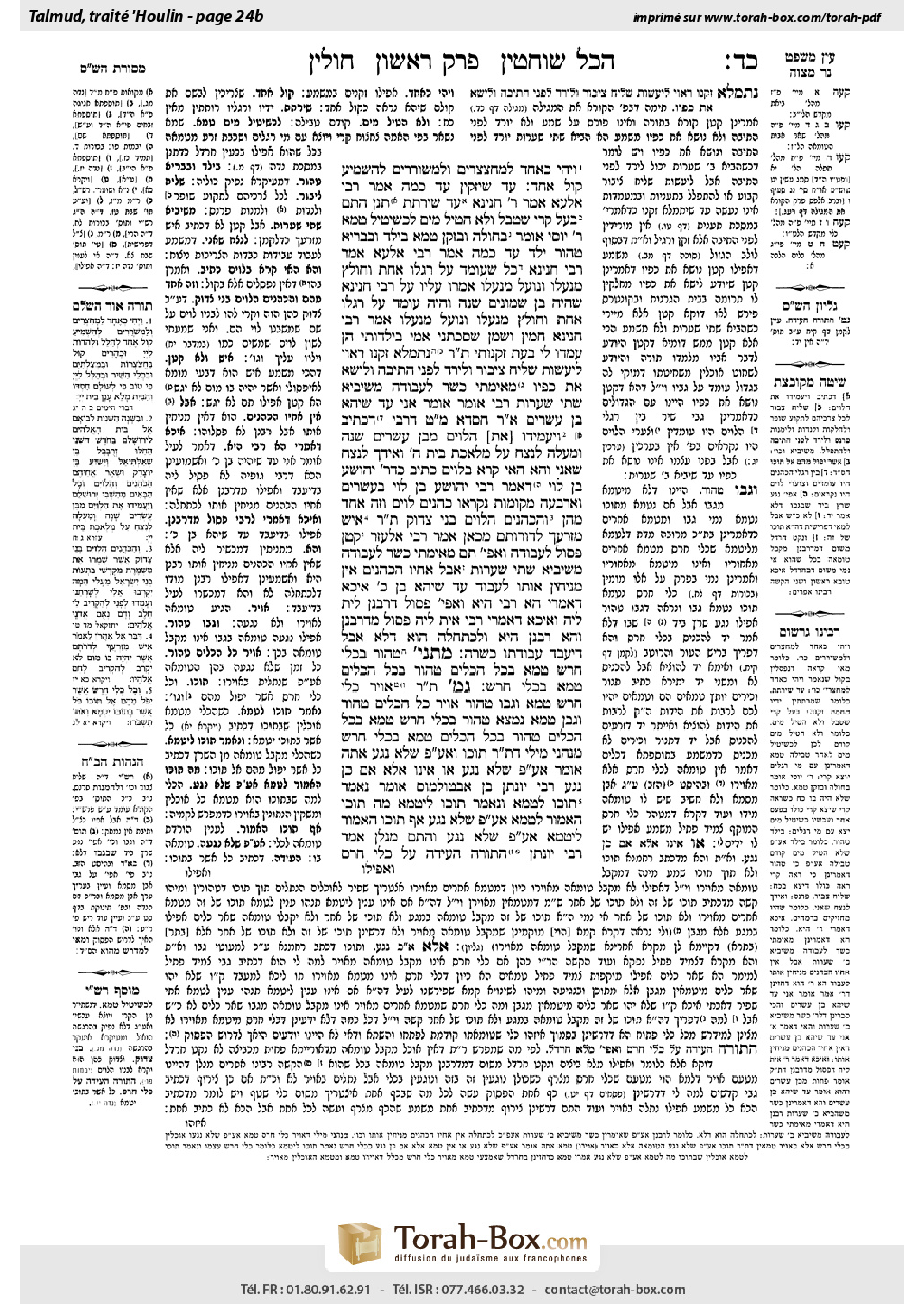
Chullin 24b: Talmud study for Daf Yomi
Study the Talmud for Daf Yomi with scanned pages, Hebrew text, English translations from Sefaria and AI-generated French translations.
Passage selection and English or AI-generated French translation are available where the scan has annotations. Daf Study is independent of Torah-Box and Sefaria.
Browse Chullin · חולין · All tractatesChullin 24b text and translations
This page of Chullin includes the Aramaic text, an English translation and an AI-generated French translation, alongside the scan above.
חולין כ״ד ב · Aramaic and Hebrew text
״וַיְהִי כְאֶחָד לַמְחַצְּצרִים וְלַמְשֹׁרְרִים לְהַשְׁמִיעַ קוֹל אֶחָד״.
עַד שֶׁיַּזְקִין – עַד כַּמָּה? אָמַר רַבִּי אִלְעָא אָמַר רַבִּי חֲנִינָא: עַד שֶׁיְּרַתֵּת.
תְּנַן הָתָם: בַּעַל קֶרִי שֶׁטָּבַל וְלֹא הֵטִיל מַיִם, לִכְשֶׁיָּטִיל – טָמֵא. רַבִּי יוֹסֵי אוֹמֵר: בְּחוֹלֶה וּבְזָקֵן – טָמֵא, בְּיֶלֶד וּבְבָרִיא – טָהוֹר.
יֶלֶד עַד כַּמָּה? אָמַר רַבִּי אִלְעָא אָמַר רַבִּי חֲנִינָא: כֹּל שֶׁעוֹמֵד עַל רַגְלוֹ אַחַת וְחוֹלֵץ מִנְעָלוֹ וְנוֹעֵל מִנְעָלוֹ. אָמְרוּ עָלָיו עַל רַבִּי חֲנִינָא, שֶׁהָיָה בֶּן שְׁמוֹנִים שָׁנָה וְהָיָה עוֹמֵד עַל רַגְלוֹ אַחַת וְחוֹלֵץ מִנְעָלוֹ וְנוֹעֵל מִנְעָלוֹ. אָמַר רַבִּי חֲנִינָא: חַמִּין וָשֶׁמֶן שֶׁסָּכַתְנִי אִמִּי בְּיַלְדוּתִי הֵן עָמְדוּ לִי בְּעֵת זִקְנוּתִי.
תָּנוּ רַבָּנַן: נִתְמַלֵּא זְקָנוֹ, רָאוּי לֵיעָשׂוֹת שְׁלִיחַ צִיבּוּר, וְלֵירֵד לִפְנֵי הַתֵּיבָה, וְלִישָּׂא אֶת כַּפָּיו. מֵאֵימָתַי כָּשֵׁר לָעֲבוֹדָה? מִשֶּׁיָּבִיא שְׁתֵּי שְׂעָרוֹת. רַבִּי אוֹמֵר: אוֹמֵר אֲנִי, עַד שֶׁיְּהֵא בֶּן עֶשְׂרִים.
אָמַר רַב חִסְדָּא: מַאי טַעְמָא דְּרַבִּי? דִּכְתִיב: ״וַיַּעֲמִידוּ [אֶת] הַלְוִיִּם מִבֶּן עֶשְׂרִים שָׁנָה וָמַעְלָה לְנַצֵּחַ עַל מְלֶאכֶת בֵּית ה׳״, וְאִידַּךְ – ״לְנַצֵּחַ״ שָׁאנֵי.
וְהָא הַאי קְרָא בִּלְוִיִּם כְּתִיב? כִּדְרַבִּי יְהוֹשֻׁעַ בֶּן לֵוִי, דְּאָמַר רַבִּי יְהוֹשֻׁעַ בֶּן לֵוִי: בְּעֶשְׂרִים וְאַרְבָּעָה מְקוֹמוֹת נִקְרְאוּ כֹּהֲנִים ״לְוִיִּם״, וְזֶה אֶחָד מֵהֶן: ״וְהַכֹּהֲנִים הַלְוִיִּם בְּנֵי צָדוֹק״.
תָּנוּ רַבָּנַן: ״אִישׁ מִזַּרְעֲךָ לְדֹרֹתָם״, מִכָּאן אָמַר רַבִּי אֶלְעָזָר: קָטָן פָּסוּל לַעֲבוֹדָה, וַאֲפִילּוּ תָּם. מֵאֵימָתַי כָּשֵׁר לַעֲבוֹדָה? מִשֶּׁיָּבִיא שְׁתֵּי שְׂעָרוֹת, אֲבָל אֶחָיו הַכֹּהֲנִים אֵין מַנִּיחִין אוֹתוֹ לַעֲבוֹד עַד שֶׁיְּהֵא בֶּן עֶשְׂרִים.
אִיכָּא דְאָמְרִי: הָא רַבִּי הִיא, וַאֲפִילּוּ פָּסוּל דְּרַבָּנַן לֵית לֵיהּ. וְאִיכָּא דְּאָמְרִי: רַבִּי אִית לֵיהּ פָּסוּל מִדְּרַבָּנַן, וְהָא רַבָּנַן הִיא, וּלְכַתְּחִלָּה הוּא דְּלָא, אֲבָל דִּיעֲבַד – עֲבוֹדָתוֹ כְּשֵׁרָה.
מַתְנִי׳ טָהוֹר בִּכְלִי חֶרֶשׂ – טָמֵא בְּכׇל הַכֵּלִים, טָהוֹר בְּכׇל הַכֵּלִים – טָמֵא בִּכְלִי חֶרֶשׂ.
גְּמָ׳ תָּנוּ רַבָּנַן: אֲוִיר כְּלִי חֶרֶשׂ טָמֵא, וְגַבּוֹ טָהוֹר. אֲוִיר כׇּל הַכֵּלִים טָהוֹר, וְגַבָּן טָמֵא. נִמְצָא, טָהוֹר בִּכְלִי חֶרֶשׂ טָמֵא בְּכׇל הַכֵּלִים, טָהוֹר בְּכׇל הַכֵּלִים טָמֵא בִּכְלִי חֶרֶשׂ.
מְנָהָנֵי מִילֵּי? דְּתָנוּ רַבָּנַן: ״תּוֹכוֹ״, וְאַף עַל פִּי שֶׁלֹּא נָגַע.
אַתָּה אוֹמֵר אַף עַל פִּי שֶׁלֹּא נָגַע, אוֹ אֵינוֹ אֶלָּא אִם כֵּן נָגַע? רַבִּי יוֹנָתָן בֶּן אַבְטוּלְמוֹס אוֹמֵר: נֶאֱמַר ״תּוֹכוֹ״ לְטַמֵּא, וְנֶאֱמַר ״תּוֹכוֹ״ לִיטַּמֵּא, מָה ״תּוֹכוֹ״ הָאָמוּר לְטַמֵּא אַף עַל פִּי שֶׁלֹּא נָגַע, אַף ״תּוֹכוֹ״ הָאָמוּר לִיטַּמֵּא אַף עַל פִּי שֶׁלֹּא נָגַע.
וְהָתָם מְנָלַן? אָמַר רַבִּי יוֹנָתָן: הַתּוֹרָה הֵעִידָה עַל כְּלִי חֶרֶס
Chullin 24b · English translation
“It came to pass, when the trumpeters and singers were as one, to make one sound to be heard” (II Chronicles 5:13). This indicates that the Levites must be capable of singing in one voice, and one who is unable to do so is unfit for service.
The baraita teaches that the priest is eligible for service until he ages. The Gemara asks: Until when, i.e., what is the definition of aging in this context? Rabbi Ela says that Rabbi Ḥanina says: Until his hands and feet begin to tremble.
We learned in a mishna there (Mikvaot 8:4): With regard to one who experienced a seminal emission who then immersed in a ritual bath and did not urinate before immersing, when he urinates he is ritually impure, because residue of the semen remain in his body and was discharged with the urine, rendering him impure. Rabbi Yosei says: In the case of an ill person and an elderly person, he is ritually impure; in the case of a young person and a healthy person, he is ritually pure, as the semen was presumably discharged in its entirety at the outset.
Until when is one considered a young person? Rabbi Ela says that Rabbi Ḥanina says: Anyone who is able to stand on one of his legs and remove his shoe or put on his shoe is considered young. They said about Rabbi Ḥanina that he was eighty years old and would stand on one of his legs and remove his shoe or put on his shoe. Rabbi Ḥanina says: The hot water and oil that my mother smeared on me in my youth benefited me in my old age.
The Sages taught: If one’s beard is fully grown, he is fit to be appointed an emissary of the community for various matters, and to descend before the ark as a prayer leader, and to lift his hands for the Priestly Benediction. From when is a priest fit for Temple service? It is from the time he reaches puberty and grows two pubic hairs. Rabbi Yehuda HaNasi says: I say that he is not fit for Temple service until he is twenty years of age.
Rav Ḥisda said: What is the reason for the opinion of Rabbi Yehuda HaNasi? The reason is as it is written: “And appointed the Levites, from twenty years old and upward, to oversee of the work of the House of the Lord” (Ezra 3:8). And what does the other tanna hold? He holds that to oversee is different and requires an older priest.
The Gemara asks: But what proof can be cited from this verse with regard to priests; isn’t that verse written with regard to Levites? The Gemara answers: It is understood in accordance with the statement of Rabbi Yehoshua ben Levi, as Rabbi Yehoshua ben Levi says: In twenty-four places in the Bible the priests are called Levites. And this is one of those verses: “And the priests the Levites, the sons of Zadok” (Ezekiel 44:15). The verse in Ezra is another one of the verses.
The Sages taught in a baraita with regard to the verse: “Any man of your descendants throughout their generations that has a blemish shall not approach to offer the bread of his God” (Leviticus 21:17); from here Rabbi Elazar says: A minor priest is unfit for Temple service, even if he is unblemished, as he is not a man. From when is he fit for service? From the time he reaches puberty and grows two pubic hairs. But his brethren the priests do not allow him to perform the service until he is twenty years of age.
There are those who say: This is the opinion of Rabbi Yehuda HaNasi, and he is of the opinion that there is no disqualification for one between puberty and twenty years of age even by rabbinic law. The other priests simply do not allow priests of that age to perform the Temple service ab initio. And there are those who say: Rabbi Yehuda HaNasi is of the opinion that there is disqualification by rabbinic law in that case, and this statement in the baraita is the opinion of the Rabbis, and they hold that it is ab initio that one may not perform the service, but after the fact, his service is valid.
MISHNA: That which is ritually pure in an earthenware vessel is ritually impure in all the other types of vessels; that which is ritually pure in all the other types of vessels is ritually impure in an earthenware vessel.
GEMARA: The Sages taught in a baraita explaining the mishna: If a primary source of ritual impurity fell into the airspace of an earthenware vessel the vessel is ritually impure, and if it fell on its outer side, the vessel is ritually pure. If a primary source of ritual impurity fell into the airspace of all the other types of vessels, the vessels are ritually pure, and if it fell on their outer side, they are ritually impure. It is found that that which is ritually pure in an earthenware vessel is ritually impure in all the other vessels, and that which is ritually pure in all the other vessels is ritually impure in an earthenware vessel.
The Gemara asks: From where are these matters derived? It is as the Sages taught in a baraita based on the verse: “And every earthenware vessel into which [tokho] any of them falls, whatever is in it [tokho] shall be impure, and it you shall break” (Leviticus 11:33); if an impure item fell “in it [tokho],” and even in a case where the impure item did not come into contact with the vessel, the vessel becomes impure.
The baraita continues: Do you say that it is impure even if the impure item did not come into contact with the vessel, or perhaps it is impure only if it did come into contact with the vessel? Rabbi Yonatan ben Avtolemos says: Tokho is stated with regard to transmitting impurity to food in its airspace, as it is stated: “Whatever is in it [tokho] shall be impure,” and tokho is stated with regard to becoming impure, as it is stated: “Into which [tokho] any of them falls”; just as in the case of tokho that is stated with regard to transmitting impurity to food in its airspace, the food is impure even if the impure item did not come into contact with the vessel, so too, in the case of tokho that is stated with regard to the vessel becoming impure, the vessel is impure even if the impure item did not come into contact with it.
The Gemara asks: And there, with regard to rendering food impure in its airspace, from where do we derive that the food becomes impure even if it did not come into contact with the impure vessel? Rabbi Yonatan said: The Torah testified about an earthenware vessel
Chullin 24b · Traduction française (IA)
« Il arriva que, lorsqu'avaient été unis les trompettistes et les chanteurs, pour former un seul son qui fût entendu » (II Chroniques 5:13). Cela montre que les Lévites doivent être capables de chanter d'une seule voix, et celui qui n'y parvient pas n'est pas digne de service.
La baraïta enseigne que le prêtre est digne de service jusqu'à ce qu'il vieillisse. La Guemara demande : jusqu'à quand, c'est-à-dire quelle est la définition de l'âge en ce contexte ? Rabbi Ela dit que Rabbi Ḥanina dit : jusqu'à ce que ses mains et ses pieds commencent à trembler.
Nous avons appris dans une mitsva là (Mikvaot 8:4) : concernant celui qui a eu une émission sémencière, puis s'est purifié dans un bain rituel et n'a pas uriné avant de se purifier, lorsqu'il urinera, il sera impur, car les résidus du sperme restent dans son corps et sont évacués avec l'urine, le rendant impur. Rabbi Yosei dit : dans le cas d'une personne malade ou âgée, il est impur ; dans le cas d'une personne jeune et en bonne santé, il est pur, car le sperme a probablement été évacué entièrement dès le départ.
Jusqu'à quel âge est-on considéré comme jeune ? Rabbi Ela dit que Rabbi Ḥanina dit : celui qui peut se tenir sur un de ses pieds et enlever ou remettre sa chaussure est considéré comme jeune. On racontait à propos de Rabbi Ḥanina qu'il avait quatre-vingt ans et pouvait se tenir sur un de ses pieds et enlever ou remettre sa chaussure. Rabbi Ḥanina dit : l'eau bouillante et l'huile que ma mère m'avait appliquée lors de ma jeunesse m'ont bénéficié dans mon âge avancé.
Les Sages enseignent : si la barbe d'une personne est pleinement développée, il est digne d'être désigné comme messager de la communauté pour diverses affaires, et de descendre devant l'arc comme chef de prière, et de lever ses mains pour la bénédiction des prêtres. À partir de quel âge un prêtre est-il digne de service dans le Temple ? C'est à partir de l'âge de la puberté et de l'apparition de deux poils pubiens. Rabbi Yehuda HaNasi dit : je dis qu'il n'est digne de service dans le Temple qu'à l'âge de vingt ans.
Rav Ḥisda dit : quelle est la raison de l'opinion de Rabbi Yehuda HaNasi ? La raison est telle que cela est écrit : « Et il désigna les Lévites, de vingt ans et au-dessus, pour surveiller l'œuvre de la Maison du Seigneur » (Esdras 3:8). Et qu'en est-il de l'opinion de l'autre tanna ? Il considère que surveiller est différent et exige un prêtre plus âgé.
La Guemara demande : mais quelle preuve peut être citée à partir de cette verset concernant les prêtres ; n'est-ce pas un verset écrit concernant les Lévites ? La Guemara répond : cela est compris selon la déclaration de Rabbi Yehoshua ben Levi, car Rabbi Yehoshua ben Levi dit : dans vingt-quatre endroits de la Bible les prêtres sont appelés Lévites. Et c'est l'un de ces versets : « Et les prêtres les Lévites, les fils de Zadok » (Ezéchiel 44:15). Le verset d'Esdras est un autre de ces versets.
Les Sages enseignent dans une baraïta concernant le verset : « Tout homme de vos descendants, à travers leurs générations, qui a un défaut ne doit pas approcher pour offrir le pain de son Dieu » (Lévitique 21:17) ; d'où Rabbi Elazar dit : un prêtre mineur n'est pas digne de service dans le Temple, même s'il est sans défaut, car il n'est pas un homme. À partir de quel âge est-il digne de service ? À partir de l'âge de la puberté et de l'apparition de deux poils pubiens. Mais ses frères les prêtres ne lui permettent pas de faire le service avant qu'il ait vingt ans.
Certains disent : c'est l'opinion de Rabbi Yehuda HaNasi, et il considère qu'il n'y a pas de disqualification pour celui entre la puberté et l'âge de vingt ans même selon la loi rabbinique. Les autres prêtres ne permettent simplement pas aux prêtres de cet âge de faire le service dès le début. Et certains disent : Rabbi Yehuda HaNasi considère qu'il y a une disqualification selon la loi rabbinique dans ce cas, et cette déclaration dans la baraïta est l'opinion des Rabbins, et ils considèrent que l'on ne peut pas faire le service dès le début, mais après, son service est valide.
MICHNA : Ce qui est pur dans un vase en terre est impur dans tous les autres types de vases ; ce qui est pur dans tous les autres types de vases est impur dans un vase en terre.
GUEMARA : Les Sages enseignent dans une baraïta qui explique la mitsva : Si une source d'impureté primaire est tombée dans l'air intérieur d'un vase en terre, le vase est impur, et si elle est tombée sur son côté externe, le vase est pur. Si une source d'impureté primaire est tombée dans l'air intérieur de tous les autres types de vases, les vases sont purs, et si elle est tombée sur leur côté externe, ils sont impurs. On trouve que ce qui est pur dans un vase en terre est impur dans tous les autres vases, et ce qui est pur dans tous les autres vases est impur dans un vase en terre.
La Guemara demande : d'où sont dérivés ces enseignements ? C'est comme les Sages enseignent dans une baraïta fondée sur le verset : « Et tout vase en terre dans lequel [tokho] l'un d'eux tombe, tout ce qui est en lui [tokho] devient impur, et tu le briseras » (Lévitique 11:33) ; si un objet impur est tombé « en lui [tokho] », et même dans un cas où l'objet impur n'a pas été en contact avec le vase, le vase devient impur.
La baraïta continue : dis-tu que c'est impur même si l'objet impur n'a pas été en contact avec le vase, ou peut-être est-ce impur seulement si l'objet impur a été en contact avec le vase ? Rabbi Yonatan ben Avtolemos dit : tokho est mentionné en ce qui concerne la transmission de l'impureté à la nourriture dans son aire intérieure, comme il est dit : « Tout ce qui est en lui [tokho] devient impur », et tokho est mentionné en ce qui concerne l'impureté elle-même, comme il est dit : « Dans lequel [tokho] l'un d'eux tombe » ; tout comme dans le cas de tokho mentionné en ce qui concerne la transmission de l'impureté à la nourriture dans son aire intérieure, la nourriture est impure même si l'objet impur n'a pas été en contact avec le vase, de même, dans le cas de tokho mentionné en ce qui concerne le vase devenant impur, le vase est impur même si l'objet impur n'a pas été en contact avec lui.
La Guemara pose la question : Et là, concernant la rendue impure de la nourriture dans son aire, d'où tirons-nous que la nourriture devient impure même si elle n'a pas été en contact avec le récipient impur ? Rabbi Yonatan dit : La Torah a témoigné d'un récipient en terre
Traduction française générée par IA à partir de l’édition anglaise de Sefaria. Vérifie toujours un passage avec le texte source.
Text from Sefaria: William Davidson Edition - Vocalized Aramaic (unknown); William Davidson Edition - English (CC BY NC).