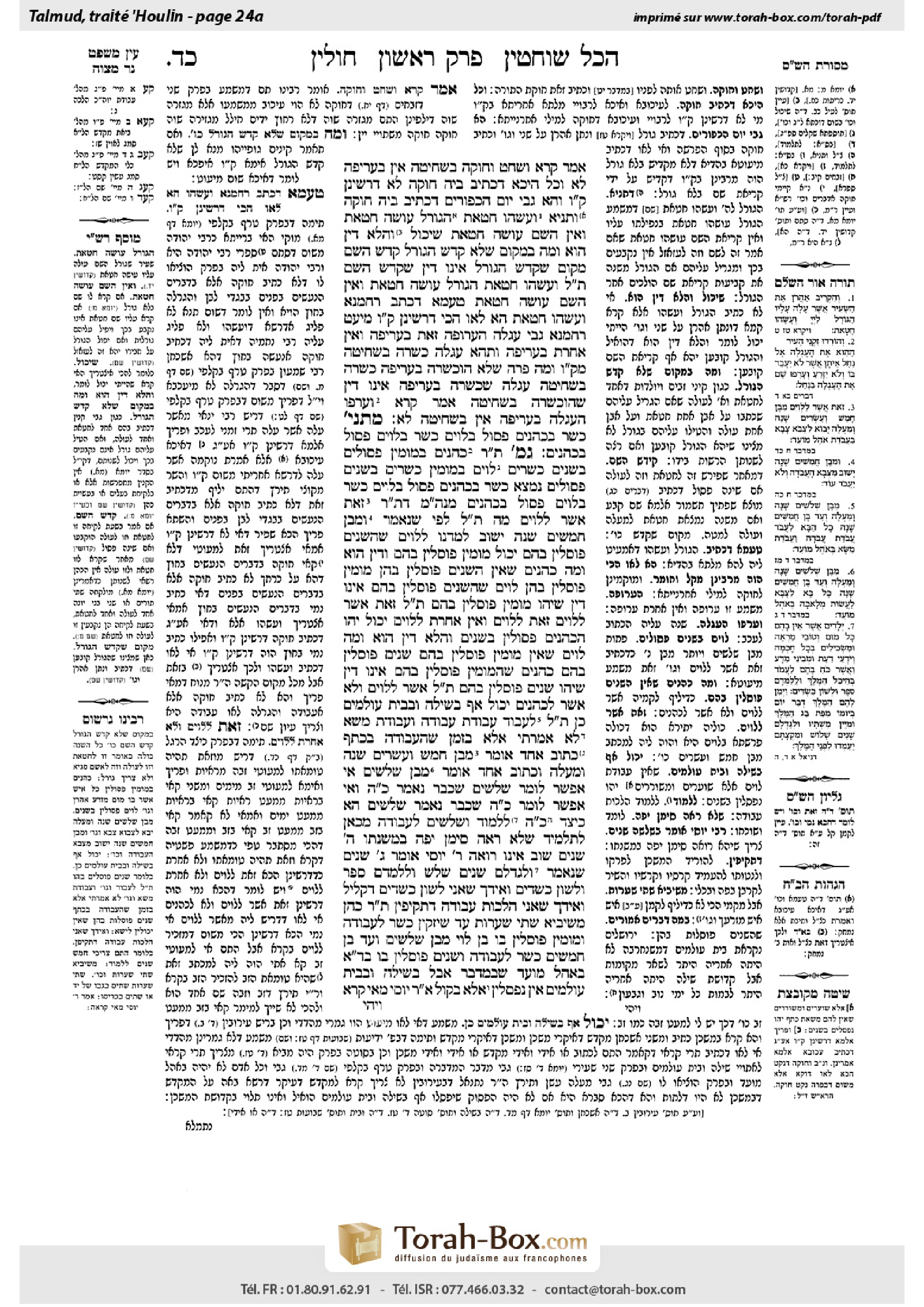
Chullin 24a: Talmud study for Daf Yomi
Study the Talmud for Daf Yomi with scanned pages, Hebrew text, English translations from Sefaria and AI-generated French translations.
Passage selection and English or AI-generated French translation are available where the scan has annotations. Daf Study is independent of Torah-Box and Sefaria.
Browse Chullin · חולין · All tractatesChullin 24a text and translations
This page of Chullin includes the Aramaic text, an English translation and an AI-generated French translation, alongside the scan above.
חולין כ״ד א · Aramaic and Hebrew text
אָמַר קְרָא ״וְשָׁחַט״ וְחוּקָּה: בִּשְׁחִיטָה אִין, בַּעֲרִיפָה לָא.
וְכֹל הֵיכָא דִּכְתִיב בֵּיהּ חוּקָּה, לָא דָּרְשִׁינַן קַל וָחוֹמֶר? וְהָא גַּבֵּי יוֹם הַכִּפּוּרִים, דִּכְתִיב בֵּיהּ חוּקָּה, וְתַנְיָא: ״וְעָשָׂהוּ חַטָּאת״ – הַגּוֹרָל עוֹשֶׂה חַטָּאת, וְאֵין הַשֵּׁם עוֹשֶׂה חַטָּאת.
שֶׁיָּכוֹל, וַהֲלֹא דִּין הוּא: וּמָה בִּמְקוֹם שֶׁלֹּא קִדֵּשׁ הַגּוֹרָל, קִדֵּשׁ הַשֵּׁם, מְקוֹם שֶׁקִּדֵּשׁ הַגּוֹרָל, אֵינוֹ דִּין שֶׁקִּדֵּשׁ הַשֵּׁם? תַּלְמוּד לוֹמַר: ״וְעָשָׂהוּ חַטָּאת״, הַגּוֹרָל עוֹשֶׂה חַטָּאת, וְאֵין הַשֵּׁם עוֹשֶׂה חַטָּאת.
טַעְמָא דִּכְתַב רַחֲמָנָא ״וְעָשָׂהוּ חַטָּאת״, הָא לָאו הָכִי דָּרְשִׁינַן קַל וָחוֹמֶר!
מַיעֵט רַחֲמָנָא גַּבֵּי עֶגְלָה הָעֲרוּפָה, ״זֹאת״ בַּעֲרִיפָה, וְאֵין אַחֶרֶת בַּעֲרִיפָה.
וּתְהֵא עֶגְלָה כְּשֵׁרָה בִּשְׁחִיטָה מִקַּל וָחוֹמֶר: וּמָה פָּרָה שֶׁלֹּא הוּכְשְׁרָה בַּעֲרִיפָה – כְּשֵׁרָה בִּשְׁחִיטָה, עֶגְלָה שֶׁכְּשֵׁרָה בַּעֲרִיפָה – אֵינוֹ דִּין שֶׁהוּכְשְׁרָה בִּשְׁחִיטָה? אָמַר קְרָא: ״וְעָרְפוּ הָעֶגְלָה״ – בַּעֲרִיפָה אִין, בִּשְׁחִיטָה לָא.
מַתְנִי׳ כָּשֵׁר בַּכֹּהֲנִים פָּסוּל בַּלְוִיִּם, כָּשֵׁר בַּלְוִיִּם פָּסוּל בַּכֹּהֲנִים.
גְּמָ׳ תָּנוּ רַבָּנַן: כֹּהֲנִים, בְּמוּמִין – פְּסוּלִים, בְּשָׁנִים – כְּשֵׁרִים. לְוִיִּם, בְּמוּמִין – כְּשֵׁרִים, בְּשָׁנִים – פְּסוּלִים. נִמְצָא כָּשֵׁר בַּכֹּהֲנִים – פָּסוּל בַּלְוִיִּם, כָּשֵׁר בַּלְוִיִּם – פָּסוּל בַּכֹּהֲנִים.
מְנָא הָנֵי מִילֵּי? דְּתָנוּ רַבָּנַן: ״זֹאת אֲשֶׁר לַלְוִיִּם״ – מָה תַּלְמוּד לוֹמַר? לְפִי שֶׁנֶּאֱמַר: ״וּמִבֶּן חֲמִשִּׁים שָׁנָה יָשׁוּב״, לָמַדְנוּ לַלְוִיִּם שֶׁהַשָּׁנִים פּוֹסְלִין בָּהֶם. יָכוֹל מוּמִין פּוֹסְלִין בָּהֶם? וְדִין הוּא: וּמָה כֹּהֲנִים שֶׁאֵין הַשָּׁנִים פּוֹסְלִין בָּהֶן, מוּמִין פּוֹסְלִין בָּהֶן – לְוִיִּם שֶׁהַשָּׁנִים פּוֹסְלִין בָּהֶם, אֵינוֹ דִּין שֶׁיְּהוּ מוּמִין פּוֹסְלִין בָּהֶם? תַּלְמוּד לוֹמַר: ״זֹאת אֲשֶׁר לַלְוִיִּם״ – זֹאת לַלְוִיִּם, וְאֵין אַחֶרֶת לַלְוִיִּם.
יָכוֹל יְהוּ הַכֹּהֲנִים פְּסוּלִין בְּשָׁנִים? וַהֲלֹא דִּין הוּא: וּמָה לְוִיִּם שֶׁאֵין מוּמִין פּוֹסְלִין בָּהֶם – שָׁנִים פּוֹסְלִין בָּהֶם, כֹּהֲנִים שֶׁהַמּוּמִין פּוֹסְלִין בָּהֶם – אֵינוֹ דִּין שֶׁיְּהוּ שָׁנִים פּוֹסְלִין בָּהֶם? תַּלְמוּד לוֹמַר: ״אֲשֶׁר לַלְוִיִּם״ – וְלֹא אֲשֶׁר לַכֹּהֲנִים.
יָכוֹל אַף בְּשִׁילֹה וּבְבֵית עוֹלָמִים כֵּן? תַּלְמוּד לוֹמַר ״לַעֲבֹד עֲבֹדַת עֲבוֹדָה וַעֲבֹדַת מַשָּׂא״, לֹא אָמַרְתִּי אֶלָּא בִּזְמַן שֶׁהָעֲבוֹדָה בַּכָּתֵף.
כָּתוּב אֶחָד אוֹמֵר: ״מִבֶּן חָמֵשׁ וְעֶשְׂרִים שָׁנָה וָמַעְלָה״, וְכָתוּב אֶחָד אוֹמֵר: ״מִבֶּן שְׁלֹשִׁים״, אִי אֶפְשָׁר לוֹמַר שְׁלֹשִׁים, שֶׁכְּבָר נֶאֱמַר חָמֵשׁ וְעֶשְׂרִים, וְאִי אֶפְשָׁר לוֹמַר חָמֵשׁ וְעֶשְׂרִים, שֶׁכְּבָר נֶאֱמַר שְׁלֹשִׁים. הָא כֵּיצַד? חָמֵשׁ וְעֶשְׂרִים לְתַלְמוּד, וּשְׁלֹשִׁים לַעֲבוֹדָה.
מִכָּאן לְתַלְמִיד שֶׁלֹּא רָאָה סִימָן יָפֶה בְּמִשְׁנָתוֹ חָמֵשׁ שָׁנִים – שׁוּב אֵינוֹ רוֹאֶה. רַבִּי יוֹסֵי אוֹמֵר: שָׁלֹשׁ שָׁנִים, שֶׁנֶּאֱמַר: ״וּלְגַדְּלָם שָׁנִים שָׁלֹשׁ״, ״וּלְלַמְּדָם סֵפֶר וּלְשׁוֹן כַּשְׂדִּים״.
וְאִידַּךְ – שָׁאנֵי לְשׁוֹן כַּשְׂדִּים, דְּקַלִּיל. וְאִידַּךְ – שָׁאנֵי הִלְכוֹת עֲבוֹדָה, דְּתַקִּיפִין.
תָּנוּ רַבָּנַן: כֹּהֵן מִשֶּׁיָּבִיא שְׁתֵּי שְׂעָרוֹת עַד שֶׁיַּזְקִין – כָּשֵׁר לַעֲבוֹדָה, וּמוּמִין פּוֹסְלִין בּוֹ. בֶּן לֵוִי מִבֶּן שְׁלֹשִׁים וְעַד בֶּן חֲמִשִּׁים כָּשֵׁר לַעֲבוֹדָה, וְשָׁנִים פּוֹסְלִין בּוֹ. בַּמֶּה דְּבָרִים אֲמוּרִים? בְּאֹהֶל מוֹעֵד שֶׁבַּמִּדְבָּר, אֲבָל בְּשִׁילֹה וּבְבֵית עוֹלָמִים אֵין נִפְסָלִין אֶלָּא בְּקוֹל. אָמַר רַבִּי יוֹסֵי: מַאי קְרָא?
Chullin 24a · English translation
The Gemara answers that the verse states with regard to the red heifer: “And he shall slaughter it” (Numbers 19:3), and it mentions the term statute: “This is the statute of the Torah” (Numbers 19:2), indicating that with slaughter, yes, the red heifer is rendered fit; with breaking the neck, the red heifer is not rendered fit.
The Gemara asks: And is it so that anywhere that statute is written with regard to a certain matter, we do not learn an a fortiori inference? But what about Yom Kippur, with regard to which statute is written: “And this shall be an everlasting statute unto you” (Leviticus 16:34), and nevertheless it is taught in a baraita: “And Aaron shall bring forward the goat upon which the lot came up for the Lord, and he shall offer it for a sin offering” (Leviticus 16:9). The verse indicates that the lottery renders the goat a sin offering, but a verbal designation of the goat with the status of a sin offering does not render it a sin offering.
The baraita continues: A verse is necessary to teach this halakha, as one might have thought that the opposite conclusion is correct: Could this not be derived through an a fortiori inference: If in a case where the lottery does not sanctify the animal with a specific designation, such as in the case of two birds brought by a woman after childbirth, and nevertheless a verbal designation of that offering sanctifies it, in a case where the lottery sanctifies the animal on Yom Kippur, isn’t it logical that a verbal designation as a sin offering sanctifies it? Therefore, the verse states: “And render it a sin offering;” the lottery renders the goat a sin offering, but a verbal designation of a sin offering does not render the goat a sin offering.
The Gemara infers: The reason that the a fortiori inference is not learned is that the Merciful One writes: “And he shall offer it for a sin offering.” But otherwise we would learn an a fortiori inference, despite the fact that statute is written with regard to the Yom Kippur service.
The Gemara explains: Actually, one may learn an a fortiori inference even in a case where statute is written. Nevertheless, with regard to the heifer whose neck is broken, the Merciful One restricts the use of breaking the neck: “And all the Elders of that city…shall wash their hands over the heifer whose neck is broken” (Deuteronomy 21:6). From the relative pronoun “whose” it is derived: This heifer is killed by breaking the neck, but no other, i.e., the red heifer, is killed by breaking the neck.
The Gemara challenges: And let it be derived that the heifer whose neck is broken is rendered fit with slaughter by means of an a fortiori inference: If a red heifer, which is not rendered fit with breaking the neck, is rendered fit with slaughter, then with regard to a heifer whose neck is broken, which is rendered fit with breaking the neck, isn’t it logical that it is rendered fit with slaughter? The Gemara responds that the verse states: “And shall break the neck of the heifer there in the valley” (Deuteronomy 21:4). The doubled reference to breaking the neck in the two verses indicates that by breaking the neck, yes, the heifer may be killed; by slaughter, the heifer may not be killed.
MISHNA: There is an element with which priests remain fit and Levites are unfit, and there is also an element with which Levites remain fit and priests are unfit.
GEMARA: The Sages taught in a baraita in explanation of the mishna: Priests are rendered unfit for Temple service with the blemishes enumerated in the Torah (see Leviticus 21:16–23), but remain fit with the passage of years, as from the moment that they reach majority they are fit for service for the rest of their lives. Levites remain fit for Temple service with the blemishes enumerated in the Torah but are unfit with the passage of years, as they are fit for service only between the ages of thirty and fifty (see Numbers 4:47). It is found that there is an element with which priests remain fit and Levites are unfit, and there is an element with which Levites remain fit and priests are unfit.
The Gemara asks: From where are these matters derived? The Gemara answers: It is as the Sages taught in a baraita: “This is that which pertains to the Levites” (Numbers 8:24); why must the verse state this? Since it is stated: “And from the age of fifty years he shall return from the service” (Numbers 8:25), we learned with regard to the Levites that the passage of years disqualifies them. One might have thought that blemishes disqualify them too. And ostensibly, it could be learned through logical inference: If priests, with regard to whom the passage of years does not disqualify them, blemishes disqualify them, then in the case of Levites, with regard to whom the passage of years disqualifies them, isn’t it logical that blemishes disqualify them? Therefore, the verse states: “This is that which pertains to the Levites,” from which it is derived: “This,” the passage of years, is a disqualification that pertains to the Levites, and there is no other disqualification that pertains to the Levites.
One might have thought that priests would be disqualified with the passage of years. And ostensibly, could this not be derived through the following a fortiori inference: If Levites, with regard to whom blemishes do not disqualify them, the passage of years disqualifies them, then in the case of priests, with regard to whom blemishes disqualify them, isn’t it logical that the passage of years disqualifies them? Therefore, the verse states: “Which pertains to the Levites,” and not which pertains to the priests.
One might have thought that the Levites were disqualified with the passage of years even in Shiloh, the permanent place of the Tabernacle, and in the eternal Temple. Therefore, the verse states: “To perform the work of service, and the work of bearing burdens” (Numbers 4:47), juxtaposing the two forms of Levite service to teach: I stated the disqualification of the passage of years only at a time when there is Levite service involving carrying the Tabernacle on their shoulders.
The baraita notes that one verse states: “From twenty-five years old and upward” (Numbers 8:24), and one verse states: “From thirty years old and upward” (Numbers 4:47). It is impossible to say thirty, as twenty-five is already stated, and it is impossible to say twenty-five, as thirty is already stated. How can these verses be reconciled? Twenty-five years old is the time for apprenticeship and thirty for service.
From here it is derived that a student who did not see a positive indication in his studies after five years will no longer see a productive result from those studies. Rabbi Yosei says that the period is three years, as it is stated with regard to Daniel and his cohort who instructed the king of Babylonia: “And they should be raised three years” (Daniel 1:5), “and he should teach them the books and the language of the Chaldeans” (Daniel 1:4).
The Gemara asks: And how does the other tanna explain the verses in Daniel? The Gemara answers: He holds that the verses in Daniel cannot be cited as a source for this principle because the language of the Chaldeans is different, as it is easy and can be learned in a shorter period. The Gemara asks: And how does the other tanna, Rabbi Yosei, explain the verses with regard to the Levites? The Gemara answers: He holds that the halakhot of Temple service are different, as they are difficult and require a longer period of study.
The Sages taught in a baraita: A priest, from the time he reaches puberty and grows two pubic hairs until he ages, is fit for Temple service, and blemishes disqualify him. A Levite from the age of thirty until the age of fifty is fit for Temple service, and the passage of years disqualifies him. In what case is this statement said? It is said with regard to the Tent of Meeting of the Tabernacle in the wilderness. But with regard to Shiloh and in the eternal Temple, Levites are disqualified only due to a change in voice that renders them unable to recite the songs in the Temple with their brethren. Rabbi Yosei said: What is the verse from which this is derived?
Chullin 24a · Traduction française (IA)
La Guemara répond que la parabole mentionne concernant la vache rouge : « Et il le sacrifiera » (Nombres 19:3), et elle mentionne le terme « statut » : « C’est le statut de la Torah » (Nombres 19:2), indiquant que par le sacrifice, oui, la vache rouge devient propre ; par la décapitation, la vache rouge ne devient pas propre.
La Guemara pose la question : Et est-ce que partout où un statut est écrit concernant une certaine affaire, nous ne tirons pas une inférence a fortiori ? Mais qu’en est-il du Yom Kippur, concernant lequel un statut est écrit : « Et cela sera un statut éternel pour vous » (Lévitique 16:34), et pourtant il est enseigné dans une baraïta : « Et Aaron présentera le bouc sur lequel le sort est tombé pour l’Éternel, et il l’offrira en sacrifice expiatoire » (Lévitique 16:9). La parabole indique que le sort rend le bouc un sacrifice expiatoire, mais une désignation verbale du bouc avec le statut de sacrifice expiatoire ne le rend pas un sacrifice expiatoire.
La baraïta continue : un verset est nécessaire pour enseigner cette halakha, car on pourrait avoir pensé que la conclusion opposée est correcte : pourrait-on ne pas en déduire une inférence a fortiori : Si dans un cas où le sort ne sanctifie pas l’animal avec une désignation spécifique, comme dans le cas des deux oiseaux offerts par une femme après l’accouchement, et pourtant une désignation verbale de cette offrande sanctifie, dans un cas où le sort sanctifie l’animal au Yom Kippur, n’est-ce pas logique que la désignation verbale en tant que sacrifice expiatoire sanctifie ? Par conséquent, le verset dit : « Et il le rendra un sacrifice expiatoire » ; le sort rend le bouc un sacrifice expiatoire, mais une désignation verbale en tant que sacrifice expiatoire ne rend pas le bouc un sacrifice expiatoire.
La Guemara déduit : La raison pour laquelle l’inférence a fortiori n’est pas tirée est que l’Éternel écrit : « Et il l’offrira en sacrifice expiatoire. » Mais autrement nous aurions tiré une inférence a fortiori, malgré le fait que la loi est écrite concernant le service du Yom Kippur.
La Guemara explique : En réalité, on peut tirer une inférence a fortiori même dans un cas où la loi est écrite. Cependant, concernant la vache dont le cou est brisé, l’Éternel limite l’usage de la décapitation : « Et tous les anciens de cette ville… laveront leurs mains sur la vache dont le cou est brisé » (Deutéronome 21:6). À partir du pronom relatif « dont », on déduit : cette vache est tuée par la décapitation, mais pas une autre, c’est-à-dire la vache rouge, n’est tuée par la décapitation.
La Guemara conteste : Et permettez que cela soit déduit que la vache dont le cou est brisé est rendue propre par le sacrifice par une inférence a fortiori : Si une vache rouge, qui n’est pas rendue propre par la décapitation, est rendue propre par le sacrifice, alors concernant une vache dont le cou est brisé, qui est rendue propre par la décapitation, n’est-ce pas logique qu’elle soit rendue propre par le sacrifice ? La Guemara répond que le verset dit : « Et il brisera le cou de la vache là-bas dans le vallon » (Deutéronome 21:4). La double mention de la décapitation dans les deux versets indique que par la décapitation, oui, la vache peut être tuée ; par le sacrifice, la vache ne peut pas être tuée.
MICHNA : Il y a un élément avec lequel les prêtres restent propres et les Lévites sont impurs, et il y a aussi un élément avec lequel les Lévites restent propres et les prêtres sont impurs.
GUEMARA : Les Sages ont enseigné dans une baraïta en explication de la mishna : les prêtres sont rendus impurs pour le service du Temple avec les défauts énumérés dans la Torah (voir Lévitique 21:16–23), mais restent propres avec le passage des années, car dès le moment où ils atteignent l’âge adulte, ils sont propres pour le service pour le reste de leur vie. Les Lévites restent propres pour le service du Temple avec les défauts énumérés dans la Torah mais sont impurs avec le passage des années, car ils sont propres pour le service seulement entre les âges de trente et cinquante (voir Nombres 4:47). On trouve que il y a un élément avec lequel les prêtres restent propres et les Lévites sont impurs, et il y a aussi un élément avec lequel les Lévites restent propres et les prêtres sont impurs.
La Guemara pose la question : D’où sont dérivés ces enseignements ? La Guemara répond : C’est comme les Sages ont enseigné dans une baraïta : « C’est ce qui concerne les Lévites » (Nombres 8:24) ; pourquoi le verset doit-il mentionner cela ? Parce qu’il est dit : « Et à l’âge de cinquante ans, il rentrera du service » (Nombres 8:25), nous avons appris concernant les Lévites que le passage des années les disqualifie. On pouvait penser que les défauts les disqualifiaient aussi. Et apparemment, cela pourrait être déduit par une inférence logique : Si les prêtres, concernant lesquels le passage des années ne les disqualifie pas, les défauts les disqualifient, alors dans le cas des Lévites, concernant lesquels le passage des années les disqualifie, n’est-ce pas logique que les défauts les disqualifient ? Par conséquent, le verset dit : « C’est ce qui concerne les Lévites », d’où on déduit : « Cela », le passage des années, est une disqualification qui concerne les Lévites, et il n’y a pas d’autre disqualification qui concerne les Lévites.
On pouvait penser que les prêtres étaient disqualifiés par le passage des années. Et apparemment, pourrait-on ne pas déduire cela par l’inférence a fortiori suivante : Si les Lévites, concernant lesquels les défauts ne les disqualifient pas, le passage des années les disqualifie, alors dans le cas des prêtres, concernant lesquels les défauts les disqualifient, n’est-ce pas logique que le passage des années les disqualifie ? Par conséquent, le verset dit : « Qui concerne les Lévites », et non celui qui concerne les prêtres.
On pouvait penser que les Lévites étaient disqualifiés par le passage des années même à Shiloh, le lieu permanent du Tabernacle, et dans le temple éternel. Par conséquent, le verset dit : « Pour accomplir le travail du service, et le travail du portage » (Nombres 4:47), juxtaposant les deux formes de service des Lévites pour enseigner : J’ai dit que la disqualification du passage des années n’est valable qu’à un moment où il y a un service des Lévites impliquant le portage du Tabernacle sur leurs épaules.
La baraïta indique que l'une des paroles divines dit : « À partir de vingt-cinq ans et au-delà » (Nombres 8:24), et l'autre dit : « À partir de trente ans et au-delà » (Nombres 4:47). Il est impossible de dire trente, car vingt-cinq est déjà mentionné, et il est impossible de dire vingt-cinq, car trente est déjà évoqué. Comment ces versets peuvent-ils être conciliés ? Vingt-cinq ans est l'âge de l'apprentissage et trente celui du service.
D'où l'on déduit que l'étudiant qui n'a pas constaté un signe positif dans ses études après cinq ans ne verra plus aucun résultat productif de ces études. Rabbi Yosei dit que la période est de trois ans, car il est dit concernant Daniel et son groupe qui instruisaient le roi de Babylone : « Et ils devaient être élevés trois ans » (Daniel 1:5), « et il devait leur enseigner les livres et la langue des Chaldéens » (Daniel 1:4).
La Guemara demande : Et comment l'autre tanna explique-t-il les versets de Daniel ? La Guemara répond : Il considère que les versets de Daniel ne peuvent pas être cités comme source de ce principe, car la langue des Chaldéens est différente, car elle est facile à apprendre et peut être maîtrisée en un temps plus court. La Guemara demande : Et comment l'autre tanna, Rabbi Yosei, explique-t-il les versets concernant les Lévites ? La Guemara répond : Il considère que les halakhot du service du Temple sont différentes, car elles sont difficiles et nécessitent une période d'étude plus longue.
Les Sages enseignèrent dans une baraïta : Un prêtre, dès qu'il atteint l'adolescence et qu'il développe deux poils pubiens jusqu'à son âge avancé, est digne de service dans le Temple, et les taches le disqualifient. Un Lévi, du âge de trente ans jusqu'à celui de cinquante ans, est digne de service dans le Temple, et l'âge avancé le disqualifie. Dans quel cas cette déclaration est-elle faite ? Elle est faite concernant la Tente de Rencontre du Tabernacle dans le désert. Mais concernant Shiloh et le Temple éternel, les Lévis sont disqualifiés uniquement en raison d'un changement de voix qui les rend incapables de chanter avec leurs frères dans le Temple. Rabbi Yosei dit : De quelle verset cette déduction est-elle tirée ?
Traduction française générée par IA à partir de l’édition anglaise de Sefaria. Vérifie toujours un passage avec le texte source.
Text from Sefaria: William Davidson Edition - Vocalized Aramaic (unknown); William Davidson Edition - English (CC BY NC).