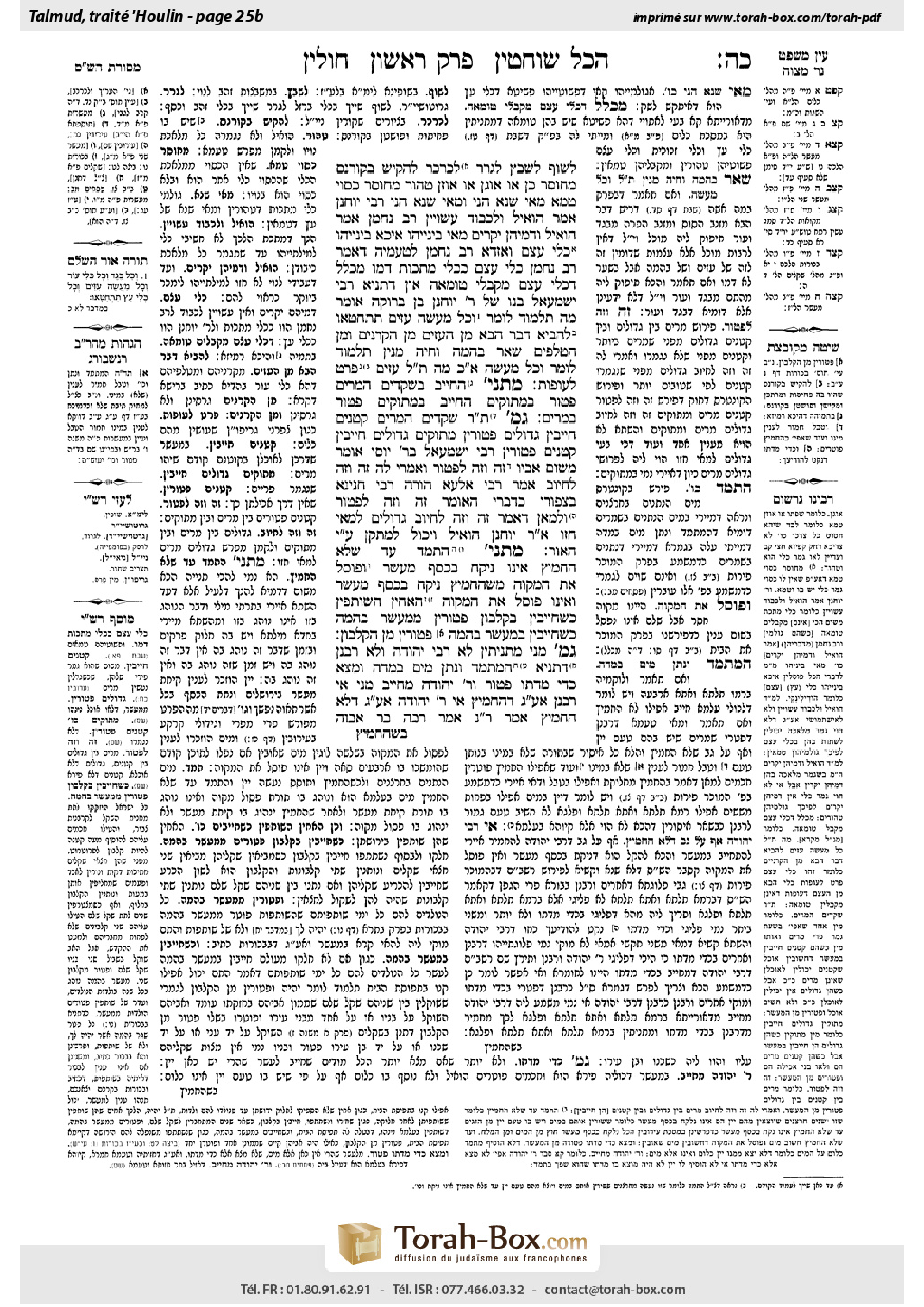
Chullin 25b: Talmud study for Daf Yomi
Study the Talmud for Daf Yomi with scanned pages, Hebrew text, English translations from Sefaria and AI-generated French translations.
Passage selection and English or AI-generated French translation are available where the scan has annotations. Daf Study is independent of Torah-Box and Sefaria.
Browse Chullin · חולין · All tractatesChullin 25b text and translations
This page of Chullin includes the Aramaic text, an English translation and an AI-generated French translation, alongside the scan above.
חולין כ״ה ב · Aramaic and Hebrew text
לָשׁוּף, לְשַׁבֵּץ, לְגָרֵר, לְכַרְכֵּר, לְהַקִּישׁ בְּקוּרְנָס. מְחוּסָּר כַּן אוֹ אוֹגֶן אוֹ אוֹזֶן – טָהוֹר, מְחוּסָּר כְּסוּי – טָמֵא.
מַאי שְׁנָא הָנֵי וּמַאי שְׁנָא הָנֵי? רַבִּי יוֹחָנָן אָמַר: הוֹאִיל וּלְכָבוֹד עֲשׂוּיִין. רַב נַחְמָן אָמַר: הוֹאִיל וּדְמֵיהֶן יְקָרִים.
מַאי בֵּינַיְיהוּ? אִיכָּא בֵּינַיְיהוּ כְּלֵי עֶצֶם, וְאַזְדָּא רַב נַחְמָן לְטַעְמֵיהּ, דְּאָמַר רַב נַחְמָן: כְּלֵי עֶצֶם כִּכְלֵי מַתָּכוֹת דָּמוּ.
מִכְּלָל דִּכְלֵי עֶצֶם מְקַבְּלִי טוּמְאָה? אִין, דְּתַנְיָא: רַבִּי יִשְׁמָעֵאל בְּנוֹ שֶׁל רַבִּי יוֹחָנָן בֶּן בְּרוֹקָה אוֹמֵר: מָה תַּלְמוּד לוֹמַר ״וְכׇל מַעֲשֵׂה עִזִּים תִּתְחַטָּאוּ״? לְהָבִיא דָּבָר הַבָּא מִן הָעִזִּים, מִן הַקַּרְנַיִם וּמִן הַטְּלָפַיִם. שְׁאָר בְּהֵמָה וְחַיָּה מִנַּיִן? תַּלְמוּד לוֹמַר ״וְכׇל מַעֲשֵׂה״. אִם כֵּן, מָה תַּלְמוּד לוֹמַר ״עִזִּים״? פְּרָט לְעוֹפוֹת.
מַתְנִי׳ הַחַיָּיב בִּשְׁקֵדִים הַמָּרִים – פָּטוּר בַּמְּתוּקִים, הַחַיָּיב בַּמְּתוּקִים – פָּטוּר בַּמָּרִים.
גְּמָ׳ תָּנוּ רַבָּנַן: שְׁקֵדִים הַמָּרִים, קְטַנִּים – חַיָּיבִין, גְּדוֹלִים – פְּטוּרִין. מְתוּקִים, גְּדוֹלִים – חַיָּיבִין, קְטַנִּים – פְּטוּרִין.
רַבִּי יִשְׁמָעֵאל בְּרַבִּי יוֹסֵי אוֹמֵר מִשּׁוּם אָבִיו: זֶה וָזֶה לִפְטוּר, וְאָמְרִי לַהּ: זֶה וָזֶה לְחִיּוּב. אָמַר רַבִּי אִלְעָא: הוֹרָה רַבִּי חֲנִינָא בְּצִפּוֹרִי כְּדִבְרֵי הָאוֹמֵר זֶה וָזֶה לִפְטוּר.
וּלְמַאן דְּאָמַר זֶה וָזֶה לְחִיּוּב, גְּדוֹלִים לְמַאי חֲזוּ? אָמַר רַבִּי יוֹחָנָן: הוֹאִיל וְיָכוֹל לְמַתְּקָן עַל יְדֵי הָאוּר.
מַתְנִי׳ הַתֶּמֶד, עַד שֶׁלֹּא הֶחְמִיץ – אֵינוֹ נִיקָּח בְּכֶסֶף מַעֲשֵׂר, וּפוֹסֵל אֶת הַמִּקְוֶה. מִשֶּׁהֶחְמִיץ – נִיקָּח בְּכֶסֶף מַעֲשֵׂר, וְאֵינוֹ פּוֹסֵל אֶת הַמִּקְוֶה.
הָאַחִין הַשּׁוּתָּפִין, כְּשֶׁחַיָּיבִין בַּקָּלְבּוֹן – פְּטוּרִין מִמַּעְשַׂר בְּהֵמָה; כְּשֶׁחַיָּיבִין בְּמַעְשַׂר בְּהֵמָה – פְּטוּרִין מִן הַקָּלְבּוֹן.
גְּמָ׳ מַנִּי מַתְנִיתִין? לָא רַבִּי יְהוּדָה וְלָא רַבָּנַן, דְּתַנְיָא: הַמְתַמֵּד וְנָתַן מַיִם בַּמִּדָּה וּמָצָא כְּדֵי מִדָּתוֹ – פָּטוּר, וְרַבִּי יְהוּדָה מְחַיֵּיב.
מַנִּי? אִי רַבָּנַן – אַף עַל גַּב דְּהֶחְמִיץ, אִי רַבִּי יְהוּדָה – אַף עַל גַּב דְּלֹא הֶחְמִיץ! אָמַר רַב נַחְמָן אָמַר רַבָּה בַּר אֲבוּהּ:
Chullin 25b · English translation
to smooth, to set gems or ornaments in it, to plane it, to adorn it, to strike it with a hammer, or if it is lacking a base or a rim or a handle, the vessel is not susceptible to impurity. If the vessel was complete and was lacking a cover, the vessel is susceptible to becoming impure.
The Gemara asks: What is different about these unfinished wooden vessels, with regard to which the halakha is that provided they are fit for use they are susceptible to impurity, and what is different about those unfinished metal vessels, with regard to which the halakha is that even if they are fit for use they are not susceptible to impurity until their crafting is complete? Rabbi Yoḥanan said: The difference is that since metal vessels are crafted for uses of honor, they are not considered vessels until their completion. Rav Naḥman said: The difference is that since the worth of metal vessels is expensive, they cannot be sold at that price unless they are complete.
The Gemara asks: What is the practical difference between their opinions? The Gemara answers: The difference between them is with regard to bone vessels crafted from horns, which are expensive but are not crafted for uses of honor. And Rav Naḥman follows his line of reasoning, as Rav Naḥman says: The halakhic status of bone vessels with regard to impurity is like that of metal vessels.
The Gemara asks: Is that to say by inference that bone vessels are susceptible to ritual impurity? The Gemara answers: Yes, as it is taught in a baraita that Rabbi Yishmael, son of Rabbi Yoḥanan ben Beroka, says: What is the meaning when the verse states: “And all work of goats…you shall purify” (Numbers 31:20)? It is to include vessels that come from the goats, from the horns and from the hooves, and indicate that they are susceptible to impurity. And from where is it derived that vessels that come from the horns and the hooves of other domesticated animals and undomesticated animals are susceptible to impurity? It is derived from the verse, as the verse states: “And all work,” where the term “all” is an amplification. If so, why must the verse state: “Goats?” It serves to exclude birds, as vessels crafted from the bones of birds are not susceptible to impurity.
MISHNA: With regard to the obligation of separating teruma and tithes, the stage of development that is obligated in bitter almonds is exempt in sweet almonds; and the stage in development that is obligated in sweet almonds is exempt in bitter almonds.
GEMARA: The Sages taught in explanation of the mishna: In the case of bitter almonds, when they are small one is obligated to separate teruma and tithes, as they are not yet bitter and are fit for consumption; when they are large one is exempt from separating teruma and tithes, because they are bitter and unfit for consumption. In the case of sweet almonds, when they are large one is obligated to separate teruma and tithes, because the almonds are ripe and fit for consumption; when they are small one is exempt from separating teruma and tithes, because they are not fit for consumption.
With regard to bitter almonds, Rabbi Yishmael, son of Rabbi Yosei, says in the name of his father to exempt both this small almond and that large almond. And some say to obligate both this small almond and that large almond. Rabbi Ela said: Rabbi Ḥanina issued a ruling in Tzippori in accordance with the statement of the one who says to exempt both this small almond and that large almond.
The Gemara asks: And according to the one who says to obligate both this small almond and that large almond, for what use are the large almonds fit? They are bitter and unfit for consumption. Rabbi Yoḥanan said: Since one can sweeten them by means of roasting them on the fire, this renders them fit for consumption.
MISHNA: Temed, a beverage produced from grape residue soaked in water, until it fermented, may not be purchased with second-tithe money to be drunk in Jerusalem, because it is not wine. And if three log of it fall into a ritual bath, its halakhic status is that of drawn water and it invalidates the ritual bath. Once it fermented, it is wine, and therefore it may be purchased with second-tithe money and it does not invalidate the ritual bath.
With regard to brothers who are partners in the inheritance of their father, when they are obligated to add the premium [kalbon] to their annual half-shekel payment to the Temple, they are exempt from animal tithe; when they are obligated to separate animal tithe, they are exempt from adding the premium. Partners who pay the half-shekel are required to add the premium and are exempt from animal tithe. If they are not true partners, but their inheritance remains the property of the father, the sons are exempt from paying the premium, and they are obligated to separate animal tithe.
GEMARA: With regard to temed, the Gemara asks: Whose opinion is expressed in the mishna? Ostensibly, it is neither the opinion of Rabbi Yehuda nor the opinion of the Rabbis, as it is taught in a mishna (Ma’asrot 5:6): With regard to one who prepares temed by placing water over grape byproducts, and he placed a certain measure of water, and when measuring the finished product he found its measure equivalent to the measure of water that he placed, he is exempt from the obligation of tithing it, as although it tastes like wine, there is nothing in it but water. And Rabbi Yehuda obligates him to tithe it because the taste determines that it is wine.
Whose opinion is expressed in the mishna? If it is the opinion of the Rabbis, then if there is no more than the initial measure of water that he placed, he should be exempt even if it fermented. If it is the opinion of Rabbi Yehuda, he holds that one is obligated even if it did not ferment, as taste is his sole criterion. Rav Naḥman said that Rabba bar Avuh said:
Chullin 25b · Traduction française (IA)
Pour l'aplatir, pour y placer des pierres ou des ornements, pour le raboter, pour le décorer, pour le frapper avec un marteau, ou si le récipient manque de base, de bord ou de manche, le récipient n'est pas sujet à la souillure. Si le récipient était complet et manquait d'un couvercle, le récipient est sujet à la souillure.
Le Guemara pose la question : Quelle est la différence entre ces récipients en bois incomplets, concernant lesquels la halakha est que s'ils sont aptes à l'usage ils sont sujets à la souillure, et quelle est la différence entre ces récipients en métal incomplets, concernant lesquels la halakha est que même s'ils sont aptes à l'usage ils ne sont pas sujets à la souillure jusqu'à ce qu'ils soient achevés ? Rabbi Yoḥanan a dit : La différence est que puisque les récipients en métal sont façonnés pour des usages d'honneur, ils ne sont pas considérés comme des récipients avant leur achèvement. Rav Naḥman a dit : La différence est que puisque les récipients en métal sont coûteux, ils ne peuvent être vendus à ce prix qu'une fois achevés.
Le Guemara pose la question : Quelle est la différence pratique entre leurs opinions ? Le Guemara répond : La différence entre eux concerne les récipients en os façonnés à partir de cornes, qui sont coûteux mais ne sont pas façonnés pour des usages d'honneur. Et Rav Naḥman suit cette ligne de raisonnement, car Rav Naḥman dit : Le statut halakhique des récipients en os en ce qui concerne la souillure est comme celui des récipients en métal.
Le Guemara pose la question : Est-ce que cela signifie par déduction que les récipients en os sont sujets à la souillure rituelle ? Le Guemara répond : Oui, car il est enseigné dans une baraïta que Rabbi Yishmael, fils de Rabbi Yoḥanan ben Beroka, dit : Quelle est la signification lorsque la Parashia dit : « Et toute œuvre de boucs… vous purifierez » (Nombres 31:20) ? C'est pour inclure les récipients provenant des boucs, des cornes et des sabots, et indiquer qu'ils sont sujets à la souillure. Et d'où est tiré le fait que les récipients provenant des cornes et des sabots des animaux domestiques et des animaux sauvages sont sujets à la souillure ? C'est tiré de la Parashia, car la Parashia dit : « Et toute œuvre », où le terme « toute » est une amplification. Si tel est le cas, pourquoi la Parashia dit-elle : « De boucs » ? Cela sert à exclure les oiseaux, car les récipients faits des os d'oiseaux ne sont pas sujets à la souillure.
MICHNA : En ce qui concerne l'obligation de séparer la terouma et les dîmes, la phase de développement qui est obligée pour les amandes amères est exemptée pour les amandes douces ; et la phase de développement qui est obligée pour les amandes douces est exemptée pour les amandes amères.
GUEMARA : Les Sages ont enseigné en explication de la mishna : En ce qui concerne les amandes amères, lorsque elles sont petites, on est obligé de séparer la terouma et les dîmes, car elles ne sont pas encore amères et sont aptes à la consommation ; lorsque elles sont grandes, on est exempté de séparer la terouma et les dîmes, car elles sont amères et inaptes à la consommation. En ce qui concerne les amandes douces, lorsque elles sont grandes, on est obligé de séparer la terouma et les dîmes, car les amandes sont mûres et aptes à la consommation ; lorsque elles sont petites, on est exempté de séparer la terouma et les dîmes, car elles ne sont pas aptes à la consommation.
En ce qui concerne les amandes amères, Rabbi Yishmael, fils de Rabbi Yosei, dit en nom de son père pour exempter à la fois cette amande petite et celle grande. Et certains disent pour obliger à la fois cette amande petite et celle grande. Rabbi Ela a dit : Rabbi Ḥanina a rendu un jugement à Tzippori selon l'avis de celui qui dit d'exempter à la fois cette amande petite et celle grande.
Le Guemara pose la question : Et selon celui qui dit d'obliger à la fois cette amande petite et celle grande, à quel usage les amandes grandes sont-elles aptes ? Elles sont amères et inaptes à la consommation. Rabbi Yoḥanan a dit : Puisqu'on peut les rendre douces en les grillant sur le feu, cela les rend aptes à la consommation.
MICHNA : Le temed, un breuvage produit à partir des résidus de raisin imbibés d'eau jusqu'à leur fermentation, ne peut pas être acheté avec les fonds de la deuxième dîme pour être bu à Jérusalem, car il n'est pas du vin. Et si trois log de ce breuvage tombent dans un mikvé, son statut halakhique est celui de l'eau tirée et il invalide le mikvé. Une fois qu'il a fermenté, il est du vin, et par conséquent il peut être acheté avec les fonds de la deuxième dîme et il ne invalide pas le mikvé.
En ce qui concerne les frères qui sont partenaires dans l'héritage de leur père, lorsqu'ils sont obligés d'ajouter le prix de rachat à leur paiement annuel de moitié de shekel pour le Temple, ils sont exemptés de la dîme d'animal ; lorsqu'ils sont obligés de séparer la dîme d'animal, ils sont exemptés d'ajouter le prix de rachat. Les partenaires qui paient la moitié de shekel sont tenus d'ajouter le prix de rachat et sont exemptés de la dîme d'animal. Si ce ne sont pas des partenaires véritables, mais que l'héritage reste la propriété du père, les fils sont exemptés de payer le prix de rachat et sont obligés de séparer la dîme d'animal.
GUEMARA : En ce qui concerne le temed, le Guemara pose la question : Quel est l'avis exprimé dans la mishna ? Apparemment, ce n'est ni l'avis de Rabbi Yehuda ni celui des Sages, car il est enseigné dans une mishna (Ma’asrot 5:6) : En ce qui concerne celui qui prépare le temed en plaçant de l'eau sur les résidus de raisin, et il a mis une certaine mesure d'eau, et lorsqu'il mesure le produit fini il trouve sa mesure équivalente à la mesure d'eau qu'il a mis, il est exempt de l'obligation de le titrer, car bien qu'il ait le goût du vin, il n'y a rien dedans que de l'eau. Et Rabbi Yehuda oblige à le titrer car le goût détermine qu'il est du vin.
Quel est l'avis exprimé dans la mishna ? Si c'est l'avis des Sages, alors si ce n'est pas plus que la mesure initiale d'eau qu'il a mise, il devrait être exempt même s'il a fermenté. Si c'est l'avis de Rabbi Yehuda, il considère qu'on est obligé même s'il n'a pas fermenté, car le goût est son seul critère. Rav Naḥman a dit que Rabba bar Avuh a dit :
Traduction française générée par IA à partir de l’édition anglaise de Sefaria. Vérifie toujours un passage avec le texte source.
Text from Sefaria: William Davidson Edition - Vocalized Aramaic (unknown); William Davidson Edition - English (CC BY NC).