Chullin 26a: Talmud study for Daf Yomi
Study the Talmud for Daf Yomi with scanned pages, Hebrew text, English translations from Sefaria and AI-generated French translations.
Passage selection and English or AI-generated French translation are available where the scan has annotations. Daf Study is independent of Torah-Box and Sefaria.
Browse Chullin · חולין · All tractatesChullin 26a text and translations
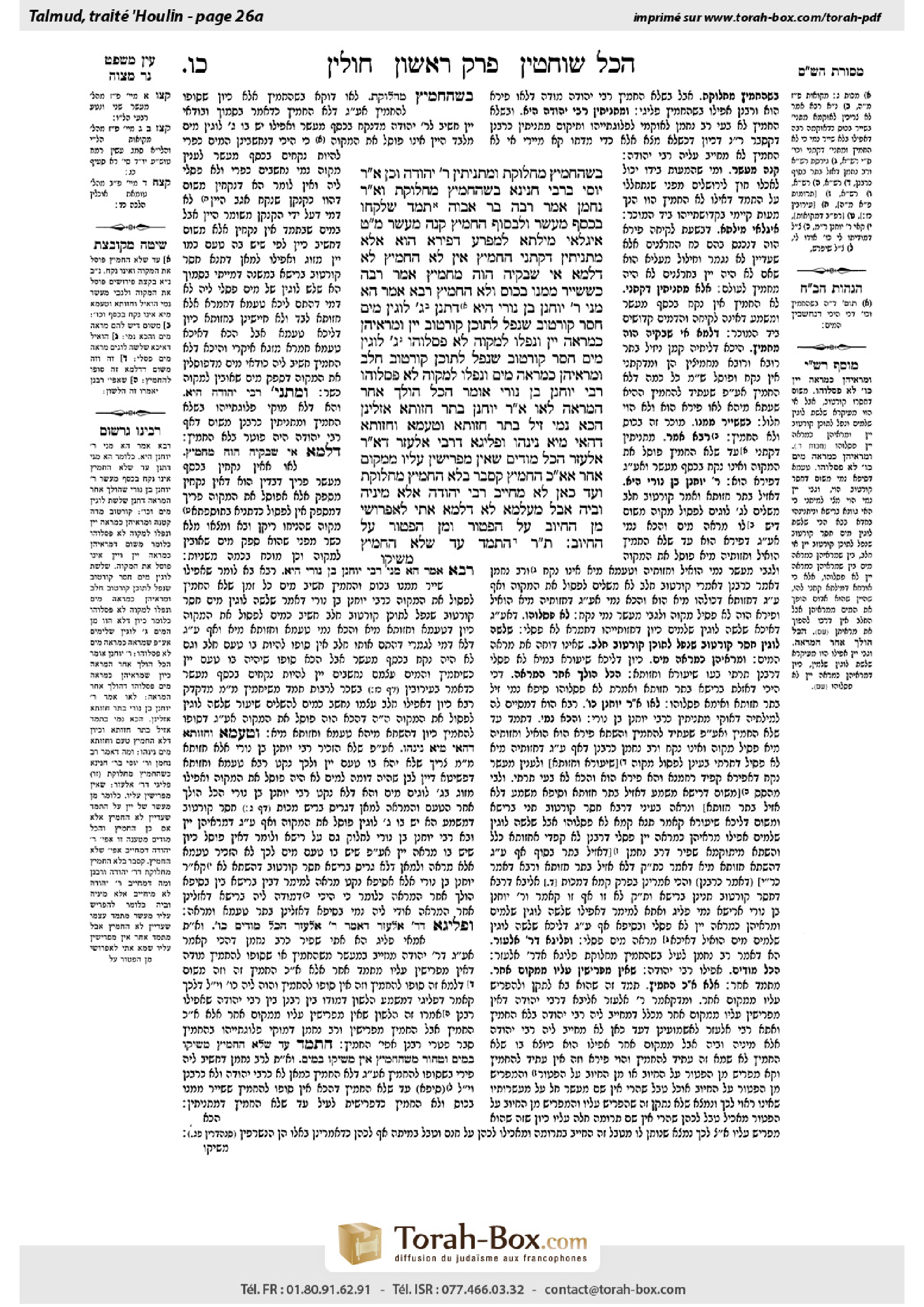
This page of Chullin includes the Aramaic text, an English translation and an AI-generated French translation, alongside the scan above.
חולין כ״ו א · Aramaic and Hebrew text
בְּשֶׁהֶחְמִיץ מַחְלוֹקֶת, וּמַתְנִיתִין רַבִּי יְהוּדָה. וְכֵן אָמַר רַבִּי יוֹסֵי בְּרַבִּי חֲנִינָא: בְּשֶׁהֶחְמִיץ מַחְלוֹקֶת.
וְאָמַר רַב נַחְמָן אָמַר רַבָּה בַּר אֲבוּהּ: תֶּמֶד שֶׁלְּקָחוֹ בְּכֶסֶף מַעֲשֵׂר, וּלְבַסּוֹף הֶחְמִיץ – קָנָה מַעֲשֵׂר. מַאי טַעְמָא? אִיגַּלַּאי מִילְּתָא לְמַפְרֵעַ דְּפֵירָא הוּא.
אֶלָּא, מַתְנִיתִין דְּקָתָנֵי הֶחְמִיץ – אִין, לֹא הֶחְמִיץ – לָא, דִּלְמָא אִי שַׁבְקֵיהּ הֲוָה מַחְמִיץ! אָמַר רַבָּה: כְּשֶׁשִּׁיֵּיר מִמֶּנּוּ בְּכוֹס וְלֹא הֶחְמִיץ.
רָבָא אָמַר: הָא מַנִּי? רַבִּי יוֹחָנָן בֶּן נוּרִי הִיא, דִּתְנַן: שְׁלֹשָׁה לוּגִּין מַיִם חָסֵר קוּרְטוֹב, שֶׁנָּפַל לְתוֹכָן קוּרְטוֹב יַיִן, וּמַרְאֵיהֶן כְּמַרְאֵה יַיִן, וְנָפְלוּ לַמִּקְוֶה – לֹא פְּסָלוּהוּ.
שְׁלֹשָׁה לוּגִּין מַיִם חָסֵר קוּרְטוֹב, שֶׁנָּפַל לְתוֹכָן קוּרְטוֹב חָלָב, וּמַרְאֵיהֶן כְּמַרְאֵה מַיִם, וְנָפְלוּ לַמִּקְוֶה – לֹא פְּסָלוּהוּ.
רַבִּי יוֹחָנָן בֶּן נוּרִי אוֹמֵר: הַכֹּל הוֹלֵךְ אַחַר הַמַּרְאֶה.
לָאו אָמַר רַבִּי יוֹחָנָן: בָּתַר חֲזוּתָא אָזְלִינַן? הָכָא נָמֵי זִיל בָּתַר חֲזוּתָא, וְטַעְמָא וַחֲזוּתָא דְּהַאי מַיָּא נִינְהוּ.
וּפְלִיגָא דְּרַבִּי אֶלְעָזָר, דְּאָמַר רַבִּי אֶלְעָזָר: הַכֹּל מוֹדִים שֶׁאֵין מַפְרִישִׁין עָלָיו מִמָּקוֹם אַחֵר, אֶלָּא אִם כֵּן הֶחְמִיץ.
קָסָבַר בְּלֹא הֶחְמִיץ מַחְלוֹקֶת, וְעַד כָּאן לָא מְחַיֵּיב רַבִּי יְהוּדָה אֶלָּא מִינֵּיהּ וּבֵיהּ, אֲבָל מֵעָלְמָא לָא, דִּלְמָא אָתֵי לְאַפְרוֹשֵׁי מִן הַחִיּוּב עַל הַפְּטוּר וּמִן הַפְּטוּר עַל הַחִיּוּב.
תָּנוּ רַבָּנַן: הַתֶּמֶד עַד שֶׁלֹּא הֶחְמִיץ –
Chullin 26a · English translation
It is in a case where the temed fermented that there is a dispute between Rabbi Yehuda and the Rabbis. It is only then that Rabbi Yehuda deems him obligated to tithe the temed if it tastes like wine, and the mishna that treats fermented temed like wine is in accordance with the opinion of Rabbi Yehuda. And likewise, Rabbi Yosei, son of Rabbi Ḥanina, said: It is in a case where the temed fermented that there is a dispute.
§ And Rav Naḥman says that Rabba bar Avuh says: In a case of unfermented temed that one purchased with second-tithe money and that ultimately fermented, the temed he purchased assumes the sanctity of second-tithe produce, and the money is desacralized. What is the reason that the temed assumes the sanctity of second-tithe produce? The reason is that the matter was revealed retroactively, such that when the temed was purchased it was produce fit to be purchased with second-tithe money and was not merely water.
But in that case, the mishna that teaches that if the temed fermented, yes, one may purchase it with second-tithe money, but if it did not ferment, one may not, and the money remains sacred, why does the mishna state it unequivocally? Perhaps, if he would have left the temed long enough, it would have fermented. Rabba said in explanation: The mishna is referring to a case where one left some of the temed in a cup to monitor its status and it did not ferment. Therefore, one may be certain that it was not produce when he purchased it with second-tithe money, and the money remains sacred.
Rava said: It is not necessary to understand the mishna specifically in that manner; rather, in accordance with whose opinion is this mishna? It is in accordance with the opinion of Rabbi Yoḥanan ben Nuri, as we learned in a mishna (Mikvaot 7:5): In a case where there are three log of drawn water less one sixty-fourth of a log [kortov], or any small measure of water, into which a kortov of wine fell, increasing the measure of liquid to a total of three log, and the appearance of those three log is like the appearance of wine, and then those three log fell into a ritual bath, completing its requisite forty se’a, it has not invalidated the ritual bath. The reason is that three log of drawn water invalidate the ritual bath, and less than that measure of water fell into the ritual bath.
Furthermore, in a case where there are three log of drawn water less one kortov, into which a kortov of milk fell, and the appearance of those three log is like the appearance of water, and those three log fell into a ritual bath, it has not invalidated the ritual bath, because in this case too, less than three log of drawn water fell into the ritual bath.
Rabbi Yoḥanan ben Nuri says: Everything follows the appearance of those three log. Therefore, in the case of a kortov of milk completing the three log, the ritual bath is invalidated because the mixture still has the appearance of water.
Rava reasoned: Doesn’t Rabbi Yoḥanan ben Nuri say that we follow the appearance in determining the halakhic status of the liquid? Here too, in the mishna, follow the appearance in determining the halakhic status of the liquid, and in the case of the temed, as long as it has not yet fermented, the taste and the appearance of that liquid is that of water. By contrast, Rav Naḥman holds in accordance with the opinion of the first tanna in the mishna in tractate Mikvaot that the status of the liquid is not determined by its appearance. Rather, since it ultimately fermented, it became clear retroactively that when the temed was purchased it was produce fit to be purchased with second-tithe money, and was not merely water.
The Gemara resumes its discussion of the dispute between Rabbi Yehuda and the Rabbis with regard to which Rav Naḥman said: It is in a case where the temed fermented that there is a dispute between Rabbi Yehuda and the Rabbis, and it is only then that Rabbi Yehuda deems one obligated to tithe the temed if it tastes like wine. If it did not yet ferment, even Rabbi Yehuda concedes that one is not obligated to tithe it. The Gemara notes: And Rav Naḥman disagrees with the opinion of Rabbi Elazar, as Rabbi Elazar says: Everyone, even Rabbi Yehuda, agrees that one may not separate tithes for this temed from temed in another place, unless it fermented.
Apparently, Rabbi Elazar holds that it is in a case where the temed did not ferment that there is a dispute between Rabbi Yehuda and the Rabbis, and Rabbi Yehuda obligates one to tithe the temed that did not ferment only from that temed itself, because if it ferments it is tithe and if not, he has done nothing. But concerning temed that comes from elsewhere, one may not separate it for this temed, as perhaps he will come to separate tithe from the produce of obligation, i.e., fermented temed, for the produce of exemption, i.e., temed that will not ferment, and from the produce of exemption for the produce of obligation.
§ The Sages taught: With regard to temed that became ritually impure, until it ferments,
Chullin 26a · Traduction française (IA)
Il y a un désaccord entre Rabbi Yéhuda et les Rabbins dans le cas où le temed a fermenté. C'est seulement alors que Rabbi Yéhuda considère qu'il est tenu de dîmer le temed s'il a le goût du vin, et la mitsva qui traite le temed fermenté comme du vin est en conformité avec l'opinion de Rabbi Yéhuda. De même, Rabbi Yosei, fils de Rabbi Ḥanina, a dit : Il y a un désaccord entre Rabbi Yéhuda et les Rabbins dans le cas où le temed a fermenté.
§ Rav Naḥman dit que Rabba bar Avouh a dit : Dans le cas d'un temed non fermenté acheté avec des fonds de dîme secondaire et qui finit par fermenter, le temed acheté acquiert la sanctité des produits de dîme secondaire, et les fonds sont désacralisés. Pourquoi le temed acquiert-il la sanctité des produits de dîme secondaire ? La raison est que la situation a été révélée en arrière, de sorte que lors de l'achat du temed, il était un produit adapté à l'achat avec des fonds de dîme secondaire et non simplement de l'eau.
Mais dans ce cas, pourquoi la mitsva dit-elle clairement que si le temed a fermenté, on peut l'acheter avec des fonds de dîme secondaire, mais si ce n'est pas le cas, on ne peut pas, et les fonds restent sacrés ? Peut-être, s'il avait laissé le temed assez longtemps, il aurait fermenté. Rabba explique : La mitsva fait référence à un cas où l'on a laissé du temed dans une coupe pour surveiller son état et il n'a pas fermenté. Ainsi, on peut être certain qu'il ne s'agissait pas de produit lors de l'achat avec des fonds de dîme secondaire, et les fonds restent sacrés.
Rava a dit : Il n'est pas nécessaire de comprendre la mitsna dans ce sens précis ; plutôt, selon l'opinion de qui est-ce que cette mitsna ? C'est selon l'opinion de Rabbi Yoḥanan ben Nuri, comme nous l'avons appris dans une mitsna (Mikvaot 7:5) : Dans le cas où il y a trois log d'eau tirée moins un kortov, ou toute mesure petite d'eau, dans laquelle tombe un kortov de vin, augmentant la mesure du liquide à un total de trois log, et l'apparence de ces trois log est comme celle du vin, et ensuite ces trois log tombent dans un bain rituel, complétant ainsi les quarante se'a requis, ce bain rituel n'a pas été invalidé. La raison est que trois log d'eau tirée invalident le bain rituel, et moins de cette mesure d'eau est tombée dans le bain rituel.
De plus, dans le cas où il y a trois log d'eau tirée moins un kortov, dans lequel tombe un kortov de lait, et l'apparence de ces trois log est comme celle de l'eau, et ces trois log tombent dans un bain rituel, ce bain rituel n'a pas été invalidé, car dans ce cas également, moins de trois log d'eau tirée est tombé dans le bain rituel.
Rabbi Yoḥanan ben Nuri a dit : Tout suit l'apparence de ces trois log. Ainsi, dans le cas d'un kortov de lait complétant les trois log, le bain rituel est invalidé car le mélange a encore l'apparence de l'eau.
Rava a raisonné : N'est-ce pas ce que Rabbi Yoḥanan ben Nuri dit, que nous suivons l'apparence pour déterminer le statut halakhique du liquide ? Ici aussi, dans la mitsna, on suit l'apparence pour déterminer le statut halakhique du liquide, et dans le cas du temed, tant qu'il n'a pas encore fermenté, le goût et l'apparence de ce liquide sont ceux de l'eau. En revanche, Rav Naḥman suit l'opinion du premier tanna de la mitsna dans le traité Mikvaot, selon laquelle le statut du liquide n'est pas déterminé par son apparence. Plutôt, puisque le temed a finalement fermenté, il est devenu clair en arrière que lors de l'achat du temed, il était un produit adapté à l'achat avec des fonds de dîme secondaire et non simplement de l'eau.
La Guemara reprend la discussion du désaccord entre Rabbi Yéhuda et les Rabbins concernant ce que Rav Naḥman a dit : Il y a un désaccord entre Rabbi Yéhuda et les Rabbins dans le cas où le temed a fermenté, et c'est seulement alors que Rabbi Yéhuda considère qu'il est tenu de dîmer le temed s'il a le goût du vin. Si le temed n'a pas encore fermenté, même Rabbi Yéhuda reconnaît qu'il n'est pas tenu de le dîmer. La Guemara note : Et Rav Naḥman est en désaccord avec l'opinion de Rabbi Elazar, car Rabbi Elazar dit : Tout le monde, même Rabbi Yéhuda, est d'accord pour dire qu'on ne peut pas séparer des dîmes pour ce temed à partir d'un temed ailleurs, sauf s'il a fermenté.
Apparemment, Rabbi Elazar affirme que c'est dans le cas où le temed n'a pas fermenté qu'il y a un désaccord entre Rabbi Yéhuda et les Rabbins, et Rabbi Yéhuda considère qu'il faut dîmer le temed qui n'a pas fermenté uniquement à partir de ce temed lui-même, car si celui-ci fermente, il est dîme et si non, il n'a rien fait. Concernant le temed provenant d'ailleurs, on ne peut pas le séparer pour ce temed, car on pourrait venir à séparer des dîmes à partir du produit d'obligation, c'est-à-dire le temed fermenté, pour le produit d'exemption, c'est-à-dire le temed qui ne fermentera pas, et du produit d'exemption pour le produit d'obligation.
§ Les Sages ont enseigné : Concernant le temed devenu impur rituellement, jusqu'à ce qu'il fermente,
Traduction française générée par IA à partir de l’édition anglaise de Sefaria. Vérifie toujours un passage avec le texte source.
Text from Sefaria: William Davidson Edition - Vocalized Aramaic (unknown); William Davidson Edition - English (CC BY NC).