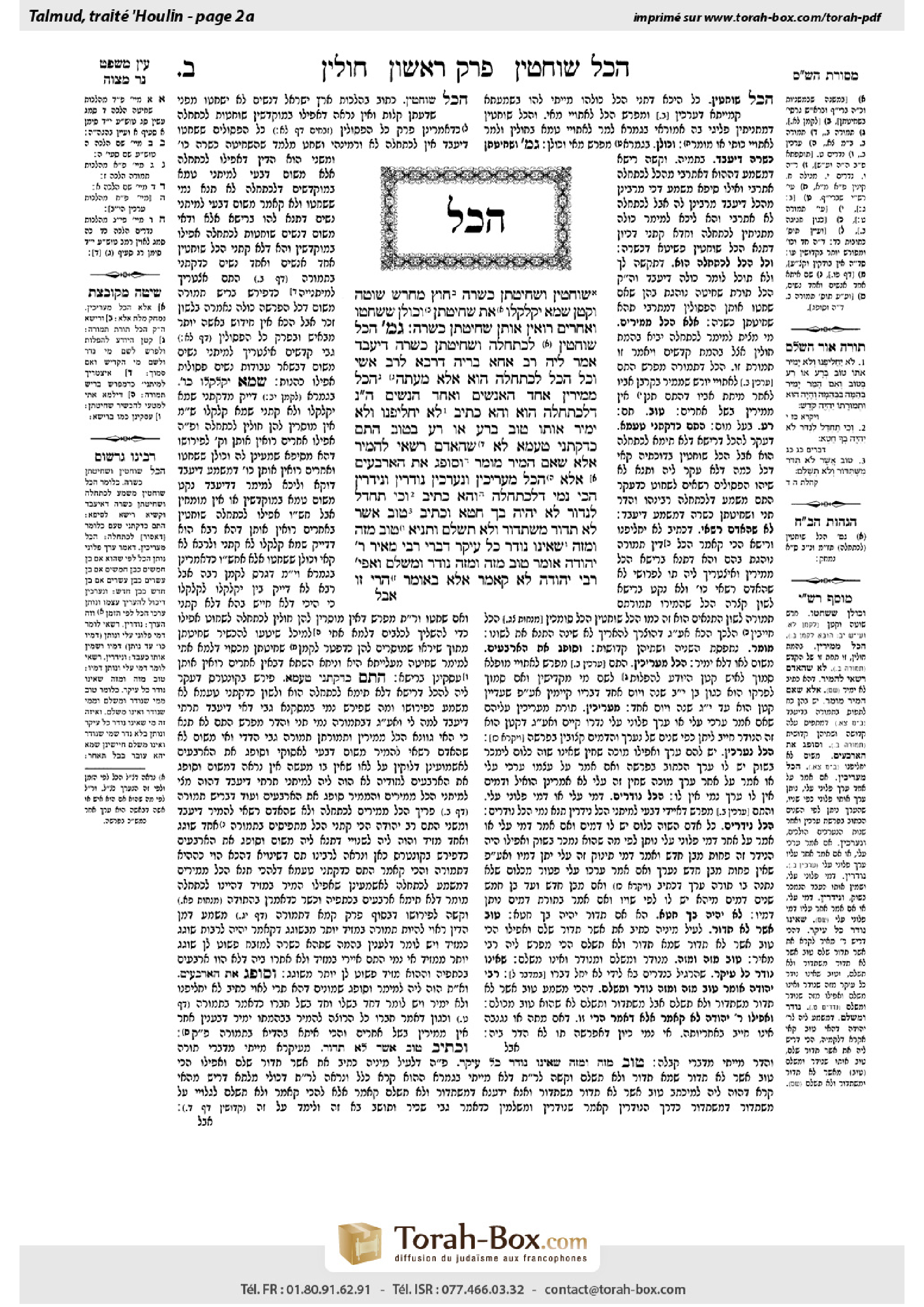
Chullin 2a: Talmud study for Daf Yomi
Study the Talmud for Daf Yomi with scanned pages, Hebrew text, English translations from Sefaria and AI-generated French translations.
Passage selection and English or AI-generated French translation are available where the scan has annotations. Daf Study is independent of Torah-Box and Sefaria.
Browse Chullin · חולין · All tractatesChullin 2a text and translations
This page of Chullin includes the Aramaic text, an English translation and an AI-generated French translation, alongside the scan above.
חולין ב׳ א · Aramaic and Hebrew text
מַתְנִי׳ הַכֹּל שׁוֹחֲטִין וּשְׁחִיטָתָן כְּשֵׁרָה, חוּץ מֵחֵרֵשׁ שׁוֹטֶה וְקָטָן, שֶׁמָּא יְקַלְקְלוּ אֶת שְׁחִיטָתָן. וְכוּלָּן שֶׁשָּׁחֲטוּ וַאֲחֵרִים רוֹאִין אוֹתָן – שְׁחִיטָתָן כְּשֵׁרָה.
גְּמָ׳ ״הַכֹּל שׁוֹחֲטִין״ – לְכַתְּחִלָּה, ״וּשְׁחִיטָתָן כְּשֵׁרָה״ – דִּיעֲבַד!
אֲמַר לֵיהּ רַב אַחָא בְּרֵיהּ דְּרָבָא לְרַב אָשֵׁי: וְכֹל ״הַכֹּל״ לְכַתְּחִלָּה הוּא? אֶלָּא מֵעַתָּה: הַכֹּל מְמִירִין, אֶחָד הָאֲנָשִׁים וְאֶחָד הַנָּשִׁים – הָכִי נָמֵי דִּלְכַתְּחִלָּה הוּא? וְהָא כְּתִיב: ״לֹא יַחֲלִיפֶנּוּ וְלֹא יָמִיר אֹתוֹ טוֹב בְּרָע אוֹ רַע בְּטוֹב״!
הָתָם, כִּדְקָתָנֵי טַעְמָא: לֹא שֶׁהָאָדָם רַשַּׁאי לְהָמִיר, אֶלָּא שֶׁאִם הֵמִיר – מוּמָר, וְסוֹפֵג אֶת הָאַרְבָּעִים.
אֶלָּא הַכֹּל מַעֲרִיכִין וְנֶעֱרָכִין, נוֹדְרִין וְנִידָּרִין, הָכִי נָמֵי דִּלְכַתְּחִלָּה? וְהָא כְּתִיב: ״וְכִי תֶחְדַּל לִנְדֹּר לֹא יִהְיֶה בְךָ חֵטְא״!
וּכְתִיב: ״טוֹב אֲשֶׁר לֹא תִדֹּר מִשֶּׁתִּדּוֹר וְלֹא תְשַׁלֵּם״, וְתַנְיָא: טוֹב מִזֶּה וּמִזֶּה שֶׁאֵינוֹ נוֹדֵר כׇּל עִיקָּר, דִּבְרֵי רַבִּי מֵאִיר. רַבִּי יְהוּדָה אוֹמֵר: טוֹב מִזֶּה וּמִזֶּה נוֹדֵר וּמְשַׁלֵּם. וַאֲפִילּוּ רַבִּי יְהוּדָה לָא קָאָמַר אֶלָּא בְּאוֹמֵר ״הֲרֵי זוֹ״,
Chullin 2a · English translation
MISHNA: Everyone slaughters an animal, i.e., can perform halakhically valid slaughter, and their slaughter is valid, except for a deaf-mute, an imbecile, and a minor, lest they ruin their slaughter because they lack competence. And for all of them, when they slaughtered an animal and others see and supervise them, their slaughter is valid.
GEMARA: There is an apparent contradiction between the first two phrases of the mishna. The tanna begins: Everyone slaughters an animal, indicating that their performing slaughter is permitted ab initio, and then teaches: And their slaughter is valid, indicating that their slaughter is valid only after the fact.
Rav Aḥa, son of Rava, said to Rav Ashi: And does every use of the term: Everyone, indicate that the action in question is permitted ab initio? If that is so, in the mishna (Temura 2a), where it says: Everyone substitutes a non-sacred animal for a sacrificial animal, both men and women, is that also an expression indicating that it is permitted ab initio? But isn’t it written: “He shall neither exchange it, nor substitute it, good for bad, or bad for good” (Leviticus 27:10)?
Rav Ashi answers: There, the reason the mishna uses the word everyone is that it immediately teaches: That is not to say that it is permitted for a person to substitute; rather, it means that if one did substitute a non-sacred animal for a sacrificial animal, substitution takes effect, and the one who substituted the non-sacred animal incurs [vesofeg] the forty lashes that are the punishment for violating the prohibition “Nor substitute it.” But here, since the mishna does not similarly qualify its statement, it indicates that everyone may perform the slaughter ab initio.
Rav Aḥa challenges: But a mishna teaches (Arakhin 2a): Everyone takes vows of valuation and is thereby obligated to donate to the Temple treasury the value fixed by the Torah based on the age and gender of the person valuated; and everyone is valuated, and therefore one who vowed to donate his fixed value is obligated to pay; everyone vows to donate the market value of a person as a slave to the Temple treasury and is thereby obligated to pay; and everyone is the object of a vow if others vowed to donate his market value. Is that also an expression indicating that it is permitted ab initio? But it is written: “And if you shall cease to vow, there shall be no sin in you” (Deuteronomy 23:23), indicating that it is preferable not to vow.
And it is written: “It is better that you should not vow, than that you should vow and not pay” (Ecclesiastes 5:4); and it is taught in a baraita with regard to that verse: Better than both this one, who vows and does not pay, and that one, who vows and pays, is one who does not take a vow at all; this is the statement of Rabbi Meir. Rabbi Yehuda says: Better than both this one, who vows and does not pay, and that one, who does not vow at all, is one who vows and pays in fulfillment of that vow. Rav Aḥa comments: And even Rabbi Yehuda states his opinion only in a case where one vows and says: This animal is designated for sacrifice, as in that case there is no concern that he will fail to fulfill his commitment, since even if the animal is stolen or lost, he is not required to bring another in its place.
Chullin 2a · Traduction française (IA)
MICHNA : Tout le monde peut effectuer la boucherie d'un animal, c'est-à-dire peut accomplir une boucherie halakhiquement valide, et leur boucherie est valide, sauf pour un sourd-muet, un imbécile et un mineur, afin qu'ils ne détruisent pas leur boucherie en raison de leur incompétence. Et pour tous ceux-ci, lorsqu'ils effectuent la boucherie d'un animal et que d'autres les regardent et les surveillent, leur boucherie est valide.
GUEMARA : Il y a une contradiction apparente entre les deux premières phrases de la mishna. Le tanna commence par : Tout le monde peut effectuer la boucherie d'un animal, indiquant que l'action est permise dès le début, et ensuite il enseigne : Et leur boucherie est valide, indiquant que leur boucherie est valide uniquement après coup.
Rav Aḥa, fils de Rava, dit à Rav Ashi : Et chaque utilisation du terme : Tout le monde, indique-t-elle que l'action en question est permise dès le début ? Si c'est le cas, dans la mishna (Temura 2a), où il est dit : Tout le monde peut substituer un animal non sacré à un animal sacré, hommes et femmes, est-ce aussi une expression indiquant que cela est permis dès le début ? Mais n'est-il pas écrit : « Il ne doit ni échanger ni substituer, le bon par le mauvais, ni le mauvais par le bon » (Lévitique 27:10) ?
Rav Ashi répond : Là, la raison pour laquelle la mishna utilise le mot tout le monde est qu'elle immédiatement enseigne : Cela ne signifie pas que l'on peut substituer à une personne ; au contraire, cela signifie que si l'on substitue un animal non sacré à un animal sacré, la substitution est efficace, et celui qui a substitué l'animal non sacré encourt [vesofeg] quarante coups de verges, la sanction pour avoir violé l'interdiction « Ni substituer ». Mais ici, puisque la mishna ne qualifie pas ainsi son énoncé, cela indique que tout le monde peut effectuer la boucherie dès le début.
Rav Aḥa conteste : Mais une mishna enseigne (Arakhin 2a) : Tout le monde prend des vœux de valeur et est ainsi tenu de donner au trésor du Temple la valeur fixée par la Torah selon l'âge et le sexe de la personne évaluée ; et tout le monde est évalué, et donc celui qui a juré de donner sa valeur fixe est tenu de payer ; tout le monde jure de donner la valeur marchande d'une personne comme esclave au trésor du Temple et est ainsi tenu de payer ; et tout le monde est l'objet d'un vœu si d'autres jurent de donner sa valeur marchande. Est-ce aussi une expression indiquant que cela est permis dès le début ? Mais il est écrit : « Et si tu cesses de jurer, il n'y aura pas de péché en toi » (Dn 23:23), indiquant que c'est préférable de ne pas jurer.
Et il est écrit : « Il est préférable que tu ne jures pas, que tu jures et ne paies pas » (Eccl 5:4) ; et il est enseigné dans une baraïta concernant cette versette : Meilleur que ces deux-là, celui qui jure et ne paie pas, et celui qui jure et paie, est celui qui ne prend pas de vœu du tout ; c'est la parole de Rabbi Meir. Rabbi Yehuda dit : Meilleur que ces deux-là, celui qui jure et ne paie pas, et celui qui ne jure pas du tout, est celui qui jure et paie en accomplissant ce vœu. Rav Aḥa commente : Et même Rabbi Yehuda exprime son opinion uniquement dans le cas où l'on jure et dit : Cet animal est désigné pour le sacrifice, comme dans ce cas-là, il n'y a pas de crainte qu'il ne remplisse pas sa promesse, car même si l'animal est volé ou perdu, il n'est pas tenu de présenter un autre à sa place.
Traduction française générée par IA à partir de l’édition anglaise de Sefaria. Vérifie toujours un passage avec le texte source.
Text from Sefaria: William Davidson Edition - Vocalized Aramaic (unknown); William Davidson Edition - English (CC BY NC).