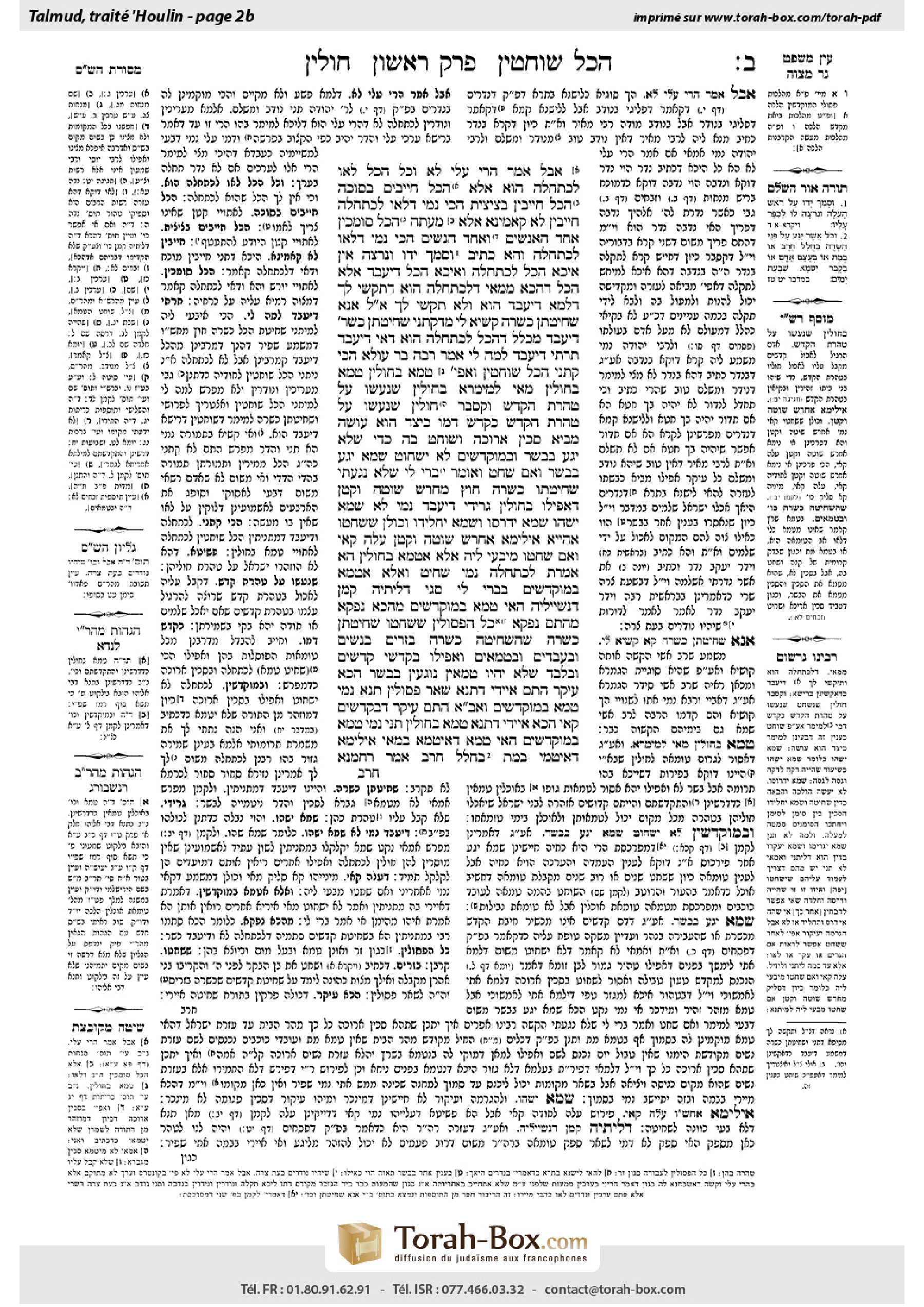
Chullin 2b: Talmud study for Daf Yomi
Study the Talmud for Daf Yomi with scanned pages, Hebrew text, English translations from Sefaria and AI-generated French translations.
Passage selection and English or AI-generated French translation are available where the scan has annotations. Daf Study is independent of Torah-Box and Sefaria.
Browse Chullin · חולין · All tractatesChullin 2b text and translations
This page of Chullin includes the Aramaic text, an English translation and an AI-generated French translation, alongside the scan above.
חולין ב׳ ב · Aramaic and Hebrew text
אֲבָל אָמַר ״הֲרֵי עָלַי״ – לֹא.
וְכֹל ״הַכֹּל״ לָאו לְכַתְּחִלָּה הוּא? אֶלָּא ״הַכֹּל חַיָּיבִים בְּסוּכָּה״, ״הַכֹּל חַיָּיבִין בְּצִיצִית״, הָכִי נָמֵי דְּלָאו לְכַתְּחִלָּה?
חַיָּיבִין – לָא קָאָמֵינָא. אֶלָּא מֵעַתָּה, ״הַכֹּל סוֹמְכִין, אֶחָד הָאֲנָשִׁים וְאֶחָד הַנָּשִׁים״ – הָכִי נָמֵי דְּלָאו לְכַתְּחִלָּה? וְהָא כְּתִיב: ״וְסָמַךְ יָדוֹ … וְנִרְצָה״!
אִין, אִיכָּא ״הַכֹּל״ לְכַתְּחִלָּה, וְאִיכָּא ״הַכֹּל״ דִּיעֲבַד. אֶלָּא ״הַכֹּל״ דְּהָכָא, מִמַּאי דִּלְכַתְּחִלָּה הוּא דְּתִקְשֵׁי לָךְ? דִּלְמָא דִּיעֲבַד הוּא, וְלָא תִּקְשֵׁי לָךְ.
אֲמַר לֵיהּ: אֲנָא ״שְׁחִיטָתָן כְּשֵׁרָה״ קַשְׁיָא לִי, מִדְּקָתָנֵי שְׁחִיטָתָן כְּשֵׁרָה דִּיעֲבַד, מִכְּלָל דְּ״הַכֹּל״ לְכַתְּחִלָּה הוּא, דְּאִי דִּיעֲבַד – תַּרְתֵּי דִּיעֲבַד לְמָה לִי?
אָמַר רַבָּה בַּר עוּלָּא: הָכִי קָתָנֵי – הַכֹּל שׁוֹחֲטִין, וַאֲפִילּוּ טָמֵא בְּחוּלִּין. טָמֵא בְּחוּלִּין מַאי לְמֵימְרָא? בְּחוּלִּין שֶׁנַּעֲשׂוּ עַל טׇהֳרַת הַקֹּדֶשׁ, וְקָסָבַר: חוּלִּין שֶׁנַּעֲשׂוּ עַל טׇהֳרַת הַקֹּדֶשׁ כְּקֹדֶשׁ דָּמוּ.
כֵּיצַד הוּא עוֹשֶׂה? מֵבִיא סַכִּין אֲרוּכָּה וְשׁוֹחֵט בָּהּ, כְּדֵי שֶׁלֹּא יִגַּע בַּבָּשָׂר.
וּבְמוּקְדָּשִׁים לֹא יִשְׁחוֹט, שֶׁמָּא יִגַּע בַּבָּשָׂר, וְאִם שָׁחַט וְאוֹמֵר ״בָּרִי לִי שֶׁלֹּא נָגַעְתִּי״ – שְׁחִיטָתוֹ כְּשֵׁרָה.
חוּץ מֵחֵרֵשׁ שׁוֹטֶה וְקָטָן, דַּאֲפִילּוּ בְּחוּלִּין גְּרֵידֵי, דִּיעֲבַד נָמֵי לָא, שֶׁמָּא יִשְׁהוּ, שֶׁמָּא יִדְרְסוּ, וְשֶׁמָּא יַחֲלִידוּ.
וְכוּלָּן שֶׁשָּׁחֲטוּ, אַהֵיָיא? אִילֵּימָא אַחֵרֵשׁ שׁוֹטֶה וְקָטָן – עֲלַהּ קָאֵי, ״וְאִם שָׁחֲטוּ״ מִיבְּעֵי לֵיהּ! אֶלָּא אַטָּמֵא בְּחוּלִּין – הָא אָמְרַתְּ: לְכַתְּחִלָּה נָמֵי שָׁחֵיט!
וְאֶלָּא, אַטָּמֵא בְּמוּקְדָּשִׁים – בְּ״בָרִי לִי״ סַגִּי! דְּלֵיתֵיהּ קַמַּן דִּנְשַׁיְּילֵיהּ.
הַאי טָמֵא בְּמוּקְדָּשִׁים, מֵהָכָא נָפְקָא? מֵהָתָם נָפְקָא: כׇּל הַפְּסוּלִין שֶׁשָּׁחֲטוּ – שְׁחִיטָתָן כְּשֵׁרָה, שֶׁהַשְּׁחִיטָה כְּשֵׁרָה בְּזָרִים, בְּנָשִׁים, וּבַעֲבָדִים, וּבִטְמֵאִים, וַאֲפִילּוּ בְּקׇדְשֵׁי קָדָשִׁים, וּבִלְבַד שֶׁלֹּא יִהְיוּ טְמֵאִין נוֹגְעִין בַּבָּשָׂר.
הָכָא עִיקָּר. הָתָם, אַיְּידֵי דִּתְנָא שְׁאָר פְּסוּלִין – תְּנָא נָמֵי טָמֵא בְּמוּקְדָּשִׁים. וְאִיבָּעֵית אֵימָא: הָתָם עִיקָּר, דִּבְקָדָשִׁים קָאֵי. הָכָא, אַיְּידֵי דִּתְנָא טָמֵא בְּחוּלִּין – תָּנֵי נָמֵי טָמֵא בְּמוּקְדָּשִׁים.
הַאי טָמֵא, דְּאִיטַּמָּא בְּמַאי? אִילֵּימָא דְּאִיטַּמִּי בְּמֵת, ״בַּחֲלַל חֶרֶב״ אָמַר רַחֲמָנָא,
Chullin 2b · English translation
But in the case of one who vows and says: It is incumbent upon me to bring an offering, even Rabbi Yehuda concedes that no, it is best not to vow at all. Likewise, it is preferable not to vow to donate a certain monetary value to the Temple treasury. Apparently, then, the statements in that mishna: Everyone takes vows of valuation, and: Everyone vows to donate the assessment of a person to the Temple treasury, do not indicate that it is permitted to do so ab initio.
Rav Ashi responded: And is that to say that every use of the term: Everyone, is an indication that the action in question is not permitted ab initio? Rather, is the term: Everyone, in the baraita that states: Everyone is obligated in the mitzva of sukka, and in the baraita that states: Everyone is obligated in the mitzva of ritual fringes, also an indication that they are not permitted ab initio?
Rav Aḥa answered: I am not speaking about cases where it is stated: Everyone is obligated, as it goes without saying that fulfilling any obligation is permitted ab initio. Rav Ashi asked: If that is so, that which was stated: Everyone who brings an offering places hands on the animal, both men and women (see Menaḥot 93a), is that also an expression indicating that it is not permitted ab initio? But isn’t it written: “And he shall place his hand upon the head of the burnt offering, and it shall be accepted for him to effect atonement for him” (Leviticus 1:4)?
Rav Aḥa answered: Indeed, there are instances where the word: Everyone, indicates ab initio, and there are instances where the word: Everyone, indicates after the fact. Rather, concerning the term: Everyone, that appears here in the mishna, from where can it be determined that it is an expression indicating that it is permitted ab initio, creating an apparent contradiction in the mishna that will be difficult for you? Perhaps it is an expression indicating that everyone’s slaughter is valid after the fact, and there will not be a contradiction in the mishna that will be difficult for you.
Rav Ashi said to Rav Aḥa: I find the phrase: And their slaughter is valid, to be difficult for me. From the fact that the tanna teaches: And their slaughter is valid, which is an expression indicating that it is valid after the fact, conclude by inference that the initial phrase in the mishna: Everyone slaughters, is an expression indicating that it is permitted ab initio. As, if it indicated that it is valid after the fact, why do I need two phrases teaching that it is valid after the fact?
Rabba bar Ulla said, in resolution of the conflict in the mishna, that this is what the mishna is teaching: Everyone slaughters, and even a ritually impure person may slaughter a non-sacred animal ab initio. The Gemara interjects: What is the purpose of stating that a ritually impure person may slaughter a non-sacred animal ab initio? There is no prohibition against rendering non-sacred meat impure. The Gemara answers that the reference is to non-sacred animals that were being prepared according to the strictures of sacrificial food, and the tanna holds that the halakhic status of non-sacred foods that were prepared according to the strictures of sacrificial food is like that of sacrificial food insofar as it is prohibited to render such food impure.
The Gemara asks: How does an impure person act in order to ensure that he will not render the flesh of the slaughtered animal impure? The Gemara answers: He brings a long knife and slaughters the animal with it, so that he will not come into contact with the flesh of the slaughtered animal.
Rabba bar Ulla continues his interpretation of the mishna: And the reason the mishna also indicates that he may not slaughter ab initio is that with regard to sacrificial animals, he may not slaughter them ab initio even with a long knife, lest he come into contact with the flesh. But if he slaughtered the sacrificial animal and says: It is clear to me that I did not come into contact with the flesh, his slaughter is valid after the fact.
And it teaches: This is the halakha with regard to all people except for a deaf-mute, an imbecile, and a minor, who, even if they slaughtered only non-sacred animals, their slaughter is not valid even after the fact. The reason the Sages deemed such slaughter not valid is lest people in these categories interrupt the slaughter, lest they press the knife in the course of slaughter, and lest they conceal the knife beneath the windpipe or the gullet in the course of an inverted slaughter.
The Gemara asks: If so, with regard to the clause that follows in the mishna: And any of them who slaughtered an animal and others see and supervise them, their slaughter is valid, to which case in the mishna is it referring? If we say that the reference is to the case of a deaf-mute, an imbecile, and a minor, why was it formulated: And any of them who slaughtered? Since it stands adjacent to that halakha, the tanna should have formulated the phrase: And if they slaughtered. Rather, perhaps the reference is to the case of a ritually impure person who slaughtered a non-sacred animal. The Gemara rejects that possibility as well. But didn’t you say in that case: He slaughters the animal even ab initio?
And rather, perhaps the reference is to the case of a ritually impure person who slaughtered a sacrificial animal. The Gemara rejects that possibility, as in that case, if the ritually impure person says: It is clear to me that I did not come into contact with the flesh, it is sufficient, and there is no need for supervision. The Gemara answers: Supervision is necessary in the case of a ritually impure person who slaughtered a sacrificial animal, to account for a case where the ritually impure person is not before us so that we can ask him whether he came into contact with the flesh.
The Gemara asks: Is this halakha of a ritually impure person who slaughtered a sacrificial animal learned from an analysis of the mishna here? It is learned explicitly from the mishna there (Zevaḥim 31b): With regard to all those who are unfit for Temple service who slaughtered an offering, their slaughter is valid, as the slaughter of an offering is valid ab initio when performed even by non-priests, by women, by Canaanite slaves, and by ritually impure individuals. And this is the halakha even with regard to offerings of the most sacred order, provided that the ritually impure will not touch the flesh of the slaughtered animal, thereby rendering it impure.
The Gemara answers: The mishna here is the primary source. There, since the tanna taught the rest of those disqualified for Temple service, he taught the case of a ritually impure person who slaughtered a sacrificial animal as well. And if you wish, say instead that the mishna there is the primary source, as it is standing in tractate Zevaḥim, which deals with sacrificial animals. Here, since the tanna taught the case of a ritually impure person who slaughtered a non-sacred animal, he also teaches the case of a ritually impure person who slaughtered a sacrificial animal.
The Gemara asks: This ritually impure person mentioned in the mishna is one who became impure with what form of impurity? If we say that he became impure with impurity imparted by a corpse, this is difficult, as the Merciful One states: “And whosoever in the open field touches one slain with a sword” (Numbers 19:16).
Chullin 2b · Traduction française (IA)
Mais dans le cas d'une personne qui fait un vœu et dit : Il m'est imposé de présenter un sacrifice, même Rabbi Yéhuda admet que non, il est préférable de ne pas faire de vœu du tout. De même, il est préférable de ne pas faire de vœu pour donner une certaine valeur monétaire au trésor du Temple. Apparemment, donc, les déclarations dans cette mitsna : Tout le monde fait des vœux de valeur, et : Tout le monde vœut de donner l'évaluation d'une personne au trésor du Temple, ne montrent pas que cela est permis dès le début.
Rav Ashi répondit : Et est-ce dire que chaque utilisation du terme : Tout le monde, indique que l'action en question n'est pas permise dès le début ? Plutôt, est-ce que le terme : Tout le monde, dans la baraïta qui dit : Tout le monde est tenu de la mitsva de la hutte, et dans la baraïta qui dit : Tout le monde est tenu de la mitsva des franges rituelles, indique aussi qu'ils ne sont pas permis dès le début ?
Rav Acha répondit : Je ne parle pas des cas où il est dit : Tout le monde est tenu, car il va sans dire que remplir une obligation est permis dès le début. Rav Ashi demanda : Si c'est ainsi, ce qui est dit : Tout celui qui présente un sacrifice pose la main sur l'animal, hommes et femmes (voir Menaĥot 93a), est-ce aussi une expression indiquant que cela n'est pas permis dès le début ? Mais n'est-il pas écrit : « Et il posera sa main sur la tête de l'holocauste, et cela sera accepté pour lui afin de faire l'atonement pour lui » (Lévitique 1:4) ?
Rav Acha répondit : En effet, il y a des cas où le terme : Tout le monde, indique dès le début, et des cas où le terme : Tout le monde, indique après coup. Cependant, concernant le terme : Tout le monde, qui apparaît ici dans la mitsna, d'où peut-on déterminer qu'il s'agit d'une expression indiquant que cela est permis dès le début, créant une contradiction dans la mitsna qui vous sera difficile ? Peut-être s'agit-il d'une expression indiquant que la mise à mort de tout le monde est valide après coup, et il n'y aura pas de contradiction dans la mitsna qui vous sera difficile.
Rav Ashi dit à Rav Acha : Je trouve la phrase : Et leur mise à mort est valide, difficile pour moi. À partir du fait que le tanna enseigne : Et leur mise à mort est valide, qui est une expression indiquant qu'elle est valide après coup, conclure par déduction que la première phrase de la mitsna : Tout le monde tue, est une expression indiquant qu'elle est permise dès le début. Car, si elle indiquait qu'elle est valide après coup, pourquoi ai-je besoin de deux phrases enseignant qu'elle est valide après coup ?
Rabba bar Ulla dit, dans la résolution du conflit dans la mitsna, que c'est ce que la mitsna enseigne : Tout le monde tue, et même une personne impure rituellement peut tuer un animal non sacré dès le début. La Guemara interjette : Quel est le but de dire qu'une personne impure peut tuer un animal non sacré dès le début ? Il n'y a pas de prohibition contre rendre la viande non sacrée impure. La Guemara répond que la référence est aux animaux non sacrés qui étaient préparés selon les strictes règles de la nourriture sacrée, et le tanna considère que le statut halakhique des aliments non sacrés préparés selon les strictes règles de la nourriture sacrée est comme celui de la nourriture sacrée en ce qu'il est interdit de rendre tels aliments impurs.
La Guemara demande : Comment une personne impure agit-elle pour s'assurer qu'elle ne rendra pas la viande de l'animal tué impure ? La Guemara répond : Il utilise un couteau long et tue l'animal avec, de sorte qu'il ne viendra pas en contact avec la viande de l'animal tué.
Rabba bar Ulla continue son interprétation de la mitsna : Et la raison pour laquelle la mitsna indique aussi qu'il ne peut pas tuer dès le début est que concernant les animaux sacrés, il ne peut pas les tuer dès le début même avec un couteau long, de peur qu'il vienne en contact avec la viande. Mais si l'animal sacré a été tué et qu'on dit : Je suis sûr que je n'ai pas été en contact avec la viande, sa mise à mort est valide après coup.
Et il enseigne : C'est la halakha concernant toutes les personnes sauf un sourd-muet, un imbécile et un mineur, qui, même s'ils ont tué seulement des animaux non sacrés, leur mise à mort n'est pas valide même après coup. La raison pour laquelle les Sages ont considéré que cette mise à mort n'était pas valide est de peur que ces personnes interrompent la mise à mort, de peur qu'ils appuient le couteau pendant la mise à mort, et de peur qu'ils cachent le couteau sous la trachée ou la gorge pendant une mise à mort inversée.
La Guemara demande : Si c'est ainsi, concernant la clause qui suit dans la Michna : Et tout celui qui a immolé un animal et d'autres l'ont vu et surveillé, sa mise à mort est valide, à quel cas dans la Michna fait-il référence ? Si nous disons que la référence est au cas d'un sourd-muet, d'un imbécile et d'un mineur, pourquoi a-t-il été formulé : Et tout celui qui a immolé ? Puisque cela est adjacent à cette halakha, le tanna devrait avoir formulé la phrase : Et s'ils ont immolé. Plutôt, peut-être la référence est au cas d'une personne impure qui a immolé un animal non sacré. La Guemara rejette cette possibilité également. Mais n'avez-vous pas dit dans ce cas : Il immole l'animal même dès le début ?
Et plutôt, peut-être la référence est au cas d'une personne impure qui a immolé un animal sacré. La Guemara rejette cette possibilité, car dans ce cas, si la personne impure dit : Je suis sûr que je n'ai pas été en contact avec la viande, cela suffit, et il n'y a pas besoin de surveillance. La Guemara répond : La surveillance est nécessaire dans le cas d'une personne impure qui a immolé un animal sacré, pour tenir compte d'un cas où la personne impure n'est pas devant nous afin que nous puissions lui demander s'il a été en contact avec la viande.
La Guemara pose la question : Cette halakha concernant une personne impure rituellement qui a sacrifié un animal sacré est-elle tirée d'une analyse de la mitsva ici ? Elle est explicitement tirée de la mitsva là (Zevaḥim 31b) : En ce qui concerne tous ceux qui ne sont pas admissibles au service du Temple qui ont sacrifié un holocauste, leur sacrifice est valide, car le sacrifice d'un holocauste est valide dès le début même s'il est accompli par des non-prêtres, des femmes, des esclaves cananéens et des personnes impures rituellement. Et c'est ainsi que la halakha est même concernant les offrandes de l'ordre le plus sacré, à condition que la personne impure rituellement ne touche pas la chair de l'animal sacrifié, ce qui ne la rendrait pas impure.
La Guemara répond : La mitsna ici est la source principale. Là, puisque le tanna a enseigné les autres cas de personnes inéligibles au service du Temple, il a également enseigné le cas d'une personne impure rituellement qui a tué un animal sacré. Et si vous le souhaitez, dites plutôt que la mitsna là est la source principale, car elle se trouve dans le traité Zevaḥim, qui traite des animaux sacrés. Ici, puisque le tanna a enseigné le cas d'une personne impure rituellement qui a tué un animal non sacré, il a également enseigné le cas d'une personne impure rituellement qui a tué un animal sacré.
La Guemara pose la question : Cette personne impure rituellement mentionnée dans la mitsna est-elle une personne devenue impure par quel type d'impureté ? Si nous disons qu'elle est devenue impure par l'impureté transmise par un cadavre, cela pose un problème, car l'Éternel dit : « Et celui qui touchera un mort dans le champ » (Nombres 19:16).
Traduction française générée par IA à partir de l’édition anglaise de Sefaria. Vérifie toujours un passage avec le texte source.
Text from Sefaria: William Davidson Edition - Vocalized Aramaic (unknown); William Davidson Edition - English (CC BY NC).