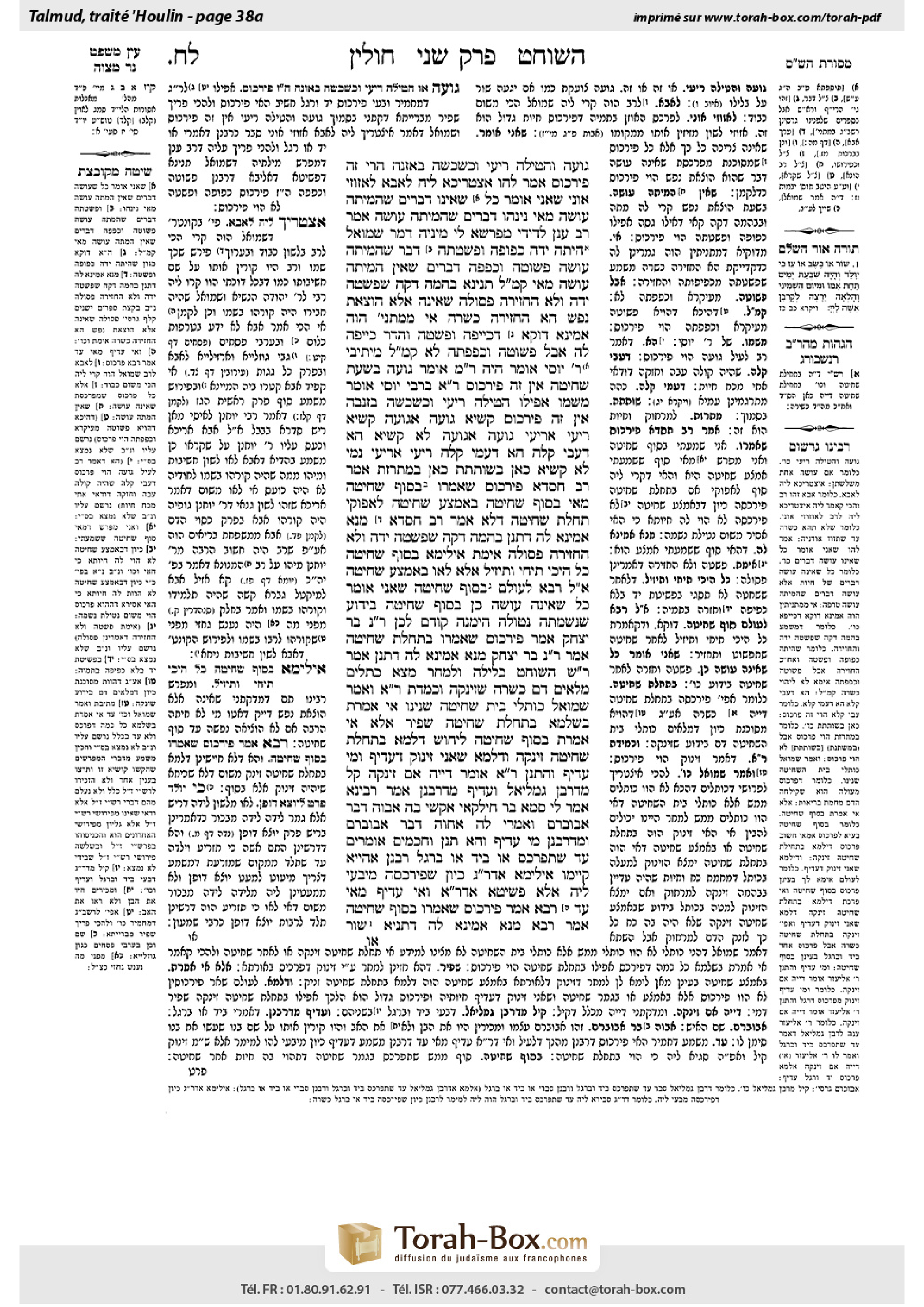
Chullin 38a: Talmud study for Daf Yomi
Study the Talmud for Daf Yomi with scanned pages, Hebrew text, English translations from Sefaria and AI-generated French translations.
Passage selection and English or AI-generated French translation are available where the scan has annotations. Daf Study is independent of Torah-Box and Sefaria.
Browse Chullin · חולין · All tractatesChullin 38a text and translations
This page of Chullin includes the Aramaic text, an English translation and an AI-generated French translation, alongside the scan above.
חולין ל״ח א · Aramaic and Hebrew text
גּוֹעָה וְהֵטִילָה רֶיעִי וְכִשְׁכְּשָׁה בְּאׇזְנָהּ – הֲרֵי זֶה פִּירְכּוּס. אֲמַר לְהוּ: אִצְטְרִיכָא לֵיהּ לְאַבָּא לְאֹזוֹזֵי אוּנֵּי, שֶׁאֲנִי אוֹמֵר כֹּל שֶׁאֵינָהּ [עוֹשָׂה] דְּבָרִים שֶׁהַמֵּתָה עוֹשָׂה.
מַאי נִינְהוּ דְּבָרִים שֶׁהַמֵּתָה עוֹשָׂה? אָמַר רַב עָנָן: לְדִידִי מִפָּרְשָׁא לִי מִינֵּיהּ דְּמָר שְׁמוּאֵל – הָיְתָה יָדָהּ כְּפוּפָה וּפְשָׁטַתָּה – דָּבָר שֶׁהַמֵּתָה עוֹשֶׂה, פְּשׁוּטָה וּכְפָפַתָּה – דְּבָרִים שֶׁאֵין הַמֵּתָה עוֹשָׂה.
מַאי קָא מַשְׁמַע לַן? תְּנֵינָא: בְּהֵמָה דַּקָּה שֶׁפָּשְׁטָה יָדָהּ וְלֹא הֶחְזִירָה – פְּסוּלָה, שֶׁאֵינָהּ אֶלָּא הוֹצָאַת נֶפֶשׁ; הָא הֶחְזִירָה – כְּשֵׁרָה.
אִי מִמַּתְנִיתִין, הֲוָה אָמֵינָא: דַּוְקָא דְּכַיְיפָה וּפָשְׁטָה וַהֲדַר כָּיְיפָה לַהּ, אֲבָל פְּשׁוּטָה וּכְפָפַתָּה – לָא, קָא מַשְׁמַע לַן.
מֵיתִיבִי: רַבִּי יוֹסֵי אוֹמֵר, הָיָה רַבִּי מֵאִיר אוֹמֵר: גּוֹעָה בִּשְׁעַת שְׁחִיטָה – אֵין זֶה פִּירְכּוּס. רַבִּי אֶלְעָזָר בְּרַבִּי יוֹסֵי אוֹמֵר מִשְּׁמוֹ: אֲפִילּוּ הֵטִילָה רֶיעִי וְכִשְׁכְּשָׁה בִּזְנָבָהּ – אֵין זֶה פִּירְכּוּס. קַשְׁיָא גּוֹעָה אַגּוֹעָה, קַשְׁיָא רֶיעִי אַרֶיעִי!
גּוֹעָה אַגּוֹעָה לָא קַשְׁיָא: הָא דְּעָבֵי קָלַהּ, הָא דְּעָמֵי קָלַהּ. רֶיעִי אַרֶיעִי נָמֵי לָא קַשְׁיָא: כָּאן בְּשׁוֹתֶתֶת, כָּאן בְּמַתְרֶזֶת.
אָמַר רַב חִסְדָּא: פִּירְכּוּס שֶׁאָמְרוּ – בְּסוֹף שְׁחִיטָה. מַאי בְּסוֹף שְׁחִיטָה? בְּאֶמְצַע שְׁחִיטָה, לְאַפּוֹקֵי תְּחִלַּת שְׁחִיטָה דְּלָא.
אָמַר רַב חִסְדָּא: מְנָא אָמֵינָא לַהּ? דִּתְנַן: בְּהֵמָה דַּקָּה שֶׁפָּשְׁטָה יָדָהּ וְלֹא הֶחְזִירָה – פְּסוּלָה. אֵימַת? אִילֵּימָא בְּסוֹף שְׁחִיטָה, כֹּל הָכִי תֵּיחֵי וְתֵיזִיל? אֶלָּא לָאו בְּאֶמְצַע שְׁחִיטָה?
אֲמַר לֵיהּ רָבָא: לְעוֹלָם בְּסוֹף שְׁחִיטָה, שֶׁאֲנִי אוֹמֵר: כֹּל שֶׁאֵינָהּ עוֹשֶׂה כֵּן בְּסוֹף שְׁחִיטָה – בְּיָדוּעַ שֶׁנִּשְׁמָתָהּ נְטוּלָה הֵימֶנָּה קוֹדֶם לָכֵן.
רַב נַחְמָן בַּר יִצְחָק אָמַר: פִּירְכּוּס שֶׁאָמְרוּ – בִּתְחִלַּת שְׁחִיטָה.
אָמַר רַב נַחְמָן בַּר יִצְחָק: מְנָא אָמֵינָא לַהּ? דִּתְנַן, אָמַר רַבִּי שִׁמְעוֹן: הַשּׁוֹחֵט בַּלַּיְלָה, וּלְמָחָר מָצָא כְּתָלִים מְלֵאִים דָּם – כְּשֵׁרָה, שֶׁזִּינְּקָה, וּכְמִדַּת רַבִּי אֱלִיעֶזֶר. וְאָמַר שְׁמוּאֵל: כּוֹתְלֵי בֵּית שְׁחִיטָה שָׁנִינוּ. אִי אָמְרַתְּ בִּשְׁלָמָא בִּתְחִלַּת שְׁחִיטָה – שַׁפִּיר, אֶלָּא אִי אָמְרַתְּ בְּסוֹף שְׁחִיטָה, לֵיחוּשׁ דִּלְמָא בִּתְחִלַּת שְׁחִיטָה זִינְּקָה.
וְדִלְמָא שָׁאנֵי זִינּוּק, דַּעֲדִיף.
וּמִי עֲדִיף? וְהָתְנַן, רַבִּי אֱלִיעֶזֶר אוֹמֵר: דַּיָּיהּ אִם זִינְּקָה, קַל מִדְּרַבָּן גַּמְלִיאֵל, וַעֲדִיף מִדְּרַבָּנַן.
אָמַר רָבִינָא: אָמַר לִי סַמָּא בַּר חִילְקַאי, אַקְשִׁי בַּהּ אֲבוּהּ דְּבַר אַבּוּבְרָם, וְאָמְרִי לַהּ אֲחוּהּ דְּבַר אַבּוּבְרָם: וּמִדְּרַבָּנַן מִי עֲדִיף? וְהָא תְּנַן: וַחֲכָמִים אוֹמְרִים: עַד שֶׁתְּפַרְכֵּס אוֹ בַיָּד אוֹ בָרֶגֶל.
רַבָּנַן אַהֵי קָיְימִי? אִילֵּימָא אַדְּרַבָּן גַּמְלִיאֵל – ״כֵּיוָן שֶׁפִּירְכְּסָה״ מִיבְּעֵי לֵיהּ!
אֶלָּא פְּשִׁיטָא אַדְּרַבִּי אֱלִיעֶזֶר, וְאִי עֲדִיף, מַאי ״עַד״?
רָבָא אָמַר: פִּירְכּוּס שֶׁאָמְרוּ – בְּסוֹף שְׁחִיטָה. אָמַר רָבָא: מְנָא אָמֵינָא לַהּ? דְּתַנְיָא: ״שׁוֹר
Chullin 38a · English translation
If the animal lows, or excreted excrement, or wiggled its ear during the slaughter, that is a convulsion, and the slaughter renders eating the flesh of the animal permitted. Shmuel said to them: Is it necessary according to Abba, i.e., Rav, for the animal to move its ears during the slaughter, which requires a considerable life force? As I say: Any movements of the animal that are not matters that the death of the animal engenders are convulsions sufficient to render the slaughter valid.
The Gemara asks: What are matters that the death of the animal engenders? Rav Anan said: This was explained to me from Master Shmuel himself: If the animal’s foreleg was bent, and the animal straightened it, that is a matter that the death of the animal engenders. But if its foreleg was straight and the animal bent it, that is among the matters that the death of the animal does not engender and is a convulsion sufficient to render the slaughter valid.
The Gemara asks: What is Shmuel teaching us with that statement? We already learn in the mishna: The slaughter of a small animal that during its slaughter extended its foreleg that was bent and did not restore it to the bent position is not valid, as extending the foreleg is nothing other than part of the natural course of removal of the animal’s soul from its body and not a convulsion indicating life. But one may infer that if the animal does restore its foreleg to the bent position, that indicates life and the slaughter is valid.
The Gemara answers: If the halakha is learned from the mishna alone, I would say that it is specifically in a case where the animal’s foreleg had been bent, and the animal now straightens it and then bends it, that the slaughter is valid. But if the foreleg had been straight and the animal bent it, the slaughter is not valid. Therefore, Shmuel teaches us that if its foreleg was straight and the animal bent it; that is a convulsion sufficient to render the slaughter valid.
The Gemara raises an objection from a baraita to Rav’s statement cited earlier. Rabbi Yosei says that Rabbi Meir would say: If an animal lows during its slaughter, that is not a convulsion sufficient to render the slaughter valid. Rabbi Elazar, son of Rabbi Yosei, says in the name of Rabbi Yosei: Even if the animal excreted excrement or wagged its tail, that is not a convulsion sufficient to render the slaughter valid. The Gemara now clarifies: Rabbi Yosei’s statement in the baraita that if an animal lows it is not a convulsion sufficient to render the slaughter valid is difficult, as it contradicts the statement of Rav that if an animal lows it is a convulsion. And Rabbi Elazar’s statement in the baraita that if an animal excreted excrement it is not a convulsion sufficient to render the slaughter valid is difficult, as it contradicts the statement of Rav that if an animal excreted excrement it is a convulsion.
The Gemara answers: The apparent contradiction between the opinion that when an animal lows it is a convulsion and the opinion that when an animal lows it is not a convulsion is not difficult. This opinion, that it is a convulsion, is referring to a case where the animal’s voice is rich and powerful, a clear indication of life; that opinion, that it is not a convulsion, is referring to a case where the animal’s voice is muted, which is not an indication of life. The apparent contradiction between the opinion that when an animal excreted excrement it is a convulsion and the opinion that when an animal excreted excrement it is not a convulsion is also not difficult. Here, the opinion that it is not a convulsion is referring to a case where the animal expels the excrement in a trickle. That is not an indication of life. There, the opinion that it is a convulsion is referring to a case where the animal expels the excrement with force. That is an indication of life.
§ The Gemara continues its definition of convulsion that indicates life. Rav Ḥisda said: I was taught that the convulsion that the Sages said is an indication of life is a convulsion at the conclusion of the act of slaughter. Rav Ḥisda elaborates: What is the meaning of: At the conclusion of the act of slaughter? It means even in the midst of the slaughter. The Sages said that it must be at the conclusion of the slaughter only to exclude convulsions at the beginning of the act of slaughter, which are not an indication of life.
Rav Ḥisda said: From where do I say that a convulsion in the midst of the act of slaughter is an indication of life? It is from the mishna, as we learned: The slaughter of a small animal that when being slaughtered extended its foreleg that was bent and did not restore it to the bent position is not valid, as extending the foreleg is only part of the natural course of removal of the animal’s soul from its body and not a convulsion indicating life. Rav Ḥisda elaborates: When did the animal extend its foreleg but not restore it? If we say that it occurred at the conclusion of the slaughter, must the animal continue living for so extended a period that it restores its leg to its bent position after the slaughter is complete? Is the slaughter truly not valid otherwise? Rather, is it not that the mishna is referring to a case where the animal extends its foreleg in the middle of the slaughter? If so, then when it restores its leg as well, it is considered a convulsion that indicates life.
Rava said to Rav Ḥisda: That is no proof. Actually, one could explain that the mishna is referring to a case where the animal extends its foreleg but did not restore it to the bent position at the conclusion of the slaughter, as I say with regard to any animal that does not do so at the conclusion of the slaughter, it is known that its soul was taken from it before that moment, and it was not alive.
Rav Naḥman bar Yitzḥak said: The convulsion that the Sages said is an indication of life is a convulsion even at the beginning of the act of slaughter.
Rav Naḥman bar Yitzḥak explained further and said: From where do I say that this is so? It is from the mishna, as we learned that Rabbi Shimon says: In the case of one who slaughters at night and the next day he awoke and found walls full of blood, the slaughter is valid, as it is clear that the blood spurted, and this is in accordance with the ruling of Rabbi Eliezer. And Shmuel said with regard to the walls mentioned in the statement of Rabbi Shimon: It is the walls of the place of the slaughter, i.e., the walls of the neck, not the walls of the house, that we learned. Granted, if you say that a convulsion even at the beginning of the act of slaughter is an indication of life, this works out well. But if you say that a convulsion is an indication of life only at the conclusion of the act of slaughter, let us be concerned that perhaps the blood spurted onto the walls of the neck at the beginning of the act of slaughter, and there was no indication of life.
The Gemara rejects that proof. But perhaps spurting is different, as it is superior as an indication of life to extending or bending a foreleg, and therefore, although extending or bending a foreleg is a sufficient indicator of life only at the conclusion of the act of slaughter, spurting is a sufficient indicator even at the beginning of the act of slaughter.
The Gemara asks: And is spurting superior? But didn’t we learn in the mishna: Rabbi Eliezer says it is sufficient if blood spurted from the neck, indicating that spurting of blood is a less substantive indication of life than those indications mentioned in the statement of Rabban Gamliel, who requires that the animal convulse with its foreleg and with its hind leg? The Gemara answers: Rabbi Eliezer’s requirement of spurting is less substantive than the requirements of Rabban Gamliel as an indication of life, but superior to the requirement of the Rabbis as an indication of life, where the Rabbis require that the animal convulse either with its foreleg or with its hind leg.
Ravina said: Samma bar Ḥilkai said to me that the father of bar Abuveram, and some say that it was the brother of bar Abuveram, raises a difficulty: And is blood spurting superior to the requirement of the Rabbis as an indication of life? But didn’t we learn in the mishna: And the Rabbis say: It is permitted only in a case where it convulses with its foreleg or with its hind leg, or in a case where it wags its tail?
Ravina elaborates: To which statement of the tanna’im in the mishna do the Rabbis stand and respond? If we say that they are responding to the statement of Rabban Gamliel, who requires that the animal convulse with its foreleg and with its hind leg, the Rabbis should have said: Once the animal convulsed with its foreleg or with its hind leg or it wagged its tail, indicating that this is sufficient.
Rather, it is obvious that the Rabbis are responding to the statement of Rabbi Eliezer. And if Rabbi Eliezer’s opinion is superior to that of the Rabbis as an indication of life, what is the meaning of: It is permitted only in a case where it convulses with its foreleg or with its hind leg or it wags its tail? In that case too, the Rabbis should have said: Once the animal convulses with its foreleg or with its hind leg or it wags its tail. Apparently, blood spurting is a less substantive indication of life, and the proof of Rav Naḥman bar Yitzḥak remains valid: If spurting at the beginning of the act of slaughter is a sufficient indication of life to render the slaughter valid, then all the more so, extending and bending a limb are also sufficient indications of life.
Rava said: The convulsion that the Rabbis said is an indication of life is a convulsion at the conclusion of the act of slaughter. Rava said: From where do I say that this is the case? It is as it is taught in a baraita with regard to the verse: “When a bull or a sheep or a goat is born, it shall be seven days under its mother; and from the eighth day and onward it may be accepted for an offering to the Lord” (Leviticus 22:27). The phrase “a bull
Chullin 38a · Traduction française (IA)
Si l'animal mugit, ou défèque, ou remue son oreille pendant l'abattage, c'est un tremblement, et l'abattage rend la consommation de la viande de l'animal permise. Shmuel dit à ceux-ci : Faut-il selon Abba, c'est-à-dire Rav, que l'animal remue ses oreilles pendant l'abattage, ce qui exige une force vitale considérable ? Je dis : Toute mouvement de l'animal qui n'est pas lié à la mort de l'animal est un tremblement suffisant pour rendre l'abattage valide.
La Guemara demande : Quels sont les mouvements liés à la mort de l'animal ? Rav Anan dit : Cela m'a été expliqué par le maître Shmuel lui-même : Si la patte avant de l'animal était courbée, et l'animal la redressait, c'est un mouvement lié à la mort de l'animal. Mais si sa patte avant était droite et l'animal la courbait, c'est un mouvement non lié à la mort de l'animal et suffisant pour rendre l'abattage valide.
La Guemara demande : Quel enseignement Shmuel nous transmet-il avec cette déclaration ? Nous apprenons déjà dans la mitsva : L'abattage d'un petit animal qui, pendant son abattage, étendait sa patte avant qui était courbée et ne la redressait pas à nouveau n'est pas valide, car étendre la patte avant n'est autre que partie du processus naturel de retrait de l'âme de l'animal de son corps et non un tremblement indiquant la vie. On peut en déduire que si l'animal restaure sa patte avant à la position courbée, cela indique la vie et l'abattage est valide.
La Guemara répond : Si la halakha est apprise uniquement à partir de la mitsva, je dirais qu'il s'agit spécifiquement d'un cas où la patte avant de l'animal avait été droite, et l'animal la courbe puis la redresse, et l'abattage est valide. Mais si la patte avant était courbée et l'animal la redressait, l'abattage n'est pas valide. Ainsi, Shmuel nous enseigne que si sa patte avant était droite et l'animal la courbait, c'est un tremblement suffisant pour rendre l'abattage valide.
La Guemara soulève un objet contre l'affirmation de Rav citée plus tôt. Rabbi Yosei dit que Rabbi Meir dirait : Si un animal mugit pendant son abattage, cela n'est pas un tremblement suffisant pour rendre l'abattage valide. Rabbi Elazar, fils de Rabbi Yosei, dit en nom de Rabbi Yosei : Même si l'animal défèque ou remue sa queue, cela n'est pas un tremblement suffisant pour rendre l'abattage valide. La Guemara clarifie maintenant : L'affirmation de Rabbi Yosei dans la baraïta que si un animal mugit, cela n'est pas un tremblement suffisant pour rendre l'abattage valide est difficile, car elle contredit l'affirmation de Rav que si un animal mugit, cela est un tremblement. Et l'affirmation de Rabbi Elazar dans la baraïta que si un animal défèque, cela n'est pas un tremblement suffisant pour rendre l'abattage valide est difficile, car elle contredit l'affirmation de Rav que si un animal défèque, cela est un tremblement.
La Guemara répond : La contradiction apparente entre l'opinion selon laquelle un animal qui mugit est un tremblement et l'opinion selon laquelle un animal qui mugit n'est pas un tremblement n'est pas difficile. Cette opinion, selon laquelle c'est un tremblement, fait référence à un cas où la voix de l'animal est puissante et riche, un signe clair de vie ; cette opinion, selon laquelle ce n'est pas un tremblement, fait référence à un cas où la voix de l'animal est étouffée, ce qui n'est pas un signe de vie. La contradiction apparente entre l'opinion selon laquelle un animal qui défèque est un tremblement et l'opinion selon laquelle un animal qui défèque n'est pas un tremblement n'est pas non plus difficile. Ici, l'opinion selon laquelle ce n'est pas un tremblement fait référence à un cas où l'animal expulse les déjections en filet, ce qui n'est pas un signe de vie. Là, l'opinion selon laquelle c'est un tremblement fait référence à un cas où l'animal expulse les déjections avec force, ce qui est un signe de vie.
§ La Guemara continue sa définition du tremblement indiquant la vie. Rav Ḥisda dit : J'ai été enseigné que le tremblement que les Sages ont dit être un signe de vie est un tremblement à la fin de l'acte d'abattage. Rav Ḥisda développe : Qu'entend-on par : à la fin de l'acte d'abattage ? Cela signifie même au milieu de l'abattage. Les Sages ont dit qu'il doit être à la fin de l'abattage uniquement pour exclure les tremblements au début de l'acte d'abattage, qui ne sont pas un signe de vie.
Rav Ḥisda dit : D'où dis-je que le tremblement au milieu de l'acte d'abattage est un signe de vie ? C'est de la mitsna, comme nous avons appris : L'abattage d'un petit animal qui, pendant son abattage, étendait sa patte avant qui était courbée et ne la redressait pas à nouveau n'est pas valide, car étendre la patte avant n'est qu'une partie du processus naturel de retrait de l'âme de l'animal de son corps et non un tremblement indiquant la vie. Rav Ḥisda développe : Quand l'animal a étendu sa patte avant mais ne l'a pas redressée ? Si nous disons que cela s'est produit à la fin de l'abattage, doit-il continuer à vivre pendant une période aussi longue qu'il faut pour redresser sa patte après l'abattage ? L'abattage n'est-il pas vraiment invalide autrement ? Plutôt, n'est-ce pas que la mitsna fait référence à un cas où l'animal a étendu sa patte avant au milieu de l'abattage ? Si tel est le cas, alors quand il redresse sa patte, cela est considéré comme un tremblement indiquant la vie.
Rava dit à Rav Ḥisda : Cela n'est pas une preuve. En réalité, on pourrait expliquer que la mitsna fait référence à un cas où l'animal étend sa patte avant mais ne la redresse pas à la fin de l'abattage, comme je le dis concernant tout animal qui ne le fait pas à la fin de l'abattage, il est connu que son âme a été prise avant ce moment, et il n'était pas vivant.
Rav Naḥman bar Yitzḥak dit : Le tremblement que les Sages ont dit être un signe de vie est un tremblement même au début de l'acte d'abattage.
Rav Naḥman bar Yitzḥak explique davantage et dit : D'où dis-je que cela est ainsi ? C'est d'après la mitsna, comme nous avons appris que Rabbi Shimon dit : Dans le cas d'une personne qui sacrifie la nuit et qu'il se réveille le lendemain et trouve des murs pleins de sang, la sacrifice est valide, car il est clair que le sang a jailli, et cela est conforme à la décision de Rabbi Eliezer. Et Shmuel dit concernant les murs mentionnés dans la déclaration de Rabbi Shimon : Ce sont les murs du lieu de la sacrifice, c'est-à-dire les murs du cou, pas les murs de la maison, que nous avons appris. Admettons que vous disiez qu'une convulsion même au début de l'acte de sacrifice est un signe de vie, cela s'explique bien. Mais si vous disiez qu'une convulsion est un signe de vie uniquement à la fin de l'acte de sacrifice, faisons-nous attention à ce que le sang ait jailli sur les murs du cou au début de l'acte de sacrifice, et qu'il n'y ait pas eu de signe de vie.
La Guemara rejette cette preuve. Mais peut-être le jaillissement est différent, car il est supérieur comme signe de vie à l'étirement ou à la flexion d'une patte, et donc, bien que l'étirement ou la flexion d'une patte soit un signe suffisant de vie uniquement à la fin de l'acte de sacrifice, le jaillissement est un signe suffisant même au début de l'acte de sacrifice.
La Guemara pose la question : Et le jaillissement est-il supérieur ? Mais n'avons-nous pas appris dans la Michna : Rabbi Eliezer dit qu'il suffit que le sang jaillisse du cou, indiquant que le jaillissement du sang est un signe moins substantiel de vie que ceux mentionnés dans la déclaration de Rabban Gamliel, qui exige que l'animal convulse avec ses pattes avant et arrière ? La Guemara répond : La condition de Rabbi Eliezer concernant le jaillissement est moins substantielle que les conditions de Rabban Gamliel comme signe de vie, mais supérieure aux conditions des Rabbins comme signe de vie, où les Rabbins exigent que l'animal convulse soit avec sa patte avant soit avec sa patte arrière.
Ravina dit : Samma bar Ḥilkai me l'a dit que le père de bar Abuveram, et certains disent que c'était le frère de bar Abuveram, soulève un problème : Et le jaillissement est-il supérieur aux conditions des Rabbins comme signe de vie ? Mais n'avons-nous pas appris dans la Michna : Et les Rabbins disent : C'est permis uniquement dans le cas où l'animal convulse avec sa patte avant ou avec sa patte arrière ou s'il agite sa queue ?
Ravina développe : À quelle déclaration des tannaïm dans la Michna les Rabbins répondent-ils ? Si nous disons qu'ils répondent à la déclaration de Rabban Gamliel, qui exige que l'animal convulse avec sa patte avant et avec sa patte arrière, les Rabbins auraient dû dire : Une fois que l'animal a convulsé avec sa patte avant ou avec sa patte arrière ou qu'il a agité sa queue, indiquant que cela suffit.
Plutôt, il est évident que les Rabbins répondent à la déclaration de Rabbi Eliezer. Et si l'opinion de Rabbi Eliezer est supérieure à celle des Rabbins comme signe de vie, quelle est la signification de : C'est permis uniquement dans le cas où l'animal convulse avec sa patte avant ou avec sa patte arrière ou s'il agite sa queue ? Dans ce cas également, les Rabbins auraient dû dire : Une fois que l'animal convulse avec sa patte avant ou avec sa patte arrière ou s'il agite sa queue. Apparemment, le jaillissement du sang est un signe moins substantiel de vie, et la preuve de Rav Naḥman bar Yitzḥak reste valide : Si le jaillissement au début de l'acte de sacrifice est un signe suffisant de vie pour rendre le sacrifice valide, alors encore davantage, l'étirement et la flexion d'un membre sont également des signes suffisants de vie.
Rava dit : La convulsion que les Rabbins ont dit être un signe de vie est une convulsion à la fin de l'acte de sacrifice. Rava dit : D'où dis-je que cela est ainsi ? C'est comme il est enseigné dans une baraïta concernant la parole : « Quand un taureau ou un agneau ou un bouc est né, il restera sept jours avec sa mère ; et à partir du huitième jour et au-delà, il peut être accepté comme offrande à l'Éternel » (Lévitique 22:27). La phrase « un taureau »
Traduction française générée par IA à partir de l’édition anglaise de Sefaria. Vérifie toujours un passage avec le texte source.
Text from Sefaria: William Davidson Edition - Vocalized Aramaic (unknown); William Davidson Edition - English (CC BY NC).