Chullin 40a: Talmud study for Daf Yomi
Study the Talmud for Daf Yomi with scanned pages, Hebrew text, English translations from Sefaria and AI-generated French translations.
Passage selection and English or AI-generated French translation are available where the scan has annotations. Daf Study is independent of Torah-Box and Sefaria.
Browse Chullin · חולין · All tractatesChullin 40a text and translations
This page of Chullin includes the Aramaic text, an English translation and an AI-generated French translation, alongside the scan above.
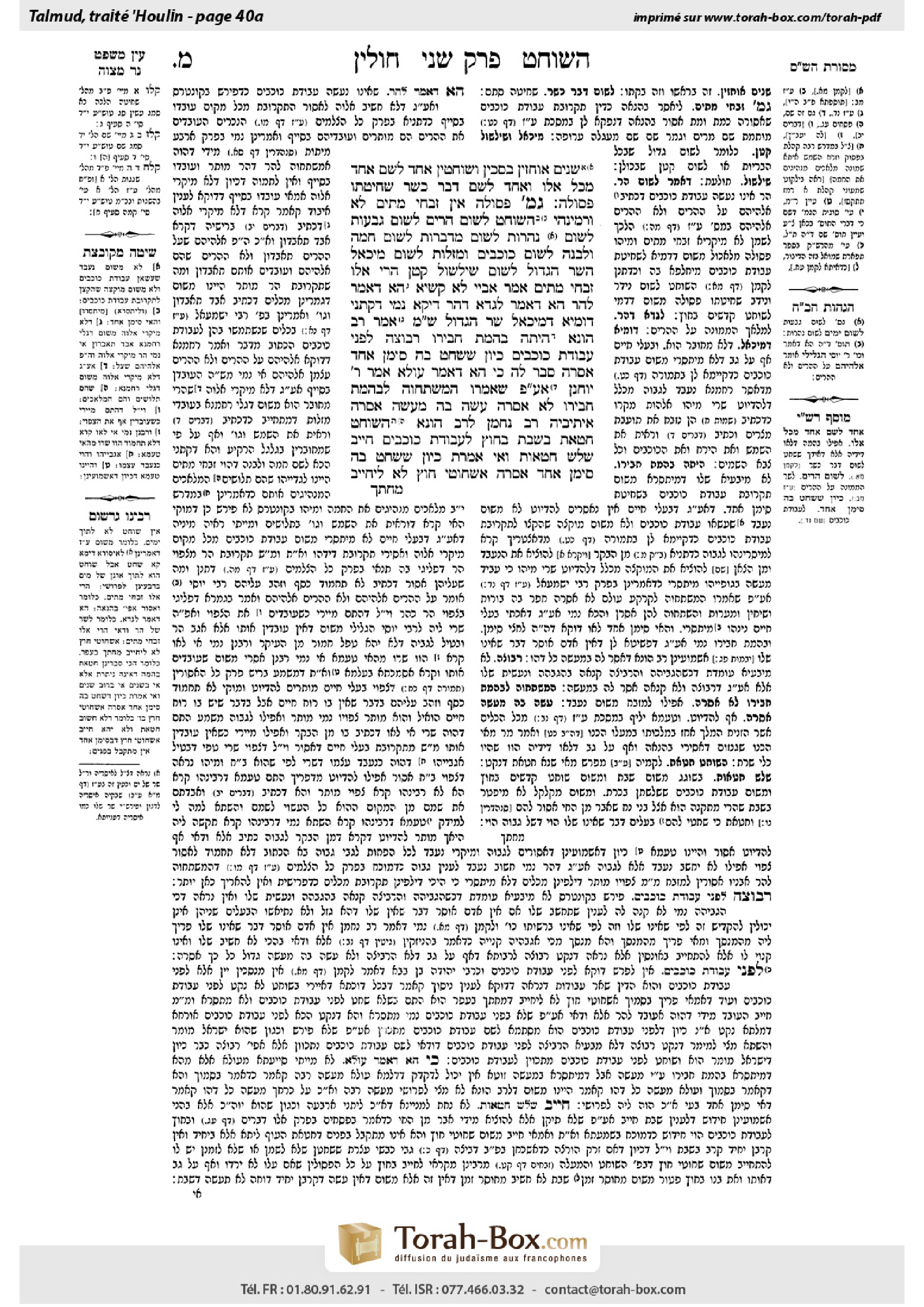
חולין מ׳ א · Aramaic and Hebrew text
שְׁנַיִם אוֹחֲזִין בְּסַכִּין וְשׁוֹחֲטִין, אֶחָד לְשֵׁם אֶחָד מִכׇּל אֵלּוּ וְאֶחָד לְשֵׁם דָּבָר כָּשֵׁר – שְׁחִיטָתוֹ פְּסוּלָה.
גְּמָ׳ פְּסוּלָה – אִין, זִבְחֵי מֵתִים – לָא. וּרְמִינְהִי: הַשּׁוֹחֵט לְשׁוּם הָרִים, לְשׁוּם גְּבָעוֹת, לְשׁוּם נְהָרוֹת, לְשׁוּם מִדְבָּרוֹת, לְשׁוּם חַמָּה וּלְבָנָה, לְשׁוּם כּוֹכָבִים וּמַזָּלוֹת, לְשׁוּם מִיכָאֵל הַשַּׂר הַגָּדוֹל, לְשׁוּם שִׁילְשׁוּל קָטָן – הֲרֵי אֵלּוּ זִבְחֵי מֵתִים.
אָמַר אַבָּיֵי: לָא קַשְׁיָא, הָא דְּאָמַר לְהַר, הָא דְּאָמַר לְגַדָּא דְּהַר. דַּיְקָא נָמֵי, דְּקָתָנֵי דּוּמְיָא דְּמִיכָאֵל שַׂר הַגָּדוֹל, שְׁמַע מִינַּהּ.
אָמַר רַב הוּנָא: הָיְתָה בֶּהֱמַת חֲבֵירוֹ רְבוּצָה לִפְנֵי עֲבוֹדָה זָרָה, כֵּיוָן שֶׁשָּׁחַט בָּהּ סִימָן אֶחָד – אֲסָרָהּ. סָבַר לַהּ כִּי הָא דְּאָמַר עוּלָּא אָמַר רַבִּי יוֹחָנָן: אַף עַל פִּי שֶׁאָמְרוּ הַמִּשְׁתַּחֲוֶה לְבֶהֱמַת חֲבֵירוֹ לֹא אֲסָרָהּ, עָשָׂה בָּהּ מַעֲשֶׂה – אֲסָרָהּ.
אֵיתִיבֵיהּ רַב נַחְמָן לְרַב הוּנָא: הַשּׁוֹחֵט חַטָּאת בְּשַׁבָּת בַּחוּץ לַעֲבוֹדָה זָרָה – חַיָּיב שָׁלֹשׁ חַטָּאוֹת, וְאִי אָמְרַתְּ: כֵּיוָן שֶׁשָּׁחַט בָּהּ סִימָן אֶחָד אֲסָרָהּ – אַשְּׁחוּטֵי חוּץ לָא לִיחַיַּיב,
Chullin 40a · English translation
If there were two people grasping a knife together and slaughtering an animal, one slaughtering for the sake of one of all those enumerated in the first clause of the mishna and one slaughtering for the sake of a legitimate matter, their slaughter is not valid.
GEMARA: The mishna states that if one slaughters for the sake of mountains or other natural entities the slaughter is unfit. The Gemara infers: It is unfit, yes; with regard to offerings to the dead, i.e., to idols, it is not in that category. Apparently, the status of the animal is that of an unslaughtered carcass, from which benefit is permitted, and not that of an idolatrous offering, from which benefit is forbidden. And the Gemara raises a contradiction from a baraita: With regard to one who slaughters for the sake of mountains, for the sake of hills, for the sake of rivers, for the sake of wildernesses, for the sake of the sun and moon, for the sake of stars and constellations, for the sake of Michael the great ministering angel, or even for the sake of a small worm, these are offerings to the dead, from which benefit is forbidden.
Abaye said: The apparent contradiction between the mishna and the baraita is not difficult. This mishna that teaches that the slaughter is not valid but benefit is permitted is referring to a case where one says that he is slaughtering the animal for the sake of the mountain itself, which is not an idol. That baraita that teaches that the animal is an offering to the dead and benefit is forbidden is referring to a case where one says that he is slaughtering the animal for the sake of the angel of the mountain. The language of the baraita is also precise, as the mountain and the other natural entities are taught together with and therefore similar to Michael, the great ministering angel. Conclude from it that the tanna is referring to slaughter for the sake of a spiritual entity, not the mountain itself.
Rav Huna says: If the animal of another was prone before an idol, once one cut one siman, the windpipe or the gullet, he rendered the animal forbidden. He holds in accordance with that which Ulla says that Rabbi Yoḥanan says: Although the Sages said that one who bows to the animal of another does not render it forbidden, if he performed a sacrificial rite upon it he renders it forbidden. The case cited by Rav Huna involves an action of that kind, cutting one siman; therefore, the animal is forbidden.
Rav Naḥman raised an objection to the opinion of Rav Huna from a baraita: One who unwittingly slaughters an animal that was designated as a sin offering on Shabbat outside the Temple, for idol worship, is liable to bring three sin offerings: One for performing the prohibited labor of slaughtering on Shabbat, one for slaughtering a sacrificial animal outside the Temple, and one for slaughtering an animal for idol worship. And if you say that once he cuts one siman he renders the animal forbidden as an idolatrous offering, then let him not be liable to bring a sin offering for slaughter of a sacrificial animal outside the Temple courtyard,
Chullin 40a · Traduction française (IA)
Si deux personnes saisissent ensemble un couteau pour sacrifier un animal, l'une sacrifiant pour le compte d'un des personnages énumérés dans la première clause de la mitsva et l'autre sacrifiant pour une affaire légitime, leur sacrifice n'est pas valide.
GUEMARA : La mitsva indique que si l'on sacrifie pour le compte des montagnes ou d'autres entités naturelles, le sacrifice est invalide. La Guemara conclut : Il est invalide, certes ; mais en ce qui concerne les offrandes aux morts, c'est-à-dire aux idoles, cela n'appartient pas à cette catégorie. Apparemment, le statut de l'animal est celui d'un cadavre non sacrifié, duquel on peut tirer un bénéfice, et non celui d'une offrande idolâtre, duquel on ne peut tirer de bénéfice. La Guemara soulève alors une contradiction à partir d'une baraïta : En ce qui concerne celui qui sacrifie pour le compte des montagnes, des collines, des rivières, des déserts, du soleil et de la lune, des étoiles et des constellations, de l'ange Michaël, le grand ministre, ou même pour le compte d'un petit ver, ces sacrifices sont des offrandes aux morts, duquel on ne peut tirer de bénéfice.
Abaye dit : La contradiction apparente entre la mitsva et la baraïta n'est pas difficile. Cette mitsva qui enseigne que le sacrifice n'est pas valide mais que le bénéfice est permis fait référence à un cas où l'on dit qu'on sacrifie l'animal pour le compte de la montagne elle-même, ce qui n'est pas une idole. Cette baraïta qui enseigne que l'animal est une offrande aux morts et que le bénéfice est interdit fait référence à un cas où l'on dit qu'on sacrifie l'animal pour le compte de l'ange de la montagne. La formulation de la baraïta est précise, car la montagne et les autres entités naturelles sont enseignées ensemble avec et donc comparables à Michaël, le grand ministre. On en conclut que le tanna fait référence à un sacrifice pour le compte d'une entité spirituelle, pas pour la montagne elle-même.
Rav Huna dit : Si l'animal d'autrui était exposé devant une idole, une fois qu'on a coupé un siman, le cou ou le gosier, on rend l'animal interdit. Il suit l'opinion de Ulla selon laquelle Rabbi Yoḥanan dit : Bien que les Sages aient dit que celui qui s'incline devant l'animal d'autrui ne le rend pas interdit, si l'on a accompli un rite sacré sur lui, on le rend interdit. Le cas cité par Rav Huna implique une telle action, à savoir couper un siman ; par conséquent, l'animal est interdit.
Rav Naḥman a soulevé une objection contre l'opinion de Rav Huna à partir d'une baraïta : Celui qui sacrifie accidentellement un animal désigné comme offrande expiatoire le sabbat en dehors du Temple, pour l'idolâtrie, est tenu de présenter trois offrandes expiatoires : une pour avoir accompli le travail interdit de sacrifier le sabbat, une pour avoir sacrifié un animal sacré en dehors du Temple, et une pour avoir sacrifié un animal pour l'idolâtrie. Et si l'on dit que dès qu'il coupe un siman, il rend l'animal interdit comme offrande idolâtre, alors qu'il ne devrait pas être tenu de présenter une offrande expiatoire pour le sacrifice d'un animal en dehors du cour du Temple.
Traduction française générée par IA à partir de l’édition anglaise de Sefaria. Vérifie toujours un passage avec le texte source.
Text from Sefaria: William Davidson Edition - Vocalized Aramaic (unknown); William Davidson Edition - English (CC BY NC).