Chullin 40b: Talmud study for Daf Yomi
Study the Talmud for Daf Yomi with scanned pages, Hebrew text, English translations from Sefaria and AI-generated French translations.
Passage selection and English or AI-generated French translation are available where the scan has annotations. Daf Study is independent of Torah-Box and Sefaria.
Browse Chullin · חולין · All tractatesChullin 40b text and translations
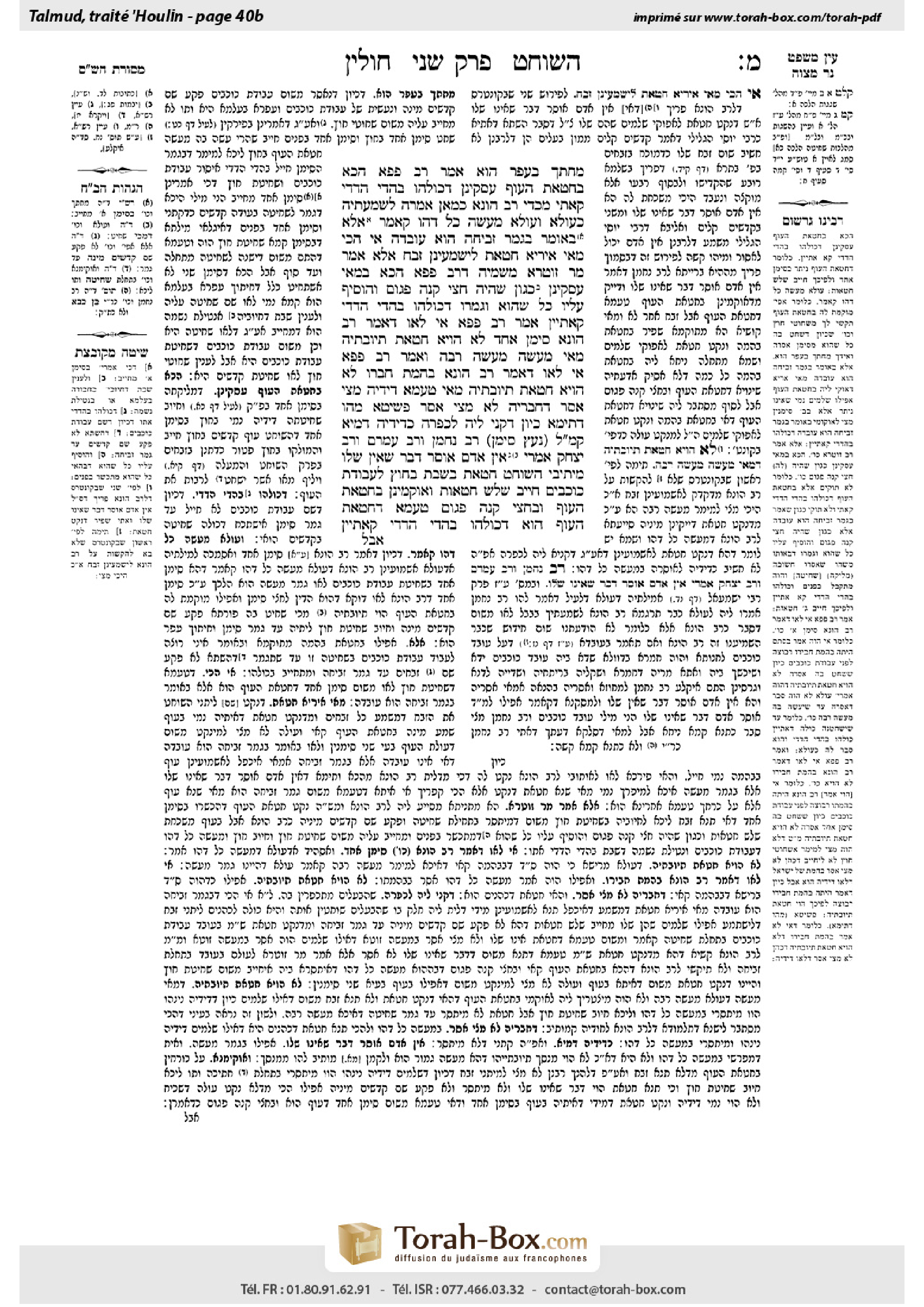
This page of Chullin includes the Aramaic text, an English translation and an AI-generated French translation, alongside the scan above.
חולין מ׳ ב · Aramaic and Hebrew text
מְחַתֵּךְ בְּעָפָר הוּא! אָמַר רַב פָּפָּא: הָכָא בְּחַטַּאת הָעוֹף עָסְקִינַן, דְּכוּלְּהוּ בַּהֲדֵי הֲדָדֵי קָאָתֵי.
מִכְּדֵי רַב הוּנָא כְּמַאן אַמְרַהּ לִשְׁמַעְתֵּיהּ? כְּעוּלָּא, וְעוּלָּא מַעֲשֶׂה כֹּל דְּהוּ קָאָמַר.
אֶלָּא, בְּאוֹמֵר בִּגְמַר זְבִיחָה הוּא עוֹבְדָהּ.
אִי הָכִי, מַאי אִירְיָא חַטָּאת? לַישְׁמְעִינַן זֶבַח!
אֶלָּא אָמַר מָר זוּטְרָא מִשְּׁמֵיהּ דְּרַב פָּפָּא: הָכָא בְּמַאי עָסְקִינַן? כְּגוֹן שֶׁהָיָה חֲצִי קָנֶה פָּגוּם, וְהוֹסִיף עָלָיו כׇּל שֶׁהוּא וּגְמָרוֹ, דְּכוּלְּהוּ בַּהֲדֵי הֲדָדֵי קָאָתְיָין.
אָמַר רַב פָּפָּא: אִי לָאו דְּאָמַר רַב הוּנָא סִימָן אֶחָד, לָא הָוְיָא חַטָּאת תְּיוּבְתֵּיהּ. מַאי מַעֲשֶׂה? מַעֲשֶׂה רַבָּה.
וְאָמַר רַב פָּפָּא: אִי לָאו דְּאָמַר רַב הוּנָא בֶּהֱמַת חֲבֵרוֹ, לָא הָוְיָא חַטָּאת תְּיוּבְתֵּיהּ. מַאי טַעְמָא? דִּידֵיהּ מָצֵי אָסַר, דְּחַבְרֵיהּ לָא מָצֵי אָסַר.
פְּשִׁיטָא! מַהוּ דְּתֵימָא: כֵּיוָן דְּקָנֵי לֵיהּ לְכַפָּרָה – כְּדִידֵיהּ דָּמְיָא, קָא מַשְׁמַע לַן.
(נָעַ״ץ – סִימָן.) רַב נַחְמָן, וְרַב עַמְרָם, וְרַב יִצְחָק אָמְרִי: אֵין אָדָם אוֹסֵר דָּבָר שֶׁאֵין שֶׁלּוֹ.
מֵיתִיבִי: הַשּׁוֹחֵט חַטָּאת בַּשַּׁבָּת בַּחוּץ לַעֲבוֹדָה זָרָה – חַיָּיב שָׁלֹשׁ חַטָּאוֹת, וְאוֹקִימְנָא בְּחַטַּאת הָעוֹף וּבַחֲצִי קָנֶה פָּגוּם. טַעְמָא דְּחַטַּאת הָעוֹף הוּא, דְּכוּלְּהוּ בַּהֲדֵי הֲדָדֵי קָאָתְיָין,
Chullin 40b · English translation
as it is as though he is merely chopping in dirt, since one is not liable for slaughtering outside the Temple courtyard a sacrificial animal unfit for sacrifice. Rav Pappa said: Here we are dealing with a bird sin offering, for which the requirement is to cut only one siman, and when cutting that siman, all of the three prohibitions come to be violated simultaneously.
The Gemara asks: Now in accordance with whose opinion did Rav Huna state his halakha? It is in accordance with the opinion of Ulla, who says: If he performed a sacrificial rite upon the animal, he renders it forbidden. And Ulla says that a minimal action renders the animal forbidden, as his ruling applies even to cutting one siman. According to Ulla’s opinion, the moment that he begins the incision, the animal is forbidden and unfit to be sacrificed. Consequently, when he completes the slaughter outside the Temple, it is as though he is chopping dirt. Why then is he liable to bring a sin offering for slaughter of a sacrificial animal outside the Temple courtyard?
The Gemara answers: Rather, the baraita is referring to a case where one says prior to the slaughter that he is worshipping the idol only at the conclusion of the slaughter; therefore, only then is the animal rendered forbidden, and one is liable for all three sin offerings simultaneously.
The Gemara asks: If so, why does the tanna teach the halakha specifically with regard to a sin offering? Let him teach us the halakha with regard to any type of offering. According to Rav Pappa, by contrast, it is clear why the tanna taught the halakha with regard to a sin offering.
The Gemara returns to Rav Pappa’s interpretation of the baraita as referring to the case of a bird sin offering. The previous difficulty then resurfaces, that the bird was rendered forbidden before the slaughter was completed, as according to Rav Huna and Ulla any minimal action renders the bird forbidden. Rather, Mar Zutra said in the name of Rav Pappa: What are we dealing with here in the baraita? It is a case where half of the windpipe was deficient before the slaughter, and the slaughterer added to that deficiency an incision of any size, and completed it. The minority of the windpipe had been cut before the slaughterer cut it further, completing the act of slaughter. As in that case all of the three prohibitions come to be violated simultaneously.
Rav Pappa said: If not for the fact that Rav Huna said that it is sufficient to cut one siman on the animal for idol worship to render it forbidden, the fact that the baraita mentions a sin offering specifically would not raise a difficulty for his opinion. In that case, one could explain: What is the action that renders the animal forbidden according to Ulla? It is a significant action, i.e., completion of the slaughter for idol worship, that renders the animal forbidden.
And Rav Pappa said: If not for the fact that Rav Huna stated his halakha specifically with regard to the animal of another, the fact that the baraita mentions specifically a sin offering would not raise a difficulty for his opinion. One could then explain: What is the reason that the animal designated as a sin offering is not rendered forbidden at the beginning of the slaughter? It is due to the fact that one is able to render his animal forbidden, but one is not able to render the animal of another forbidden. It is the priests who are entitled to derive benefit from the flesh of a sin offering.
The Gemara objects: That is obvious. The Gemara explains: Rav Pappa needs to state this, lest you say that since one who brings a sin offering acquires the animal for his atonement, its status is like that of an animal that is his. Therefore, Rav Pappa teaches us that this does not suffice that the animal be considered his.
The Gemara provides a mnemonic for the names of the amora’im who participate in the discussion that ensues: Nun, Rav Naḥman; ayin, Rav Amram; tzadi, Rav Yitzḥak. Rav Naḥman, and Rav Amram, and Rav Yitzḥak all say: A person does not render forbidden an item that is not his.
The Gemara raises an objection from a baraita: One who unwittingly slaughters an animal that was designated as a sin offering on Shabbat outside the Temple for idol worship is liable to bring three sin offerings. And we interpreted the baraita as being in the case of a bird sin offering, and in a case where half of the windpipe was deficient. The reason for the triple liability is that it is a bird sin offering, as then, all of the three prohibitions come to be violated simultaneously.
Chullin 40b · Traduction française (IA)
car c'est comme s'il ne faisait qu'entailler la boue, puisqu'on n'est pas tenu de sacrifier un animal impur en dehors du courtyard du Temple. Rav Pappa dit : nous sommes ici en présence d'un oiseau sacrifice expiatoire, pour lequel la condition est de couper seulement un siman, et lorsqu'on coupe ce siman, les trois prohibitions sont en même temps transgressées.
La Guemara pose la question : selon l'opinion de qui a-t-il exprimé son halakha Rav Huna ? C'est selon l'opinion d'Ulla, qui dit : si l'on a accompli un rite sacré sur l'animal, il devient interdit. Et Ulla dit que même une action minimale rend l'animal interdit, car sa décision s'applique même à la coupe d'un seul siman. Selon l'opinion d'Ulla, dès qu'il commence l'incision, l'animal est interdit et inadapté à la sacrifice. Ainsi, lorsqu'il termine la bête en dehors du Temple, c'est comme s'il taillait de la boue. Pourquoi alors est-il tenu de présenter un sacrifice expiatoire pour la bête sacrifiée en dehors du courtyard du Temple ?
La Guemara répond : plutôt, la baraïta fait référence à un cas où l'on dit avant le sacrifice qu'on adore l'idole seulement à la fin du sacrifice ; donc, seulement alors l'animal devient interdit, et l'on est tenu des trois sacrifices expiatoires simultanément.
La Guemara pose la question : si c'est ainsi, pourquoi le tanna enseigne-t-il spécifiquement la halakha concernant un sacrifice expiatoire ? Laissez-le nous enseigner la halakha concernant n'importe quel type de sacrifice. Selon Rav Pappa, par contre, il est clair pourquoi le tanna a enseigné la halakha concernant un sacrifice expiatoire.
La Guemara revient à l'interprétation de Rav Pappa concernant la baraïta faisant référence au cas d'un oiseau sacrifice expiatoire. La difficulté précédente ressurgit alors, à savoir que l'oiseau était rendu interdit avant la fin du sacrifice, selon Rav Huna et Ulla, toute action minimale rend l'oiseau interdit. Plutôt, Mar Zutra a dit en nom de Rav Pappa : de quoi s'agit-il dans la baraïta ? C'est un cas où la moitié du trachée était déficiente avant le sacrifice, et le bêteur a ajouté à cette déficience une incision de toute taille, et l'a achevée. La moitié restante de la trachée avait été coupée avant que le bêteur ne la coupe davantage, achevant l'acte de sacrifice. Ainsi, dans ce cas, toutes les trois prohibitions sont en même temps transgressées.
Rav Pappa dit : si ce n'était pas pour le fait que Rav Huna a dit que couper un seul siman sur l'animal suffit à rendre l'idole interdite, la mention spécifique du sacrifice expiatoire dans la baraïta ne poserait pas de difficulté pour son opinion. Dans ce cas, on pourrait expliquer : quelle est l'action qui rend l'animal interdit selon Ulla ? C'est une action significative, c'est-à-dire la completion du sacrifice pour l'idole, qui rend l'animal interdit.
Et Rav Pappa dit : si ce n'était pas pour le fait que Rav Huna a exprimé sa halakha spécifiquement concernant l'animal d'autrui, la mention spécifique du sacrifice expiatoire dans la baraïta ne poserait pas de difficulté pour son opinion. On pourrait alors expliquer : pourquoi l'animal désigné comme sacrifice expiatoire n'est-il pas rendu interdit au début du sacrifice ? C'est à cause du fait qu'on peut rendre interdit son propre animal, mais on ne peut pas rendre interdit l'animal d'autrui. Ce sont les prêtres qui sont autorisés à tirer profit de la chair d'un sacrifice expiatoire.
La Guemara s'oppose à cela : cela est évident. La Guemara explique : Rav Pappa a besoin de dire cela, afin que vous ne disiez pas que celui qui présente un sacrifice expiatoire acquiert l'animal pour son atonement, et donc son statut est comme celui d'un animal qui est le sien. Ainsi, Rav Pappa nous enseigne que cela ne suffit pas que l'animal soit considéré comme le sien.
La Guemara fournit un mnémonique pour les noms des amoraïm qui participent à la discussion qui suit : Nun, Rav Naḥman ; ayin, Rav Amram ; tzadi, Rav Yitzḥak. Rav Naḥman, et Rav Amram, et Rav Yitzḥak disent tous : une personne ne rend pas interdit un objet qui n'est pas le sien.
La Guemara soulève une objection tirée d'une baraïta : celui qui sacrifie accidentellement un animal désigné comme sacrifice expiatoire le sabbat en dehors du Temple pour l'idolatrie est tenu de présenter trois sacrifices expiatoires. Et nous avons interprété la baraïta comme faisant référence à un oiseau sacrifice expiatoire, et à un cas où la moitié du trachée était déficiente. La raison de la responsabilité triple est que c'est un oiseau sacrifice expiatoire, car alors, toutes les trois prohibitions sont en même temps transgressées.
Traduction française générée par IA à partir de l’édition anglaise de Sefaria. Vérifie toujours un passage avec le texte source.
Text from Sefaria: William Davidson Edition - Vocalized Aramaic (unknown); William Davidson Edition - English (CC BY NC).