Chullin 43b: Talmud study for Daf Yomi
Study the Talmud for Daf Yomi with scanned pages, Hebrew text, English translations from Sefaria and AI-generated French translations.
Passage selection and English or AI-generated French translation are available where the scan has annotations. Daf Study is independent of Torah-Box and Sefaria.
Browse Chullin · חולין · All tractatesChullin 43b text and translations
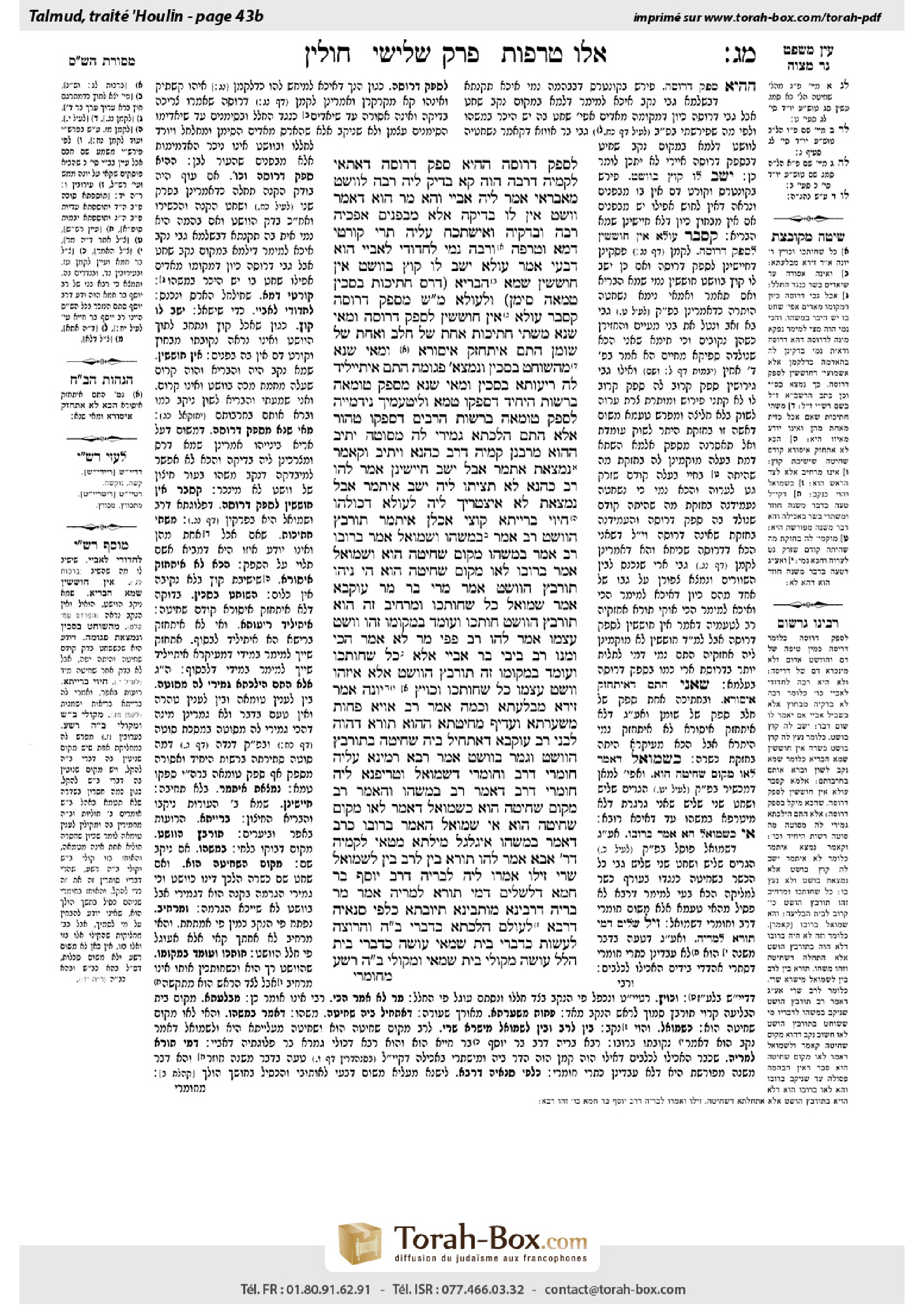
This page of Chullin includes the Aramaic text, an English translation and an AI-generated French translation, alongside the scan above.
חולין מ״ג ב · Aramaic and Hebrew text
לִסְפֵק דְּרוּסָה.
הָהִיא סְפֵק דְּרוּסָה דַּאֲתַאי לְקַמֵּיהּ דְּרַבָּה, הֲוָה קָא בָּדֵיק לֵיהּ רַבָּה לְוֶושֶׁט מֵאַבָּרַאי. אֲמַר לֵיהּ אַבָּיֵי: וְהָא מָר הוּא דְּאָמַר: וֶושֶׁט אֵין לוֹ בְּדִיקָה אֶלָּא מִבִּפְנִים! אַפְכֵיהּ רַבָּה וּבַדְקֵיהּ, וְאִישְׁתְּכַח עֲלֵיהּ תְּרֵי קוּרְטֵי דְּמָא, וְטַרְפַהּ. וְרַבָּה נָמֵי לְחַדּוֹדֵי לְאַבָּיֵי הוּא דְּבָעֵי.
אָמַר עוּלָּא: יָשַׁב לוֹ קוֹץ בַּוֶּושֶׁט, אֵין חוֹשְׁשִׁין שֶׁמָּא הִבְרִיא.
(דָּרַס חֲתִיכוֹת בְּסַכִּין טְמֵאָה, סִימָן)
וּלְעוּלָּא, מַאי שְׁנָא מִסְּפֵק דְּרוּסָה? קָסָבַר עוּלָּא אֵין חוֹשְׁשִׁין לִסְפֵק דְּרוּסָה.
וּמַאי שְׁנָא מִשְּׁתֵּי חֲתִיכוֹת, אַחַת שֶׁל חֵלֶב וְאַחַת שֶׁל שׁוּמָּן? הָתָם אִיתַּחְזַק אִיסּוּרָא.
וּמַאי שְׁנָא מֵהַשּׁוֹחֵט בְּסַכִּין, וְנִמְצֵאת פְּגוּמָה? הָתָם אִיתְיְילִיד לַהּ רֵיעוּתָא בְּסַכִּין.
וּמַאי שְׁנָא מִסְּפֵק טוּמְאָה בִּרְשׁוּת הַיָּחִיד, דִּסְפֵקוֹ טָמֵא? וְלִיטַעְמָיךְ, נִידַמְּיֵיהּ לִסְפֵק טוּמְאָה בִּרְשׁוּת הָרַבִּים, דִּסְפֵקוֹ טָהוֹר! אֶלָּא הָתָם, הִלְכְתָא גְּמִירִי לַהּ מִסּוֹטָה.
יָתֵיב הָהוּא מֵרַבָּנַן קַמֵּיהּ דְּרַב כָּהֲנָא, וְיָתֵיב וְקָאָמַר: ״נִמְצֵאת״ אִתְּמַר, אֲבָל יָשַׁב – חָיְישִׁינַן. אֲמַר לְהוּ רַב כָּהֲנָא: לָא תְּצִיתוּ לֵיהּ, ״יָשַׁב״ אִיתְּמַר, אֲבָל נִמְצֵאת – לָא אִיצְטְרִיךְ לֵיהּ לְעוּלָּא, דְּכוּלְּהוּ חֵיוֵי בָּרָיָיתָא קוֹצֵי אָכְלָן.
אִיתְּמַר: תּוּרְבַּץ הַוֶּושֶׁט – רַב אָמַר: בְּמַשֶּׁהוּ, וּשְׁמוּאֵל אָמַר: בְּרוּבּוֹ. רַב אָמַר בְּמַשֶּׁהוּ: מְקוֹם שְׁחִיטָה הוּא, וּשְׁמוּאֵל אָמַר בְּרוּבּוֹ: לָאו מְקוֹם שְׁחִיטָה הוּא.
הֵי נִיהוּ תּוּרְבַּץ הַוֶּושֶׁט? אָמַר מָרִי בַּר מָר עוּקְבָא אָמַר שְׁמוּאֵל: כֹּל שֶׁחוֹתְכוֹ וּמַרְחִיב – זֶה הוּא תּוּרְבַּץ הַוֶּושֶׁט, חוֹתְכוֹ וְעוֹמֵד בִּמְקוֹמוֹ – זֶהוּ וֶושֶׁט עַצְמוֹ. אֲמַר לְהוּ רַב פַּפֵּי: מָר לָא אָמַר הָכִי, וּמַנּוּ? רַב בִּיבִי בַּר אַבָּיֵי. אֶלָּא כֹּל שֶׁחוֹתְכוֹ וְעוֹמֵד בִּמְקוֹמוֹ – זֶה תּוּרְבַּץ הַוֶּושֶׁט, אֶלָּא אֵיזֶהוּ וֶושֶׁט עַצְמוֹ? כֹּל שֶׁחוֹתְכוֹ וְכָוֵיץ. יוֹנָה אָמַר זֵירָא: מַבְלַעְתָּא, וְכַמָּה? אָמַר רַב אַוְיָא: פָּחוּת מִשְּׂעָרְתָּא וַעֲדִיף מֵחִיטְּתָא.
הָהוּא תּוֹרָא דַּהֲוָה לִבְנֵי רַב עוּקְבָא, דְּאַתְחֵיל בֵּיהּ שְׁחִיטָה בְּתוּרְבַּץ הַוֶּושֶׁט, וּגְמַר בְּוֶושֶׁט. אָמַר רָבָא: רָמֵינָא עֲלֵיהּ חוּמְרֵי דְּרַב וְחוּמְרֵי דִּשְׁמוּאֵל, וְטָרֵיפְנָא לֵיהּ.
חוּמְרֵי דְּרַב, דְּאָמַר רַב: בְּמַשֶּׁהוּ. וְהָאָמַר רַב: מְקוֹם שְׁחִיטָה הוּא! כִּשְׁמוּאֵל, דְּאָמַר: לָאו מְקוֹם שְׁחִיטָה הוּא. אִי שְׁמוּאֵל, הָאָמַר: בְּרוּבּוֹ! כְּרַב, דְּאָמַר: בְּמַשֶּׁהוּ.
אִיגַּלְגַּל מִילְּתָא, מְטַאי לְקַמֵּיהּ דְּרַבִּי אַבָּא, אֲמַר לְהוּ: תּוֹרָא, בֵּין לְרַב בֵּין לִשְׁמוּאֵל שְׁרֵי. זִילוּ אֲמַרוּ לֵיהּ לִבְרֵיהּ דְּרַב יוֹסֵף בַּר חָמָא, דִּלְשַׁלֵּים דְּמֵי תוֹרָא לְמָרֵיהּ.
אָמַר מָר בְּרֵיהּ דְּרָבִינָא: מוֹתְבִינָא תְּיוּבְתָּא כְּלַפֵּי סָנְאֵיהּ דְּרָבָא, לְעוֹלָם הִלְכְתָא כְּדִבְרֵי בֵּית הִלֵּל, וְהָרוֹצֶה לַעֲשׂוֹת כְּדִבְרֵי בֵּית שַׁמַּאי – עוֹשֶׂה, כְּדִבְרֵי בֵּית הִלֵּל – עוֹשֶׂה. מִקּוּלֵּי בֵּית שַׁמַּאי וּמִקּוּלֵּי בֵּית הִלֵּל – רָשָׁע.
Chullin 43b · English translation
The Gemara responds: The halakha is necessary for a case in which it was uncertain whether an animal was clawed by a predator. If the animal was in fact clawed, the gullet would have become red. Since the outer lining is always red, the gullet must be checked on the inside to ascertain whether it is still white.
The Gemara recounts the case of a certain animal concerning which it was uncertain whether it was clawed by a predator, which came before Rabba. Rabba was checking its gullet from the outside. Abaye said to him: But isn’t it you, Master, who says: The gullet may be inspected only from the inside? Rabba turned over the gullet and checked it from the inside, and found on it two drops of blood, and deemed it a tereifa due to clawing. The Gemara notes: And Rabba as well desired only to sharpen Abaye by inducing him to ask. He did not forget his own statement.
Ulla says: If a thorn sat in the animal’s gullet but did not perforate the outer lining, one need not be concerned that perhaps it perforated the outer lining beforehand and the perforation healed and a scab formed over it, in which case the animal would be a tereifa, as stated above. Rather, one assumes that the thorn never perforated the outer lining and the animal is kosher.
The Gemara provides a mnemonic for the following questions with regard to Ulla’s statement: Clawed, pieces, with a knife, ritually impure.
The Gemara asks: But according to Ulla, given that this is a case of uncertainty, in what way is it different from a case of uncertainty as to whether an animal was clawed, where the animal must be checked and cannot be presumed kosher? The Gemara responds: Ulla holds that one need not be concerned with regard to an uncertainty as to whether the animal was clawed.
The Gemara asks: And in what way is this case different from a case where there were two pieces of fat before a person, one of forbidden fat and one of permitted fat, and the person ate one piece but does not know which one, where the halakha is that one must bring a provisional guilt offering due to the possibility that he consumed forbidden fat? Evidently, one may not presume that an item is permitted in a case of uncertainty. The Gemara responds: There, one finds a presumption of prohibition, since one of the pieces is certainly prohibited. Here, with regard to the thorn, there is no presumption of prohibition.
The Gemara asks: And in what way is the case of the thorn different from the case of one who slaughters with a knife that was previously checked for flaws but was then found to be notched after the slaughter? In that case, it is uncertain whether the notch existed at the time of slaughter, yet the animal is prohibited. The Gemara responds: There, a deficiency was born in the knife. Accordingly, one must be concerned that it was notched beforehand as well. By contrast, the wall of the gullet is currently intact, and one may therefore presume that it was intact beforehand as well.
The Gemara asks: And in what way is this case different from an uncertainty with regard to ritual impurity in a private domain, whose uncertainty is presumed impure? The Gemara responds: But according to your reasoning, let us compare it instead to uncertainty with regard to impurity in a public domain, whose uncertainty is presumed pure. Rather, there, with regard to the presumption of impurity in a private domain and purity in a public domain, the Sages learned this halakha through tradition from the halakha of a woman suspected by her husband of having been unfaithful [sota]. Therefore, one cannot extend it to other cases.
The Gemara relates that one of the Sages was sitting before Rav Kahana, and he was sitting and saying: It was stated that one need not be concerned that the thorn perforated the linings of the gullet only if it was found loose inside the gullet. But if it sat embedded in the gullet wall, we must be concerned that the outer lining was perforated and later healed, rendering the animal a tereifa. Rav Kahana said to the other Sages: Do not listen to him. Rather, it was stated that one need not be concerned about a possible perforation if the thorn sat embedded in the gullet wall. But in a case where it was simply found there loose, it was not necessary for Ulla to say that the animal is kosher, since all animals that live outside eat thorns, and it is reasonable to expect to find them in the gullet without presuming injury.
§ The mishna teaches that if the gullet was perforated, the animal is a tereifa. It was stated: In a case where the entrance [turbatz] of the gullet from the pharynx was perforated, Rav says: The animal is a tereifa if any part of the gullet was perforated. And Shmuel says: It is a tereifa only if its majority was perforated. Rav says: If any part was perforated, because he holds that the entrance of the gullet is a location fit for slaughter and is therefore considered part of the gullet. And Shmuel says: If its majority was perforated, because he holds that it is not a location fit for slaughter and is not considered part of the gullet.
The Gemara clarifies: Which area is the entrance of the gullet? Mari bar Mar Ukva said that Shmuel said: All of the area that widens outward when cut along its width, this is the entrance of the gullet; all the area that remains in place when cut, this is the gullet itself. Rav Pappi said to them: Master did not say so. And who is that Master? It is Rav Beivai bar Abaye. Rather, he said that all of the area that remains in place when cut, this is the entrance of the gullet. But which area, then, is the gullet itself? It is all of the area that constricts when cut and closes inward. The Sage Yona says in the name of Rabbi Zeira: The entrance of the gullet is only the area of the throat immediately bordering the gullet. And how much of the throat qualifies as the entrance of the gullet? Rav Avya said: Less than the length of a barley kernel and more than the length of a wheat kernel.
The Gemara relates an incident involving a certain bull that belonged to the sons of Rav Ukva, where its slaughter began with a small incision in the entrance of the gullet and concluded in its majority in the gullet. Rava said: I impose upon it the stringencies of Rav and the stringencies of Shmuel, and deem it a tereifa.
I impose the stringencies of Rav, as Rav said: The animal is a tereifa if any part of the entrance of the gullet was perforated before slaughter. Such is the case here, since the incision began in the entrance of the gullet. Perhaps one will ask: But doesn’t Rav say that the entrance of the gullet is a location fit for slaughter, in which case the initial incision should be considered the beginning of the act of slaughter? To this I will respond: I hold in accordance with the opinion of Shmuel, who says that it is not a location fit for slaughter. If one asks: If I hold in accordance with the opinion of Shmuel, doesn’t he say: It is a tereifa only if it was perforated in its majority? To this I will respond: I hold in accordance with the opinion of Rav, who says: If any part was perforated. Consequently, I deem the animal a tereifa.
The Gemara relates that the matter circulated, and it came before Rabbi Abba, who said to his students: This bull is permitted for consumption, both according to Rav, who holds that the entrance of the gullet is a location fit for slaughter, and according to Shmuel, who holds that it is not a tereifa unless it is perforated in its majority. Therefore, go tell the son of Rav Yosef bar Ḥama, i.e., Rava, that he is to pay the value of the bull to its owner, since he improperly deemed it a tereifa.
Mar, son of Ravina, said: I offer a conclusive refutation to the enemies of Rava, a euphemism for Rava himself, from a baraita: The halakha is always in accordance with the statement of Beit Hillel, but one who wishes to act in accordance with the statement of Beit Shammai may do so, and one who wishes to act in accordance with the statement of Beit Hillel may do so. But if one wishes to adopt both the leniencies of Beit Shammai and also the leniencies of Beit Hillel, he is a wicked person.
Chullin 43b · Traduction française (IA)
La Guemara répond : La halakha est nécessaire dans le cas où il était incertain si un animal avait été griffé par un prédateur. Si l'animal avait effectivement été griffé, la gorge serait devenue rouge. Puisque la membrane externe est toujours rouge, la gorge doit être examinée à l'intérieur pour vérifier si elle reste blanche.
La Guemara rapporte le cas d'un certain animal concernant lequel il était incertain s'il avait été griffé par un prédateur, qui s'était présenté devant Rabba. Rabba examinait la gorge depuis l'extérieur. Abaye lui dit : N'est-ce pas vous, Maître, qui disiez que la gorge ne peut être inspectée qu'à l'intérieur ? Rabba retourna la gorge et l'inspecta à l'intérieur, et trouva deux gouttes de sang sur elle, et considéra l'animal comme téréifé en raison d'une griffure. La Guemara note : Et Rabba souhaitait aussi seulement affûter Abaye en le poussant à poser la question. Il n'avait pas oublié sa propre déclaration.
Ulla dit : Si une épine était restée dans la gorge de l'animal mais n'avait pas perforé la membrane externe, on n'a pas à s'inquiéter du fait qu'elle ait peut-être perforé la membrane externe auparavant et que la perforation se soit guérie avec une croûte s'y formant, dans ce cas l'animal serait téréifé, comme mentionné ci-dessus. Plutôt, on suppose que l'épine n'a jamais perforé la membrane externe et l'animal est propre.
La Guemara fournit un moyen mnémotechnique pour les questions suivantes concernant l'affirmation d'Ulla : Griffé, morceaux, avec un couteau, impur.
La Guemara pose la question : Mais selon Ulla, dans le cas d'une incertitude, de quelle manière est-ce différent du cas d'une incertitude concernant si un animal avait été griffé, où l'animal doit être examiné et ne peut pas être supposé propre ? La Guemara répond : Ulla considère que l'on n'a pas à s'inquiéter concernant une incertitude concernant si l'animal avait été griffé.
La Guemara pose la question : Et de quelle manière ce cas est-il différent du cas où deux morceaux de graisse étaient présents devant une personne, l'un de graisse interdite et l'autre de graisse permise, et la personne avait mangé un morceau sans savoir lequel, où la halakha est que l'on doit présenter un sacrifice de culpabilité provisoire en raison de la possibilité qu'il ait mangé de la graisse interdite ? Évidemment, on ne peut pas supposer qu'un objet est permis dans un cas d'incertitude. La Guemara répond : Là, on trouve une présomption d'interdiction, puisqu'un des morceaux est certainement interdit. Ici, concernant l'épine, il n'y a pas de présomption d'interdiction.
La Guemara pose la question : Et de quelle manière ce cas est-il différent du cas où l'on a tué avec un couteau qui avait été précédemment examiné pour des défauts mais qui a été trouvé éraflé après la boucherie ? Dans ce cas, il est incertain si l'éraflure existait au moment de la boucherie, et l'animal est interdit. La Guemara répond : Là, un défaut s'est développé dans le couteau. Ainsi, on doit s'inquiéter qu'il était éraflé auparavant également. En revanche, la paroi de la gorge est actuellement intacte, et on peut donc supposer qu'elle était intacte auparavant également.
La Guemara pose la question : Et de quelle manière ce cas est-il différent d'une incertitude concernant l'impureté rituelle dans un domaine privé, dont l'incertitude est supposée impure ? La Guemara répond : Mais selon votre raisonnement, comparons-le plutôt à une incertitude concernant l'impureté dans un domaine public, dont l'incertitude est supposée pure. Plutôt, là, concernant la présomption d'impureté dans un domaine privé et de pureté dans un domaine public, les Sages ont appris cette halakha par tradition à partir de la halakha d'une femme soupçonnée par son mari d'avoir été infidèle [sota]. Par conséquent, on ne peut pas l'étendre à d'autres cas.
La Guemara rapporte que l'un des Sages était assis devant Rav Kahana, et il disait : Il a été dit que l'on n'a pas à s'inquiéter que l'épine ait perforé les membranes de la gorge, sauf si elle a été trouvée loose à l'intérieur de la gorge. Mais si elle était encastrée dans la paroi de la gorge, on doit s'inquiéter que la membrane externe ait été perforée et que la perforation se soit guérie, rendant l'animal téréifé. Rav Kahana dit aux autres Sages : N'écoutez pas celui-là. Plutôt, il a été dit que l'on n'a pas à s'inquiéter d'une possible perforation si l'épine était encastrée dans la paroi de la gorge. Mais dans le cas où elle était simplement trouvée là loose, il n'était pas nécessaire pour Ulla de dire que l'animal est propre, puisque tous les animaux qui vivent à l'extérieur mangent des épines, et il est raisonnable d'attendre de les trouver dans la gorge sans supposer un dommage.
§ La mitsva enseigne que si la gorge a été perforée, l'animal est téréifé. Il a été dit : Dans le cas où l'entrée [turbatz] de la gorge depuis la pharynx a été perforée, Rav dit : L'animal est téréifé si toute partie de la gorge a été perforée. Et Shmuel dit : C'est téréifé uniquement si sa majorité a été perforée. Rav dit : Si toute partie a été perforée, car il considère que l'entrée de la gorge est un lieu adapté à la boucherie et est donc considéré comme faisant partie de la gorge. Et Shmuel dit : Si sa majorité a été perforée, car il considère que c'est un lieu non adapté à la boucherie et n'est pas considéré comme faisant partie de la gorge.
La Guemara clarifie : Quelle zone est l'entrée de la gorge ? Mari bar Mar Ukva dit que Shmuel dit : Toute la zone qui s'élargit lorsqu'on la coupe le long de sa largeur, c'est l'entrée de la gorge ; toute la zone qui reste en place lors de la coupe, c'est la gorge elle-même. Rav Pappi dit à ceux-ci : Le Maître n'a pas dit cela. Et qui est ce Maître ? C'est Rav Beivai bar Abaye. Plutôt, il a dit que toute la zone qui reste en place lors de la coupe, c'est l'entrée de la gorge. Mais quelle zone, alors, est la gorge elle-même ? C'est toute la zone qui se resserre lors de la coupe et se referme vers l'intérieur. Le Sage Yona dit en nom de Rabbi Zeira : L'entrée de la gorge est seulement la zone de la gorge immédiatement limitant la gorge. Et combien de la gorge qualifie-t-il comme l'entrée de la gorge ? Rav Avya dit : Moins que la longueur d'un grain de blé et plus que la longueur d'un grain de froment.
La Guemara rapporte un incident concernant un taureau appartenant aux fils de Rav Ukva, où l'abattage commença par une petite incision à l'entrée de la gorge et s'acheva dans sa majorité dans la gorge. Rava dit : Je mets sur cet animal les stringences de Rav et celles de Shmuel, et je le considère comme un tereifa.
Je mets les stringences de Rav, car Rav dit : L'animal est tereifa si une partie de l'entrée de la gorge a été perfore avant l'abattage. C'est le cas ici, car l'incision a commencé à l'entrée de la gorge. Peut-être l'on demandera : Mais ne dit-on pas que Rav affirme que l'entrée de la gorge est un lieu adapté à l'abattage, dans lequel cas l'incision initiale devrait être considérée comme le début de l'acte d'abattage ? À cela je répondrai : Je suis en accord avec l'opinion de Shmuel, qui dit que ce n'est pas un lieu adapté à l'abattage. Si l'on demande : Si je suis en accord avec l'opinion de Shmuel, ne dit-il pas : Il est tereifa uniquement si la perforation a eu lieu dans sa majorité ? À cela je répondrai : Je suis en accord avec l'opinion de Rav, qui dit : Si une partie a été perfore. Ainsi, je considère l'animal comme un tereifa.
La Guemara rapporte que l'affaire circula, et elle vint devant Rabbi Abba, qui dit à ses élèves : Ce taureau est permis à la consommation, tant selon Rav, qui affirme que l'entrée de la gorge est un lieu adapté à l'abattage, que selon Shmuel, qui affirme qu'il n'est pas tereifa à moins qu'il ne soit perfore dans sa majorité. Ainsi, allez dire au fils de Rav Yosef bar Ḥama, c'est-à-dire à Rava, qu'il doit payer la valeur du taureau à son propriétaire, car il a incorrectement considéré l'animal comme tereifa.
Mar, fils de Ravina, dit : Je propose une refutation définitive aux adversaires de Rava, une expression euphemistique pour Rava lui-même, tirée d'une baraïta : La halakha est toujours conforme à la déclaration de Beit Hillel, mais celui qui veut agir selon la déclaration de Beit Shammai peut le faire, et celui qui veut agir selon la déclaration de Beit Hillel peut le faire. Mais si l'on veut adopter à la fois les leniencies de Beit Shammai et celles de Beit Hillel, il est un mauvais homme.
Traduction française générée par IA à partir de l’édition anglaise de Sefaria. Vérifie toujours un passage avec le texte source.
Text from Sefaria: William Davidson Edition - Vocalized Aramaic (unknown); William Davidson Edition - English (CC BY NC).