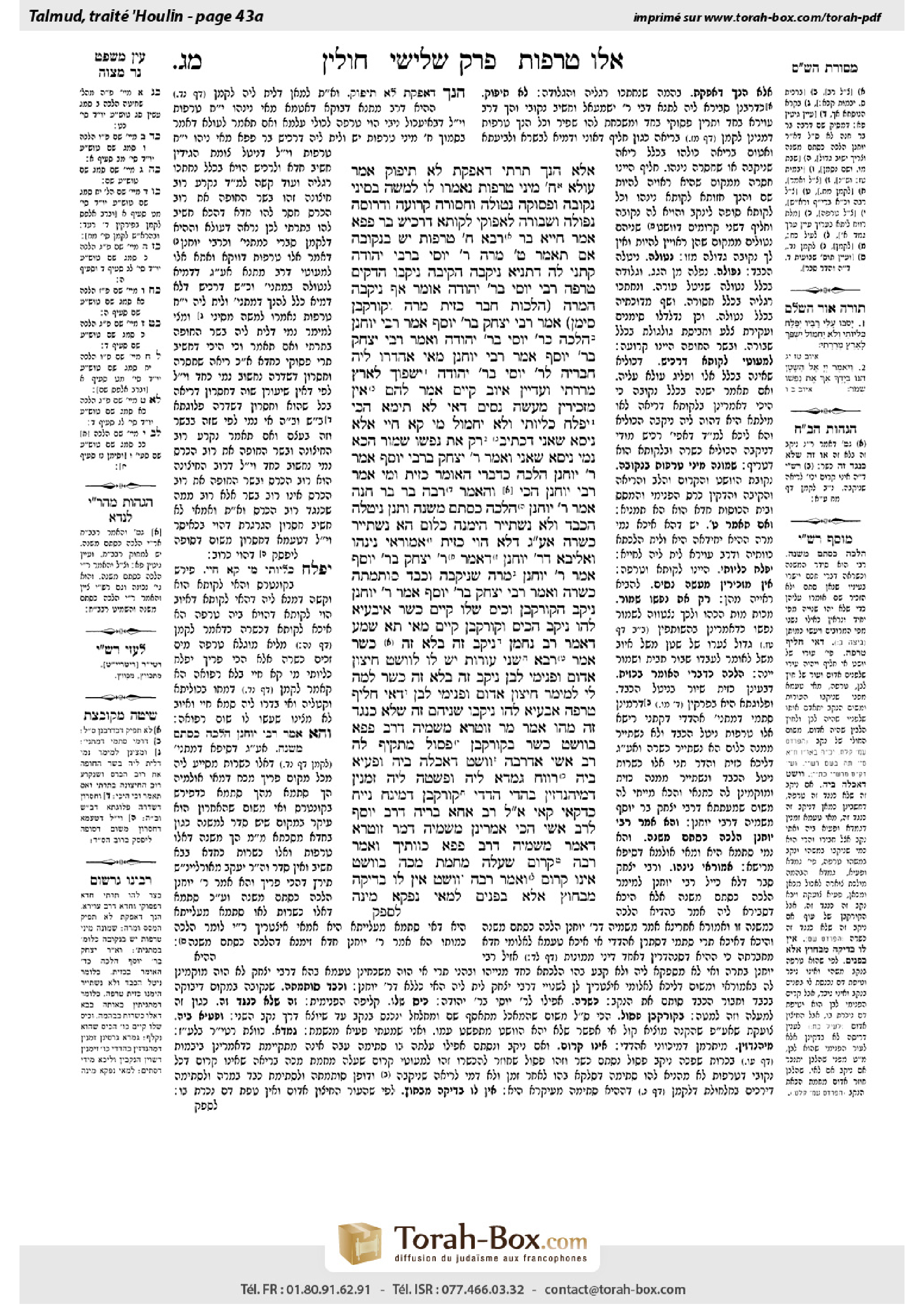
Chullin 43a: Talmud study for Daf Yomi
Study the Talmud for Daf Yomi with scanned pages, Hebrew text, English translations from Sefaria and AI-generated French translations.
Passage selection and English or AI-generated French translation are available where the scan has annotations. Daf Study is independent of Torah-Box and Sefaria.
Browse Chullin · חולין · All tractatesChullin 43a text and translations
This page of Chullin includes the Aramaic text, an English translation and an AI-generated French translation, alongside the scan above.
חולין מ״ג א · Aramaic and Hebrew text
אֶלָּא הָנָךְ תַּרְתֵּי דְּאַפֵּקְתְּ, לָא תַּפֵּיק.
אָמַר עוּלָּא: שְׁמֹנָה מִינֵי טְרֵפוֹת נֶאֶמְרוּ לוֹ לְמֹשֶׁה בְּסִינַי – נְקוּבָה, וּפְסוּקָה, נְטוּלָה, וַחֲסוּרָה, קְרוּעָה, וּדְרוּסָה, נְפוּלָה, וּשְׁבוּרָה. לְאַפּוֹקֵי לָקוּתָא דְּרָכִישׁ בַּר פָּפָּא.
אָמַר חִיָּיא בַּר רָבָא: שְׁמֹנָה טְרֵפוֹת יֵשׁ בִּנְקוּבָה, אִם תֹּאמַר תֵּשַׁע – מָרָה רַבִּי יוֹסֵי בְּרַבִּי יְהוּדָה קָתָנֵי לַהּ, דְּתַנְיָא: נִיקְּבָה הַקֵּיבָה, נִיקְּבוּ הַדַּקִּים – טְרֵפָה, רַבִּי יוֹסֵי בְּרַבִּי יְהוּדָה אוֹמֵר: אַף נִיקְּבָה הַמָּרָה.
(הִלְכוֹת חָבֵר כְּזַיִת מָרָה וְקוּרְקְבָן – סִימָן).
אָמַר רַבִּי יִצְחָק בְּרַבִּי יוֹסֵף אָמַר רַבִּי יוֹחָנָן: הֲלָכָה כְּרַבִּי יוֹסֵי בְּרַבִּי יְהוּדָה.
וְאָמַר רַבִּי יִצְחָק בְּרַבִּי יוֹסֵף אָמַר רַבִּי יוֹחָנָן: מַאי אַהְדַּרוּ לֵיהּ חַבְרֵיהּ לְרַבִּי יוֹסֵי בְּרַבִּי יְהוּדָה? ״יִשְׁפּוֹךְ לָאָרֶץ מֵרָרָתִי״, וַעֲדַיִין אִיּוֹב קַיָּים. אָמַר לָהֶם: אֵין מַזְכִּירִין מַעֲשֵׂה נִסִּים, דְּאִי לָא תֵּימָא הָכִי ״יְפַלַּח כִּלְיוֹתַי וְלֹא יַחְמוֹל״ – מִי קָא חָיֵי? אֶלָּא נִיסָּא שָׁאנֵי, דִּכְתִיב: ״רַק אֶת נַפְשׁוֹ שְׁמֹר״. הָכָא נָמֵי נִיסָּא שָׁאנֵי.
וְאָמַר רַבִּי יִצְחָק בְּרַבִּי יוֹסֵף אָמַר רַבִּי יוֹחָנָן: הֲלָכָה כְּדִבְרֵי הָאוֹמֵר כְּזַיִת.
וּמִי אָמַר רַבִּי יוֹחָנָן הָכִי? וְהָאָמַר רַבָּה בַּר בַּר חָנָה אָמַר רַבִּי יוֹחָנָן: הֲלָכָה כִּסְתַם מִשְׁנָה, וּתְנַן: נִיטְּלָה הַכָּבֵד וְלֹא נִשְׁתַּיֵּיר הֵימֶנָּה כְּלוּם – הָא נִשְׁתַּיֵּיר כְּשֵׁרָה, אַף עַל גַּב דְּלָא הָוֵי כְּזַיִת! אָמוֹרָאֵי נִינְהוּ וְאַלִּיבָּא דְּרַבִּי יוֹחָנָן.
דְּאָמַר רַבִּי יִצְחָק בְּרַבִּי יוֹסֵף אָמַר רַבִּי יוֹחָנָן: מָרָה שֶׁנִּיקְּבָה, וְכָבֵד סוֹתַמְתָּהּ – כְּשֵׁרָה.
וְאָמַר רַבִּי יִצְחָק בְּרַבִּי יוֹסֵף אָמַר רַבִּי יוֹחָנָן: נִיקַּב הַקּוּרְקְבָן וְכִיס שֶׁלּוֹ קַיָּים – כָּשֵׁר.
אִיבַּעְיָא לְהוּ: נִיקַּב הַכִּיס וְקוּרְקְבָן קַיָּים, מַאי? תָּא שְׁמַע, דְּאָמַר רַב נַחְמָן: נִיקַּב זֶה בְּלֹא זֶה – כָּשֵׁר. אָמַר רָבָא: שְׁנֵי עוֹרוֹת יֵשׁ לוֹ לַוֶּושֶׁט, חִיצוֹן אָדוֹם וּפְנִימִי לָבָן, נִיקַּב זֶה בְּלֹא זֶה – כָּשֵׁר. לְמָה לִי לְמֵימַר חִיצוֹן אָדוֹם וּפְנִימִי לָבָן? דְּאִי חַלֵּיף – טְרֵפָה.
אִבַּעְיָא לְהוּ: נִיקְּבוּ שְׁנֵיהֶם זֶה שֶׁלֹּא כְּנֶגֶד זֶה, מַהוּ? אָמַר מָר זוּטְרָא מִשְּׁמֵיהּ דְּרַב פָּפָּא: בַּוֶּושֶׁט – כָּשֵׁר, בַּקּוּרְקְבָן – פָּסוּל. מַתְקֵיף לַהּ רַב אָשֵׁי: אַדְּרַבָּה, וֶושֶׁט דְּאָכְלָה בֵּיהּ וּפָעְיָא בֵּיהּ רָוַוח, גָּמְדָא לֵיהּ וּפָשְׁטָה לֵיהּ, זִמְנִין דְּמִיהַנְדְּזִין בַּהֲדֵי הֲדָדֵי; קוּרְקְבָן דְּמֵינָח נָיַיח, כִּדְקָאֵי קָאֵי! אֲמַר לֵיהּ רַב אַחָא בְּרֵיהּ דְּרַב יוֹסֵף לְרַב אָשֵׁי: הָכִי אָמְרִינַן מִשְּׁמֵיהּ דְּמָר זוּטְרָא, דְּאָמַר מִשְּׁמֵיהּ דְּרַב פָּפָּא כְּוָותָיךְ.
וְאָמַר רַבָּה: קְרוּם שֶׁעָלָה מֵחֲמַת מַכָּה בַּוֶּושֶׁט, אֵינוֹ קְרוּם. וְאָמַר רַבָּה: וֶושֶׁט אֵין לוֹ בְּדִיקָה מִבַּחוּץ, אֶלָּא בִּפְנִים. לְמַאי נָפְקָא מִינַּהּ?
Chullin 43a · English translation
The Gemara responds: Rather, if one counts this way, one must say that these two cases that you removed, i.e., an animal whose hind legs were severed and one whose hide was removed, do not remove. The count will then remain eighteen.
§ Ulla says: Eight types of tereifot were stated to Moses at Sinai, and all the cases mentioned in the Mishna and elsewhere fall into these categories: An animal whose organ was perforated or severed, removed or missing a piece, one that was torn or clawed by wild animals, or that fell or was broken. The Gemara notes: This list is compiled to the exclusion of a diseased organ, which Rakhish bar Pappa mentioned with regard to a kidney. Ulla does not deem this a tereifa.
Ḥiyya bar Rava says: There are eight tereifot in the category of a perforated organ: A perforated gullet, brain membrane, heart, lung, abomasum, intestine, inner rumen, and reticulum or omasum that was perforated to the outside. If you say that there are nine, because a perforated gallbladder is also mentioned in the mishna, one can say that with regard to the gallbladder, only Rabbi Yosei, son of Rabbi Yehuda, teaches it, and it is the opinion of an individual. As it is taught in a baraita: If the abomasum was perforated, or the intestines were perforated, it is a tereifa. Rabbi Yosei, son of Rabbi Yehuda, says: Even if the gallbladder was perforated it is a tereifa.
§ The Gemara provides a mnemonic for the following statements of Rabbi Yitzḥak, son of Rabbi Yosef: Halakhot, friend, olive-bulk, gallbladder, and gizzard.
Rabbi Yitzḥak, son of Rabbi Yosef, says that Rabbi Yoḥanan disagrees with the statement of Ḥiyya bar Rava and says: The halakha is in accordance with the opinion of Rabbi Yosei, son of Rabbi Yehuda, that a perforated gallbladder renders the animal a tereifa.
And Rabbi Yitzḥak, son of Rabbi Yosef, says that Rabbi Yoḥanan says: What did the friends of Rabbi Yosei, son of Rabbi Yehuda, respond to him? They responded that Job said: “He pours out my gall upon the ground” (Job 16:13), and yet Job was still alive. Evidently, one with a perforated gallbladder can live. Rabbi Yosei said to them: Job was kept alive by a miracle, and one does not mention miraculous acts as proof for a general ruling. As, if you do not say so, then the other phrase in the verse: “He cleaves my kidneys asunder, and does not spare,” is problematic. Does one with cleaved kidneys live? Rather, a miracle is different, as it is written that God said to Satan with regard to Job: “Only spare his life” (Job 2:6). Under natural circumstances, Job should have died from his injuries, but in this case he was kept alive by a miracle. Here too, with regard to the gallbladder, one must say that a miracle is different, and one cannot bring proof from it.
And Rabbi Yitzḥak, son of Rabbi Yosef, says that Rabbi Yoḥanan says: The halakha is in accordance with the statement of the one who says that if the liver of an animal was removed but one olive-bulk of it remains, it is kosher.
The Gemara asks: And does Rabbi Yoḥanan really say this? But doesn’t Rabba bar bar Ḥana say that Rabbi Yoḥanan says: The halakha is always in accordance with an unattributed mishna; and we learned in the mishna: If the liver was removed and nothing remained of it, the animal is a tereifa? One can infer that if any of it remained, the animal is kosher even if what remains does not constitute an olive-bulk. The Gemara responds: They are amora’im, and they disagree with regard to the opinion of Rabbi Yoḥanan as to whether he holds that the halakha is always in accordance with an unattributed mishna.
The Gemara brings another statement that Rabbi Yitzḥak, son of Rabbi Yosef, says that Rabbi Yoḥanan says: If the gallbladder was perforated in a place where it was adjacent to the liver, and the liver seals the hole, the animal is kosher, even though a perforated gallbladder normally renders the animal a tereifa according to Rabbi Yoḥanan.
And Rabbi Yitzḥak, son of Rabbi Yosef, says that Rabbi Yoḥanan says: Even though the mishna on 56a teaches that if a bird’s gizzard was perforated it is a tereifa, if the gizzard was perforated but its inner lining is intact, the bird is kosher.
A dilemma was raised before the Sages: If the inner lining of the gizzard was perforated, but the flesh of the gizzard is intact, what is the halakha? The Gemara suggests: Come and hear a proof from that which Rav Naḥman said with regard to a perforated gullet: If both its outer and inner lining were perforated, the animal is a tereifa, but if this lining was perforated without that lining being perforated, it is kosher. Similarly, Rava says: The gullet has two linings, the outer red, and the inner white. If this lining was perforated without that lining being perforated, the animal is kosher. The Gemara asks: Why do I need for Rava to state that the outer one is red and the inner one is white? Isn’t this self-evident? The Gemara responds: This teaches that if the two were switched, i.e., the outer lining turned white and the inner red, the animal is a tereifa.
A dilemma was raised before the Sages: If both linings were perforated, but not adjacent to one another, what is the halakha? Mar Zutra says in the name of Rav Pappa: If this occurred in the gullet, the animal is kosher; but if it occurred in the gizzard, it is unfit for consumption. Rav Ashi objects to this: On the contrary, the gullet, with which the animal eats and calls, is spacious and flexible, and the animal constricts it and stretches it. Since the two linings are not connected to each other, there are times in the course of their movement that the two holes align [demihandezin] with one another, creating a fully aligned perforation. But the gizzard, which is always at rest in place, stands as it always stands. Accordingly, two such perforations will never align. Rav Aḥa, son of Rav Yosef, said to Rav Ashi: So we say in the name of Mar Zutra, that he in fact said in the name of Rav Pappa in accordance with your objection.
§ And Rabba says: A membrane that appeared due to a wound in the gullet, i.e., a scab that covered a perforation, is not considered a membrane that prevents the animal from being rendered a tereifa. And Rabba says: The gullet cannot be inspected from outside to determine whether the animal is a tereifa, since the outer lining itself is red, and therefore reddening due to injury cannot be discerned in it. Rather, it must be inspected from inside, where the lining is white. The Gemara asks: What difference is there as a result of this statement, i.e., in what case must the gullet be checked from the inside?
Chullin 43a · Traduction française (IA)
La Guemara répond : Plutôt, si l'on compte ainsi, il faut dire que ces deux cas que vous avez éliminés, c'est-à-dire un animal dont les jambes arrière ont été tranchées et un animal dont la peau a été retirée, ne sont pas éliminés. Le compte restera alors dix-huit.
§ Ulla dit : Huit types de tereifot ont été déclarés à Moïse au Sinaï, et tous les cas mentionnés dans la Michna et ailleurs s'inscrivent dans ces catégories : un animal dont un organe a été percé ou tranché, retiré ou manquant d'une partie, un animal qui a été déchiré ou mordu par des animaux sauvages, ou qui est tombé ou brisé. La Guemara note : cette liste est établie en excluant un organe malade, mentionné par Rakhish bar Pappa concernant le rein. Ulla ne considère pas cela comme un tereifa.
Ḥiyya bar Rava dit : Il y a huit tereifot dans la catégorie d'un organe percé : un gullet percé, une membrane cérébrale percée, un cœur percé, un poumon percé, un abomasum percé, un intestin percé, un rumen interne percé, et un reticulum ou un omasum percé à l'extérieur. Si vous dites qu'il y en a neuf, car un gallbladder percé est également mentionné dans la Michna, on peut dire que concernant le gallbladder, seul Rabbi Yosei, fils de Rabbi Yehuda, l'enseigne, et c'est l'opinion d'un individu. Comme il est enseigné dans une baraïta : Si l'abomasum a été percé, ou les intestins ont été percés, c'est un tereifa. Rabbi Yosei, fils de Rabbi Yehuda, dit : Même si le gallbladder a été percé, c'est un tereifa.
§ La Guemara fournit un mnémonique pour les affirmations suivantes de Rabbi Yitzḥak, fils de Rabbi Yosef : Halakhot, ami, volume d'olive, foie et rate.
Rabbi Yitzḥak, fils de Rabbi Yosef, dit que Rabbi Yoḥanan désaccorde avec l'affirmation de Ḥiyya bar Rava et dit : La halakha suit l'opinion de Rabbi Yosei, fils de Rabbi Yehuda, qui dit qu'un foie percé rend l'animal un tereifa.
Et Rabbi Yitzḥak, fils de Rabbi Yosef, dit que Rabbi Yoḥanan dit : Qu'est-ce que les amis de Rabbi Yosei, fils de Rabbi Yehuda, ont répondu à lui ? Ils ont répondu que Job disait : « Il verse mon bile sur la terre » (Job 16:13), et pourtant Job était encore vivant. Évidemment, une personne avec un foie percé peut vivre. Rabbi Yosei a dit à eux : Job a été sauvé par un miracle, et l'on ne mentionne pas les actes miraculeux comme preuve d'une décision générale. Car, si l'on ne dit pas cela, alors l'autre phrase du verset : « Il déchire mes reins et ne les épargne pas », est problématique. Un homme avec des reins déchirés vit-il ? Plutôt, un miracle est différent, car il est écrit que Dieu a dit à Satan concernant Job : « Ne sacrifie pas sa vie » (Job 2:6). Sous des circonstances naturelles, Job aurait dû mourir de ses blessures, mais dans ce cas, il a été sauvé par un miracle. Ici aussi, concernant le foie, il faut dire qu'un miracle est différent, et l'on ne peut en tirer une preuve.
Et Rabbi Yitzḥak, fils de Rabbi Yosef, dit que Rabbi Yoḥanan dit : La halakha suit l'affirmation de celui qui dit que si le foie d'un animal a été retiré mais qu'un volume d'olive de celui-ci reste, il est propre.
La Guemara pose une question : Et Rabbi Yoḥanan dit vraiment cela ? Mais ne dit pas Rabba bar bar Ḥana que Rabbi Yoḥanan dit : La halakha suit toujours une Michna non attribuée ; et nous avons appris dans la Michna : Si le foie a été retiré et que rien ne lui reste, l'animal est un tereifa ? On peut en déduire que si quelque chose de celui-ci reste, l'animal est propre même si ce qui reste ne constitue pas un volume d'olive. La Guemara répond : Ils sont des amora’im, et ils s'opposent à l'opinion de Rabbi Yoḥanan concernant la question de savoir s'il considère que la halakha suit toujours une Michna non attribuée.
La Guemara rapporte une autre affirmation que Rabbi Yitzḥak, fils de Rabbi Yosef, dit que Rabbi Yoḥanan dit : Si le gallbladder a été percé dans un endroit où il est adjacent au foie, et que le foie ferme le trou, l'animal est propre, même si un gallbladder percé rend normalement l'animal un tereifa selon Rabbi Yoḥanan.
Et Rabbi Yitzḥak, fils de Rabbi Yosef, dit que Rabbi Yoḥanan dit : Même si la Michna sur 56a enseigne que si le gizzard d'un oiseau a été percé, il est un tereifa, si le gizzard a été percé mais que son revêtement interne est intact, l'oiseau est propre.
Un dilemme a été soulevé devant les Sages : Si le revêtement interne du gizzard a été percé, mais la chair du gizzard est intacte, quelle est la halakha ? La Guemara suggère : Venez écouter une preuve à partir de ce que Rav Naḥman a dit concernant un gullet percé : Si les deux de ses revêtements ont été percés, l'animal est un tereifa, mais si ce revêtement a été percé sans que celui-ci ne le soit, il est propre. De même, Rava dit : Le gullet a deux revêtements, l'extérieur rouge et l'intérieur blanc. Si ce revêtement a été percé sans que celui-ci ne le soit, l'animal est propre. La Guemara pose une question : Pourquoi ai-je besoin que Rava affirme que l'extérieur est rouge et l'intérieur blanc ? N'est-ce pas évident ? La Guemara répond : Cela enseigne que si les deux étaient inversés, c'est-à-dire si l'extérieur était blanc et l'intérieur rouge, l'animal est un tereifa.
Un dilemme a été soulevé devant les Sages : Si les deux revêtements ont été percés, mais sans être adjacents, quelle est la halakha ? Mar Zutra dit en nom de Rav Pappa : Si cela s'est produit dans le gullet, l'animal est propre ; mais si cela s'est produit dans le gizzard, il est non conforme. Rav Ashi s'oppose à cela : Au contraire, le gullet, avec lequel l'animal mange et parle, est vaste et flexible, et l'animal le contracte et l'étire. Puisque les deux revêtements ne sont pas connectés entre eux, il y a des moments, au cours de leurs mouvements, où les deux trous s'alignent [demihandezin] l'un avec l'autre, créant une perforation entièrement alignée. Mais le gizzard, qui est toujours immobile, reste comme il est. Ainsi, deux telles perforations ne s'aligneront jamais. Rav Aḥa, fils de Rav Yosef, a dit à Rav Ashi : Ainsi nous disons en nom de Mar Zutra, qu'il a en effet dit en nom de Rav Pappa conformément à votre objection.
§ Et Rabba dit : Une membrane qui est apparue en raison d'une plaie dans le gosier, c'est-à-dire une croûte qui recouvrait une perforation, n'est pas considérée comme une membrane qui empêche l'animal d'être rendu tereifa. Et Rabba dit : Le gosier ne peut pas être inspecté depuis l'extérieur pour déterminer si l'animal est tereifa, car la muqueuse externe elle-même est rouge, et donc la rougeur due à une blessure ne peut pas être discernée dans celle-ci. Il faut plutôt l'inspecter depuis l'intérieur, où la muqueuse est blanche. La Guemara demande : Quelle différence cela fait-il, c'est-à-dire dans quel cas le gosier doit-il être examiné depuis l'intérieur ?
Traduction française générée par IA à partir de l’édition anglaise de Sefaria. Vérifie toujours un passage avec le texte source.
Text from Sefaria: William Davidson Edition - Vocalized Aramaic (unknown); William Davidson Edition - English (CC BY NC).