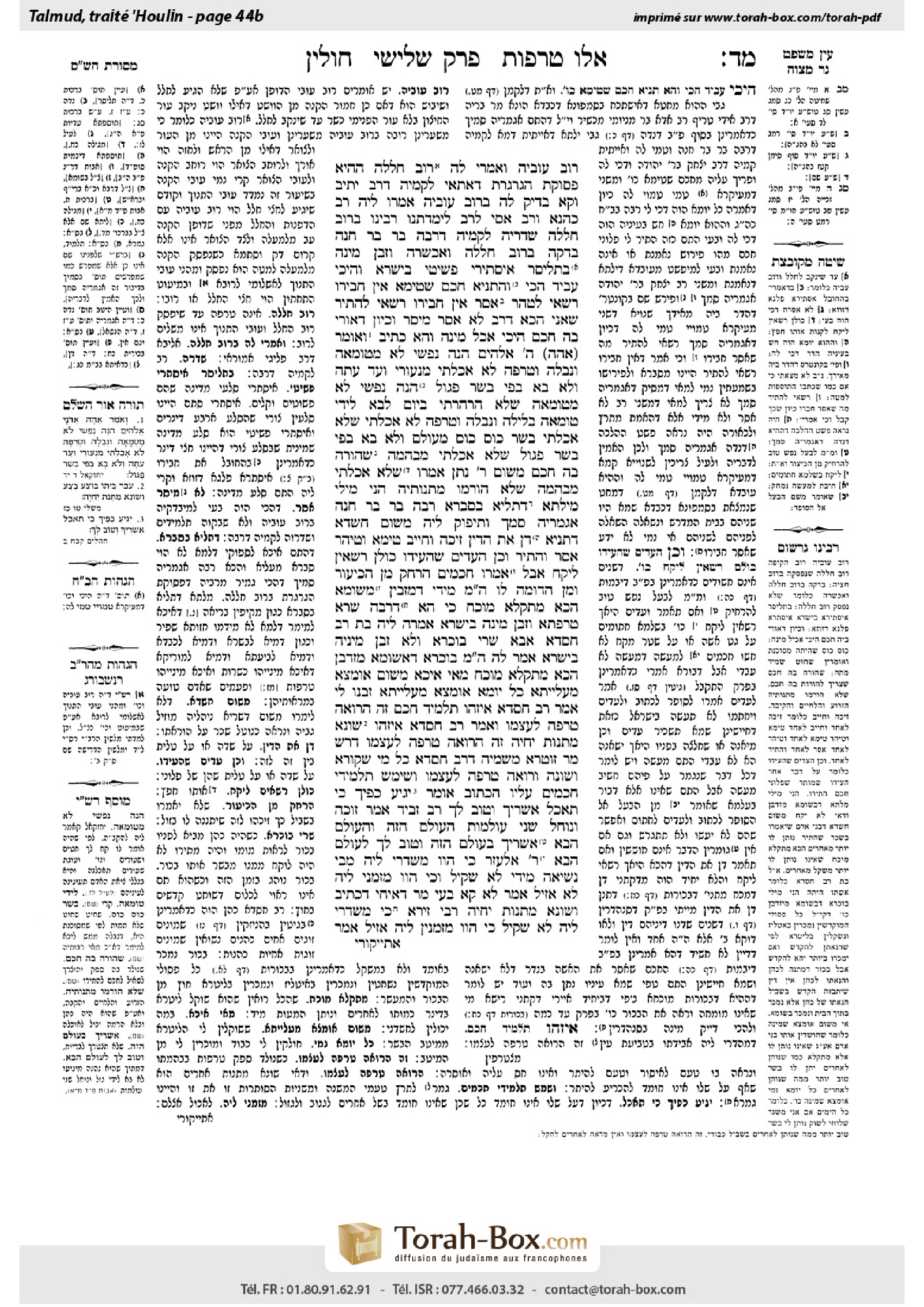
Chullin 44b: Talmud study for Daf Yomi
Study the Talmud for Daf Yomi with scanned pages, Hebrew text, English translations from Sefaria and AI-generated French translations.
Passage selection and English or AI-generated French translation are available where the scan has annotations. Daf Study is independent of Torah-Box and Sefaria.
Browse Chullin · חולין · All tractatesChullin 44b text and translations
This page of Chullin includes the Aramaic text, an English translation and an AI-generated French translation, alongside the scan above.
חולין מ״ד ב · Aramaic and Hebrew text
רוֹב עוֹבְיָהּ, וְאָמְרִי לַהּ: רוֹב חֲלָלָה.
הָהִיא פְּסוּקַת הַגַּרְגֶּרֶת דַּאֲתַאי לְקַמֵּיהּ דְּרַב, יָתֵיב וְקָא בָּדֵיק לַהּ בְּרוֹב עוֹבְיָהּ. אֲמַרוּ לֵיהּ רַב כָּהֲנָא וְרַב אַסִּי לְרַב: לִימַּדְתָּנוּ רַבֵּינוּ בְּרוֹב חֲלָלָהּ! שַׁדְּרֵיהּ לְקַמֵּיהּ דְּרַבָּה בַּר בַּר חָנָה, בַּדְקַהּ בְּרוֹב חֲלָלָהּ וְאַכְשְׁרַהּ, וּזְבַן מִינַּהּ בִּתְלֵיסַר אִיסְתֵּירֵי פְּשִׁיטֵי בִּישְׂרָא.
וְהֵיכִי עָבֵיד הָכִי? וְהָתַנְיָא: חָכָם שֶׁטִּימֵּא – אֵין חֲבֵירוֹ רַשַּׁאי לְטַהֵר, אָסַר – אֵין חֲבֵירוֹ רַשַּׁאי לְהַתִּיר! שָׁאנֵי הָכָא, דְּרַב לָא אֲסַר מֵיסָר.
וְכֵיוָן דְּאוֹרִי בַּהּ חָכָם, הֵיכִי אֲכַל מִינַּהּ? וְהָא כְּתִיב: ״וָאֹמַר אֲהָהּ ה׳ אֱלֹהִים הִנֵּה נַפְשִׁי לֹא מְטֻמָּאָה וּנְבֵלָה וּטְרֵפָה לֹא אָכַלְתִּי מִנְּעוּרַי וְעַד עַתָּה וְלֹא בָא בְּפִי בְּשַׂר פִּגּוּל״.
״הִנֵּה נַפְשִׁי לֹא מְטֻמָּאָה״ – שֶׁלֹּא הִרְהַרְתִּי בַּיּוֹם לָבֹא לִידֵי טוּמְאָה בַּלַּיְלָה, ״וּנְבֵלָה וּטְרֵפָה לֹא אָכַלְתִּי״ – שֶׁלֹּא אָכַלְתִּי בְּשַׂר ״כּוֹס כּוֹס״ מֵעוֹלָם, ״וְלֹא בָא בְּפִי בְּשַׂר פִּגּוּל״ – שֶׁלֹּא אָכַלְתִּי מִבְּהֵמָה שֶׁהוֹרָה בָּהּ חָכָם. מִשּׁוּם רַבִּי נָתָן אָמְרוּ: שֶׁלֹּא אָכַלְתִּי מִבְּהֵמָה שֶׁלֹּא הוּרְמוּ מַתְּנוֹתֶיהָ.
הָנֵי מִילֵּי – מִילְּתָא דְתַלְיָא בִּסְבָרָא, רַבָּה בַּר בַּר חָנָה אַגְּמָרֵיהּ סְמַךְ.
וְתִיפּוֹק לֵיהּ מִשּׁוּם חֲשָׁדָא, דְּתַנְיָא: דָּן אֶת הַדִּין, זִיכָּה וְחַיָּיב, טִימֵּא וְטִיהֵר, אָסַר וְהִתִּיר, וְכֵן הָעֵדִים שֶׁהֵעִידוּ – כּוּלָּן רַשָּׁאִין לִיקַּח, אֲבָל אָמְרוּ חֲכָמִים: הַרְחֵק מִן הַכִּיעוּר וּמִן הַדּוֹמֶה לוֹ.
הָנֵי מִילֵּי מִידֵּי דִּמְזַבֵּין מִשּׁוּמָא, הָכָא מַתְקְלָא מוֹכַח, כִּי הָא דְּרַבָּה שְׁרָא טְרֵפְתָּא וּזְבַן מִינַּהּ בִּישְׂרָא, אֲמַרָה לֵיהּ בַּת רַב חִסְדָּא: אַבָּא שָׁרֵי בּוּכְרָא וְלָא זָבֵן מִינֵּיהּ בִּישְׂרָא.
אֲמַר לַהּ: הָנֵי מִילֵּי בּוּכְרָא דְּאַשּׁוּמָא מִזְדְּבַן, הָכָא מַתְקְלָא מוֹכַח, מַאי אִיכָּא – מִשּׁוּם אוּמְצָא מְעַלַּיְיתָא? כֹּל יוֹמָא אוּמְצָא מְעַלַּיְיתָא זַבִּנוּ לִי.
אָמַר רַב חִסְדָּא: אֵיזֶהוּ תַּלְמִיד חָכָם? זֶה הָרוֹאֶה טְרֵפָה לְעַצְמוֹ. וְאָמַר רַב חִסְדָּא: אֵיזֶהוּ ״שׂוֹנֵא מַתָּנֹת יִחְיֶה״? זֶה הָרוֹאֶה טְרֵפָה לְעַצְמוֹ.
דָּרֵשׁ מָר זוּטְרָא מִשְּׁמֵיהּ דְּרַב חִסְדָּא: כׇּל מִי שֶׁקּוֹרֵא וְשׁוֹנֶה, וְרוֹאֶה טְרֵפָה לְעַצְמוֹ, וְשִׁימֵּשׁ תַּלְמִידֵי חֲכָמִים – עָלָיו הַכָּתוּב אוֹמֵר: ״יְגִיעַ כַּפֶּיךָ כִּי תֹאכֵל אַשְׁרֶיךָ וְטוֹב לָךְ״. רַב זְבִיד אָמַר: זוֹכֶה וְנוֹחֵל שְׁנֵי עוֹלָמוֹת, הָעוֹלָם הַזֶּה וְהָעוֹלָם הַבָּא, ״אַשְׁרֶיךָ״ – בְּעוֹלָם הַזֶּה, ״וְטוֹב לָךְ״ – לָעוֹלָם הַבָּא.
רַבִּי אֶלְעָזָר, כִּי הֲווֹ מְשַׁדְּרִי לֵיהּ מִבֵּי נְשִׂיאָה מִידֵּי, לָא שָׁקֵיל, וְכִי הֲווֹ מְזַמְּנִי לֵיהּ, לָא אָזֵיל. אָמַר: לָא קָא בָּעֵי מָר דְּאֵיחֵי? דִּכְתִיב: ״וְשׂוֹנֵא מַתָּנוֹת יִחְיֶה״. רַבִּי זֵירָא, כִּי מְשַׁדְּרִי לֵיהּ, לָא שָׁקֵיל, כִּי הֲווֹ מַזְמְנִין לֵיהּ, אָזֵיל. אֲמַר:
Chullin 44b · English translation
The majority of its width, counting the width of the wall of the windpipe itself, the thickness of which is uneven. And some say that Rav says: The majority of its space, the inner area of the cross section of the windpipe, not counting the width of the windpipe wall.
The Gemara recounts: There was a certain animal with a cut windpipe that came before Rav, i.e., it was brought for inspection to decide whether it was kosher. Rav was sitting and checking it to see if the windpipe had been cut in the majority of its width. Rav Kahana and Rav Asi said to Rav: Didn’t you teach us, our teacher, that a cut windpipe is measured by the majority of its space? Rav sent the animal before Rabba bar bar Ḥana, who checked it in the majority of its space and deemed it kosher, and purchased meat from it at the price of thirteen plain istera coins.
The Gemara asks: And how could Rabba bar bar Ḥana do this, i.e., deem permitted an animal that Rav was going to deem prohibited? But isn’t it taught in a baraita: If a halakhic authority deemed an item impure, another halakhic authority is not allowed to deem it pure; likewise, if he prohibited it, another authority is not allowed to permit it? The Gemara responds: It is different here, since Rav did not actually prohibit the animal. He merely considered doing so, but he sent it to Rabba bar bar Ḥana before issuing a formal ruling.
The Gemara asks: And once a halakhic authority has ruled with regard to the animal, even to permit it, how could Rabba bar bar Ḥana eat from it? But isn’t it written: “Then I said: Alas, Lord God, my soul has not become impure; and from my youth until now I have not eaten an unslaughtered carcass, or a tereifa; and no piggul flesh came into my mouth” (Ezekiel 4:14).
The Sages interpreted the verse as follows: “My soul has not become impure” means that I did not think of sexual thoughts during the day so as to come to the impurity of a seminal emission at night. “I have not eaten an unslaughtered carcass, or a tereifa” means that I never ate the flesh of an animal that was in danger of imminent death, leading one to say: Slaughter it, slaughter it quickly, before it dies. “And no piggul flesh came into my mouth,” means that I never ate from an animal with regard to which there was uncertainty whether it is prohibited and a Sage issued a ruling to permit it. The Sages said in the name of Rabbi Natan: The phrase means that I never ate from an animal from which the gifts of the priesthood, the foreleg, jaw, and abomasum, were not separated. The above acts are technically permitted but unseemly. How, then, could Rabba bar bar Ḥana consume the meat of this animal?
The Gemara responds: This statement, that it is unseemly for a halakhic authority to rely on his own ruling to permit the meat, applies only to a matter that depends on reasoning. Rabba bar bar Ḥana relied on his learning, i.e., a received tradition. There is nothing unseemly about relying upon a received tradition.
The Gemara objects: But let one derive that Rabba bar bar Ḥana should not have purchased the meat due to suspicion, as it is taught in a baraita: If one issued a judgment, acquitted or convicted, deemed impure or pure, prohibited or permitted; or if witnesses testified with regard to a case, in all of these instances the judges or witnesses are allowed to purchase the item that they deemed permitted. But the Sages said: Distance yourself from unseemliness and from things similar to it. If so, Rabba bar bar Ḥana should not have purchased the meat that he himself permitted.
The Gemara responds: This statement applies only to an item that is sold based on an appraisal of its value and not by standard measure. In such cases onlookers might suspect that the judge is receiving a favorable price in return for his judgment. But here, the weight of the meat proves that the judge is not receiving a discount, but is paying the standard price. This is like that incident where Rabba permitted a possible tereifa for consumption and bought meat from it. His wife, the daughter of Rav Ḥisda, said to him: Father permitted a firstborn animal, declaring that it possessed a blemish that renders it permitted for consumption, but did not buy meat from it. Why are you acting differently?
Rabba said to her: That matter applies to a firstborn, which is sold based on appraisal of its value. Here, the weight of the meat proves that I am paying the standard price and not unfairly deriving benefit from my judgment. What suspicion is there in this case? Will people suspect me because I received a superior piece of meat? Every day they sell me a superior piece of meat.
The Gemara cites an aphorism: Rav Ḥisda says: Who is a Torah scholar? This is one who sees his own tereifa. In other words, when the status of his own animal is uncertain, he deems it prohibited without concern for his own monetary loss. And Rav Ḥisda says: Who is referred to by the verse: “He that hates gifts shall live” (Proverbs 15:27)? This is one who sees his own tereifa. He is careful to avoid deriving benefit from that which is not his own, and even from items that are his concerning which it is questionable whether or not they are permitted.
Mar Zutra taught in the name of Rav Ḥisda: Anyone who reads the Torah and studies the Mishna, and sees his own tereifa, and has served Torah scholars to learn the ways of halakhic judgment, about him the verse states: “When you eat the labor of your hands, happy shall you be, and it shall be well with you” (Psalms 128:2). Rav Zevid says: Such a person merits inheriting two worlds, this world and the World-to-Come. When the verse states: “Happy shall you be,” it means in this world, and when it states: “And it shall be well with you,” it is referring to the World-to-Come.
With regard to the verse: “He that hates gifts shall live,” the Gemara relates that when they would send Rabbi Elazar some gift from the house of the Nasi, he would not take it. And when they would invite him, he would not go there. When declining these offers, he said to them: Does Master not desire that I live? As it is written: “He that hates gifts shall live.” By contrast, when they would send a gift to Rabbi Zeira, he would not take it, but when they would invite him he would go. He said in explanation:
Chullin 44b · Traduction française (IA)
La majorité de sa largeur, en comptant la largeur de la paroi de la trachée elle-même, dont l'épaisseur est inégale. Et certains disent que Rav dit : La majorité de son espace, la surface intérieure de la section transversale de la trachée, sans compter la largeur de la paroi de la trachée.
La Guemara rapporte : Il y avait un animal avec une trachée coupée qui vint devant Rav, c'est-à-dire qu'il fut amené pour être examiné afin de décider s'il était kasher. Rav était assis et examinait s'il avait été coupé dans la majorité de sa largeur. Rav Kahana et Rav Asi dirent à Rav : N'avez-vous pas enseigné, notre maître, que la trachée coupée est mesurée par la majorité de son espace ? Rav envoya l'animal devant Rabba bar bar Ḥana, qui l'examina dans la majorité de son espace et le déclara kasher, et acheta de la viande à prix de treize istera ordinaires.
La Guemara pose la question : Et comment Rabba bar bar Ḥana a-t-il pu faire cela, c'est-à-dire déclarer permis un animal que Rav allait déclarer interdit ? Mais n'est-il pas enseigné dans une baraïta : Si un autorité halakhique a déclaré un objet impur, une autre autorité halakhique n'est pas autorisée à le déclarer pur ; de même, si il l'a interdit, une autre autorité n'est pas autorisée à le permettre ? La Guemara répond : C'est différent ici, car Rav n'a pas réellement interdit l'animal. Il n'avait qu'une simple réflexion, mais il envoya l'animal devant Rabba bar bar Ḥana avant d'émettre un jugement officiel.
La Guemara pose la question : Et une fois qu'une autorité halakhique a rendu un jugement concernant l'animal, même pour le permettre, comment Rabba bar bar Ḥana a-t-il pu en manger ? Mais n'est-il pas écrit : « Alors je dis : Ah, Seigneur Dieu, mon âme n'a pas été impure ; et depuis mon enfance jusqu'à présent, je n'ai pas mangé une carcasse non sacrifiée, ou un tereifa ; et aucune viande de piggul n'a entré dans ma bouche » (Ezéchiel 4:14).
Les Sages interprétèrent la parole ainsi : « Mon âme n'a pas été impure » signifie que je n'ai pas pensé à des pensées sexuelles pendant la journée afin de parvenir à l'impureté d'une émission sémencière la nuit. « Je n'ai pas mangé une carcasse non sacrifiée, ou un tereifa » signifie que je n'ai jamais mangé la viande d'un animal en danger d'immédiate mort, ce qui conduit à dire : Tue-le, tue-le rapidement, avant qu'il ne meure. « Et aucune viande de piggul n'a entré dans ma bouche », signifie que je n'ai jamais mangé d'animal concernant lequel il y avait une incertitude quant à son interdiction et un Sage avait rendu un jugement pour le permettre. Les Sages dirent en nom de Rabbi Natan : La phrase signifie que je n'ai jamais mangé d'animal dont les offrandes du priesthood, le premier pied, la mâchoire et l'abomasum, n'étaient pas séparés. Les actes mentionnés sont techniquement permis mais inappropriés. Comment alors Rabba bar bar Ḥana a-t-il pu manger la viande de cet animal ?
La Guemara répond : Cette déclaration, selon laquelle il est inapproprié pour une autorité halakhique de se reposer sur son propre jugement pour permettre la viande, s'applique uniquement à une question dépendant de la raison. Rabba bar bar Ḥana s'est reposé sur son apprentissage, c'est-à-dire une tradition reçue. Il n'est rien d'inapproprié de se reposer sur une tradition reçue.
La Guemara s'oppose : Mais laissez-nous déduire que Rabba bar bar Ḥana ne devrait pas avoir acheté la viande en raison de soupçons, car il est enseigné dans une baraïta : Si l'on a rendu un jugement, acquitté ou condamné, déclaré impur ou pur, interdit ou permis ; ou si des témoins ont témoigné concernant un cas, dans tous ces cas, les juges ou les témoins sont autorisés à acheter l'objet qu'ils ont déclaré permis. Mais les Sages dirent : Éloignez-vous de l'inapproprié et des choses semblables. Si tel est le cas, Rabba bar bar Ḥana ne devrait pas avoir acheté la viande qu'il avait lui-même permis.
La Guemara répond : Cette déclaration s'applique uniquement à un objet vendu en fonction d'une estimation de sa valeur et non par mesure standard. Dans ces cas, les spectateurs pourraient soupçonner que le juge reçoit un prix avantageux en échange de son jugement. Ici, le poids de la viande prouve que le juge ne reçoit pas un rabais, mais paie le prix standard. C'est comme l'incident où Rabba permit un possible tereifa pour la consommation et acheta de la viande à partir de lui. Sa femme, la fille de Rav Ḥisda, lui dit : Père, tu as permis un animal primitif, déclarant qu'il possédait une tare qui le rendait permis à la consommation, mais tu n'as pas acheté de viande à partir de lui. Pourquoi agis-tu différemment ?
Rabba lui répondit : Cette affaire s'applique à un primitif, qui est vendu en fonction d'une estimation de sa valeur. Ici, le poids de la viande prouve que je paie le prix standard et non de manière injuste en tirant un avantage de mon jugement. Quel soupçon y a-t-il dans ce cas ? Les gens soupçonneraient-ils que je reçois une viande supérieure ? Chaque jour, ils me vendent une viande supérieure.
La Guemara cite une aphorisme : Rav Ḥisda dit : Qui est un savant de la Torah ? C'est celui qui voit son propre tereifa. En d'autres termes, lorsque le statut de son propre animal est incertain, il le déclare interdit sans s'inquiéter de sa perte financière. Et Rav Ḥisda dit : Qui est celui auquel la parole : « Celui qui déteste les présents vivra » (Proverbes 15:27) fait référence ? C'est celui qui voit son propre tereifa. Il est prudent pour éviter de tirer un avantage de ce qui n'est pas à lui, et même des choses qui lui appartiennent, concernant lesquelles il y a une incertitude quant à leur permis.
Mar Zutra enseigna en nom de Rav Ḥisda : Quiconque lit la Torah et étudie la Michna, et voit son propre tereifa, et a servi des savants de la Torah pour apprendre les manières de jugement halakhique, à son sujet la parole dit : « Quand tu mangeras le travail de tes mains, tu seras heureux, et cela te sera bien » (Psaumes 128:2). Rav Zevid dit : Ce tel mérite d'hériter de deux mondes, ce monde et le Monde à Venir. Lorsque la parole dit : « Tu seras heureux », cela signifie dans ce monde, et lorsqu'elle dit : « Et cela te sera bien », cela fait référence au Monde à Venir.
Concernant la parole : « Celui qui déteste les présents vivra », la Guemara rapporte que lorsqu'on envoyait à Rabbi Eléazar un présent de la maison du Nasi, il ne le prenait pas. Et lorsqu'on l'invitait, il ne venait pas. En refusant ces offres, il disait à ceux-ci : N'est-ce pas que le Maître ne désire pas que je vive ? Comme il est écrit : « Celui qui déteste les présents vivra ». En revanche, lorsqu'on envoyait un présent à Rabbi Zéira, il ne le prenait pas, mais lorsqu'on l'invitait, il venait. Il expliquait ainsi :
Traduction française générée par IA à partir de l’édition anglaise de Sefaria. Vérifie toujours un passage avec le texte source.
Text from Sefaria: William Davidson Edition - Vocalized Aramaic (unknown); William Davidson Edition - English (CC BY NC).