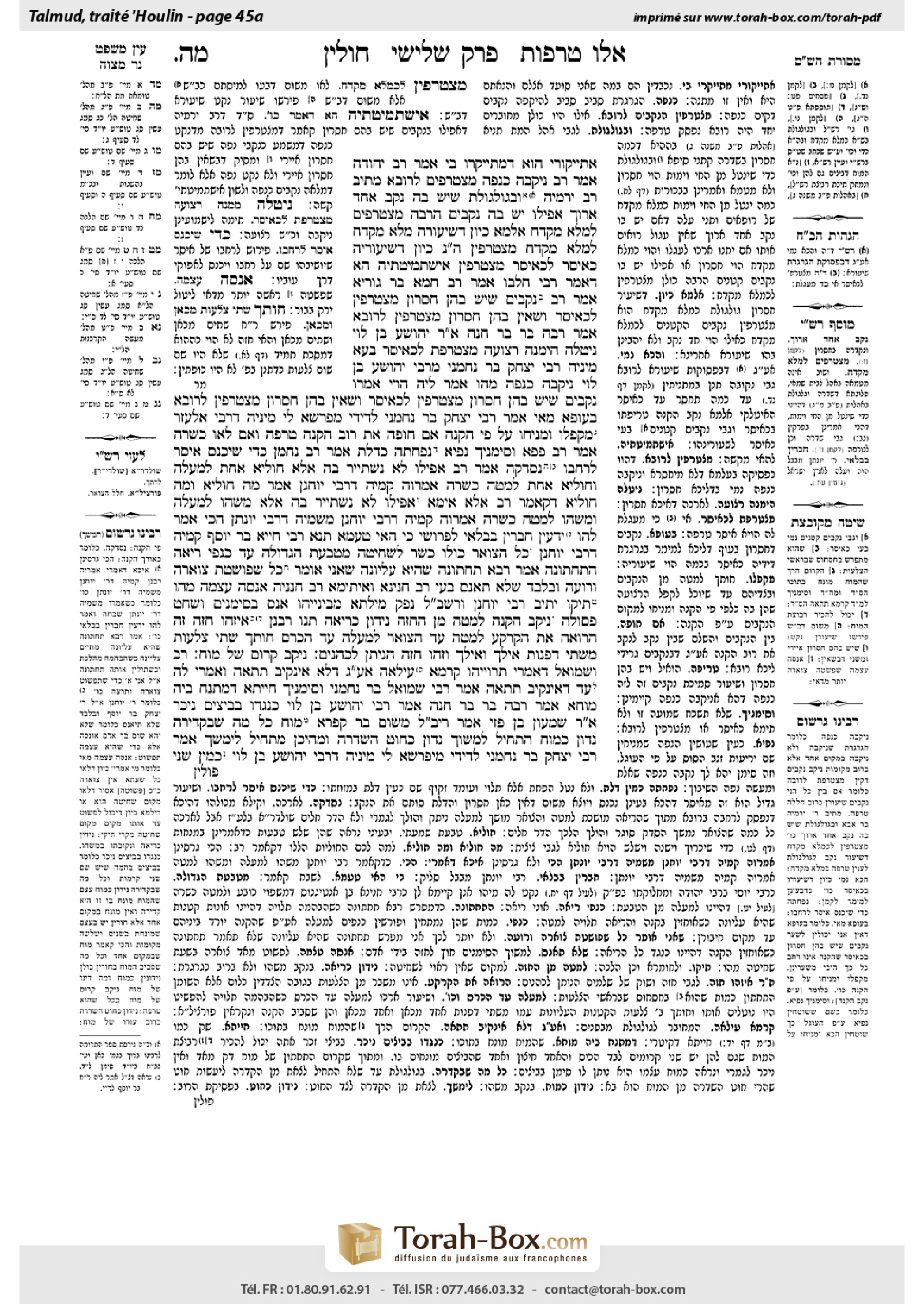
Chullin 45a: Talmud study for Daf Yomi
Study the Talmud for Daf Yomi with scanned pages, Hebrew text, English translations from Sefaria and AI-generated French translations.
Passage selection and English or AI-generated French translation are available where the scan has annotations. Daf Study is independent of Torah-Box and Sefaria.
Browse Chullin · חולין · All tractatesChullin 45a text and translations
This page of Chullin includes the Aramaic text, an English translation and an AI-generated French translation, alongside the scan above.
חולין מ״ה א · Aramaic and Hebrew text
אִתְיַיקּוֹרֵי הוּא דְּמִתְיַיקְּרוּ בִּי.
אָמַר רַב יְהוּדָה אָמַר רַב: נִיקְּבָה כְּנָפָה – מִצְטָרְפִים לְרוּבָּא.
מֵתִיב רַב יִרְמְיָה: וּבְגוּלְגּוֹלֶת שֶׁיֵּשׁ בָּהּ נֶקֶב אֶחָד אָרוֹךְ, אֲפִילּוּ יֵשׁ בָּהּ נְקָבִים הַרְבֵּה – מִצְטָרְפִים לִמְלֹא מַקְדֵּחַ. אַלְמָא, כֵּיוָן דְּשִׁיעוּרַהּ מְלֹא מַקְדֵּחַ – לִמְלֹא מַקְדֵּחַ מִצְטָרְפִין. הָכָא נָמֵי, כֵּיוָן דְּשִׁיעוּרֵיהּ כְּאִיסָּר – לִכְאִיסָּר מִצְטָרְפִין.
אִישְׁתְּמִיטְתֵּיהּ הָא דְּאָמַר רַבִּי חֶלְבּוֹ אָמַר רַב חָמָא בַּר גּוּרְיָא אָמַר רַב: נְקָבִים שֶׁיֵּשׁ בָּהֶן חֶסְרוֹן מִצְטָרְפִין לִכְאִיסָּר, וְשֶׁאֵין בָּהֶן חֶסְרוֹן מִצְטָרְפִין לְרוּבָּא.
אָמַר רַבָּה בַּר בַּר חָנָה אָמַר רַבִּי יְהוֹשֻׁעַ בֶּן לֵוִי: נִיטְּלָה הֵימֶנָּה רְצוּעָה – מִצְטָרֶפֶת לִכְאִיסָּר. בְּעָא מִינֵּיהּ רַבִּי יִצְחָק בַּר נַחְמָנִי מֵרַבִּי יְהוֹשֻׁעַ בֶּן לֵוִי: נִיקְּבָה כְּנָפָה מַהוּ? אֲמַר לֵיהּ: הֲרֵי אָמְרוּ: נְקָבִים שֶׁיֵּשׁ בָּהֶן חִסָּרוֹן – מִצְטָרְפִין לִכְאִיסָּר, וְשֶׁאֵין בָּהֶן חִסָּרוֹן – מִצְטָרְפִין לְרוּבָּא.
בְּעוֹפָא מַאי?
אָמַר רַבִּי יִצְחָק בַּר נַחְמָנִי: לְדִידִי מִפָּרְשָׁא לִי מִינֵּיהּ דְּרַבִּי אֶלְעָזָר: מְקַפְּלוֹ וּמַנִּיחוֹ עַל פִּי הַקָּנֶה, אִם חוֹפֶה אֶת רוֹב הַקָּנֶה – טְרֵפָה, וְאִם לָאו – כְּשֵׁרָה. אָמַר רַב פָּפָּא: וְסִימָנָיךְ – נָפְיָא.
נִפְחֲתָה כְּדֶלֶת, אָמַר רַב נַחְמָן: כְּדֵי שֶׁיִּכָּנֵס אִיסָּר לְרׇחְבּוֹ. נִסְדְּקָה, אָמַר רַב: אֲפִילּוּ לֹא נִשְׁתַּיֵּיר בָּהּ אֶלָּא חוּלְיָא אַחַת לְמַעְלָה וְחוּלְיָא אַחַת לְמַטָּה – כְּשֵׁרָה.
אַמְרוּהָ קַמֵּיהּ דְּרַבִּי יוֹחָנָן, אָמַר: מָה חוּלְיָא וּמָה חוּלְיָא דְּקָאָמַר רַב? אֶלָּא אֵימָא: אֲפִילּוּ לֹא נִשְׁתַּיֵּיר בָּהּ אֶלָּא מַשֶּׁהוּ לְמַעְלָה וּמַשֶּׁהוּ לְמַטָּה – כְּשֵׁרָה.
אַמְרוּהָ קַמֵּיהּ דְּרַבִּי יוֹחָנָן מִשְּׁמֵיהּ דְּרַבִּי יוֹנָתָן הָכִי, אֲמַר לְהוּ: יָדְעִין חַבְרִין בַּבְלָאֵי לְפָרוֹשֵׁי כִּי הַאי טַעְמָא?
תָּנֵא רַבִּי חִיָּיא בַּר יוֹסֵף קַמֵּיהּ דְּרַבִּי יוֹחָנָן: כׇּל הַצַּוָּאר כּוּלּוֹ כָּשֵׁר לִשְׁחִיטָה, מִטַּבַּעַת הַגְּדוֹלָה עַד כַּנְפֵי רֵיאָה הַתַּחְתּוֹנָה. אָמַר רָבָא: תַּחְתּוֹנָה שֶׁהִיא עֶלְיוֹנָה, שֶׁאֲנִי אוֹמֵר כֹּל שֶׁפּוֹשֶׁטֶת צַוָּארָהּ וְרוֹעָה, וּבִלְבַד שֶׁלֹּא תֵּאָנֵס.
בָּעֵי רַב חֲנִינָא, וְאִיתֵּימָא רַב חֲנַנְיָה: אָנְסָה עַצְמָהּ מַהוּ? תֵּיקוּ. יָתֵיב רַבִּי יוֹחָנָן וְרַבִּי שִׁמְעוֹן בֶּן לָקִישׁ, נְפַק מִילְּתָא מִבֵּינַיְיהוּ: אָנַס בַּסִּימָנִים וְשָׁחַט – פְּסוּלָה. נִיקַּב הַקָּנֶה לְמַטָּה מִן הֶחָזֶה – נִידּוֹן כְּרֵיאָה.
תָּנוּ רַבָּנַן: אֵיזֶהוּ חָזֶה? זֶה הָרוֹאֶה אֶת הַקַּרְקַע, לְמַטָּה – עַד הַצַּוָּאר, לְמַעְלָה – עַד הַכָּרֵס. חוֹתֵךְ שְׁתֵּי צְלָעוֹת מִשְּׁתֵּי דְפָנוֹת אֵילָךְ וְאֵילָךְ, וְזֶהוּ חָזֶה הַנִּיתָּן לַכֹּהֲנִים.
נִיקַּב קְרוּם שֶׁל מוֹחַ. רַב וּשְׁמוּאֵל דְּאָמְרִי תַּרְוַיְיהוּ: קְרָמָא עִילָּאָה, אַף עַל גַּב דְּלָא אִינְּקִיב תַּתָּאָה. וְאָמְרִי לַהּ: עַד דְּאִינְּקִיב תַּתָּאָה. אָמַר רַבִּי שְׁמוּאֵל בַּר נַחְמָנִי: וְסִימָנָיךְ חַיְיתָא דְּמִתְּנַח בֵּיהּ מוֹחָא.
אָמַר רַבָּה בַּר בַּר חָנָה אָמַר רַבִּי יְהוֹשֻׁעַ בֶּן לֵוִי: כְּנֶגְדּוֹ בַּבֵּיצִים נִיכָּר. אָמַר רַבִּי שִׁמְעוֹן בֶּן פַּזִּי אָמַר רַבִּי יְהוֹשֻׁעַ בֶּן לֵוִי מִשּׁוּם בַּר קַפָּרָא: מוֹחַ – כׇּל מַה שֶּׁבַּקְּדֵירָה נִדּוֹן כְּמוֹחַ, הִתְחִיל לִימָּשֵׁךְ נִדּוֹן כְּחוּט הַשִּׁדְרָה. וּמֵהֵיכָן מַתְחִיל לִימָּשֵׁךְ? אָמַר רַבִּי יִצְחָק בַּר נַחְמָנִי: לְדִידִי מִיפָּרְשָׁא לִי מִינֵּיהּ דְּרַבִּי יְהוֹשֻׁעַ בֶּן לֵוִי – כְּמִין שְׁנֵי
Chullin 45a · English translation
It is an honor for them to honor me. My attendance is not for my benefit but for theirs.
§ With regard to the halakha that a cut windpipe renders the animal a tereifa, Rav Yehuda says that Rav says: If the windpipe was perforated with a series of small holes around its circumference like a sieve, the small holes join together to constitute a majority of the circumference. Therefore, if their collective size is a majority of the circumference, the windpipe is considered cut.
Rav Yirmeya raises an objection: The mishna teaches (Oholot 2:3) that if a skull of a corpse has a round hole at least the size of a drill bit used for surgery, then the skull does not impart ritual impurity in a tent. With regard to this, a baraita states: And in a skull that contains one long hole, or even if it has many small holes, the areas of the holes join together to constitute the size of a drill hole. Evidently, since the requisite measure is the size of a drill hole, the small holes join together to constitute the size of a drill hole, and not another measure. If so, here, too, in the case of the windpipe, since the requisite measure of a hole to render the animal a tereifa is the size of an issar (see 54a), the small holes should join together to constitute the size of an issar. Why must they constitute the majority of the circumference?
The Gemara notes: It escaped him, i.e., Rav Yirmeya, that which Rabbi Ḥelbo says that Rav Ḥama bar Gurya says that Rav says: Perforations that are a deficiency, i.e., holes of significant area, join together to constitute the size of an issar, and perforations that are not a deficiency, but are as small as the holes of a sieve, must join together to constitute a majority of the circumference, which is the measure of a cut windpipe. Since the holes are not substantial in area, the windpipe cannot be said to be missing a piece, but it may be considered cut.
Rabba bar bar Ḥana says that Rabbi Yehoshua ben Levi says: If a strip of the windpipe was removed from it, its area joins to constitute the size of an issar, even if the strip itself is narrower than an issar. Rabbi Yitzḥak bar Naḥmani asked Rabbi Yehoshua ben Levi: If the windpipe was perforated like a sieve, what is the halakha? Rabbi Yehoshua ben Levi said to him: The Sages said with regard to this case: Perforations that are a deficiency join together to constitute the size of an issar, and perforations that are not a deficiency join together to constitute a majority of the circumference.
The Gemara raises a question: The measure of an issar for missing flesh in the windpipe applies only to animals. In birds, this cannot be the measure, as the entire width of the windpipe is less than the diameter of an issar. What, then, is the measure with regard to a bird?
Rabbi Yitzḥak bar Naḥmani said: It was explained to me personally by Rabbi Elazar: One severs the perforated tissue, folds and lays it over the opening of the windpipe. If it covers the majority of the windpipe, the animal is a tereifa; and if not, the animal is kosher. Rav Pappa said: And your mnemonic for this halakha should be a sieve. If the tissue is perforated like a sieve, one must place it over the opening of the windpipe as if it were a sieve.
The Gemara continues: If the windpipe was missing a piece so that its appearance was like a door, where the missing flesh was partially attached as though on a hinge, Rav Naḥman said: If the missing piece is so large that an issar can enter the hole widthwise, i.e., it is wider and taller than an issar, the animal is a tereifa. If the windpipe was cracked along its length, Rav said: Even if only one undamaged segment remains in the windpipe above the crack and one segment below it, the animal is kosher.
The Sages said this statement before Rabbi Yoḥanan, who said: What is this segment and what is that segment that Rav says? Segments are immaterial to the matter. Rather, say: Even if any amount remained intact in the windpipe above the crack, and any amount below, the animal is kosher.
The Sages said this statement in Eretz Yisrael before Rabbi Yoḥanan in the name of Rabbi Yonatan the Babylonian, i.e., that any amount of undamaged tissue above and below the crack renders the animal kosher. Rabbi Yoḥanan said to them, excitedly: Do our Babylonian friends know how to interpret in accordance with this explanation? He was happy that Rabbi Yonatan interpreted it the same way he did.
§ Rabbi Ḥiyya bar Yosef taught before Rabbi Yoḥanan: The entire neck is fit for slaughter, from the large uppermost ring of the windpipe downward until the lower edges of the lung. Rava says that the phrase: Lower edges of the lung, is referring to an animal hung by the feet; that is, it actually denotes the upper edges nearest the head. As I say that the area fit for slaughter is all the length of the neck that an animal extends in order to graze, provided that it is not forced to extend its neck further than it wishes. Consequently, the very bottom of the neck is not a location fit for slaughter.
Rav Ḥanina, and some say Rav Ḥananya, raises a dilemma: If the animal forced itself and extended its neck, what is the halakha with regard to the additional area? The Gemara responds: The question shall stand unresolved. The Gemara relates that Rabbi Yoḥanan and Rabbi Shimon ben Lakish sat together, and a matter emerged from between them: If the slaughterer forced the animal to extend the simanim by stretching the neck and slaughtered the animal at the lower end of the neck, the slaughter is not valid. And if the windpipe was perforated below the breast, it is considered to be like a perforated lung, which renders the animal a tereifa no matter the size of the perforation. A perforation in the upper windpipe must be the size of an issar to render the animal a tereifa (see 54a).
The Gemara elaborates: The Sages taught in a baraita: Which is the breast that must be given to the priests as a gift from every peace offering (see Leviticus 7:31)? This is the section that faces the ground, not the ribbed area on the sides. And lengthwise it extends below, when the animal is hung from the legs, until the neck, and above until the rumen. One cuts the two ribs nearest the head from the two sides of the animal from both directions, and this is the breast that is given to the priests.
§ The mishna states: If the membrane of the brain was perforated, the animal is a tereifa. The Gemara cites Rav and Shmuel, who both say: The brain is covered by two membranes, a thick outer membrane adjacent to the skull and a thin inner membrane adjacent to the brain. The animal is a tereifa if the outer membrane was perforated, even if the inner membrane was not perforated. And some say that the animal is not a tereifa unless the inner membrane was perforated as well. Rabbi Shmuel bar Naḥmani says: And this is your mnemonic to remember the halakha: The bag in which the brain rests, i.e., the inner membrane.
Rabba bar bar Ḥana says that Rabbi Yehoshua ben Levi says: Even though the inner membrane of the brain is very thin and not easily visible, its equivalent in the testicles, which are also enclosed in a thin membrane, is conspicuous, as it has an appearance different from the testicles themselves. Rabbi Shimon ben Pazi says that Rabbi Yehoshua ben Levi says in the name of bar Kappara: With regard to the brain, everything inside the skull is considered part of the brain. From the point where it begins to extend like a cord out of the base of the skull, it is considered the spinal cord. And from where does it begin to be extended? Rabbi Yitzḥak bar Naḥmani said: It was explained to me personally by Rabbi Yehoshua ben Levi himself: Protrusions similar to two
Chullin 45a · Traduction française (IA)
C'est un honneur pour eux de les honorer. Ma présence n'est pas pour mon bénéfice, mais pour le leur.
§ En ce qui concerne la halakha selon laquelle un cou tranché rend l'animal tereifa, Rav Yehuda dit que Rav dit : Si le cou avait été percé de petits trous autour de son contour, comme un tamis, ces petits trous se joignent pour constituer la majorité du contour. Ainsi, si leur taille collective constitue la majorité du contour, le cou est considéré comme tranché.
Rav Yirmeya soulève un objection : La mitsna enseigne (Oholot 2:3) que si la tête d'un cadavre a un trou ronds au moins aussi grand qu'un foret utilisé en chirurgie, alors la tête ne transmet pas la souillure rituelle dans une tente. En ce qui concerne cela, une baraïta dit : Et dans une tête qui contient un trou long, ou même si elle a plusieurs petits trous, les zones des trous se joignent pour constituer la taille d'un foret. Évidemment, puisque la mesure requise est la taille d'un foret, les petits trous se joignent pour constituer la taille d'un foret, et non une autre mesure. Si c'est ainsi, ici aussi, dans le cas du cou, puisque la mesure requise d'un trou pour rendre l'animal tereifa est la taille d'un issar (voir 54a), les petits trous devraient se joindre pour constituer la taille d'un issar. Pourquoi doivent-ils constituer la majorité du contour ?
La Guemara observe : Il lui a échappé, c'est-à-dire Rav Yirmeya, ce que Rabbi Ḥelbo a dit que Rav Ḥama bar Gurya a dit que Rav a dit : Les perforations qui constituent un défaut, c'est-à-dire des trous de grande surface, se joignent pour constituer la taille d'un issar, et les perforations qui ne constituent pas un défaut, mais sont aussi petites que les trous d'un tamis, doivent se joindre pour constituer la majorité du contour, qui est la mesure d'un cou tranché. Puisque les trous ne sont pas substantiels en surface, le cou ne peut pas être considéré comme manquant d'une pièce, mais il peut être considéré comme tranché.
Rabba bar bar Ḥana dit que Rabbi Yehoshua ben Levi dit : Si un morceau du cou avait été retiré, sa surface se joignait pour constituer la taille d'un issar, même si le morceau lui-même est plus fin qu'un issar. Rabbi Yitzḥak bar Naḥmani a demandé à Rabbi Yehoshua ben Levi : Si le cou avait été percé comme un tamis, quelle est la halakha ? Rabbi Yehoshua ben Levi a répondu à lui : Les Sages ont dit concernant ce cas : Les perforations qui constituent un défaut se joignent pour constituer la taille d'un issar, et les perforations qui ne constituent pas un défaut se joignent pour constituer la majorité du contour.
La Guemara soulève une question : La mesure d'un issar pour la chair manquante dans le cou s'applique uniquement aux animaux. Chez les oiseaux, cela ne peut pas être la mesure, car la largeur totale du cou est inférieure au diamètre d'un issar. Quelle est alors la mesure concernant un oiseau ?
Rabbi Yitzḥak bar Naḥmani dit : On me l'a expliqué personnellement par Rabbi Elazar : On coupe le tissu perforé, on le plie et on le place sur l'ouverture du trachée. Si cela couvre la majorité du trachée, l'animal est tereifa ; et si non, l'animal est kosher. Rav Pappa dit : Et votre mnémotechnique pour cette halakha devrait être un tamis. Si le tissu est perforé comme un tamis, on doit le placer sur l'ouverture du trachée comme si c'était un tamis.
La Guemara continue : Si le trachée manquait un morceau de sorte qu'il ressemblait à une porte, où la chair manquante était partiellement attachée comme si elle était sur un axe, Rav Naḥman dit : Si le morceau manquant est si grand que l'issar peut entrer dans le trou en largeur, c'est-à-dire s'il est plus large et plus haut qu'un issar, l'animal est tereifa. Si le trachée était fissuré le long de sa longueur, Rav dit : Même si un seul segment intact reste dans le trachée au-dessus de la fissure et un segment en dessous, l'animal est kosher.
Les Sages ont dit cette déclaration devant Rabbi Yoḥanan, qui dit : Quel est ce segment et quel est celui-là qui Rav dit ? Les segments sont sans importance. Plutôt, dis : Même si une quantité quelconque restait intacte dans le trachée au-dessus de la fissure, et une quantité en dessous, l'animal est kosher.
Les Sages ont dit cette déclaration en Eretz Yisrael devant Rabbi Yoḥanan en nom de Rabbi Yonatan le Babylonien, c'est-à-dire que toute quantité de tissu intacte au-dessus et en dessous de la fissure rend l'animal kasher. Rabbi Yoḥanan a dit à eux, avec enthousiasme : Nos amis babyloniens savent-ils interpréter selon cette explication ? Il était heureux que Rabbi Yonatan l'interprète de la même manière que lui.
§ Rabbi Ḥiyya bar Yosef a enseigné devant Rabbi Yoḥanan : Tout le cou est adapté à la bête, du grand anneau supérieur du cou vers le bas jusqu'aux bords inférieurs des poumons. Rava dit que la phrase : Bords inférieurs des poumons, fait référence à un animal suspendu par les pieds ; c'est-à-dire qu'elle désigne en réalité les bords supérieurs proches de la tête. Comme je dis que la zone adaptée à la bête est toute la longueur du cou que l'animal étire pour manger, à condition qu'il ne soit pas forcé d'étirer son cou plus qu'il ne le souhaite. Ainsi, le bas du cou n'est pas un lieu adapté à la bête.
Rav Ḥanina, et certains disent Rav Ḥananya, soulève un dilemme : Si l'animal s'est forcé et a étiré son cou, quelle est la halakha concernant la zone supplémentaire ? La Guemara répond : La question restera sans réponse. La Guemara rapporte que Rabbi Yoḥanan et Rabbi Shimon ben Lakish s'étaient assis ensemble, et un sujet est survenu entre eux : Si le boucher a forcé l'animal à étirer les simanim en tirant sur le cou et a sacrifié l'animal à la base du cou, la boucherie n'est pas valide. Et si le cou était perforé en dessous de la poitrine, il est considéré comme un poumon perforé, ce qui rend l'animal tereifa indépendamment de la taille de la perforation. Une perforation dans le haut du cou doit être de la taille d'un issar pour rendre l'animal tereifa (voir 54a).
La Guemara développe : Les Sages ont enseigné dans une baraïta : Quel est le sein qui doit être donné aux prêtres comme don de chaque offrande de paix (cf. Lévitique 7:31) ? C'est la section qui fait face au sol, pas la partie à côtes. Et dans la longueur, il s'étend en dessous, lorsque l'animal est suspendu par les pattes, jusqu'au cou, et en haut jusqu'au rumen. On coupe les deux côtes les plus proches de la tête des deux côtés de l'animal depuis les deux directions, et c'est ce sein qui est donné aux prêtres.
§ La mitsva dit : Si la membrane du cerveau était percée, l'animal est un tereifa. La Guemara cite Rav et Shmuel, qui disent tous les deux : Le cerveau est recouvert de deux membranes, une membrane épaisse extérieure adjacente à la boîte crânienne et une membrane fine intérieure adjacente au cerveau. L'animal est un tereifa si la membrane extérieure était percée, même si la membrane intérieure n'était pas percée. Et certains disent que l'animal n'est pas un tereifa à moins que la membrane intérieure ne soit également percée. Rabbi Shmuel bar Naḥmani dit : Et c'est votre mnémotechnique pour retenir la halakha : La poche dans laquelle le cerveau repose, c'est-à-dire la membrane intérieure.
Rabba bar bar Ḥana dit que Rabbi Yéhoshua ben Levi dit : Même si la membrane intérieure du cerveau est très fine et peu visible, son équivalent dans les testicules, qui sont également enfermés dans une membrane fine, est évident, car il a une apparence différente des testicules eux-mêmes. Rabbi Šimon ben Pazi dit que Rabbi Yéhoshua ben Levi dit en nom de bar Kappara : En ce qui concerne le cerveau, tout ce qui est à l'intérieur de la boîte crânienne est considéré comme faisant partie du cerveau. À partir du point où il commence à s'étendre comme un fil en dehors de la base de la boîte crânienne, il est considéré comme la moelle épinière. Et à partir de quel point commence-t-il à s'étendre ? Rabbi Yitzḥak bar Naḥmani a dit : Il m'a été expliqué personnellement par Rabbi Yéhoshua ben Levi lui-même : Des protubérances semblables à deux
Traduction française générée par IA à partir de l’édition anglaise de Sefaria. Vérifie toujours un passage avec le texte source.
Text from Sefaria: William Davidson Edition - Vocalized Aramaic (unknown); William Davidson Edition - English (CC BY NC).