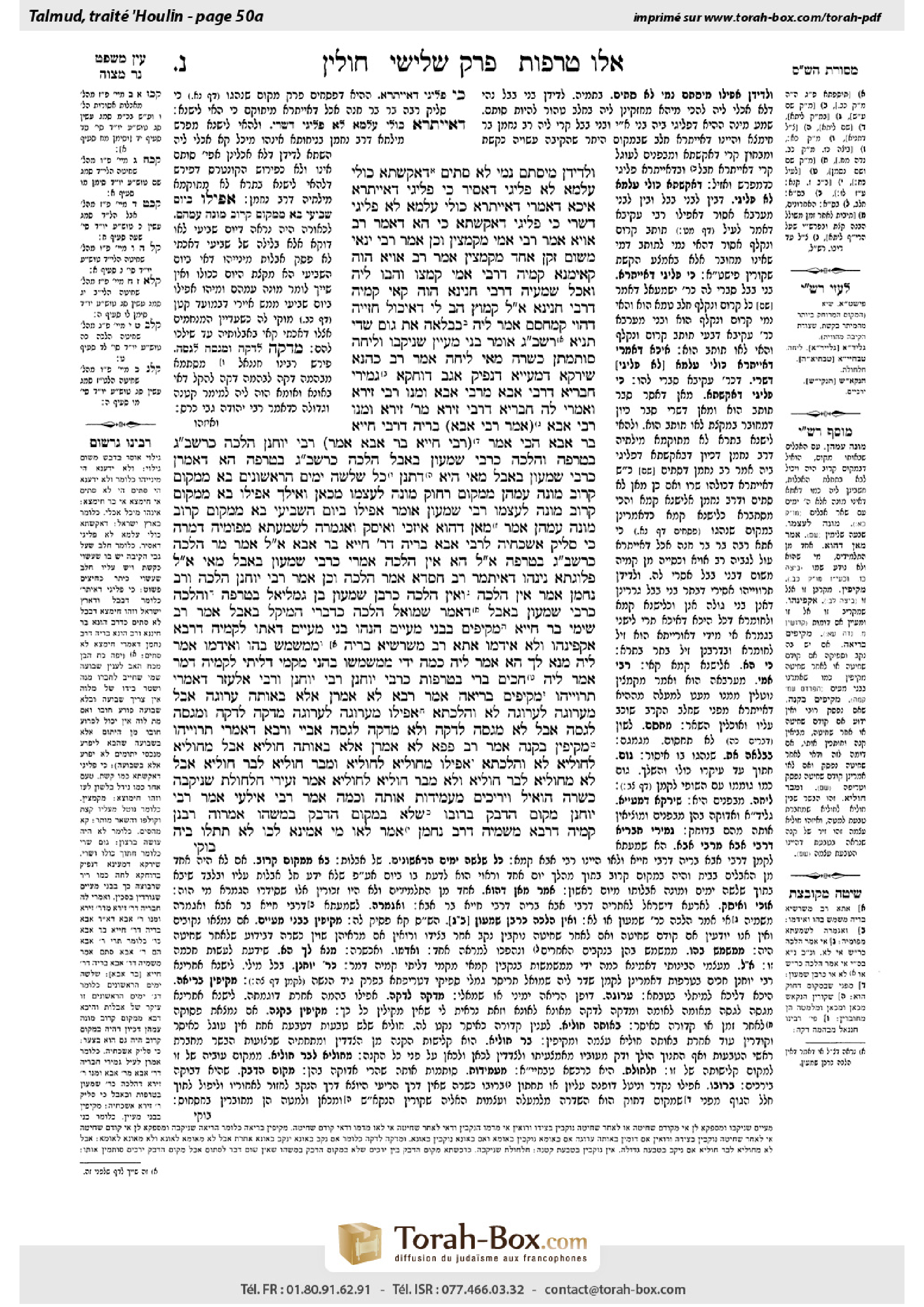
Chullin 50a: Talmud study for Daf Yomi
Study the Talmud for Daf Yomi with scanned pages, Hebrew text, English translations from Sefaria and AI-generated French translations.
Passage selection and English or AI-generated French translation are available where the scan has annotations. Daf Study is independent of Torah-Box and Sefaria.
Browse Chullin · חולין · All tractatesChullin 50a text and translations
This page of Chullin includes the Aramaic text, an English translation and an AI-generated French translation, alongside the scan above.
חולין נ׳ א · Aramaic and Hebrew text
וּלְדִידַן מִיסְתָּם נָמֵי לָא סָתֵים.
דְּאַקַּשְׁתָּא – כּוּלֵּי עָלְמָא לָא פְּלִיגִי דַּאֲסִיר, כִּי פְּלִיגִי – דְּאַיִּיתְרָא.
אִיכָּא דְּאָמְרִי, דְּאַיִּיתְרָא – כּוּלֵּי עָלְמָא לָא פְּלִיגִי דִּשְׁרֵי, כִּי פְּלִיגִי – דְּאַקַּשְׁתָּא.
כִּי הָא דְּאָמַר רַב אַוְיָא אָמַר רַבִּי אַמֵּי: מְקַמְּצִין, וְכֵן אָמַר רַבִּי יַנַּאי מִשּׁוּם זָקֵן אֶחָד: מְקַמְּצִין. אָמַר רַב אַוְיָא: הֲוָה קָאֵימְנָא קַמֵּיהּ דְּרַבִּי אַמֵּי, קְמַצוּ וְהַבוּ לֵיהּ, וַאֲכַל.
שַׁמָּעֵיהּ דְּרַבִּי חֲנִינָא הֲוָה קָאֵי קַמֵּיהּ דְּרַבִּי חֲנִינָא, אֲמַר לֵיהּ: קְמוֹץ, הַב לִי דְּאֵיכוֹל. חַזְיֵיהּ דַּהֲוָה קָמְחַסֵּם, אֲמַר לֵיהּ: בַּבְלָאָה אַתְּ, גּוֹם שְׁדִי.
תַּנְיָא: רַבָּן שִׁמְעוֹן בֶּן גַּמְלִיאֵל אוֹמֵר: בְּנֵי מֵעַיִין שֶׁנִּיקְּבוּ, וְלֵיחָה סוֹתַמְתָּן – כְּשֵׁרָה. מַאי לֵיחָה? אָמַר רַב כָּהֲנָא: שִׁירְקָא דִּמְעַיָּיא דְּנָפֵיק אַגַּב דּוּחְקָא.
גְּמִירִי חַבְרַיָּא דְּרַבִּי אַבָּא מֵרַבִּי אַבָּא, וּמַנּוּ? רַבִּי זֵירָא, וְאָמְרִי לַהּ חַבְרַיָּא דְּרַבִּי זֵירָא מֵרַבִּי זֵירָא, וּמַנּוּ? רַבִּי אַבָּא. אָמַר רַבִּי אַבָּא בְּרֵיהּ דְּרַבִּי חִיָּיא בַּר אַבָּא: הָכִי אָמַר רַבִּי חִיָּיא בַּר אַבָּא אָמַר רַבִּי יוֹחָנָן: הֲלָכָה כְּרַבָּן שִׁמְעוֹן בֶּן גַּמְלִיאֵל בִּטְרֵפָה, וַהֲלָכָה כְּרַבִּי שִׁמְעוֹן בְּאֵבֶל.
הֲלָכָה כְּרַבָּן שִׁמְעוֹן בֶּן גַּמְלִיאֵל בִּטְרֵפָה – הָא דַּאֲמַרַן. כְּרַבִּי שִׁמְעוֹן בְּאֵבֶל, מַאי הִיא? דִּתְנַן: כׇּל שְׁלֹשָׁה יָמִים הָרִאשׁוֹנִים, בָּא מִמָּקוֹם קָרוֹב – מוֹנֶה עִמָּהֶן.
מִמָּקוֹם רָחוֹק – מוֹנֶה לְעַצְמוֹ. מִכָּאן וְאֵילָךְ, אֲפִילּוּ בָּא מִמָּקוֹם קָרוֹב – מוֹנֶה לְעַצְמוֹ. רַבִּי שִׁמְעוֹן אוֹמֵר: אֲפִילּוּ בְּיוֹם הַשְּׁבִיעִי, בָּא מִמָּקוֹם קָרוֹב – מוֹנֶה עִמָּהֶן.
אָמַר מַאן דְּהוּא: אִיזְכֵּי וְאֶיסַּק וְאֶגְמְרַהּ לִשְׁמַעְתָּא מִפּוּמֵּיהּ דְּמָרַהּ. כִּי סְלֵיק, אַשְׁכְּחֵיהּ לְרַבִּי אַבָּא בְּרֵיהּ דְּרַבִּי חִיָּיא בַּר אַבָּא. אֲמַר לֵיהּ: אֲמַר מָר הֲלָכָה כְּרַבָּן שִׁמְעוֹן בֶּן גַּמְלִיאֵל בִּטְרֵפָה? אֲמַר לֵיהּ: הָא אֵין הֲלָכָה אֲמַרִי.
כְּרַבִּי שִׁמְעוֹן בְּאָבֵל, מַאי? אֲמַר לֵיהּ: פְּלוּגָתָא נִינְהוּ, דְּאִיתְּמַר: רַב חִסְדָּא אָמַר הֲלָכָה, וְכֵן אָמַר רַבִּי יוֹחָנָן הֲלָכָה, וְרַב נַחְמָן אָמַר אֵין הֲלָכָה.
וְאֵין הֲלָכָה כְּרַבָּן שִׁמְעוֹן בֶּן גַּמְלִיאֵל בִּטְרֵפָה, וַהֲלָכָה כְּרַבִּי שִׁמְעוֹן בְּאֵבֶל, דְּאָמַר שְׁמוּאֵל: הֲלָכָה כְּדִבְרֵי הַמֵּיקֵל בְּאֵבֶל.
אָמַר רַב שִׁימִי בַּר חִיָּיא: מַקִּיפִים בִּבְנֵי מֵעַיִים.
הָנְהוּ בְּנֵי מֵעַיִים דַּאֲתוֹ לְקַמֵּיהּ דְּרָבָא, אַקְּפִינְהוּ וְלָא אִידְּמוֹ. אֲתָא רַב מְשַׁרְשְׁיָא בְּרֵיהּ, מְמַשְׁמֵשׁ בְּהוּ וְאִידְּמוֹ. אֲמַר לֵיהּ: מְנָא לָךְ הָא? אֲמַר לֵיהּ: כַּמָּה יְדֵי מַשְׁמִשׁוּ בְּהָנֵי מִקַּמֵּי דְּלֵיתֵי לְקַמֵּיהּ דְּמָר. אֲמַר לֵיהּ: חַכִּים בְּרִי בִּטְרֵפוֹת כְּרַבִּי יוֹחָנָן.
רַבִּי יוֹחָנָן וְרַבִּי אֶלְעָזָר דְאָמְרִי תַּרְוַיְיהוּ: מַקִּיפִים בָּרֵיאָה. אָמַר רָבָא: לָא אֲמַרַן אֶלָּא בְּאוֹתָהּ עֲרוּגָה, אֲבָל מֵעֲרוּגָה לַעֲרוּגָה – לָא. וְהִלְכְתָא: אֲפִילּוּ מֵעֲרוּגָה לַעֲרוּגָה, מִדַּקָּה לְדַקָּה, וּמִגַּסָּה לְגַסָּה, אֲבָל לֹא מִגַּסָּה לְדַקָּה, וְלֹא מִדַּקָּה לְגַסָּה.
אַבָּיֵי וְרָבָא דְּאָמְרִי תַּרְוַיְיהוּ: מַקִּיפִין בַּקָּנֶה. אָמַר רַב פָּפָּא: לָא אֲמַרַן אֶלָּא בְּאוֹתָהּ חוּלְיָא, אֲבָל מֵחוּלְיָא לְחוּלְיָא – לָא. וְהִלְכְתָא: אֲפִילּוּ מֵחוּלְיָא לְחוּלְיָא, וּמִבַּר חוּלְיָא לְבַר חוּלְיָא, אֲבָל לָא מֵחוּלְיָא לְבַר חוּלְיָא, וְלָא מִבַּר חוּלְיָא לְחוּלְיָא.
אָמַר זְעֵירִי: חַלְחוֹלֶת שֶׁנִּיקְּבָה כְּשֵׁרָה, הוֹאִיל וִירֵיכַיִם מַעֲמִידוֹת אוֹתָהּ. וְכַמָּה? אָמַר רַבִּי אִילְעַי אָמַר רַבִּי יוֹחָנָן: מְקוֹם הַדֶּבֶק – בְּרוּבּוֹ, שֶׁלֹּא בִּמְקוֹם הַדֶּבֶק – בְּמַשֶּׁהוּ.
אַמְרוּהָ רַבָּנַן קַמֵּיהּ דְּרָבָא מִשְּׁמֵיהּ דְּרַב נַחְמָן, אָמַר: לָאו מִי אָמֵינָא לְכוּ לָא תִּתְלוֹ בֵּיהּ
Chullin 50a · English translation
and to us, the residents of Babylonia, not only is it forbidden but it also does not seal a perforation? It cannot be that this fat is forbidden by Torah law if they permit it for consumption. Even though we are stringent with regard to its consumption, we may still maintain that it effectively seals a perforation.
The Gemara explains: The abomasum is shaped like a bow. The side facing outward is curved like the bow itself, while the side facing inward is flat and straight like the bowstring. With regard to the fat that is on the bow, everyone agrees, even the residents of Eretz Yisrael, that it is forbidden for consumption. This fat, then, is the ḥimtza, which does not seal a perforation according to Rav Naḥman. When they disagree, it is with regard to the fat that is on the bowstring. The residents of Eretz Yisrael permit it for consumption, while those of Babylonia prohibit it. According to Rav Naḥman, the residents of Babylonia should concede that it is nevertheless an effective seal. This, then, is the bar ḥimtza.
There are those who say that with regard to the fat that is on the bowstring, everyone agrees that it is permitted. This, then, is the bar ḥimtza. When they disagree, it is with regard to the fat that is on the bow. The residents of Eretz Yisrael permit it, but the residents of Babylonia prohibit it. This, then, is the ḥimtza.
The Gemara adds: When it was stated that only the residents of Eretz Yisrael permit the fat on the bowstring for consumption, this means that they would eat it in a manner like that which Rav Avya says that Rabbi Ami says: One takes a handful of the fat that lies above the fat on the bowstring, since this is the fat prohibited by the verse: “And all the fat that is upon the innards” (Leviticus 3:3), and the rest is permitted for consumption. And so says Rabbi Yannai, also a resident of Eretz Yisrael, in the name of a certain elder: One takes a handful. Rav Avya said: I was standing before Rabbi Ami. The people there took a handful of the fat on the bowstring and gave him the remaining fat, and he ate from it.
The Gemara relates: The attendant of Rabbi Ḥanina was standing before Rabbi Ḥanina, a resident of Eretz Yisrael. Rabbi Ḥanina said to him: Take off a handful from that fat on the bowstring and give me the rest so that I will eat from it. Rabbi Ḥanina saw that the attendant was hesitating, so he said to him: You are a Babylonian and usually consider all of this fat forbidden. If so, cut off all the fat and throw it away.
§ The mishna states that if the small intestines are perforated, the animal is a tereifa. With regard to this, it is taught in a baraita: Rabban Shimon ben Gamliel says: If the intestines were perforated but mucus seals the perforated intestines, the animal is kosher. The Gemara asks: What is this mucus? Rav Kahana said: It is the mucus of the intestines that comes out under pressure, when one scrapes with a knife.
The Gemara relates: The colleagues of Rabbi Abba learned a tradition from Rabbi Abba. And who are they? The phrase: Colleagues of Rabbi Abba, is referring to Rabbi Zeira. And some say the colleagues of Rabbi Zeira learned it from Rabbi Zeira. And who are they? Rabbi Abba. This is the tradition: Rabbi Abba, son of Rabbi Ḥiyya bar Abba, said that this is what Rabbi Ḥiyya bar Abba says that Rabbi Yoḥanan says: The halakha is in accordance with the opinion of Rabban Shimon ben Gamliel with regard to a tereifa, and the halakha is in accordance with the opinion of Rabbi Shimon with regard to the halakhot of mourning.
The Gemara elaborates: The halakha is in accordance with the opinion of Rabban Shimon ben Gamliel with regard to a tereifa; this is the halakha that we stated above, that mucus forms an effective seal in the intestines. The halakha is in accordance with the opinion of Rabbi Shimon with regard to mourning; what is this halakha? As we learned in a baraita: If one learns of the death of an immediate relative after other relatives have already begun their period of mourning, the halakha is as follows: During the entire first three days of mourning, if a mourner comes to the house of mourning from a nearby place, he counts his days of mourning with the other mourners and completes his mourning with them.
The baraita continues: If he came from a distant place, he counts seven days on his own from the time that he was informed of the death. From this point forward, i.e., after the first three days, even if he comes from a nearby place, he counts seven days on his own. Rabbi Shimon says: Even on the seventh day, if he comes from a nearby place, he counts and completes his mourning with the other mourners.
Someone whose name was not given said: May I merit to go up to Eretz Yisrael and learn this halakha from the mouth of its Master. When he went up from Babylonia to Eretz Yisrael, he found Rabbi Abba, son of Rabbi Ḥiyya bar Abba, and said to him: Is it true that the Master said that the halakha is in accordance with the opinion of Rabban Shimon ben Gamliel with regard to a tereifa? Rabbi Abba said to him: This is not true. Rather, I said just the opposite, that the halakha is not in accordance with Rabban Shimon ben Gamliel, and even if mucus seals the perforation of the intestine, the animal is a tereifa.
The anonymous man asked Rabbi Abba again: What about the other ruling reported in your name, that the halakha is in accordance with the opinion of Rabbi Shimon with regard to mourning; is this accurate? Rabbi Abba said to him: There are conflicting opinions with regard to this matter, as it was stated that Rav Ḥisda says that the halakha is in accordance with the opinion of Rabbi Shimon, and so says Rabbi Yoḥanan: That is the halakha. But Rav Naḥman says: That is not the halakha.
The Gemara concludes: And the halakha is not in accordance with the opinion of Rabban Shimon ben Gamliel with regard to a tereifa, and the halakha is in accordance with the opinion of Rabbi Shimon with regard to mourning, in accordance with the statement of Shmuel, who says: The halakha is in accordance with the statement of the more lenient authority in matters relating to mourning.
§ Rav Shimi bar Ḥiyya says: One may compare perforations in the intestines. If one is unsure whether a perforation occurred before or after slaughter, one may make an additional perforation and compare the two. If their appearance is similar, one may conclude that the perforation occurred after slaughter, and the animal is kosher.
The Gemara relates: There were certain perforated intestines that came before Rava. Rava made other perforations and compared them, but they were not similar. Rav Mesharshiyya, his son, came and rubbed the new perforations, and they were similar. Rav Mesharshiyya therefore deemed the animal kosher. Rava said to him: From where did you know to do this? Rav Mesharshiyya said to him: I reasoned: How many hands rubbed these earlier perforations before they came before the Master? Therefore, I thought that if I handled the new ones, perhaps they would look similar. Rava said to him: My son is as wise in matters of tereifot as Rabbi Yoḥanan.
Similarly, Rabbi Yoḥanan and Rabbi Elazar both say: One may compare perforations in the lung to determine whether they occurred after slaughter. Rava said: We said this only when the two perforations are on the same side of the lungs. But one may not compare perforations from one side to the other side. The Gemara rules: And the halakha is: One may compare even from one side to the other side, and even from a small animal to another small animal, or from a large animal to another large animal, but not from a large animal to a small animal, and not from a small animal to a large animal.
Similarly, Abaye and Rava both say: One may compare severed or perforated areas in the windpipe. Rav Pappa said: We said this only when the two areas are in the same segment of the windpipe. But one may not compare from one segment to another segment. The Gemara rules: And the halakha is: One may even compare from one segment to another segment, and from one subsegment, i.e., a thin segment between the main segments, to another subsegment, but not from a segment to a subsegment, and not from a subsegment to a segment.
§ Ze’eiri says: If the rectum was perforated, the animal is kosher, since the hips hold it up and seal the perforation. And to how much of the rectum does this apply? Rabbi Ilai says that Rabbi Yoḥanan says: If the rectum was perforated in the place where it is attached to the hips, even if it was perforated in its majority, the animal is kosher. If the perforation was not in the place where it is attached to the hips, the animal is a tereifa if it was perforated in any amount.
The Sages said this halakha before Rava in the name of Rav Naḥman. Rava said to them: Have I not told you not to hang on Rav Naḥman
Chullin 50a · Traduction française (IA)
et pour nous, les habitants de Babylone, ce n'est pas seulement interdit, mais cela ne scelle pas non plus une perforation ? Il ne peut pas être question que cette graisse soit interdite selon la loi divine si les habitants de Babylone permettent de la consommer. Même si nous sommes stricts quant à sa consommation, nous pouvons encore maintenir qu'elle scelle effectivement une perforation.
La Guemara explique : L'abomasum est en forme d'arc. Le côté tourné vers l'extérieur est courbé comme l'arc lui-même, tandis que le côté tourné vers l'intérieur est plat et droit comme la corde de l'arc. Concernant la graisse qui est sur l'arc, tout le monde s'accorde, même les habitants d'Israël, sur le fait qu'elle est interdite à la consommation. Cette graisse, alors, est la ḥimtza, qui ne scelle pas une perforation selon Rav Naḥman. Lorsqu'ils divergent, c'est concernant la graisse qui est sur la corde. Les habitants d'Israël la permettent à la consommation, tandis que ceux de Babylone la prohibent. Selon Rav Naḥman, les habitants de Babylone devraient reconnaître qu'elle scelle effectivement une perforation. C'est alors la bar ḥimtza.
Certains disent que concernant la graisse qui est sur la corde, tout le monde s'accorde sur le fait qu'elle est permise à la consommation. C'est alors la bar ḥimtza. Lorsqu'ils divergent, c'est concernant la graisse qui est sur l'arc. Les habitants d'Israël la permettent, mais les habitants de Babylone la prohibent. C'est alors la ḥimtza.
La Guemara ajoute : Lorsqu'il a été dit que seulement les habitants d'Israël permettent la consommation de la graisse sur la corde, cela signifie qu'ils la mangent de la manière que Rav Avya rapporte que Rabbi Ami dit : On prend une poignée de la graisse qui est au-dessus de la graisse sur l'arc, puisque c'est la graisse interdite par la parole : « Et toute la graisse qui est sur les viscères » (Lévitique 3:3), et le reste est permis à la consommation. Et ainsi dit Rabbi Yannai, également un habitant d'Israël, en nom d'un certain ancien : On prend une poignée. Rav Avya dit : J'étais devant Rabbi Ami. Les gens là-bas ont pris une poignée de la graisse sur la corde et lui ont donné la graisse restante, et il a mangé de celle-ci.
La Guemara rapporte : L'assistant de Rabbi Ḥanina était devant Rabbi Ḥanina, un habitant d'Israël. Rabbi Ḥanina a dit à lui : Retire une poignée de cette graisse sur la corde et donne-moi le reste afin que je puisse m'en nourrir. Rabbi Ḥanina a vu que l'assistant hésitait, alors il a dit à lui : Tu es un Babylonien et tu considères généralement toute cette graisse comme interdite. Si c'est le cas, coupe toute la graisse et jette-la.
§ La michna stipule que si les intestins sont perforés, l'animal est un tereifa. À ce sujet, il est enseigné dans une baraïta : Rabban Shimon ben Gamliel dit : Si les intestins sont perforés mais que la muqueuse scelle les intestins perforés, l'animal est propre. La Guemara pose la question : Qu'est-ce que cette muqueuse ? Rav Kahana a dit : C'est la muqueuse des intestines qui sort sous pression, lorsqu'on gratte avec un couteau.
La Guemara rapporte : Les collègues de Rabbi Abba ont appris une tradition de Rabbi Abba. Et qui sont-ils ? La phrase : Collègues de Rabbi Abba, fait référence à Rabbi Zeira. Et certains disent que les collègues de Rabbi Zeira l'ont appris de Rabbi Zeira. Et qui sont-ils ? Rabbi Abba. C'est la tradition : Rabbi Abba, fils de Rabbi Ḥiyya bar Abba, a dit que c'est ce que Rabbi Ḥiyya bar Abba dit que Rabbi Yoḥanan dit : La halakha suit l'opinion de Rabban Shimon ben Gamliel concernant un tereifa, et la halakha suit l'opinion de Rabbi Shimon concernant les halakhot de deuil.
La Guemara développe : La halakha suit l'opinion de Rabban Shimon ben Gamliel concernant un tereifa ; c'est la halakha que nous avons mentionné ci-dessus, que la muqueuse forme un scellement efficace dans les intestins. La halakha suit l'opinion de Rabbi Shimon concernant le deuil ; qu'est-ce que cette halakha ? Comme nous l'avons appris dans une baraïta : Si l'on apprend la mort d'un parent proche après que d'autres parents ont déjà commencé leur période de deuil, la halakha est la suivante : Pendant les trois premiers jours de deuil, si un deuil vient chez le ménage de deuil d'une place proche, il compte ses jours de deuil avec les autres deuils et termine son deuil avec eux.
La baraïta continue : S'il est venu d'une place éloignée, il compte sept jours seul à partir du moment où il a été informé de la mort. À partir de ce point, c'est-à-dire après les trois premiers jours, même s'il vient d'une place proche, il compte sept jours seul. Rabbi Shimon dit : Même le septième jour, s'il vient d'une place proche, il compte et termine son deuil avec les autres deuils.
Un homme dont le nom n'a pas été donné a dit : Je mérite de monter en Terre d'Israël et d'apprendre cette halakha à la bouche de son Maître. Lorsqu'il est monté de Babylone en Terre d'Israël, il a trouvé Rabbi Abba, fils de Rabbi Ḥiyya bar Abba, et lui a dit : Est-ce vrai que le Maître a dit que la halakha suit l'opinion de Rabban Shimon ben Gamliel concernant un tereifa ? Rabbi Abba lui a répondu : Ce n'est pas vrai. Plutôt, j'ai dit tout le contraire, que la halakha ne suit pas l'opinion de Rabban Shimon ben Gamliel, et même si la muqueuse scelle la perforation de l'intestin, l'animal est un tereifa.
L'homme anonyme a demandé à Rabbi Abba à nouveau : Et concernant l'autre décision rapportée sous votre nom, que la halakha suit l'opinion de Rabbi Shimon concernant le deuil ; est-ce exact ? Rabbi Abba lui a répondu : Il y a des divergences d'opinions concernant cette question, comme il a été dit que Rav Ḥisda dit que la halakha suit l'opinion de Rabbi Shimon, et ainsi dit Rabbi Yoḥanan : C'est la halakha. Mais Rav Naḥman dit : Ce n'est pas la halakha.
La Guemara conclut : Et la halakha ne suit pas l'opinion de Rabban Shimon ben Gamliel concernant un tereifa, et la halakha suit l'opinion de Rabbi Shimon concernant le deuil, conformément à la déclaration de Shmuel, qui dit : La halakha suit la déclaration de l'autorité la plus clémente en matière de deuil.
§ Rav Shimi bar Ḥiyya dit : On peut comparer les perforations dans les intestins. Si l'on est不确定 si une perforation s'est produite avant ou après l'abattage, on peut faire une perforation supplémentaire et comparer les deux. Si leur apparence est semblable, on peut conclure que la perforation s'est produite après l'abattage, et l'animal est kosher.
La Guemara rapporte : Il y avait certaines intestines perforées qui sont venues devant Rava. Rava a fait d'autres perforations et les a comparées, mais elles n'étaient pas semblables. Rav Mesharshiyya, son fils, est venu et a frotté les nouvelles perforations, et elles étaient semblables. Rav Mesharshiyya a donc estimé l'animal propre. Rava a dit à lui : D'où as-tu su faire cela ? Rav Mesharshiyya a dit à lui : J'ai raisonné : Combien de mains ont frotté ces perforations précédentes avant qu'elles viennent devant le Maître ? J'ai donc pensé que si j'assaisonnais les nouvelles, peut-être qu'elles ressembleraient. Rava a dit à lui : Mon fils est aussi sage en matière de tereifot que Rabbi Yoḥanan.
De même, Rabbi Yoḥanan et Rabbi Elazar disent tous les deux : On peut comparer les perforations dans le poumon afin de déterminer si elles ont eu lieu après l'abattage. Rava a dit : Nous avons dit cela seulement lorsque les deux perforations sont du même côté des poumons. Mais on ne peut pas comparer les perforations d'un côté à l'autre. La Guemara règle : Et la halakha est : On peut même comparer d'un côté à l'autre, et même d'un petit animal à un autre petit animal, ou d'un grand animal à un autre grand animal, mais pas d'un grand animal à un petit animal, et pas d'un petit animal à un grand animal.
De même, Abaye et Rava disent tous les deux : On peut comparer les zones sectionnées ou perforées dans la trachée. Rav Pappa a dit : Nous avons dit cela seulement lorsque les deux zones sont dans le même segment de la trachée. Mais on ne peut pas comparer d'un segment à un autre segment. La Guemara règle : Et la halakha est : On peut même comparer d'un segment à un autre segment, et d'un sous-segment, c'est-à-dire un segment fin entre les segments principaux, à un autre sous-segment, mais pas d'un segment à un sous-segment, et pas d'un sous-segment à un segment.
§ Ze’eiri dit : Si le rectum était perforé, l'animal est propre, car les hanches le tiennent et le scellent. Et jusqu'à quel point du rectum cela s'applique-t-il ? Rabbi Ilai dit que Rabbi Yoḥanan dit : Si le rectum était perforé à l'endroit où il est attaché aux hanches, même s'il était perforé dans sa majorité, l'animal est propre. Si la perforation n'était pas à l'endroit où il est attaché aux hanches, l'animal est tereifa si la perforation était dans une quantité quelconque.
Les Sages ont dit cette halakha à Rava en nom de Rav Naḥman. Rava a dit à eux : N'ai-je pas dit que vous ne devriez pas vous appuyer sur Rav Naḥman ?
Traduction française générée par IA à partir de l’édition anglaise de Sefaria. Vérifie toujours un passage avec le texte source.
Text from Sefaria: William Davidson Edition - Vocalized Aramaic (unknown); William Davidson Edition - English (CC BY NC).