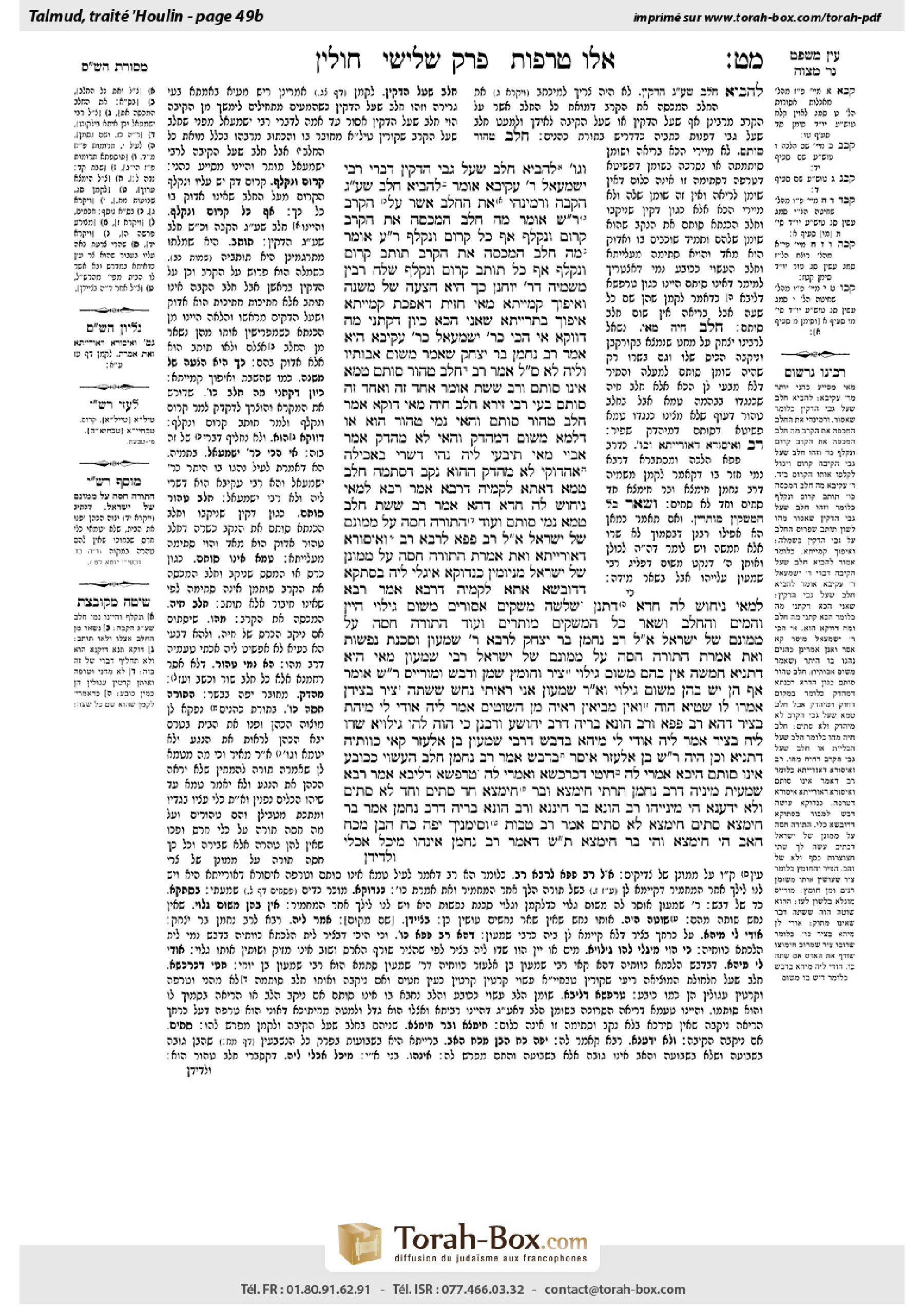
Chullin 49b: Talmud study for Daf Yomi
Study the Talmud for Daf Yomi with scanned pages, Hebrew text, English translations from Sefaria and AI-generated French translations.
Passage selection and English or AI-generated French translation are available where the scan has annotations. Daf Study is independent of Torah-Box and Sefaria.
Browse Chullin · חולין · All tractatesChullin 49b text and translations
This page of Chullin includes the Aramaic text, an English translation and an AI-generated French translation, alongside the scan above.
חולין מ״ט ב · Aramaic and Hebrew text
וְגוֹ׳״ – לְהָבִיא חֵלֶב שֶׁעַל גַּבֵּי הַדַּקִּין, דִּבְרֵי רַבִּי יִשְׁמָעֵאל. רַבִּי עֲקִיבָא אוֹמֵר: לְהָבִיא חֵלֶב שֶׁעַל גַּבֵּי הַקֵּבָה.
וּרְמִינְהִי: ״אֶת הַחֵלֶב אֲשֶׁר עַל הַקֶּרֶב״ – רַבִּי שִׁמְעוֹן אוֹמֵר: מָה חֵלֶב הַמְכַסֶּה אֶת הַקֶּרֶב קְרוּם וְנִקְלָף, אַף כֹּל קְרוּם וְנִקְלָף. רַבִּי עֲקִיבָא אוֹמֵר: מָה חֵלֶב הַמְכַסֶּה אֶת הַקֶּרֶב תּוֹתָב קְרוּם וְנִקְלָף, אַף כֹּל תּוֹתָב קְרוּם וְנִקְלָף.
שְׁלַח רָבִין מִשְּׁמֵיהּ דְּרַבִּי יוֹחָנָן: כָּךְ הִיא הַצָּעָה שֶׁל מִשְׁנָה, וְאֵיפוֹךְ קַמַּיְיתָא.
מַאי חָזֵית דְּאָפְכַתְּ קַמַּיְיתָא? אֵיפוֹךְ בָּתְרָיְיתָא! שָׁאנֵי הָכָא, כֵּיוָן דְּקָתָנֵי ״מָה״, דַּוְוקָא.
אִי הָכִי, כְּרַבִּי יִשְׁמָעֵאל? כְּרַבִּי עֲקִיבָא הִיא! אָמַר רַב נַחְמָן בַּר יִצְחָק: שֶׁאָמַר מִשּׁוּם אֲבוֹתָיו, וְלֵיהּ לָא סְבִירָא לֵיהּ.
אָמַר רַב: חֵלֶב טָהוֹר – סוֹתֵם, טָמֵא – אֵינוֹ סוֹתֵם. וְרַב שֵׁשֶׁת אוֹמֵר: אֶחָד זֶה וְאֶחָד זֶה סוֹתֵם.
בָּעֵי רַבִּי זֵירָא: חֵלֶב חַיָּה מַאי? דַּוְקָא אָמַר חֵלֶב טָהוֹר סוֹתֵם, וְהַאי נָמֵי טָהוֹר הוּא, אוֹ דִלְמָא מִשּׁוּם דִּמְהַדַּק, וְהַאי לָא מְהַדַּק?
אָמַר אַבָּיֵי: מַאי תִּיבְּעֵי לֵיהּ? נְהִי דִּשְׁרֵי בַּאֲכִילָה, אִהַדּוֹקֵי לָא מְהַדַּק.
הָהוּא נֶקֶב דְּסַתְמֵהּ חֵלֶב טָמֵא, דַּאֲתָא לְקַמֵּיהּ דְּרָבָא. אָמַר רָבָא: לְמַאי נֵיחוּשׁ לַהּ? חֲדָא – דְּהָא אָמַר רַב שֵׁשֶׁת: חֵלֶב טָמֵא נָמֵי סוֹתֵם, וְעוֹד – הַתּוֹרָה חָסָה עַל מָמוֹנָם שֶׁל יִשְׂרָאֵל. אֲמַר לֵיהּ רַב פָּפָּא לְרָבָא: רַב, וְאִיסּוּרָא דְּאוֹרָיְיתָא, וְאַתְּ אָמְרַתְּ ״הַתּוֹרָה חָסָה עַל מָמוֹנָן שֶׁל יִשְׂרָאֵל״?!
מִנְיוֹמִין כַּנְדּוּקָא אִיגַּלִּי לֵיהּ בֻּסְתְּקָא דְּדוּבְשָׁא, אֲתָא לְקַמֵּיהּ דְּרָבָא. אָמַר רָבָא: לְמַאי נֵיחוּשׁ לַהּ? חֲדָא – דִּתְנַן, שְׁלֹשָׁה מַשְׁקִים אֲסוּרִים מִשּׁוּם גִּילּוּי: הַיַּיִן וְהַמַּיִם וְהֶחָלָב, וּשְׁאָר כׇּל הַמַּשְׁקִים מוּתָּרִים, וְעוֹד – הַתּוֹרָה חָסָה עַל מָמוֹנָם שֶׁל יִשְׂרָאֵל. אֲמַר לֵיהּ רַב נַחְמָן בַּר יִצְחָק לְרָבָא: רַבִּי שִׁמְעוֹן, וְסַכָּנַת נְפָשׁוֹת, וְאַתְּ אָמְרַתְּ ״הַתּוֹרָה חָסָה עַל מָמוֹנָם שֶׁל יִשְׂרָאֵל״?
רַבִּי שִׁמְעוֹן מַאי הִיא? דְּתַנְיָא: חֲמִשָּׁה אֵין בָּהֶם מִשּׁוּם גִּילּוּי: צִיר, וָחוֹמֶץ, שֶׁמֶן, וּדְבַשׁ, וּמוּרְיָיס. רַבִּי שִׁמְעוֹן אוֹמֵר: אַף הֵן יֵשׁ בָּהֶן מִשּׁוּם גִּילּוּי. וְאָמַר רַבִּי שִׁמְעוֹן: אֲנִי רָאִיתִי נָחָשׁ שֶׁשָּׁתָה צִיר בְּצַיְדָּן. אָמְרוּ לוֹ: שָׁטְיָא הֲוָה, וְאֵין מְבִיאִין רְאָיָה מִן הַשּׁוֹטִים.
אֲמַר לֵיהּ: אוֹדִי לִי מִיהַת בְּצִיר, דְּהָא רַב פָּפָּא וְרַב הוּנָא בְּרֵיהּ דְּרַב יְהוֹשֻׁעַ וְרַבָּנַן, כִּי הֲוָה לְהוּ גִּילּוּיָא, שָׁדוּ לֵיהּ בְּצִיר. אֲמַר לֵיהּ: אוֹדִי לִי מִיהָא בִּדְבַשׁ, דְּרַבִּי שִׁמְעוֹן בֶּן אֶלְעָזָר קָאֵי כְּוָותֵיהּ, דְּתַנְיָא: וְכֵן הָיָה רַבִּי שִׁמְעוֹן בֶּן אֶלְעָזָר אוֹסֵר בִּדְבַשׁ.
אָמַר רַב נַחְמָן: חֵלֶב הֶעָשׂוּי כְּכוֹבַע אֵינוֹ סוֹתֵם. הֵיכָא? אָמְרִי לַהּ: חִיטֵּי דְּכַרְכְּשָׁא, וְאָמְרִי לַהּ: טַרְפְּשָׁא דְּלִיבָּא.
אָמַר רָבָא: שְׁמַעִית מִינֵּיהּ דְּרַב נַחְמָן תַּרְתֵּי, חִימְצָא וּבַר חִימְצָא, חַד סָתֵים וְחַד לָא סָתֵים, וְלָא יָדַעְנָא הֵי מִינַּיְיהוּ. רַב הוּנָא בַּר חִינָּנָא וְרַב הוּנָא בְּרֵיהּ דְּרַב נַחְמָן אָמַר: בַּר חִימְצָא סָתֵים, חִימְצָא לָא סָתֵים. אָמַר רַב טָבוּת: וְסִימָנָיךְ – יָפֶה כֹּחַ הַבֵּן מִכֹּחַ הָאָב.
הֵי חִימְצָא וְהֵי בַּר חִימְצָא? תָּא שְׁמַע, דְּאָמַר רַב נַחְמָן: אִינְהוּ מֵיכָל אָכְלִי,
Chullin 49b · English translation
the word “all” serves to include the fat that is on the small intestines; this is the statement of Rabbi Yishmael. Rabbi Akiva says: The word “all” serves to include the fat that is on the abomasum. According to Rabbi Yishmael, the fat of the abomasum is permitted.
And the Gemara raises a contradiction from another baraita: The verse states: “The fat that covers the innards, and all the fat that is upon the innards” (Leviticus 3:3). Rabbi Shimon, i.e., Rabbi Yishmael, says: Just as the fat that covers the innards possesses a membrane, and that membrane is easily peeled off, so too, all fat possessing a membrane and whose membrane is easily peeled is forbidden, including the fat on the abomasum. Rabbi Akiva says: Just as the fat that covers the innards is spread out loosely over them, and it possesses a membrane, and the membrane is easily peeled off, so too, all fat that is spread out loosely, and possesses a membrane, and whose membrane is easily peeled, e.g., the fat on the intestines, is forbidden. The fat on the abomasum is fixed tightly and is therefore permitted. It would seem from this baraita that Rabbi Akiva and Rabbi Yishmael contradict themselves.
Ravin sent an answer in the name of Rabbi Yoḥanan: Such is the proper layout of the mishna, i.e., the baraita. The latter attribution of the opinions is correct, and one must reverse the attribution of opinions in the first baraita. Accordingly, Rabbi Akiva deems the fat on the intestines prohibited, while Rabbi Yishmael deems the fat on the abomasum prohibited as well.
The Gemara asks: What did you see that led you to reverse the first baraita? Why not reverse the second baraita instead? The Gemara responds: The second baraita here is different, since it teaches using the formula: Just as. Because it takes care to specifically provide the textual justifications for the opinions, it is presumably accurate about the attributions as well.
The Gemara asks: If so, how can Rabbi Oshaya claim above that the priests acted in accordance with the opinion of Rabbi Yishmael? It was actually in accordance with the opinion of Rabbi Akiva. Rav Naḥman bar Yitzḥak said: Rabbi Oshaya meant only that Rabbi Yishmael says the lenient opinion in the name of his forefathers, but Rabbi Yishmael himself does not hold accordingly, and he considers the fat of the abomasum forbidden.
§ The Gemara discusses a connection between the issue of fats and that of tereifot: Rav says: Kosher fat effectively seals a perforation that it covers, and the animal is not rendered a tereifa. Non-kosher fat does not effectively seal a perforation, and the animal is a tereifa. And Rav Sheshet says: Both this and that fat effectively seal a perforation.
Rabbi Zeira raises a dilemma: With regard to the fat of an undomesticated animal, all of which is permitted for consumption, what is the halakha? Shall one say that Rav specifically said that kosher fat seals a perforation, and since this too, i.e., all the fat of an undomesticated animal, is kosher, it is all considered an effective seal? Or perhaps Rav specified that permitted fat of a domesticated animal seals a perforation only because it is firmly attached. But this, the fat on the innards of an undomesticated animal, is not firmly attached, and it is not an effective seal, even though it is permitted for consumption.
Abaye said: Why does Rabbi Zeira raise this dilemma? Granted that the fat of the innards is permitted for consumption, but still, it is not firmly attached and clearly does not form an effective seal.
The Gemara relates: There was a certain perforation that was sealed by non-kosher fat that came before Rava. Rava said: With regard to what need we be concerned? First, doesn’t Rav Sheshet say: Non-kosher fat also effectively seals a perforation? And furthermore, in general, the Torah spares the money of the Jewish people, and it is appropriate to rule leniently in this regard. Rav Pappa said to Rava: But there is also the opinion of Rav that non-kosher fat does not seal a perforation, and this dispute concerns a prohibition by Torah law, and yet you say that the Torah spares the money of the Jewish people? One cannot rely on this principle to rule in accordance with the lenient opinion with regard to such matters.
The Gemara relates a similar episode: Manyumin the jug maker had a jug [bisteka] full of honey that was left uncovered, and he was concerned it might have been contaminated by snake venom. He came before Rava to inquire as to the halakha. Rava said: With regard to what need we be concerned? First, as we learned in a mishna (Terumot 8:4): Three liquids are prohibited due to exposure: Wine, water, and milk; and all other liquids are permitted. Honey, therefore, is permitted. And furthermore, the Torah spares the money of the Jewish people. Rav Naḥman bar Yitzḥak said to Rava: But there is also the opinion of Rabbi Shimon that exposed honey is prohibited, and this dispute concerns a matter of mortal danger, and yet you say that the Torah spares the money of the Jewish people?
The Gemara clarifies: What is this opinion of Rabbi Shimon? As it is taught in a baraita: Five liquids are not subject to the prohibition of exposure, since snakes do not drink from them: Fish brine, vinegar, oil, honey, and fish gravy [morayes] made from fish brine mixed with oil and salt. Rabbi Shimon says: Even they are subject to prohibition due to exposure. And Rabbi Shimon said: I once saw a snake that drank fish brine in Tzaidan. The Rabbis said to him: That snake was strange, i.e., it behaved differently than other snakes, and one does not bring a proof from strange creatures.
Rava said to Rav Naḥman bar Yitzḥak: Concede to me, at least, with regard to fish brine that it is not prohibited by exposure, as when Rav Pappa and Rav Huna, son of Rabbi Yehoshua, and the Sages would have a case of exposure of some liquid, they would cast it into fish brine. The sharpness of the brine neutralizes the snake venom. Accordingly, just as the halakha is not in accordance with the opinion of Rabbi Shimon with regard to fish brine, so too it is not in accordance with his opinion with regard to honey. Rav Naḥman bar Yitzḥak said to him: Concede to me, at least, with regard to honey that it is prohibited by exposure, as Rabbi Shimon ben Elazar held in accordance with the opinion of Rabbi Shimon. As it is taught in a baraita: And likewise, Rabbi Shimon ben Elazar would deem exposed honey prohibited.
The Gemara returns to the initial discussion with regard to fats and perforations: Rav Naḥman says: Permitted fat that is made like a hat does not effectively seal a perforation, even though it is permitted for consumption. The Gemara clarifies: Where is this fat? Some say it is the grains of fat found on the rectum, which, if perforated, renders the animal a tereifa. And some say that it is the membrane surrounding the heart, which, if perforated to the chambers, renders the animal a tereifa.
§ Rava said: I heard from Rav Naḥman about two fats found on the abomasum, in different places. One is called the ḥimtza and one the bar ḥimtza, meaning: Son of ḥimtza. One effectively seals a perforation of the abomasum, and one does not effectively seal a perforation of the abomasum. But I do not know which of them is which. Rav Huna bar Ḥinnana and Rav Huna, son of Rav Naḥman, said: The bar ḥimtza seals; the ḥimtza does not seal. Rav Tavot said: And your mnemonic is: The power of the son is greater than the power of the father.
The Gemara asks: Which is the ḥimtza and which is the bar ḥimtza? The Gemara suggests: Come and hear proof from that which Rav Naḥman says with regard to one of the fats on the abomasum. Can it be that they, the residents of Eretz Yisrael, eat it, considering it permitted for consumption,
Chullin 49b · Traduction française (IA)
le mot « tous » sert à inclure la graisse qui est sur les intestines grêles ; c'est la déclaration du Rabbi Yishmael. Le Rabbi Akiva dit : le mot « tous » sert à inclure la graisse qui est sur l'abomasum. Selon le Rabbi Yishmael, la graisse de l'abomasum est permise.
Et la Guemara soulève une contradiction à partir d'une autre baraïta : la parole dit : « La graisse qui recouvre les viscères, et toute la graisse qui est sur les viscères » (Lévitique 3:3). Le Rabbi Shimon, c'est-à-dire le Rabbi Yishmael, dit : comme la graisse qui recouvre les viscères possède une membrane et que cette membrane est facile à décoller, ainsi aussi toute la graisse qui possède une membrane et dont la membrane est facile à décoller est interdite, y compris la graisse sur l'abomasum. Le Rabbi Akiva dit : comme la graisse qui recouvre les viscères est étalée librement sur eux et possède une membrane et que cette membrane est facile à décoller, ainsi aussi toute la graisse qui est étalée librement, et possède une membrane, et dont la membrane est facile à décoller, par exemple la graisse sur les intestines, est interdite. La graisse sur l'abomasum est fixée étroitement et est donc permise. Il semble que d'après cette baraïta que le Rabbi Akiva et le Rabbi Yishmael s'opposent entre eux.
Ravin envoya une réponse au nom du Rabbi Yoḥanan : c'est ainsi que doit être organisé la Michna, c'est-à-dire la baraïta. L'attribution des opinions dans la suite est correcte, et il faut inverser l'attribution des opinions dans la première baraïta. Ainsi, le Rabbi Akiva considère la graisse sur les intestines comme interdite, tandis que le Rabbi Yishmael considère la graisse sur l'abomasum comme interdite également.
La Guemara pose la question : Qu'as-tu vu qui t'a conduit à inverser la première baraïta ? Pourquoi ne pas inverser la deuxième baraïta plutôt ? La Guemara répond : La deuxième baraïta ici est différente, car elle enseigne en utilisant la formule : « Comme ». Elle prend soin de fournir spécifiquement les justifications textuelles pour les opinions, et elle est donc probablement correcte quant aux attributions.
La Guemara pose la question : Si c'est ainsi, comment peut Rabbi Oshaya affirmer ci-dessus que les prêtres agissaient selon l'opinion de Rabbi Yishmael ? En réalité, ils agissaient selon l'opinion de Rabbi Akiva. Rav Naḥman bar Yitzḥak dit : Rabbi Oshaya voulait simplement dire que Rabbi Yishmael dit l'opinion leniente en nom de ses ancêtres, mais Rabbi Yishmael lui-même ne l'adopte pas, et il considère la graisse de l'abomasum comme interdite.
§ La Guemara discute d'une connexion entre la question des graisses et celle des tereifot : Rav dit : La graisse kasher efficacement scelle une perforation qu'elle recouvre, et l'animal n'est pas rendu tereifa. La graisse non kasher ne scelle pas efficacement une perforation, et l'animal est tereifa. Et Rav Sheshet dit : Les deux, cette graisse et celle-là, scellent efficacement une perforation.
Le Rabbi Zeira soulève un dilemme : Concernant la graisse d'un animal non domestiqué, toutes sont permises à la consommation, quelle est la halakha ? Doit-on dire que Rav spécifiquement a dit que la graisse kasher scelle une perforation, et puisque celle-ci, c'est-à-dire toute la graisse d'un animal non domestiqué, est kasher, elle est considérée comme un scellement efficace ? Ou peut-être que Rav a spécifié que la graisse permise d'un animal domestiqué scelle une perforation uniquement parce qu'elle est fermement attachée. Mais celle-ci, la graisse sur les viscères d'un animal non domestiqué, n'est pas fermement attachée, et elle ne forme pas un scellement efficace, même si elle est permise à la consommation.
Abaye dit : Pourquoi le Rabbi Zeira soulève-t-il ce dilemme ? En admettant que la graisse des viscères est permise à la consommation, mais en tout cas, elle n'est pas fermement attachée et clairement ne forme pas un scellement efficace.
La Guemara rapporte : Il y avait une perforation qui a été scellée par une graisse non kasher avant Rava. Rava dit : À propos de quoi devons-nous avoir des craintes ? D'abord, n'est-ce pas que Rav Sheshet dit : La graisse non kasher scelle également efficacement une perforation ? Et de plus, en général, la Torah épargne l'argent du peuple juif, et il est approprié de décider lenientement à cet égard. Rav Pappa dit à Rava : Mais il y a aussi l'opinion de Rav que la graisse non kasher ne scelle pas efficacement une perforation, et ce débat concerne une interdiction selon la Loi divine, et pourtant tu dis que la Torah épargne l'argent du peuple juif ? On ne peut pas se fier à ce principe pour décider selon l'opinion leniente à cet égard.
La Guemara relate un épisode similaire : Manyumin le fabricant de jarres avait une jarre [bisteka] pleine de miel laissée non couverte, et il était inquiet qu'elle ait pu être contaminée par le venin de serpent. Il vint devant Rava pour demander la halakha. Rava dit : À propos de quoi devons-nous avoir des craintes ? D'abord, comme nous avons appris dans une Michna (Terouma 8:4) : Trois liquides sont interdits en raison d'exposition : Le vin, l'eau et le lait ; et tous les autres liquides sont permis. Le miel, donc, est permis. Et de plus, la Torah épargne l'argent du peuple juif. Rav Naḥman bar Yitzḥak dit à Rava : Mais il y a aussi l'opinion du Rabbi Shimon que le miel exposé est interdit, et ce débat concerne une question de danger mortel, et pourtant tu dis que la Torah épargne l'argent du peuple juif ?
La Guemara clarifie : Quelle est cette opinion du Rabbi Shimon ? Comme il est enseigné dans une baraïta : Cinq liquides ne sont pas soumis à l'interdiction d'exposition, car les serpents ne boivent pas dans eux : Le sel de poisson, l'acide, l'huile, le miel, et la sauce de poisson [morayes] faite de sel de poisson mélangé à l'huile et au sel. Le Rabbi Shimon dit : Même ceux-ci sont soumis à l'interdiction en raison d'exposition. Et le Rabbi Shimon dit : J'ai vu un serpent boire du sel de poisson à Tzaidan. Les Rabbins dirent à lui : Ce serpent était étrange, c'est-à-dire il agissait différemment des autres serpents, et on ne peut pas établir une preuve à partir de créatures étranges.
Rava a dit à Rav Naḥman bar Yitzḥak : Concédez-moi, du moins, en ce qui concerne la saumure de poisson, qu'elle n'est pas interdite par exposition, comme lorsqu'il y avait un cas d'exposition d'un liquide, Rav Pappa et Rav Huna, fils de Rabbi Yehoshua, et les Sages jetaient ce liquide dans la saumure de poisson. La dureté de la saumure neutralise le venin des serpents. Ainsi, tout comme la halakha ne suit pas l'opinion de Rabbi Shimon en ce qui concerne la saumure de poisson, elle ne suit pas non plus son opinion en ce qui concerne le miel. Rav Naḥman bar Yitzḥak a dit à lui : Concédez-moi, du moins, en ce qui concerne le miel qu'il est interdit par exposition, comme le tenait Rabbi Shimon ben Elazar selon l'opinion de Rabbi Shimon. Comme il est enseigné dans une baraïta : Et de même, Rabbi Shimon ben Elazar considérait le miel exposé comme interdit.
Le Guemara reprend la discussion initiale concernant les graisses et les perforations : Rav Naḥman dit : La graisse permise qui est faite comme un chapeau ne scelle pas efficacement une perforation, même si elle est permise à la consommation. Le Guemara précise : Où est cette graisse ? Certains disent qu'il s'agit des grains de graisse trouvés sur le rectum, qui, s'ils sont perforés, rendent l'animal tereifa. D'autres disent qu'il s'agit de la membrane entourant le cœur, qui, si elle est perforée jusqu'aux cavités, rend l'animal tereifa.
§ Rava a dit : J'ai entendu de Rav Naḥman parler de deux graisses trouvées sur l'abomasum, à des endroits différents. L'une s'appelle la ḥimtza et l'autre la bar ḥimtza, c'est-à-dire : Fils de ḥimtza. L'une scelle efficacement une perforation de l'abomasum, et l'autre ne scelle pas efficacement une perforation de l'abomasum. Mais je ne sais pas laquelle est laquelle. Rav Huna bar Ḥinnana et Rav Huna, fils de Rav Naḥman, ont dit : La bar ḥimtza scelle ; la ḥimtza ne scelle pas. Rav Tavot a dit : Et votre mnémotechnie est : La puissance du fils est supérieure à la puissance du père.
Le Guemara pose la question : Laquelle est la ḥimtza et laquelle est la bar ḥimtza ? Le Guemara suggère : Venez et entendez la preuve à partir de ce que Rav Naḥman dit concernant l'une des graisses situées sur l'abomasum. Peut-être qu'ils, les habitants de la Terre d'Israël, la mangent, la considérant comme permise à la consommation,
Traduction française générée par IA à partir de l’édition anglaise de Sefaria. Vérifie toujours un passage avec le texte source.
Text from Sefaria: William Davidson Edition - Vocalized Aramaic (unknown); William Davidson Edition - English (CC BY NC).