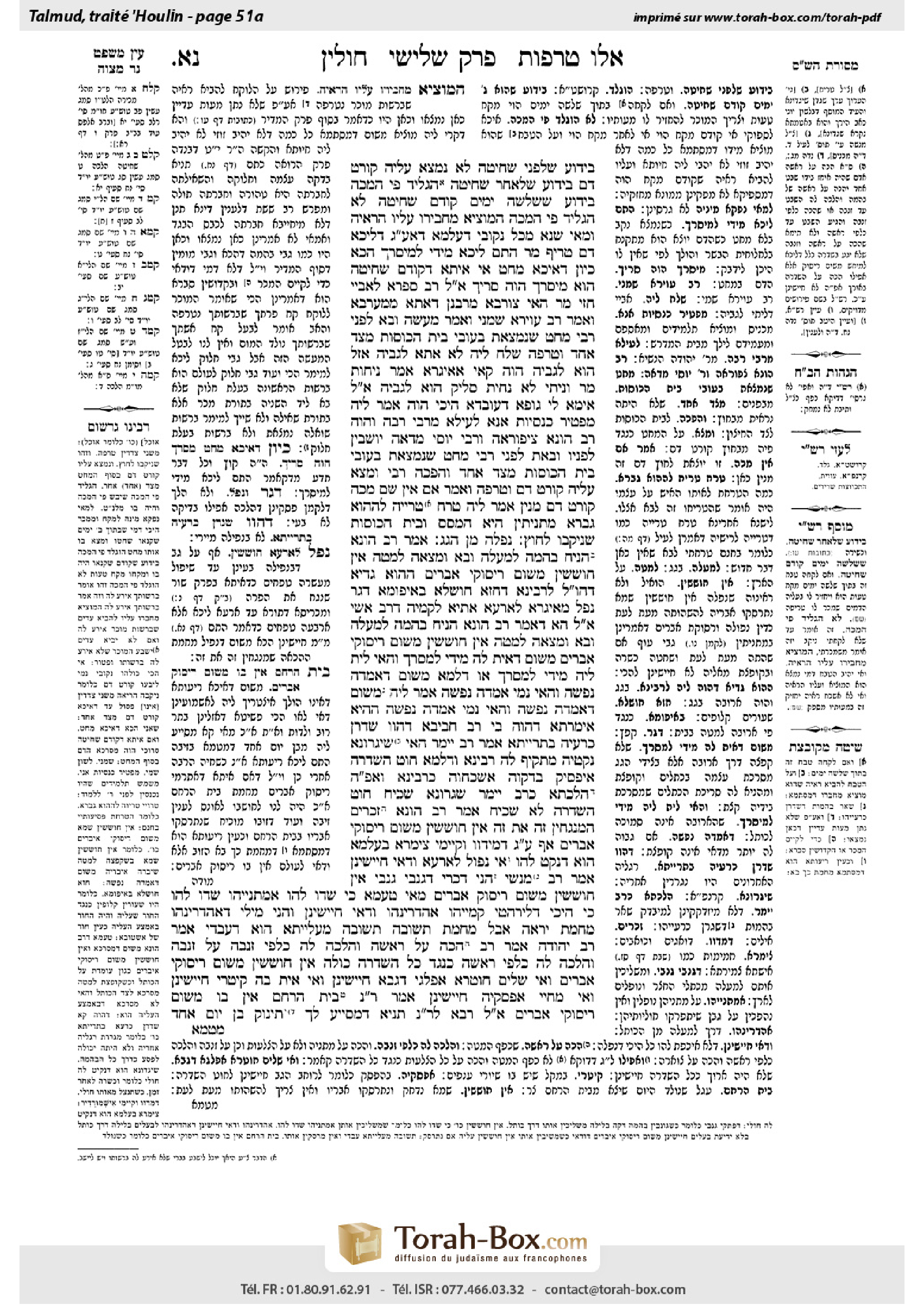
Chullin 51a: Talmud study for Daf Yomi
Study the Talmud for Daf Yomi with scanned pages, Hebrew text, English translations from Sefaria and AI-generated French translations.
Passage selection and English or AI-generated French translation are available where the scan has annotations. Daf Study is independent of Torah-Box and Sefaria.
Browse Chullin · חולין · All tractatesChullin 51a text and translations
This page of Chullin includes the Aramaic text, an English translation and an AI-generated French translation, alongside the scan above.
חולין נ״א א · Aramaic and Hebrew text
בְּיָדוּעַ שֶׁלִּפְנֵי שְׁחִיטָה, לֹא נִמְצָא עָלֶיהָ קוֹרֶט דָּם – בְּיָדוּעַ שֶׁלְּאַחַר שְׁחִיטָה.
הִגְלִיד פִּי הַמַּכָּה – בְּיָדוּעַ שֶׁשְּׁלֹשָׁה יָמִים קוֹדֶם שְׁחִיטָה. לֹא הִגְלִיד פִּי הַמַּכָּה – הַמּוֹצִיא מֵחֲבֵירוֹ עָלָיו הָרְאָיָה.
וּמַאי שְׁנָא מִכֹּל נְקוּבֵי דְּעָלְמָא, דְּאַף עַל גַּב דְּלֵיכָּא דָּם טָרֵיף מָר? הָתָם לֵיכָּא מִידֵּי לְמִיסְרַךְ, הָכָא כֵּיוָן דְּאִיכָּא מַחַט, אִי אִיתָא דְּקוֹדֶם שְׁחִיטָה הוּא – מִיסְרָךְ הֲוָה סָרֵיךְ.
אֲמַר לֵיהּ רַב סָפְרָא לְאַבָּיֵי: חֲזִי מָר הַאי צוּרְבָּא מֵרַבָּנַן דַּאֲתָא מִמַּעְרְבָא, וְאָמַר: רַב עַוִּירָא שְׁמֵנִי, וְאָמַר: מַעֲשֶׂה וּבָא לִפְנֵי רַבִּי מַחַט שֶׁנִּמְצֵאת בְּעוֹבִי בֵּית הַכּוֹסוֹת מִצַּד אֶחָד, וּטְרָפָהּ. שְׁלַח לֵיהּ לָא אֲתָא לְגַבֵּיהּ, אֲזַל הוּא לְגַבֵּיהּ. הֲוָה קָאֵי אַאִיגָּרָא, אָמַר: נֵיחוֹת מָר וְנֵיתֵי. לָא נָחֵית, סָלֵיק הוּא לְגַבֵּיהּ. אֲמַר לֵיהּ: אֵימָא לִי גּוּפָא דְעוֹבָדָא הֵיכִי הֲוָה?
אֲמַר לֵיהּ: מַפְטִיר כְּנֵסִיּוֹת אֲנָא, לְעֵילָּא מֵרַבִּי רַבָּה. וַהֲוָה רַב הוּנָא צִיפּוֹרָאָה וְרַבִּי יוֹסֵי מָדָאָה יוֹשְׁבִין לְפָנָיו, וּבָאת לִפְנֵי רַבִּי מַחַט שֶׁנִּמְצֵאת בְּעוֹבִי בֵּית הַכּוֹסוֹת מִצַּד אֶחָד, וַהֲפָכָהּ רַבִּי וּמָצָא עָלֶיהָ קוֹרֶט דָּם וּטְרָפָהּ, וְאָמַר: אִם אֵין שָׁם מַכָּה, קוֹרֶט דָּם מִנַּיִן? אֲמַר לֵיהּ: טְרָא טַרְיֵיהּ לְהָהוּא גַּבְרָא! מַתְנִיתִין הִיא: הֶמְסֵס וּבֵית הַכּוֹסוֹת שֶׁנִּיקְּבוּ לַחוּץ.
נָפְלָה מִן הַגָּג, אָמַר רַב הוּנָא: הִנִּיחַ בְּהֵמָה לְמַעְלָה, וּבָא וּמְצָאָהּ לְמַטָּה – אֵין חוֹשְׁשִׁין מִשּׁוּם רִיסּוּקֵי אֵבָרִים.
הָהוּא גַּדְיָא דַּהֲוָה לֵיהּ לְרָבִינָא, דַּחֲזָא חוּשְׁלָא בְּאִיפּוּמָא דְּגַר, נְפַל מֵאִיגָּרָא לְאַרְעָא, אַתְיוּהּ לְקַמֵּיהּ דְּרַב אָשֵׁי. אֲמַר לֵיהּ: הָא דְּאָמַר רַב הוּנָא ״הִנִּיחַ בְּהֵמָה לְמַעְלָה וּבָא וּמְצָאָהּ לְמַטָּה אֵין חוֹשְׁשִׁין מִשּׁוּם רִיסּוּקֵי אֵבָרִים״, מִשּׁוּם דְּאִית לַהּ מִידֵּי לְמִסְרַךְ, וְהַאי לֵית לֵיהּ מִידֵּי לְמִסְרַךְ? אוֹ דִלְמָא מִשּׁוּם דְּאָמְדָה נַפְשָׁהּ, וְהַאי נָמֵי אָמֵדה נַפְשֵׁהּ?
אֲמַר לֵיהּ: מִשּׁוּם דְּאָמְדָה נַפְשָׁהּ, וְהַאי נָמֵי אָמֵדה נַפְשֵׁהּ.
הָהִיא אִימַּרְתָּא דַּהֲוָה בֵּי רַב חֲבִיבָא, דַּהֲווֹ שָׁדְרָן כַּרְעַיהּ בָּתְרָיָיתָא. אָמַר רַב יֵימַר: הַאי שִׁיגְרוֹנָא נַקְטַיהּ. מַתְקֵיף לַהּ רָבִינָא: וְדִלְמָא חוּט הַשִּׁדְרָה אִיפְּסִיק? בַּדְקוּהָ, אַשְׁכְּחוּהָ כְּרָבִינָא. וַאֲפִילּוּ הָכִי, הִלְכְתָא כְּרַב יֵימַר, שִׁגְרוֹנָא שְׁכִיחַ, חוּט הַשִּׁדְרָה לָא שְׁכִיחַ.
אָמַר רַב הוּנָא: זְכָרִים הַמְנַגְּחִין זֶה אֶת זֶה – אֵין חוֹשְׁשִׁין מִשּׁוּם רִיסּוּקֵי אֵבָרִים, אַף עַל גַּב דְּמִידְּווּ וְקָיְימִי – צִימְרָא בְּעָלְמָא הוּא דְּנָקֵט לְהוּ; אִי נְפוּל לְאַרְעָא – וַדַּאי חָיְישִׁינַן.
אָמַר רַב מְנַשֵּׁי: הָנֵי דִּכְרֵי דְּגָנְבִי גַּנָּבֵי – אֵין חוֹשְׁשִׁין מִשּׁוּם רִיסּוּק אֵבָרִים, מַאי טַעְמָא? כִּי שָׁדוּ לְהוּ אַמׇּתְנַיְיהוּ שָׁדוּ לְהוּ, כִּי הֵיכִי דְּלִירְהֲטוּ קַמַּיְיהוּ. אַהְדְּרִינְהוּ – וַדַּאי חָיְישִׁינַן; וְהָנֵי מִילֵּי דְּאַהְדְּרִינְהוּ מֵחֲמַת יִרְאָה, אֲבָל מֵחֲמַת תְּשׁוּבָה – תְּשׁוּבָה מְעַלַּיְיתָא הוּא דְּעָבְדִי.
אָמַר רַב יְהוּדָה אָמַר רַב: הִכָּהּ עַל רֹאשָׁהּ וְהָלְכָה לָהּ כְּלַפֵּי זְנָבָהּ, עַל זְנָבָהּ וְהָלְכָה לָהּ כְּלַפֵּי רֹאשָׁהּ, כְּנֶגֶד כׇּל הַשִּׁדְרָה כּוּלָּהּ – אֵין חוֹשְׁשִׁין מִשּׁוּם רִיסּוּקֵי אֵבָרִים, וְאִי שְׁלֵים חוּטְרָא אַפַּלְגֵי דְּגַבָּא – חָיְישִׁינַן; וְאִי אִית בַּהּ קִיטְרֵי – חָיְישִׁינַן; וְאִי מַחְיַיהּ אַפַּסְקִית – חָיְישִׁינַן.
אָמַר רַב נַחְמָן: בֵּית הָרֶחֶם אֵין בּוֹ מִשּׁוּם רִיסּוּקֵי אֵבָרִים. אֲמַר לֵיהּ רָבָא לְרַב נַחְמָן: תַּנְיָא דִּמְסַיַּיע לָךְ, תִּינוֹק בֶּן יוֹם אֶחָד
Chullin 51a · English translation
it is certain that the perforation was created before the slaughter of the animal, and it is therefore a tereifa. If a drop of blood is not found on it, it is certain that it occurred after the slaughter, when the blood of the animal had stopped flowing. The animal is therefore kosher.
If a scab covered the opening of the wound, i.e., the perforation, it is certain that the perforation occurred three days before the slaughter. Consequently, if the animal was sold less than three days before the slaughter, the buyer can claim that the transaction was performed in error, as he did not intend to purchase a tereifa animal, and the seller must refund the buyer. If a scab did not cover the opening of the wound, and it is uncertain whether the perforation occurred before or after the animal was purchased, the burden of proof rests upon the claimant. Accordingly, the buyer must furnish proof that the perforation occurred before the purchase in order to demand a refund.
The Gemara asks: But in what way is this case different from all other perforations, where even though there is no blood on the wound the Master deems the animal a tereifa? The Gemara responds: There, in all other cases, there is nothing to which the blood can attach. Even if the wound had bled, the blood would be reabsorbed into the flesh. Here, since there is a needle, it follows that if it is the case that the perforation occurred before slaughter, blood from the wound would have attached to the needle. Accordingly, if there is no blood on the needle, it is certain that the perforation occurred after slaughter.
The Gemara relates that Rav Safra said to Abaye: Did the Master see a Torah scholar who came from the West, Eretz Yisrael, and said: My name is Rav Avira? He said that there was an incident that came before Rabbi Yehuda HaNasi involving a needle that was found in the thickness of the reticulum protruding from only one side, and he deemed the animal a tereifa. Abaye sent a message to Rav Avira calling for him to come and explain the matter, since this contradicts the baraita that states that the animal is a tereifa only if the needle protrudes from both sides. Rav Avira did not come before him, so Abaye went before Rav Avira. Rav Avira was standing on the roof. Abaye said to him: Let Master descend and come, but Rav Avira did not descend. Abaye ascended to him and said to him: Say to me, what were the circumstances of the incident itself?
Rav Avira said to him: I am a director of assemblies in the study hall. I was standing above the Great Rabbi Yehuda HaNasi, and Rav Huna of Tzippori and Rabbi Yosei of Media were sitting before him, and a needle came before Rabbi Yehuda HaNasi that was found in the thickness of the reticulum protruding from one side, i.e., the inside, and Rabbi Yehuda HaNasi turned the reticulum over and found a drop of blood on the outside, parallel to the wound on the inside, and he deemed the animal a tereifa. And he said: If there is no wound on the outside there as well, from where is this drop of blood? Abaye said to Rav Avira: He caused that man trouble needlessly, i.e., you troubled me for no reason. This is nothing more than the mishna, which states that an animal is a tereifa if the omasum or the reticulum was perforated to the outside.
§ The mishna states: An animal that fell from the roof is a tereifa, since its limbs may have been shattered. Rav Huna says: If one left an animal above, on the roof, and he came back and found it below, but did not see it fall, one need not be concerned with regard to the shattering of limbs. One may presume that it jumped intentionally and was not injured.
The Gemara relates: There was a certain kid belonging to Ravina that saw barley groats through an open skylight. It jumped down through the skylight and fell from the roof to the ground. The case came before Rav Ashi, and Ravina said to him: What is the rationale for this statement that Rav Huna says, that if one left an animal above and he came back and found it below, one need not be concerned about the possible shattering of limbs? Is it because the animal usually has something to grab hold of? If so, since this kid jumped through a skylight, it did not have something to grab hold of, and one must be concerned. Or perhaps it is because the animal evaluates itself and determines that it can jump without injury. If so, this kid also evaluated itself before jumping, and one need not be concerned.
Rav Ashi said to him: It is because the animal evaluates itself before jumping, and this kid also evaluated itself before jumping. Therefore, one need not be concerned about the possible shattering of limbs.
The Gemara relates that there was a certain ewe that was in the house of Rav Ḥaviva, whose hind legs would drag. Rav Yeimar said: This ewe suffers from rheumatism [shigrona], and this is why she drags her legs. Ravina objects to this: But perhaps the spinal cord was cut, and this is why the ewe dragged her legs, and the animal is a tereifa. They inspected her and found that the spinal cord was cut, as Ravina said. The Gemara notes: And even so, the halakha is in accordance with the opinion of Rav Yeimar, since rheumatism is common, but a cut spinal cord is not common. Accordingly, one need not be concerned about the possibility of a cut spinal cord.
Rav Huna also says: With regard to rams that butt one another, one need not be concerned with regard to shattering of limbs. Even though they are in pain and stand still, it is only a fever that afflicts them; one need not be concerned about the possibility of severe injuries. But if they fall to the ground due to the impact, we certainly must be concerned that their limbs may have been shattered.
Rav Menashei says: With regard to these rams that thieves steal and throw over the fence, one need not be concerned with regard to the shattering of limbs. What is the reason for this? When the thieves throw them over the fence, they throw them so that they land on their hips, where they will not be injured, so that they will be able to run before them. But if the thieves returned them to the owner, we certainly must be concerned that their limbs may have been shattered, since thieves do not throw them carefully when returning them. And this statement applies only when they return them due to fear of being caught, or are otherwise forced to return them. But if they return them due to repentance, they have performed full-fledged repentance and will take care to return them without injury.
Rav Yehuda says that Rav says: If one hit an animal on its head with a stick, and the length of the stick continued toward its back; or if one hit the animal on its tail and the length of the stick continued toward its head, such that in either case the blow extended along the entire spine, one need not be concerned with regard to the shattering of limbs. But if the length of the stick concluded at the middle of the back, we must be concerned that the strike caused an injury to the spine. And if there are knots, i.e., protrusions, on the stick, we must be concerned that it injured the spine, even if the stick fell across the entire back. And if he struck it like a slash across the width of the back, we must be concerned that it injured the spine.
§ Rav Naḥman says: The womb is not subject to concern about possible shattered limbs. In other words, one need not be concerned that the limbs of a newborn calf may have been shattered by the narrow birth canal. Rava said to Rav Naḥman: That which is taught in a baraita supports your opinion: A one-day-old infant
Chullin 51a · Traduction française (IA)
Il est certain que la perforation a été créée avant la mise à mort de l'animal, et il s'agit donc d'un tereifa. Si un goutte de sang n'est pas trouvé sur elle, il est certain qu'elle s'est produite après la mise à mort, lorsque le sang de l'animal avait cessé de couler. L'animal est donc propre.
Si une croûte recouvrait l'ouverture de la plaie, c'est-à-dire la perforation, il est certain que la perforation s'est produite trois jours avant la mise à mort. Par conséquent, si l'animal a été vendu moins de trois jours avant la mise à mort, l'acheteur peut réclamer que la transaction a été effectuée en erreur, car il n'avait pas l'intention d'acheter un animal tereifa, et le vendeur doit rembourser l'acheteur. Si une croûte ne recouvrait pas l'ouverture de la plaie, et si l'origine de la perforation est incertaine, la charge de la preuve incombe au réclamant. Ainsi, l'acheteur doit fournir une preuve que la perforation s'est produite avant l'achat afin de demander un remboursement.
La Guemara pose la question : Mais dans quelle mesure ce cas diffère-t-il de tous les autres perforations, où même s'il n'y a pas de sang sur la plaie, le Maître considère l'animal comme tereifa ? La Guemara répond : Là, dans tous les autres cas, il n'y a rien à quoi le sang puisse s'attacher. Même si la plaie avait saigné, le sang serait réabsorbé dans la chair. Ici, puisque l'on a un aiguille, il suit que si la perforation s'est produite avant la mise à mort, le sang de la plaie aurait s'attacher à l'aiguille. Ainsi, si il n'y a pas de sang sur l'aiguille, il est certain que la perforation s'est produite après la mise à mort.
La Guemara rapporte que Rav Safra dit à Abaye : Le Maître a-t-il vu un savant de la Torah qui est venu du West, Eretz Yisrael, et qui a dit : Mon nom est Rav Avira ? Il dit qu'il y avait un incident qui s'était produit avant Rabbi Yehuda HaNasi concernant une aiguille trouvée dans l'épaisseur du réticulum, sortant d'un seul côté, et il avait considéré l'animal comme tereifa. Abaye envoya un message à Rav Avira pour l'inviter à venir expliquer cette affaire, car cela contredisait la baraïta qui stipule que l'animal est tereifa uniquement si l'aiguille sort de côté. Rav Avira ne vint pas devant lui, donc Abaye alla devant Rav Avira. Rav Avira était debout sur le toit. Abaye dit à lui : Descends, Maître, et viens, mais Rav Avira ne descendit pas. Abaye monta vers lui et dit : Dis-moi, quels étaient les circonstances de l'incident lui-même ?
Rav Avira dit à lui : Je suis un directeur de réunions dans la salle de étude. J'étais debout au-dessus du Grand Rabbi Yehuda HaNasi, et Rav Huna de Tzippori et Rabbi Yosei de Media étaient assis devant lui, et une aiguille vint devant Rabbi Yehuda HaNasi qui était trouvée dans l'épaisseur du réticulum, sortant d'un seul côté, c'est-à-dire de l'intérieur, et Rabbi Yehuda HaNasi retourna le réticulum et trouva une goutte de sang sur l'extérieur, parallèle à la plaie à l'intérieur, et il considéra l'animal comme tereifa. Et il dit : Si il n'y a pas de plaie à l'extérieur également, d'où vient cette goutte de sang ? Abaye dit à Rav Avira : Il a causé à cette personne des ennuis inutilement, c'est-à-dire que vous m'avez causé des ennuis pour rien. Cela n'est rien de plus que la mitsna, qui stipule qu'un animal est tereifa si l'omaculum ou le réticulum a été perforé vers l'extérieur.
§ La mitsna stipule : Un animal tombé du toit est tereifa, car ses membres peuvent avoir été brisés. Rav Huna dit : Si l'on a laissé un animal au-dessus, sur le toit, et l'on est revenu et l'on a trouvé en dessous, mais l'on n'a pas vu qu'il est tombé, l'on n'a pas besoin de s'inquiéter concernant la fracture des membres. On peut supposer qu'il a sauté intentionnellement et n'a pas été blessé.
La Guemara rapporte : Il y avait un petit agneau appartenant à Ravina qui a vu des grains de blé à travers une ouverture de toit. Il est tombé par l'ouverture de toit et est tombé du toit au sol. Le cas est venu devant Rav Ashi, et Ravina dit à lui : Quel est le raisonnement de cette déclaration que Rav Huna dit, que si l'on a laissé un animal au-dessus et l'on est revenu et l'on a trouvé en dessous, l'on n'a pas besoin de s'inquiéter concernant la possible fracture des membres ? Est-ce parce que l'animal a quelque chose à saisir ? Si c'est le cas, puisque cet agneau a sauté à travers une ouverture de toit, il n'avait pas quelque chose à saisir, et l'on doit s'inquiéter. Ou peut-être est-ce parce que l'animal évalue lui-même et détermine qu'il peut sauter sans être blessé. Si c'est le cas, cet agneau a également évalué lui-même avant de sauter, et l'on n'a pas besoin de s'inquiéter.
Rav Ashi dit à lui : C'est parce que l'animal évalue lui-même avant de sauter, et cet agneau a également évalué lui-même avant de sauter. Par conséquent, l'on n'a pas besoin de s'inquiéter concernant la possible fracture des membres.
La Guemara rapporte qu'il y avait une certaine brebis qui était chez Rav Ḥaviva, dont les pattes arrière traînaient. Rav Yeimar dit : Cette brebis souffre de rhumatisme [shigrona], et c'est pourquoi elle traîne ses pattes. Ravina s'oppose à cela : Mais peut-être la moelle épinière a été coupée, et c'est pourquoi la brebis traîne ses pattes, et l'animal est tereifa. Ils l'ont inspectée et ont trouvé que la moelle épinière avait été coupée, comme Ravina l'avait dit. La Guemara note : Et même ainsi, la halakha suit l'opinion de Rav Yeimar, car le rhumatisme est commun, mais une moelle épinière coupée n'est pas commune. Ainsi, l'on n'a pas besoin de s'inquiéter de la possibilité d'une moelle épinière coupée.
Rav Huna dit aussi : Concernant les boucs qui se cognent les uns aux autres, l'on n'a pas besoin de s'inquiéter concernant la fracture des membres. Même s'ils sont en souffrance et restent immobiles, c'est seulement une fièvre qui les afflige ; l'on n'a pas besoin de s'inquiéter de la possibilité de blessures graves. Mais si ils tombent au sol en raison de l'impact, nous devons certainement nous inquiéter que leurs membres puissent avoir été brisés.
Rav Menashei dit : Concernant ces béliers que les voleurs volent et jettent par-dessus le mur, on n'a pas à craindre la fracture des membres. Pourquoi ? Lorsque les voleurs les jettent par-dessus le mur, ils les jettent de manière à ce qu'ils atterrissent sur leurs hanches, où ils ne seront pas blessés, afin qu'ils puissent fuir avant eux. Mais si les voleurs rendaient les béliers à leur propriétaire, nous devons certainement avoir peur que leurs membres aient été fracturés, car les voleurs ne jettent pas les béliers avec soin lorsqu'ils les rendent. Et cette déclaration s'applique uniquement lorsqu'ils les rendent par peur d'être pris ou par contrainte. Mais si ils les rendent par repentance, ils ont accompli une repentance complète et prendront soin de les rendre sans les blesser.
Rav Yéhuda dit que Rav dit : Si l'on frappe un animal à la tête avec un bâton, et que la longueur du bâton s'étend vers son dos ; ou si l'on frappe l'animal à la queue et que la longueur du bâton s'étend vers sa tête, de sorte que dans chaque cas le coup s'étend le long de toute la colonne vertébrale, on n'a pas à craindre la fracture des membres. Mais si la longueur du bâton s'arrête au milieu du dos, nous devons avoir peur que le coup ait blessé la colonne vertébrale. Et si le bâton a des nœuds, c'est-à-dire des bosses, nous devons avoir peur qu'il ait blessé la colonne vertébrale, même si le bâton s'étend sur tout le dos. Et si l'on frappe l'animal comme un coup de lames transversalement sur le dos, nous devons avoir peur qu'il ait blessé la colonne vertébrale.
§ Rav Naḥman dit : Le ventre n'est pas sujet à la crainte d'une fracture des membres. En d'autres termes, on n'a pas à craindre que les membres d'un veau nouveau-né aient été fracturés par le canal de naissance étroit. Rava dit à Rav Naḥman : Ce qui est enseigné dans une baraïta soutient votre opinion : un nouveau-né d'un jour
Traduction française générée par IA à partir de l’édition anglaise de Sefaria. Vérifie toujours un passage avec le texte source.
Text from Sefaria: William Davidson Edition - Vocalized Aramaic (unknown); William Davidson Edition - English (CC BY NC).