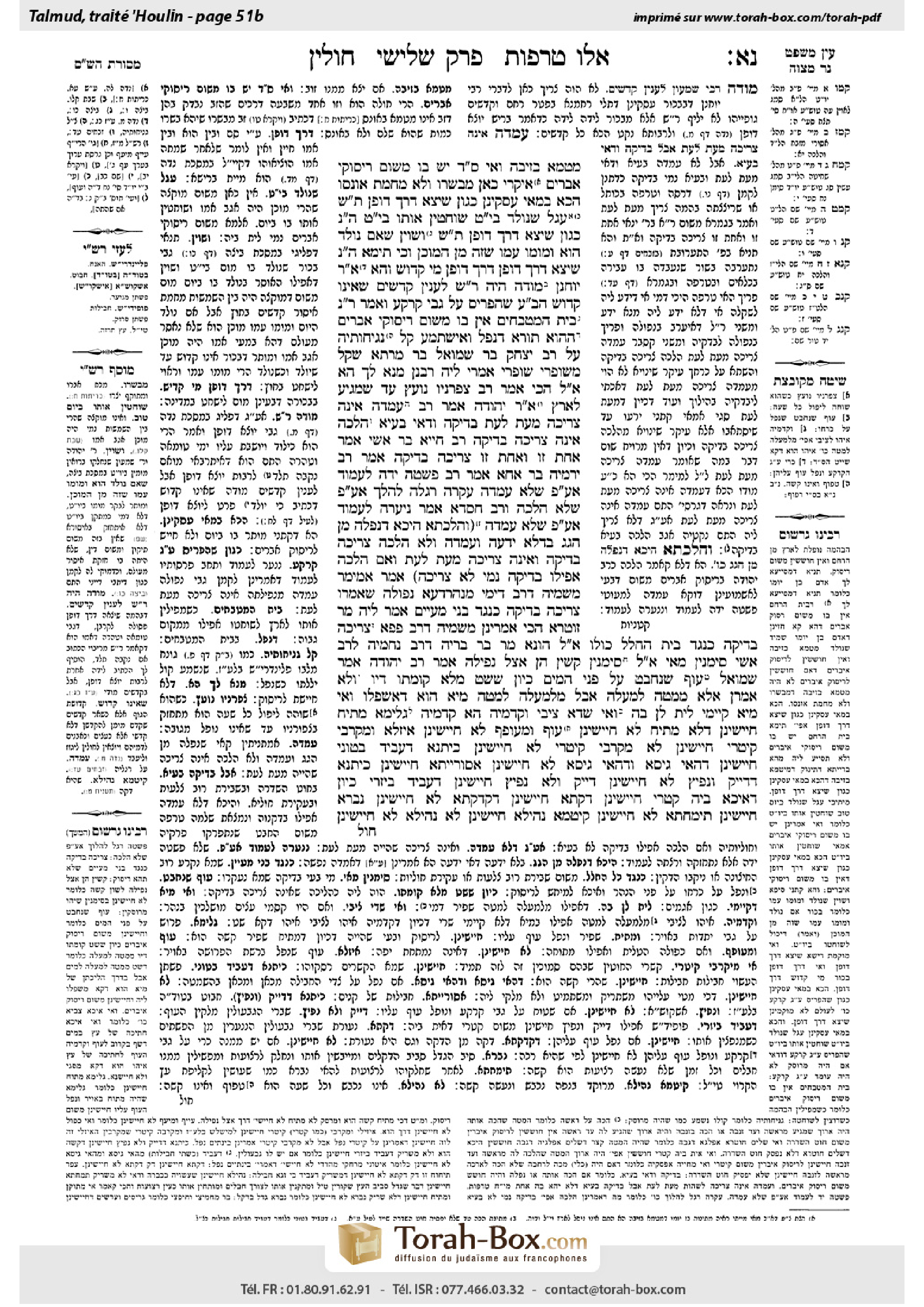
Chullin 51b: Talmud study for Daf Yomi
Study the Talmud for Daf Yomi with scanned pages, Hebrew text, English translations from Sefaria and AI-generated French translations.
Passage selection and English or AI-generated French translation are available where the scan has annotations. Daf Study is independent of Torah-Box and Sefaria.
Browse Chullin · חולין · All tractatesChullin 51b text and translations
This page of Chullin includes the Aramaic text, an English translation and an AI-generated French translation, alongside the scan above.
חולין נ״א ב · Aramaic and Hebrew text
מְטַמֵּא בְּזִיבָה, וְאִי סָלְקָא דַעְתָּךְ יֵשׁ בּוֹ מִשּׁוּם רִיסּוּקֵי אֵבָרִים, אִיקְרִי כָּאן ״מִבְּשָׂרוֹ״ וְלֹא מֵחֲמַת אוֹנְסוֹ.
הָכָא בְּמַאי עָסְקִינַן, כְּגוֹן שֶׁיָּצָא דֶּרֶךְ דּוֹפֶן.
תָּא שְׁמַע: עֵגֶל שֶׁנּוֹלַד בְּיוֹם טוֹב – שׁוֹחֲטִין אוֹתוֹ בְּיוֹם טוֹב. הָכָא נָמֵי, כְּגוֹן שֶׁיָּצָא דֶּרֶךְ דּוֹפֶן.
תָּא שְׁמַע: וְשָׁוִין שֶׁאִם נוֹלַד הוּא וּמוּמוֹ עִמּוֹ, שֶׁזֶּה מִן הַמּוּכָן. וְכִי תֵּימָא הָכָא נָמֵי שֶׁיָּצָא דֶּרֶךְ דּוֹפֶן – דֶּרֶךְ דּוֹפֶן מִי קָדוֹשׁ? וְהָא אָמַר רַבִּי יוֹחָנָן: מוֹדֶה הָיָה רַבִּי שִׁמְעוֹן לְעִנְיַן קָדָשִׁים שֶׁאֵינוֹ קָדוֹשׁ!
הָכָא בְּמַאי עָסְקִינַן, שֶׁהִפְרִיס עַל גַּבֵּי קַרְקַע.
וְאָמַר רַב נַחְמָן: בֵּית הַמִּטְבָּחַיִם אֵין בּוֹ מִשּׁוּם רִיסּוּקֵי אֵבָרִים.
הָהוּא תּוֹרָא דִּנְפַל, וְאִישְׁתְּמַע קָל גְּנִיחוֹתֵיהּ, עָל רַב יִצְחָק בַּר שְׁמוּאֵל בַּר מָרְתָא שְׁקַל מִשּׁוּפְרֵי שׁוּפְרֵי. אָמְרִי לֵיהּ רַבָּנַן: מְנָא לָךְ הָא? אֲמַר לְהוּ: הָכִי אָמַר רַב: צִפׇּרְנָיו נוֹעֵץ עַד שֶׁמַּגִּיעַ לָאָרֶץ.
אָמַר רַב יְהוּדָה אָמַר רַב: עָמְדָה – אֵינָהּ צְרִיכָה מֵעֵת לְעֵת, בְּדִיקָה – וַדַּאי בָּעֲיָא, הָלְכָה – אֵינָהּ צְרִיכָה בְּדִיקָה. רַב חִיָּיא בַּר אָשֵׁי אָמַר: אַחַת זוֹ וְאַחַת זוֹ צְרִיכָה בְּדִיקָה.
אָמַר רַב יִרְמְיָה בַּר אַחָא אָמַר רַב: פָּשְׁטָה יָדָהּ לַעֲמוֹד, אַף עַל פִּי שֶׁלֹּא עָמְדָה. עָקְרָה רַגְלָהּ לְהַלֵּךְ, אַף עַל פִּי שֶׁלֹּא הָלְכָה. וְרַב חִסְדָּא אָמַר: נִנְעֲרָה לַעֲמוֹד, אַף עַל פִּי שֶׁלֹּא עָמְדָה.
וְהִלְכְתָא: הֵיכָא דְּנָפְלָה מִן הַגָּג בִּדְלָא יָדְעָה, וְעָמְדָה וְלֹא הָלְכָה – צְרִיכָה בְּדִיקָה, וְאֵינָהּ צְרִיכָה מֵעֵת לְעֵת. וְאִם הָלְכָה – אֲפִילּוּ בְּדִיקָה נָמֵי לָא צְרִיכָה.
אָמַר אַמֵּימָר מִשְּׁמֵיהּ דְּרַב דִּימִי מִנְּהַרְדְּעָא: נְפוּלָה שֶׁאָמְרוּ – צְרִיכָה בְּדִיקָה כְּנֶגֶד בְּנֵי מֵעַיִים. אֲמַר לֵיהּ מָר זוּטְרָא: הָכִי אָמְרִינַן מִשְּׁמֵיהּ דְּרַב פָּפָּא: צְרִיכָה בְּדִיקָה כְּנֶגֶד בֵּית הֶחָלָל כּוּלּוֹ.
אֲמַר לֵיהּ הוּנָא מָר בַּר בְּרֵיהּ דְּרַב נְחֶמְיָה לְרַב אָשֵׁי: סִימָנִין מַאי? אֲמַר לֵיהּ: סִימָנִין קָשִׁין הֵן אֵצֶל נְפִילָה.
אָמַר רַב יְהוּדָה אָמַר שְׁמוּאֵל: עוֹף שֶׁנֶּחְבַּט עַל פְּנֵי הַמַּיִם, כֵּיוָן שֶׁשָּׁט מְלֹא קוֹמָתוֹ – דַּיּוֹ. וְלָא אֲמַרַן אֶלָּא מִמַּטָּה לְמַעְלָה, אֲבָל מִלְּמַעְלָה לְמַטָּה – מַיָּא הוּא דְּאַשְׁפִּלוּ. וְאִי מַיָּא קָיְימִי – לֵית לַן בַּהּ, וְאִי שְׁדָא צִיבֵי וְקַדְמֵיהּ – הָא קַדְמֵיהּ.
גְּלִימָא מְתִיחַ – חָיְישִׁינַן; דְּלָא מְתִיחַ – לָא חָיְישִׁינַן; עוּף וּמְעוּפָּף – לָא חָיְישִׁינַן; אִיזְלָא וּמְקָרְבִי קִיטְרֵי – חָיְישִׁינַן; לָא מְקָרְבִי קִיטְרֵי – לָא חָיְישִׁינַן.
כִּיתָּנָא דַּעֲבִיד בְּטוּנֵי – חָיְישִׁינַן; דְּהַאי גִּיסָא וּדְהַאי גִּיסָא – לָא חָיְישִׁינַן; אִסּוּרְיָיתָא – חָיְישִׁינַן; כִּיתָּנָא דִּדְיִיק וּנְפִיץ – לָא חָיְישִׁינַן; דְּיִיק וְלָא נְפִיץ – חָיְישִׁינַן; דַּעֲבִיד בִּיזְרֵי כֵּיוָן דְּאִיכָּא בֵּיהּ קִטְרֵי – חָיְישִׁינַן; דַּקְתָּא – חָיְישִׁינַן; דַּקְדַּקְתָּא – לָא חָיְישִׁינַן.
נַבְרָא – חָיְישִׁינַן; תִּימַחְתָא – לָא חָיְישִׁינַן; קִיטְמָא נְהִילָא – חָיְישִׁינַן; לָא נְהִילָא – לָא חָיְישִׁינַן.
Chullin 51b · English translation
becomes ritually impure if he experiences a gonorrhea-like discharge [ziva]. And if it should enter your mind that a newborn is subject to concern about possible shattered limbs, read here the ruling stated with regard to ziva, that one’s discharge renders one impure only when it issues “out of his flesh” (Leviticus 15:2), but not when it issues due to circumstances beyond his control, e.g., due to illness. Therefore, if one must be concerned that a newborn’s limbs may have shattered during birth, his discharge would not render him impure.
The Gemara responds: One cannot bring a proof from this baraita, since here we are dealing with a case where the infant left the womb by caesarean section and did not exit through the narrow birth canal. By contrast, after normal births, a newborn’s discharge does not render it impure, since one is concerned about the possibility of shattered limbs.
The Gemara suggests: Come and hear proof from a baraita: If a calf was born on a Festival, one may slaughter it and eat it on the Festival. One need not wait twenty-four hours before deeming the animal kosher, as one does for an animal that fell from a roof. Apparently, one need not be concerned that its limbs were shattered during the birth. The Gemara responds: Here, too, the baraita is referring to a case where the calf left the womb by caesarean section. But after normal births, one must wait twenty-four hours before slaughtering the calf.
The Gemara suggests: Come and hear proof from another baraita: And all agree that if a firstborn animal was born on a Festival and its blemish was born with it, i.e., if it was born with a blemish that removes its sanctity and renders it permitted for consumption, it is considered to be prepared for the Festival and may be eaten. Evidently, one need not wait twenty-four hours before deeming it kosher. And if you would say that here too, the baraita deals with a case where the animal left the womb by caesarean section, one might respond: Is a firstborn animal born by caesarean section sanctified? But doesn’t Rabbi Yoḥanan say: Rabbi Shimon would concede with regard to sacrificial animals, e.g., a firstborn, that an animal born by caesarean section is not sanctified? Therefore, the baraita must be referring to an animal born naturally.
The Gemara responds: Here we are dealing with a firstborn that spread out its legs on the ground and stood up immediately after birth. In such a case the animal is certainly not a tereifa on account of shattered limbs.
§ And Rav Naḥman says: If an animal was thrown to the ground in the slaughterhouse in preparation for slaughter, it is not subject to concern for shattered limbs.
The Gemara relates: A certain bull fell in the slaughterhouse, and its bellowing was audible due to the blow. Still, Rav Yitzḥak bar Shmuel bar Marta entered and took from the very best portions of the bull and was not concerned that it may have been a tereifa. The Sages said to him: From where did you learn this? Rav Yitzḥak bar Shmuel bar Marta said to them: This is what Rav said: When falling, the bull digs in its hooves until it reaches the earth. Therefore, one need not be concerned that it fell roughly.
§ Rav Yehuda says that Rav says: If an animal fell and stood up again, it does not require a twenty-four-hour period mentioned in the mishna (56b) to determine if it may be slaughtered. Nevertheless, it certainly requires inspection after slaughter to determine whether it was injured by the fall and rendered a tereifa. But if it both stood up and walked after the fall, it does not even require inspection after slaughter. Rav Ḥiyya bar Ashi says: Both in this case and in that case, i.e., even if it walked after the fall, it requires inspection.
Rav Yirmeya bar Aḥa says that Rav says: If the animal stretched out its foreleg to stand, even if it did not actually stand, it is considered to have stood and does not require a twenty-four-hour waiting period. If it raised its leg to walk, even if it did not actually walk, it is considered to have walked and does not require inspection according to Rav. And Rav Ḥisda says: Even if it did not stretch out its foreleg, but simply struggled to stand, even if it did not stand, it is considered to have stood and may be slaughtered that day.
The Gemara concludes: And the halakha is: In any case where an animal fell from the roof unawares, i.e., unintentionally, and stood but did not walk, it requires inspection after slaughter but does not require a twenty-four-hour period before slaughter. And if it walked, it does not even require an inspection.
§ Ameimar said in the name of Rav Dimi of Neharde’a: A fallen animal that the Sages said requires inspection must be inspected around the intestines to see whether the organs there have been perforated or torn, rendering the animal a tereifa. Mar Zutra said to him: This is what we say in the name of Rav Pappa: Such an animal requires inspection around the entire space of the body cavity, in case the ribs or spine have been damaged.
Huna Mar, grandson of Rav Neḥemya, said to Rav Ashi: What about the two organs that must be severed in ritual slaughter [simanim], i.e., the windpipe and the gullet? Do they require inspection as well? Rav Ashi said to him: The simanim are hard and resistant to damage in falling. Therefore, one need not inspect them.
§ With regard to birds that have fallen, Rav Yehuda says that Shmuel says: If a bird fell and hit the surface of the water, once it swims the full length of its body, this is sufficient to indicate that its limbs have not been shattered, similar to an animal that walks after falling. And we said this only in cases where it swam from below to above, i.e., upstream. But if it swam from above to below, i.e., downstream, it is only the water that carried it down, and it must be inspected. And if the water is standing, e.g., in a pond, we have no problem with it, as it is clear that the bird is swimming on its own strength, and it need not be inspected. And even if the bird swims downstream, if straw was scattered in front of it and the bird overtook it with its swimming, then the bird overtook it on its own strength and need not be inspected.
If the bird fell on a garment spread out taut over poles, we must be concerned that its limbs may have been shattered from the impact. If it fell on a garment that was not taut, we need not be concerned. In any event, if the garment was folded, we need not be concerned, since it presumably was not taut enough to injure the bird. If the bird fell on a net whose knots were woven closely together, we must be concerned that its limbs may have been shattered from the impact. If the knots were not close together, we need not be concerned.
If the bird fell directly on to flax arranged into bundles, we must be concerned that its limbs may have been shattered from the impact, because the bundles are hard. If it fell on this side or that side of the bundles, we need not be concerned, because it did not fall directly onto the bundles and the impact was dampened. If it fell on bundles of reeds, we must be concerned. If it fell on beaten and combed flax, with the impurities removed, we need not be concerned, since it is soft. If it fell on flax that was beaten but not combed, we must be concerned due to the residue of flax stalks in the bundles. If it fell on flax that was bundled after it was beaten and combed, since it has knots in it we must be concerned. If the bird fell on flax tow, a coarse bundle of unspun fiber, we must be concerned. If it fell on fine tow, we need not be concerned, because it is soft.
If the bird fell on nevara, the fibers that grow around a palm tree, we must be concerned that its limbs may have been shattered. If it fell on timaḥta, palm bark cut into strips, we need not be concerned. If it fell on sifted ashes, we must be concerned, because the ashes harden. If it fell on unsifted ashes, we need not be concerned, because they are soft and scatter on impact.
Chullin 51b · Traduction française (IA)
devient impur s'il éprouve un écouvillonnage similaire à celui de la goutte [ziva]. Et si cela vous vient à l'esprit que le nouveau-né est sujet à l'inquiétude concernant la possibilité de membres brisés, lisez ici la décision concernant le ziva, qui stipule que le débit de l'individu le rend impur uniquement lorsqu'il sort "de sa chair" (Lévitique 15:2), mais pas lorsqu'il est dû à des circonstances hors de son contrôle, par exemple en raison d'une maladie. Ainsi, si l'on doit s'inquiéter que les membres du nouveau-né aient pu être brisés lors de l'accouchement, son débit ne le rendra pas impur.
La Guemara répond : On ne peut pas établir une preuve à partir de ce baraïta, car ici nous sommes en présence d'un cas où l'enfant est sorti du ventre par césarienne et n'a pas traversé le canal de naissance étroit. À l'inverse, après des accouchements normaux, le débit du nouveau-né ne le rend pas impur, car l'on s'inquiète de la possibilité de membres brisés.
La Guemara suggère : Venez écouter une preuve à partir d'un baraïta : Si un veau est né pendant un festival, on peut le sacrifier et le manger pendant le festival. On n'a pas besoin d'attendre vingt-quatre heures avant de considérer l'animal comme kasher, comme on le fait pour un animal tombé du toit. Apparemment, on n'a pas besoin de s'inquiéter que ses membres aient pu être brisés lors de la naissance. La Guemara répond : Ici aussi, le baraïta fait référence à un cas où le veau est sorti du ventre par césarienne. Mais après des accouchements normaux, on doit attendre vingt-quatre heures avant de sacrifier le veau.
La Guemara suggère : Venez écouter une preuve à partir d'un autre baraïta : Et tous s'accordent sur le fait que si un animal premier-né est né pendant un festival et qu'il a une tache née avec lui, c'est-à-dire s'il est né avec une tache qui annule sa sanctité et le rend permis à manger, il est considéré comme préparé pour le festival et peut être mangé. Évidemment, on n'a pas besoin d'attendre vingt-quatre heures avant de le considérer comme kasher. Et si vous dites que ici aussi, le baraïta fait référence à un cas où l'animal est sorti du ventre par césarienne, on pourrait répondre : Un animal premier-né né par césarienne est-il sanctifié ? Mais ne dit pas Rabbi Yoḥanan : Rabbi Shimon admettrait, concernant les animaux sacrés, par exemple le premier-né, que l'animal né par césarienne n'est pas sanctifié ? Ainsi, le baraïta doit faire référence à un animal né naturellement.
La Guemara répond : Ici nous sommes en présence d'un premier-né qui a étalé ses jambes au sol et s'est levé immédiatement après la naissance. Dans ce cas, l'animal n'est certainement pas un tereifa en raison de membres brisés.
§ Rav Naḥman dit : Si un animal a été jeté au sol dans l'abattoir en préparation à la bataille, il n'est pas sujet à l'inquiétude concernant des membres brisés.
La Guemara rapporte : Un certain taureau est tombé dans l'abattoir, et son mugissement était audible en raison du coup. Cependant, Rav Yitzḥak bar Shmuel bar Marta est entré et a pris les meilleures parties du taureau sans s'inquiéter qu'il puisse être un tereifa. Les Sages lui dirent : D'où as-tu appris cela ? Rav Yitzḥak bar Shmuel bar Marta répondit : C'est ce que Rav a dit : Lorsqu'il tombe, le taureau enfonce ses sabres jusqu'à atteindre le sol. Ainsi, on n'a pas besoin de s'inquiéter qu'il ait chuté brutalement.
§ Rav Yehuda dit que Rav dit : Si un animal est tombé et s'est levé à nouveau, il ne nécessite pas une période de vingt-quatre heures mentionnée dans la mishna (56b) pour déterminer s'il peut être sacrifié. Cependant, il faut certainement inspecter l'animal après la bataille pour déterminer s'il a été blessé par la chute et est devenu un tereifa. Mais si l'animal s'est levé et a marché après la chute, il ne nécessite même pas d'inspection après la bataille. Rav Ḥiyya bar Ashi dit : À la fois dans ce cas et dans celui-là, c'est-à-dire même si l'animal a marché après la chute, il faut inspecter.
Rav Yirmeya bar Aḥa dit que Rav dit : Si l'animal a étiré sa patte avant pour se lever, même s'il n'a pas réellement levé, il est considéré comme ayant levé et ne nécessite pas une période d'attente de vingt-quatre heures. Si l'animal a levé sa patte pour marcher, même s'il n'a pas réellement marché, il est considéré comme ayant marché et ne nécessite pas d'inspection selon Rav. Et Rav Ḥisda dit : Même s'il n'a pas étiré sa patte, mais s'est simplement débattu pour se lever, même s'il n'a pas levé, il est considéré comme ayant levé et peut être sacrifié ce jour-là.
La Guemara conclut : Et la halakha est : Dans tout cas où un animal est tombé du toit sans le vouloir, c'est-à-dire de manière inattendue, et s'est levé mais n'a pas marché, il nécessite une inspection après la bataille mais ne nécessite pas une période de vingt-quatre heures avant la bataille. Et si l'animal a marché, il ne nécessite même pas d'inspection.
§ Ameimar a dit en nom de Rav Dimi de Neharde’a : Un animal tombé que les Sages ont dit nécessiter une inspection doit être inspecté autour des intestins pour voir si les organes y ont été perçés ou déchirés, rendant l'animal un tereifa. Mar Zutra lui a dit : C'est ce que nous disons en nom de Rav Pappa : Cet animal nécessite une inspection autour de l'ensemble de la cavité corporelle, en cas de dommages aux côtes ou à la colonne vertébrale.
Huna Mar, petit-fils de Rav Neḥemya, a dit à Rav Ashi : Qu'en est-il des deux organes qui doivent être sectionnés lors de la bataille [simanim], c'est-à-dire la trachée et le gosier ? Doivent-ils être inspectés également ? Rav Ashi a dit à lui : Les simanim sont durs et résistants aux dommages lors de la chute. Ainsi, on n'a pas besoin d'inspecter ces organes.
§ Concernant les oiseaux tombés, Rav Yehuda dit que Shmuel dit : Si un oiseau tombe et heurte la surface de l'eau, une fois qu'il nage la longueur de son corps, cela suffit à indiquer que ses membres n'ont pas été brisés, comme un animal qui marche après avoir chuté. Et nous avons dit cela uniquement dans les cas où il nageait du bas vers le haut, c'est-à-dire en amont. Mais si il nageait du haut vers le bas, c'est-à-dire en aval, c'est seulement l'eau qui l'a porté en bas, et il doit être inspecté. Et si l'eau est calme, par exemple dans un étang, nous n'avons pas de problème avec cela, car il est clair que l'oiseau nage de ses propres forces, et il n'a pas besoin d'être inspecté. Et même si l'oiseau nage en aval, si des pailles étaient dispersées devant lui et que l'oiseau les dépassait en nageant, alors l'oiseau les dépassait de ses propres forces et n'a pas besoin d'être inspecté.
Si l'oiseau tombe sur un vêtement tendu sur des poteaux, nous devons nous inquiéter que ses membres puissent avoir été brisés à cause de l'impact. Si l'oiseau tombe sur un vêtement qui n'était pas tendu, nous n'avons pas besoin de nous inquiéter. En tout cas, si le vêtement était plié, nous n'avons pas besoin de nous inquiéter, car il est probablement trop lâche pour blesser l'oiseau. Si l'oiseau tombe sur un filet dont les nœuds étaient serrés, nous devons nous inquiéter que ses membres puissent avoir été brisés à cause de l'impact. Si les nœuds n'étaient pas serrés, nous n'avons pas besoin de nous inquiéter.
Si l'oiseau tombe directement sur du lin disposé en ballots, nous devons nous inquiéter qu'il ait pu avoir ses membres brisés à cause de l'impact, car les ballots sont durs. Si l'oiseau tombe sur un côté ou l'autre des ballots, nous n'avons pas besoin de nous inquiéter, car il n'est pas tombé directement sur les ballots et l'impact a été atténué. Si l'oiseau tombe sur des ballots de roseaux, nous devons nous inquiéter. Si l'oiseau tombe sur du lin battu et peigné, avec les impuretés enlevées, nous n'avons pas besoin de nous inquiéter, car il est doux. Si l'oiseau tombe sur du lin battu mais non peigné, nous devons nous inquiéter à cause des résidus de tiges de lin dans les ballots. Si l'oiseau tombe sur du lin qui a été balloté après avoir été battu et peigné, puisque les ballots ont des nœuds, nous devons nous inquiéter. Si l'oiseau tombe sur du lin filé, un ballot grossier de fibres non filées, nous devons nous inquiéter. Si l'oiseau tombe sur du lin fin, nous n'avons pas besoin de nous inquiéter, car il est doux.
Si l'oiseau tombe sur nevara, les fibres qui croissent autour d'un arbre à palmier, nous devons nous inquiéter qu'il ait pu avoir ses membres brisés. Si l'oiseau tombe sur timaḥta, la peau de palmier coupée en bandes, nous n'avons pas besoin de nous inquiéter. Si l'oiseau tombe sur des cendres tamisées, nous devons nous inquiéter, car les cendres durcissent. Si l'oiseau tombe sur des cendres non tamisées, nous n'avons pas besoin de nous inquiéter, car elles sont douces et se dispersent à l'impact.
Traduction française générée par IA à partir de l’édition anglaise de Sefaria. Vérifie toujours un passage avec le texte source.
Text from Sefaria: William Davidson Edition - Vocalized Aramaic (unknown); William Davidson Edition - English (CC BY NC).