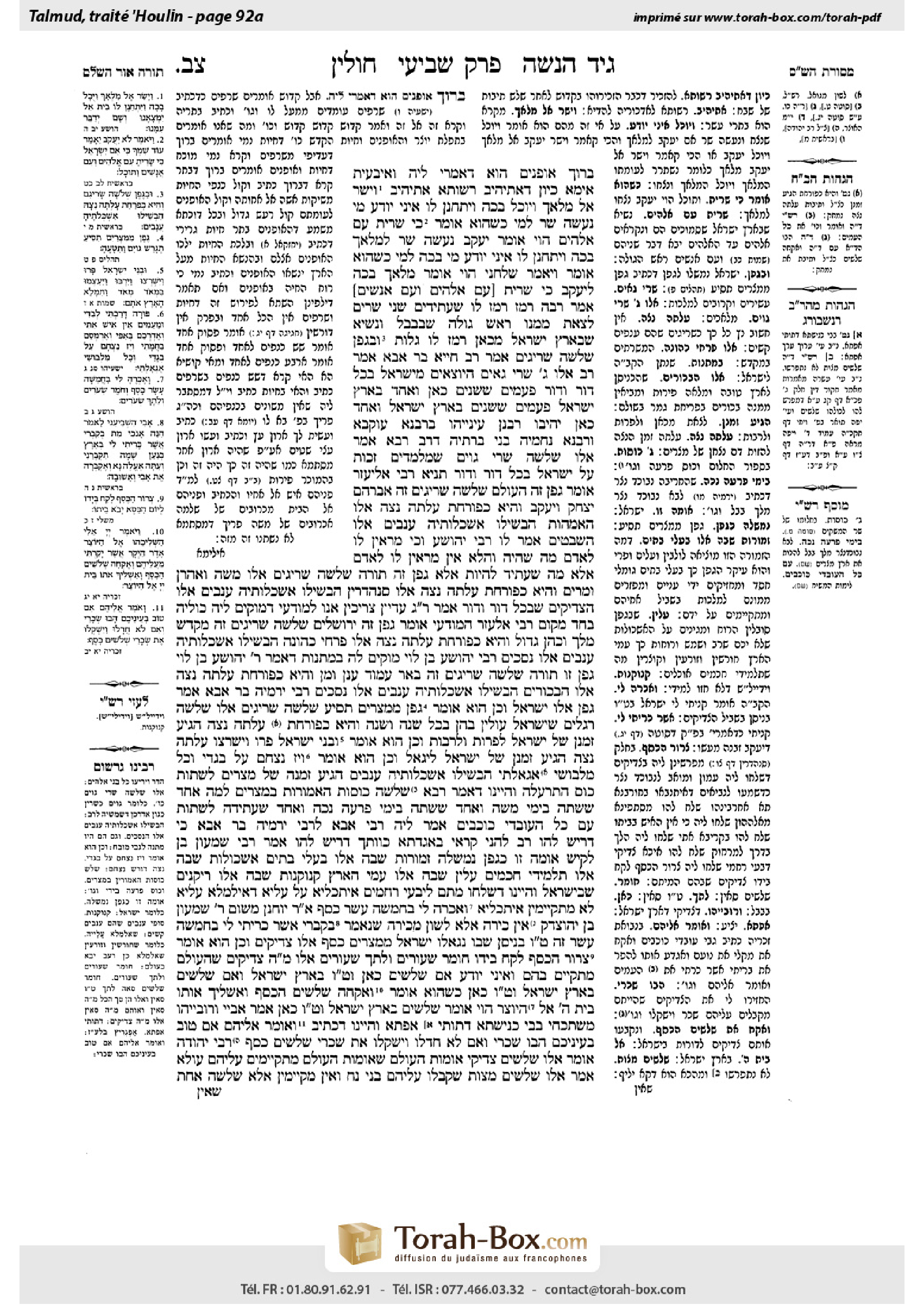
Chullin 92a: Talmud study for Daf Yomi
Study the Talmud for Daf Yomi with scanned pages, Hebrew text, English translations from Sefaria and AI-generated French translations.
Passage selection and English or AI-generated French translation are available where the scan has annotations. Daf Study is independent of Torah-Box and Sefaria.
Browse Chullin · חולין · All tractatesChullin 92a text and translations
This page of Chullin includes the Aramaic text, an English translation and an AI-generated French translation, alongside the scan above.
חולין צ״ב א · Aramaic and Hebrew text
״בָּרוּךְ״ – אוֹפַנִּים הוּא דְּאָמְרִי לֵיהּ. וְאִיבָּעֵית אֵימָא: כֵּיוָן דְּאִתְיְהִיב רְשׁוּתָא, אִתְיְהִיב.
״וַיָּשַׂר אֶל מַלְאָךְ וַיֻּכָל בָּכָה וַיִּתְחַנֶּן לוֹ״ – אֵינִי יוֹדֵעַ מִי נַעֲשָׂה שַׂר לְמִי, כְּשֶׁהוּא אוֹמֵר ״כִּי שָׂרִיתָ עִם אֱלֹהִים״ – הֱוֵי אוֹמֵר יַעֲקֹב נַעֲשָׂה שַׂר לַמַּלְאָךְ.
״בָּכָה וַיִּתְחַנֶּן לוֹ״ – אֵינִי יוֹדֵעַ מִי בָּכָה לְמִי, כְּשֶׁהוּא אוֹמֵר ״וַיֹּאמֶר שַׁלְּחֵנִי״, הֱוֵי אוֹמֵר: מַלְאָךְ בָּכָה לְיַעֲקֹב.
״כִּי שָׂרִיתָ עִם אֱלֹהִים וְעִם אֲנָשִׁים״, אָמַר רַבָּה: רֶמֶז רָמַז לוֹ שֶׁעֲתִידִים שְׁנֵי שָׂרִים לָצֵאת מִמֶּנּוּ, רֹאשׁ גּוֹלָה שֶׁבְּבָבֶל וְנָשִׂיא שֶׁבְּאֶרֶץ יִשְׂרָאֵל, מִכָּאן רָמַז לוֹ גָּלוּת.
״וּבַגֶּפֶן שְׁלֹשָׁה שָׂרִיגִים״, אָמַר רַב חִיָּיא בַּר אַבָּא אָמַר רַב: אֵלּוּ שְׁלֹשָׁה שָׂרֵי גֵּאִים הַיּוֹצְאִים מִיִּשְׂרָאֵל בְּכׇל דּוֹר וָדוֹר, פְּעָמִים שֶׁשְּׁנַיִם כָּאן וְאֶחָד בְּאֶרֶץ יִשְׂרָאֵל, פְּעָמִים שֶׁשְּׁנַיִם בְּאֶרֶץ יִשְׂרָאֵל וְאֶחָד כָּאן. יְהִיבוּ רַבָּנַן עֵינַיְיהוּ בְּרַבָּנָא עוּקְבָא וְרַבָּנָא נְחֶמְיָה בְּנֵי בְרַתֵּיה דְּרַב.
רָבָא אָמַר: אֵלּוּ שְׁלֹשָׁה שָׂרֵי גוֹיִם, שֶׁמְלַמְּדִים זְכוּת עַל יִשְׂרָאֵל בְּכׇל דּוֹר וָדוֹר.
תַּנְיָא, רַבִּי אֱלִיעֶזֶר אוֹמֵר: ״גֶּפֶן״ – זֶה הָעוֹלָם, ״שְׁלֹשָׁה שְׂרִיגִים״ – זֶה אַבְרָהָם יִצְחָק וְיַעֲקֹב, ״וְהִיא כְפֹרַחַת עָלְתָה נִצָּהּ״ – אֵלּוּ הָאִמָּהוֹת, ״הִבְשִׁילוּ אַשְׁכְּלֹתֶיהָ עֲנָבִים״ – אֵלּוּ הַשְּׁבָטִים.
אָמַר לוֹ רַבִּי יְהוֹשֻׁעַ: וְכִי מַרְאִין לוֹ לְאָדָם מַה שֶּׁהָיָה? וַהֲלֹא אֵין מַרְאִין לוֹ לְאָדָם אֶלָּא מַה שֶּׁעָתִיד לִהְיוֹת! אֶלָּא ״גֶּפֶן״ – זֶה תּוֹרָה, ״שְׁלֹשָׁה שָׂרִיגִים״ – אֵלּוּ מֹשֶׁה וְאַהֲרֹן וּמִרְיָם, ״וְהִיא כְפֹרַחַת עָלְתָה נִצָּהּ״ – אֵלּוּ סַנְהֶדְרִין, ״הִבְשִׁילוּ אַשְׁכְּלֹתֶיהָ עֲנָבִים״ – אֵלּוּ הַצַּדִּיקִים שֶׁבְּכָל דּוֹר וָדוֹר.
אָמַר רַבָּן גַּמְלִיאֵל: עֲדַיִין צְרִיכִין אָנוּ לַמּוֹדָעִי, דְּמוֹקֵים לֵיהּ כּוּלֵּיהּ בְּחַד מָקוֹם. רַבִּי אֶלְעָזָר הַמּוֹדָעִי אוֹמֵר: ״גֶּפֶן״ – זֶה יְרוּשָׁלַיִם, ״שְׁלֹשָׁה שָׂרִיגִים״ – זֶה מִקְדָּשׁ, מֶלֶךְ, וְכֹהֵן גָּדוֹל, ״וְהִיא כְפֹרַחַת עָלְתָה נִצָּהּ״ – אֵלּוּ פִּרְחֵי כְהוּנָּה, ״הִבְשִׁילוּ אַשְׁכְּלֹתֶיהָ עֲנָבִים״ – אֵלּוּ נְסָכִים.
רַבִּי יְהוֹשֻׁעַ בֶּן לֵוִי מוֹקֵים לַהּ בְּמַתָּנוֹת, דְּאָמַר רַבִּי יְהוֹשֻׁעַ בֶּן לֵוִי: ״גֶּפֶן״ – זוֹ תּוֹרָה, ״שְׁלֹשָׁה שָׂרִיגִים״ – זֶה בְּאֵר, עַמּוּד עָנָן, וּמָן, ״וְהִיא כְפֹרַחַת עָלְתָה נִצָּהּ״ – אֵלּוּ הַבִּכּוּרִים, ״הִבְשִׁילוּ אַשְׁכְּלֹתֶיהָ עֲנָבִים״ – אֵלּוּ נְסָכִים.
רַבִּי יִרְמְיָה בַּר אַבָּא אָמַר: ״גֶּפֶן״ – אֵלּוּ יִשְׂרָאֵל, וְכֵן הוּא אוֹמֵר: ״גֶּפֶן מִמִּצְרַיִם תַּסִּיעַ״. ״שְׁלֹשָׁה שָׂרִיגִים״ – אֵלּוּ שְׁלֹשָׁה רְגָלִים שֶׁיִּשְׂרָאֵל עוֹלִין בָּהֶן בְּכׇל שָׁנָה וְשָׁנָה. ״וְהִיא כְפֹרַחַת עָלְתָה נִצָּהּ״ – הִגִּיעַ זְמַנָּן שֶׁל יִשְׂרָאֵל לִפְרוֹת וְלִרְבּוֹת, וְכֵן הוּא אוֹמֵר: ״וּבְנֵי יִשְׂרָאֵל פָּרוּ וַיִּשְׁרְצוּ״.
״עָלְתָה נִצָּה״ – הִגִּיעַ זְמַן שֶׁל יִשְׂרָאֵל לִיגָּאֵל, וְכֵן הוּא אוֹמֵר: ״וְיֵז נִצְחָם עַל בְּגָדַי וְכׇל מַלְבּוּשַׁי אֶגְאָלְתִּי״, ״הִבְשִׁילוּ אַשְׁכְּלֹתֶיהָ עֲנָבִים״ – הִגִּיעַ זְמַנָּהּ שֶׁל מִצְרַיִם לִשְׁתּוֹת כּוֹס הַתַּרְעֵלָה.
וְהַיְינוּ דְּאָמַר רָבָא: שְׁלֹשָׁה כּוֹסוֹת הָאֲמוּרוֹת בְּמִצְרַיִם לָמָה? אֶחָד, שֶׁשָּׁתָת בִּימֵי מֹשֶׁה, וְאֶחָד שֶׁשָּׁתָת בִּימֵי פַּרְעֹה נְכֹה, וְאֶחָד שֶׁעֲתִידָה לִשְׁתּוֹת עִם כׇּל הַגּוֹיִם.
אֲמַר לֵיהּ רַבִּי אַבָּא לְרַבִּי יִרְמְיָה בַּר אַבָּא: כִּי דָרֵישׁ לְהוּ רַב לְהָנֵי קְרָאֵי בְּאַגַּדְתָּא, כְּוָותָךְ דָּרֵישׁ לְהוּ.
אָמַר רַבִּי שִׁמְעוֹן בֶּן לָקִישׁ: אוּמָּה זוֹ כְּגֶפֶן נִמְשְׁלָה. זְמוֹרוֹת שֶׁבָּהּ – אֵלּוּ בַּעֲלֵי בָתִּים, אֶשְׁכּוֹלוֹת שֶׁבָּהּ – אֵלּוּ תַּלְמִידֵי חֲכָמִים, עָלִין שֶׁבָּהּ – אֵלּוּ עַמֵּי הָאָרֶץ, קְנוֹקָנוֹת שֶׁבָּהּ – אֵלּוּ רֵיקָנִים שֶׁבְּיִשְׂרָאֵל.
וְהַיְינוּ דִּשְׁלַחוּ מִתָּם: לִיבְעֵי רַחֲמִים אִיתְכָּלַיָּא עַל עָלַיָּא, דְּאִילְמָלֵא עָלַיָּא לָא מִתְקַיְּימָן אִיתְכָּלַיָּא.
״וָאֶכְּרֶהָ לִּי בַּחֲמִשָּׁה עָשָׂר כָּסֶף״, אָמַר רַבִּי יוֹחָנָן מִשּׁוּם רַבִּי שִׁמְעוֹן בֶּן יְהוֹצָדָק: אֵין ״כִּירָה״ אֶלָּא לְשׁוֹן מְכִירָה, שֶׁנֶּאֱמַר ״בְּקִבְרִי אֲשֶׁר כָּרִיתִי לִי״.
״בַּחֲמִשָּׁה עָשָׂר״ – זֶה חֲמִשָּׁה עָשָׂר בְּנִיסָן שֶׁבּוֹ נִגְאֲלוּ יִשְׂרָאֵל מִמִּצְרַיִם, ״כָּסֶף״ – אֵלּוּ צַדִּיקִים, וְכֵן הוּא אוֹמֵר ״צְרוֹר הַכֶּסֶף לָקַח בְּיָדוֹ״.
״חוֹמֶר שְׂעוֹרִים וְלֶתֶךְ שְׂעוֹרִים״ – אֵלּוּ אַרְבָּעִים וַחֲמִשָּׁה צַדִּיקִים שֶׁהָעוֹלָם מִתְקַיֵּים בָּהֶם, וְאֵינִי יוֹדֵעַ אִם שְׁלֹשִׁים כָּאן וַחֲמִשָּׁה עָשָׂר בְּאֶרֶץ יִשְׂרָאֵל, וְאִם שְׁלֹשִׁים בְּאֶרֶץ יִשְׂרָאֵל וַחֲמִשָּׁה עָשָׂר כָּאן. כְּשֶׁהוּא אוֹמֵר: ״וָאֶקְחָה שְׁלֹשִׁים הַכֶּסֶף וָאַשְׁלִיךְ אֹתוֹ בֵּית ה׳ אֶל הַיּוֹצֵר״ – הֱוֵי אוֹמֵר: שְׁלֹשִׁים בְּאֶרֶץ יִשְׂרָאֵל וַחֲמִשָּׁה עָשָׂר כָּאן.
אָמַר אַבָּיֵי: וְרוּבַּיְיהוּ מִשְׁתַּכְחִי בְּבֵי כְנִישְׁתָּא דְּתוּתֵי אַפְּתָא, וְהַיְינוּ דִּכְתִיב: ״וָאֹמַר אֲלֵיהֶם אִם טוֹב בְּעֵינֵיכֶם הָבוּ שְׂכָרִי וְאִם לֹא חֲדָלוּ וַיִּשְׁקְלוּ אֶת שְׂכָרִי שְׁלֹשִׁים כָּסֶף״.
רַבִּי יְהוּדָה אוֹמֵר: אֵלּוּ שְׁלֹשִׁים צַדִּיקֵי אוּמּוֹת הָעוֹלָם, שֶׁאוּמּוֹת הָעוֹלָם מִתְקַיְּימִים עֲלֵיהֶם. עוּלָּא אָמַר: אֵלּוּ שְׁלֹשִׁים מִצְוֹת שֶׁקִּבְּלוּ עֲלֵיהֶם בְּנֵי נֹחַ, וְאֵין מְקַיְּימִין אֶלָּא שְׁלֹשָׁה. אַחַת
Chullin 92a · English translation
The Gemara answers that it is the ofanim who say the verse: “Blessed be the glory of the Lord from His place,” as the next verse mentions “the noise of the ofanim” (Ezekiel 3:13), and Rav Ḥanina’s statement citing Rav was referring not to ofanim but to ministering angels. And if you wish, say that once permission has been given to them to mention the name of God after three words when they say: “Holy, holy, holy,” permission is also given to them to mention the name of God again while praising Him even after fewer than three words.
The Gemara continues to discuss Jacob wrestling with the angel. The prophet states: “So he strove [vayyasar] with an angel, and prevailed; he wept, and made supplication to him; at Beth El he would find him, and there he would speak with us” (Hosea 12:5). From this verse I do not know who became master [sar], i.e., was victorious, over whom. When another verse states: “And he said: Your name shall no longer be called Jacob, but Israel; for you have striven with angels and with men, and have prevailed” (Genesis 32:29), you must say that Jacob became master over the angel.
The verse in Hosea states: “He wept, and made supplication to him.” From this verse I do not know who cried to whom. When another verse states: “And he said: Let me go, for the dawn has risen” (Genesis 32:27), you must say that the angel cried to Jacob.
The verse states: “And he said: Your name shall no longer be called Jacob, but Israel; for you have striven with angels [elohim] and with men, and have prevailed” (Genesis 32:29). Rabba says: The angel intimated to Jacob that in the future two princes would emerge from him: They are the Exilarch who is in Babylonia and the Nasi who is in Eretz Yisrael. And from here he also intimated to Jacob that there would be an exile.
Similarly, with regard to the dream of Pharaoh’s butler, the verse states: “And in the vine were three branches [sarigim]; and as it was budding, its blossoms shot forth, and its clusters brought forth ripe grapes” (Genesis 40:10). Rav Ḥiyya bar Abba says that Rav says: These three branches refer to the three proud princes [sarei ge’im] who emerge from the Jewish people in each and every generation. There are times when two are here in Babylonia and one is in Eretz Yisrael, and there are times when two are in Eretz Yisrael and one is here in Babylonia. When this was stated in the study hall, the Sages present turned their eyes toward Rabbana Ukva and Rabbana Neḥemya, the sons of the daughter of Rav, who were from the family of the Exilarch and were two leaders of the generation who resided in Babylonia.
Rava says a different explanation of the verse: These three branches [sarigim] are the three ministering angels appointed to oversee the gentiles [sarei goyim], who plead in favor of the Jewish people in each and every generation.
It is taught in a baraita: Rabbi Eliezer says an alternate interpretation of the verse. “Vine”; this is a reference to the world. “Three branches”; this is a reference to Abraham, Isaac, and Jacob. “And as it was budding, its blossoms shot forth”; these are the matriarchs. “And its clusters brought forth ripe grapes”; these are the twelve tribes, i.e., the twelve sons of Jacob.
Rabbi Yehoshua said to him: But is a person shown in a dream what was in the past? Isn’t it true that one is shown only what will be in the future? Since the patriarchs, matriarchs, and sons of Jacob were all born prior to this dream, the dream was not alluding to them. Rather, the verse should be interpreted as follows: “Vine”; this is a reference to the Torah. “Three branches”; these are Moses, Aaron, and Miriam. “And as it was budding, its blossoms shot forth”; these are the members of the Sanhedrin. “And its clusters brought forth ripe grapes”; these are the righteous people who live in each and every generation.
Rabban Gamliel said: In order to understand this verse (Genesis 40:10) we still need the explanation of Rabbi Elazar HaModa’i, who is an expert in matters of aggada, as he interprets all of the phrases in the verse as referring to one location. Rabbi Elazar HaModa’i says: “Vine”; this is a reference to Jerusalem. “Three branches”; this is a reference to the Temple, the king and the High Priest. “And as it was budding [poraḥat], its blossoms shot forth”; these are the young priests [pirḥei khehunna]. “And its clusters brought forth ripe grapes”; these are the wine libations.
Rabbi Yehoshua ben Levi interprets it with reference to the gifts that God gave the Jewish people, as Rabbi Yehoshua ben Levi said: “Vine”; this is a reference to the Torah. “Three branches”; this is a reference to the miraculous items that accompanied the Jewish people in the wilderness and sustained and protected them: The well, the pillar of cloud, and the manna. “And as it was budding, its blossoms shot forth”; these are the first fruits that are brought to the Temple. “And its clusters brought forth ripe grapes”; these are the wine libations.
Rabbi Yirmeya bar Abba says: “Vine”; this is a reference to the Jewish people, and similarly another verse states: “You plucked up a vine out of Egypt; You drove out the nations and planted it” (Psalms 80:9). “Three branches”; these are the three pilgrimage Festivals, on which the Jewish people ascend to Jerusalem every year. “And as it was budding, its blossoms shot forth,” means that the time has arrived for the Jewish people to be fruitful and multiply, and similarly another verse states: “And the children of Israel were fruitful, and increased abundantly, and multiplied, and became exceeding mighty; and the land was filled with them” (Exodus 1:7).
“Its blossoms [nitzah] shot forth” means that the time has arrived for the Jewish people to be redeemed. And similarly another verse states: “And their eternity [nitzḥam] is dashed against My garments, and I have redeemed all My raiment” (Isaiah 63:3). “And its clusters brought forth ripe grapes” means that the time has arrived for Egypt to drink the cup of fury, i.e., to receive its punishment.
And this is as Rava said: Why are there three cups stated with regard to Egypt in the dream of Pharaoh’s butler (see Genesis 40:11)? They are an allusion to three cups of misfortune that would later befall Egypt: One that Egypt drank in the days of Moses during the ten plagues and the Exodus; one that Egypt drank in the days of Pharaoh Nekho, the king of Egypt defeated by Nebuchadnezzar; and one that Egypt will drink in the future with all the other nations, when they are punished in the time of the Messiah.
Rabbi Abba said to Rabbi Yirmeya bar Abba: When Rav interpreted these verses homiletically he interpreted them according to the way in which you have interpreted them, and not according to any of the other opinions cited above.
Similar to Rabbi Yirmeya bar Abba’s interpretation of the word vine as an allusion to the Jewish people, Rabbi Shimon ben Lakish says: This nation is likened to a vine. The branches of the vine support the clusters of grapes, the leaves, and the tendrils; these are represented among the Jewish people by the homeowners, who provide financial support for the entire nation. The clusters of grapes on the vine, these are the Torah scholars. The leaves on the vine, which protect the grapes, these are the ignoramuses, who protect the Torah scholars. The tendrils of the vine, which do not directly serve the grapes themselves, these are the empty ones of the Jewish people.
And this is the meaning of the instruction that they sent from there, i.e., from Eretz Yisrael: Let the clusters of grapes pray for the leaves, as were it not for the leaves, the clusters of grapes would not survive.
§ The Gemara cites homiletical interpretations of other verses that pertain to the leaders of the Jewish people in Eretz Yisrael and Babylonia. The verse states: “So I bought her [va’ekkereha] to me for fifteen pieces of silver, and a ḥomer of barley, and a half-ḥomer of barley” (Hosea 3:2). Rabbi Yoḥanan says in the name of Rabbi Shimon ben Yehotzadak: The term kira, which forms the basis of the verb va’ekkereha, is nothing other than language referring to a sale [mekhira], as it is stated that Joseph said: “My father made me swear, saying: Lo, I die; in my grave that I have acquired [kariti] for me in the land of Canaan, there shall you bury me” (Genesis 50:5).
Rabbi Yoḥanan continues: “For fifteen pieces of silver”; this is a reference to the fifteenth of Nisan, the date on which the Jewish people were redeemed from Egypt. “Silver”; these are the righteous people. And similarly, another verse states: “He has taken the bag of silver with him” (Proverbs 7:20), a reference to God taking the righteous away prior to the destruction of the First Temple (see Sanhedrin 96b).
The verse states: “A ḥomer of barley, and a half-ḥomer of barley.” A ḥomer equals thirty se’a, and a half-ḥomer equals fifteen se’a, totaling forty-five se’a; these are the forty-five righteous individuals in whose merit the world continues to exist. And although the verse alludes to the fact that thirty of these righteous individuals are in one place and fifteen are elsewhere, I do not know if thirty are here in Babylonia and fifteen are in Eretz Yisrael, or if thirty are in Eretz Yisrael and fifteen are here in Babylonia. When it says in a different verse: “And I took the thirty pieces of silver and cast them into the treasury, in the house of the Lord” (Zechariah 11:13), you must say that thirty of the righteous individuals are in Eretz Yisrael and fifteen are here in Babylonia.
Abaye said: And most of the fifteen righteous individuals in Babylonia are found in the synagogue under the upper room. And this is the meaning of that which is written: “And I said to them: If it is good in your eyes, give me my hire; and if not, refrain. And they weighed for my hire thirty pieces of silver” (Zechariah 11:12).
Rabbi Yehuda says: These are the thirty righteous individuals among the nations of the world, in whose merit the nations of the world continue to exist. Ulla says: These are the thirty mitzvot that the descendants of Noah initially accepted upon themselves; but they fulfill only three of them. One of these three mitzvot is
Chullin 92a · Traduction française (IA)
La Guemara répond que ce sont les ofanim qui prononcent la parole : « Béni soit la gloire du Seigneur de son lieu », car la prochaine parole mentionne « le bruit des ofanim » (Ezéchiel 3:13), et la déclaration de Rav Ḥanina citant Rav ne faisait pas référence aux ofanim mais aux anges ministéreux. Et si vous le souhaitez, dites que lorsqu'on leur a donné la permission de mentionner le nom de Dieu après trois mots lorsqu'ils disent : « Saint, saint, saint », on leur donne aussi la permission de mentionner à nouveau le nom de Dieu lorsqu'ils l'élèvent, même après moins de trois mots.
La Guemara continue à discuter de Jacob qui lutte avec l'ange. Le prophète dit : « Il lutta [vayyasar] avec un ange, et l'emporta ; il pleura, et supplia auprès de lui ; à Beth El il le trouverait, et là il parlerait avec nous » (Hosée 12:5). À partir de cette parole, je ne sais pas qui est devenu maître [sar], c'est-à-dire qui a gagné, par rapport à qui. Lorsqu'une autre parole dit : « Et il dit : Ton nom ne sera plus Jacob, mais Israel ; car tu as lutté avec des anges et avec des hommes, et tu as l'emporté » (Genèse 32:29), vous devez dire que Jacob est devenu maître de l'ange.
La parole dans Hosée dit : « Il pleura, et supplia auprès de lui ». À partir de cette parole, je ne sais pas qui pleura auprès de qui. Lorsqu'une autre parole dit : « Et il dit : Laisse-moi partir, car l'aube est levée » (Genèse 32:27), vous devez dire que l'ange pleura auprès de Jacob.
La parole dit : « Et il dit : Ton nom ne sera plus Jacob, mais Israel ; car tu as lutté avec des anges [elohim] et avec des hommes, et tu as l'emporté » (Genèse 32:29). Rabba dit : L'ange a laissé entendre à Jacob que deux princes émergeraient à l'avenir de lui : ils sont l'Exilarch qui est en Babylone et le Nasi qui est en Terre d'Israël. Et d'ici, il a aussi laissé entendre à Jacob qu'il y aurait une dispersion.
De même, concernant le rêve du serviteur de Pharaon, la parole dit : « Et dans la vigne il y avait trois branches [sarigim] ; et quand elle commençait à fleurir, ses boutons s'épanouirent, et ses grappes produisirent des raisins mûrs » (Genèse 40:10). Rav Ḥiyya bar Abba dit que Rav dit : ces trois branches font référence aux trois princes [sarei ge’im] orgueilleux qui émergent du peuple juif à chaque génération. Il y a des moments où deux sont ici en Babylone et un est en Terre d'Israël, et des moments où deux sont en Terre d'Israël et un est ici en Babylone. Lorsque cela a été dit dans la salle de étude, les Sages présents ont tourné leurs yeux vers Rabbana Ukva et Rabbana Neḥemya, les fils de la fille de Rav, qui étaient de la famille de l'Exilarch et étaient deux leaders de la génération qui résidaient en Babylone.
Rava dit une autre interprétation de la parole : ces trois branches [sarigim] sont les trois anges ministéreux chargés de surveiller les nations [sarei goyim], qui supplient en faveur du peuple juif à chaque génération.
Il est enseigné dans une baraïta : Rabbi Eliezer dit une autre interprétation de la parole. « Vigne » ; c'est une référence au monde. « Trois branches » ; c'est une référence à Abraham, Isaac et Jacob. « Et quand elle commençait à fleurir, ses boutons s'épanouirent » ; ces sont les matriarches. « Et ses grappes produisirent des raisins mûrs » ; ces sont les douze tribus, c'est-à-dire les douze fils de Jacob.
Rabbi Yehoshua dit à lui : Mais est-ce que l'on montre à une personne ce qui s'est passé dans le passé ? N'est-ce pas vrai que l'on montre seulement ce qui sera à l'avenir ? Puisque les patriarches, les matriarches et les fils de Jacob sont tous nés avant ce rêve, ce rêve ne faisait pas référence à eux. Plutôt, la parole doit être interprétée ainsi : « Vigne » ; c'est une référence à la Torah. « Trois branches » ; ces sont Moïse, Aaron et Miriam. « Et quand elle commençait à fleurir, ses boutons s'épanouirent » ; ces sont les membres du Sanhédrin. « Et ses grappes produisirent des raisins mûrs » ; ces sont les justes qui vivent à chaque génération.
Rabban Gamliel dit : Afin de comprendre cette parole (Genèse 40:10), nous avons encore besoin de l'explication de Rabbi Elazar HaModa’i, qui est un expert en matière d'aggada, car il interprète toutes les phrases de la parole comme faisant référence à un seul lieu. Rabbi Elazar HaModa’i dit : « Vigne » ; c'est une référence à Jérusalem. « Trois branches » ; c'est une référence au Temple, au roi et au grand prêtre. « Et quand elle commençait à fleurir [poraḥat], ses boutons s'épanouirent » ; ces sont les jeunes prêtres [pirḥei khehunna]. « Et ses grappes produisirent des raisins mûrs » ; ces sont les libations de vin.
Rabbi Yehoshua ben Levi l'interprète en référence aux dons que Dieu a donnés au peuple juif, comme Rabbi Yehoshua ben Levi a dit : « Vigne » ; c'est une référence à la Torah. « Trois branches » ; c'est une référence aux objets miraculeux qui accompagnaient le peuple juif dans le désert et le soutenaient et le protégeaient : la source, la colonne de nuage et la manne. « Et quand elle commençait à fleurir, ses boutons s'épanouirent » ; ces sont les premiers fruits qui sont apportés au Temple. « Et ses grappes produisirent des raisins mûrs » ; ces sont les libations de vin.
Rabbi Yirmeya bar Abba dit : « Vigne » ; c'est une référence au peuple juif, et une autre parole dit aussi : « Tu as arraché une vigne d'Égypte ; tu as expulsé les nations et planté celle-ci » (Psaumes 80:9). « Trois branches » ; ces sont les trois fêtes de pèlerinage, auxquelles le peuple juif monte à Jérusalem chaque année. « Et quand elle commençait à fleurir, ses boutons s'épanouirent », cela signifie que le moment est arrivé pour que le peuple juif soit fécond et multiplié, et une autre parole dit aussi : « Et les enfants d'Israël furent féconds, et s'accrurent, et se multiplièrent, et devinrent extrêmement puissants ; et la terre fut remplie d'eux » (Exode 1:7).
« Ses boutons [nitzah] s'épanouirent » signifie que le moment est arrivé pour que le peuple juif soit libéré. Et une autre parole dit aussi : « Et leur éternité [nitzḥam] fut brisée contre mes vêtements, et j'ai racheté tout mon vêtement » (Yachout 63:3). « Et ses grappes produisirent des raisins mûrs » signifie que le moment est arrivé pour que l'Égypte boive le verre de colère, c'est-à-dire pour qu'elle reçoive sa punition.
Et c'est ce que Rava a dit : Pourquoi y a-t-il trois coupes mentionnées en ce qui concerne l'Égypte dans le rêve du serviteur de Pharaon (cf. Genèse 40:11) ? Ce sont des allusions à trois coupes de malheurs qui allaient ensuite frapper l'Égypte : une qui fut bu en temps de Moïse, durant les dix plaques et l'Exode ; une qui fut bu en temps de Pharaon Nécho, roi de l'Égypte vaincu par Nabuchodolonaser ; et une qui sera bue à l'avenir avec tous les autres peuples, lorsqu'ils seront punis à l'époque du Messie.
Rabbi Abba dit à Rabbi Yirmeya bar Abba : Lorsque Rav a interprété ces versets de manière allégorique, il les a interprétés selon la manière dont vous les avez interprétés, et non selon l'une des autres opinions citées ci-dessus.
Comme l'interprétation de Rabbi Yirmeya bar Abba du mot vigne comme allusion au peuple juif, Rabbi Shimon ben Lakish dit : Ce peuple est comparé à une vigne. Les branches de la vigne soutiennent les grappes de raisin, les feuilles et les rameaux ; ces derniers sont représentés parmi le peuple juif par les propriétaires, qui fournissent un soutien financier à l'ensemble du peuple. Les grappes de raisin sur la vigne, ces sont les savants de la Torah. Les feuilles de la vigne, qui protègent les raisins, ces sont les ignorants, qui protègent les savants de la Torah. Les rameaux de la vigne, qui ne servent pas directement les raisins eux-mêmes, ces sont les vides du peuple juif.
Et c'est la signification de l'instruction qu'ils ont envoyée d'où ils étaient, c'est-à-dire d'Israël : Que les grappes de raisin prie pour les feuilles, car sans les feuilles, les grappes de raisin ne survivraient pas.
§ La Guemara cite d'autres interprétations allégoriques de versets qui concernent les chefs du peuple juif en Israël et en Babylone. Le verset dit : « Et j'ai acheté [va'ekkereha] pour moi une femme, pour quinze pièces d'argent, et un ḥomer de blé, et un demi-ḥomer de blé » (Hosée 3:2). Rabbi Yoḥanan, en nom de Rabbi Shimon ben Yehotzadak, dit : Le mot kira, qui est la base du verbe va'ekkereha, n'est autre que le langage d'une vente [mekhira], comme il est dit que Joseph a dit : « Mon père m'a fait jurer, disant : Voici que je meurs ; dans ma tombe que j'ai acquis [kariti] pour moi dans la terre de Canaan, là tu m'enterreras » (Genèse 50:5).
Rabbi Yoḥanan continue : « Pour quinze pièces d'argent » ; c'est une référence à la quinzième de Nisan, la date à laquelle le peuple juif a été libéré d'Égypte. « L'argent » ; ce sont les justes. Et de même, un autre verset dit : « Il a pris le sac d'argent avec lui » (Proverbes 7:20), une référence à Dieu qui prend les justes avant la destruction du Premier Temple (cf. Sanhédrin 96b).
Le verset dit : « Un ḥomer de blé, et un demi-ḥomer de blé ». Un ḥomer égale trente se'a, et un demi-ḥomer égale quinze se'a, totalisant quarante-cinq se'a ; ce sont les quarante-cinq justes dont le monde continue à subsister. Et bien que le verset suggère que trente de ces justes sont dans un lieu et quinze dans un autre, je ne sais pas si trente sont ici en Babylone et quinze en Israël, ou si trente sont en Israël et quinze ici en Babylone. Lorsqu'il est dit dans un autre verset : « Et j'ai pris les trente pièces d'argent et je les ai jetées dans le trésor, dans la maison du Seigneur » (Zacharie 11:13), vous devez dire que trente des justes sont en Israël et quinze ici en Babylone.
Abaye dit : Et la plupart des quinze justes en Babylone sont trouvés dans la synagogue sous la salle supérieure. Et c'est la signification de ce qui est écrit : « Et je disais à eux : Si cela te plaît, donne-moi mon salaire ; et si non, abstiens-toi. Et ils pesèrent pour mon salaire trente pièces d'argent » (Zacharie 11:12).
Rabbi Yehuda dit : Ce sont les trente justes parmi les nations du monde, dont les nations du monde continuent à subsister. Ulla dit : Ce sont les trente mitsvot que les descendants de Noé ont initialement acceptés sur eux ; mais ils remplissent seulement trois d'entre elles. L'une de ces trois mitsvot est
Traduction française générée par IA à partir de l’édition anglaise de Sefaria. Vérifie toujours un passage avec le texte source.
Text from Sefaria: William Davidson Edition - Vocalized Aramaic (unknown); William Davidson Edition - English (CC BY NC).