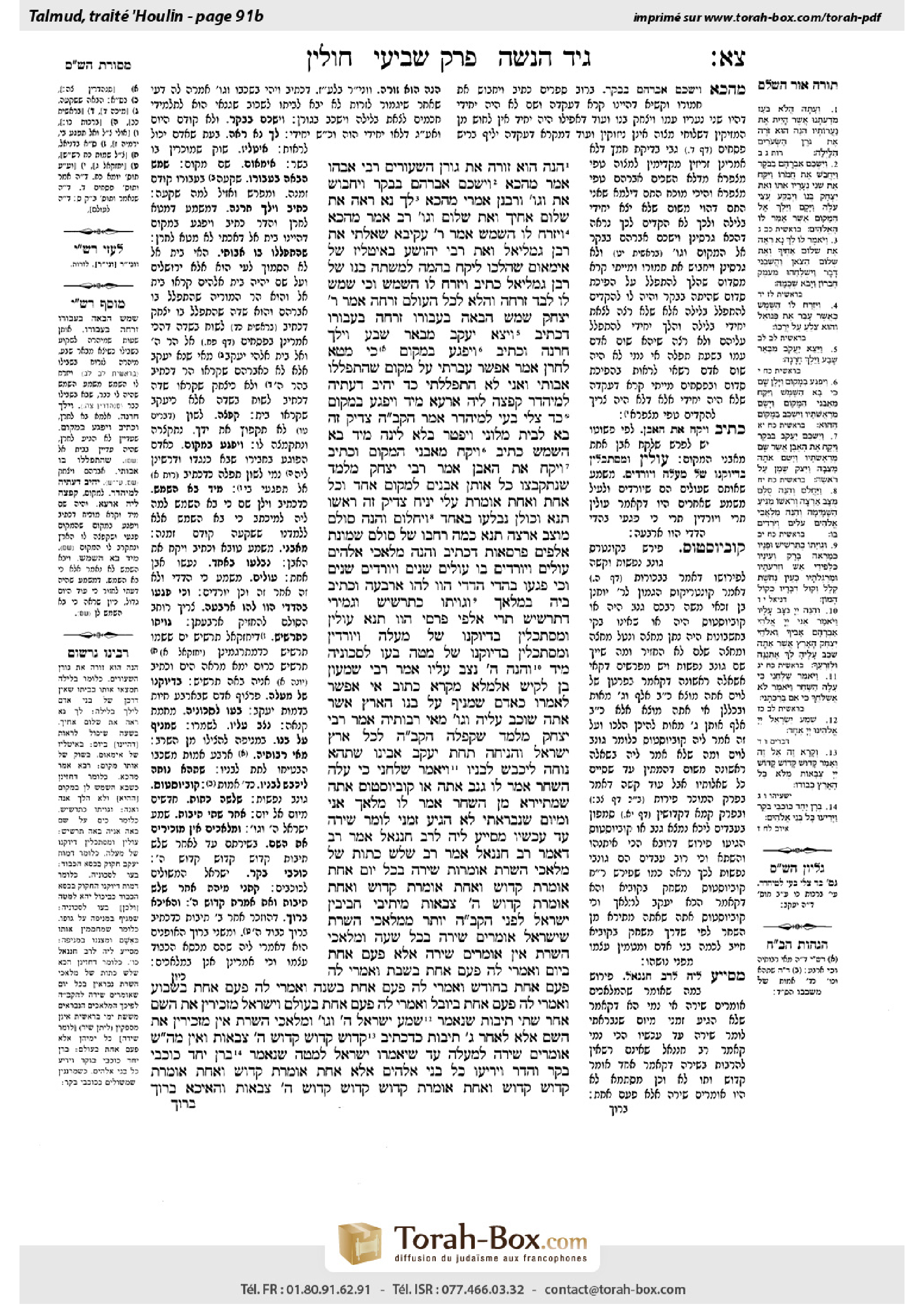
Chullin 91b: Talmud study for Daf Yomi
Study the Talmud for Daf Yomi with scanned pages, Hebrew text, English translations from Sefaria and AI-generated French translations.
Passage selection and English or AI-generated French translation are available where the scan has annotations. Daf Study is independent of Torah-Box and Sefaria.
Browse Chullin · חולין · All tractatesChullin 91b text and translations
This page of Chullin includes the Aramaic text, an English translation and an AI-generated French translation, alongside the scan above.
חולין צ״א ב · Aramaic and Hebrew text
״הִנֵּה הוּא זֹרֶה אֶת גֹּרֶן הַשְּׂעֹרִים״.
רַבִּי אֲבָהוּ אָמַר מֵהָכָא: ״וַיַּשְׁכֵּם אַבְרָהָם בַּבֹּקֶר וַיַּחֲבֹשׁ אֶת וְגוֹ׳״.
וְרַבָּנַן אָמְרִי מֵהָכָא: ״לֶךְ נָא רְאֵה אֶת שְׁלוֹם אַחֶיךָ וְאֶת שְׁלוֹם וְגוֹ׳״.
רַב אָמַר מֵהָכָא: ״וַיִּזְרַח לוֹ הַשֶּׁמֶשׁ״.
אָמַר רַבִּי עֲקִיבָא: שָׁאַלְתִּי אֶת רַבָּן גַּמְלִיאֵל וְאֶת רַבִּי יְהוֹשֻׁעַ בָּאִיטְלִיז שֶׁל אִימָאוּם, שֶׁהָלְכוּ לִיקַּח בְּהֵמָה לְמִשְׁתֵּה בְנוֹ שֶׁל רַבָּן גַּמְלִיאֵל. כְּתִיב ״וַיִּזְרַח לוֹ הַשֶּׁמֶשׁ״, וְכִי שֶׁמֶשׁ לוֹ לְבַד זָרְחָה? וַהֲלֹא לְכׇל הָעוֹלָם זָרְחָה!
אָמַר רַבִּי יִצְחָק: שֶׁמֶשׁ הַבָּאָה בַּעֲבוּרוֹ זָרְחָה בַּעֲבוּרוֹ, דִּכְתִיב: ״וַיֵּצֵא יַעֲקֹב מִבְּאֵר שָׁבַע וַיֵּלֶךְ חָרָנָה״, וּכְתִיב: ״וַיִּפְגַּע בַּמָּקוֹם״. כִּי מְטָא לְחָרָן אָמַר: אֶפְשָׁר עָבַרְתִּי עַל מָקוֹם שֶׁהִתְפַּלְּלוּ אֲבוֹתַי וַאֲנִי לֹא הִתְפַּלַּלְתִּי? כַּד יָהֵיב דַּעְתֵּיהּ לְמִיהְדַּר, קְפַצָה לֵיהּ אַרְעָא, מִיָּד – ״וַיִּפְגַּע בַּמָּקוֹם״.
כַּד צַלִּי, בָּעֵי לְמֶיהְדַּר, אָמַר הַקָּדוֹשׁ בָּרוּךְ הוּא: צַדִּיק זֶה בָּא לְבֵית מְלוֹנִי, וְיִפָּטֵר בְּלֹא לִינָה? מִיָּד, ״בָּא הַשֶּׁמֶשׁ״.
כְּתִיב ״וַיִּקַּח מֵאַבְנֵי הַמָּקוֹם״, וּכְתִיב ״וַיִּקַּח אֶת הָאֶבֶן״. אָמַר רַבִּי יִצְחָק: מְלַמֵּד שֶׁנִּתְקַבְּצוּ כׇּל אוֹתָן אֲבָנִים לְמָקוֹם אֶחָד, וְכׇל אַחַת וְאַחַת אוֹמֶרֶת: ״עָלַי יַנִּיחַ צַדִּיק זֶה רֹאשׁוֹ״. תָּנָא: וְכוּלָּן נִבְלְעוּ בְּאֶחָד.
״וַיַּחֲלֹם וְהִנֵּה סֻלָּם מֻצָּב אַרְצָה״, תָּנָא: כַּמָּה רׇחְבּוֹ שֶׁל סוּלָּם? שְׁמוֹנַת אֲלָפִים פַּרְסָאוֹת, דִּכְתִיב: ״וְהִנֵּה מַלְאֲכֵי אֱלֹהִים עוֹלִים וְיוֹרְדִים בּוֹ״, ״עוֹלִים״ – שְׁנַיִם, ״וְיוֹרְדִים״ – שְׁנַיִם, וְכִי פָגְעוּ בַּהֲדֵי הֲדָדֵי הָווּ לְהוּ אַרְבָּעָה.
וּכְתִיב בֵּיהּ בְּמַלְאָךְ ״וּגְוִיָּתוֹ כְתַרְשִׁישׁ״, וּגְמִירִי דְּתַרְשִׁישׁ תְּרֵי אַלְפֵי פַּרְסֵי הָוֵי.
תָּנָא: עוֹלִין וּמִסְתַּכְּלִין בִּדְיוֹקְנוֹ שֶׁל מַעְלָה, וְיוֹרְדִין וּמִסְתַּכְּלִין בִּדְיוֹקְנוֹ שֶׁל מַטָּה. בְּעוֹ לְסַכּוֹנֵיהּ, מִיָּד ״וְהִנֵּה ה׳ נִצָּב עָלָיו״. אָמַר רַבִּי שִׁמְעוֹן בֶּן לָקִישׁ: אִלְמָלֵא מִקְרָא כָּתוּב אִי אֶפְשָׁר לְאׇמְרוֹ, כְּאָדָם שֶׁמֵּנִיף עַל בְּנוֹ.
״הָאָרֶץ אֲשֶׁר אַתָּה שֹׁכֵב עָלֶיהָ וְגוֹ׳״, מַאי רְבוּתֵיהּ? אָמַר רַבִּי יִצְחָק: מְלַמֵּד שֶׁקִּפְּלָהּ הַקָּדוֹשׁ בָּרוּךְ הוּא לְכׇל אֶרֶץ יִשְׂרָאֵל וְהִנִּיחָה תַּחַת יַעֲקֹב אָבִינוּ, שֶׁתְּהֵא נוֹחָה לִיכָּבֵשׁ לְבָנָיו.
״וַיֹּאמֶר שַׁלְּחֵנִי כִּי עָלָה הַשָּׁחַר״, אָמַר לוֹ: גַּנָּב אַתָּה אוֹ קוּבְיוּסְטוּס אַתָּה שֶׁמִּתְיָירֵא מִן הַשַּׁחַר? אָמַר לוֹ: מַלְאָךְ אֲנִי, וּמִיּוֹם שֶׁנִּבְרֵאתִי לֹא הִגִּיעַ זְמַנִּי לוֹמַר שִׁירָה עַד עַכְשָׁיו.
מְסַיַּיע לֵיהּ לְרַב חֲנַנְאֵל אָמַר רַב, דְּאָמַר רַב חֲנַנְאֵל אָמַר רַב: שָׁלֹשׁ כִּתּוֹת שֶׁל מַלְאֲכֵי הַשָּׁרֵת אוֹמְרוֹת שִׁירָה בְּכׇל יוֹם, אַחַת אוֹמֶרֶת ״קָדוֹשׁ״, וְאַחַת אוֹמֶרֶת ״קָדוֹשׁ״, וְאַחַת אוֹמֶרֶת ״קָדוֹשׁ ה׳ צְבָאוֹת״.
מֵיתִיבִי: חֲבִיבִין יִשְׂרָאֵל לִפְנֵי הַקָּדוֹשׁ בָּרוּךְ הוּא יוֹתֵר מִמַּלְאֲכֵי הַשָּׁרֵת, שֶׁיִּשְׂרָאֵל אוֹמְרִים שִׁירָה בְּכׇל שָׁעָה, וּמַלְאֲכֵי הַשָּׁרֵת אֵין אוֹמְרִים שִׁירָה אֶלָּא פַּעַם אַחַת בַּיּוֹם, וְאָמְרִי לַהּ פַּעַם אַחַת בְּשַׁבָּת, וְאָמְרִי לַהּ פַּעַם אַחַת בְּחוֹדֶשׁ, וְאָמְרִי לַהּ פַּעַם אַחַת בַּשָּׁנָה, וְאָמְרִי לַהּ פַּעַם אַחַת בְּשָׁבוּעַ, וְאָמְרִי לַהּ פַּעַם אַחַת בְּיוֹבֵל, וְאָמְרִי לַהּ פַּעַם אַחַת בָּעוֹלָם.
וְיִשְׂרָאֵל מַזְכִּירִין אֶת הַשֵּׁם אַחַר שְׁתֵּי תֵּיבוֹת, שֶׁנֶּאֱמַר: ״שְׁמַע יִשְׂרָאֵל ה׳ וְגוֹ׳״, וּמַלְאֲכֵי הַשָּׁרֵת אֵין מַזְכִּירִין אֶת הַשֵּׁם אֶלָּא לְאַחַר שָׁלֹשׁ תֵּיבוֹת, כְּדִכְתִיב: ״קָדוֹשׁ קָדוֹשׁ קָדוֹשׁ ה׳ צְבָאוֹת״.
וְאֵין מַלְאֲכֵי הַשָּׁרֵת אוֹמְרִים שִׁירָה לְמַעְלָה, עַד שֶׁיֹּאמְרוּ יִשְׂרָאֵל לְמַטָּה, שֶׁנֶּאֱמַר: ״בְּרׇן יַחַד כּוֹכְבֵי בֹקֶר״, וַהֲדַר ״וַיָּרִיעוּ כׇּל בְּנֵי אֱלֹהִים״.
אֶלָּא, אַחַת אוֹמֶרֶת ״קָדוֹשׁ״, וְאַחַת אוֹמֶרֶת ״קָדוֹשׁ קָדוֹשׁ״, וְאַחַת אוֹמֶרֶת ״קָדוֹשׁ קָדוֹשׁ קָדוֹשׁ ה׳ צְבָאוֹת״. וְהָאִיכָּא ״בָּרוּךְ״!
Chullin 91b · English translation
“And now is there not Boaz our kinsman, whose maidens you were with? Behold, he winnows barley tonight in the threshing floor…and it shall be, when he lies down, that you shall mark the place where he shall lie” (Ruth 3:2–3). This teaches that the reason Boaz did not return home from the threshing floor was that a Torah scholar should not go out alone at night.
Rabbi Abbahu said that the source is from here: “And Abraham rose early in the morning, and saddled his donkey, and took two of his young men with him and Isaac his son; and he split the wood for the burnt offering, and rose up, and went to the place that God had told him” (Genesis 22:3). The fact that Abraham waited until morning and did not set off at night, even though others were traveling with him, indicates that a Torah scholar should not go out at night at all, and certainly not alone.
And the Rabbis say that the source is from here, the verse that describes when Jacob sent Joseph to his brothers: “And he said to him: Go now, see whether it is well with you brothers and well with the flock; and bring me back word. So he sent him out of the valley of Hebron, and he came to Shechem” (Genesis 37:14). The verse indicates that Jacob sent Joseph at a time when he could see his brothers, i.e., during the day. This shows that a Torah scholar should not go out alone at night.
Rav said that the source is from here: “And the sun rose for him as he passed over Peniel, and he limped upon his thigh” (Genesis 32:32). This indicates that Jacob remained where he was all night and left in the morning, because a Torah scholar should not go out alone at night.
The Gemara cites an incident involving the final verse cited above. Rabbi Akiva says: I asked the following question of Rabban Gamliel and Rabbi Yehoshua in the meat market [be’itliz] of the town Emmaus, where they went to purchase an animal for the wedding feast of Rabban Gamliel’s son: It is written in the verse: “And the sun shone for him when he passed Peniel, and he limped upon his thigh” (Genesis 32:32). But did the sun shine only for him? Didn’t it shine for the entire world?
Rabbi Yitzḥak says: The verse means that the sun, which set early exclusively for him, also shone early exclusively for him in order to rectify the disparity created by the premature sunset. The Gemara explains when the sun set early for him: As it is written: “And Jacob went out from Beersheba and went toward Haran” (Genesis 28:10). And it is written thereafter: “And he encountered the place, and he slept there, because the sun had set” (Genesis 28:11). When Jacob arrived at Haran, he said: Is it possible that I passed a place where my fathers prayed and I did not pray there? When he set his mind to return, the land contracted for him. Immediately the verse states: “And he encountered the place,” indicating that he arrived there miraculously.
When he had finished praying and he wanted to return to Haran, the Holy One, Blessed be He, said: This righteous man came to my lodging place and he will depart without remaining overnight? Immediately, the sun set before its proper time so that Jacob would stay overnight in that place.
The Gemara cites another exposition of Rabbi Yitzḥak to explain an apparent contradiction between two verses pertaining to this incident. It is written: “And he took of the stones of the place, and placed them under his head, and lay down in that place to sleep” (Genesis 28:11). And it is written: “And Jacob rose up early in the morning, and he took the stone that he had placed under his head, and set it up for a pillar, and poured oil upon the top of it” (Genesis 28:18). The first verse indicates that Jacob took several stones, whereas the latter verse indicates that he took only one stone. Rabbi Yitzḥak says: This teaches that all those stones gathered to one place and each one said: Let this righteous man place his head upon me. And it was taught: And all of them were absorbed into one large rock.
The Gemara expounds other verses pertaining to the same incident. The verse states: “And he dreamed, and behold a ladder set up on the earth, and the top of it reached to heaven; and behold the angels of God ascending and descending on it” (Genesis 28:12). It was taught: How wide was the ladder? It was eight thousand parasangs [parsaot], as it is written: “And behold the angels of God ascending and descending on it.” The word “ascending [olim],” written in plural, indicates that there were two angels ascending simultaneously. Likewise, the term “and descending [veyordim],” also in the plural, indicates that two angels were descending simultaneously. And when they met one another they were a total of four in one place, so the ladder must have been wide enough to accommodate four angels.
And it is written in a verse with regard to an angel: “His body was like Tarshish” (Daniel 10:6). And it is learned as a tradition that the city of Tarshish was two thousand parasangs. Consequently, in order to accommodate four angels, the ladder must have been eight thousand parasangs wide.
It was taught that the angels were ascending and gazing at the image of [bidyokeno] Jacob above, engraved on the Throne of Glory, and descending and gazing at his image below. The angels subsequently became jealous of Jacob, and wanted to endanger his life. Immediately Jacob received divine protection, as the verse states: “And behold, the Lord stood over him” (Genesis 28:13). Rabbi Shimon ben Lakish says: Were it not written in a verse it would be impossible to utter it, in deference to God, since it describes God as standing over Jacob to protect him from the angels like a man who waves a fan over his son to cool him down.
The Gemara explains another verse from Jacob’s dream. “And behold, the Lord stood over him and said: I am the Lord, the God of Abraham your father and the God of Isaac. The land upon which you lie, to you will I give it, and to your seed” (Genesis 28:13). The Gemara asks: What is the greatness of this promise, i.e., why is it expressed in this way despite the fact that in a literal sense Jacob was lying on a very small amount of land? Rabbi Yitzḥak says: This teaches that the Holy One, Blessed be He, folded up the entirety of Eretz Yisrael and placed it under Jacob, our patriarch, so that it would be easy for his children to conquer.
The Gemara returns to the verses that describe Jacob wrestling with the angel. “And he said: Let me go, for the dawn has risen. And he said: I will not let you go until you bless me” (Genesis 32:27). Jacob said to the angel: Are you a thief, or are you a gambler [kuveyustus], who is afraid of dawn? The angel said to him: I am an angel, and from the day I was created my time to recite a song before God has not arrived, until now. Now I must ascend so that I can sing songs of praise to God.
The Gemara comments: This supports the opinion of Rav Ḥananel when he related what Rav said. As Rav Ḥananel said that Rav said: Three groups of ministering angels recite a song every day from the verse “Holy, holy, holy is the Lord”; one says: “Holy,” and another one says: “Holy,” and another one says: “Holy is the Lord of hosts; the whole earth is full of His glory” (Isaiah 6:3).
The Gemara raises an objection from the following baraita: The Jewish people are more dear to the Holy One, Blessed be He, than the ministering angels, as the Jewish people may recite a song of praise to God at any time, but ministering angels recite a song of praise only one time per day. And some say that the ministering angels recite a song of praise one time per week. And some say that they recite a song of praise one time per month. And some say that they recite a song of praise one time per year. And some say that they recite a song of praise one time in every seven years. And some say that they recite a song of praise one time per Jubilee. And some say that they recite a song of praise one time in the entire history of the world.
And furthermore, the Jewish people mention the name of God after two words, as it is stated: “Hear, Israel: The Lord our God, the Lord is one” (Deuteronomy 6:4). But the ministering angels mention the name of God only after three words, as it is written: “And one called unto another, and said: “Holy, holy, holy is the Lord of hosts; the whole earth is full of His glory” (Isaiah 6:3).
And the ministering angels do not recite their song above until the Jewish people recite their song below, on earth, as it is stated: “When the morning stars sang together” (Job 38:7), referring to the Jewish people, who are compared to stars; and only then does the verse state: “And all the sons of God shouted for joy,” which is a reference to the angels. This baraita teaches that the angels mention the name of God only after three words, i.e., after saying the word “holy” three times, whereas according to what Rav Ḥananel stated that Rav said, the third group of angels says the word “holy” once and then immediately mentions the name of God.
The Gemara emends Rav Ḥananel’s statement citing Rav: Rather, Rav said that one group of ministering angels says: “Holy,” and another one says: “Holy, holy,” and another one says: “Holy, holy, holy is the Lord of hosts.” The Gemara challenges the statement of the baraita that the angels mention the name of God only after three words: But there is the verse: “Then a spirit lifted me up, and I heard behind me the voice of a great rushing: Blessed be the glory of the Lord from His place” (Ezekiel 3:12). In this praise, “Blessed be the glory of the Lord,” the word “Lord” appears as the third Hebrew word, apparently uttered by the ministering angels.
Chullin 91b · Traduction française (IA)
«Et maintenant, n’y a-t-il pas Boaz notre parent, avec lequel vous avez été, qui sépare le blé ce soir dans le moulin à céréales… et il sera, quand il se couchera, que vous marquerez la place où il se couchera» (Ruqot 3:2–3). Cela enseigne que la raison pour laquelle Boaz ne rentra pas chez lui du moulin à céréales était que le sage ne doit pas sortir seul la nuit.
Rabbi Abbahu a dit que la source est ici : «Et Abraham se leva de bonne heure le matin, et sella son âne, et prit deux de ses jeunes hommes avec lui et Isaac son fils ; et il coupa le bois pour l’offrande brûlée, et se leva, et alla au lieu que Dieu lui avait dit» (Genèse 22:3). Le fait que Abraham attendit jusqu’au matin et ne partit pas la nuit, même s’il avait des compagnons, indique que le sage ne doit pas sortir la nuit du tout, et encore moins seul.
Et les Rabbins disent que la source est ici, la versette qui décrit quand Jacob envoya Joseph à ses frères : «Et il dit à lui : Va maintenant, vois si c’est bien avec toi frères et bien avec le troupeau ; et rapporte-moi la nouvelle. Et il l’envoya hors de la vallée de Hébron, et il vint à Sichem» (Genèse 37:14). La versette indique que Jacob envoya Joseph à un moment où il pouvait voir ses frères, c’est-à-dire pendant la journée. Cela montre que le sage ne doit pas sortir seul la nuit.
Rav a dit que la source est ici : «Et le soleil s’éleva pour lui quand il passa Peniel, et il boitilla sur sa cuisse» (Genèse 32:32). Cela indique que Jacob resta là toute la nuit et partit au matin, car un savant ne doit pas sortir seul la nuit.
La Guemara cite un incident lié à la versette citée ci-dessus. Rabbi Akiva dit : J’ai posé cette question à Rabban Gamliel et à Rabbi Yéhoshua dans le marché de viande [be’itliz] de la ville d’Emmaüs, où ils allaient acheter un animal pour le banquet de mariage du fils de Rabban Gamliel : Il est écrit dans la versette : «Et le soleil s’éleva pour lui quand il passa Peniel, et il boitilla sur sa cuisse» (Genèse 32:32). Mais le soleil s’éleva-t-il uniquement pour lui ? N’éclaira-t-il pas toute la terre ?
Rabbi Yitzhak dit : La versette signifie que le soleil, qui s’est couché tôt exclusivement pour lui, s’est aussi levé tôt exclusivement pour lui afin de corriger la disparité créée par le coucher prématuré du soleil. La Guemara explique quand le soleil s’est couché tôt pour lui : Comme il est écrit : «Et Jacob sortit de Béershaba et alla vers Haran» (Genèse 28:10). Et il est écrit ensuite : «Et il rencontra le lieu, et il dormit là, car le soleil avait couché» (Genèse 28:11). Quand Jacob arriva à Haran, il dit : Est-il possible que j’ai passé un lieu où mes pères priaient et que je n’ai pas prié là ? Quand il se mit à penser à revenir, la terre se contracta pour lui. Aussitôt la versette dit : «Et il rencontra le lieu», indiquant qu’il y arriva miraculeusement.
Quand il eut fini de prier et qu’il voulut revenir à Haran, le Saint, béni soit Son Nom, dit : Ce justifié est venu à mon lieu de repos et il partira sans y rester la nuit ? Aussitôt, le soleil cessa de briller à son heure pour que Jacob reste la nuit dans ce lieu.
La Guemara cite une autre explication de Rabbi Yitzhak pour expliquer une contradiction apparente entre deux versets relatifs à cet incident. Il est écrit : «Et il prit des pierres du lieu, et les posa sous sa tête, et s’allongea là pour dormir» (Genèse 28:11). Et il est écrit aussi : «Et Jacob se leva de bonne heure le matin, et il prit la pierre qu’il avait posée sous sa tête, et la dressa en pilier, et versa de l’huile sur le dessus d’elle» (Genèse 28:18). Le premier verset indique que Jacob prit plusieurs pierres, tandis que le second indique qu’il prit une seule pierre. Rabbi Yitzhak dit : Cela enseigne que toutes ces pierres se réunirent en un seul lieu et chacune dit : Que ce justifié pose sa tête sur moi. Et il a été enseigné : Et toutes furent absorbées dans une grande pierre.
La Guemara développe d’autres versets relatifs à l’incident. Le verset dit : «Et il rêva, et voici une échelle dressée sur la terre, et la tête de celle-ci atteignait au ciel ; et voici les anges de Dieu montant et descendant sur elle» (Genèse 28:12). Il a été enseigné : De quelle largeur était l’échelle ? Elle était de huit mille parasangs [parsaot], comme il est écrit : «Et voici les anges de Dieu montant et descendant sur elle». Le mot «montant [olim]», écrit au pluriel, indique qu’il y avait deux anges montant simultanément. De même, le terme «et descendant [veyordim]», également au pluriel, indique que deux anges descendaient simultanément. Et quand ils se rencontrèrent, ils faisaient un total de quatre dans un même lieu, donc l’échelle devait être suffisamment large pour accueillir quatre anges.
Et il est écrit dans un verset concernant un ange : « Son corps était comme Tarshish » (Daniel 10:6). Et il a été appris comme une tradition que la ville de Tarshish était de deux mille parasangs. Par conséquent, afin d’accueillir quatre anges, l’échelle devait être de huit mille parasangs de large.
Il a été enseigné que les anges montaient et regardaient l’image de Jacob au-dessus, gravée sur le Trône de Gloire, et descendaient et regardaient son image en dessous. Les anges devinrent ensuite jaloux de Jacob et souhaitèrent mettre sa vie en danger. Aussitôt, Jacob reçut une protection divine, comme le dit le verset : « Et voici, l’Éternel était debout sur lui » (Genèse 28:13). Rabbi Shim’on ben Lakish dit : S’il n’avait pas été écrit dans un verset, on ne pourrait pas l’énoncer, par respect pour Dieu, car il décrit l’Éternel debout sur Jacob pour le protéger des anges, comme un homme qui agite un fanal sur son fils pour le refroidir.
La Guemara explique une autre verset du rêve de Jacob. « Et voici, l'Éternel se tenait sur lui et dit : Je suis l'Éternel, le Dieu d'Abraham ton père et le Dieu d'Isaac. La terre sur laquelle tu reposais, tu la recevras, et celle de tes descendants » (Genèse 28:13). La Guemara demande : Quelle est la grandeur de cette promesse, c'est-à-dire pourquoi est-elle exprimée ainsi malgré le fait que, littéralement, Jacob reposait sur une quantité très petite de terre ? Rabbi Yitzhak dit : Cela enseigne que l'Éternel, le Saint, le Béni soit-il, a plié toute l'Éretz Yisrael et l'a placée sous Jacob, notre patriarche, afin que ce soit facile pour ses enfants de la conquérir.
La Guemara reprend les versets qui décrivent la lutte de Jacob avec l'ange. « Et il dit : Laisse-moi partir, car le jour est levé. Et il dit : Je ne te laisserai pas partir jusqu'à ce que tu me bénisses » (Genèse 32:27). Jacob dit à l'ange : Es-tu un voleur, ou es-tu un joueur de dés [kuveyustus], qui a peur de l'aube ? L'ange dit à lui : Je suis un ange, et depuis le jour où j'ai été créé, mon temps de chanter une chanson devant Dieu n'est pas arrivé, jusqu'à maintenant. Maintenant je dois monter afin de chanter des chansons de louange à Dieu.
La Guemara commente : Cela soutient l'opinion de Rav Hananel lorsqu'il rapportait ce que Rav avait dit. Comme Rav Hananel avait dit que Rav avait dit : Trois groupes d'anges ministérielles chantent une chanson chaque jour à partir du verset « Saint, saint, saint est l'Éternel » ; un dit : « Saint », un autre dit : « Saint », et un troisième dit : « Saint est l'Éternel des armées ; toute la terre est pleine de Sa gloire » (Yachout 6:3).
La Guemara soulève une objection tirée de la suivante baraïta : Le peuple juif est plus cher à l'Éternel, le Saint, le Béni soit-il, que les anges ministérels, car le peuple juif peut chanter une chanson de louange à Dieu à tout moment, mais les anges ministérels chantent une chanson de louange seulement une fois par jour. Et certains disent qu'ils chantent une chanson de louange une fois par semaine. Et certains disent qu'ils chantent une chanson de louange une fois par mois. Et certains disent qu'ils chantent une chanson de louange une fois par an. Et certains disent qu'ils chantent une chanson de louange une fois tous les sept ans. Et certains disent qu'ils chantent une chanson de louange une fois pendant toute l'histoire du monde.
Et de plus, le peuple juif mentionne le nom de Dieu après deux mots, comme il est dit : « Écoute, Israël : l'Éternel notre Dieu, l'Éternel est un » (Deutéronome 6:4). Mais les anges ministérels mentionnent le nom de Dieu seulement après trois mots, comme il est écrit : « Et l'un appelait l'autre, et disait : « Saint, saint, saint est l'Éternel des armées ; toute la terre est pleine de Sa gloire » (Yachout 6:3).
Et les anges ministérels ne chantent leur chanson que lorsque le peuple juif chante sa chanson sur la terre, comme il est dit : « Quand les étoiles du matin chantaient ensemble » (Job 38:7), ce qui fait référence au peuple juif, qui est comparé aux étoiles ; et seulement alors le verset dit : « Et tous les fils de Dieu criaient de joie », ce qui fait référence aux anges. Cette baraïta enseigne que les anges mentionnent le nom de Dieu seulement après trois mots, c'est-à-dire après avoir dit le mot « saint » trois fois, alors que selon ce que Rav Hananel avait rapporté que Rav avait dit, le troisième groupe d'anges dit le mot « saint » une fois et immédiatement mentionne le nom de Dieu.
La Guemara corrige la déclaration de Rav Hananel en citant Rav : En réalité, Rav avait dit que l'un des groupes d'anges ministérielles dit : « Saint », un autre dit : « Saint, saint », et un troisième dit : « Saint, saint, saint est l'Éternel des armées ». La Guemara conteste la déclaration de la baraïta selon laquelle les anges mentionnent le nom de Dieu seulement après trois mots : Mais il y a le verset : « Puis un esprit m'a soulevé, et j'ai entendu derrière moi la voix d'un grand souffle : Béni soit la gloire de l'Éternel de Sa place » (Ezechiel 3:12). Dans cette louange, « Béni soit la gloire de l'Éternel », le mot « Éternel » apparaît comme le troisième mot hébreu, semblant être dit par les anges ministérielles.
Traduction française générée par IA à partir de l’édition anglaise de Sefaria. Vérifie toujours un passage avec le texte source.
Text from Sefaria: William Davidson Edition - Vocalized Aramaic (unknown); William Davidson Edition - English (CC BY NC).