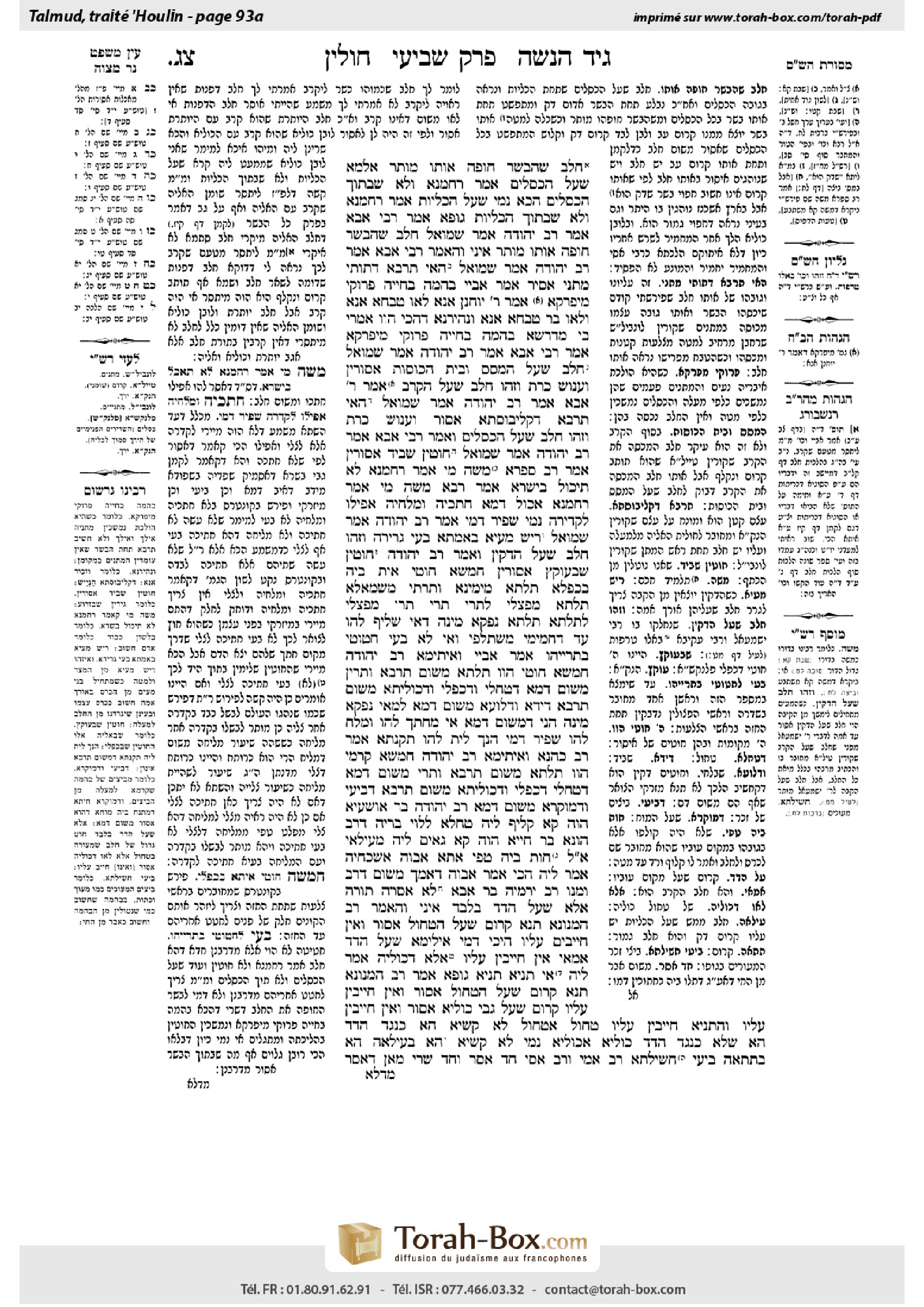
Chullin 93a: Talmud study for Daf Yomi
Study the Talmud for Daf Yomi with scanned pages, Hebrew text, English translations from Sefaria and AI-generated French translations.
Passage selection and English or AI-generated French translation are available where the scan has annotations. Daf Study is independent of Torah-Box and Sefaria.
Browse Chullin · חולין · All tractatesChullin 93a text and translations
This page of Chullin includes the Aramaic text, an English translation and an AI-generated French translation, alongside the scan above.
חולין צ״ג א · Aramaic and Hebrew text
חֵלֶב שֶׁהַבָּשָׂר חוֹפֶה אוֹתוֹ מוּתָּר, אַלְמָא שֶׁעַל הַכְּסָלִים אָמַר רַחֲמָנָא וְלֹא שֶׁבְּתוֹךְ הַכְּסָלִים, הָכָא נָמֵי שֶׁעַל הַכְּלָיוֹת אָמַר רַחֲמָנָא וְלֹא שֶׁבְּתוֹךְ הַכְּלָיוֹת.
גּוּפָא, אָמַר רַבִּי אַבָּא אָמַר רַב יְהוּדָה אָמַר שְׁמוּאֵל: חֵלֶב שֶׁהַבָּשָׂר חוֹפֶה אוֹתוֹ – מוּתָּר. אִינִי? וְהָאָמַר רַבִּי אַבָּא אָמַר רַב יְהוּדָה אָמַר שְׁמוּאֵל: הַאי תַּרְבָּא דְּתוּתֵי מָתְנֵי – אֲסִיר!
אָמַר אַבָּיֵי: בְּהֵמָה בְּחַיֶּיהָ פָּרוֹקֵי מִיפַּרְקָא. אָמַר רַבִּי יוֹחָנָן: אֲנָא לָאו טַבָּחָא אֲנָא וְלָאו בַּר טַבָּחָא אֲנָא, וּנְהִירְנָא דְּהָכִי הֲווֹ אָמְרִי בֵּי מִדְרְשָׁא: בְּהֵמָה בְּחַיֶּיהָ פָּרוֹקֵי מִיפַּרְקָא.
אָמַר רַבִּי אַבָּא, אָמַר רַב יְהוּדָה, אָמַר שְׁמוּאֵל: חֵלֶב שֶׁעַל הֶמְסֵס וּבֵית הַכּוֹסוֹת (אסורין) [אָסוּר], וְעָנוּשׁ כָּרֵת, וְזֶהוּ חֵלֶב שֶׁעַל הַקֶּרֶב. אָמַר רַבִּי אַבָּא, אָמַר רַב יְהוּדָה, אָמַר שְׁמוּאֵל: הַאי תַּרְבָּא דִּקְלִיבוּסְתָּא אָסוּר, וְעָנוּשׁ כָּרֵת, וְזֶהוּ חֵלֶב שֶׁעַל הַכְּסָלִים.
וְאָמַר רַבִּי אַבָּא, אָמַר רַב יְהוּדָה, אָמַר שְׁמוּאֵל: חוּטִין שֶׁבַּיָּד אֲסוּרִין. אָמַר רַב סָפְרָא: מֹשֶׁה, מִי אָמַר רַחֲמָנָא ״לָא תֵּיכוֹל בִּישְׂרָא״? אָמַר רָבָא: מֹשֶׁה, מִי אָמַר רַחֲמָנָא ״אֲכוֹל דְּמָא״? חַתְכֵיהּ וּמַלְחֵיהּ, אֲפִילּוּ לִקְדֵירָה נָמֵי שַׁפִּיר דָּמֵי.
אָמַר רַב יְהוּדָה, אָמַר שְׁמוּאֵל: רֵישׁ מְעַיָּא בְּאַמְּתָא בָּעֵי גְּרִירָה, וְזֶהוּ חֵלֶב שֶׁעַל הַדַּקִּין.
וְאָמַר רַב יְהוּדָה: חוּטִין שֶׁבָּעוֹקֶץ אֲסוּרִין. חַמְשָׁא חוּטֵי אִית בֵּיהּ בְּכַפְלָא, תְּלָתָא מִיַּמִּינָא וְתַרְתֵּי מִשְּׂמָאלָא. תְּלָתָא מִפַּצְלִי לִתְרֵי תְּרֵי, תְּרֵי מִפַּצְלִי לִתְלָתָא תְּלָתָא. נָפְקָא מִינַּהּ, דְּאִי שָׁלֵיף לְהוּ עַד דְּחַמִּימֵי – מִשְׁתַּלְּפִי, וְאִי לָא – בָּעֵי חַטּוֹטֵי בָּתְרַיְיהוּ.
אָמַר אַבָּיֵי, וְאִיתֵּימָא רַב יְהוּדָה: חַמְשָׁא חוּטֵי הָווּ, תְּלָתָא מִשּׁוּם תַּרְבָּא, וּתְרֵין מִשּׁוּם דְּמָא. דִּטְחָלֵי וּדְכַפְלֵי וּדְכוּלְיָתָא – מִשּׁוּם תַּרְבָּא, דִּידָא וּדְלוֹעָא – מִשּׁוּם דְּמָא.
לְמַאי נָפְקָא מִינַּהּ – הָנֵי דְּמִשּׁוּם דְּמָא, אִי מְחַתֵּךְ לְהוּ וּמָלַח לְהוּ – שַׁפִּיר דָּמֵי, הָנָךְ – לֵית לְהוּ תַּקַּנְתָּא.
אָמַר רַב כָּהֲנָא, וְאִיתֵּימָא רַב יְהוּדָה: חַמְשָׁא קְרָמֵי הָווּ, תְּלָתָא מִשּׁוּם תַּרְבָּא, וּתְרֵי מִשּׁוּם דְּמָא. דִּטְחָלֵי דְּכַפְלֵי וּדְכוּלְיָתָא מִשּׁוּם תַּרְבָּא, דְּבֵיעֵי וּדְמוֹקְרָא מִשּׁוּם דְּמָא.
רַב יְהוּדָה בַּר אוֹשַׁעְיָא הֲוָה קָא קָלֵיף לֵיהּ טְחָלָא לְלֵוִי בְּרֵיהּ דְּרַב הוּנָא בַּר חִיָּיא, הֲוָה קָא גָאֵים לֵיהּ מֵעִילַּאי. אֲמַר לֵיהּ: חוֹת בֵּיהּ טְפֵי. אֲתָא אֲבוּהּ אַשְׁכְּחֵיהּ, אֲמַר לֵיהּ: הָכִי אָמַר אֲבוּהּ דְּאִמָּךְ מִשּׁוּם דְּרַב, וּמַנּוּ רַב יִרְמְיָה בַּר אַבָּא: לֹא אָסְרָה תּוֹרָה אֶלָּא שֶׁעַל הַדַּד בִּלְבָד.
אִינִי? וְהָאָמַר רַב הַמְנוּנָא: תָּנָא קְרוּם שֶׁעַל הַטְּחוֹל אָסוּר, וְאֵין חַיָּיבִים עָלָיו. הֵיכִי דָמֵי? אִילֵּימָא שֶׁעַל הַדַּד – אַמַּאי אֵין חַיָּיבִין עָלָיו? אֶלָּא דְּכוּלֵּיהּ. אֲמַר לֵיהּ: אִי תַּנְיָא – תַּנְיָא.
גּוּפָא, אָמַר רַב הַמְנוּנָא: תָּנָא, קְרוּם שֶׁעַל הַטְּחוֹל אָסוּר וְאֵין חַיָּיבִין עָלָיו, קְרוּם שֶׁעַל גַּבֵּי כּוּלְיָא אָסוּר וְאֵין חַיָּיבִין עָלָיו. וְהָתַנְיָא: חַיָּיבִין עָלָיו!
טְחוֹל אַטְּחוֹל לָא קַשְׁיָא: הָא כְּנֶגֶד הַדַּד, הָא שֶׁלֹּא כְּנֶגֶד הַדַּד.
כּוּלְיָא אַכּוּלְיָא נָמֵי לָא קַשְׁיָא: הָא בְּעִילָּאָה, הָא בְּתַתָּאָה.
בֵּיעֵי חֲשִׁילָתָא, רַב אַמֵּי וְרַב אַסִּי – חַד אָסַר וְחַד שָׁרֵי. מַאן דְּאָסַר,
Chullin 93a · English translation
The fat that is covered by the flesh is permitted. Apparently, when the Merciful One states in the Torah that the fat that is upon the loins is prohibited (see Leviticus 3:4), it is referring only to the fat above the loins but not the fat that is inside the loins. Here also, the Merciful One states in the Torah that the fat that is upon the kidneys is prohibited (see Leviticus 3:4), but this does not include the fat that is inside the kidneys.
§ The Gemara addresses the matter itself cited in the discussion above: Rabbi Abba said that Rav Yehuda said that Shmuel said: The fat that is covered by the flesh is permitted. The Gemara asks: Is that so? But didn’t Rabbi Abba say that Rav Yehuda said that Shmuel said: This fat that is under the loins is forbidden, even though it is covered by flesh?
The Gemara answers that Abaye said: When an animal is alive its limbs separate at the joints as it walks, so that the fat under the loins is not covered by flesh. Therefore, even after it has been slaughtered this fat is forbidden and does not have the status of fat that is covered by flesh. Rabbi Yoḥanan said: I am not a butcher and I am not the son of a butcher, i.e., I am not expert in the anatomy of animals, but I remember that this is what they would say in the study hall: When an animal is alive its limbs separate at the joints as it walks, so that the fat under the loins is exposed.
§ Rabbi Abba said that Rav Yehuda said that Shmuel said: The fat that is on the omasum and the reticulum is forbidden, and its consumption is punishable by karet. And this is the fat that is referred to in the Torah as being upon the innards (see Leviticus 3:3). Rabbi Abba said that Rav Yehuda said that Shmuel said: This fat of the coccygeal bone is forbidden, and its consumption is punishable by karet. And this is the fat that is referred to in the Torah as being upon the loins (see Leviticus 3:4).
And Rabbi Abba said that Rav Yehuda said that Shmuel said: The veins that are in the foreleg of an animal are forbidden. Rav Safra said to Rabbi Abba: Moses! Did the Merciful One say in the Torah: Do not eat meat? The veins of the foreleg are part of the meat and are not forbidden. Rava said: Moses! Did the Merciful One say in the Torah: Eat blood? The reason that these veins are forbidden is that they are filled with blood. Therefore, if one cuts the foreleg open and salts it to remove the blood, it is permitted even to cook it in a pot; and it is certainly permitted to roast it over a fire, which also draws out the blood.
Rav Yehuda said that Shmuel said: The fat on the top cubit of the small intestine requires scraping, i.e., it is forbidden and must be removed. And this is the fat referred to by the Sages (see 49b) as the fat that is on the small intestine.
And Rav Yehuda says: The sinews that are in the tailbone are forbidden for consumption, because they contain forbidden fat. There are five sinews in the tail: Three on the right and two on the left. The three on the right each split into two, and the two on the left each split into three. The practical difference, i.e., the reason the Gemara describes this in detail, is that if one draws them out while they are still warm soon after slaughter they are drawn out easily, but if not, he is required to scrape around them, i.e., dig into the flesh to remove them. It is important to know how many there are to ensure that one removes them all.
Abaye said, and some say that Rav Yehuda said: There are five strands that are forbidden for consumption; three of them are forbidden because they contain forbidden fat, and two are forbidden because they contain blood. The ligaments of the spleen and of the tail and of the kidneys are forbidden because they contain forbidden fat. And the veins of the foreleg and of the pharynx, i.e., the carotid artery, are forbidden because they contain blood.
The Gemara asks: What difference is there whether they are forbidden due to fat or due to blood? The Gemara answers: With regard to these veins and arteries that are forbidden because they contain blood, if one cuts them open and then salts them to remove the blood they are permitted. But those strands that contain forbidden fat have no rectification and can never be eaten.
Rav Kahana said, and some say that it was Rav Yehuda who said: There are five membranes that are forbidden for consumption; three of them are forbidden because they contain forbidden fat, and two are forbidden because they contain blood. The membranes of the spleen and of the tail and of the kidneys are forbidden because they contain forbidden fat. And the membranes of the testicles and of the brain are forbidden because they contain blood.
The Gemara relates that Rav Yehuda bar Oshaya was peeling the membranes from a spleen for Levi, son of Rav Huna bar Ḥiyya. He was cutting them only from the upper surface of the spleen. Levi said to Rav Yehuda: Go down further, i.e., remove the fat that is lower down as well. Levi’s father, Rav Huna bar Ḥiyya, came and found him as Levi was saying this to Rav Yehuda. Rav Huna bar Ḥiyya said to him: This is what your mother’s father said in the name of Rav; and who was Levi’s mother’s father? It was Rav Yirmeya bar Abba. He said: The Torah prohibits only the membranes that are on the thick, upper surface of the spleen.
Levi asked: Is that so? But didn’t Rav Hamnuna say that it was taught in a baraita that the membrane that is on the spleen is forbidden, but one is not liable to receive the punishment of karet for eating it? Levi clarifies: What are the circumstances referred to in the baraita? If we say that it is referring to the membranes that are on the thick, upper surface of the spleen, why is one not liable to the punishment of karet for eating it? Rather, it must be referring to the membranes on all sides of the spleen, even the underside. Rav Huna bar Ḥiyya said to his son, Levi: If this baraita is taught, it is taught, and I cannot take issue with it.
§ The Gemara returns to discuss the matter itself mentioned above: Rav Hamnuna said that it was taught in a baraita: The membrane that is on the spleen is forbidden, but one is not liable to receive karet for eating it. The membrane that is on the kidney is forbidden, but one is not liable to receive karet for eating it. The Gemara challenges this statement: But isn’t it taught in a baraita that one is liable to receive karet for eating the membrane on the spleen or the kidney?
The Gemara answers: The apparent contradiction between the baraita that states that one is not liable to receive karet for eating the membrane on the spleen and the baraita that states that one is liable to receive karet for eating the membrane on the spleen is not difficult: This baraita that states that one is liable is referring to the membrane on the thick, upper part of the spleen, whereas that baraita that states that one is not liable is referring to the membrane that is not on the thick part of the spleen.
Likewise, the apparent contradiction between the baraita that states that one is not liable to receive karet for eating the membrane on the kidney and the baraita that states that one is liable to receive karet for eating the membrane on the kidney is not difficult: This baraita that states that one is liable is referring to the membrane on the upper part of the kidney, whereas that baraita that states that one is not liable is referring to the membrane on the lower part of the kidney.
§ With regard to testicles that were crushed while the animal was alive but were still attached to their cords in the scrotum, there is a dispute between Rav Ami and Rav Asi. One of them prohibits eating the testicles after the animal is slaughtered and one of them permits eating them. The Gemara clarifies: The one who prohibits them holds that
Chullin 93a · Traduction française (IA)
Le gras qui est recouvert par la chair est permis. Apparemment, lorsque le Tout-Puissant indique dans la Torah que le gras qui est sur les reins est interdit (voir Lévitique 3:4), il s'agit uniquement du gras au-dessus des reins, mais pas du gras qui est à l'intérieur des reins. Ici aussi, le Tout-Puissant indique dans la Torah que le gras qui est sur les reins est interdit (voir Lévitique 3:4), mais cela ne comprend pas le gras qui est à l'intérieur des reins.
§ Le Guemara aborde la question elle-même évoquée dans la discussion précédente : Rabbi Abba a dit que Rav Yehuda a dit que Shmuel a dit : Le gras qui est recouvert par la chair est permis. Le Guemara demande : Est-ce ainsi ? Mais n'avait-il pas dit Rabbi Abba que Rav Yehuda a dit que Shmuel a dit : Ce gras qui est sous les reins est interdit, même s'il est recouvert par la chair ?
Le Guemara répond que Abaye a dit : Lorsqu'un animal est vivant, ses membres se séparent aux articulations lorsqu'il marche, de sorte que le gras sous les reins n'est pas recouvert par la chair. Par conséquent, même après avoir été sacrifié, ce gras est interdit et ne possède pas le statut de gras recouvert par la chair. Rabbi Yoḥanan a dit : Je ne suis pas boucher et je ne suis pas le fils d'un boucher, c'est-à-dire que je ne suis pas expert en anatomie animale, mais je me souviens que c'est ce que l'on disait dans la salle de étude : Lorsqu'un animal est vivant, ses membres se séparent aux articulations lorsqu'il marche, de sorte que le gras sous les reins est exposé.
§ Rabbi Abba a dit que Rav Yehuda a dit que Shmuel a dit : Le gras qui est sur l'omophage et le réseau est interdit, et sa consommation est punie par karet. Et c'est ce gras qui est mentionné dans la Torah comme étant sur les viscères (voir Lévitique 3:3). Rabbi Abba a dit que Rav Yehuda a dit que Shmuel a dit : Ce gras du os du coccyx est interdit, et sa consommation est punie par karet. Et c'est ce gras qui est mentionné dans la Torah comme étant sur les reins (voir Lévitique 3:4).
Et Rabbi Abba a dit que Rav Yehuda a dit que Shmuel a dit : Les veines qui sont dans la cuisse d'un animal sont interdites. Rav Safra a dit à Rabbi Abba : Moïse ! Le Tout-Puissant n'a-t-il pas dit dans la Torah : Ne mangez pas de viande ? Les veines de la cuisse font partie de la viande et ne sont pas interdites. Rava a dit : Moïse ! Le Tout-Puissant n'a-t-il pas dit dans la Torah : Mangez le sang ? La raison pour laquelle ces veines sont interdites est qu'elles sont pleines de sang. Par conséquent, si l'on ouvre la cuisse et qu'on la salit pour enlever le sang, elle est permise même pour la cuisson dans une marmite ; et elle est certainement permise pour la cuisson sur un feu, qui enlève aussi le sang.
Rav Yehuda a dit que Shmuel a dit : Le gras sur le premier cubit du petit intestin nécessite d'être graté, c'est-à-dire qu'il est interdit et doit être retiré. Et c'est ce gras mentionné par les Sages (voir 49b) comme étant sur le petit intestin.
Et Rav Yehuda dit : Les nerfs qui sont dans le coccyx sont interdits à la consommation, car ils contiennent du gras interdit. Il y a cinq nerfs dans le coccyx : trois à droite et deux à gauche. Les trois à droite se divisent chacun en deux, et les deux à gauche se divisent chacun en trois. La différence pratique, c'est-à-dire la raison pour laquelle le Guemara décrit cela en détail, est que si l'on les retire alors qu'ils sont encore chauds peu après la bataille, ils sont retirés facilement, mais si l'on ne le fait pas, on est tenu de gratter autour d'eux, c'est-à-dire de creuser dans la chair pour les enlever. Il est important de savoir combien il y en a pour s'assurer qu'on enlève tous.
Abaye a dit, et certains disent que Rav Yehuda a dit : Il y a cinq fils interdits à la consommation ; trois d'entre eux sont interdits car ils contiennent du gras interdit, et deux sont interdits car ils contiennent du sang. Les ligaments du foie, du coccyx et des reins sont interdits car ils contiennent du gras interdit. Et les veines de la cuisse et de la gorge, c'est-à-dire l'artère carotidienne, sont interdites car elles contiennent du sang.
Le Guemara demande : Quelle différence y a-t-il entre le fait qu'ils soient interdits en raison du gras ou en raison du sang ? Le Guemara répond : En ce qui concerne ces veines et artères interdites en raison du sang, si l'on ouvre les veines et qu'on les salit pour enlever le sang, elles sont permises. Mais ces fils qui contiennent du gras interdit n'ont pas de remède et ne peuvent jamais être mangés.
Rav Kahana a dit, et certains disent que c'était Rav Yehuda qui a dit : Il y a cinq membranes interdites à la consommation ; trois d'entre elles sont interdites car elles contiennent du gras interdit, et deux sont interdites car elles contiennent du sang. Les membranes du rein, du coccyx et des reins sont interdites car elles contiennent du gras interdit. Et les membranes des testicules et du cerveau sont interdites car elles contiennent du sang.
Le Guemara rapporte que Rav Yehuda bar Oshaya retirait les membranes d'un rein pour Levi, fils de Rav Huna bar Ḥiyya. Il retirait les membranes uniquement de la surface supérieure du rein. Levi a dit à Rav Yehuda : Descendez plus loin, c'est-à-dire retirez aussi le gras qui est en dessous. Le père de Levi, Rav Huna bar Ḥiyya, est venu et l'a trouvé en train de dire cela à Rav Yehuda. Rav Huna bar Ḥiyya a dit à son fils, Levi : C'est ce que votre grand-père maternel a dit au nom de Rav ; et qui était le grand-père maternel de Levi ? C'était Rav Yirmeya bar Abba. Il a dit : La Torah interdit uniquement les membranes qui sont sur la surface épaisse supérieure du rein.
Levi a demandé : Est-ce ainsi ? Mais n'avait-il pas dit Rav Hamnuna que cela a été enseigné dans une baraïta que la membrane qui est sur le rein est interdite, mais on n'est pas puni de karet pour en manger ? Levi clarifie : Quelles sont les circonstances évoquées dans la baraïta ? Si nous disons qu'il s'agit des membranes qui sont sur la surface épaisse supérieure du rein, pourquoi n'est-on pas puni de karet pour en manger ? Plutôt, il doit s'agir des membranes sur tous les côtés du rein, même le dessous. Rav Huna bar Ḥiyya a dit à son fils, Levi : Si cette baraïta est enseignée, elle est enseignée, et je ne peux pas contester cela.
§ La Guemara reprend la discussion sur la question évoquée ci-dessus : Rav Hamnuna a dit qu'on avait appris dans une baraïta : La membrane qui est sur le rate est interdite, mais on n'est pas puni de karet pour en manger. La membrane qui est sur le rein est interdite, mais on n'est pas puni de karet pour en manger. La Guemara conteste cette déclaration : Mais n'est-ce pas enseigné dans une baraïta que l'on est puni de karet pour manger la membrane sur le rate ou sur le rein ?
La Guemara répond : La contradiction apparente entre la baraïta qui dit qu'on n'est pas puni de karet pour manger la membrane sur le rate et la baraïta qui dit qu'on est puni de karet pour manger la membrane sur le rate n'est pas difficile : cette baraïta qui dit qu'on est puni fait référence à la membrane sur la partie épaisse, supérieure du rate, tandis que celle qui dit qu'on n'est pas puni fait référence à la membrane qui n'est pas sur la partie épaisse du rate.
De même, la contradiction apparente entre la baraïta qui dit qu'on n'est pas puni de karet pour manger la membrane sur le rein et la baraïta qui dit qu'on est puni de karet pour manger la membrane sur le rein n'est pas difficile : cette baraïta qui dit qu'on est puni fait référence à la membrane sur la partie supérieure du rein, tandis que celle qui dit qu'on n'est pas puni fait référence à la membrane sur la partie inférieure du rein.
§ En ce qui concerne les testicules écrasés pendant que l'animal était vivant mais encore attachés à leurs cordons dans le scrotum, il y a un désaccord entre Rav Ami et Rav Asi. L'un d'eux interdit de manger les testicules après l'abattage de l'animal et l'autre permet de les manger. La Guemara précise : celui qui les interdit considère que
Traduction française générée par IA à partir de l’édition anglaise de Sefaria. Vérifie toujours un passage avec le texte source.
Text from Sefaria: William Davidson Edition - Vocalized Aramaic (unknown); William Davidson Edition - English (CC BY NC).