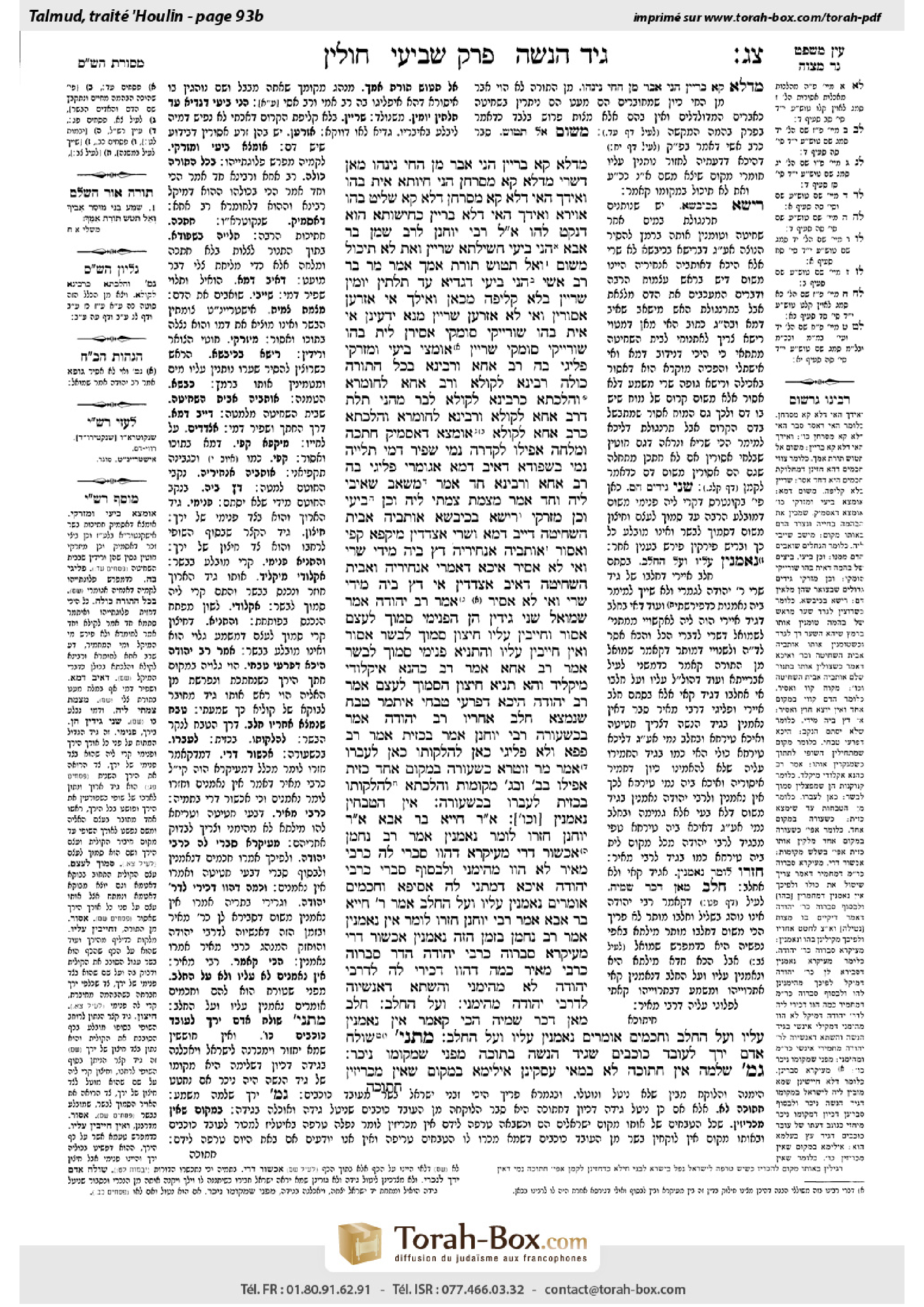
Chullin 93b: Talmud study for Daf Yomi
Study the Talmud for Daf Yomi with scanned pages, Hebrew text, English translations from Sefaria and AI-generated French translations.
Passage selection and English or AI-generated French translation are available where the scan has annotations. Daf Study is independent of Torah-Box and Sefaria.
Browse Chullin · חולין · All tractatesChullin 93b text and translations
This page of Chullin includes the Aramaic text, an English translation and an AI-generated French translation, alongside the scan above.
חולין צ״ג ב · Aramaic and Hebrew text
מִדְּלָא קָא בָרְיָין, הָנֵי אֵבֶר מִן הַחַי נִינְהוּ. מַאן דְּשָׁרֵי, מִדְּלָא קָא מַסְרְחָן, הָנֵי חִיּוּתָא אִית בְּהוּ.
וְאִידָּךְ, הַאי דְּלָא קָא מַסְרְחָן – דְּלָא קָא שָׁלֵיט בְּהוּ אַוֵּירָא, וְאִידָּךְ – הַאי דְּלָא בָּרְיָין, כְּחִישׁוּתָא הוּא דִּנְקַט לְהוּ.
אֲמַר לֵיהּ רַבִּי יוֹחָנָן לְרַב שֶׁמֶן בַּר אַבָּא: הָנֵי בֵּיעֵי חֲשִׁילָתָא שַׁרְיָין, וְאַתְּ לָא תֵּיכוֹל מִשּׁוּם ״וְאַל תִּטֹּשׁ תּוֹרַת אִמֶּךָ״.
אָמַר מָר בַּר רַב אָשֵׁי: הָנֵי בֵּיעֵי דְּגַדְיָא, עַד תְּלָתִין יוֹמִין שַׁרְיָין בְּלָא קְלִיפָה, מִכָּאן וְאֵילָךְ – אִי אזַרְעָן אֲסוּרִין, וְאִי לָא אזַרְעָן שַׁרְיָין. מְנָא יָדְעִינַן? אִי אִית בְּהוּ שׁוּרְיָיקֵי סוּמָּקֵי – אֲסִירָן, לֵית בְּהוּ שׁוּרְיָיקֵי סוּמָּקֵי – שַׁרְיָין.
אוּמְצֵי בֵּיעֵי וּמְזִירְקֵי, פְּלִיגִי בַּהּ רַב אַחָא וְרָבִינָא. בְּכׇל הַתּוֹרָה כּוּלָּהּ, רָבִינָא לְקוּלָּא וְרַב אַחָא לְחוּמְרָא, וְהִלְכְתָא כְּרָבִינָא לְקוּלָּא, לְבַר מֵהָנֵי תְּלָת דְּרַב אַחָא לְקוּלָּא וְרָבִינָא לְחוּמְרָא, וְהִלְכְתָא כְּרַב אַחָא לְקוּלָּא.
אוּמְצָא דְּאַסְמֵיק, חַתְכַהּ וּמַלְחַהּ – אֲפִילּוּ לִקְדֵרָה נָמֵי שַׁפִּיר דָּמֵי. תַּלְיַיהּ נָמֵי בְּשַׁפּוּדָא, דָּאֵיב דְּמָא. אַגּוּמְרֵי – פְּלִיגִי בַּהּ רַב אַחָא וְרָבִינָא: חַד אָמַר: מִשְׁאָב שָׁאיְבִי לֵיהּ, וְחַד אָמַר: מִצְמָת צָמְתִי לֵיהּ. וְכֵן בֵּיעֵי, וְכֵן מְזִירְקֵי.
רֵישָׁא בְּכִיבְשָׁא, אוֹתְבֵיהּ אַבֵּית הַשְּׁחִיטָה – דָּיֵיב דְּמָא וּשְׁרֵי. אַצְּדָדִין – מִיקְפָּא קָפֵי וַאֲסִיר. אוֹתְבֵיהּ אַנְּחִירֵיהּ, דָּץ בֵּיהּ מִידֵּי – שְׁרֵי, וְאִי לָא – אֲסִיר.
אִיכָּא דְּאָמְרִי: אַנְּחִירֵיהּ וְאַבֵּית הַשְּׁחִיטָה – דָּאֵיב, אַצְּדָדִין – אִי דָּץ בֵּיהּ מִידֵּי – שְׁרֵי, וְאִי לָא – אֲסִיר.
אָמַר רַב יְהוּדָה אָמַר שְׁמוּאֵל, שְׁנֵי גִּידִין הֵן: הַפְּנִימִי סָמוּךְ לָעֶצֶם – אָסוּר, וְחַיָּיבִין עָלָיו; חִיצוֹן סָמוּךְ לַבָּשָׂר – אָסוּר, וְאֵין חַיָּיבִין עָלָיו.
וְהָתַנְיָא: פְּנִימִי סָמוּךְ לַבָּשָׂר! אָמַר רַב אַחָא אָמַר רַב כָּהֲנָא: אִיקְּלוֹדֵי מִיקְּלִיד.
וְהָא תַּנְיָא: חִיצוֹן הַסָּמוּךְ לָעֶצֶם! אָמַר רַב יְהוּדָה: הֵיכָא דְּפָרְעִי טַבָּחֵי.
אִיתְּמַר: טַבָּח שֶׁנִּמְצָא חֵלֶב אַחֲרָיו, רַב יְהוּדָה אָמַר: בְּכִשְׂעוֹרָה, רַבִּי יוֹחָנָן אָמַר: בִּכְזַיִת.
אָמַר רַב פָּפָּא: וְלָא פְּלִיגִי, כָּאן – לְהַלְקוֹתוֹ, כָּאן – לְעַבְּרוֹ.
אָמַר מָר זוּטְרָא: כִּשְׂעוֹרָה בְּמָקוֹם אֶחָד, כְּזַיִת – אֲפִילּוּ בִּשְׁנַיִם וּבִשְׁלֹשָׁה מְקוֹמוֹת. וְהִלְכְתָא: לְהַלְקוֹתוֹ – בִּכְזַיִת, לְעַבְּרוֹ – בְּכִשְׂעוֹרָה.
אֵין הַטַּבָּחִין נֶאֱמָנִין [וְכוּ׳]. אָמַר רַבִּי חִיָּיא בַּר אַבָּא אָמַר רַבִּי יוֹחָנָן: חָזְרוּ לוֹמַר נֶאֱמָנִין.
אָמַר רַב נַחְמָן: אִכַּשּׁוּר דָּרֵי? מֵעִיקָּרָא דַּהֲווֹ סָבְרִי לַהּ כְּרַבִּי מֵאִיר – לָא הֲווֹ מְהֵימְנִי, וּלְבַסּוֹף סָבְרִי כְּרַבִּי יְהוּדָה.
אִיכָּא דְּמַתְנֵי לַהּ אַסֵּיפָא, וַחֲכָמִים אוֹמְרִים: נֶאֱמָנִין עָלָיו וְעַל הַחֵלֶב. אָמַר רַבִּי חִיָּיא בַּר אַבָּא אָמַר רַבִּי יוֹחָנָן: חָזְרוּ לוֹמַר אֵין נֶאֱמָנִין. אָמַר רַב נַחְמָן: בִּזְמַן הַזֶּה נֶאֱמָנִין.
אִכַּשּׁוּר דָּרֵי? מֵעִיקָּרָא סַבְרוּהָ כְּרַבִּי יְהוּדָה, הֲדַר סַבְרוּהָ כְּרַבִּי מֵאִיר.
כַּמָּה דַּהֲווֹ דְּכִירִי לַהּ לִדְרַבִּי יְהוּדָה – לָא מְהֵימְנֵי, וְהַשְׁתָּא דְּאִנַּשְׁיוּהָ לִדְרַבִּי יְהוּדָה – מְהֵימְנֵי.
וְעַל הַחֵלֶב – חֵלֶב, מַאן דְּכַר שְׁמֵיהּ? הָכִי קָאָמַר: אֵין נֶאֱמָנִין עָלָיו וְעַל הַחֵלֶב, וַחֲכָמִים אוֹמְרִים: נֶאֱמָנִין עָלָיו וְעַל הַחֵלֶב.
מַתְנִי׳ שׁוֹלֵחַ אָדָם יָרֵךְ לְגוֹי שֶׁגִּיד הַנָּשֶׁה בְּתוֹכָהּ, מִפְּנֵי שֶׁמְּקוֹמוֹ נִיכָּר.
גְּמָ׳ שְׁלֵמָה – אִין, חֲתוּכָה – לָא. בְּמַאי עָסְקִינַן? אִילֵימָא בִּמְקוֹם שֶׁאֵין מַכְרִיזִין,
Chullin 93b · English translation
since these testicles do not heal, they are considered a limb severed from a living animal even though they are still attached to the animal. Consequently, they are forbidden even after the animal is slaughtered. And the one who permits eating crushed testicles holds that since they do not rot, there is vitality in them, and they are not considered to have been detached from the animal.
And the other opinion, which holds that crushed testicles are forbidden, holds that the reason the testicles do not rot is not because they have vitality but rather because air does not penetrate the scrotum, and it is contact with air that would cause them to rot. And the other opinion, which holds that crushed testicles are permitted, holds that the fact that they do not heal is because they have been struck with weakness, but not because they are entirely devoid of vitality. Consequently, they should not be considered detached from the body.
Rabbi Yoḥanan said to Rav Shemen bar Abba: These crushed testicles are permitted for consumption, but you should not eat them due to the dictum: “And do not forsake the Torah of your mother” (Proverbs 1:8). Since Rav Shemen bar Abba was from Babylonia, where it was customary to be stringent, it was prohibited for him to eat crushed testicles even when he was in Eretz Yisrael.
§ The Gemara cites other halakhot related to testicles. Mar bar Rav Ashi said: With regard to these testicles of goats, from the time the goat is born until the goat is thirty days old, its testicles are permitted without peeling off the membrane that encloses them, because they are presumed not to contain blood. From this point forward, if they contain semen they are forbidden, but if they do not contain semen they are permitted. The Gemara asks: How can we know whether or not they contain semen? The Gemara answers: If they have red streaks in them they are forbidden. If they do not have red streaks in them they are permitted.
The Gemara quotes a related discussion pertaining to three cases: With regard to raw meat that is eaten without being salted, testicles of an animal, and the large veins of the neck, Rav Aḥa and Ravina disagree about the halakha. The Gemara points out: In all of their disputes with regard to other realms of the Torah where it is not clear which of them holds which opinion, the opinion of Ravina is lenient, and the opinion of Rav Aḥa is stringent, and the halakha is in accordance with the opinion of Ravina to be lenient. This applies to all their disputes except for these three, in which Rav Aḥa is lenient and Ravina is stringent, and the halakha is in accordance with the opinion of Rav Aḥa to be lenient.
The Gemara explains: With regard to raw meat that became red from the blood inside it, if one cut it and salted it, it is permitted even to cook it in a pot, because the salt removes blood from meat. It is also permitted if one hung it on a spit in order to roast it, because the blood is drawn out by the heat of the fire. With regard to a case where one placed it on coals, Rav Aḥa and Ravina disagree about the halakha: One says that the coals draw out the blood from the meat, and one says that the coals cause the meat to shrivel and harden, trapping the blood inside. And similarly Ravina and Rav Aḥa disagree with regard to testicles placed on coals, and similarly with regard to the large veins of the neck that were placed on coals.
§ Apropos raw meat placed on coals, the Gemara discusses a related topic. In a case where one wants to remove the hair from the head of an animal by placing it in hot ashes, if one placed it with the neck down so that the location of the slaughter is in the ashes, the blood is drawn out by the heat and the meat is permitted. But if one placed the head in the ashes on one of its sides, the blood congeals inside the head and cannot flow out, and therefore the head is forbidden for consumption. In a case where one placed the head down on its nostrils, if he inserted something into the nostrils to keep them open and allow the blood to flow out, the meat is permitted, but if he did not do so it is forbidden.
There are those who say: If the head was placed on its nostrils or on the location of the slaughter, the blood is drawn out and the meat is permitted. If he placed it on one of its sides, then if he inserted something into it in order to allow the blood to flow out, it is permitted, and if not it is forbidden.
§ The Gemara returns to the prohibition of eating the sciatic nerve. Rav Yehuda says that Shmuel says: There are two nerves included in the prohibition of the sciatic nerve. The inner nerve, which is next to the bone, is forbidden by Torah law, and one is liable to be flogged for eating it. The outer nerve, which is next to the flesh, is forbidden by rabbinic law, and therefore one is not liable to be flogged for eating it.
The Gemara asks: But isn’t it taught in a baraita that the inner nerve, which is forbidden by Torah law, is next to the flesh? The Gemara answers: Rav Aḥa said that Rav Kahana said: The inner nerve is next to the bone, but it bores into the flesh as well.
The Gemara challenges: But isn’t it taught in a baraita: The outer nerve is next to the bone? The Gemara answers: Rav Yehuda said: This is referring to the spot where the butchers cut the leg open and reveal the nerve, and at that point in the leg the outer nerve is closest to the bone.
§ It was stated: With regard to a butcher who removed the forbidden fats of the animal, and yet forbidden fat was found after he completed his work, Rav Yehuda says that the butcher is held liable if there is forbidden fat remaining that is the size of a barley grain. Rabbi Yoḥanan says that the butcher is held liable only if there is forbidden fat remaining that is the size of an olive-bulk.
Rav Pappa said: Rav Yehuda and Rabbi Yoḥanan are referring to two different levels of liability, and they do not disagree. Here, when Rabbi Yoḥanan said he is liable only if there is an olive-bulk of forbidden fat remaining, he was referring to flogging him. There, when Rav Yehuda said he is liable even if he leaves forbidden fat the size of a barley grain, he was referring to removing him from his position as a butcher.
Mar Zutra said an alternative explanation: If the butcher left forbidden fat the size of a barley grain in one place he is liable, and if he left forbidden fat the size of an olive-bulk, he is liable even if it is spread out in two or three places. The Gemara concludes: And the halakha is that with regard to flogging him, the butcher is liable only if he left forbidden fat the size of an olive-bulk. With regard to removing him, the butcher is liable even if he left forbidden fat the size of a barley grain.
§ The mishna stated (89b): Butchers are not deemed credible to say that the sciatic nerve was removed; this is the statement of Rabbi Meir. And the Rabbis say: They are deemed credible about the sciatic nerve. Rabbi Ḥiyya bar Abba says that Rabbi Yoḥanan says: The Rabbis initially held that butchers are not deemed credible about the sciatic nerve, and subsequently they retracted and said that butchers are deemed credible in this regard.
Rav Naḥman said to him: Have the later generations improved such that butchers are more reliable than they were in earlier generations? The Gemara answers: Initially, when the Rabbis held in accordance with the opinion of Rabbi Meir that one must scrape around the flesh in order to remove the roots of the sciatic nerve, butchers were not deemed credible, due to the exertion involved in this process. But later the Rabbis held in accordance with the opinion of Rabbi Yehuda that it is unnecessary to scrape around the flesh. Consequently, removing the sciatic nerve is not especially arduous, and butchers are deemed credible to say that they removed it.
There are those who teach this discussion with regard to the latter clause of the mishna, as follows: And the Rabbis say: They are deemed credible about the sciatic nerve and about the forbidden fat. Rabbi Ḥiyya bar Abba said that Rabbi Yoḥanan said: They subsequently retracted this opinion and said that butchers are not deemed credible. Rav Naḥman says: Today the butchers are deemed credible.
The Gemara asks: Have the later generations improved such that butchers are more reliable than they were in earlier generations? The Gemara answers: Initially they held that the halakha is in accordance with the opinion of Rabbi Yehuda that one is not required to scrape around the flesh to remove the roots of the sciatic nerve, and therefore butchers were deemed credible to say that they removed it. The Rabbis then reversed their opinion and held that the halakha is in accordance with the opinion of Rabbi Meir that one is required to scrape around the flesh.
As long as the butchers remembered the opinion of Rabbi Yehuda and did not scrape around the flesh to remove the roots of the sciatic nerve, they were not deemed credible to say that they removed it; but now that they have forgotten the opinion of Rabbi Yehuda and have grown accustomed to scraping around the flesh to remove the roots of the sciatic nerve, they are deemed credible.
§ The mishna teaches that the Rabbis maintain that butchers are deemed credible about the sciatic nerve and about the forbidden fat. The Gemara asks: Who mentioned anything about forbidden fat? The topic of discussion in the mishna until this point is the sciatic nerve, not forbidden fat; why do the Rabbis mention forbidden fat? The Gemara answers: This is what the mishna is saying: The butchers are not deemed credible about the sciatic nerve or about the forbidden fat; this is the statement of Rabbi Meir. But the Rabbis say: The butchers are deemed credible about the sciatic nerve and about the forbidden fat.
MISHNA: Although it is prohibited for Jews to eat the sciatic nerve, a Jewish person may send the thigh of an animal to a gentile with the sciatic nerve in it, without concern that the gentile will then sell the thigh to a Jew and the Jew will eat the sciatic nerve. This leniency is due to the fact that the place of the sciatic nerve is conspicuous in the thigh.
GEMARA: The mishna’s statement that a Jew may send a thigh to a gentile indicates that if it is whole, yes, a Jew may send it to a gentile, but if the thigh has been cut, a Jew may not send it to a gentile. The Gemara asks: What are we dealing with? If we say that the mishna is referring to a place where all the butchers are Jewish but they do not announce publicly when they have sold to a gentile an animal that turns out to have a wound that will cause it to die within twelve months [tereifa], then it is prohibited for Jews to purchase any meat from gentiles, due to the possibility that it was from an animal that was a tereifa.
Chullin 93b · Traduction française (IA)
puisque ces testicules ne guérissent pas, ils sont considérés comme un membre détaché d'un animal vivant, même s'ils sont encore attachés à l'animal. Par conséquent, ils sont interdits même après que l'animal ait été sacrifié. Et celui qui permet de manger des testicules écrasés affirme que puisque ces testicules ne pourrissent pas, ils contiennent de la vitalité, et ils ne sont pas considérés comme détachés de l'animal.
Et l'autre opinion, celle qui affirme que les testicules écrasés sont interdits, affirme que la raison pour laquelle les testicules ne pourrissent pas n'est pas parce qu'ils contiennent de la vitalité, mais plutôt parce que l'air ne pénètre pas dans le scrotum, et c'est le contact avec l'air qui provoquerait leur pourriture. Et l'autre opinion, celle qui affirme que les testicules écrasés sont permis, affirme que le fait qu'ils ne guérissent pas est dû à ce qu'ils ont été frappés par la faiblesse, mais pas parce qu'ils sont entièrement dépourvus de vitalité. Par conséquent, ils ne devraient pas être considérés comme détachés du corps.
Rabbi Yoḥanan dit à Rav Shemen bar Abba : Ces testicules écrasés sont permis à la consommation, mais vous ne devriez pas en manger en raison de la déclaration : « Et ne négligez pas la Torah de votre mère » (Proverbes 1:8). Puisque Rav Shemen bar Abba était de Babylone, où il était coutume d'être strict, il était interdit pour lui de manger des testicules écrasés même lorsqu'il était en Terre d'Israël.
§ Le Guemara cite d'autres halakhot concernant les testicules. Mar bar Rav Ashi dit : Concernant ces testicules de boucs, du moment où le bouc est né jusqu'au moment où il a trente jours, ses testicules sont permis sans ôter la membrane qui les entoure, car on suppose qu'ils ne contiennent pas de sang. À partir de ce moment, si ils contiennent du sperme, ils sont interdits, mais s'ils n'en contiennent pas, ils sont permis. Le Guemara demande : Comment peut-on savoir si ils contiennent ou non du sperme ? Le Guemara répond : Si ils ont des taches rouges, ils sont interdits. Si ils n'ont pas de taches rouges, ils sont permis.
Le Guemara cite une discussion liée concernant trois cas : concernant la viande crue qui est mangée sans être salée, les testicules d'un animal, et les grandes veines du cou, Rav Aḥa et Ravina divergent sur la halakha. Le Guemara souligne : Dans tous leurs désaccords concernant d'autres domaines de la Torah où il n'est pas clair qui adopte quel avis, l'avis de Ravina est leniant, et celui de Rav Aḥa est strict, et la halakha suit l'avis de Ravina pour être leniant. Cela s'applique à tous leurs désaccords sauf ces trois, dans lesquels Rav Aḥa est leniant et Ravina est strict, et la halakha suit l'avis de Rav Aḥa pour être leniant.
Le Guemara explique : Concernant la viande crue qui est devenue rouge à cause du sang à l'intérieur, si l'on la coupe et qu'on la sale, elle est permise même à cuire dans une marmite, car le sel élimine le sang de la viande. Elle est également permise si l'on accroche la viande à un brochet, car le sang est évacué par la chaleur du feu. Concernant le cas où l'on place la viande sur des braises, Rav Aḥa et Ravina divergent sur la halakha : l'un affirme que les braises éliminent le sang de la viande, et l'autre affirme que les braises font sécher et durcir la viande, laissant le sang à l'intérieur. De même, Ravina et Rav Aḥa divergent concernant les testicules placés sur des braises, ainsi qu'avec les grandes veines du cou placées sur des braises.
§ A propos de la viande crue placée sur des braises, le Guemara discute d'un sujet lié. Dans le cas où l'on veut retirer la fourrure de la tête d'un animal en le plaçant dans des cendres chaudes, si l'on place la tête avec le cou en bas de sorte que le lieu de la boucherie soit dans les cendres, le sang est évacué par la chaleur et la viande est permise. Mais si l'on place la tête dans les cendres sur l'un de ses côtés, le sang coagule à l'intérieur de la tête et ne peut pas s'écouler, et par conséquent la tête est interdite à la consommation. Dans le cas où l'on place la tête en bas sur ses narines, si l'on insère quelque chose dans les narines pour les maintenir ouvertes et permettre au sang d'écouler, la viande est permise, mais si l'on n'y a pas fait, elle est interdite.
Il y a ceux qui disent : Si la tête a été placée sur ses narines ou sur le lieu de la boucherie, le sang est évacué et la viande est permise. Si l'on a placé la tête sur l'un de ses côtés, alors si l'on a inséré quelque chose pour permettre au sang d'écouler, elle est permise, et si l'on n'a pas fait cela, elle est interdite.
§ Le Guemara reprend l'interdiction de manger le nerf sciatique. Rav Yehuda dit que Shmuel dit : Il y a deux nerfs inclus dans l'interdiction du nerf sciatique. Le nerf interne, qui est adjacent à l'os, est interdit par la loi divine, et celui qui en mange est puni de flagellation. Le nerf externe, qui est adjacent à la chair, est interdit par la loi rabbinique, et par conséquent celui qui en mange n'est pas puni de flagellation.
Le Guemara demande : Mais n'est-ce pas enseigné dans une baraïta que le nerf interne, qui est interdit par la loi divine, est adjacent à la chair ? Le Guemara répond : Rav Aḥa dit que Rav Kahana dit : Le nerf interne est adjacent à l'os, mais il pénètre également dans la chair.
Le Guemara conteste : Mais n'est-ce pas enseigné dans une baraïta : Le nerf externe est adjacent à l'os ? Le Guemara répond : Rav Yehuda dit : Cela fait référence au point où les bouchers coupent la jambe et révèlent le nerf, et à ce point de la jambe, le nerf externe est le plus proche de l'os.
§ Il a été dit : Concernant un boucher qui a retiré les graisses interdites de l'animal, et pourtant on a trouvé de la graisse interdite après qu'il a terminé son travail, Rav Yehuda dit que le boucher est tenu responsable si une graisse interdite reste de la taille d'une graine de blé. Rabbi Yoḥanan dit que le boucher est tenu responsable uniquement si une graisse interdite reste de la taille d'une olivette.
Rav Pappa a dit : Rav Yéhuda et le maître Yochanan parlent de deux niveaux différents de responsabilité, et ils ne s'entendent pas. Ici, lorsque le maître Yochanan a dit qu'il est responsable uniquement s'il reste une quantité d'huile interdite égale à une olive, il parlait de le battre. Là, lorsque Rav Yéhuda a dit qu'il est responsable même s'il laisse une quantité d'huile interdite égale à un grain de blé, il parlait de le destituer de son poste de boucher.
Mar Zutra a dit une autre explication : Si le boucher a laissé une quantité d'huile interdite égale à un grain de blé dans un endroit, il est responsable, et si il a laissé une quantité d'huile interdite égale à une olive, il est responsable même si elle est répartie dans deux ou trois endroits. La Guemara conclut : Et la halakha est que, concernant la flagellation, le boucher est responsable uniquement s'il a laissé une quantité d'huile interdite égale à une olive. Concernant la destitution, le boucher est responsable même s'il a laissé une quantité d'huile interdite égale à un grain de blé.
§ La mitsva a dit (89b) : Les bouchers ne sont pas considérés comme fiables pour dire que le nerf sciatique a été retiré ; c'est l'opinion du maître Méir. Et les Rabbins disent : Ils sont considérés comme fiables concernant le nerf sciatique. Le maître Hiyaa bar Abba dit que le maître Yochanan dit : Les Rabbins ont d'abord pensé que les bouchers ne sont pas considérés comme fiables concernant le nerf sciatique, puis ils ont rétracté et dit que les bouchers sont considérés comme fiables à cet égard.
Rav Naḥman a dit à lui : Les générations ultérieures ont-elles amélioré tellement que les bouchers sont plus fiables qu'ils ne l'étaient dans les générations précédentes ? La Guemara répond : Au début, lorsque les Rabbins suivaient l'opinion du maître Méir qui exigeait de gratter autour de la viande pour retirer les racines du nerf sciatique, les bouchers n'étaient pas considérés comme fiables, en raison de l'effort requis pour cette procédure. Mais plus tard, les Rabbins suivaient l'opinion du maître Yéhuda qui disait qu'il n'était pas nécessaire de gratter autour de la viande. Par conséquent, le retrait du nerf sciatique n'est pas particulièrement ardu, et les bouchers sont considérés comme fiables pour dire qu'ils l'ont retiré.
Certains enseignent cette discussion concernant la seconde partie de la mitsna, comme suit : Et les Rabbins disent : Ils sont considérés comme fiables concernant le nerf sciatique et concernant la graisse interdite. Le maître Hiyaa bar Abba a dit que le maître Yochanan a dit : Ils ont rétracté cette opinion et ont dit que les bouchers ne sont pas considérés comme fiables. Rav Naḥman dit : Aujourd'hui les bouchers sont considérés comme fiables.
La Guemara demande : Les générations ultérieures ont-elles amélioré tellement que les bouchers sont plus fiables qu'ils ne l'étaient dans les générations précédentes ? La Guemara répond : Au début, ils pensaient que la halakha suit l'opinion du maître Yéhuda qui disait qu'il n'était pas nécessaire de gratter autour de la viande pour retirer les racines du nerf sciatique, et par conséquent les bouchers étaient considérés comme fiables pour dire qu'ils l'avaient retiré. Les Rabbins ont ensuite changé d'opinion et ont pensé que la halakha suit l'opinion du maître Méir qui exigeait de gratter autour de la viande.
Tant que les bouchers se souvenaient de l'opinion du maître Yéhuda et ne grattaient pas autour de la viande pour retirer les racines du nerf sciatique, ils n'étaient pas considérés comme fiables pour affirmer qu'ils l'avaient retiré ; mais maintenant qu'ils ont oublié l'opinion du maître Yéhuda et sont habitués à gratter autour de la viande pour retirer les racines du nerf sciatique, ils sont considérés comme fiables.
§ La mitsva enseigne que les Rabbins maintiennent que les bouchers sont considérés comme fiables concernant le nerf sciatique et concernant l'huile interdite. La Guemara demande : Qui a mentionné l'huile interdite ? Le sujet de la discussion dans la mitsva jusqu'à présent est le nerf sciatique, pas l'huile interdite ; pourquoi les Rabbins mentionnent-ils l'huile interdite ? La Guemara répond : C'est ce que la mitsva dit : Les bouchers ne sont pas considérés comme fiables concernant le nerf sciatique ou concernant l'huile interdite ; c'est l'opinion du maître Méir. Mais les Rabbins disent : Les bouchers sont considérés comme fiables concernant le nerf sciatique et concernant l'huile interdite.
MITSVA : Bien que ce soit interdit aux Juifs de manger le nerf sciatique, un Juif peut envoyer la cuisse d'un animal à un non-Juif avec le nerf sciatique dedans, sans craindre que le non-Juif vende alors la cuisse à un Juif et que ce dernier mange le nerf sciatique. Cette leniencé est due au fait que la place du nerf sciatique est visible dans la cuisse.
GUEMARA : La déclaration de la mitsva selon laquelle un Juif peut envoyer une cuisse à un non-Juif indique que si elle est entière, oui, un Juif peut l'envoyer à un non-Juif, mais si la cuisse a été coupée, un Juif ne peut pas l'envoyer à un non-Juif. La Guemara demande : De quoi sommes-nous en train de parler ? Si nous disons que la mitsva parle d'un lieu où tous les bouchers sont juifs mais ils ne déclarent pas publiquement quand ils ont vendu à un non-Juif un animal qui se révèle avoir une blessure qui le fera mourir en douze mois [tereifa], alors il est interdit aux Juifs d'acheter toute viande des non-Juifs, en raison de la possibilité qu'elle provienne d'un animal tereifa.
Traduction française générée par IA à partir de l’édition anglaise de Sefaria. Vérifie toujours un passage avec le texte source.
Text from Sefaria: William Davidson Edition - Vocalized Aramaic (unknown); William Davidson Edition - English (CC BY NC).