Eruvin 104b: Talmud study for Daf Yomi
Study the Talmud for Daf Yomi with scanned pages, Hebrew text, English translations from Sefaria and AI-generated French translations.
Passage selection and English or AI-generated French translation are available where the scan has annotations. Daf Study is independent of Torah-Box and Sefaria.
Browse Eruvin · עירובין · All tractatesEruvin 104b text and translations
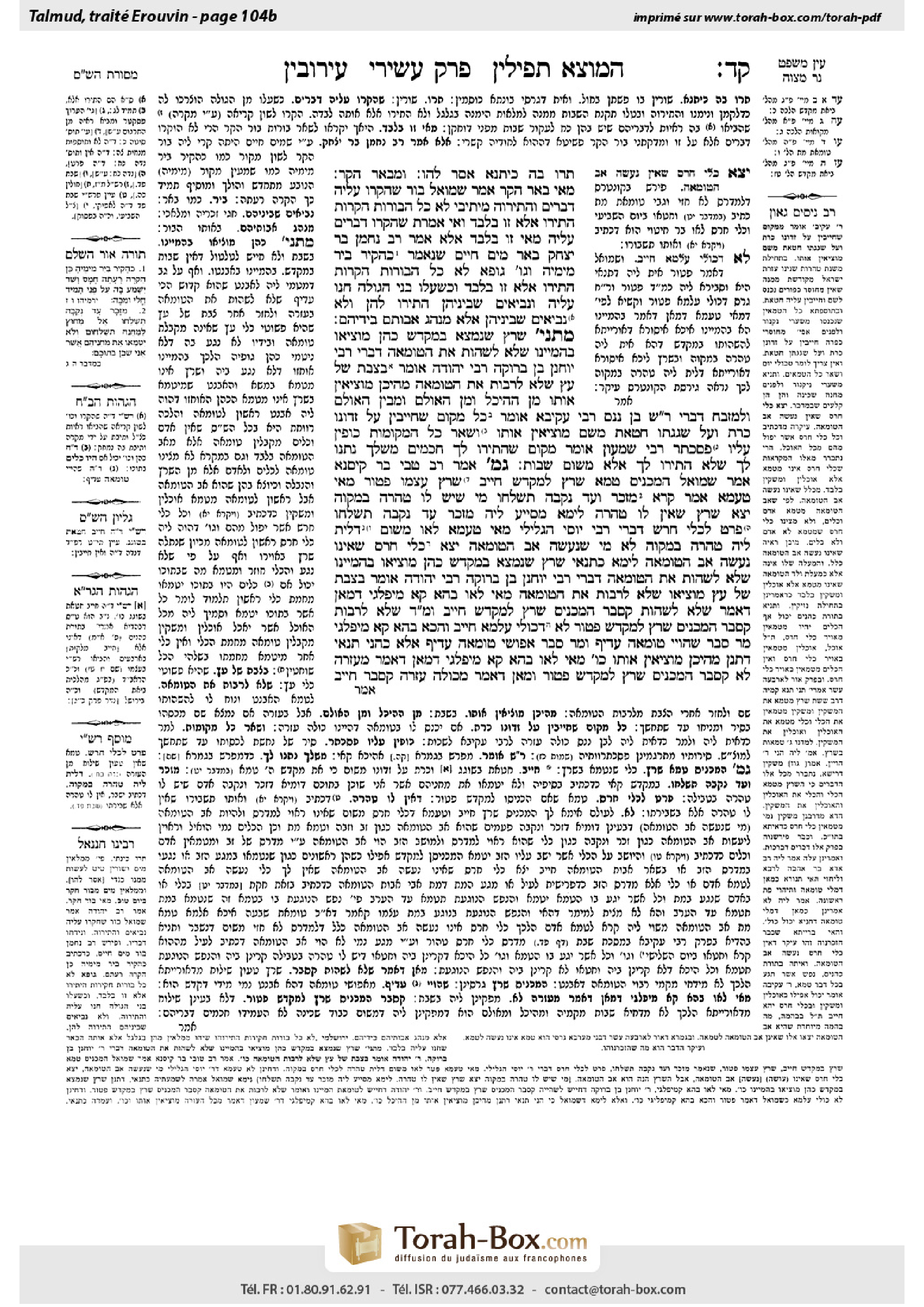
This page of Eruvin includes the Aramaic text, an English translation and an AI-generated French translation, alongside the scan above.
עירובין ק״ד ב · Aramaic and Hebrew text
תָּרוּ בַּהּ כִּיתָּנָא — אֲסַר לְהוּ.
וּמִבְּאֵר הַקַּר. מַאי בְּאֵר הַקַּר? אָמַר שְׁמוּאֵל: בּוֹר שֶׁהִקְרוּ עָלֶיהָ דְּבָרִים וְהִתִּירוּהָ.
מֵיתִיבִי: לֹא כׇּל הַבּוֹרוֹת הַקָּרוֹת הִתִּירוּ, אֶלָּא זוֹ בִּלְבַד. וְאִי אָמְרַתְּ ״שֶׁהִקְרוּ דְּבָרִים עָלֶיהָ״, מַאי ״זוֹ בִּלְבַד״?
אֶלָּא אָמַר רַב נַחְמָן בַּר יִצְחָק: בְּאֵר מַיִם חַיִּים, שֶׁנֶּאֱמַר: ״כְּהָקִיר בַּיִר מֵימֶיהָ וְגוֹ׳״.
גּוּפָא: לֹא כׇּל הַבּוֹרוֹת הַקָּרוֹת הִתִּירוּ, אֶלָּא זוֹ בִּלְבַד. וּכְשֶׁעָלוּ בְּנֵי הַגּוֹלָה חָנוּ עָלֶיהָ, וּנְבִיאִים שֶׁבֵּינֵיהֶן הִתִּירוּ לָהֶן. וְלֹא נְבִיאִים שֶׁבֵּינֵיהֶן, אֶלָּא מִנְהַג אֲבוֹתָם בִּידֵיהֶם.
מַתְנִי׳ שֶׁרֶץ שֶׁנִּמְצָא בַּמִּקְדָּשׁ — כֹּהֵן מוֹצִיאוֹ בְּהֶמְיָינוֹ, שֶׁלֹּא לִשְׁהוֹת אֶת הַטּוּמְאָה, דִּבְרֵי רַבִּי יוֹחָנָן בֶּן בְּרוֹקָה. רַבִּי יְהוּדָה אוֹמֵר: בִּצְבַת שֶׁל עֵץ, שֶׁלֹּא לְרַבּוֹת אֶת הַטּוּמְאָה.
מֵהֵיכָן מוֹצִיאִין אוֹתוֹ — מִן הַהֵיכָל, וּמִן הָאוּלָם, וּמִבֵּין הָאוּלָם וְלַמִּזְבֵּחַ, דִּבְרֵי רַבִּי שִׁמְעוֹן בֶּן נַנָּס.
רַבִּי עֲקִיבָא אוֹמֵר: כׇּל מָקוֹם שֶׁחַיָּיבִין עַל זְדוֹנוֹ כָּרֵת וְעַל שִׁגְגָתוֹ חַטָּאת — מִשָּׁם מוֹצִיאִין אוֹתוֹ. וּשְׁאָר כׇּל הַמְּקוֹמוֹת — כּוֹפִין עָלָיו פְּסַכְתֵּר.
רַבִּי שִׁמְעוֹן אוֹמֵר: מָקוֹם שֶׁהִתִּירוּ לְךָ חֲכָמִים, מִשֶּׁלְּךָ נָתְנוּ לָךְ — שֶׁלֹּא הִתִּירוּ לְךָ אֶלָּא מִשּׁוּם שְׁבוּת.
גְּמָ׳ אָמַר רַב טָבִי בַּר קִיסְנָא אָמַר שְׁמוּאֵל: הַמַּכְנִיס טְמֵא שֶׁרֶץ לַמִּקְדָּשׁ — חַיָּיב, שֶׁרֶץ עַצְמוֹ — פָּטוּר. מַאי טַעְמָא? אָמַר קְרָא: ״מִזָּכָר וְעַד נְקֵבָה תְּשַׁלֵּחוּ״, מִי שֶׁיֵּשׁ לוֹ טׇהֳרָה בְּמִקְוֶה. יָצָא שֶׁרֶץ שֶׁאֵין לוֹ טׇהֳרָה.
לֵימָא מְסַיַּיע לֵיהּ: ״מִזָּכָר עַד נְקֵבָה תְּשַׁלֵּחוּ״ — פְּרָט לִכְלִי חֶרֶשׂ, דִּבְרֵי רַבִּי יוֹסֵי הַגְּלִילִי. מַאי טַעְמָא, לָאו מִשּׁוּם דְּלֵית לֵיהּ טׇהֳרָה בְּמִקְוֶה?
לָא, מִי שֶׁנַּעֲשָׂה אַב הַטּוּמְאָה. יָצָא כְּלִי חֶרֶס, שֶׁאֵינוֹ נַעֲשָׂה אַב הַטּוּמְאָה.
לֵימָא כְּתַנָּאֵי: שֶׁרֶץ שֶׁנִּמְצָא בַּמִּקְדָּשׁ — כֹּהֵן מוֹצִיאוֹ בְּהֶמְיָינוֹ, שֶׁלֹּא לְשַׁהוֹת אֶת הַטּוּמְאָה, דִּבְרֵי רַבִּי יוֹחָנָן בֶּן בְּרוֹקָה. רַבִּי יְהוּדָה אוֹמֵר: בִּצְבָת שֶׁל עֵץ מוֹצִיאוֹ, שֶׁלֹּא לְרַבּוֹת אֶת הַטּוּמְאָה.
מַאי לָאו, בְּהָא קָא מִיפַּלְגִי: דְּמַאן דְּאָמַר שֶׁלֹּא לְשַׁהוֹת, קָסָבַר: הַמַּכְנִיס שֶׁרֶץ לַמִּקְדָּשׁ — חַיָּיב. וּמַאן דְּאָמַר שֶׁלֹּא לְרַבּוֹת, קָסָבַר: הַמַּכְנִיס שֶׁרֶץ לַמִּקְדָּשׁ — פָּטוּר.
לָא, דְּכוּלֵּי עָלְמָא חַיָּיב. וְהָכָא בְּהָא קָא מִיפַּלְגִי, מָר סָבַר: שַׁהוֹיֵי טוּמְאָה — עֲדִיף. וּמָר סָבַר: אַפּוֹשֵׁי טוּמְאָה — עֲדִיף.
אֶלָּא כְּהָנֵי תַּנָּאֵי, דִּתְנַן: מֵהֵיכָן מוֹצִיאִין אוֹתוֹ כּוּ׳.
מַאי לָאו, בְּהָא קָא מִיפַּלְגִי: דְּמַאן דְּאָמַר מֵעֲזָרָה לָא, קָסָבַר: הַמַּכְנִיס שֶׁרֶץ לַמִּקְדָּשׁ — פָּטוּר, וּמַאן דְּאָמַר מִכּוּלַּהּ עֲזָרָה, קָסָבַר — חַיָּיב.
Eruvin 104b · English translation
they were soaking flax in the water, he prohibited them from drawing water by means of a wheel, so that they should not draw water for prohibited purposes.
We learned in the mishna that water may be drawn on a Festival from the Heker Well. The Gemara asks: What is the Heker Well? Shmuel said: It is a cistern with regard to which they advanced [hikru] arguments and permitted drawing water from it on a Festival, by proving that the Torah permits doing so.
The Gemara raises an objection from a baraita: They did not permit all Heker wells, but only this one. And if you say it was named because it is a cistern with regard to which they put forward arguments and permitted it, what is the meaning of Heker wells in the plural, and what does only this one mean? If it was named because of a particular announcement, how could other wells, about which no announcement was issued, bear the same name?
Rather, Rav Naḥman bar Yitzḥak said: The term Heker well denotes a well of living water, as it is stated: “As a well keeps its water fresh [hakir], so she keeps fresh her wickedness” (Jeremiah 6:7), i.e., it is a well of spring water.
Returning to the matter itself, the Gemara cites the above baraita in full: They did not permit all Heker wells, but only this one. And when the exiles ascended from Babylonia, they encamped by it, and the prophets among them, Haggai, Zechariah, and Malachi, permitted it to them. And it was not really the prophets among them who permitted them to draw water from this well on a Festival, but rather, it was a customary practice that was handed down to them from their forefathers, a practice the prophets permitted them to continue.
MISHNA: With regard to the carcass of a creeping animal, of one of the eight species of reptile or rodent listed in Leviticus 11:29–30, one of the primary sources of ritual impurity that is found in the Temple, a priest should carry it out on Shabbat in his girdle, which was one of the priestly garments. Although the girdle will be defiled by the carcass of the creeping animal, this is the best way to proceed, so as not to delay the removal of the impurity from the Temple. This is the statement of Rabbi Yoḥanan ben Beroka. Rabbi Yehuda says: The creeping animal carcass should be removed with wooden prongs, so as not to increase the impurity, as a wooden prong is not susceptible to impurity.
It is obvious that on a weekday the creeping animal carcass is removed from wherever it is found in the Temple, but from where does one remove it on Shabbat? From the Sanctuary, from the Entrance Hall, and from the area in the courtyard between the Entrance Hall and the altar, the most sanctified precincts of the Temple. However, it need not be removed from the rest of the courtyard. This is the statement of Rabbi Shimon ben Nannas.
Rabbi Akiva says: Any place where one is liable to be punished with karet if he intentionally enters there in a state of ritual impurity, and is liable to bring a sin-offering if he does so unwittingly, from there one must remove it. This includes the entire area of the Temple courtyard. And as for the rest of the places in the Temple, one covers the creeping animal carcass with a bowl [pesakhter] and leaves it there until the conclusion of Shabbat.
Rabbi Shimon says that this is the principle: Wherever the Sages permitted something to you, they granted you only from your own, as they permitted to you only activities that are prohibited due to rabbinic decree, not labors prohibited by Torah law.
GEMARA: Rav Tavi bar Kisna said that Shmuel said: With regard to one who brings into the Temple an object that was defiled by a creeping animal carcass, he is liable, but if he brings in the carcass of a creeping animal itself, he is exempt. What is the reason for this distinction? The verse said: “Both male and female shall you put out, without the camp shall you put them; that they defile not their camp, in the midst whereof I dwell” (Numbers 5:3). This verse teaches that the obligation to send out of the camp applies only to one who has the option of purification in a ritual bath, i.e., the male and female mentioned by the Torah; this excludes the carcass of a creeping animal, which has no purification. Consequently, one who brings the carcass of a creeping animal into the Temple is exempt, as he did not transgress the Torah’s commandment to send away the impure.
The Gemara suggests: Let us say that a baraita supports him: “Both male and female shall you put out”; this excludes an earthenware vessel. This is the statement of Rabbi Yosei HaGelili. What is the reason for this? Is it not because an earthenware vessel does not have purification in a ritual bath, in accordance with the opinion of Rav Tavi bar Kisna?
The Gemara rejects this contention: No, the reason is that only something that can become a primary source of ritual impurity, i.e., a human being or a metal utensil, must be sent out of the camp. This excludes an earthenware vessel, which cannot become a primary source of ritual impurity.
The Gemara suggests: Let us say that this issue, whether or not there is liability for bringing a creeping animal carcass into the Temple, is parallel to a dispute between tanna’im, as we learned in the mishna: With regard to a creeping animal carcass that is found in the Temple, a priest should carry it out on Shabbat in his girdle, so as not to delay the removal of the impurity. This is the statement of Rabbi Yoḥanan ben Beroka. Rabbi Yehuda says: He should remove it with wooden prongs, so as not to increase the impurity.
What, isn’t it the case that this is the matter with regard to which the two tanna’im disagree: The one who said we should not delay the removal of the impurity maintains that one who brings a creeping animal carcass into the Temple is liable, and therefore every effort must be made to remove it immediately. And the one who said we should not increase impurity maintains that one who brings a creeping animal carcass into the Temple is exempt. As no special command is in effect, the correct procedure is to prevent any additional impurity.
The Gemara rejects this explanation: No, everyone agrees that one who brings a creeping animal carcass itself into the Temple is liable, and here, this is the matter with regard to which they disagree: The one Sage, Rabbi Yoḥanan ben Beroka, holds: Delaying removal of the impurity is the consideration that takes precedence. Consequently, it is permitted even to defile the priestly garments to prevent any delay in the removal of the impurity from the holy place. Whereas the other Sage, Rabbi Yehuda, holds: Increasing impurity is the consideration that takes precedence, and therefore the impurity should be removed only by means of wooden prongs.
Rather, the Gemara suggests that this issue is the subject of a dispute between these tanna’im, as we learned in that same mishna: From where does one remove the creeping animal carcass? Rabbi Shimon ben Nannas and Rabbi Akiva disagree whether it is removed only from the Sanctuary, the Entrance Hall, and the area of the courtyard between the Entrance Hall and the altar, or from the entire area of the courtyard as well.
Isn’t it the case that the two tanna’im disagree about the following: The one who said we do not remove it from the Temple courtyard maintains that one who brings a creeping animal carcass into the Temple is exempt, and there is therefore no obligation to remove it from the courtyard on Shabbat. And the one who said that it must be removed from the entire courtyard maintains that one who brings a creeping animal carcass into the Temple is liable.
Eruvin 104b · Traduction française (IA)
Ils trempaient du lin dans l'eau, il leur interdisait d'extraire l'eau à l'aide d'une roue, afin qu'ils ne l'utilisent pas à des fins interdites.
Nous avons appris dans la Michna que l'eau peut être tirée pendant un festival depuis le puits de Heker. La Guemara pose la question : Quel est le puits de Heker ? Shmuel dit : C'est un puits dont ils ont avancé des débats et dont ils ont permis l'extrusion de l'eau pendant un festival, en prouvant que la Torah permet cela.
La Guemara soulève un objet à partir d'une baraïta : Ils n'ont pas permis tous les puits de Heker, mais seulement celui-ci. Et si vous dites qu'il s'appelait ainsi parce qu'il s'agit d'un puits dont ils ont avancé des débats et l'ont permis, quelle est la signification des puits de Heker au pluriel, et que signifie « seulement celui-ci » ? Si c'était à cause d'une déclaration particulière, comment d'autres puits, dont aucune déclaration n'avait été faite, pouvaient-ils porter le même nom ?
Plutôt, Rav Naḥman bar Yitzḥak dit : Le terme « Heker » désigne un puits d'eau vive, car il est dit : « Comme un puits conserve son eau fraîche [hakir], ainsi elle conserve sa malice fraîche » (Jérémie 6:7), c'est-à-dire qu'il s'agit d'un puits d'eau de source.
En revenant à la question principale, la Guemara cite la baraïta ci-dessus en entier : Ils n'ont pas permis tous les puits de Heker, mais seulement celui-ci. Et lorsque les exilés sont montés de Babylone, ils se sont installés près de lui, et les prophètes parmi eux, Haggai, Zacharie et Malachie, l'ont permis à eux. Et ce n'était pas vraiment les prophètes parmi eux qui ont permis à l'extrusion de l'eau de ce puits pendant un festival, mais plutôt, c'était une coutume transmise par leurs pères, une coutume que les prophètes leur ont permis de continuer.
MITSVA : Concernant la carcasse d'un animal rampant, d'un des huit espèces de reptiles ou de rongeurs mentionnés dans Lévitique 11:29–30, l'une des principales sources de souillure rituelle trouvée dans le Temple, un prêtre doit la transporter le sabbat dans sa ceinture, l'un des vêtements sacrés. Bien que la ceinture soit souillée par la carcasse d'un animal rampant, c'est la meilleure façon de procéder afin de ne pas retarder l'élimination de la souillure du Temple. C'est la déclaration de Rabbi Yoḥanan ben Beroka. Rabbi Yehuda dit : La carcasse d'un animal rampant doit être éliminée avec des piques en bois, afin de ne pas augmenter la souillure, car une pique en bois n'est pas sujette à la souillure.
Il est évident que pendant un jour de semaine, la carcasse d'un animal rampant est éliminée de là où elle est trouvée dans le Temple, mais d'où l'élimine-t-on le sabbat ? Du Sanctuaire, de la Cour d'entrée, et de la zone dans la cour entre la Cour d'entrée et l'autel, les lieux les plus saints du Temple. Cependant, il n'est pas nécessaire de l'éliminer du reste de la cour. C'est la déclaration de Rabbi Shimon ben Nannas.
Rabbi Akiva dit : Tout lieu où l'on est puni de karet s'il entre volontairement là dans un état de souillure rituelle, et s'il entre accidentellement, il doit y être éliminé. Cela inclut toute l'aire du cour du Temple. Et concernant les autres lieux du Temple, on recouvre la carcasse d'un animal rampant avec un bol [pesakhter] et on le laisse là jusqu'à la fin du sabbat.
Rabbi Shimon dit que c'est le principe : Partout où les Sages ont permis quelque chose à vous, ils vous ont accordé seulement à partir de votre propre, car ils ont permis à vous seulement des activités interdites par des décrets rabbiniques, pas des travaux interdits par la loi divine.
GUEMARA : Rav Tavi bar Kisna dit que Shmuel dit : Concernant celui qui apporte dans le Temple un objet souillé par la carcasse d'un animal rampant, il est responsable, mais si il apporte la carcasse d'un animal rampant elle-même, il est exempt. Quelle est la raison de cette distinction ? La parabase dit : « Vous en expulseriez les deux sexes, hors du camp vous les mettrez, afin qu'ils ne souillent pas leur camp, au milieu duquel je demeure » (Nombres 5:3). Cette parabase enseigne que l'obligation d'expulser hors du camp s'applique seulement à celui qui a l'option de purification dans un bain rituel, c'est-à-dire les deux sexes mentionnés par la Torah ; cela exclut la carcasse d'un animal rampant, qui n'a pas de purification. Ainsi, celui qui apporte la carcasse d'un animal rampant dans le Temple est exempt, car il n'a pas transgressé l'ordre divin d'expulser la souillure.
La Guemara suggère : Disons que une baraïta soutient lui : « Vous en expulseriez les deux sexes », cela exclut un vase en terre. C'est la déclaration de Rabbi Yosei HaGelili. Quelle est la raison de cela ? N'est-ce pas parce qu'un vase en terre n'a pas de purification dans un bain rituel, selon l'opinion de Rav Tavi bar Kisna ?
La Guemara rejette cette contention : Non, la raison est que seulement quelque chose qui peut devenir une source principale de souillure rituelle, c'est-à-dire un être humain ou un ustensile en métal, doit être expulsé hors du camp. Cela exclut un vase en terre, qui ne peut pas devenir une source principale de souillure rituelle.
La Guemara suggère : Disons que cette question, savoir s'il y a responsabilité pour apporter la carcasse d'un animal rampant dans le Temple, est parallèle à un débat entre les tanna’im, comme nous l'avons appris dans la mitsna : Concernant la carcasse d'un animal rampant trouvée dans le Temple, un prêtre doit la transporter le sabbat dans sa ceinture, afin de ne pas retarder l'élimination de la souillure. C'est la déclaration de Rabbi Yoḥanan ben Beroka. Rabbi Yehuda dit : Il doit l'éliminer avec des piques en bois, afin de ne pas augmenter la souillure.
Qu’est-ce que cela signifie, n’est-ce pas que c’est la question sur laquelle les deux tanna’im s’entendent à l’inverse : celui qui dit qu’il ne faut pas retarder l’élimination de l’impureté affirme que celui qui introduit un cadavre d’animal rampant dans le Temple est responsable, et par conséquent, il faut faire tout ce qui est nécessaire pour l’éliminer immédiatement. Et celui qui dit qu’il ne faut pas accroître l’impureté affirme que celui qui introduit un cadavre d’animal rampant dans le Temple est exempt. Puisque aucune ordonnance particulière n’est en vigueur, la procédure correcte est de prévenir toute impureté supplémentaire.
La Guemara rejette cette explication : Non, tout le monde s’accorde sur le fait que celui qui introduit un cadavre d’animal rampant dans le Temple est responsable, et ici, c’est la question sur laquelle ils s’entendent à l’inverse : le Sage, Rabbi Yoḥanan ben Beroka, affirme que le retard dans l’élimination de l’impureté est la considération qui prime. Par conséquent, il est permis même de salir les vêtements sacrés afin d’éviter tout retard dans l’élimination de l’impureté du lieu saint. En revanche, le Sage Rabbi Yehuda affirme que l’accroissement de l’impureté est la considération qui prime, et par conséquent, l’impureté doit être éliminée uniquement par l’usage de piques en bois.
Au contraire, la Guemara suggère que cette question est l’objet d’un débat entre ces tanna’im, comme nous l’avons appris dans la même mishna : d’où l’on élimine le cadavre d’animal rampant ? Rabbi Shimon ben Nannas et Rabbi Akiva s’entendent à l’inverse sur le fait qu’il est éliminé uniquement du Sanctuaire, de la Cour d’entrée et de la zone de la cour entre la Cour d’entrée et l’autel, ou bien de l’ensemble de la cour.
N’est-ce pas que les deux tanna’im s’entendent à l’inverse sur la question suivante : celui qui dit qu’il ne faut pas l’éliminer de la cour du Temple affirme que celui qui introduit un cadavre d’animal rampant dans le Temple est exempt, et par conséquent, il n’y a pas d’obligation d’en éliminer de la cour le sabbat. Et celui qui dit qu’il faut l’éliminer de toute la cour affirme que celui qui introduit un cadavre d’animal rampant dans le Temple est responsable.
Traduction française générée par IA à partir de l’édition anglaise de Sefaria. Vérifie toujours un passage avec le texte source.
Text from Sefaria: William Davidson Edition - Vocalized Aramaic (CC BY NC); William Davidson Edition - English (CC BY NC).