Eruvin 104a: Talmud study for Daf Yomi
Study the Talmud for Daf Yomi with scanned pages, Hebrew text, English translations from Sefaria and AI-generated French translations.
Passage selection and English or AI-generated French translation are available where the scan has annotations. Daf Study is independent of Torah-Box and Sefaria.
Browse Eruvin · עירובין · All tractatesEruvin 104a text and translations
This page of Eruvin includes the Aramaic text, an English translation and an AI-generated French translation, alongside the scan above.
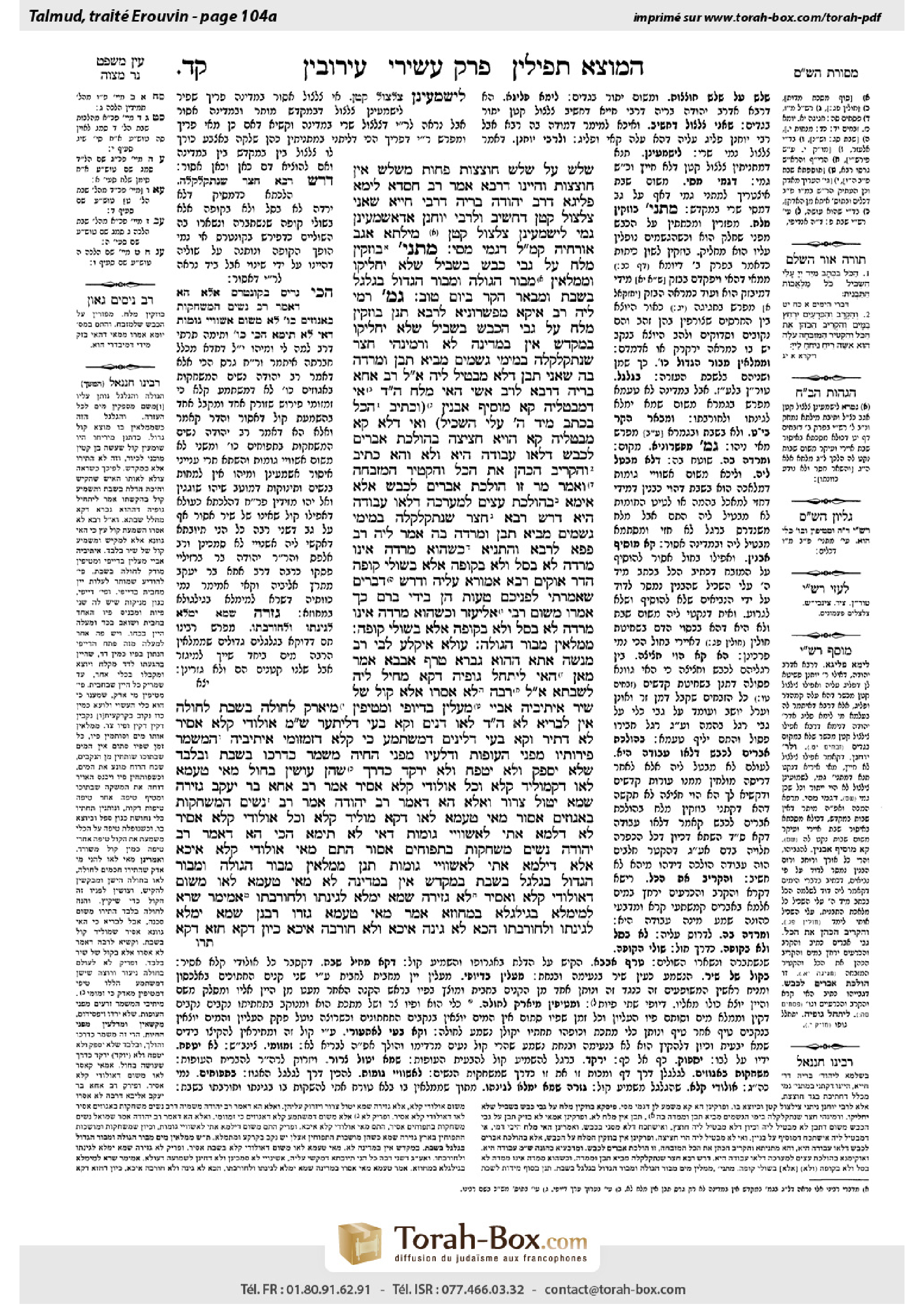
עירובין ק״ד א · Aramaic and Hebrew text
שָׁלֹשׁ עַל שָׁלֹשׁ — חוֹצְצוֹת, פָּחוֹת מִשָּׁלֹשׁ — אֵין חוֹצְצוֹת, וְהַיְינוּ דְּרָבָא אָמַר רַב חִסְדָּא.
לֵימָא פְּלִיגָא דְּרַב יְהוּדָה בְּרֵיהּ דְּרַבִּי חִיָּיא? שָׁאנֵי צִלְצוֹל קָטָן דַּחֲשִׁיב.
וּלְרַבִּי יוֹחָנָן: אַדְּאַשְׁמְעִינַן גֶּמִי לַישְׁמְעִינַן צִלְצוֹל קָטָן!
מִילְּתָא אַגַּב אוֹרְחֵיהּ קָא מַשְׁמַע לַן, דְּגֶמִי מַסֵּי.
מַתְנִי׳ בּוֹזְקִין מֶלַח עַל גַּבֵּי כֶּבֶשׁ בִּשְׁבִיל שֶׁלֹּא יַחְלִיקוּ, וּמְמַלְּאִין מִבּוֹר הַגּוֹלָה וּמִבּוֹר הַגָּדוֹל בַּגַּלְגַּל בַּשַּׁבָּת, וּמִבְּאֵר הַקַּר בְּיוֹם טוֹב.
גְּמָ׳ רָמֵי לֵיהּ רַב אִיקָא מִפַּשְׁרוּנְיָא לְרָבָא, תְּנַן: בּוֹזְקִין מֶלַח עַל גַּבֵּי הַכֶּבֶשׁ בִּשְׁבִיל שֶׁלֹּא יַחֲלִיקוּ. בַּמִּקְדָּשׁ — אִין, בַּמְּדִינָה — לָא. וּרְמִינְהִי: חָצֵר שֶׁנִּתְקַלְקְלָה בְּמֵימֵי גְשָׁמִים — מֵבִיא תֶּבֶן וּמְרַדֶּה בָּהּ!
שָׁאנֵי תֶּבֶן, דְּלָא מְבַטֵּיל לֵיהּ.
אֲמַר לֵיהּ רַב אַחָא בְּרֵיהּ דְּרָבָא לְרַב אָשֵׁי: הַאי מֶלַח הֵיכִי דָמֵי? אִי דִּמְבַטְּלֵיהּ — קָא מוֹסֵיף אַבִּנְיָן (וּכְתִיב: ״הַכֹּל בִּכְתָב מִיַּד ה׳ עָלַי הִשְׂכִּיל״).
וְאִי דְּלָא קָא מְבַטְּלֵיהּ, קָא הָוְיָא חֲצִיצָה.
בְּהוֹלָכַת אֵבָרִים לַכֶּבֶשׁ, דְּלָאו עֲבוֹדָה הִיא.
וְלָא? וְהָא כְּתִיב: ״וְהִקְרִיב הַכֹּהֵן אֶת הַכֹּל וְהִקְטִיר הַמִּזְבֵּחָה״, וְאָמַר מָר: זוֹ הוֹלָכַת אֵבָרִים לַכֶּבֶשׁ! אֶלָּא אֵימָא: בְּהוֹלָכַת עֵצִים לַמַּעֲרָכָה, דְּלָאו עֲבוֹדָה הִיא.
דָּרֵשׁ רָבָא: חָצֵר שֶׁנִּתְקַלְקְלָה בְּמֵימֵי גְשָׁמִים — מֵבִיא תֶּבֶן וּמְרַדֶּה בָּהּ. אֲמַר לֵיהּ רַב פָּפָּא לְרָבָא, וְהָתַנְיָא: כְּשֶׁהוּא מְרַדֶּה — אֵינוֹ מְרַדֶּה לֹא בְּסַל וְלֹא בְּקוּפָּה, אֶלָּא בְּשׁוּלֵי קוּפָּה!
הֲדַר אוֹקֵים רָבָא אָמוֹרָא עֲלֵיהּ וּדְרַשׁ: דְּבָרִים שֶׁאָמַרְתִּי לִפְנֵיכֶם טָעוּת הֵן בְּיָדִי, בְּרַם כָּךְ אָמְרוּ מִשּׁוּם רַבִּי אֱלִיעֶזֶר: וּכְשֶׁהוּא מְרַדֶּה — אֵינוֹ מְרַדֶּה לֹא בְּסַל וְלֹא בְּקוּפָּה, אֶלָּא בְּשׁוּלֵי קוּפָּה.
מְמַלְּאִין מִבּוֹר הַגּוֹלָה. עוּלָּא אִיקְּלַע לְבֵי רַב מְנַשֶּׁה, אֲתָא הָהוּא גַּבְרָא טְרַף אַבָּבָא אֲמַר: מַאן הַאי? לִיתַּחַל גּוּפֵיהּ, דְּקָא מַחֵיל לֵיהּ לְשַׁבְּתָא.
אֲמַר לֵיהּ רַבָּה: לֹא אָסְרוּ אֶלָּא קוֹל שֶׁל שִׁיר. אֵיתִיבֵיהּ אַבָּיֵי: מַעֲלִין בִּדְיוֹפִי וּמַטִּיפִין מֵיאֶרֶק לַחוֹלֶה בַּשַּׁבָּת.
לַחוֹלֶה אִין, לַבָּרִיא לָא. הֵיכִי דָּמֵי? לָאו דְּנָיֵם וְקָא בָּעֵי דְּלִיתְּעַר. שְׁמַע מִינַּהּ: אוֹלוֹדֵי קָלָא אֲסִיר!
לָא: דְּתִיר, וְקָא בָּעֵי דְּלֵינִים — דְּמִשְׁתַּמֵּעַ כִּי קָלָא דְזִמְזוּמֵי.
אֵיתִיבֵיהּ: הַמְשַׁמֵּר פֵּירוֹתָיו מִפְּנֵי הָעוֹפוֹת, וּדְלֻעָיו מִפְּנֵי הַחַיָּה — מְשַׁמֵּר כְּדַרְכּוֹ בְּשַׁבָּת, וּבִלְבַד שֶׁלֹּא יִסְפֹּק וְלֹא יְטַפֵּחַ וְלֹא יְרַקֵּד כְּדֶרֶךְ שֶׁהֵן עוֹשִׂין בַּחוֹל.
מַאי טַעְמָא — לָאו דְּקָמוֹלֵיד קָלָא, וְכׇל אוֹלוֹדֵי קָלָא אֲסִיר? אָמַר רַב אַחָא בַּר יַעֲקֹב: גְּזֵירָה שֶׁמָּא יִטּוֹל צְרוֹר.
וְאֶלָּא הָא דְּאָמַר רַב יְהוּדָה אָמַר רַב: נָשִׁים הַמְשַׂחֲקוֹת בֶּאֱגוֹזִים — אָסוּר. מַאי טַעְמָא — לָאו דְּקָא מוֹלֵיד קָלָא, וְכׇל אוֹלוֹדֵי קָלָא אֲסִיר?
לָא, דִּלְמָא אָתֵי לְאַשְׁווֹיֵי גּוּמּוֹת.
דְּאִי לָא תֵּימָא הָכִי, הָא דְּאָמַר רַב יְהוּדָה: נָשִׁים מְשַׂחֲקוֹת בְּתַפּוּחִים — אָסוּר, הָתָם מַאי אוֹלוֹדֵי קָלָא אִיכָּא?! אֶלָּא: דִּילְמָא אָתֵי לְאַשְׁווֹיֵי גּוּמּוֹת.
תְּנַן: מְמַלְּאִין מִבּוֹר הַגּוֹלָה וּמִבּוֹר הַגָּדוֹל בַּגַּלְגַּל בְּשַׁבָּת, בְּמִקְדָּשׁ — אִין, בִּמְדִינָה — לָא. מַאי טַעְמָא, לָאו מִשּׁוּם דְּאוֹלוֹדֵי קָלָא — וַאֲסִיר?
לָא, גְּזֵירָה שֶׁמָּא יְמַלֵּא לְגִינָּתוֹ וּלְחוּרְבָּתוֹ.
אַמֵּימָר שְׁרָא לְמִימְלֵא בְּגִילְגְּלָא בְּמָחוֹזָא, אָמַר: מַאי טַעְמָא גְּזַרוּ רַבָּנַן — שֶׁמָּא יְמַלֵּא לְגִינָּתוֹ וּלְחוּרְבָּתוֹ? הָכָא, לָא גִּינָּה אִיכָּא, וְלָא חוּרְבָּה אִיכָּא.
כֵּיוָן דְּקָא חָזֵא דְּקָא
Eruvin 104a · English translation
If the fabric was three fingerbreadths by three fingerbreadths, it interposes; but if it was less than three fingerbreadths by three fingerbreadths, it does not interpose. And this is the same teaching that Rava said that Rav Ḥisda said.
The Gemara suggests: Let us say that this disagrees with the opinion of Rav Yehuda, son of Rabbi Ḥiyya, who prohibits a sash even smaller than three fingerbreadths by three fingerbreadths. The Gemara rejects this contention: This is not necessarily so, as a small sash is different, since it is significant. It is therefore like a garment, even if it is smaller than three fingerbreadths by three fingerbreadths.
The Gemara raises a question: And according to the opinion of Rabbi Yoḥanan: Rather than teaching us the halakha with regard to a reed, let the mishna teach us that a priest may wrap his wounded finger with a small sash, as that does not constitute an interposition.
The Gemara explains: The tanna teaches us another matter in passing, that a reed heals. However, as far as a priest involved in the service in concerned, there is no concern with regard to this prohibition either, as it is also a rabbinic decree that is not in effect in the Temple.
MISHNA: One may scatter salt on Shabbat on the ramp that leads to the altar so that the priests will not slip on their way up. And likewise, one may draw water from the Cistern of the Exiles and from the Great Cistern, which were located in the Temple, by means of the wheel designed for drawing water, even on Shabbat. And one may draw water from the Heker Well only on a Festival.
GEMARA: Rav Ika from Pashronya raised a contradiction before Rava: We learned in the mishna: One may scatter salt on Shabbat on the ramp that leads to the altar, so that the priests will not slip, from which it can be inferred: In the Temple, yes, it is permitted to do so, but outside the Temple, in the rest of the country, no, it is prohibited to scatter salt on a ramp. And he raised his contradiction from a baraita: With regard to a courtyard that was damaged on Shabbat by rainwater, so that it became difficult to cross, one may bring straw and scatter it about to absorb the water. Apparently, an action of this kind is permitted even outside the Temple.
The Gemara answers: Straw is different, as one does not negate it; rather, he intends to remove it once the water has been absorbed. He is therefore permitted to scatter the straw in the courtyard, just as it is permitted to put it in any other place. However, it is prohibited to scatter objects that one intends to leave in place, such as salt, as this appears as though he is adding to the ground and building.
Rav Aḥa, son of Rava, said to Rav Ashi: This salt, what are the circumstances? If one negates it vis-à-vis the ramp so that it becomes part of the ramp, he effectively adds to the structure of the Temple, and it states with regard to the Temple: “All this do I give you in writing as God has made me wise by His hand upon me, even all the works of this pattern” (I Chronicles 28:19). This verse indicates that all the details of the Temple structure were determined through prophecy and may not be changed in any way, even on a weekday.
And if he does not negate the salt vis-à-vis the ramp, it would constitute an interposition between the feet of the priests and the altar. This would mean that they would not be walking on the ramp during their service, and consequently they would not be performing the service as required by the Torah.
The Gemara answers: In fact, he does not negate the salt. However, he scatters it when the limbs of the sacrifice are brought up the ramp, a procedure that is not considered part of the Temple service subject to disqualification due to interposition, as it is merely preparation for the burning of the limbs.
The Gemara asks: And is this not a service? But isn’t it written: “And the priest shall offer it whole and make it smoke upon the altar” (Leviticus 1:13), and the Master said in explanation: This is referring to bringing the limbs to the top of the ramp. Evidently, this too is a service written in the Torah. Rather, say that he scatters the salt when the wood is brought up the ramp to the arrangement of wood on the altar, a procedure that is not a service.
Rava taught: In a courtyard that was damaged on Shabbat by rainwater, one may bring straw and scatter it about to make it easier to walk across. Rav Pappa said to Rava: But wasn’t it taught in a baraita: When one scatters the straw, he must not scatter it either with a small basket or with a large basket, but only with the bottom of a broken basket, i.e., he must scatter the straw in a manner different from that of an ordinary weekday. Rava, however, indicates that he may scatter the straw in the usual fashion.
Rava then appointed an amora before him to publicize his teaching, and taught: The statement I issued before you was a mistake of mine. However, in fact they said in the name of Rabbi Eliezer as follows: And when one scatters the straw, he must not scatter it either with a small basket or with a large basket, but only with the bottom of a broken basket.
We learned in the mishna: One may draw water from the Cistern of the Exiles by means of a wheel. The Gemara relates: Ulla happened to come to the house of Rav Menashe when a certain man came and knocked at the door. Ulla said: Who is that? May his body be desecrated, as he desecrates Shabbat by producing a sound.
Rabba said to him: The Sages prohibited only a pleasant musical sound on Shabbat, not the rasping sound of knocking on a door. Abaye raised an objection to Rabba from a baraita: One may draw up wine from a barrel with a siphon [diyofei], and one may drip water from a vessel that releases water in drops [miarak], for an ill person on Shabbat.
The Gemara infers: For an ill person, yes, this is permitted, but for a healthy person, no, one may not do so, what are the circumstances? Is it not the case that he is dozing off and they wish to waken him, and as they do not want to alarm him due to his illness, they do it by means of the sound of water poured from a vessel? And one can learn from here that it is prohibited to produce a sound on Shabbat, even one that is unpleasant, as the Sages permitted this only for an ill person.
The Gemara rejects this contention: No, it is referring to an ill person who is awake and whom they want to have fall asleep, and to this end they let water fall in drops, producing a sound that is heard as melodious.
Abaye raised another objection to Rabba from a baraita: One who is guarding his produce from birds or his gourds from beasts may guard them, in the manner that he typically does so, on Shabbat, as his guarding does not entail a prohibited labor, provided that he neither claps, nor slaps his hands against his body, nor dances and produces noise with his feet, in the manner that is performed on weekdays to chase away birds and animals.
The Gemara asks: What is the reason that these activities are prohibited? Is it not because he is producing a sound on Shabbat, and any production of a sound is prohibited? Rav Aḥa bar Ya’akov said: This is not the reason. Rather, it is a decree issued by the Sages, lest while acting in his usual weekday fashion he mistakenly picks up a pebble to throw at the birds, thereby handling an object that is set-aside.
The Gemara asks: However, with regard to that which Rav Yehuda said that Rav said: Women who play with nuts by rolling them on the ground until they collide with each other, it is prohibited for them to do so; what is the reason for this prohibition? Is it not because knocking nuts together produces a sound, and any production of a sound is prohibited?
The Gemara rejects this contention: No, it is prohibited because perhaps they will come to level the holes. As small holes in the ground will interfere with their game, they might level them out and seal them up on Shabbat, which is prohibited as building.
For if you do not say that this is the reason, there is a difficulty with that which Rav Yehuda said: Women who play with apples, this is prohibited, as what production of a sound is involved there? Apples do not produce a sound when they collide with each other. Rather, the reason is that they will perhaps come to level holes, and the same reasoning applies to nuts.
We learned in the mishna: One may draw water from the Cistern of the Exiles and from the Great Cistern by means of the wheel on Shabbat. From this it can be inferred: In the Temple, yes, it is permitted to do so; but outside the Temple in the rest of the country, no, it is prohibited to draw water from cisterns. What is the reason for this? Is it not because he is producing a sound, and that is prohibited on Shabbat?
The Gemara again rejects this contention: No, it is a decree issued by the Sages, lest he draw water for his garden and for his ruin. As the wheel draws up large quantities of water, once he starts to use it, he might draw water for his garden as well and thereby transgress the prohibition against watering on Shabbat, a subcategory of a prohibited labor.
The Gemara relates that Ameimar permitted people to draw water on Shabbat by means of a wheel in Meḥoza, as he said: What is the reason the Sages decreed that this is prohibited? They did so lest one draw water for his garden and for his ruin. However, here in Meḥoza there are neither gardens nor ruins. Meḥoza was entirely built up and lacked gardens or empty areas for sowing, and consequently, there was no concern that people might transgress.
However, once he saw that
Eruvin 104a · Traduction française (IA)
Si la toile mesurait trois paumes par trois paumes, elle interposait ; mais si elle mesurait moins de trois paumes par trois paumes, elle ne l'interposait pas. Et c'est la même enseignement que Rava a dit que Rav Ḥisda avait dit.
Le Guemara suggère : Disons que cela contredit l'opinion de Rav Yehuda, fils de Rabbi Ḥiyya, qui interdit un ceinture même plus petit que trois paumes par trois paumes. Le Guemara rejette cette affirmation : Ce n'est pas nécessairement vrai, car une ceinture petite est différente, car elle est significative. Elle est donc comme une robe, même si elle est plus petite que trois paumes par trois paumes.
Le Guemara soulève une question : Et selon l'opinion de Rabbi Yoḥanan : Plutôt que d'enseigner la halakha concernant un bâton, que la mitsna nous enseigne que le prêtre peut envelopper son doigt blessé avec une petite ceinture, car cela ne constitue pas une interposition.
Le Guemara explique : Le tanna enseigne en passant une autre question, que le bambou guérit. Cependant, concernant un prêtre impliqué dans le service, il n'y a pas de préoccupation à cet égard non plus, car c'est aussi un décret rabbinique qui n'est pas en vigueur dans le Temple.
MICHNA : On peut répandre du sel le sabbat sur la rampe qui mène à l'autel afin que les prêtres ne glissent pas sur le chemin. De même, on peut tirer de l'eau du Cistern des Exilés et du Grand Cistern, qui étaient situés dans le Temple, par le moyen de la roue conçue pour tirer l'eau, même le sabbat. On peut tirer de l'eau du puits Heker uniquement lors d'un festival.
Le Guemara rapporte que Rav Ika de Pashronya a soulevé une contradiction devant Rava : Nous avons appris dans la mitsna : On peut répandre du sel le sabbat sur la rampe qui mène à l'autel, afin que les prêtres ne glissent pas, d'où on peut déduire : Dans le Temple, oui, cela est permis, mais en dehors du Temple, dans le reste du pays, non, il est interdit de répandre du sel sur une rampe. Et il a soulevé cette contradiction à partir d'une baraïta : Concernant un jardin qui a été endommagé le sabbat par l'eau de pluie, de sorte qu'il devenait difficile de traverser, on peut apporter des pailles et les répandre pour absorber l'eau. Apparemment, une telle action est permise même en dehors du Temple.
Le Guemara répond : Les pailles sont différentes, car on ne les rejette pas ; au contraire, l'intention est de les retirer une fois que l'eau a été absorbée. Il est donc permis de répandre les pailles dans le jardin, tout comme il est permis de les placer n'importe où. Cependant, il est interdit de répandre des objets dont l'intention est de les laisser en place, comme le sel, car cela semble comme si l'on ajoutait au sol et qu'on construisait.
Rav Aḥa, fils de Rava, a dit à Rav Ashi : Ce sel, quelles sont les circonstances ? Si l'on rejette le sel par rapport à la rampe de sorte qu'il devienne partie de la rampe, on ajoute effectivement à la structure du Temple, et il est dit concernant le Temple : « Tout cela je vous donne par écrit, comme Dieu m'a rendu sage par Sa main sur moi, même toutes les œuvres de ce modèle » (I Chroniques 28:19). Cette verset indique que tous les détails de la structure du Temple étaient déterminés par la prophétie et ne peuvent être modifiés de quelque manière que ce soit, même un jour de semaine.
Et si l'on ne rejette pas le sel par rapport à la rampe, cela constituerait une interposition entre les pieds des prêtres et l'autel. Cela signifierait qu'ils ne marcheraient pas sur la rampe lors de leur service, et par conséquent ils ne réaliseraient pas le service tel que requis par la Torah.
Le Guemara répond : En réalité, il ne nie pas le sel. Cependant, il le répand lorsque les membres du sacrifice sont amenés sur la rampe, une procédure qui n'est pas considérée comme faisant partie du service du Temple soumis à l'interdiction en raison d'une interposition, car il s'agit simplement de préparation à la combustion des membres.
Le Guemara demande : Et n'est-ce pas un service ? Mais n'est-il pas écrit : « Et le prêtre offrira tout entier et le fera brûler sur l'autel » (Lévitique 1:13), et le Maître a dit en explication : Cela fait référence à l'apport des membres au sommet de la rampe. Évidemment, cela aussi est un service écrit dans la Torah. Plutôt, disons qu'il répand le sel lorsque le bois est amené sur la rampe pour l'arrangement du bois sur l'autel, une procédure qui n'est pas un service.
Rava enseigna : Dans un jardin endommagé le sabbat par l'eau de pluie, on peut apporter des pailles et les répandre pour faciliter la marche. Rav Pappa dit à Rava : Mais n'était-il pas appris dans une baraïta : Lorsqu'on répand les pailles, on ne doit pas les répandre avec un petit panier ou un grand panier, mais seulement avec le fond d'un panier brisé, c'est-à-dire qu'on doit répandre les pailles d'une manière différente de celle d'un jour ordinaire. Rava, cependant, indique qu'on peut répandre les pailles de la manière habituelle.
Rava désigna ensuite un amora devant lui pour publier son enseignement, et enseigna : L'affirmation que j'ai émise devant vous était une erreur de ma part. Cependant, en réalité, ils ont dit en nom de Rabbi Eliezer comme suit : Et lorsqu'on répand les pailles, on ne doit pas les répandre avec un petit panier ou un grand panier, mais seulement avec le fond d'un panier brisé.
Nous avons appris dans la mitsna : On peut tirer de l'eau du Cistern des Exilés par le moyen d'une roue. La Guemara rapporte : Ulla arriva chez Rav Menashe lorsqu'un certain homme vint et frappa à la porte. Ulla dit : Qui est-ce ? Que son corps soit profané, car il profane le sabbat en produisant un son.
Rabba dit à lui : Les Sages ont interdit uniquement un son musical agréable le sabbat, pas le bruit râpeux de la frappe à la porte. Abaye souleva une objection contre Rabba à partir d'une baraïta : On peut tirer du vin d'une barrique avec un siphon [diyofei], et on peut faire couler de l'eau d'un récipient qui libère de l'eau goutte à goutte [miarak], pour un malade le sabbat.
La Guemara conclut : Pour une personne malade, oui, cela est permis, mais pour une personne en bonne santé, non, on ne peut pas le faire, dans quelles circonstances ? N'est-ce pas le cas où il dort et qu'ils souhaitent le réveiller, et comme ils ne veulent pas l'effrayer à cause de sa maladie, ils le font en utilisant le bruit de l'eau versée d'un récipient ? Et on peut en tirer la conclusion que produire un bruit le sabbat est interdit, même un bruit désagréable, car les Sages ont permis cela uniquement pour une personne malade.
La Guemara rejette cette affirmation : Non, il s'agit d'une personne malade qui est éveillée et qu'ils souhaitent faire dormir, et pour cela ils laissent tomber de l'eau goutte à goutte, produisant un son qui est perçu comme mélodieux.
Abaye a soulevé un autre objet contre Rabba à partir d'une baraïta : Celui qui surveille ses récoltes contre les oiseaux ou ses citrouilles contre les bêtes peut les surveiller, de la même manière qu'il le fait habituellement, le sabbat, car sa surveillance ne constitue pas un travail interdit, à condition qu'il ne frappe pas, qu'il ne tape pas ses mains contre son corps, qu'il ne danse pas et ne produise pas de bruit avec ses pieds, de la manière habituelle du jour de semaine pour chasser les oiseaux et les animaux.
La Guemara demande : Quel est le motif qui rend ces activités interdites ? N'est-ce pas parce qu'il produit un bruit le sabbat, et toute production de bruit est interdite ? Rav Acha bar Ya'akov a dit : Ce n'est pas la raison. Plutôt, c'est un décret émis par les Sages, de peur qu'en agissant selon sa manière habituelle du jour de semaine, il ne prenne par erreur une pierre pour la lancer aux oiseaux, et ainsi manipule un objet désigné.
La Guemara demande : Cependant, concernant ce que Rav Yéhuda a dit que Rav a dit : Les femmes qui jouent avec des noix en les faisant rouler sur le sol jusqu'à ce qu'elles s'entrechoquent, il est interdit qu'elles le fassent ; quelle est la raison de cette interdiction ? N'est-ce pas parce que le bruit des noix entrechoquées produit un bruit, et toute production de bruit est interdite ?
La Guemara rejette cette affirmation : Non, c'est interdit parce qu'ils pourraient venir combler les trous. Les petits trous dans le sol perturbent leur jeu, ils pourraient les combler et les sceller le sabbat, ce qui est interdit comme construction.
Si vous ne dites pas que c'est la raison, il y a une difficulté concernant ce que Rav Yéhuda a dit : Les femmes qui jouent avec des pommes, cela est interdit, car quel bruit est impliqué là ? Les pommes ne produisent pas de bruit lorsqu'elles s'entrechoquent. Plutôt, la raison est qu'elles pourraient venir combler les trous, et la même raison s'applique aux noix.
Nous avons appris dans la mitsna : On peut tirer de l'eau du Cistern des Exilés et du Grand Cistern par le moyen de la roue le sabbat. De cela on peut déduire : Dans le Temple, oui, cela est permis ; mais en dehors du Temple dans le reste du pays, non, il est interdit de tirer de l'eau des cisternes. Quelle est la raison de cela ? N'est-ce pas parce qu'il produit un bruit, et cela est interdit le sabbat ?
La Guemara rejette à nouveau cette affirmation : Non, c'est un décret émis par les Sages, de peur qu'il tire de l'eau pour son jardin et pour son ruine. Comme la roue tire une grande quantité d'eau, une fois qu'il commence à l'utiliser, il pourrait tirer de l'eau pour son jardin également et ainsi transgresser l'interdiction d'arroser le sabbat, une sous-catégorie d'un travail interdit.
La Guemara rapporte que Ameimar a permis à la population de tirer de l'eau le sabbat par le moyen d'une roue à Meḥoza, car il a dit : Quelle est la raison pour laquelle les Sages ont émis ce décret ? Ils l'ont fait de peur qu'on tire de l'eau pour son jardin et pour son ruine. Cependant, ici à Meḥoza, il n'y a ni jardins ni ruines. Meḥoza était entièrement construit et manquait de jardins ou d'espaces vides pour la culture, et par conséquent, il n'y avait pas de préoccupation qu'on transgresse.
Cependant, une fois qu'il a vu que
Traduction française générée par IA à partir de l’édition anglaise de Sefaria. Vérifie toujours un passage avec le texte source.
Text from Sefaria: William Davidson Edition - Vocalized Aramaic (CC BY NC); William Davidson Edition - English (CC BY NC).