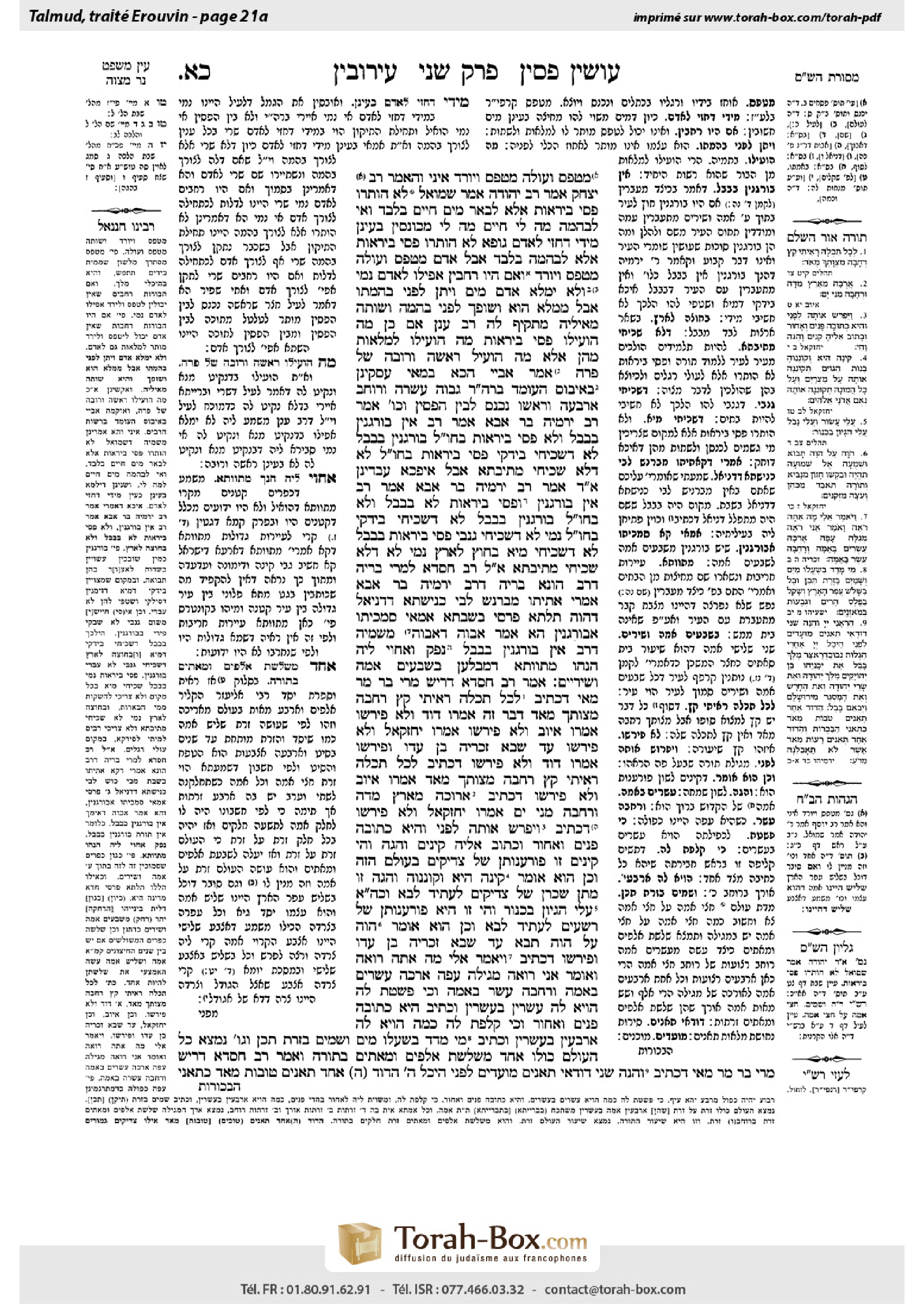
Eruvin 21a: Talmud study for Daf Yomi
Study the Talmud for Daf Yomi with scanned pages, Hebrew text, English translations from Sefaria and AI-generated French translations.
Passage selection and English or AI-generated French translation are available where the scan has annotations. Daf Study is independent of Torah-Box and Sefaria.
Browse Eruvin · עירובין · All tractatesEruvin 21a text and translations
This page of Eruvin includes the Aramaic text, an English translation and an AI-generated French translation, alongside the scan above.
עירובין כ״א א · Aramaic and Hebrew text
מְטַפֵּס וְעוֹלֶה מְטַפֵּס וְיוֹרֵד.
אִינִי? וְהָאָמַר רַב יִצְחָק אָמַר רַב יְהוּדָה אָמַר שְׁמוּאֵל: לֹא הוּתְּרוּ פַּסֵּי בֵירָאוֹת אֶלָּא לִבְאֵר מַיִם חַיִּים בִּלְבַד. וְאִי לִבְהֵמָה, מָה לִי חַיִּים מָה לִי מְכוּנָּסִין? בָּעִינַן מִידֵּי דַּחֲזֵי לְאָדָם.
גּוּפָא: לֹא הוּתְּרוּ פַּסֵּי בֵירָאוֹת אֶלָּא לִבְהֵמָה בִּלְבַד, אֲבָל אָדָם מְטַפֵּס וְעוֹלֶה מְטַפֵּס וְיוֹרֵד. וְאִם הָיוּ רְחָבִין, אֲפִילּוּ לְאָדָם נָמֵי. וְלֹא יְמַלֵּא אָדָם מַיִם וְיִתֵּן לִפְנֵי בְהֶמְתּוֹ, אֲבָל מְמַלֵּא הוּא וְשׁוֹפֵךְ לִפְנֵי בְּהֵמָה וְשׁוֹתָה מֵאֵילֶיהָ.
מַתְקֵיף לַהּ רַב עָנָן: אִם כֵּן, מָה הוֹעִילוּ פַּסֵּי בֵירָאוֹת? מָה הוֹעִילוּ?! לְמַלּאוֹת מֵהֶן!
אֶלָּא: מָה הוֹעִיל רֹאשָׁהּ וְרוּבָּהּ שֶׁל פָּרָה?
אָמַר אַבָּיֵי: הָכָא בְּמַאי עָסְקִינַן — בְּאֵיבוּס הָעוֹמֵד בִּרְשׁוּת הָרַבִּים גָּבוֹהַּ עֲשָׂרָה וְרוֹחַב אַרְבָּעָה וְרֹאשׁוֹ נִכְנָס לְבֵין הַפַּסִּין וְכוּ׳.
אָמַר רַב יִרְמְיָה בַּר אַבָּא אָמַר רַב: אֵין בּוּרְגָּנִין בְּבָבֶל, וְלֹא פַּסֵּי בֵירָאוֹת בְּחוּץ לָאָרֶץ.
בּוּרְגָּנִין בְּבָבֶל לָא — דִּשְׁכִיחִי בִּידְקֵי, פַּסֵּי בֵירָאוֹת בְּחוּץ לָאָרֶץ לָא — דְּלָא שְׁכִיחִי מְתִיבָתָא. אֲבָל אִיפְּכָא עָבְדִינַן.
אִיכָּא דְּאָמְרִי, אָמַר רַב יִרְמְיָה בַּר אַבָּא אָמַר רַב: אֵין בּוּרְגָּנִין וּפַסֵּי בֵירָאוֹת, לֹא בְּבָבֶל וְלֹא בַּחוּץ לָאָרֶץ. בּוּרְגָּנִין בְּבָבֶל לֹא — דִּשְׁכִיחִי בִּידְקֵי, בְּחוּץ לָאָרֶץ נָמֵי לָא — דִּשְׁכִיחִי גַּנָּבֵי.
פַּסֵּי בֵירָאוֹת בְּבָבֶל לָא — דִּשְׁכִיחִי מַיָּא. בְּחוּץ לָאָרֶץ נָמֵי לָא — דְּלָא שְׁכִיחִי מְתִיבָתָא.
אֲמַר לֵיהּ רַב חִסְדָּא לְמָרִי בְּרֵיהּ דְּרַב הוּנָא בְּרֵיהּ דְּרַב יִרְמְיָה בַּר אַבָּא: אָמְרִי אָתֵיתוּ מִבַּרְנִשׁ לְבֵי כְנִישְׁתָּא דְּדָנִיֵּאל דַּהֲוָה תְּלָתָא פַּרְסֵי בְּשַׁבְּתָא, אַמַּאי סָמְכִיתוּ — אַבּוּרְגָּנִין? הָא אָמַר אֲבוּהּ דַּאֲבוּהּ מִשְּׁמֵיהּ דְּרַב: אֵין בּוּרְגָּנִין בְּבָבֶל!
נָפֵק וְאַחְוִי לֵיהּ הָנְהוּ מָתָווֹתָא, דְּמִבַּלְעָן בְּשִׁבְעִים אַמָּה וְשִׁירַיִים.
אָמַר רַב חִסְדָּא, דָּרֵישׁ מָרִי בַּר מָר: מַאי דִּכְתִיב ״לְכׇל תִּכְלָה רָאִיתִי קֵץ רְחָבָה מִצְוָתְךָ מְאֹד״, דָּבָר זֶה אֲמָרוֹ דָּוִד וְלֹא פֵּירְשׁוֹ, אֲמָרוֹ אִיּוֹב וְלֹא פֵּירְשׁוֹ, אֲמָרוֹ יְחֶזְקֵאל וְלֹא פֵּירְשׁוֹ, עַד שֶׁבָּא זְכַרְיָה בֶּן עִדּוֹ וּפֵירְשׁוֹ.
אֲמָרוֹ דָּוִד וְלֹא פֵּירְשׁוֹ, דִּכְתִיב: ״לְכׇל תִּכְלָה רָאִיתִי קֵץ רְחָבָה מִצְוָתְךָ מְאֹד״. אֲמָרוֹ אִיּוֹב וְלֹא פֵּירְשׁוֹ, דִּכְתִיב: ״אֲרוּכָּה מֵאֶרֶץ מִדָּהּ וּרְחָבָה מִנִּי יָם״.
אֲמָרוֹ יְחֶזְקֵאל וְלֹא פֵּירְשׁוֹ, דִּכְתִיב: ״וַיִּפְרֹשׂ אוֹתָהּ לְפָנַי וְהִיא כְתוּבָה פָּנִים וְאָחוֹר וְכָתוּב אֵלֶיהָ קִינִים וָהֶגֶה וָהִי״.
״קִינִים״ — זוֹ פּוּרְעָנוּתָן שֶׁל צַדִּיקִים בָּעוֹלָם הַזֶּה, וְכֵן הוּא אוֹמֵר: ״קִינָה הִיא וְקוֹנְנוּהָ״. ״וָהֶגֶה״ — זוֹ מַתַּן שְׂכָרָן שֶׁל צַדִּיקִים לֶעָתִיד לָבֹא, וְכֵן הוּא אוֹמֵר: ״עֲלֵי הִגָּיוֹן בְּכִנּוֹר״. ״וָהִי״ — זוֹ הִיא פּוּרְעָנוּתָן שֶׁל רְשָׁעִים לֶעָתִיד לָבֹא, וְכֵן הוּא אוֹמֵר: ״הֹוָה עַל הֹוָה תָּבֹא״.
עַד שֶׁבָּא זְכַרְיָה בֶּן עִדּוֹ וּפֵירְשׁוֹ, דִּכְתִיב: ״וַיֹּאמֶר אֵלַי מָה אַתָּה רוֹאֶה וָאוֹמַר אֲנִי רוֹאֶה מְגִילָּה עָפָה אׇרְכָּהּ עֶשְׂרִים בָּאַמָּה וְרׇחְבָּהּ עֶשֶׂר בָּאַמָּה״. וְכִי פָּשְׁטַתְּ לַהּ, הָוְיָא לַהּ עֶשְׂרִין בְּעֶשְׂרִין. וּכְתִיב: ״הִיא כְתוּבָה פָּנִים וְאָחוֹר״, וְכִי קָלְפַתְּ לַהּ, כַּמָּה הָוְיָא לַהּ — אַרְבְּעִין בְּעֶשְׂרִין.
וּכְתִיב: ״מִי מָדַד בְּשׇׁעֳלוֹ מַיִם וְשָׁמַיִם בַּזֶּרֶת תִּכֵּן וְגוֹ׳״ — נִמְצָא כׇּל הָעוֹלָם כּוּלּוֹ אֶחָד מִשְּׁלֹשֶׁת אֲלָפִים וּמָאתַיִם בַּתּוֹרָה.
וְאָמַר רַב חִסְדָּא, דָּרֵישׁ מָרִי בַּר מָר, מַאי דִּכְתִיב: ״וְהִנֵּה שְׁנֵי דּוּדָאֵי תְאֵנִים מוּעָדִים לִפְנֵי הֵיכַל ה׳. הַדּוּד הָאֶחָד תְּאֵנִים טוֹבוֹת מְאֹד כִּתְאֵנֵי
Eruvin 21a · English translation
must climb up and climb down into the well, and drink there.
The Gemara raises a difficulty: Is that so? Is the allowance of upright boards for animals alone? Didn’t Rav Yitzḥak say that Rav Yehuda said that Shmuel said: Upright boards surrounding wells were permitted only where the wells contain potable, running spring water? If the allowance is only for animals, what is the difference to me if it is spring water and what is the difference to me if it is collected water? Granted, collected water is inferior to spring water, but it is still suitable for animals to drink. The Gemara answers: We require something that is fit for humans.
The Gemara examines the baraita cited in the course of the previous discussion. Returning to the matter itself, the statement quoted above: Upright boards surrounding wells were permitted only for cattle, but a person must climb up and climb down into the well and drink there. But if the wells were too wide for him to climb, they are permitted for a person as well. A person may not fill a bucket with water and hold it before his animal on Shabbat, but he may fill it and pour it out before the animal into a trough, and the animal drinks of its own accord.
Rav Anan strongly objects to this explanation: If so, what purpose do the boards surrounding a well serve? The Gemara immediately expresses its surprise: How can he ask what purpose do they serve? They allow people to draw water from the wells, which would otherwise be prohibited.
Rather, Rav Anan’s question should be understood as follows: What purpose is served in requiring that the enclosed area be large enough for the cow’s head and most of its body, if in any case the cow may not be given to drink straight from the bucket?
Abaye said: In fact, it is permitted to give the animal to drink in any manner in the area enclosed by the boards surrounding the well. With what are we dealing here? We are dealing with a special case, with a manger or trough that stands in the public domain, and is ten handbreadths high and four handbreadths wide, i.e., it constitutes a private domain, and one end of it interposes into the area between the upright boards surrounding a well. In such a case, the Sages prohibited one to fill a bucket with water in the area enclosed by the upright boards and hold it before his animal; they were concerned that the manger might become damaged, and one might come to carry the bucket from the private domain into the public domain or vice versa while fixing the damaged manger.
It is prohibited to walk more than two thousand cubits from a city on Shabbat. However, if there are small watchmen’s huts [burganin] outside the city that are relatively close together, they are considered part of the city, and consequently the two thousand cubit limit is measured from the last such hut. Rav Yirmeya bar Abba said that Rav said: The law with regard to these huts [burganin] does not apply in Babylonia, nor does the allowance with regard to upright boards surrounding a well apply outside of Eretz Yisrael.
The Gemara explains: The law with regard to huts does not apply in Babylonia because floods are common there; and since the huts are liable to be swept away by the floodwaters, they are not regarded as dwellings. The allowance with regard to upright boards surrounding a well does not apply outside of Eretz Yisrael, because yeshivot are not common there, and the allowance was only granted to those traveling for the sake of a mitzva such as Torah study. But we do say the opposite, i.e., we apply the law of huts outside of Eretz Yisrael and we apply the allowance of upright boards surrounding a well in Babylonia.
The Gemara cites an alternative version of the previous discussion. Some say that Rav Yirmeya bar Abba said that Rav said: The laws with regard to huts and upright boards surrounding a well apply neither in Babylonia specifically, nor outside of Eretz Yisrael generally. The Gemara explains: The law with regard to huts does not apply in Babylonia, because floods are common there. It also does not apply outside of Eretz Yisrael, because thieves who steal from such huts are common there; therefore, people do not regard the huts as dwellings.
The allowance with regard to upright boards surrounding a well does not apply in Babylonia, because water is common there. Babylonia has many rivers and canals, and therefore wells are not essential there. Outside of Eretz Yisrael in general it also does not apply, because yeshivot are not common there.
Rav Ḥisda said to Marei, son of Rav Huna, son of Rav Yirmeya bar Abba: People say that you walk from the city of Barnish to Daniel’s synagogue, which is a distance of three parasangs [parsei], on Shabbat. Upon what do you rely? Do you rely on the huts located at the city’s outskirts that extend the Shabbat boundary toward the synagogue? Didn’t your father’s father say in the name of Rav: The law of huts does not apply in Babylonia?
Marei then went out and showed Rav Ḥisda certain ruins of towns that were subsumed within a distance of seventy cubits and a remainder, two-thirds of a cubit, of each other. He relied upon the ruins, rather than upon the huts, to be permitted to walk the entire distance from Barnish to Daniel’s synagogue.
Rav Ḥisda said: Mari bar Mar interpreted homiletically: What is the meaning of that which is written: “I have seen a limit to every purpose; but Your commandment is exceedingly broad” (Psalms 119:96)? This idea with regard to the breadth of the Torah was stated by David, but he did not explain it; it was stated by Job, but he too did not explain it; it was stated by Ezekiel, but he also did not explain it, until Zechariah, son of Berechiah, son of Iddo, came and explained it.
Rav Ḥisda explains: This idea was stated by David, but he did not explain it, as it is written: “I have seen a limit to every purpose; but Your commandment is exceedingly broad,” i.e., he stated that the Torah is exceedingly broad, but he did not explain how broad. And likewise this idea was stated by Job, but he too did not explain it, as it is written: “Its measure is longer than the earth and broader than the sea” (Job 11:9).
And similarly, it was stated by Ezekiel, but he also did not explain it, as it is written: “And He spread it,” the scroll, “before me, and it was written inside and outside; and in it was written lamentations, and melody [hegeh], and woe [vahi]” (Ezekiel 2:10).
The Gemara explains: “Lamentations,” this refers to the punishment of the righteous in this world, and so it is stated: “It is a lamentation and they shall make lament with it” (Ezekiel 32:16). “And melody [hegeh],” this refers to the reward of the righteous in the World-to-Come, and the proof that this word is an expression of joy is the verse that states: “Upon an instrument of ten strings, and upon the harp, to the melody [higayon] of a lyre” (Psalms 92:4). And “woe [vahi],” this is the punishment of the wicked in the World-to-Come, and so it states: “Calamity [hova] shall follow upon calamity” (Ezekiel 7:26).
But nonetheless, Ezekiel did not explain the extent of the Torah, until Zechariah, son of Berechiah, son of Iddo, came and explained it, as it is written: “And he said to me: What do you see? And I said: I see a flying [afa] scroll; the length of it is twenty cubits, and the breadth of it is ten cubits” (Zechariah 5:2). Since the scroll was flying, the implication is that it had two equal sides, so that when you open it, it is twenty by twenty cubits. And it is written: “And it was written inside and outside,” i.e., on both sides. And when you peel them apart and separate the two sides, how much is it? Its entire area amounts to forty by twenty cubits, or eight hundred of God’s cubits.
In order to determine the measure of God’s cubit, the Gemara cites a verse that describes the size of the span between God’s thumb and little finger, in a manner of speaking. And it is written: “Who has measured the waters in the hollow of His hand, and meted out heaven with the span, and comprehended the dust of the earth in a measure” (Isaiah 40:12). If the entire world measures one square span, which is a quarter of one square cubit, we find according to this calculation that the entire world is one part in three thousand and two hundred of the Torah.
And Rav Ḥisda further said: Mari bar Mar interpreted homiletically: What is the meaning of that which is written: “The Lord showed me, and behold two baskets of figs were set before the temple of the Lord, after Nebuchadrezzar king of Babylon had carried away captive Jeconiah, son of Jehoiakim, the king of Judah, and the princes of Judah with the craftsmen and the smiths, from Jerusalem, and had brought them to Babylon. One basket [dud] had very good figs, like the figs
Eruvin 21a · Traduction française (IA)
il doit monter et descendre dans le puits et boire là.
La Guemara soulève une difficulté : C'est ainsi ? L'autorisation des planches verticales pour les animaux est-elle seule ? N'a-t-il pas dit Rav Yitzḥak que Rav Yehuda rapportait que Shmuel disait : Les planches verticales entourant les puits étaient autorisées uniquement là où les puits contenaient de l'eau potable, d'eau de source courante ? Si l'autorisation est uniquement pour les animaux, quelle différence cela fait-il pour moi si c'est de l'eau de source et quelle différence cela fait-il pour moi si c'est de l'eau collectée ? Bien que l'eau collectée soit inférieure à l'eau de source, elle reste tout de même appropriée pour que les animaux boivent. La Guemara répond : Nous exigeons quelque chose qui convient aux humains.
La Guemara examine la baraïta citée lors de la discussion précédente. Revenant à la question elle-même, la déclaration citée ci-dessus : Les planches verticales entourant les puits étaient autorisées uniquement pour les bœufs, mais une personne doit monter et descendre dans le puits et boire là. Mais si les puits étaient trop larges pour qu'il puisse monter, ils sont autorisés pour une personne également. Une personne ne peut pas remplir un seau d'eau et le tenir devant son animal le sabbat, mais elle peut le remplir et le verser dans un bac devant l'animal, et l'animal boit tout seul.
Rav Anan s'oppose fermement à cette explication : Si c'est ainsi, à quel usage servent les planches entourant un puits ? La Guemara exprime immédiatement sa surprise : Comment peut-il demander à quel usage elles servent ? Elles permettent aux gens d'extraire de l'eau des puits, ce qui serait autrement interdit.
En réalité, la question de Rav Anan devrait être comprise ainsi : À quel usage sert-il de exiger que la zone enclose soit suffisamment grande pour la tête du bœuf et la plus grande partie de son corps, si, en tout cas, le bœuf ne peut pas être donné à boire directement du seau ?
Abaye dit : En réalité, il est permis de donner à boire à l'animal de toute manière dans la zone enclose par les planches entourant le puits. Avec quoi sommes-nous en train de nous occuper ? Nous sommes en train de nous occuper d'un cas particulier, d'un mangeoire ou d'un bac qui se trouve dans le domaine public, et qui est haut de dix tefsin et large de quatre tefsin, c'est-à-dire qu'il constitue un domaine privé, et l'une de ses extrémités s'étend dans la zone entre les planches verticales entourant un puits. Dans ce cas, les Sages interdisent à l'homme de remplir un seau d'eau dans la zone enclose par les planches verticales et de le tenir devant son animal ; ils craignaient que la mangeoire ne se dégrade, et qu'on vienne à porter le seau du domaine privé vers le domaine public ou vice versa pendant la réparation de la mangeoire dégradée.
Il est interdit de marcher plus de deux mille coudées hors de la ville le sabbat. Cependant, si des huttes de gardes [burganin] sont présentes en dehors de la ville et sont relativement proches les unes des autres, elles sont considérées comme faisant partie de la ville, et par conséquent la limite des deux mille coudées est mesurée à partir de la dernière telle hutte. Rav Yirmeya bar Abba dit que Rav a dit : La loi concernant ces huttes [burganin] ne s'applique pas en Babylonie, ni l'autorisation concernant les planches verticales entourant les puits ne s'applique hors d'Israël.
La Guemara explique : La loi concernant les huttes ne s'applique pas en Babylonie, car les inondations y sont fréquentes ; et puisque les huttes sont susceptibles d'être emportées par les eaux, elles ne sont pas considérées comme des habitations. L'autorisation concernant les planches verticales entourant les puits ne s'applique pas hors d'Israël, car les yeshivot ne sont pas communes là-bas, et l'autorisation fut uniquement accordée à ceux voyageant pour une mitsva telle que l'étude de la Torah. Mais nous disons le contraire, c'est-à-dire nous appliquons la loi des huttes hors d'Israël et nous appliquons l'autorisation des planches verticales entourant les puits en Babylonie.
La Guemara cite une version alternative de la discussion précédente. Certains disent que Rav Yirmeya bar Abba a dit que Rav a dit : Les lois concernant les huttes et les planches verticales entourant les puits ne s'appliquent ni spécifiquement en Babylonie, ni généralement hors d'Israël. La Guemara explique : La loi concernant les huttes ne s'applique pas en Babylonie, car les inondations y sont fréquentes. Elle ne s'applique pas non plus hors d'Israël, car les voleurs qui volent dans ces huttes sont nombreux là-bas ; par conséquent, les gens ne considèrent pas les huttes comme des habitations.
L'autorisation concernant les planches verticales entourant les puits ne s'applique pas en Babylonie, car l'eau y est commune. Babylonie possède de nombreux rivières et canaux, et par conséquent les puits ne sont pas essentiels là-bas. Hors d'Israël, en général, elle ne s'applique pas non plus, car les yeshivot ne sont pas communes là-bas.
Rav Ḥisda dit à Marei, fils de Rav Huna, fils de Rav Yirmeya bar Abba : On dit que vous marchez de la ville de Barnish à la synagogue de Daniel, une distance de trois parasangs [parsei], le sabbat. Sur quoi vous appuyez-vous ? Vous appuyez-vous sur les huttes situées aux abords de la ville qui étendent la limite du sabbat vers la synagogue ? N'a-t-il pas dit votre père de père en nom de Rav : La loi des huttes ne s'applique pas en Babylonie ?
Marei sortit alors et montra à Rav Ḥisda certains ruines de villes qui étaient incluses dans une distance de soixante-dix coudées et un reste, deux tiers d'une coudée, les unes des autres. Il s'appuyait sur les ruines, plutôt que sur les huttes, pour être autorisé à marcher toute la distance de Barnish à la synagogue de Daniel.
Rav Ḥisda dit : Mari bar Mar interprète par allégorie : Quel est le sens de ce qui est écrit : « J'ai vu une limite à toute fin ; mais Votre commandement est extrêmement vaste » (Psaumes 119:96) ? Cette idée concernant la largeur de la Torah a été énoncée par David, mais il ne l'a pas expliquée ; elle a été énoncée par Job, mais lui non plus ne l'a pas expliquée ; elle a été énoncée par Ezéchiel, mais lui aussi ne l'a pas expliquée, jusqu'à Zécharie, fils de Béréchiah, fils d'Iddo, qui est venu l'expliquer.
Rav Ḥisda explique : Cette idée a été émise par David, mais il ne l'a pas expliquée, car il est écrit : « J'ai vu une limite à toute intention ; mais votre commandement est extrêmement vaste », c'est-à-dire qu'il a affirmé que la Torah est extrêmement vaste, mais il n'a pas expliqué jusqu'où elle s'étend. De même, cette idée a été émise par Job, mais lui non plus n'a pas l'expliqué, car il est écrit : « Sa mesure est plus longue que la terre et plus large que la mer » (Job 11:9).
Et de même, cette idée a été émise par Ézéchiel, mais lui non plus n'a pas l'expliqué, car il est écrit : « Et il l'a étalé », le rouleau, « devant moi, et il était écrit à l'intérieur et à l'extérieur ; et en lui était écrit des lamentations, et un chant [hegeh], et une douleur [vahi] » (Ézéchiel 2:10).
La Guemara explique : « Des lamentations », cela fait référence à la punition des justes dans ce monde, et ainsi il est dit : « C'est une lamentation et ils feront des lamentations avec cela » (Ézéchiel 32:16). « Et un chant [hegeh] », cela fait référence à la récompense des justes dans le Monde à Venir, et la preuve que ce mot exprime la joie est la versette qui dit : « Sur un instrument de dix cordes, et sur la harpe, à la mélodie [higayon] d'une lyre » (Psaumes 92:4). Et « une douleur [vahi] », cela est la punition des méchants dans le Monde à Venir, et ainsi il est dit : « Une calamité [hova] suivra une calamité » (Ézéchiel 7:26).
Mais néanmoins, Ézéchiel n'a pas expliqué l'étendue de la Torah, jusqu'à ce que Zacharie, fils de Bérachia, fils d'Iddo, vienne l'expliquer, car il est écrit : « Et il me dit : Qu'est-ce que tu vois ? Et je dis : Je vois un rouleau volant ; la longueur d'entre lui est de vingt coudées, et la largeur d'entre lui est de dix coudées » (Zacharie 5:2). Puisque le rouleau était volant, cela implique qu'il avait deux côtés égaux, de sorte que lorsqu'on l'ouvre, il mesure vingt par vingt coudées. Et il est écrit : « Et il était écrit à l'intérieur et à l'extérieur », c'est-à-dire sur les deux côtés. Et lorsqu'on sépare les deux côtés, combien mesure-t-il ? Son aire totale est de quarante par vingt coudées, soit huit cents coudées de Dieu.
Afin de déterminer la mesure de la coudée de Dieu, la Guemara cite un verset qui décrit la taille de l'espace entre le pouce et le majeur de Dieu, en un sens. Et il est écrit : « Qui a mesuré les eaux dans la paume de Sa main, et a mesuré le ciel avec la paume, et a compris la poussière de la terre dans une mesure » (Isaïe 40:12). Si tout le monde mesure une seule paume carrée, ce qui est un quart d'une coudée carrée, on trouve selon ce calcul que tout le monde est une part sur trois mille deux cents de la Torah.
Et Rav Ḥisda a dit davantage : Mari bar Mar interprète de manière allégorique : Quel est le sens de ce qui est écrit : « L'Éternel m'a montré, et voici deux paniers de figues qui étaient posés devant le temple de l'Éternel, après que Nabuchodolonozar, roi de Babylone, eut emmené en captivité Jéconiah, fils de Jéhoiakim, roi de Juda, et les princes de Juda avec les artisans et les forgerons, de Jérusalem, et les eut amenés à Babylone. Un panier [dud] avait des figues très bonnes, comme les figues
Traduction française générée par IA à partir de l’édition anglaise de Sefaria. Vérifie toujours un passage avec le texte source.
Text from Sefaria: William Davidson Edition - Vocalized Aramaic (CC BY NC); William Davidson Edition - English (CC BY NC).