Eruvin 20b: Talmud study for Daf Yomi
Study the Talmud for Daf Yomi with scanned pages, Hebrew text, English translations from Sefaria and AI-generated French translations.
Passage selection and English or AI-generated French translation are available where the scan has annotations. Daf Study is independent of Torah-Box and Sefaria.
Browse Eruvin · עירובין · All tractatesEruvin 20b text and translations
This page of Eruvin includes the Aramaic text, an English translation and an AI-generated French translation, alongside the scan above.
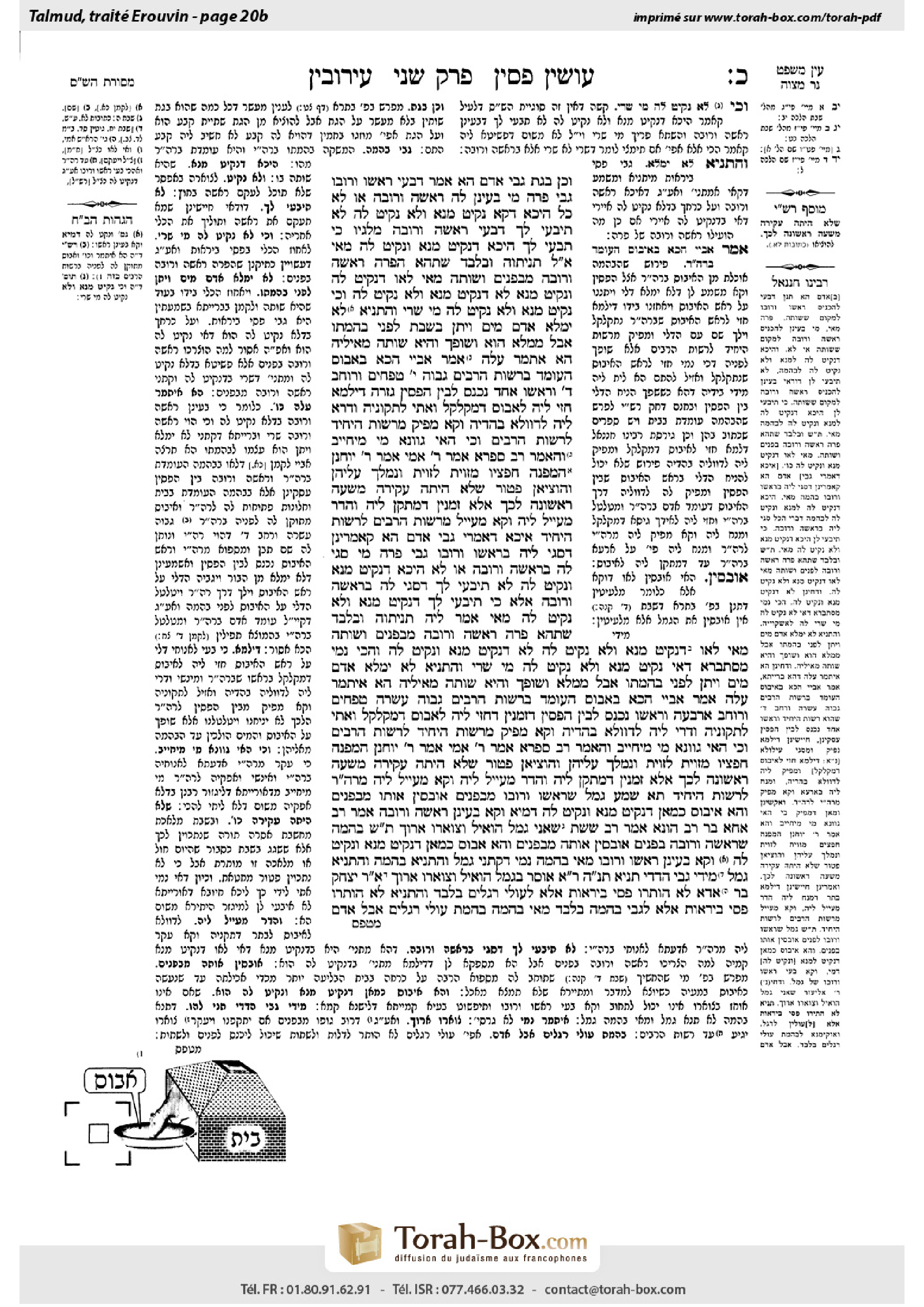
עירובין כ׳ ב · Aramaic and Hebrew text
וְכֵן בַּגַּת.
גַּבֵּי אָדָם — הָא אָמַר דְּבָעֵי רֹאשׁוֹ וְרוּבּוֹ. גַּבֵּי פָּרָה — מִי בָּעִינַן לַהּ רֹאשָׁהּ וְרוּבָּהּ אוֹ לָא?
כֹּל הֵיכָא דְּקָא נָקֵיט מָנָא וְלָא נָקֵיט לַהּ — לָא תִּיבְּעֵי לָךְ דְּבָעֵי רֹאשָׁהּ וְרוּבָּהּ מִלְּגָיו. כִּי תִּבְּעֵי לָךְ — הֵיכָא דְּנָקֵיט מָנָא וְנָקֵיט לַהּ, מַאי?
אֲמַר לֵיהּ, תְּנֵיתוּהָ: וּבִלְבַד שֶׁתְּהֵא הַפָּרָה רֹאשָׁהּ וְרוּבָּהּ מִבִּפְנִים וְשׁוֹתָה. מַאי לָאו, דְּנָקֵיט לַהּ וְנָקֵיט מָנָא? לָא, דְּנָקֵיט מָנָא וְלָא נָקֵיט לַהּ.
וְכִי נָקֵיט מָנָא וְלָא נָקֵיט לַהּ, מִי שְׁרֵי? וְהָתַנְיָא: לֹא יְמַלֵּא אָדָם מַיִם וְיִתֵּן בְּשַׁבָּת לִפְנֵי בְהֶמְתּוֹ, אֲבָל מְמַלֵּא הוּא וְשׁוֹפֵךְ, וְהִיא שׁוֹתָה מֵאֵילֶיהָ!
הָא אִתְּמַר עֲלַהּ: אָמַר אַבָּיֵי, הָכָא בְּאֵבוּס הָעוֹמֵד בִּרְשׁוּת הָרַבִּים גָּבוֹהַּ עֲשָׂרָה טְפָחִים וְרוֹחַב אַרְבָּעָה, וְרֹאשׁוֹ אֶחָד נִכְנָס לְבֵין הַפַּסִּין.
גְּזֵרָה דִּילְמָא חָזֵי לֵיהּ לְאֵבוּס דִּמְקַלְקַל וְאָתֵי לְתַקּוֹנֵיהּ, וְדָרֵא לֵיהּ לְדַוְולָא בַּהֲדֵיהּ, וְקָא מַפֵּיק מֵרְשׁוּת הַיָּחִיד לִרְשׁוּת הָרַבִּים.
וְכִי הַאי גַּוְונָא מִי מִיחַיַּיב? וְהָאָמַר רַב סָפְרָא אָמַר רַבִּי אַמֵּי אָמַר רַבִּי יוֹחָנָן: הַמְפַנֶּה חֲפָצָיו מִזָּוִית לְזָוִית, וְנִמְלַךְ עֲלֵיהֶן וְהוֹצִיאָן — פָּטוּר, שֶׁלֹּא הָיְתָה עֲקִירָה מִשָּׁעָה רִאשׁוֹנָה לְכָךְ.
אֶלָּא: זִמְנִין דִּמְתַקֵּן לֵיהּ וַהֲדַר מְעַיֵּיל לֵיהּ, וְקָא מְעַיֵּיל מֵרְשׁוּת הָרַבִּים לִרְשׁוּת הַיָּחִיד.
אִיכָּא דְּאָמְרִי: גַּבֵּי אָדָם הָא קָאָמְרִינַן דְּסַגִּי לֵיהּ בְּרֹאשׁוֹ וְרוּבּוֹ. גַּבֵּי פָרָה מִי סַגִּי לַהּ בְּרֹאשָׁהּ וְרוּבָּהּ, אוֹ לָא?
הֵיכָא דְּנָקֵיט מָנָא וְנָקֵיט לַהּ — לָא תִּיבְּעֵי לָךְ דְּסַגִּי לַהּ בְּרֹאשָׁהּ וְרוּבָּהּ, אֶלָּא כִּי תִּיבְּעֵי לָךְ דְּנָקֵיט מָנָא וְלָא נָקֵיט לַהּ, מַאי?
אֲמַר לֵיהּ, תְּנֵיתוּהָ: וּבִלְבַד שֶׁתְּהֵא פָּרָה רֹאשָׁהּ וְרוּבָּהּ מִבִּפְנִים וְשׁוֹתָה. מַאי לָאו דְּנָקֵיט מָנָא וְלָא נָקֵיט לַהּ: לָא, דְּנָקֵיט מָנָא וְנָקֵיט לַהּ.
וְהָכִי נָמֵי מִסְתַּבְּרָא, דְּאִי נָקֵיט מָנָא וְלָא נָקֵיט לַהּ, מִי שְׁרֵי? וְהָתַנְיָא: לֹא יְמַלֵּא אָדָם מַיִם וְיִתֵּן לִפְנֵי בְּהֶמְתּוֹ, אֲבָל מְמַלֵּא וְשׁוֹפֵךְ וְהִיא שׁוֹתָה מֵאֵילֶיהָ!
הָא אִיתְּמַר עֲלַהּ אָמַר אַבָּיֵי: הָכָא בְּאֵבוּס הָעוֹמֵד בִּרְשׁוּת הָרַבִּים גָּבוֹהַּ עֲשָׂרָה טְפָחִים וְרוֹחַב אַרְבָּעָה, וְרֹאשׁוֹ נִכְנָס לְבֵין הַפַּסִּין, דְּזִמְנִין דְּחָזֵי לֵיהּ לְאֵבוּס דִּמְקַלְקַל וְאָתֵי לְתַקּוֹנֵיהּ, וְדָרֵי לֵיהּ לְדַוְולָא בַּהֲדֵיהּ, וְקָא מַפֵּיק מֵרְשׁוּת הַיָּחִיד לִרְשׁוּת הָרַבִּים.
וְכִי הַאי גַּוְונָא מִי מִיחַיַּיב? וְהָאָמַר רַב סָפְרָא אָמַר רַבִּי אַמֵּי אָמַר רַבִּי יוֹחָנָן: הַמְפַנֶּה חֲפָצָיו מִזָּוִית לְזָוִית וְנִמְלַךְ עֲלֵיהֶן וְהוֹצִיאָן — פָּטוּר, שֶׁלֹּא הָיְתָה עֲקִירָה מִשָּׁעָה רִאשׁוֹנָה לְכָךְ!
אֶלָּא: זִמְנִין דִּמְתַקֵּן לֵיהּ וַהֲדַר מְעַיֵּיל לֵיהּ, וְקָא מְעַיֵּיל לֵיהּ מֵרְשׁוּת הָרַבִּים לִרְשׁוּת הַיָּחִיד.
תָּא שְׁמַע: גָּמָל שֶׁרֹאשׁוֹ וְרוּבּוֹ מִבִּפְנִים אוֹבְסִין אוֹתוֹ מִבִּפְנִים, וְהָא אִיבּוּס כְּמַאן דְּנָקֵיט מָנָא וְנָקֵיט לַהּ דָּמְיָא, וְקָא בָּעִינַן רֹאשָׁהּ וְרוּבָּהּ!
אָמַר רַב אַחָא בַּר רַב הוּנָא אָמַר רַב שֵׁשֶׁת: שָׁאנֵי גָּמָל, הוֹאִיל וְצַוָּארוֹ אָרוֹךְ.
תָּא שְׁמַע: בְּהֵמָה שֶׁרֹאשָׁהּ וְרוּבָּהּ בִּפְנִים אוֹבְסִין אוֹתָהּ מִבִּפְנִים. וְהָא אֵבוּס כְּמַאן דְּנָקֵיט מָנָא וְנָקֵיט לַהּ, וְקָא בָּעִינַן רֹאשׁוֹ וְרוּבּוֹ! מַאי ׳בְּהֵמָה׳ נָמֵי דְּקָתָנֵי — גָּמָל.
וְהָתַנְיָא ׳בְּהֵמָה׳ וְהָתַנְיָא ׳גָּמָל׳!
מִידֵּי גַּבֵּי הֲדָדֵי תַּנְיָא?! תַּנְיָא נָמֵי הָכִי: רַבִּי אֶלְעָזָר אוֹסֵר בְּגָמָל, הוֹאִיל וְצַוָּארוֹ אָרוֹךְ.
אָמַר רַבִּי יִצְחָק בַּר אַדָּא: לֹא הוּתְּרוּ פַּסֵּי בֵירָאוֹת אֶלָּא לְעוֹלֵי רְגָלִים בִּלְבַד. וְהָתַנְיָא: לֹא הוּתְּרוּ פַּסֵּי בֵירָאוֹת אֶלָּא לְגַבֵּי בְהֵמָה בִּלְבַד! מַאי בְּהֵמָה — בֶּהֱמַת עוֹלֵי רְגָלִים. אֲבָל אָדָם
Eruvin 20b · English translation
And the law is likewise in a winepress with respect to tithes. As long as one’s head and most of his body is in the winepress, he may drink from the wine without first separating tithes because drinking wine in a winepress is considered incidental drinking, which does not require tithing. The activity of harvesting and ingathering grapes is not considered completed as long as the grapes are in the winepress, since the grapes are still intended for making wine. Consequently, at this stage one may consume the produce in a casual, incidental manner. Once the work has been completed, however, one must tithe the produce before consuming any of it.
The Gemara clarifies several laws related to this issue: With regard to a person, it was said in connection to these laws that it is necessary that his head and most of his body be inside the domain from which he is drinking. However, a question may be raised with regard to a cow standing in a public domain and drinking from a private domain, or vice versa: Is it necessary that its head and most of its body be inside the domain from which it is drinking, or not?
The Gemara clarifies: Wherever one holds the bucket from which the cow is drinking but does not hold the animal, there should not be a dilemma for you, for it is certainly necessary for its head and most of its body to be inside, as the cow might move backward and pull the bucket with it, causing him to carry it from one domain to the other. Where there should be a dilemma for you is where he holds the bucket and also holds the animal. What is the law in such a case?
He said to him: We already learned a resolution to this dilemma, for we have learned in the mishna: It is permitted to bring the upright boards closer to the well, provided that the enclosed area is large enough for a cow to stand in, with its head and most of its body inside the partitioned space and drink. Does this not refer even to a case where one holds the cow and also holds the bucket? The Gemara rejects this argument: No, this may refer exclusively to the case where he holds the bucket but does not hold the animal.
The Gemara raises a difficulty: And where he holds the bucket but does not hold the animal, is it permitted to give his animal to drink in such a fashion? Wasn’t it taught in the following baraita: A person may not fill a bucket with water and hold it before his animal on Shabbat; but he may fill it and pour it out into a trough, and it, i.e., the animal, drinks of its own accord? Consequently, we see that it is prohibited to give an animal to drink from a bucket if he does not hold the animal.
The Gemara refutes this: Wasn’t it stated with regard to this baraita that Abaye said: Here we are dealing with a cow standing inside a house with windows open to the public domain, eating from a manger or trough that stands in the public domain that is ten handbreadths high and four handbreadths wide, i.e., it constitutes a private domain, and one end of this manger interposes into the area between the upright boards surrounding a well?
In such a case, it is prohibited to fill a bucket with water in the area enclosed by the upright boards and hold it before his animal, unless the animal is within the enclosed area. This is a rabbinical decree, lest one see that the manger was damaged on the side in the public domain and go to fix it, and he might take the bucket with him, thereby carrying it from the private domain to the public domain. Rather, he must pour out the water into the manger, so that it reaches the animal on its own.
The Gemara asks: Even if he carried the bucket into the public domain, would he be liable in such a case? Didn’t Rav Safra say that Rabbi Ami said that Rabbi Yoḥanan said: With regard to one who transfers objects from corner to corner in a house, and changed his mind about them while carrying them and carried them out to the public domain, he is exempt because the lifting at the first moment was not for that purpose of carrying out to a different domain; when he picked them up, he intended merely to move them around his house. Here too, then, one should not be liable, since when he picked up the bucket he did not intend from the outset to carry it into the public domain; accordingly, there is no room for such a decree.
Rather, say that the decree is due to a different concern, that at times one would fix the manger and then bring the bucket back in again, thereby carrying from the public domain into the private domain. In this case one picks up the bucket from the outset with the intention of carrying it from a public domain into a private domain.
Some say a different version of the previous discussion. With regard to a person, we said that it is sufficient if his head and most of his body are inside the domain from which he is drinking. But a question may be raised with regard to a cow standing in a public domain and drinking from a private domain, or vice versa: Is it sufficient if its head and most of its body are inside the domain from which it is drinking, or not? Perhaps all of the cow must be in that domain.
The Gemara clarifies the question. The case where one holds the bucket from which the cow is drinking and also holds the animal should not be a dilemma for you, as it is certainly enough if its head and most of its body are in the domain. Rather, the case where there should be a dilemma for you is where he holds the bucket but does not hold the animal. What is the halakha in such a case?
He said to him: We already learned a resolution to this dilemma in the mishna: It is permitted to bring the upright boards closer to the well, provided that the enclosed area is large enough for a cow to stand in, with its head and most of its body inside the partitioned space, and drink. Doesn’t this refer even to a case where one holds the bucket but does not hold the animal? The Gemara rejects this argument: No, this may refer only to the case where he holds the bucket and also holds the animal.
The Gemara comments: So too, it is reasonable to say this, for if one holds the bucket but does not hold the animal, is it in fact permitted to give his animal to drink in such a fashion? Wasn’t it taught in a baraita: A person may not fill a bucket with water and hold it before his animal on Shabbat. But he may fill it and pour it out into a trough, and the animal drinks of its own accord.
The Gemara refutes this argument: Wasn’t it stated with regard to this baraita that Abaye said: Here, we are dealing with a manger that stands in the public domain, and it is ten handbreadths high and four handbreadths wide, i.e., it constitutes a private domain, and one end of the manger interposes into the area between the upright boards surrounding a well, and the animal is standing at the other end in the public domain. In such a case, it is prohibited to fill a bucket with water in the area enclosed by the boards and hold it before his animal, unless the animal is within the enclosed area. This is a rabbinical decree, lest at times one see that the manger was damaged on the side in the public domain and go to fix it and take the bucket with him, thereby carrying it from the private domain into the public domain.
The Gemara asks: But would he be liable in such a case? Didn’t Rav Safra say that Rabbi Ami said that Rabbi Yoḥanan said: With regard to one who transfers objects from corner to corner in a house, and changed his mind about them while carrying them and took them out to the public domain, he is exempt because the lifting at the first moment was not for that purpose of carrying out to a different domain; when he picked them up, he intended merely to move them around his house. Here too, then, he should not be liable, since when he picked up the bucket he did not intend from the outset to carry it into the public domain; accordingly, there is no room for such a decree.
Rather, we must say that the decree is due to a different concern, that at times one would fix the manger and then bring the bucket back in again, carrying from the public domain into the private domain. In this case, he picks up the bucket with the intention of carrying it from a public domain into a private domain. In any case, no proof can be brought from this source.
The Gemara cites a different proof. Come and hear the following baraita: A camel whose head and most of its body are inside a private domain may be force-fed from inside the private domain. Now, force-feeding is like the case where he holds the bucket and also holds the animal, as one cannot force-feed an animal without holding it by its neck, and nonetheless we require that its head and most of its body be inside the domain where it is eating.
Rav Aḥa bar Rav Huna said that Rav Sheshet said: A camel is different, as since its neck is long, its head and most of its body must be inside; otherwise it could stretch its neck into the public domain, and the one feeding it might come to carry the bucket from the private domain into the public domain. In the case of other animals, however, there is no reason for such stringency.
The Gemara attempts to cite yet another proof. Come and hear the following baraita: An animal whose head and most of its body were inside a private domain may be force-fed from inside the private domain. Now, as stated above, force-feeding is like the case where he holds the bucket and also holds the animal, and nonetheless we require that its head and most of its body be inside the domain where it is eating. The Gemara refutes this argument: What is this animal that is taught in this baraita? It is also a camel.
The Gemara objects: Wasn’t it taught as animal in one baraita, and wasn’t it taught as camel in the other baraita? The implication is that this law applies not only to camels, but to other animals as well.
The Gemara answers: Were these two baraitot taught next to each other? Had both of these baraitot been taught together, we would indeed expect the tanna not to teach the same law using different formulations. However, since these two baraitot come from different sources, it is possible that one of the tanna’im referred to a camel with the generic term animal, and hence no proof can be brought from here. This same idea that a camel is different was also taught in another baraita: Rabbi Eliezer prohibits this in the case of a camel, since its neck is long.
Rabbi Yitzḥak bar Adda said: Upright boards surrounding wells were only permitted to Festival pilgrims. The Gemara raises a difficulty: Wasn’t it taught in a baraita that boards surrounding wells were permitted only for cattle? The Gemara answers: What is the cattle mentioned here? It means the cattle of festival pilgrims. However, a person
Eruvin 20b · Traduction française (IA)
Et la loi est également applicable dans une cuve à vin en ce qui concerne les dîmes. Tant que la tête et la plus grande partie du corps d'une personne est dans la cuve, il peut boire le vin sans avoir d'abord séparé les dîmes, car boire du vin dans une cuve est considéré comme une consommation incidente, qui ne nécessite pas de dîmes. L'activité de la récolte et de la collecte des raisins n'est pas considérée comme achevée tant que les raisins sont dans la cuve, car les raisins sont encore destinés à être transformés en vin. Par conséquent, à cette étape, on peut consommer les produits de manière informelle et incidentelle. Une fois que l'œuvre est achevée, cependant, il faut dîmer les produits avant de les consommer.
La Guemara clarifie plusieurs lois liées à cette question : En ce qui concerne une personne, il a été dit à propos de ces lois qu'il est nécessaire que sa tête et la plus grande partie de son corps soient à l'intérieur du domaine d'où il boit. Cependant, une question peut être soulevée concernant un bœuf qui se tient dans un domaine public et boit d'un domaine privé, ou inversement : est-il nécessaire que sa tête et la plus grande partie de son corps soient à l'intérieur du domaine d'où il boit, ou non ?
La Guemara clarifie : Partout où l'on tient le seau d'où le bœuf boit mais ne tient pas l'animal, il ne devrait pas y avoir de dilemme pour vous, car il est certainement nécessaire que sa tête et la plus grande partie de son corps soient à l'intérieur, car le bœuf pourrait reculer et tirer le seau avec lui, causant ainsi à l'homme de transporter ce dernier d'un domaine à l'autre. C'est là qu'il devrait y avoir un dilemme pour vous, c'est-à-dire lorsque l'on tient à la fois le seau et l'animal. Quelle est la loi dans ce cas ?
Il lui dit : Nous avons déjà appris une solution à ce dilemme, car nous avons appris dans la Michna : Il est permis d'approcher les poutres verticales du puits, à condition que l'espace enfermé soit suffisamment grand pour que le bœuf puisse se tenir dedans, avec sa tête et la plus grande partie de son corps à l'intérieur de l'espace délimité et boire. N'est-ce pas applicable même dans le cas où l'on tient le bœuf et le seau ? La Guemara rejette cet argument : Non, cela pourrait s'appliquer uniquement au cas où l'on tient le seau mais pas l'animal.
La Guemara soulève une difficulté : Et dans le cas où l'on tient le seau mais pas l'animal, est-il permis de donner à son animal à boire ainsi ? N'avait-on pas appris dans la suivante baraïta : Un homme ne peut pas remplir un seau d'eau et le tenir devant son animal le sabbat ; mais il peut le remplir et le verser dans un abreuvoir, et l'animal boit tout seul ? Par conséquent, nous voyons que c'est interdit de donner à un animal à boire d'un seau si l'on ne tient pas l'animal.
La Guemara réfute cela : N'avait-on pas dit à propos de cette baraïta que Abaye a dit : Ici, nous parlons d'un bœuf qui se tient à l'intérieur d'une maison avec des fenêtres ouvertes vers le domaine public, mangeant d'une mangeoire ou d'un abreuvoir qui se trouve dans le domaine public, qui est haut de dix tefachim et large de quatre tefachim, c'est-à-dire qu'il constitue un domaine privé, et l'une des extrémités de cette mangeoire s'interpose dans l'espace entre les poutres verticales entourant un puits ?
Dans ce cas, il est interdit de remplir un seau d'eau dans l'espace délimité par les poutres verticales et de le tenir devant son animal, à moins que l'animal ne soit à l'intérieur de l'espace délimité. C'est une déclaration rabbinique, afin que l'on ne voie pas que la mangeoire a été endommagée du côté du domaine public et qu'on aille la réparer, et qu'on emporte le seau avec lui, causant ainsi un transport du domaine privé vers le domaine public. Il faut plutôt verser l'eau dans la mangeoire, de sorte qu'elle atteigne l'animal par elle-même.
La Guemara pose une question : Même s'il a transporté le seau dans le domaine public, serait-il tenu responsable dans ce cas ? N'avait-on pas dit que Rav Safra a dit que Rabbi Ami a dit que Rabbi Yoḥanan a dit : En ce qui concerne celui qui transfère des objets d'une extrémité à l'autre d'une maison, et a changé d'avis sur eux pendant qu'il les transportait et les a emportés dans le domaine public, il est exempt, car l'acte de soulever au premier moment n'était pas pour ce but de transporter dans un autre domaine ; lorsqu'il les a soulevés, il n'avait l'intention que de les déplacer dans sa maison. Ici aussi, donc, on ne devrait pas être tenu responsable, car lorsqu'il a soulevé le seau, il n'avait pas l'intention dès le départ de le transporter dans le domaine public ; par conséquent, il n'y a pas de place pour une telle déclaration.
Plutôt, disons que la déclaration est due à une autre préoccupation, à savoir que parfois l'on répare la mangeoire et puis on ramène le seau à l'intérieur, causant ainsi un transport du domaine public vers le domaine privé. Dans ce cas, on prend le seau dès le départ avec l'intention de le transporter du domaine public vers le domaine privé.
Certains disent une version différente de la discussion précédente. En ce qui concerne une personne, nous avons dit que c'est suffisant que sa tête et la plus grande partie de son corps soient à l'intérieur du domaine d'où il boit. Mais une question peut être soulevée concernant un bœuf qui se tient dans un domaine public et boit d'un domaine privé, ou inversement : est-ce suffisant que sa tête et la plus grande partie de son corps soient à l'intérieur du domaine d'où il boit, ou non ? Peut-être que toute la bête doit être dans ce domaine.
La Guemara clarifie la question. Le cas où l'on tient le seau d'où le bœuf boit et l'animal lui-même ne devrait pas être un dilemme pour vous, car il est certainement suffisant que sa tête et la plus grande partie de son corps soient dans le domaine. Plutôt, le cas où il devrait y avoir un dilemme pour vous est celui où l'on tient le seau mais pas l'animal. Quelle est la halakha dans ce cas ?
Il lui dit : Nous avons déjà appris une solution à ce dilemme dans la Michna : Il est permis d'approcher les poutres verticales du puits, à condition que l'espace enfermé soit suffisamment grand pour que le bœuf puisse se tenir dedans, avec sa tête et la plus grande partie de son corps à l'intérieur de l'espace délimité, et boire. N'est-ce pas applicable même dans le cas où l'on tient le seau mais pas l'animal ? La Guemara rejette cet argument : Non, cela pourrait s'appliquer uniquement au cas où l'on tient à la fois le seau et l'animal.
Le Guemara commente : De même, il est raisonnable de dire cela, car si l'on tient le seau mais qu'on ne tient pas l'animal, est-il vraiment permis de donner à boire à son animal de cette façon ? N'avait-on pas appris dans une baraïta : Une personne ne doit pas remplir un seau d'eau et le tenir devant son animal le sabbat. Cependant, il peut le remplir et le verser dans un abreuvoir, et l'animal boit tout seul.
Le Guemara réfute cet argument : N'avait-on pas dit concernant cette baraïta que Abaye a dit : Ici, nous parlons d'un mangeoire qui se trouve dans le domaine public, et qui est haute de dix paumes et large de quatre paumes, c'est-à-dire qu'elle constitue un domaine privé, et l'une des extrémités de la mangeoire s'étend dans la zone entre les planches entourant un puits, et l'animal est debout à l'autre extrémité dans le domaine public. Dans ce cas, il est interdit de remplir un seau d'eau dans la zone entourée par les planches et de le tenir devant son animal, sauf si l'animal est dans la zone entourée. C'est une déclaration rabbinique, afin que l'on ne vienne pas à voir que la mangeoire était abîmée du côté du domaine public et à aller la réparer en emportant le seau avec soi, ce qui entraînerait de porter le seau du domaine privé vers le domaine public.
Le Guemara pose la question : Mais serait-il tenu responsable dans ce cas ? N'avait-on pas dit que Rav Safra a dit que Rabbi Ami a dit que Rabbi Yoḥanan a dit : Concernant celui qui transporte des objets d'une extrémité à l'autre d'une maison, et change d'avis en les transportant et les sort dans le domaine public, il est exempt, car le premier levé n'était pas pour le but de transporter vers un autre domaine ; lorsqu'il les a soulevés, il n'avait l'intention que de les déplacer dans sa maison. De même, dans ce cas-là, il ne devrait pas être tenu responsable, car lorsqu'il a soulevé le seau, il n'avait pas l'intention dès le départ de le transporter dans le domaine public ; par conséquent, il n'y a pas de place pour une telle déclaration.
Plutôt, nous devons dire que cette décision est due à une préoccupation différente, à savoir que parfois l'on installe la mangeoire et puis l'on ramène le seau à l'intérieur, en le transportant du domaine public vers le domaine privé. Dans ce cas, il soulève le seau avec l'intention de le transporter du domaine public vers le domaine privé. En tout cas, aucune preuve ne peut être tirée de cette source.
Le Guemara cite une autre preuve. Vient-on entendre la baraïta suivante : Un chameau dont la tête et la plus grande partie de son corps sont dans un domaine privé peut être nourri forcé depuis le domaine privé. Maintenant, l'alimentation forcée est comme le cas où l'on tient le seau et l'animal également, car on ne peut nourrir un animal sans le tenir par le cou, et pourtant nous exigeons que sa tête et la plus grande partie de son corps soient dans le domaine où il mange.
Rav Aḥa bar Rav Huna a dit que Rav Sheshet a dit : Le chameau est différent, car étant donné que son cou est long, sa tête et la plus grande partie de son corps doivent être à l'intérieur ; autrement, il pourrait étirer son cou dans le domaine public, et celui qui le nourrit pourrait venir à porter le seau du domaine privé vers le domaine public. Cependant, pour les autres animaux, il n'y a pas de raison pour une telle stricteur.
Le Guemara tente de citer une autre preuve. Vient-on entendre la baraïta suivante : Un animal dont la tête et la plus grande partie de son corps étaient dans un domaine privé peut être nourri forcé depuis le domaine privé. Maintenant, comme on l'a dit ci-dessus, l'alimentation forcée est comme le cas où l'on tient le seau et l'animal également, et pourtant nous exigeons que sa tête et la plus grande partie de son corps soient dans le domaine où il mange. Le Guemara réfute cet argument : De quel animal s'agit-il dans cette baraïta ? C'est aussi un chameau.
Le Guemara s'oppose : N'avait-on pas appris comme animal dans une baraïta, et n'avait-on pas appris comme chameau dans l'autre baraïta ? L'implication est que cette loi s'applique non seulement aux chameaux, mais aussi aux autres animaux.
Le Guemara répond : Ces deux baraitot ont-elles été apprises côte à côte ? Si ces deux baraitot avaient été apprises ensemble, nous aurions effectivement pu attendre que le tanna ne parte pas de la même loi avec des formulations différentes. Cependant, puisque ces deux baraitot proviennent de sources différentes, il est possible que l'un des tanna’im ait fait référence à un chameau avec le terme général d'animal, et par conséquent, aucune preuve ne peut être tirée de là. Cette même idée que le chameau est différent a également été enseignée dans une autre baraïta : Rabbi Eliezer interdit cela dans le cas d'un chameau, car son cou est long.
Rabbi Yitzḥak bar Adda a dit : Les planches entourant les puits étaient permises uniquement aux pèlerins du festival. Le Guemara soulève une difficulté : N'avait-on pas appris dans une baraïta que les planches entourant les puits étaient permises uniquement aux bêtes de trait ? Le Guemara répond : De quel bétail s'agit-il ici ? Il s'agit des bêtes des pèlerins du festival. Cependant, une personne
Traduction française générée par IA à partir de l’édition anglaise de Sefaria. Vérifie toujours un passage avec le texte source.
Text from Sefaria: William Davidson Edition - Vocalized Aramaic (CC BY NC); William Davidson Edition - English (CC BY NC).